Catena Aurea by St. Thomas Aguinas
17:2630
26. And as it was in the days of Noe, so shall it be also in the days of the Son of man.
27. They did eat, they drank, they married wives, they were given in marriage, until the day that Noe entered into the ark, and the flood came, and destroyed them all.
28. Likewise also as it was in the days of Lot; they did eat, they drank, they bought, they sold, they planted, they builded;
29. But the same day that Lot went out of Sodom it rained fire and brimstone from heaven, and destroyed them all.
30. Even thus shall it be in the day when the Son of man is revealed.
BEDE. The coming of our Lord, which He had compared to lightning flying swiftly across the heavens, He now likens to the days of Noah and Lot, when a sudden destruction came upon mankind.
CHRYSOSTOM. (Hom. 1, in Ep. 1. ad Thess.) For refusing to believe the words of warning they were suddenly visited with a real punishment from God; but their unbelief proceeded from self-indulgence, and softness of mind. For such as a mans wishes and inclinations are, will also be his expectations. Therefore it follows, they eat and drank.
AMBROSE. He rightly declares the deluge to have been caused by our sins, for God did not create evil, but our deservings found it out for themselves. Let it not however be supposed that marriages, or again meat and drink, are condemned, seeing that by the one succession is sustained, by the other nature, but moderation is to be sought for in all things. For whatsoever is more than this is of evil.
BEDE. Now Noah builds the ark mystically. The Lord builds His Church of Christs faithful servants, by uniting them together in one, as smooth pieces of wood; and when it is perfectly finished, He enters it: as at the day of Judgment, He who ever dwells within His Church enlightens it with His visible presence. But while the ark is in building, the wicked flourish, when it is entered, they perish; as they who revile the saints in their warfare here, shall when they are crowned hereafter be smitten with eternal condemnation.
EUSEBIUS. Having used the example of the deluge, that no one might expect a future deluge by water, our Lord cites, secondly, the example of Lot, to shew the manner of the destruction of the wicked, namely, that the wrath of God would descend upon them by fire from heaven.
BEDE. Passing by the unutterable wickedness of the Sodomites, He mentions only those which may be thought trifling offences, or none at all; that you may understand how fearfully unlawful pleasures are punished, when lawful pleasures taken to excess receive for their reward fire and brimstone.
EUSEBIUS. He does not say that fire came down from heaven upon the wicked Sodomites before that Lot went out from them, just as the deluge did not swallow up the inhabitants of the earth before that Noah entered the ark; for as long as Noah and Lot dwelt with the wicked, God suspended His anger that they might not perish together with the sinners, but when He would destroy those, He withdrew the righteous. So also at the end of the world, the consummation shall not come before all the just are separated from the wicked.
BEDE. For He who in the mean time though we see Him not yet sees all things, shall then appear to judge all things. And He shall come especially at that time, when He shall see all who are forgetful of His judgments in bondage to this world.
THEOPHYLACT. For when Antichrist has come, then shall men become wanton, given up to abominable vices, as the Apostle says, Lovers of pleasure rather than lovers of God. (2 Tim. 3:4.) For if Antichrist is the dwelling-place of every sin, what else will he then implant in the miserable race of men, but what belongs to himself. And this our Lord implies by the instances of the deluge and the people of Sodom.
BEDE. Now mystically, Lot, which is interpreted turning aside, is the people of the elect, who, while in Sodom, i. e. among the wicked, live as strangers, to the utmost of their power turning aside from all their wicked ways. But when Lot went out, Sodom is destroyed, for at the end of the world, the angels shall go forth and sever the wicked from among the just, and cast them into a furnace of fire. (Matt. 13:49.) The fire and brimstone, however, which He relates to have rained from heaven, does not signify the flame itself of everlasting punishment, but the sudden coming of that day.
17:3133
31. In that day, he which shall he upon the housetop, and his stuff in the house, let him not come down to take it away: and he that is in the field, let him likewise not return back.
32. Remember Lots wife.
33. Whosoever shall seek to save his life shall lose it; and whosoever shall lose his life shall preserve it.
AMBROSE. Because good men must needs on account of the wicked be sore vexed in this world, in order that they may receive a more plentiful reward in the world to come, they are here punished with certain remedies, as it is here said, In that day, &c. that is, if a man goes up to the top of his house and rises to the summit of the highest virtues, let him not fall back to the grovelling business of this world.
AUGUSTINE. For he is on the housetop who, departing from carnal things, breathes as it were the free air of a spiritual life. But the vessels in the house are the carnal senses, which many using to discover truth which is only taken in by the intellect, have entirely missed it. Let the spiritual man then beware, lest in the day of tribulation he again take pleasure in the carnal life which is fed by the bodily senses, and descend to take away this worlds vessels. It follows, And he that is in the field, let him not return back; that is, He who labours in the Church, as Paul planting and Apollos watering, let him not look back upon the worldly prospects which he has renounced.
THEOPHYLACT. Matthew relates all these things to have been said by our Lord, with reference to the destruction of Jerusalem, that when the Romans came upon them, they who were on the housetop should not come down to take any thing, but fly at once, nor they that were in the field return home. And surely so it was at the taking of Jerusalem, and again will be at the coming of Antichrist, but much more at the completion of all things, when that intolerable destruction shall come.
EUSEBIUS. He hereby implies that a persecution will come from the son of perdition upon Christs faithful. By that day then He means the time previous to the end of the world, in which let not him who is flying return, nor care to lose his goods, lest he imitate Lots wife, who when she fled out of the city of Sodom, turning back, died, and became a pillar of salt.
AMBROSE. Because thus she looked behind, she lost the gift of her nature. For Satan is behind, behind also Sodom. Wherefore flee from intemperance, turn away from lust, for recollect, that he who turned not back to his old pursuits escaped, because he reached the mount; whereas she looking back to what was left behind, could not even by the aid of her husband reach the mount, but remained fixed.
AUGUSTINE. Lots wife represents those who in time of trouble look back and turn aside from the hope of the divine promise, and hence she was made a pillar of salt as a warning to men not to do likewise, and to season as it were their hearts, lest they become corrupt.
THEOPHYLACT. Next follows the promise, Whosoever shall seek, &c. as if he said, Let no man in the persecutions of Antichrist seek to secure his life, for he shall lose it, but whoso shall expose himself to trials and death shall be safe, never submitting himself to the tyrant from his love of life.
CYRIL OF ALEXANDRIA. How a man may lose his own life to save it, St. Paul explains when he speaks of some who crucified their flesh with the affections and lusts, (Gal. 5:24.) that is, with perseverance and devotion engaging in the conflict.
17:3437
34. I tell you, in that night there shall be two men in one bed; the one shall be taken, and the other shall be left.
35. Two women shall be grinding together; the one shall be taken, and the other left.
36. Two men shall be in the field; the one shall be taken, and the other left.
37. And they answered and said unto him, Where, Lord? And he said unto them, Wheresoever the body is, thither will the eagles be gathered together.
BEDE. Our Lord had just before said, that he who is in the field must not return back; and lest this should seem to have been spoken of those only who would openly return from the field, that is, who would publicly deny their Lord, He goes on to shew, that there are some who, while seeming to turn their face forward, are yet in their heart looking behind.
AMBROSE. He rightly says, night, for Antichrist is the hour of darkness, because he pours a dark cloud over the minds of men while he declares himself to be Christ. But Christ as lightning shines brightly, that we may be able to see in that night the glory of the resurrection.
AUGUSTINE. (de Qu. Ev. lib. ii. qu. 41.) Or He says, in that night, meaning in that tribulation.
THEOPHYLACT. Or He teaches us the suddenness of Christs coming, which we are told will be in the night. And having said that the rich can scarcely be saved, He shews that not all the rich perish, nor all the poor are saved.
CYRIL OF ALEXANDRIA. For by the two men in one bed, He seems to denote the rich who repose themselves in worldly pleasures, for a bed is a sign of rest. But not all who abound in riches are wicked, but if one is good and elect in the faith, he will be taken, but another who is not so will be left. For when our Lord descends to judgment, He will send His Angels, who while they leave behind on the earth the rest to suffer punishment, will bring the holy and righteous men to Him; according to the Apostles words, We shall be caught up together in the clouds to meet Christ in the air. (1 Thess 4:17.)
AMBROSE. Or out of the same bed of human infirmity, one is left, that is, rejected, another is taken up, that is, is caught to meet Christ in the air. By the two grinding together, he seems to imply the poor and the oppressed. To which belongs what follows. Two men shall be in the field, &c. For in these there is no slight difference. For some nobly bear up against the burden of poverty, leading a lowly but honest life, and these shall be taken up; but the others are very active in wickedness, and they shall be left. Or those grinding at the mill seem to represent such as seek nourishment from hidden sources, and from secret places draw forth things openly to view. And perhaps the world is a kind of corn mill, in which the soul is shut up as in a bodily prison. And in this corn mill either the synagogue or the soul exposed to sin, like the wheat, softened by grinding and spoilt by too great moisture, cannot separate the outward from the inner parts, and so is left because its flour dissatisfies. But the holy Church, or the soul which is not soiled by the stains of sin, which grinds such wheat as is ripened by the heat of the eternal sun, presents to God a good flour from the secret shrines of the heart. Who the two men in the field are we may discover if we consider, that there are two minds in us, one of the outer man which wasteth away, the other of the inner man which is renewed by the Sacrament. These are then the labourers in the field, the one of which by diligence brings forth good fruit, the other by idleness loses that which he has. Or those who are compared we may interpret to be two nations, one of which being faithful is taken, the other being unfaithful is left.
AUGUSTINE. (de Qu. Ev. ut sup) Or there are three classes of men here represented. The first is composed of those who prefer their ease and quiet, and busy not themselves in secular or ecclesiastical concerns. And this quiet life of theirs is signified by the bed. The next class embraces those who being placed among the people are governed by teachers. And such he has described by the name of women, because it is best for them to be ruled by the advice of those who are set over them; and he has described these as grinding at the mill, because in their hands revolves the wheel and circle of temporal concerns. And with reference to these matters he has represented them as grinding together, inasmuch as they give their services to the benefit of the Church. The third class are those who labour in the ministry of the Church as in the field of God. In each of these three classes then there are two sorts of men, of which the one abide in the Church and are taken up, the other fall away and are left.
AMBROSE. For God is not unjust that He should separate in His reward of their deserts men of like pursuits in life, and not differing in the quality of their actions. But the habit of living together does not equalize the merits of men, for not all accomplish what they attempt, but he only who shall persevere to the end shall be saved.
CYRIL OF ALEXANDRIA. When He said that some should be taken up, the disciples not unprofitably inquire, Where, Lord?
BEDE. Our Lord was asked two questions, where the good should be taken up, and where the bad left; He gave only one answer, and left the other to be understood, saying, Wheresoever the body is, thither will the eagles be gathered together.
CYRIL OF ALEXANDRIA. As if He said, As when a dead body is thrown away, all the birds which feed on human flesh flock to it, so when the Son of man shall come, all the eagles, that is, the saints, shall haste to meet Him.
AMBROSE. For the souls of the righteous are likened to eagles, because they soar high and forsake the lower parts, and are said to live to a great age. Now concerning the body, we can have no doubt, and above all if we remember that Joseph received the body from Pilate. (Matt. 28.) And do not you see the eagles around the body are the women and Apostles gathered together around our Lords sepulchre? Do not you see them then, when he shall come in the clouds, and every eye shall behold him? (Rev. 1:7.) But the body is that of which it was said, My flesh is meat indeed; (John 6:55.) and around this body are the eagles which fly about on the wings of the Spirit, around it also eagles which believe that Christ has come in the flesh. And this body is the Church, in which by the grace of baptism we are renewed in the Spirit.
EUSEBIUS. Or by the eagles feeding on the dead animals, he has here described the rulers of the world, and those who shall at that time persecute the saints of God, in whose power are left all those who are unworthy of being taken up, who are called the body or carcase. Or by the eagles are meant the avenging powers which shall fly about to torment the wicked.
AUGUSTINE. (de Con. Ev. l. ii. c. 7.) these things which Luke has given us in a different place from Matthew, he either relates by anticipation, so as to mention beforehand what was afterwards spoken by our Lord, or he means us to understand that they were twice uttered by Him.
Catena Aurea Luke 17
The Story of St. Laurence O’Toole
Patron Saint of the ArchDiocese of Dublin
Feastday: 14th November
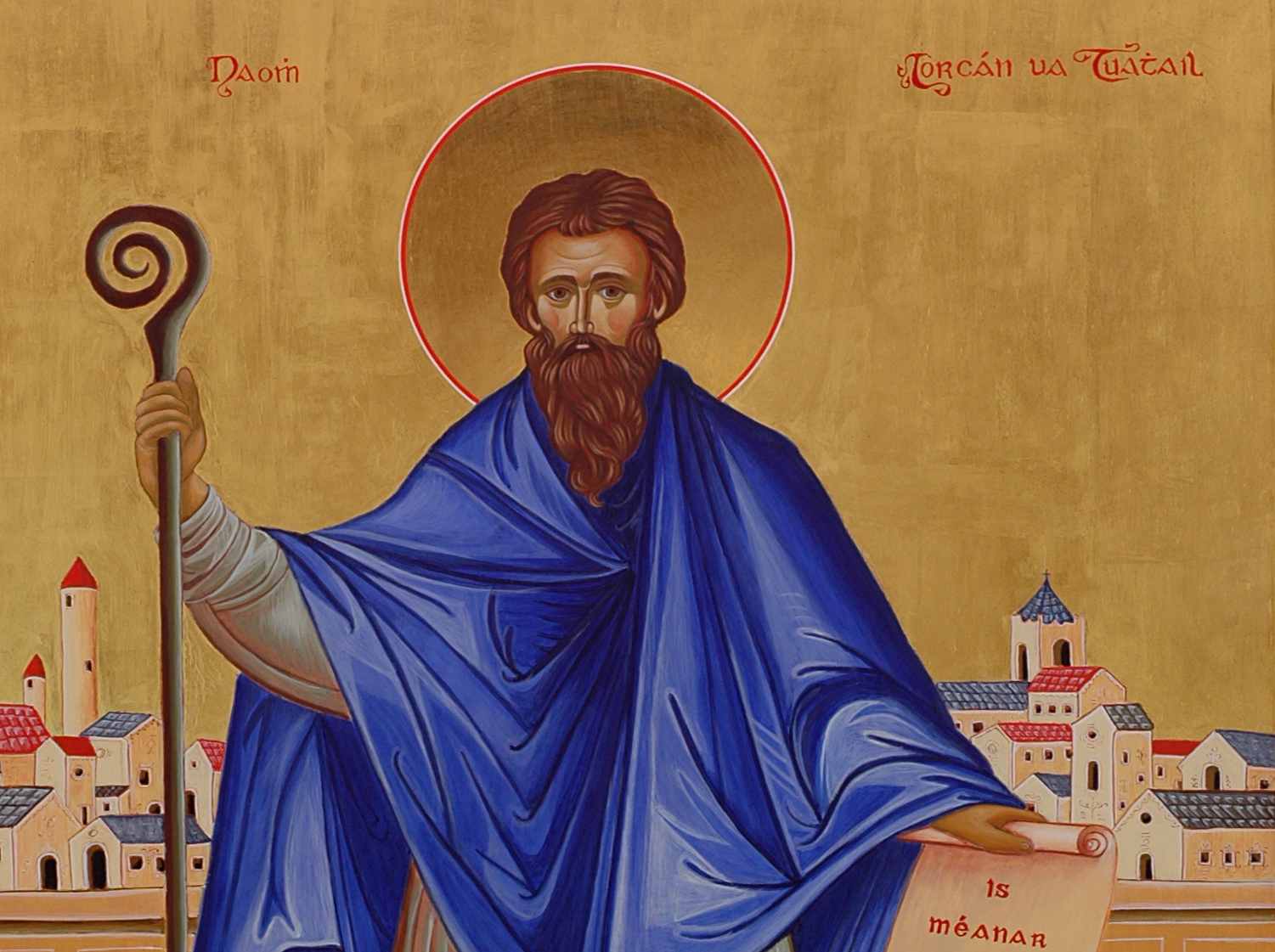
St Laurence OToole (Lorcán Ó Tuathail) was born in Castledermot, Co. Kildare in 1128. He became Abbot of Glendalough in 1153 and Archbishop of Dublin in 1162. He died in Eu in Normandy on the 14th of November 1180 and was canonised in 1225. His eventful life can be summarised under eight headings.
1. HOSTAGE. Laurences father was Maurice OToole, King of Hy Murray. When Laurence was 10 he was given as a hostage to Dermot McMurrough, King of Leinster, who treated him with great harshness. The boy was sent in chains to a remote area where he was ill-housed, ill-clothed and ill-fed. For two years, the kings son learned what it was to experience real poverty and oppression.
2. MONK. After two years, Dermot was forced to release Laurence and send him to Glendalough monastery, where his father could reclaim him. When Maurice arrived, he found his son had fallen in love with the life of the monks and he gave him permission to join the community. Laurence was only 25 when he was elected Abbot, and he proved to be the greatest Abbot of Glendalough since St Kevin its founder. He encouraged learning, built new churches and renewed -monastic life by bringing in monks from the continent. He was unfailing in his care for the poor and sold the monastery treasures to feed famine victims.
3. ARCHBISHOP. In 1162 Laurence became the first Irish Archbishop of the Danish city of Dublin. Many of the citizens were no more than nominal Christians and he made it his duty to deepen their faith and reform their lives. He introduced Augustinian monks from France to Christ Church Cathedral to reform the liturgy and he became a member of their community. He continued his works of charity, especially towards homeless children, whom he led and housed in his own residence.
4. CONTEMPLATIVE. Laurence was a man of prayer. He rose in the early hours to sing the office with the other monks in the cathedral and often stayed on afterwards, deep in prayer. Then he would walk for a time in the graveyard, watching and praying over the city as it woke to another day. When his duties allowed him, he liked nothing better than to escape to Glendalough and spend a few days in solitude in a lakeside hermitage which could be reached only by boat.
5. MEDIATOR. The Normans landed in Ireland in 1190. The following year they besieged Dublin under their leader, Strongbow. Laurence met Strongbow to arrange a peace but the Normans attacked while the talks were going on. They seized the city, and began killing the citizens and looting their houses. Laurence saved the lives of many by the sheer force of his presence and he carried the bodies of others in his own arms to be buried. In spite of many setbacks, he was to continue his efforts as peace-maker to the end of his life.
6. TRAVELLER For the last ten years of his life, Laurence was a constant traveller. He often visited England in his efforts to bring about peace between the two countries. Sea travel was hazardous and shipwrecks were common. More than once, his ship was caught in a Violent storm and its safe arrival was attributed to the power of his prayer. Travellers believed that when he was on board, they had nothing to fear. His efforts were not entirely in vain. In 1175 he was one of the signers of the Treaty of Windsor between Englands King Henry II and lrelands High King, Roderick OConnor.
7. LEGATE. Laurence led the six Irish bishops who attended the Third Lateran Council in Rome in 1179. Pope Alexander III was so impressed that he appointed him Papal Legate to Ireland with the responsibility of reforming the Church in Ireland and defending it against attack. On his return, Laurence summoned a council of the Irish Church at Clonfert which took firm action against the abuses of the time. It was only his death that prevented him from completing his work of reformation.
8. SAINT Laurence left Dublin for the last time in the spring of 1180. His mission was to settle a dispute that had arisen between the English and Irish Kings. Henry II, the man responsible for the murder of St Thomas a Becket, Archbishop of Canterbury, received him badly, abused him roundly and forbade him to return to Ireland. Then he went to visit his dominions in Normandy. Laurence followed him, sick and exhausted though he was. He died in the monastery at Eu, without having met the King. His tomb in Eu rapidly became a place of pilgrimage and many miracles were attributed to his intercession. He was canonised in 1225.
The above summary of the life of St Laurence OToole is based on THE MAN IN THE MIDDLE by Desmond Forristal, published by Veritas, which is recommended for further reading and which can also be got from Amazon Books Secure website.
Dec 13, 2011
dublindiocese.ie
NAVARRE BIBLE COMMENTARY(RSV)
Ad Majorem Dei Gloriam (To the Greater Glory of God)
First Reading:
From: Wisdom 13:1-9
Created Things Tell Us of God
-----------------------------
[1] For all men who were ignorant of God were foolish by nature; and they were unable from the good things that are seen to know him who exists, nor did they recognize the craftsman while paying heed to his works; [2] but they supposed that either fire or wind or swift air, or the circle of the stars, or turbulent water, or the luminaries of heaven were the gods that rule the world. [3] If through delight in the beauty of these things men assumed them to be gods, let them know how much better than these is their Lord, for the author of beauty created them. [4] And if men were amazed at their power and working, let them perceive from them how much more powerful is he who formed them. [5] For from the greatness and beauty of created things comes a corresponding perception of their Creator. [6] Yet these men are little to be blamed, for perhaps they go astray while seeking God and desiring to find him. [7] For as they live among his works they keep searching, and they trust in what they see, because the things that are seen are beautiful. [8] Yet again, not even they are to be excused; [9] for if they had the power to know so much that they could investigate the world, how did they fail to find sooner the Lord of these things?
***********************************************************************
Commentary:
13:1-9. This is the great biblical text on the proof of the existence of God by means of analogy. It constitutes a searching critique of many of the philosophies in fashion at the time, and of idolatry involving the “elements” of nature and heavenly bodies (cf. the notes on 11:1-12:2). The line of reasoning here is something not seen before in the Old Testament, and it is developed in the New Testament in Romans 1:18-32. Using these passages from Wisdom and Romans, the Church teaches that it is possible to have natural knowledge of God by working up from visible creation: “The world, and man, attest that they contain within themselves neither their first principle nor their final end, but rather that they participate in Being itself, which alone is without origin or end. Thus, in different ways, man can come to know that there exists a reality which is the first cause and final end of all things, a reality ‘that everyone calls “God” (St Thomas Aquinas, "Summa Theologiae" 1, 2, 3)” ("Catechism of the Catholic Church", 34).
The Magisterium of the Church has laid much stress, especially since Vatican I(1870), on the fact that “God, the beginning and the end of all things, can be known with certainty from created things through the natural light of human reason” ("Dei Filius", Chap. 2). Vatican II, for its part, says that “Holy Scripture teaches that man was created ‘to the image of God,’ as able to know and love his Creator,” and it added: ‘The dignity of man rests above all on the fact that he is called to communion with God. The invitation to converse with God is addressed to man as soon as he comes into being. For if man exists it is because God had created him through love, and through love continues to hold him in existence” ("Gaudium Et Spes", 12 and 19). By God’s mercy, natural reason is aided by supernatural Revelation, which never contradicts reason or supplants it, but raises it onto a higher level and enlightens it: “For man to be able to enter into real intimacy with him, God willed both to reveal himself to man, and to give him the grace of being able to welcome this revelation in faith. The proofs of God’s existence, however, can predispose one to faith and help one to see that faith is not opposed to reason” ("Catechism of the Catholic Church", 35).
The created world is itself a (natural) Revelation of God: “Even before revealing himself to man in words of truth, God reveals himself to him through the universal language of creation, the work of his Word, of his wisdom: the order and harmony of the cosmos--which both the child and the scientist discover --‘from the greatness and beauty of created things comes a corresponding perception of their Creator’, ‘for the author of beauty created them’ (Wis 13:5)” ( "Ibid"., 2500). Developing these teachings, John Paul II explains: “This is to recognize as a first stage of divine Revelation the marvelous ‘book of nature’, which, when read with the proper tools of human reason, can lead to knowledge of the Creator” ("Fides Et Ratio", 19).
Gospel Reading: From: Luke 17:26-37
The Day of the Son of Man (Continuation)
----------------------------------------
(Jesus said to His disciples,) [26] "As it was in the days of Noah, so will it be in the days of the Son of Man. [27] They ate, they drank, they married, they were given in marriage, until the day when Noah entered the ark, and the flood came and destroyed them all. [28] Likewise as it was in the days of Lot--they ate, they drank, they bought, they sold, they planted, they built, [29] but on the day when Lot went out from Sodom fire and brimstone rained from Heaven and destroyed them all--[30] so will it be on the day when the Son of Man is revealed. [31] On that day, let him who is on the housetop, with his goods in the house, not come down to take them away; and likewise let him who is in the field not turn back. [32] Remember Lot's wife. [33] Whoever seeks to gain his life will lose it, but whoever loses his life will preserve it. [34] I tell you, in that night there will be two men in one bed; one will be taken and the other left. [35] There will be two women grinding together; one will be taken and the other left." [37] And they said to Him, "Where Lord?" He said to them, "Where the body is, there the eagles will be gathered together."
***********************************************************************
Commentary:
23-36. These words of our Lord are a prophecy about the last coming of the Son of Man. We should remember that prophecy often involves events on different levels, many symbols, a terminology of its own; the "chiaroscuro" which they create gives us insight into future events, but the concrete details only become clear when the events actually occur. Our Lord's last coming will be something sudden and unexpected; it will catch many people unprepared. Jesus illustrates this by giving examples from sacred history: as in the time of Noah (cf. Genesis 6:9-19:7) and that of Lot (cf. Genesis 18:16-19:27) divine judgment will be visited on men without warning.
However, it is useful to recall here that everyone will find himself before the divine Judge immediately when he dies, at the Particular Judgment. Thus Jesus' teaching has also a present urgency about it: HERE AND NOW a disciple should scrutinize his own conduct, for the Lord can call him when he least expects.
33. "Will preserve it": what the Greek word literally means is "will engender (his life)", that is to say, "will give true life to the soul". Thus our Lord seems to mean the following: he who wants to save his life at all costs, making it his basic value, will lose eternal life; whereas he who is ready to lose his earthly life--that is, to resist even to death the enemies of God and of his soul--will obtain eternal happiness through this struggle. In content this passage is almost identical with Luke 9:24.
36. In the Vulgate this verse reads: "Una assumetur, et altera relinquetur. Duo in agro; unus assumetur, et alter relinquetur" ("One will be taken and the other left. Two men will be in the field; one will be taken and the other left"). These words seem to be an addition to Luke, taken from Matthew 24:40; they do not appear in the better Greek manuscripts, which is why the New Vulgate omits them.
37. "Where the body is, there the eagles will gather": the Greek text uses a word which could mean either eagle or vulture. In any event the proverb indicates the speed with which birds of prey swoop down on their victims--apparently referring to the sudden, unexpected way the Second Coming or Last Judgment will happen. Sacred Scripture also deals with this subject in other passages: "But as to the times and the seasons, brethren, you have no need to have anything written to you. For you yourselves know well that the day of the Lord will come like a thief in the night" (1 Thessalonians 5:1-2). Once more Jesus is exhorting us to be watchful: we should never neglect the most important thing in life--eternal salvation. "All that, which worries you for the moment, is of relative importance. What is of absolute importance is that you be happy, that you be saved" (St. J. Escriva, "The Way", 297). So curious are the Pharisees and the disciples about the time and place of the Last Coming that they are distracted from Jesus' main point; the same thing happens to us: for example, we can spend a lot of time pondering the circumstances of the deaths of people we know, and fail to grasp the warning these deaths contain--that this life is going to end one way or another and that after it we too will meet God.