Posted on 11/11/2025 2:38:14 PM PST by ebb tide
The War on Reverence
In Charlotte, North Carolina, the faithful have just learned that Bishop Michael Martin has decreed the removal of altar rails across his diocese beginning November 30, the first Sunday of Advent. Parishes with temporary kneelers must remove them. The justification? Allegiance to the “norms” of the U.S. bishops’ conference.
The irony is breathtaking. Three out of every four Charlotte seminarians come from parishes with altar rails. Those rails, physical and spiritual, have formed the very men now preparing for priesthood. The gesture of kneeling to receive the Body of Christ has not diminished vocations; it has nourished them. Yet the bishop’s solution to a vocations boom appears to be: remove what made it possible.
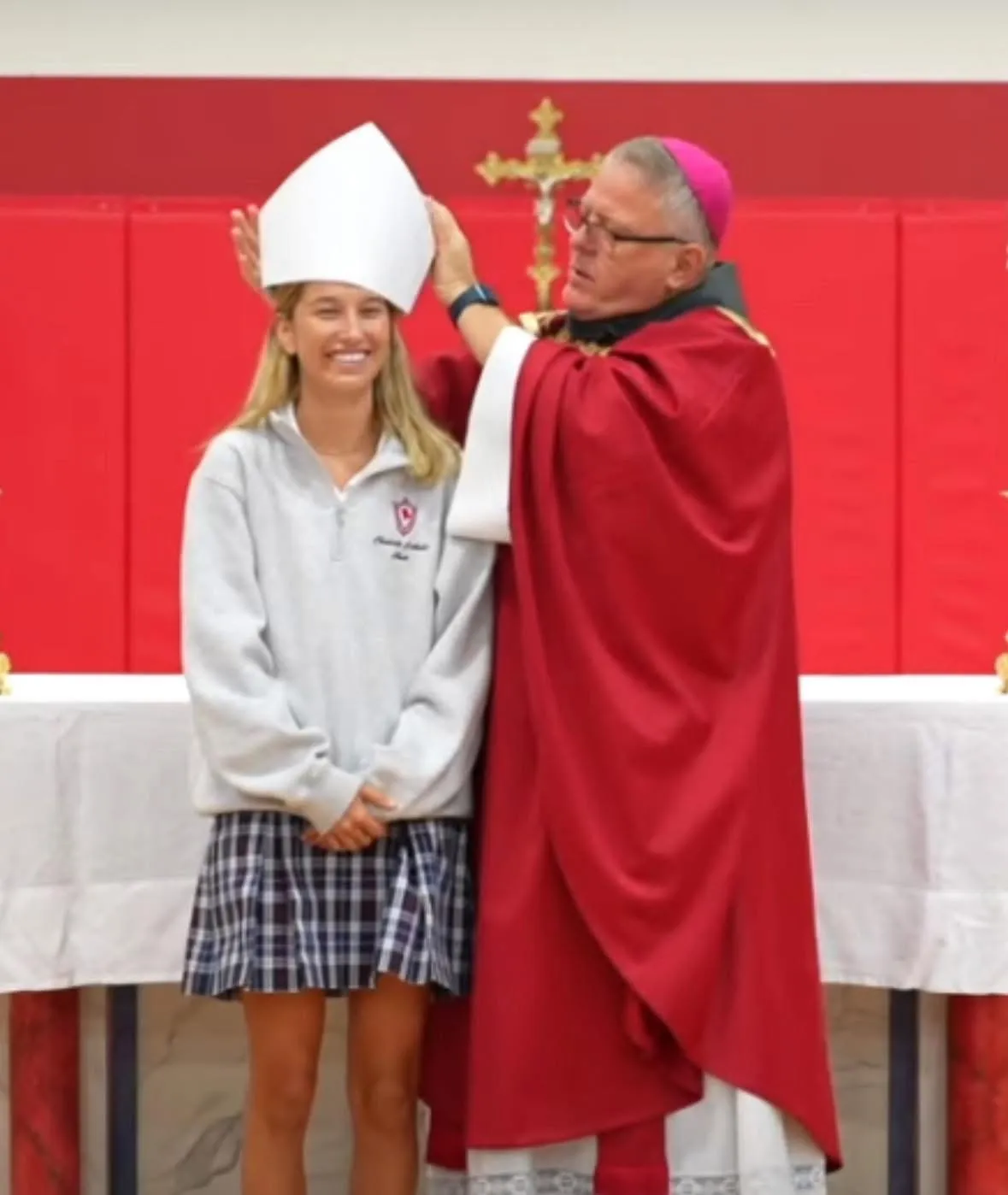
(The “reverent” Bishop Michael Martin places a mitre on a school girl during Mass)
This is not the governance of a father protecting reverence but the administration of a functionary protecting uniformity. When the act of kneeling becomes “inconsistent with national norms,” the bureaucracy has already devoured the Faith.
The Debate: “Lawful” vs. “Rightful”
My X exchange with Fr. Peter Totleben, O.P., revealed something larger than a disagreement over canon law. It exposed the chasm between two religions now occupying the same Church. Totleben insists that Martin’s decree is “lawful,” and that obedience consists in doing what one is told, even when the order erases a practice older than the bishop’s own office. He calls the assertion of a “right to disobey” “literally big modernism.”
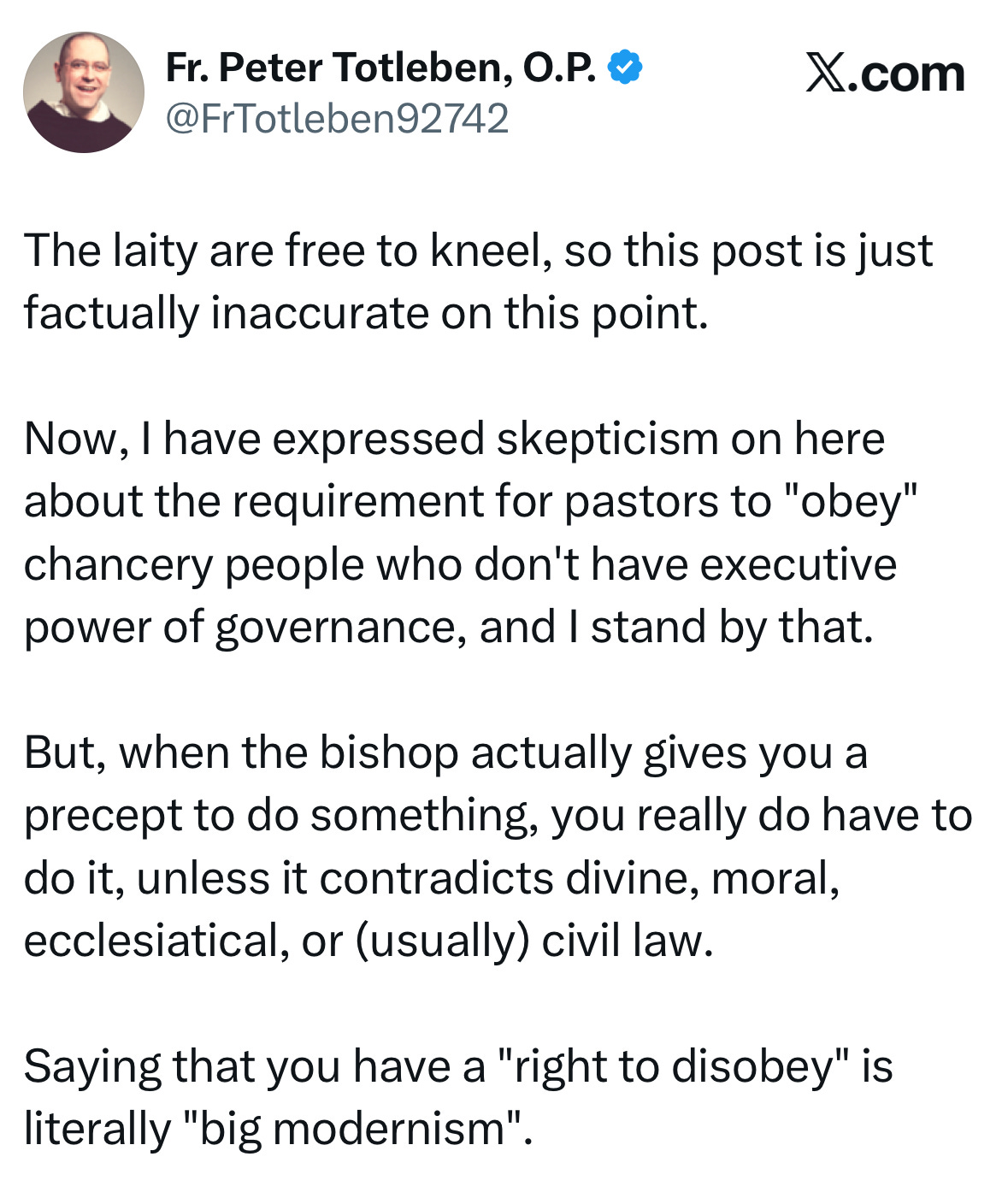
Fr. Peter Totleben’s tweet reads like a homily to bureaucracy. He insists that “the laity are free to kneel,” and that my post is “factually inaccurate.” That’s a disingenuous deflection.
No one said the bishop had banned kneeling. My statement was moral, not procedural: Catholics have the right to kneel in adoration before God. That right flows from divine law and cannot be revoked by episcopal whim. The bishop may not have issued a written prohibition, but he has removed the very structures that facilitate kneeling. That’s like saying, “You’re free to pray,” while padlocking the church. Technically true, completely dishonest.
Totleben’s position is the theology of plausible deniability. As long as the paperwork doesn’t say ban, he can pretend nothing has been suppressed, even as the posture of reverence is deliberately stripped away. It’s a lawyer’s defense masquerading as obedience.
Then comes the heart of his argument: “When the bishop gives you a precept, you really do have to do it, unless it contradicts divine, moral, ecclesiastical, or civil law.” And yet, when authority is used to undermine reverence for the Eucharist, the supreme act of divine worship, it does contradict divine law. The virtue of obedience depends entirely on the justice of what is commanded. When authority discourages reverence, obedience ceases to be virtue and becomes cowardice.
This is the irony Totleben can’t see. He accuses me of “modernism” for defending the faithful’s right to kneel, while advancing the most modernist claim imaginable: that authority defines truth instead of serving it. That is literally modernism: the idea that what the hierarchy decrees becomes the measure of orthodoxy, regardless of what the faith has always held.
The Church has never taught that every episcopal decree is holy by default. Authority in the Church is ministerial, not proprietary. A bishop does not own the liturgy; he serves it. Reverence toward the Eucharist isn’t an optional custom he can dial up or down depending on his mood, it’s owed to Christ by divine law and by the constant practice of the Church. Telling people they “can’t use altar rails” or discouraging kneeling attacks the very posture of adoration that defines Latin Rite worship. You can’t call that lawful any more than you could call it lawful to tell people not to genuflect before the tabernacle.
Totleben keeps repeating “lawful” as though legality were the same as legitimacy. But the Church doesn’t think that way. Authority is not self-justifying; it’s bound to the ends for which Christ instituted it. A decree that discourages reverence is contrary to those ends, even if it follows every canonical form. His logic is the same as the modern state’s: once the paperwork is in order, it’s “lawful.” That’s not Catholic obedience, it’s legal positivism in a Dominican habit.
And if the bishop ever did formally forbid kneeling, Totleben would be the first to insist we “have to obey” because it’s “lawful.” He’s already built the framework that justifies every abuse so long as it comes with a letterhead.
True obedience doesn’t mean doing whatever you’re told. It means submitting when authority acts for the Faith, not against it. When you defend reverence, you obey Christ. When you defend its suppression, you obey a policy.
If Totleben’s superior told him to stop saying the Rosary and instead meditate on recycling and the “cry of the Earth,” he’d toss his beads in the trash and fall asleep clutching Al Gore’s latest.

That’s the spiritual species now produced by modern seminaries: obedient technicians of a dying bureaucracy, reciting rubrics while the altar is stripped before their eyes.
Obedience has been severed from faith; submission detached from truth. The bishop who suppresses reverence commits sacrilege. The priest who justifies it becomes an accessory. And the faithful who refuse to comply are not the rebels, they’re the last Catholics left.
Greensburg and the Gaslight of “Clarification”
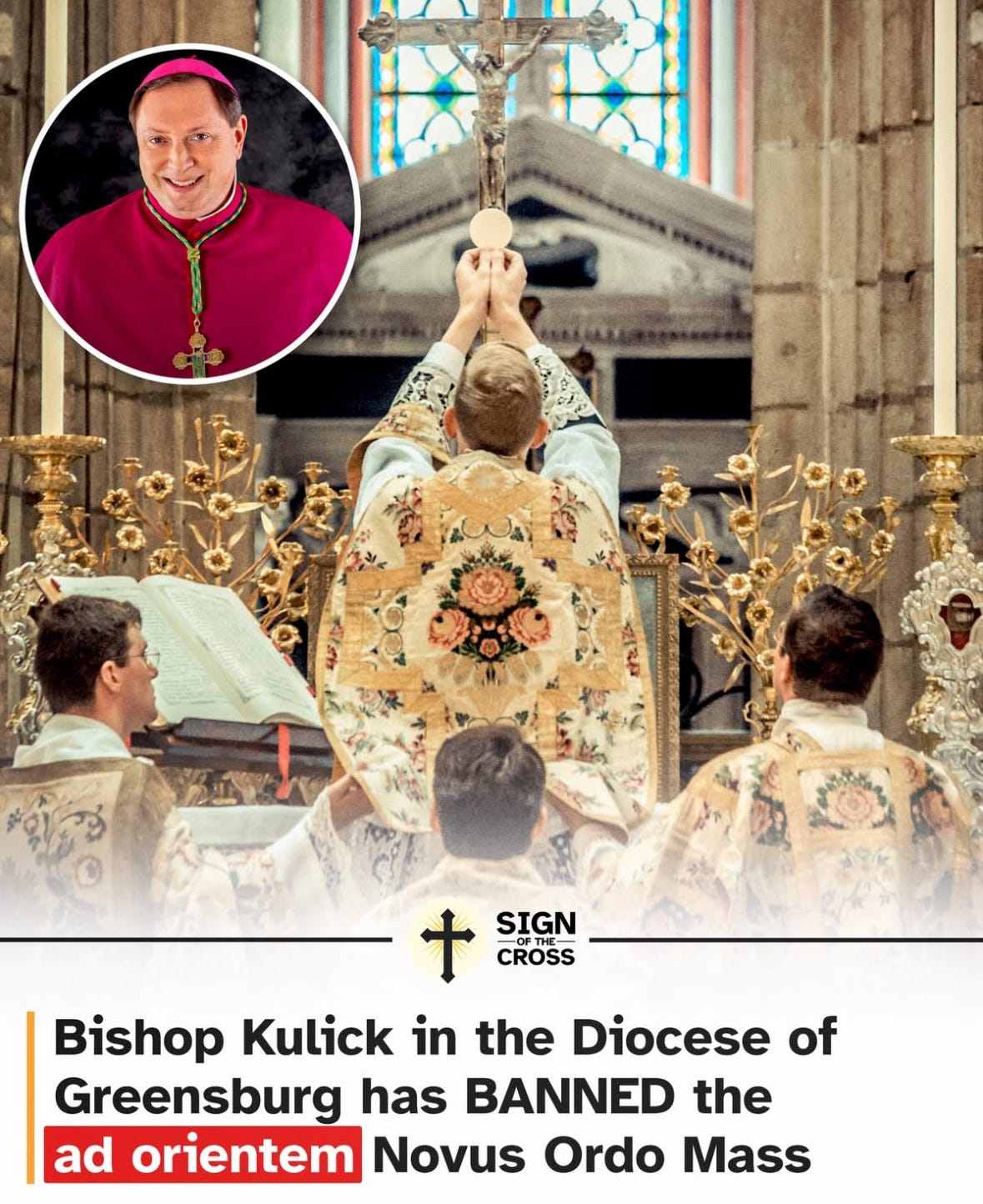
Meanwhile in Pennsylvania, the Diocese of Greensburg denies having banned ad orientem celebration of the Novus Ordo, the ancient practice of the priest facing the altar with the people. Yet multiple parishioners claim they were told by the bishop’s own secretary that such Masses are not permitted.
So which is it? The diocese says no decree exists, but parishes are informed off the record that the orientation “is not allowed.” It’s the perfect modern compromise: deny the persecution publicly, enforce it privately.
The irony is that even the post-Vatican II documents explicitly affirm the legitimacy of ad orientem. Redemptionis Sacramentum forbids a bishop from banning it outright. But as with altar rails, it isn’t the letter of the law that matters; it’s the will to suppress reverence. Every modern restriction on traditional posture or orientation carries the same psychological message: “Don’t act as though God is really here.”
The Silent Death of a Confessor
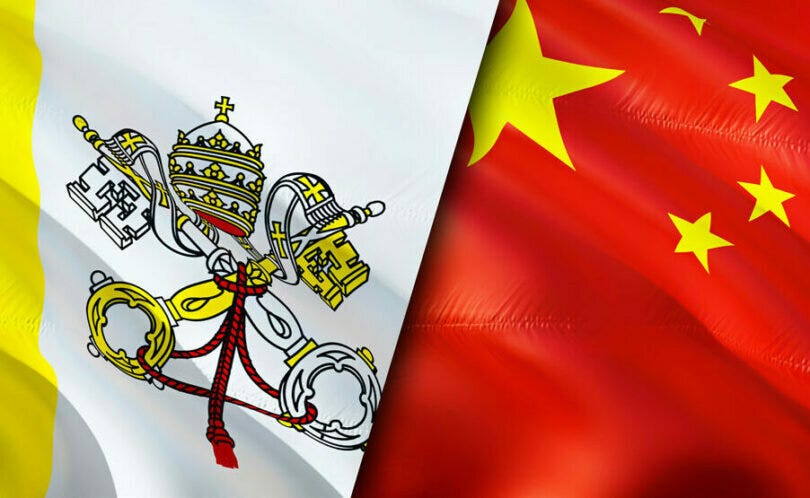
While bishops in the West micromanage kneelers and orientations, the underground Church in China buries another confessor. Bishop Julius Jia Zhiguo, who spent decades in Communist prisons for refusing to submit to the regime’s “patriotic” church, has died at ninety.
Rome said nothing.
This silence speaks louder than any papal condolence. Jia’s faithfulness to the underground Church, the suffering Church that clung to Rome in hope, is now an embarrassment to the new Vatican, which prefers “dialogue” with Beijing to fidelity under persecution. Once upon a time, a bishop who defied tyrants would be honored as a martyr. Today, he’s quietly forgotten, lest his courage contrast too sharply with the Vatican’s compliance.
Leo XIV’s Homily on “Reverence”

To complete the absurd symmetry, Leo XIV marked the Feast of the Dedication of the Lateran Basilica with a homily calling for “renewed reverence and beauty in the Church’s liturgy.”
As he spoke of “solemn sobriety” and “care of the liturgy as an example for the whole Church,” bishops under his authority were banning rails, silencing priests who celebrate ad orientem, and driving faithful Catholics to the margins of parish life. It’s the standard postconciliar theater: speak like Augustine, govern like Bugnini.
One wonders whether Leo’s words are meant as a signal or a sedative. If the Church’s liturgy is to embody “beauty and reverence,” will he begin by disciplining bishops who punish those very things? Or will his rhetoric remain, as usual, an ornament draped over desecration?
The False Obedience of a Dying Bureaucracy
In every one of these stories, the same spirit appears: the substitution of obedience for faith. Catholics are told that to kneel, to turn toward the altar, or to preserve silence is an act of disobedience, while to dismantle, to face the people, and to chatter endlessly is “lawful.”
But lawful to whom? The Church is not a corporation; bishops are not middle managers of mystery. Their authority is real only insofar as it serves what they have received. Once they wield it to suppress reverence or erase tradition, they no longer act in continuity with the Church’s mission but as instruments of its inversion.
The faithful who resist such decrees are not rebels. They are Catholics in the oldest sense of the word: those who obey God rather than men, those who will not genuflect before the new golden calf of bureaucratic compliance.
And as the Church in China buries her confessors, the Church in America is told to stop kneeling. The distance between those two forms of persecution, one violent, one spiritual, grows smaller every day.
Ping
Disclaimer: Opinions posted on Free Republic are those of the individual posters and do not necessarily represent the opinion of Free Republic or its management. All materials posted herein are protected by copyright law and the exemption for fair use of copyrighted works.