Skip to comments.
Catholic Caucus: Daily Mass Readings 3-November-2025
Universalis/Jerusalem Bible ^
Posted on 11/03/2025 5:00:43 AM PST by annalex
3 November 2025
Monday of week 31 in Ordinary Time
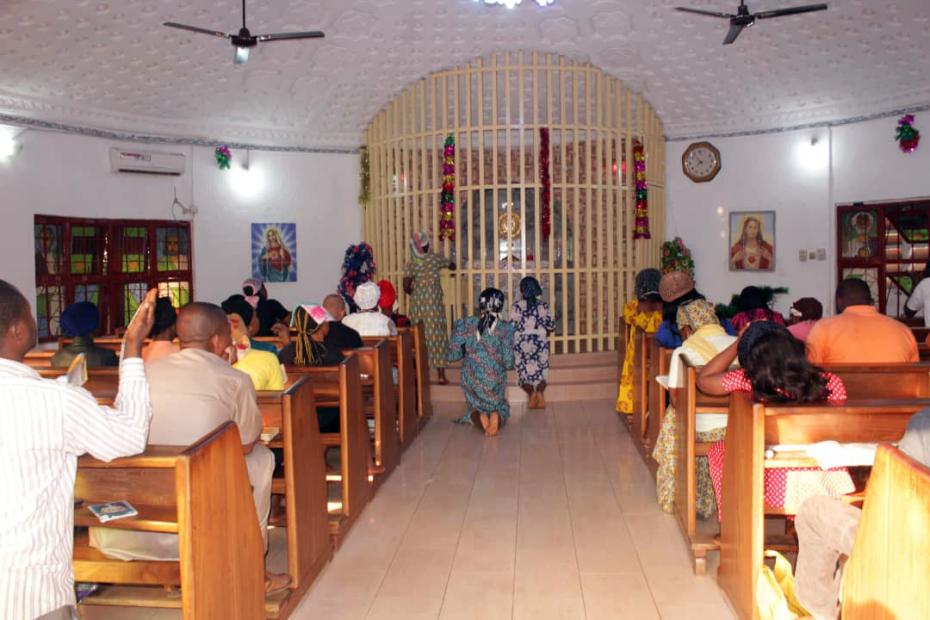
St. Mary Catholic Church, Enugu, Nigeria Readings at MassLiturgical Colour: Green. Year: C(I).
| First reading | Romans 11:29-36 |
|---|
God never takes back his giftsGod never takes back his gifts or revokes his choice. Just as you changed from being disobedient to God, and now enjoy mercy because of their disobedience, so those who are disobedient now – and only because of the mercy shown to you – will also enjoy mercy eventually. God has imprisoned all men in their own disobedience only to show mercy to all mankind. How rich are the depths of God – how deep his wisdom and knowledge – and how impossible to penetrate his motives or understand his methods! Who could ever know the mind of the Lord? Who could ever be his counsellor? Who could ever give him anything or lend him anything? All that exists comes from him; all is by him and for him. To him be glory for ever! Amen.
| Responsorial Psalm |
|---|
| Psalm 68(69):30-31,33-34,36-37 |
|---|
In your great love, answer me, O God. As for me in my poverty and pain let your help, O God, lift me up. I will praise God’s name with a song; I will glorify him with thanksgiving. In your great love, answer me, O God. The poor when they see it will be glad and God-seeking hearts will revive; for the Lord listens to the needy and does not spurn his servants in their chains. In your great love, answer me, O God. For God will bring help to Zion and rebuild the cities of Judah and men shall dwell there in possession. The sons of his servants shall inherit it; those who love his name shall dwell there. In your great love, answer me, O God.
| Gospel Acclamation | Ps118:18 |
|---|
Alleluia, alleluia! Open my eyes, O Lord, that I may consider the wonders of your law. Alleluia! Alleluia, alleluia! If you make my word your home you will indeed be my disciples, and you will learn the truth, says the Lord. Alleluia!
Do not invite those who might be able to invite you backJesus said to his host, one of the leading Pharisees, ‘When you give a lunch or a dinner, do not ask your friends, brothers, relations or rich neighbours, for fear they repay your courtesy by inviting you in return. No; when you have a party, invite the poor, the crippled, the lame, the blind; that they cannot pay you back means that you are fortunate, because repayment will be made to you when the virtuous rise again.’ You can also view this page with the New Testament in Greek and English. Universalis podcast: Resurrection is Now: part 1 of 8Foreword; Prologue; Death as the End: The Death of Experience, The Death of Love.
Dom Aelred Watkin (1918-1997) was a wise and respected Head Master of Downside from 1962 to 1975.
"Resurrection is Now" is a rare opportunity to benefit from his understanding. This book covers death in all its aspects, both as an end and as a beginning, and looks at life from the perspective of a preparation for death. It combines intellectual rigour with a poetic delight in the wonder of being in all its aspects.
You can listen to the book here, or you can read it as a Daily Book in Universalis: the Episode Notes have instructions.. (22 minutes)
Episode notes.Play Christian Art Each day, The Christian Art website gives a picture and reflection on the Gospel of the day. The readings on this page are from the Jerusalem Bible, which is used at Mass in most of the English-speaking world. The New American Bible readings, which are used at Mass in the United States, are available in the Universalis apps, programs and downloads.
You can also view this page with the Gospel in Greek and English. |
TOPICS: Catholic; General Discusssion; Prayer; Worship
KEYWORDS: catholic; lk14; ordinarytime; prayer
For your reading, reflection, faith-sharing, comments, questions, discussion.
1
posted on
11/03/2025 5:00:43 AM PST
by
annalex
To: All
KEYWORDS: catholic; lk14; ordinarytime; prayer
2
posted on
11/03/2025 5:01:05 AM PST
by
annalex
(fear them not)
To: nickcarraway; NYer; ELS; Pyro7480; livius; ArrogantBustard; Catholicguy; RobbyS; marshmallow; ...

Alleluia Ping Please FReepmail me to get on/off the Alleluia Ping List.
3
posted on
11/03/2025 5:01:50 AM PST
by
annalex
(fear them not)
To: annalex
4
posted on
11/03/2025 5:02:32 AM PST
by
annalex
(fear them not)
To: annalex
| Luke |
| | English: Douay-Rheims | Latin: Vulgata Clementina | Greek NT: Byzantine/Majority Text (2000) |
| | Luke 14
|
| 12. | And he said to him also that had invited him: When thou makest a dinner or a supper, call not thy friends, nor thy brethren, nor thy kinsmen, nor thy neighbours who are rich; lest perhaps they also invite thee again, and a recompense be made to thee. | Dicebat autem et ei, qui invitaverat : Cum facis prandium, aut cœnam, noli vocare amicos tuos, neque fratres tuos, neque cognatos, neque vicinos divites : ne forte te et ipsi reinvitent, et fiat tibi retributio ; | ελεγεν δε και τω κεκληκοτι αυτον οταν ποιης αριστον η δειπνον μη φωνει τους φιλους σου μηδε τους αδελφους σου μηδε τους συγγενεις σου μηδε γειτονας πλουσιους μηποτε και αυτοι σε αντικαλεσωσιν και γενηται σοι ανταποδομα |
| 13. | But when thou makest a feast, call the poor, the maimed, the lame, and the blind; | sed cum facis convivium, voca pauperes, debiles, claudos, et cæcos : | αλλ οταν ποιης δοχην καλει πτωχους αναπηρους χωλους τυφλους |
| 14. | And thou shalt be blessed, because they have not wherewith to make thee recompense: for recompense shall be made thee at the resurrection of the just. | et beatus eris, quia non habent retribuere tibi : retribuetur enim tibi in resurrectione justorum. | και μακαριος εση οτι ουκ εχουσιν ανταποδουναι σοι ανταποδοθησεται γαρ σοι εν τη αναστασει των δικαιων |
5
posted on
11/03/2025 5:04:42 AM PST
by
annalex
(fear them not)
To: annalex

Catena Aurea by St. Thomas Aguinas
14:12–14
12. Then said he also to him that bade him, When thou makest a dinner or a supper, call not thy friends, nor thy brethren, neither thy kinsmen, nor thy rich neighbours; lest they also bid thee again, and a recompence be made thee.
13. But when thou makest a feast, call the poor, the maimed, the lame, the blind:
14. And thou shalt be blessed; for they cannot recompense thee: for thou shalt be recompensed at the resurrection of the just.
THEOPHYLACT. The supper being composed of two parties, the invited and the inviter, and having already exhorted the invited to humility, He next rewards by His advice the inviter, guarding him against making a feast to gain the favour of men. Hence it is said, Then said he also to him that bade him, When thou makest a dinner or a supper, call not thy friends.
CHRYSOSTOM. (Hom. 1, 3. in ep. Col.) Many are the sources from which friendships are made. Leaving out all unlawful ones, we shall speak only of those which are natural and moral; the natural are, for instance, between father and son, brother and brother, and such like; which He meant, saying, Nor thy brethren, nor thy kinsmen; the moral, when a man has become your guest or neighbour; and with reference to these He says, nor thy neighbours.
BEDE. Brothers then, and friends, and the rich, are not forbidden, as though it were a crime to entertain one another, but this, like all the other necessary intercourse among men, is shewn to fail in meriting the reward of everlasting life; as it follows, Lest perchance they also bid thee again, and a recompense be made thee. He says not, “and sin be committed against thee.” And the like to this He speaks in another place, And if ye do good to those who do good to you, what thank have ye? (Luke 6:33.) There are however certain mutual feastings of brothers and neighbours, which not only incur a retribution in this life, but also condemnation hereafter. And these are celebrated by the general gathering together of all, or the hospitality in turn of each one of the company; and they meet together that they may perpetrate foul deeds, and through excess of wine be provoked to all kinds of lustful pleasure.
CHRYSOSTOM. Let us not then bestow kindness on others under the hope of return. For this is a cold motive, and hence it is that such a friendship soon vanishes. But if you invite the poor, God, who never forgets, will be your debtor, as it follows, But when ye make a feast, call the poor, the maimed, the lame, and the blind.
CHRYSOSTOM. (Hom. 45. in Act.) For the humbler our brother is, so much the more does Christ come through him and visit us. For he who entertains a great man does it often from vainglory. And elsewhere, But very often interest is his object, that through such a one he may gain promotion. I could indeed mention many who for this pay court to the most distinguished of the nobles, that through their assistance they may obtain the greater favour from the prince. Let us not then ask those who can recompense us, as it follows, And thou shalt be blessed, for they cannot recompense thee. And let us not be troubled when we receive no return of a kindness, but when we do; for if we have received it we shall receive nothing more, but if man does not repay us, God will. As it follows, For thou shall be recompensed at the resurrection of the just.
BEDE. And though all rise again, yet it is called the resurrection of the just, because in the resurrection they doubt not that they are blessed. Whoever then bids the poor to his feast shall receive a reward hereafter. But he who invites his friends, brothers, and the rich, has received his reward. But if he does this for God’s sake after the example of the sons of Job, God, who Himself commanded all the duties of brotherly love, will reward him.
CHRYSOSTOM. But thou sayest, the poor are unclean and filthy. Wash him, and make him to sit with thee at table. If he has dirty garments, give him clean ones. Christ comes to thee through him, and dost thou stand trifling?
GREGORY OF NYSSA. Do not then let them lie as though they were nothing worth. Reflect who they are, and thou wilt discover their preciousness. They have put on the image of the Saviour. Heirs of future blessings, bearing the keys of the kingdom, able accusers and excusers, not speaking themselves, but examined by the judge.
CHRYSOSTOM. (Hom. 45. in Act.) It would become thee then to receive them above in the best chamber, but if thou shrinkest, at least admit Christ below, where are the menials and servants. Let the poor man be at least thy door keeper. For where there is alms, the devil durst not enter. And if thou sittest not down with them, at any rate send them the dishes from thy table.
ORIGEN. But mystically, he who shuns vain-glory calls to a spiritual banquet the poor, that is, the ignorant, that he may enrich them; the weak, that is, those with offended consciences, that he may heal them; the lame, that is, those who have wandered from reason, that he may make their paths straight; the blind, that is, those who discern not the truth, that they may behold the true light. But it is said, They cannot recompense thee, i. e. they know not how to return an answer.
Catena Aurea Luke 14
6
posted on
11/03/2025 5:05:30 AM PST
by
annalex
(fear them not)
To: annalex

Miraculous Mass
Simone Martini
1312-17
Fresco, 390 x 200 cm
Cappella di San Martino, Lower Church, San Francesco, Assisi In the bay to the right we find the scene of the Miraculous Mass, an episode that is only very rarely included in Italian fresco cycles. This was the first time it was depicted. The event took place in Albenga and was similar to what happened in Amiens. After having given a beggar his tunic, Martin is about to celebrate mass. During the elevation, the most deeply spiritual moment in the mass, two angels appear and give Martin a very beautiful and precious piece of fabric. There is extraordinary spontaneity and beauty in the deacon's expression of surprise, in his almost fearful gesture: his astonishment is so great that he instinctively reaches out towards his bishop. The scene is a masterful composition of volumes and shapes with the linear elements (the candlesticks and the decoration of the altar-cloth) alternating with the solid structures of the altar and the dais, beneath a barrel-vaulted ceiling.
Source
7
posted on
11/03/2025 5:06:59 AM PST
by
annalex
(fear them not)
To: annalex
November 3: Saint Martin de Porres
The Apostle of Indigenous Peoples
Saint Martin de Porres was born in Lima, Peru, on December 9, 1579, and was baptized in the Church of Saint Sebastian. In the early years of his life, he lived with his mother—an ex-slave of African descent—and his sister Giovanna, in difficult conditions despite being acknowledged by his father. When Martin was about eight years old, his father, Juan de Porres, a Spanish nobleman, finally decided to take charge of his education, bringing his children with him to Guayaquil, Ecuador, where they could live more comfortably.
Later, when his father was appointed governor of Panama, he brought Martin back to Lima and left his mother enough means to support and educate him. Martin became interested in medicine while spending time with two local pharmacists, Mateo Pastor and Francesca Velez Michel. He continued his training by working in the barbershop of Marcello de Rivera, where he learned techniques of surgery and healing.
At the age of fifteen, Martin felt a religious calling and approached the Dominican Order, which had been active in Lima since the time of the first Bishop of Peru, Vicente Valverde. He entered the Convent of Our Lady of the Rosary, where he was received as a “donado,” that is, a lay helper assigned to the most humble tasks, such as cleaning. This choice displeased his father, but Martin was happy to serve. In his free time, he used his medical knowledge to assist his fellow friars, even caring for those who had once mocked him.
It is said that when the convent fell into severe financial difficulty, the prior was about to sell precious objects to pay off debts. Martin approached him and offered to sell himself as a slave instead. Moved by his humility, the prior refused, saying, “You are not for sale.”
Martin was humble but also learned. Although not formally educated, he showed a deep understanding of the philosophy and theology of Saint Thomas Aquinas. One day, he gave a brilliant answer to a question about God posed by two students, leaving them astonished. Their professor remarked, “Martin has the knowledge of the saints.”
In addition to healing the sick, he preached the Gospel to the poor he met, including the slaves and servants on the Limatambo estate. Because of his dedication and humility, his superiors decided to admit him as a full lay brother on June 2, 1603.
Martin then began to live an even more ascetic life, spending long hours in prayer before the Blessed Sacrament, practicing penance, and meditating on the Passion of Jesus. According to some accounts, he received the gift of ecstasy and was seen lifted from the ground while praying.
He was friends with other holy religious figures, such as Saint John Macías, and his fame spread so widely that even the governor and the viceroy sought his counsel. Yet he continued to devote himself to the poor, especially the Indigenous people. When a plague struck Lima, he cared for as many as sixty friars.
Among his other activities, he continued to work as a barber—a crucial role in such a large convent. His reputation as a healer helped him attract donations from wealthy benefactors who wished to perform acts of charity. With these resources, he was able to equip the infirmary with everything needed, including beds and medicines. He often took in the poor, the sick, and the homeless. One of them, a 14-year-old boy named Giovanni Vásquez, became his assistant and helped distribute alms to impoverished families.
Nobles and churchmen visiting Lima sought him out. One such visitor was Archbishop Feliciano de la Vega, who was cured by Martin when ill. Although the archbishop invited him to go to Mexico, Martin chose to remain in Lima to care for the poor.
His friend and benefactor, Governor Juan de Figueroa, once received a somber warning from him: “Hard times are coming.” A few days later, the governor was struck by illness, slander, and financial loss. Only then did Martin reassure him that, though he would lose much, he would still have enough to live with dignity.
Because of the large number of poor people he served, Martin’s infirmary was located apart from the rest of the convent, but in urgent cases, he brought the sick into his own cell.
Although little is known about how he prepared his medicines, it is said that he gathered herbs at the Limatambo estate, where he probably maintained a small laboratory.
One of his most enduring works was the founding of the College of the Holy Cross, one of the first schools for poor children in the Americas. It was a difficult undertaking: neither the Church nor the civil authorities offered support. Eventually, he found benefactors and succeeded in opening the school, entrusting its management to Mateo Pastor. The school welcomed many orphaned or abandoned children, saving them from a life on the streets.
Martin was also deeply loved for his compassion toward animals. A true story tells of a large wounded dog that entered the infirmary; Martin carefully tended its wounds and, once it recovered, returned it to its owner.
Martin died on the evening of November 3, 1639, surrounded by friars praying for him. The next day, his funeral was attended by Archbishop Feliciano de la Vega of Mexico City and the city authorities. His body was buried in the crypt beneath the chapter hall of the convent.
On January 10, 1945, Pope Pius XII declared him Patron of Social Justice Works in Peru, and on May 6, 1962, Pope John XXIII canonized him. In 1966, Pope Paul VI named him Patron Saint of Barbers.
vaticanstate.va
8
posted on
11/03/2025 5:10:33 AM PST
by
annalex
(fear them not)
To: annalex

Anonymous painting in the Monastery of Santa Rosa de las Monjas de Lima
9
posted on
11/03/2025 5:12:32 AM PST
by
annalex
(fear them not)
To: annalex
NAVARRE BIBLE COMMENTARY(RSV)
Ad Majorem Dei Gloriam (To the Greater Glory of God)
First Reading:
From: Romans 11:29-36
The Conversion of the Jews (Continuation)
-----------------------------------------
[29] For the gifts and the call of God are irrevocable. [30] Just as you were once disobedient to God but now have received mercy because of their disobedience, [31] so they have now been disobedient in order that by the mercy shown to you they may also receive mercy. [32] For God has consigned all men to disobedience, that he may have mercy upon all.
[33] O the depth of the riches and wisdom and knowledge of God! How unsearchable are his judgments and how inscrutable his ways!
[34] "For who has known the mind of the Lord, or who has been his counselor?" [35] "Or who has given a gift to him that he might be repaid?"
[36] For from him and through him and to him are all things. To him be glory for ever. Amen.
******************************************************
Commentary:
25-32. We all yearn for the fulfillment of these words--threatening yet consoling--which Christ addressed to the scribes and Pharisees: "For I tell you, you will not see me again, until you say 'Blessed is he who comes in the name of the Lord"' (Mt 23:39). "Together with the prophets and the Apostle, the Church awaits the day, known to God alone, when all peoples will call on God with one voice and 'serve him with one accord' (Zeph 3:9)" (Vatican II, "Nostra Aetate", 4). The conversion of the Jews is a secret--a mystery, the text says (v. 25)—hidden in the future, which will come about when the Incarnation of the Word achieves its ultimate purpose.
This conversion will follow on that of the Gentiles, which will be as it were a prelude to it. Jesus has foretold that "Jerusalem will be trodden down by the Gentiles, until the times of the Gentiles are fulfilled" (Lk 21:24; cf. note on same), which in some way suggests that the Jews will be converted at the end of time.
However, when the Church in its preaching touches on the main signs of the end of the world, it only refers to the proclamation of the Gospel throughout the world, to apostasy and to the Antichrist, but it has nothing to say about the conversion of the Jews (cf. "St Pius V Catechism", I, 8, 7). What the Church does do, and what we should do, is to pray the Lord to listen to its prayers "that the people you first made your own may arrive at the fullness of redemption" ("Roman Missal", Good Friday Liturgy, Prayer of the Faithful).
"The same thing is happening, St Paul explains, now that the Gospel is being preached. The people of Israel in general are not accepting it and are not becoming part of the Church; only a small number of Jews have believed, and these are the "remnant.' of Israel, chosen by God so that in them the promises might be kept. The conversion of Paul himself is an example and an earnest of this return of the people of Israel to their God, in line with the invitation that Hosea addressed to them: "Return, O Israel, to the Lord your God, for you have stumbled because of your iniquity" (Hos 14:2).
Throughout the history of the Church lapses of this type have occurred, with a consequent breakdown in morality. Whenever this happens, those Christians who stay true to the faith may, like Elijah, feel inclined to despair; but they should react with a realistic and vigilant optimism and not indulge in useless lamentation. In the presence of God, they should reflect on the fact that God actually wants to use them and their holy lives to turn the situation around: "A secret, an open secret: these world crises are sanctity crises. God wants a handful of men 'of his own' in every human activity. And then...'"pax Christi in regno Christi"--the peace of Christ in the kingdom of Christ"(St. J. Escriva, The Way, 301).
29. God never goes back on anything he promises; therefore he continues to call the Jews to enter the chosen people. He does not take account of their disobedience or their sins: he will love them with an everlasting love, as he promised the patriarchs and in line with the merits accruing to them for their fidelity (cf. Rom 9:4-5). It is this very immutability of God's love that makes it possible for "all Israel" (v. 26) to be saved. God's calling, which is eternal, cannot cease; but we for our part can reject his call. The immutability of God's plan is reassuring to us: it means that even if we abandon him at any point, we can always return to our earlier fidelity: he is still there, waiting for us.
33-36. God's admirable goodness, to both Jews and Gentiles, permitting them to disobey and then talking pity on them in their wretchedness, causes the Apostle to pour out his heart in words reminiscent of the Book of Isaiah: "For my thoughts are not your thoughts, neither are your ways my ways, says the Lord. For as the heavens are higher than the earth, so are my ways higher than your ways, and my thoughts than your thoughts" (55:8-9). The designs of divine Providence may disconcert us, may be difficult to understand; but if we remember how great God is--he is beyond our comprehension--and how God's power and faithfulness overcome any obstacle man may place in God's way we will realize that the very things which seem to frustrate his plans actually serve to forward them.
The correct attitude of man to the designs of God is one of humility. This will lead him to realize that the mysteries of God, which are intrinsically clear, seem obscure to us, simply because our mind's capacity is limited. Therefore, as Fray Luis de Granada reminds us, we must avoid saying that "something cannot be because we cannot understand it [...], for what is more in conformity with reason than to him the highest and best nature that our mind can conceive? [...] So it is that our failure to understand the sublimity of this mystery has a trace and scent of something divine, because, as we said, God being infinite must necessarily be beyond our comprehension" ("Introduccion Al Simbolo De La Fe", Part IV).
10
posted on
11/03/2025 8:00:26 AM PST
by
fidelis
(Ecce Crucem Domini! Fugite partes adversae! Vicit Leo de tribu Juda, Radix David! Alleluia!)
Gospel Reading: From: Luke 14:12-14
Attitude to the Poor
--------------------------
[12] He (Jesus) said to the man who had invited Him, "When you give a dinner or a banquet, do not invite your friends or your brothers or your kinsmen or rich neighbours, lest they also invite you in return, and you be repaid. [13] But when you give a feast, invite the poor, the maimed, the lame, the blind, [14] and you will be blessed, because they cannot repay you. You will be repaid at the resurrection of the just."
*********************************************************************
Commentary:
11. Humility is necessary for salvation that Jesus takes every opportunity to stress its importance. Here He uses the attitudes of people at banquet to remind us again that it is God who assigns the places at the Heavenly banquet. "Together with humility, the realization of the greatness of man's dignity--and of the overwhelming fact that, by grace, we are made children of God--forms a single attitude. It is not our own efforts that save us and gives us life; it is the grace of God. This is a truth which must never be forgotten" (St. J. Escriva, "Christ Is Passing By", 133).
14. A Christian acts in the world in the same way anyone else does; but his dealings with his colleagues and others should not be based on pursuit of reward or vainglory: the first thing he should seek is God's glory, desiring Heaven as his only reward (cf. Luke 6:32-34).
11
posted on
11/03/2025 8:00:49 AM PST
by
fidelis
(Ecce Crucem Domini! Fugite partes adversae! Vicit Leo de tribu Juda, Radix David! Alleluia!)
12
posted on
11/03/2025 8:01:30 AM PST
by
fidelis
(Ecce Crucem Domini! Fugite partes adversae! Vicit Leo de tribu Juda, Radix David! Alleluia!)
Disclaimer:
Opinions posted on Free Republic are those of the individual
posters and do not necessarily represent the opinion of Free Republic or its
management. All materials posted herein are protected by copyright law and the
exemption for fair use of copyrighted works.
FreeRepublic.com is powered by software copyright 2000-2008 John Robinson
