Skip to comments.
Catholic Caucus: Daily Mass Readings 24-October-2025
Universalis/Jerusalem Bible ^
Posted on 10/24/2025 3:44:09 PM PDT by annalex
24 October 2025
Friday of week 29 in Ordinary Time
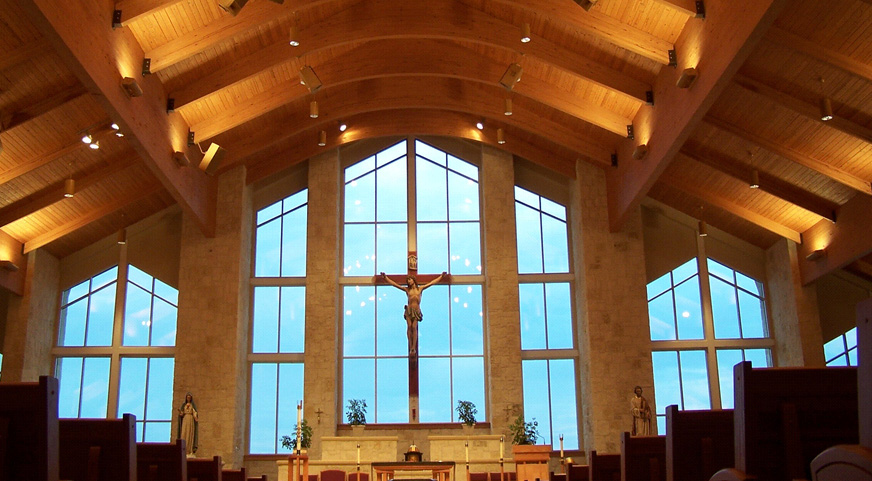
St Anthony Mary Claret Catholic Church, San Antonio
Readings at MassLiturgical Colour: Green. Year: C(I).
| First reading | Romans 7:18-25 |
|---|
Every time I want to do good it is something evil that comes to handI know of nothing good living in me – living, that is, in my unspiritual self – for though the will to do what is good is in me, the performance is not, with the result that instead of doing the good things I want to do, I carry out the sinful things I do not want. When I act against my will, then, it is not my true self doing it, but sin which lives in me. In fact, this seems to be the rule, that every single time I want to do good it is something evil that comes to hand. In my inmost self I dearly love God’s Law, but I can see that my body follows a different law that battles against the law which my reason dictates. This is what makes me a prisoner of that law of sin which lives inside my body. What a wretched man I am! Who will rescue me from this body doomed to death? Thanks be to God through Jesus Christ our Lord!
| Responsorial Psalm |
|---|
| Psalm 118(119):66,68,76-77,93-94 |
|---|
Lord, teach me your statutes. Teach me discernment and knowledge for I trust in your commands. You are good and your deeds are good; teach me your statutes. Lord, teach me your statutes. Let your love be ready to console me by your promise to your servant. Let your love come and I shall live for your law is my delight. Lord, teach me your statutes. I will never forget your precepts for with them you give me life. Save me, for I am yours since I seek your precepts. Lord, teach me your statutes.
Alleluia, alleluia! Harden not your hearts today, but listen to the voice of the Lord. Alleluia! Alleluia, alleluia! Blessed are you, Father, Lord of heaven and earth, for revealing the mysteries of the kingdom to mere children. Alleluia!
Do you not know how to interpret these times?Jesus said to the crowds: ‘When you see a cloud looming up in the west you say at once that rain is coming, and so it does. And when the wind is from the south you say it will be hot, and it is. Hypocrites! You know how to interpret the face of the earth and the sky. How is it you do not know how to interpret these times? ‘Why not judge for yourselves what is right? For example: when you go to court with your opponent, try to settle with him on the way, or he may drag you before the judge and the judge hand you over to the bailiff and the bailiff have you thrown into prison. I tell you, you will not get out till you have paid the very last penny.’ You can also view this page with the New Testament in Greek and English. Christian Art Each day, The Christian Art website gives a picture and reflection on the Gospel of the day. The readings on this page are from the Jerusalem Bible, which is used at Mass in most of the English-speaking world. The New American Bible readings, which are used at Mass in the United States, are available in the Universalis apps, programs and downloads.
You can also view this page with the Gospel in Greek and English. |
TOPICS: Catholic; General Discusssion; Prayer; Worship
KEYWORDS: catholic; lk12; ordinarytime; prayer
For your reading, reflection, faith-sharing, comments, questions, discussion.
1
posted on
10/24/2025 3:44:09 PM PDT
by
annalex
To: All
KEYWORDS: catholic; lk12; ordinarytime; prayer
2
posted on
10/24/2025 3:44:37 PM PDT
by
annalex
(fear them not)
To: nickcarraway; NYer; ELS; Pyro7480; livius; ArrogantBustard; Catholicguy; RobbyS; marshmallow; ...

Alleluia Ping Please FReepmail me to get on/off the Alleluia Ping List.
3
posted on
10/24/2025 3:45:24 PM PDT
by
annalex
(fear them not)
To: annalex
4
posted on
10/24/2025 3:46:12 PM PDT
by
annalex
(fear them not)
To: annalex
| Luke |
| | English: Douay-Rheims | Latin: Vulgata Clementina | Greek NT: Byzantine/Majority Text (2000) |
| | Luke 12
|
| 54. | And he said also to the multitudes: When you see a cloud rising from the west, presently you say: A shower is coming: and so it happeneth: | Dicebat autem et ad turbas : Cum videritis nubem orientem ab occasu, statim dicitis : Nimbus venit : et ita fit. | ελεγεν δε και τοις οχλοις οταν ιδητε την νεφελην ανατελλουσαν απο δυσμων ευθεως λεγετε ομβρος ερχεται και γινεται ουτως |
| 55. | And when ye see the south wind blow, you say: There will be heat: and it cometh to pass. | Et cum austrum flantem, dicitis : Quia æstus erit : et fit. | και οταν νοτον πνεοντα λεγετε οτι καυσων εσται και γινεται |
| 56. | You hypocrites, you know how to discern the face of the heaven and of the earth: but how is it that you do not discern this time? | Hypocritæ ! faciem cæli et terræ nostis probare : hoc autem tempus quomodo non probatis ? | υποκριται το προσωπον της γης και του ουρανου οιδατε δοκιμαζειν τον δε καιρον τουτον πως ου δοκιμαζετε |
| 57. | And why even of yourselves, do you not judge that which is just? | quid autem et a vobis ipsis non judicatis quod justum est ? | τι δε και αφ εαυτων ου κρινετε το δικαιον |
| 58. | And when thou goest with thy adversary to the prince, whilst thou art in the way, endeavour to be delivered from him: lest perhaps he draw thee to the judge, and the judge deliver thee to the exacter, and the exacter cast thee into prison. | Cum autem vadis cum adversario tuo ad principem, in via da operam liberari ab illo, ne forte trahat te ad judicem, et judex tradat te exactori, et exactor mittat te in carcerem. | ως γαρ υπαγεις μετα του αντιδικου σου επ αρχοντα εν τη οδω δος εργασιαν απηλλαχθαι απ αυτου μηποτε κατασυρη σε προς τον κριτην και ο κριτης σε παραδω τω πρακτορι και ο πρακτωρ σε βαλη εις φυλακην |
| 59. | I say to thee, thou shalt not go out thence, until thou pay the very last mite. | Dico tibi, non exies inde, donec etiam novissimum minutum reddas. | λεγω σοι ου μη εξελθης εκειθεν εως ου και τον εσχατον λεπτον αποδως |
5
posted on
10/24/2025 3:48:10 PM PDT
by
annalex
(fear them not)
To: annalex

Catena Aurea by St. Thomas Aguinas
12:54–57
54. And he said also to the people, When ye see a cloud rise out of the west, straightway ye say, There cometh a shower; and so it is.
55. And when ye see the south wind blow, ye say, There will be heat; and it cometh to pass.
56. Ye hypocrites, ye can discern the face of the sky and of the earth; but how is it that ye do not discern this time?
57. Yea, and why even of yourselves judge ye not what is right?
THEOPHYLACT. When He spoke about preaching, and called it a sword, His hearers may have been troubled, not knowing what He meant. And therefore our Lord adds, that as men determine the state of the weather by certain signs, so ought they to know His coming. And this is what he means by saying, When ye see a cloud rise out of the west, straightway ye say, There cometh a shower. And when ye see the south wind blowing, ye say, There will be heat, &c. As if He says, Your words and works shew me to be opposed to you. Ye may therefore suppose that I came not to give peace, but the storm and whirlwind. For I am a cloud, and I come out of the west, that is, from human nature; which has been long since clothed with the thick darkness of sin. I came also to send fire, that is, to stir up heat. For I am the strong south wind, opposed to the northern coldness.
BEDE. Or, they who from the change of the elements can easily when they like predetermine the state of the weather, might if they wished also understand the time of our Lord’s coming from the words of the Prophets.
CYRIL OF ALEXANDRIA. For the prophets have in many ways foretold the mystery of Christ; it became them therefore, if they were wise, to stretch their prospect beyond to the future, nor will ignorance of the time to come avail them after the present life. For there will be wind and rain, and a future punishment by fire; and this is signified when it is said, A shower cometh. It became them also not to be ignorant of the time of salvation, that is, the coming of the Saviour, through whom perfect piety entered into the world. And this is meant when it is said, Ye say that there will be heat. Whence it follows in censure of them, Ye hypocrites, ye can discern the face of the sky and the earth, but how is it that ye do not discern this time?
BASIL. (in Hexam. Hom. 6, 4.) Now we must observe, that conjectures concerning the stars are necessary to the life of man, as long as we do lot push our searches into their signs beyond due limits. For it is possible to discover some things with respect to coming rain, still more concerning heat and the force of the winds, whether partial or universal, stormy or gentle. But the great advantage that is rendered to life by these conjectures is known to every one. For it is of importance to the sailor to prognosticate the dangers of storms, to the traveller the changes of the weather, to the husbandman the abundant supply of his fruits.
BEDE. But lest any of the people should allege their ignorance of the prophetical books as a reason why they could not discern the courses of the times, He carefully adds, And why even of yourselves judge ye not what is right, shewing them that although unlearned they might still by their natural ability discern Him, who did works such as none other man did, to be above man, and to be God, and that therefore after the injustice of this world, the just judgment of the creation would come.
ORIGEN. But had it not been implanted in our nature to judge what is right, our Lord would never have said this.
12:58–59
58. When thou goest with thine adversary to the magistrate, as thou art in the way, give diligence that thou mayest be delivered from him; lest he hale thee to the judge, and the judge deliver thee to the officer, and the officer cast thee into prison.
59. I tell thee, thou shalt not depart thence, till thou hast paid the very last mite.
THEOPHYLACT. Our Lord having described a rightful difference, next teaches us a rightful reconciliation, saying, When thou goest with thine adversary to the magistrate, as thou art in the way, give diligence that thou mayest be delivered from him, &c. As if He says, When thine adversary is bringing thee to judgment, give diligence, that is, try every method, to be released from him. Or give diligence, that is, although thou hast nothing, borrow in order that thou may be released from him, lest he summon thee before the judge, as it follows, Lest he hale thee to the judge, and the judge deliver thee to the officer, and the officer cast thee into prison.
CYRIL OF ALEXANDRIA. Where thou wilt suffer want until thou payest the last farthing; and this is what He adds, I say unto you, thou shalt not depart hence.
CHRYSOSTOM. (Hom. 16. in Matt.) It seems to me that He is speaking of the present judges, and of the way to the present judgment, and of the prison of this world. For by these things which are visible and at hand, ignorant men are wont to gain improvement. For often He gives a lesson, not only from future good and evil but from present, for the sake of His ruder hearers.
AMBROSE. Or our adversary is the devil, who lays his baits for sin, that he may have those his partners in punishment who were his accomplices in crime; our adversary is also every vicious practice. Lastly, our adversary is an evil conscience, which affects us both in this world, and will accuse and betray us in the next. Let us then give heed, while we are in this life’s course, that we may be delivered from every bad act as from an evil enemy. Nay, while we are going with our adversary to the magistrate, as we are in the way, we should condemn our fault. But who is the magistrate, but He in whose hands is all power? But the Magistrate delivers the guilty to the Judge, that is, to Him, to whom He gives the power over the quick and dead, namely, Jesus Christ, through Whom the secrets are made manifest, and the punishment of wicked works awarded. He delivers to the officer, and the officer casts into prison, for He says, Bind him hand and foot, and cast him into outer darkness. (Matt. 22:12.) And he shews that His officers are the angels, of whom he says, The angels shall come forth, and sever the wicked from among the just, and shall cast them into the furnace of fire; (Matt. 13:49.) but it is added, I tell thee, thou shalt not depart thence till thou hast paid the very last mite. For as they who pay money on interest do not get rid of the debt of interest before that the amount of the whole principal is paid even up to the least sum in every kind of payment, so by the compensation of love and the other acts, or by each particular kind of satisfaction the punishment of sin is cancelled.
ORIGEN. Or else, He here introduces four characters, the adversary, the magistrate, the officer, and the judge. But with Matthew the character of the magistrate is left out, and instead of the officer a servant is introduced. They differ also in that the one has written a farthing, the other a mite, but each has called it the last. Now we say that all men have present with them two angels, a bad one who encourages them to wicked deeds, a good one who persuades all that is best. Now the former, our adversary whenever we sin rejoices, knowing that he has an occasion for exultations and boasting with the prince of the world, who sent him. But in the Greek, “the adversary” is written with the article, to signify that he is one out of many, seeing that each individual is under the ruler of his nation. Give diligence then that you may be delivered from your adversary, or from the ruler to whom the adversary drags you, by having wisdom, justice, fortitude, and temperance. But if you have given diligence, let it be in Him who says, I am the life, (John 14:6.) otherwise the adversary will hale thee to the judge. Now he says, hale, to point out that they are forced unwillingly to condemnation. But I know no other judge but our Lord Jesus Christ who delivers to the officer. Each of us have our own officers; the officers exercise rule over us, if we owe any thing. If I paid every man every thing, I come to the officers and answer with a fearless heart, “I owe them nothing.” But if I am a debtor, the officer will cast me into prison, nor will he suffer me to go out from thence until I have paid every debt. For the officer has no power to let me off even a farthing. He who forgave one debtor five hundred pence and another fifty, (Luke 7:41.) was the Lord, but the exactor is not the master, but one appointed by the master to demand the debts. But the last mite he calls slight and small, for our sins are either heavy or slight. Happy then is he who sinneth not, and next in happiness he who has sinned slightly. Even among slight sins there is diversity, otherwise he would not say until he has paid the last mite. For if he owes a little, he shall not come out till he pays the last mite. But he who has been guilty of a great debt, will have endless ages for his payment.
BEDE. Or else, our adversary in the way is the word of God, which opposes our carnal desires in this life; from which he is delivered who is subject to its precepts. Else he will be delivered to the judge, for of contempt of God’s word the sinner will be accounted guilty in the judgment of the judge. The judge will deliver him to the officer, that is, the evil spirit for punishment. He will then be cast into prison, that is, to hell, where because he will ever have to pay the penalty by suffering, but never by paying it obtain pardon, he will never come out from thence, but with that most terrible serpent the devil, will expiate everlasting punishment.
Catena Aurea Luke 12
6
posted on
10/24/2025 3:49:23 PM PDT
by
annalex
(fear them not)
To: annalex
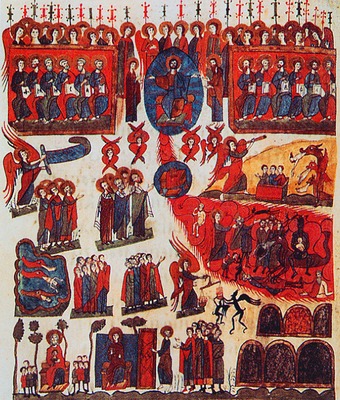
The Last Judgment
Miniature from the Gospel
16-17c.
7
posted on
10/24/2025 3:49:46 PM PDT
by
annalex
(fear them not)
To: annalex
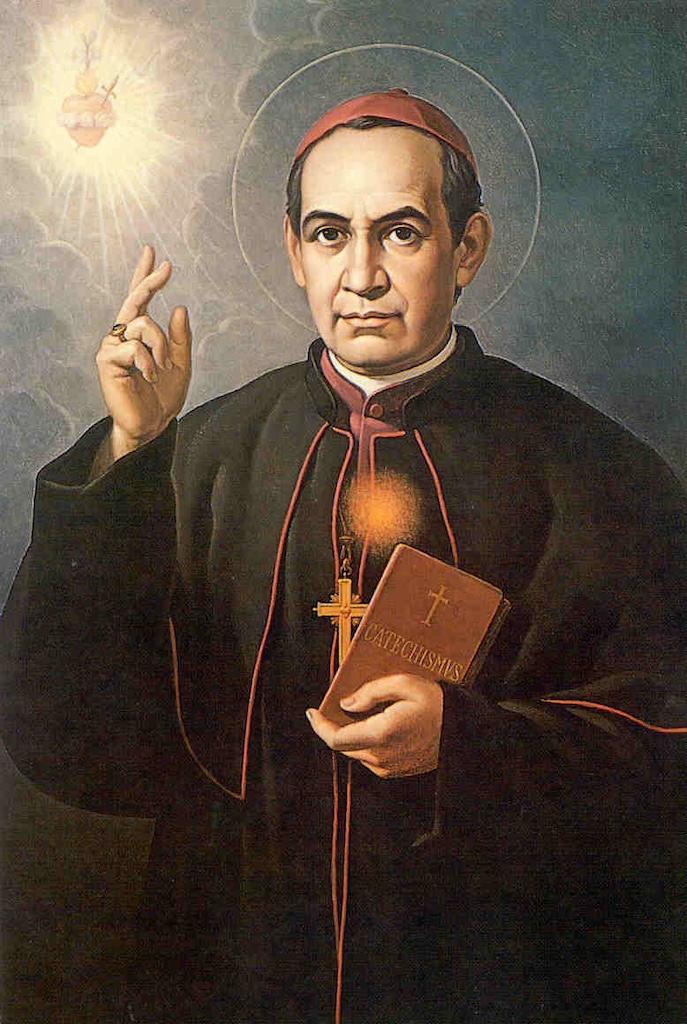
October 24: Saint Anthony Mary Claret
The Zeal of a Shepherd for His Flock
A tireless missionary, promoter of Christian culture and defender of justice, capable of uniting contemplation and action at every stage of his intense life — this was Saint Anthony Mary Claret. He was born on December 23, 1807 in Sallent, a small town near Barcelona, into a family working in the textile trade. His home was profoundly Christian and spirituality was as natural there as the air they breathed.
From an early age, Anthony showed a marked religious inclination: he was drawn to prayer, felt compassion for those who suffered, and reflected deeply on the meaning of life and eternal salvation. This sensitivity was strengthened by the hardships of his time — wars, insecurity and family sorrows shaped in him a firm and resolute spirit.
At twelve, he felt in his heart the desire to become a priest but the political and social turmoil of the era obstructed his first steps. His school was closed and Anthony was forced to work alongside his father at the family looms. Later, he moved to Barcelona to pursue technical studies in the textile field where he showed both talent and discipline. However, the pursuit of success began to draw him away from the simple faith of his childhood. Only a series of traumatic experiences — a friend’s betrayal, a moral temptation and a near-death experience by drowning — led him to reflect once again on the deeper meaning of life.
It was then that the Gospel struck him profoundly: the verse asking, “What does it profit a man to gain the whole world, if he loses his own soul?” made him reconsider every choice. He decided to leave everything behind and follow the path of religious life. He began his studies in Vic, intending to become a Carthusian monk, but poor health forced him to abandon that plan. He remained in the seminary, however, where he continued his studies and faced severe spiritual trials — overcome through prayer and devotion to the Virgin Mary.
He was ordained a priest in 1835 and began his ministry in his hometown. Yet the call to mission was too strong to keep him confined to a parish. He began traveling from village to village, preaching the Gospel with simplicity, walking on foot, refusing money, carrying only a Bible and a small bundle. His humble and direct style touched hearts and he soon became renowned as a preacher. He founded a publishing house to distribute inexpensive religious texts and produced catechetical works for children, youth, families, and priests. He also promoted ongoing religious formation and established confraternities to sustain the spiritual life of communities.
In 1849, he founded the Congregation of the Missionary Sons of the Immaculate Heart of Mary, giving concrete form to his apostolic spirit. Only a few months later, he was appointed Archbishop of Santiago de Cuba — a land marked by grave injustices, slavery and moral decay. During the six years of his episcopal ministry on the island, he visited every corner of the diocese multiple times, promoted popular missions, fought against the slave trade, established schools and social works, introduced religious communities, and, together with Mother Antonia Paris, founded a women’s institute. He suffered persecution and even survived an assassination attempt but never lost courage.
Upon returning to Spain in 1857, Queen Isabella II, struck by his spiritual charisma and moral authority, asked Anthony Mary Claret to become her personal confessor. This appointment required him to move to the capital, where he regularly attended court to provide spiritual guidance to the queen and to oversee the religious education of the young Prince Alfonso and the princesses. Despite the prestige of his position, Claret lived austerely and simply, faithful to his poor and detached lifestyle.
Nevertheless, life at court neither satisfied him humanly nor spiritually. He felt that his apostolic zeal could not be confined within palace walls. With his usual fervor, he also devoted himself to evangelization in Madrid — preaching, hearing confessions, visiting the sick in hospitals and ministering to prisoners. During official journeys with the royal family, he seized every opportunity to preach wherever he went, bringing the Gospel to every corner of Spain.
Committed to promoting Christian culture, he founded and supported the Academy of St. Michael — an ambitious project bringing together artists, scientists, and thinkers with the aim of uniting faith, art, and knowledge. Its purpose was to counter harmful ideologies, spread truth and promote good reading to form consciences.
In 1859, the Queen appointed him protector of the church and hospital of Montserrat, and president of the renowned monastery of El Escorial. In this role, he demonstrated extraordinary organizational ability: he restored the entire complex, enriched it with new sacred furnishings and revitalized it as a center of education — establishing a religious community, an interdiocesan seminary, a school for students, and even the first courses of a university.
One of his deepest desires was to see a living and renewed Church. For this, he worked to promote capable and fervent bishops, actively supported consecrated life, and cared for both the congregations he founded — the Missionary Sons of the Immaculate Heart of Mary and the Claretian Sisters — and many other religious communities struggling for recognition.
Although he stayed away from partisan politics, his public role and influence made him a target of criticism and attacks. His prudent choices did not spare him from suspicion and slander. He himself once admitted that, despite avoiding favoritism, he was still wounded by gossip and calumny. His profound union with Christ reached its summit in a mystical experience: on August 26, 1861, at the royal estate of La Granja in Segovia, he received the extraordinary gift of the preservation of the Eucharistic spirit in his heart.
After the revolution of 1868, Claret was forced to leave Spain with the deposed queen. During exile in Paris, he continued his ministry — offering spiritual assistance to the royal family, promoting the Conferences of the Holy Family and dedicating himself to Spanish immigrants and the poor.
In 1869, he went to Rome for the priestly jubilee of Pope Pius IX and to participate in the preparatory work for the First Vatican Council. During the Council, he ardently defended the doctrine of papal infallibility. But his health was failing and he felt the end approaching. Leaving Rome, he retired to Prades in southern France, where some exiled Claretian missionaries had settled.
Soon he learned that his enemies had obtained an arrest warrant to bring him back to Spain for trial. To escape capture, he had to leave Prades and take refuge in the Cistercian monastery of Fontfroide, near Narbonne. In that quiet and hidden place, surrounded by the affection of the monks and a few disciples, he peacefully passed away on October 24, 1870 at the age of sixty-two.
In 1897, his remains were brought back to Vic. He was beatified by Pope Pius XI in 1934 and canonized by Pius XII in 1950.
vaticanstate.va
8
posted on
10/24/2025 3:52:47 PM PDT
by
annalex
(fear them not)
To: annalex
9
posted on
10/24/2025 3:54:07 PM PDT
by
annalex
(fear them not)
To: annalex
NAVARRE BIBLE COMMENTARY(RSV)
Ad Majorem Dei Gloriam (To the Greater Glory of God)
First Reading:
From: Romans 7:18-25b
Interior Struggle
-----------------
[18] For I know that nothing good dwells within me, that is, in my flesh. I can will what is right, but I cannot do it. [19] For I do not do the good I want, but the evil I do not want is what I do. [20] Now if I do what I do not want, it is no longer I that do it, but sin which dwells within me.
[21] So I find it to be a law that when I want to do right, evil lies close at hand. [22] For I delight in the law of God, in my inmost self, [23] but I see in my members another law at war with the law of my mind and making me captive to the law of sin which dwells in my members. [24] Wretched man that I am! Who will deliver me from this body of death? [25b] Thanks be to God through Jesus Christ our Lord!
***********************************************************************
Commentary:
14-25. As can be seen from the use of the present tense, the "I" in vv.14-25 is no longer Paul before his conversion, but rather after it: and it also stands for all mankind redeemed by Christ's grace. Here we have a vivid description of the interior struggle which everyone experiences, Christians included. These words are in line with something we are all well aware of: in our bodies there is a "law", an inclination, which fights against the law of our spirit (cf. v. 23), that is, against the spiritual good which God's grace causes us to desire. The very expression "the law of sin which dwells in my members" emphasizes how strenuously our senses, appetites and passions try to reject the dictates of the spirit; however, the spirit can gain the upper hand. The Church's teaching is that Baptism does not take away a person's inclination to sin ("fomes peccati"), concupiscence: he or she still experiences a strong desire for earthly or sensual pleasure. "Since it [concupiscence] is left to provide a trial, it has no power to injure those who do not consent and who, by the grace of Christ Jesus, manfully resist" (Council of Trent, "De Peccato Originali", can. 5).
The Jews were able to keep the Law of Moses only through the help of divine grace granted them in anticipation of the merits of Christ. Without grace they were like slaves, "sold-under sin" (v. 14). After Christ, a person who rejects the Redemption is in a similar position, for "in the state of corrupt nature man needs grace to heal his nature and enable him to avoid sin entirely. In this present life this healing is brought about in his mind [the spiritual part of man]: the carnal appetite is not completely healed. Hence the Apostle (Rom 7:25) says of the person healed by grace, 'I serve the law of God with my mind, but with my flesh I serve the law of sin'. In this state a person can avoid mortal sin [...] but he cannot avoid all venial sin, due to the corruption of his sensual appetite" (St Thomas Aquinas, "Summa Theologiae", I-II, q. 109, a. 8).
Hence our need for God's help if we are to persevere in virtue; hence also our need to make a genuine personal effort to be faithful. The "St Pius V Catechism", when dealing with the fact that even after Baptism man is subject to various disabilities, including concupiscence, explains that God has willed that death and suffering, which originate in sin, remain part of our lot, thereby enabling us to attain mystical and real union with Christ, who chose to undergo suffering and death; and, likewise, we still have concupiscence, and experience bodily weakness etc. "that in them we may have the seed and material of virtue a which we shall hereafter receive a more abundant harvest of glory and more ample rewards" (II, 2, 48). "'Infelix ego homo!, quis me liberabit de corpore mortis huius? Unhappy man that I am! Who will deliver me from this body of death?' The cry is Saint Paul's--Courage: he too had to fight" (St J. Escriva, "The Way", 138).
10
posted on
10/24/2025 5:34:10 PM PDT
by
fidelis
(Ecce Crucem Domini! Fugite partes adversae! Vicit Leo de tribu Juda, Radix David! Alleluia!)
Gospel Reading: From: Luke 12:54-59
The Coming of Christ
--------------------
[54] He (Jesus) also said to the multitudes, "When you see a cloud rising in the west, you say at once, `A shower is coming'; and so it happens. [55] And when you see the south wind blowing, you say, `There will be scorching heat'; and it happens. [56] You hypocrites! You know how to interpret the appearances of earth and sky; but why do you not know how to interpret the present time?"
[57] "And why do you not judge for yourselves what is right? [58] As you go with your accuser before the magistrate, make an effort to settle with him on the way, lest he drag you to the judge, and the judge hand you over to the officer, and the officer put you in prison. [59] I tell you, you will never get out till you have paid the very last copper."
***********************************************************************
Commentary:
56. Jesus' listeners knew from experience how to forecast the weather. However, although they knew the signs of the Messiah's coming announced by the prophets, and were hearing His preaching and witnessing His miracles, they did not want to draw the logical conclusion; they lacked the necessary good will and upright intention, and they just closed their eyes to the light of the Gospel (cf. Romans 1:18ff).
This attitude is also found to be very widespread in our own time, in forms of certain kinds of atheism denounced by the Second Vatican Council: "Those who willfully try to drive God from their heart and to avoid all questions about religion, not following the biddings of their conscience, are not free from blame" ("Gaudium Et Spes", 19).
11
posted on
10/24/2025 5:34:27 PM PDT
by
fidelis
(Ecce Crucem Domini! Fugite partes adversae! Vicit Leo de tribu Juda, Radix David! Alleluia!)
12
posted on
10/24/2025 5:35:28 PM PDT
by
fidelis
(Ecce Crucem Domini! Fugite partes adversae! Vicit Leo de tribu Juda, Radix David! Alleluia!)
Disclaimer:
Opinions posted on Free Republic are those of the individual
posters and do not necessarily represent the opinion of Free Republic or its
management. All materials posted herein are protected by copyright law and the
exemption for fair use of copyrighted works.
FreeRepublic.com is powered by software copyright 2000-2008 John Robinson