Skip to comments.
Catholic Caucus: Daily Mass Readings 21-October-2025
Universalis/Jerusalem Bible ^
Posted on 10/21/2025 4:19:57 AM PDT by annalex
21 October 2025
Tuesday of week 29 in Ordinary Time
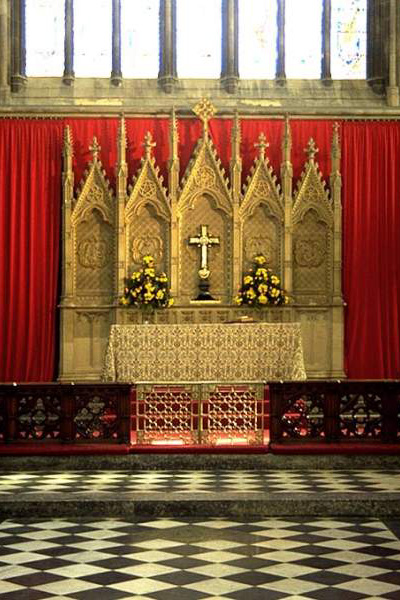
Bridlington Priory Church, Bridlington, East YorkshireReadings at MassLiturgical Colour: Green. Year: C(I).
| First reading |
|---|
| Romans 5:12,15,17-21 |
|---|
Divine grace, coming through Jesus Christ, came as an abundant free giftSin entered the world through one man, and through sin death, and thus death has spread through the whole human race because everyone has sinned; but the gift itself considerably outweighed the fall. If it is certain that through one man’s fall so many died, it is even more certain that divine grace, coming through the one man, Jesus Christ, came to so many as an abundant free gift. If it is certain that death reigned over everyone as the consequence of one man’s fall, it is even more certain that one man, Jesus Christ, will cause everyone to reign in life who receives the free gift that he does not deserve, of being made righteous. Again, as one man’s fall brought condemnation on everyone, so the good act of one man brings everyone life and makes them justified. As by one man’s disobedience many were made sinners, so by one man’s obedience many will be made righteous. When law came, it was to multiply the opportunities of failing, but however great the number of sins committed, grace was even greater; and so, just as sin reigned wherever there was death, so grace will reign to bring eternal life thanks to the righteousness that comes through Jesus Christ our Lord.
| Responsorial Psalm |
|---|
| Psalm 39(40):7-10,17 |
|---|
Here I am, Lord! I come to do your will. You do not ask for sacrifice and offerings, but an open ear. You do not ask for holocaust and victim. Instead, here am I. Here I am, Lord! I come to do your will. In the scroll of the book it stands written that I should do your will. My God, I delight in your law in the depth of my heart. Here I am, Lord! I come to do your will. Your justice I have proclaimed in the great assembly. My lips I have not sealed; you know it, O Lord. Here I am, Lord! I come to do your will. O let there be rejoicing and gladness for all who seek you. Let them ever say: ‘The Lord is great’, who love your saving help. Here I am, Lord! I come to do your will.
| Gospel Acclamation | cf.Lk8:15 |
|---|
Alleluia, alleluia! Blessed are those who, with a noble and generous heart, take the word of God to themselves and yield a harvest through their perseverance. Alleluia! Alleluia, alleluia! Stay awake, praying at all times for the strength to stand with confidence before the Son of Man. Alleluia!
Be dressed for action and have your lamps litJesus said to his disciples: ‘See that you are dressed for action and have your lamps lit. Be like men waiting for their master to return from the wedding feast, ready to open the door as soon as he comes and knocks. Happy those servants whom the master finds awake when he comes. I tell you solemnly, he will put on an apron, sit them down at table and wait on them. It may be in the second watch he comes, or in the third, but happy those servants if he finds them ready.’ You can also view this page with the New Testament in Greek and English. Christian Art Each day, The Christian Art website gives a picture and reflection on the Gospel of the day. The readings on this page are from the Jerusalem Bible, which is used at Mass in most of the English-speaking world. The New American Bible readings, which are used at Mass in the United States, are available in the Universalis apps, programs and downloads.
You can also view this page with the Gospel in Greek and English. |
TOPICS: Catholic; General Discusssion; Prayer; Worship
KEYWORDS: catholic; lk12; ordinarytime; prayer
For your reading, reflection, faith-sharing, comments, questions, discussion.
1
posted on
10/21/2025 4:19:57 AM PDT
by
annalex
To: All
KEYWORDS: catholic; lk12; ordinarytime; prayer
2
posted on
10/21/2025 4:20:31 AM PDT
by
annalex
(fear them not)
To: nickcarraway; NYer; ELS; Pyro7480; livius; ArrogantBustard; Catholicguy; RobbyS; marshmallow; ...

Alleluia Ping Please FReepmail me to get on/off the Alleluia Ping List.
3
posted on
10/21/2025 4:21:28 AM PDT
by
annalex
(fear them not)
To: annalex
4
posted on
10/21/2025 4:21:53 AM PDT
by
annalex
(fear them not)
To: annalex
| Luke |
| | English: Douay-Rheims | Latin: Vulgata Clementina | Greek NT: Byzantine/Majority Text (2000) |
| | Luke 12
|
| 35. | Let your loins be girt, and lamps burning in your hands. | Sint lumbi vestri præcincti, et lucernæ ardentes in manibus vestris, | εστωσαν υμων αι οσφυες περιεζωσμεναι και οι λυχνοι καιομενοι |
| 36. | And you yourselves like to men who wait for their lord, when he shall return from the wedding; that when he cometh and knocketh, they may open to him immediately. | et vos similes hominibus exspectantibus dominum suum quando revertatur a nuptiis : ut, cum venerit et pulsaverit, confestim aperiant ei. | και υμεις ομοιοι ανθρωποις προσδεχομενοις τον κυριον εαυτων ποτε αναλυση εκ των γαμων ινα ελθοντος και κρουσαντος ευθεως ανοιξωσιν αυτω |
| 37. | Blessed are those servants, whom the Lord when he cometh, shall find watching. Amen I say to you, that he will gird himself, and make them sit down to meat, and passing will minister unto them. | Beati servi illi quos, cum venerit dominus, invenerit vigilantes : amen dico vobis, quod præcinget se, et faciet illos discumbere, et transiens ministrabit illis. | μακαριοι οι δουλοι εκεινοι ους ελθων ο κυριος ευρησει γρηγορουντας αμην λεγω υμιν οτι περιζωσεται και ανακλινει αυτους και παρελθων διακονησει αυτοις |
| 38. | And if he shall come in the second watch, or come in the third watch, and find them so, blessed are those servants. | Et si venerit in secunda vigilia, et si in tertia vigilia venerit, et ita invenerit, beati sunt servi illi. | και εαν ελθη εν τη δευτερα φυλακη και εν τη τριτη φυλακη ελθη και ευρη ουτως μακαριοι εισιν οι δουλοι εκεινοι |
5
posted on
10/21/2025 4:24:31 AM PDT
by
annalex
(fear them not)
To: annalex

Catena Aurea by St. Thomas Aguinas
12:3540
35. Let your loins be girded about, and your lights burning;
36. And ye yourselves like unto men that wait for their lord, when he will return from the wedding; that when he cometh and knocketh, they may open unto him immediately.
37. Blessed are those servants, whom the lord when he cometh shall find watching: verily I say unto you, that he shall gird himself, and make them to sit down to meat, and will come forth and serve them.
38. And if he shall come in the second watch, or in the third watch, and find them so, blessed are those servants.
39. And this know, that if the goodman of the house had known what hour the thief would come, he would have watched, and not have suffered his house to be broken through.
40. Be ye therefore ready also: for the Son of man cometh at an hour when ye think not.
THEOPHYLACT. Our Lord having taught His disciples moderation, taking from them all care and conceit of this life, now leads them on to serve and obey, saying, Let your loins be girded, that is, always ready to do the work of your Lord, and your lamps burning, that is, do not lead a life in darkness, but have with you the light of reason, shewing you what to do and what to avoid. For this world is the night, but they have their loins girded, who follow a practical or active life. For such is the condition of servants who must have with them also lamps burning; that is, the gift of discernment, that the active man may be able to distinguish not only what he ought to do, but in what way; otherwise men rush down the precipice of pride. But we must observe, that He first orders our loins to be girded, secondly, our lamps to be burning. For first indeed comes action, then reflection, which is an enlightening of the mind. Let us then strive to exercise the virtues, that we may have two lamps burning, that is, the conception of the mind ever shining forth in the soul, by which we are ourselves enlightened, and learning, whereby we enlighten others.
MAXIMUS. Or, he teaches us to keep our lamps burning, by prayer and contemplation and spiritual love.
CYRIL OF ALEXANDRIA. Or, to be girded, signifies activity and readiness to undergo evils from regard to Divine love. But the burning of the lamp signifies that we should not suffer any to live in the darkness of ignorance.
GREGORY. (Hom. 13. in Evang.) Or else, we gird our loins when by continence we control the lusts of the flesh. For the lust of men is in their loins, and of women in their womb; by the name of loins, therefore, from the principal sex, lust is signified. But because it is a small thing not to do evil, unless also men strive to labour in good works, it is added, And your lamps burning in your hands; for we hold burning lamps in our hands, when by good works we shew forth bright examples to our neighbours.
AUGUSTINE. (de Qu. Ev. lib. ii. q. 25.) Or, He teaches us also to gird our loins for the sake of keeping ourselves from the love of the things of this world, and to have our lamps burning, that this thing may be done with a true end and right intention.
GREGORY. (ubi sup.) But if a man has both of these, whosoever he be, nothing remains for him but that he should place his whole expectation on the coming of the Redeemer. Therefore it is added, And be ye like to men that wait for their Lord, when he will return from the wedding, &c. For our Lord went to the wedding, when ascending up into heaven as the Bridegroom He joined to Himself the heavenly multitude of angels.
THEOPHYLACT. Daily also in the heavens He betroths the souls of the Saints, whom Paul or another offers to Him, as a chaste virgin. (2 Cor 11:2.) But He returns from the celebration of the heavenly marriage, perhaps to all at the end of the whole world, when He shall come from heaven in the glory of the Father; perhaps also every hour standing suddenly present at the death of each individual.
CYRIL OF ALEXANDRIA. Now consider that He comes from the wedding as from a festival, which God is ever keeping; for nothing can cause sadness to the Incorruptible Nature.
GREGORY OF NYSSA. (Hom. 11. in Cant..) Or else, when the wedding was celebrated and the Church received into the secret bridal chamber, the angels were expecting the return of the King to His own natural blessedness. And after their example we order our life, that as they living together without evil, are prepared to welcome their Lords return, so we also, keeping watch at the door, should make ourselves ready to obey Him when He comes knocking; for it follows, that when he cometh and knocketh, they may open to him immediately.
GREGORY. (ubi sup.) For He comes when He hastens to judgment, but He knocks, when already by the pain of sickness He denotes that death is at hand; to whom we immediately open if we receive Him with love. For he who trembles to depart from the body, has no wish to open to the Judge knocking, and dreads to see that Judge whom he remembers to have despised. But he who rests secure concerning his hope and works, immediately opens to Him that knocks; for when he is aware of the time of death drawing near, he grows joyful, because of the glory of his reward; and hence it is added, Blessed are the servants whom the Lord when he cometh shall find watching. He watches who keeps the eyes of his mind open to behold the true light; who by his works maintains that which he beholds, who drives from himself the darkness of sloth and carelessness.
GREGORY OF NYSSA. (ubi sup.) For the sake then of keeping watch, our Lord advised above that our loins should be girded, and our lamps burning, for light when placed before the eyes drives away sleep. The loins also when tied with a girdle, make the body incapable of sleep. For he who is girt about with chastity, and illuminated by a pure conscience, continues wakeful.
CYRIL OF ALEXANDRIA. When then our Lord coming shall find us awake and girded, having our hearts enlightened, He will then pronounce us blessed, for it follows, Verily I say unto you, that he shall gird himself; from which we perceive that He will recompense us in like manner, seeing that He will gird Himself with those that are girded. (Isa. 11:5.)
ORIGEN. For He will be girded about His loins with righteousness.
GREGORY. (Hom. 13. in Ev.) By which He girds Himself, that is, prepares for judgment.
THEOPHYLACT. Or, He will gird Himself, in that He imparts not the whole fulness of blessings, but confines it within a certain measure. For who can comprehend God how great He is? Therefore are the Seraphims said to veil their countenance, because of the excellence of the Divine brightness. It follows, and will make them to sit down; for as a man sitting down causes his whole body to rest, so in the future coming the Saints will have complete rest; for here they have not rest for the body, but there together with their souls their spiritual bodies partaking of immortality will rejoice in perfect rest.
CYRIL OF ALEXANDRIA. He will then make them to sit down as a refreshment to the weary, setting before them spiritual enjoyments, and ordering a sumptuous table of His gifts.
PSEUDO-DIONYSIUS. (Dion. in Ep. ad Tit.) The sitting down is taken to be the repose from many labours, a life without annoyance, the divine conversation of those that dwell in the region of light enriched with all holy affections, and an abundant pouring forth of all gifts, whereby they are filled with joy. For the reason why Jesus makes them to sit down, is that He might give them perpetual rest, and distribute to them blessings without number. Therefore it follows, And will pass over (transiens) and serve them.
THEOPHYLACT. That is, Give back to them, as it were, an equal return, that as they served Him, so also He will serve them.
GREGORY. (Hom. 13. in Ev.) But He is said to be passing over, when He returns from the judgment to His kingdom. Or the Lord passes to us after the judgment, and raises us from the form of His humanity to a contemplation of His divinity.
CYRIL OF ALEXANDRIA. Our Lord knew the proneness of human infirmity to sin, but because He is merciful, He docs not allow us to despair, but rather has compassion, and gives us repentance as a saving remedy. And therefore He adds, And if he shall come in the second watch, &c. For they who keep watch on the walls of cities, or observe the attacks of the enemy, divide the night into three or four watches.
GREGORY. (ubi sup.) The first watch then is the earliest time of our life, that is, childhood, the second youth and manhood, but the third represents old age. He then who is unwilling to watch in the first, let him keep even the second. And he who is unwilling in the second, let him not lose the remedies of the third watch, that he who has neglected conversion in childhood, may at least in the time of youth or old age recover himself.
CYRIL OF ALEXANDRIA. Of the first watch, however, he makes no mention, for childhood is not punished by God, but obtains pardon; but the second and third age owe obedience to God, and the leading of an honest life according to His will.
GREEK EXPOSITOR. (Severus.) Or, to the first watch belong those who live more carefully, as having gained the first step, but to the second, those who keep the measure of a moderate conversation, but to the third, those who are below these. And the same must be supposed of the fourth, and if it should so happen also of the fifth. For there are different measures of life, and a good rewarder metes out to every man according to his deserts.
THEOPHYLACT. Or since the watches are the hours of the night which lull men to sleep, you must understand that there are also in our life certain hours which make us happy if we are found awake. Does any one seize your goods? Are your children dead? Are you accused? But if at these times you have done nothing against the commandments of God, He will find you watching in the second and third watch, that is, at the evil time, which brings destructive sleep to idle souls.
GREGORY. (ubi sup.) But to shake off the sloth of our minds, even our external losses are by a similitude set before us. For it is added, And this know, that if the goodman of the house had known what hour the thief would come.
THEOPHYLACT. Some understand this thief to be the devil, the house, the soul, the goodman of the house, man. This interpretation, however, does not seem to agree with what follows. For the Lords coming is compared to the thief as suddenly at hand, according to the word of the Apostle, The day of the Lord so cometh as a thief in the night. (1 Thess. 5:2.) And hence also it is here added, Be ye also ready, for the Son of man cometh at an hour when ye think not.
GREGORY. (Hom. 13. in Ev.) Or else; unknown to the master the thief breaks into the house, because while the spirit sleeps instead of guarding itself, death comes unexpectedly, and breaks into the dwelling place of our flesh. But he would resist the thief if he were watching, because being on his guard against the coming of the Judge, who secretly seizes his soul, he would by repentance go to meet Him, lest he should perish impenitent. But the last hour our Lord wishes to be unknown to us, in order as we cannot foresee it, we may be unceasingly preparing for it.
Catena Aurea Luke 12
6
posted on
10/21/2025 4:26:03 AM PDT
by
annalex
(fear them not)
To: annalex
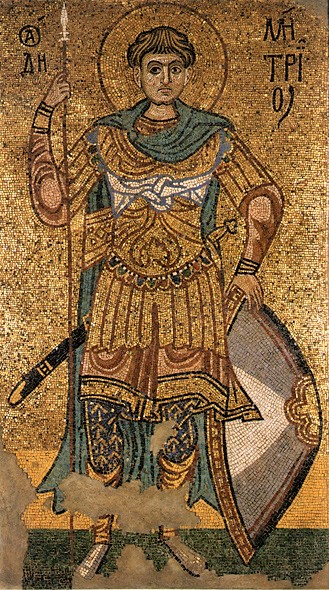
St. Demetrius of Salonica
12th-century
Tretyakov Gallery, Moscow
7
posted on
10/21/2025 4:26:29 AM PDT
by
annalex
(fear them not)
To: annalex
John Twenge
presbyter
John Twenge is an English saint of the 14th century Career
John was schooled in the village from the age of five, before completing his studies at Oxford. He then entered the Augustinian Canons Regular community of Priory of Bridlington. He carried out his duties with humility and diligence, and was in turn novice master, almsgiver, preacher and sub-prior.
He became Canon of the Priory in 1346 and was eventually elected Prior in 1356.
John initially declined out of humility, but after being re-elected, probably in 1361, that he took on the duties of Prior in January 1362. He served as Prior for 17 years before his death on 10 October 1379.
In his lifetime he enjoyed a reputation for great holiness and for miraculous powers. Reputedly on one occasion he changed water into wine.
On another, five seamen from Hartlepool in danger of shipwreck called upon God in the name of His servant, John of Bridlington, whereupon the prior himself appeared to them in his canonical habit and brought them safely to shore.
The men left their vessel at the harbour and walked to the Monastery where they thanked John in person for saving their lives. After his death from natural causes the fame of the supposed miracles wrought by his intercession spread rapidly through the land. Archbishop of York Neville charged his suffragans and others to take evidence with a view to his canonisation, 26 July 1386.
Richard Scrope, Archbishop of York 1398-1405, assisted by the Bishops of Durham and Carlisle Cathedrals, officiated at a solemn translation of his body, 11 March 1404, de mandato Domini Papae.
This pope, Boniface IX, shortly afterwards canonised him. The fact has been doubted and disputed.
But the original Bulletin was unearthed in the Vatican archives by Mr. T.A. Twemlow, who was engaged in research work there for the British government.
At the English Reformation Henry VIII was asked to spare the magnificent shrine of the saint, but in vain.
lieutenant was destroyed in 1537. The nave of the church, restored in 1857, is all that now remains of Bridlington Priory. The saint"s feast is observed by the canons regular on 9 October.
Street John of Bridlington was commended for the integrity of his life, his scholarship, and his quiet generosity.
He was the last English saint to be canonised before the English Reformation. King Henry V attributed his victory at Agincourt to the intercession in heaven of this Saint John and of Saint John of Beverley.
Women in difficult labour may pray to Street John of Bridlington as their patron saint and he is also associated with the local fishing industry. At All Saints Church Thwing, there is a window showing Street John of Bridlington and Street Cecilia.
There is a Street John Street in Bridlington named after him, an old thoroughfare linking the "Old Town" that grew up around Bridlington Priory with the quayside community of fishermen and traders.
At the church of Street Andrew, Hempstead, a wooden panel showing John of Bridlington depicts him holding a fish, and in episcopal robes, though he never served as bishop.
prabook.com
8
posted on
10/21/2025 4:33:37 AM PDT
by
annalex
(fear them not)
To: annalex
9
posted on
10/21/2025 4:36:07 AM PDT
by
annalex
(fear them not)
To: annalex
NAVARRE BIBLE COMMENTARY(RSV)
Ad Majorem Dei Gloriam (To the Greater Glory of God)
First Reading:
From: Romans 5:12-21
Adam's Original Sin
-------------------
[12] Therefore as sin came into the world through one man and death through sin, and so death spread to all men because all men sinned-- [13] sin indeed was in the world before the law was given, but sin is not counted where there is no law. [14] Yet death reigned from Adam to Moses, even over those whose sins were not like the transgressions of Adam, who was a type of the One who was to come.
[15] But the free gift is not like the trespass. For if many died through one man's trespass, much more have the grace of God and the free gift in the grace of that one man Jesus Christ abounded for many. [16] And the free gift is not like the effect of that one man's sin. For the judgment following one trespass brought condemnation, but the free gift following many trespasses brings justification. [17] If, because of one man's trespass, death reigned through that one man, much more will those who receive the abundance of grace and the free gift of righteousness reign in life through the one man Jesus Christ.
[18] Then as one man's trespass led to condemnation for all men, so one man's act of righteousness leads to acquittal and life for all men. [19] For as by one man's disobedience many were made sinners, so by One Man's obedience many will be made righteous. [20] Law came in, to increase the trespass; but where sin increased, grace abounded all the more, [21] so that, as sin reigned in death, grace also might reign through righteousness to eternal life through Jesus Christ our Lord.
************************************************************************
Commentary:
12-21. Four important teachings are discernible in this passage: 1) Adam's sin and its consequences, which include, particular death (verses 12-14); 2) the contrast between the effects of Original Sin and those of the Redemption wrought by Christ (verses 15-19); 3) the role of the Law of Moses in relation to sin (especially verses 13, 20), anticipating what is explained more elaborately in Chapter 7; 4) the final victory of the reign of grace (verses 20-21). These teachings are closely connected by one single idea: only Jesus Christ can justify us and bring us to salvation. The Apostle refers to Adam as a "type of the One who was to come", that is, Jesus, the Messiah, who is the true head of the human race; and he also stresses that Christ, by His obedience and submission to the Father's will, counters the disobedience and rebellion of Adam, restoring to us--superabundantly--the happiness and eternal life which we lost through the sin of our First Parents.
Here we can see the clash of the two kingdoms--the kingdom of sin and death and the kingdom of righteousness and grace. These two kingdoms were established, the first by Adam and the second by Christ, and spread to all mankind.
Because the superabundance of Christ's grace is the more important factor, Adam's sin is referred to in no great detail. St. Paul takes it as something everyone is familiar with. All Christians have read about or been told about the account of the Fall in Genesis (Genesis 3) and they are familiar with many passages in Sacred Scripture which confirm and explain something which is self-evident--that all men are mortal and that the human race is subject to a whole series of afflictions (cf. Sirach 25:33; Wisdom 2:23-24; Psalm 51:7; Job 14:4; Genesis 8:21; etc.)
12-14. This passage can be elaborated on as follows: just as sin entered the world through the action of a single individual man, so righteousness is attained for us by one man--Jesus Christ. Adam, the first man, is a type of the "new Adam": Adam contained within himself all mankind, his offspring; the "new Adam" is "the first-born of all creation" and "the head of the body, the Church" (Colossians 1:15, 18) because He is the redeeming Word Incarnate. To Adam we are linked by flesh and blood, to Christ by faith and the Sacraments.
When, in His infinite goodness, He raised Adam to share in the divine life, God also decreed that our First Parent would pass on to us his human nature and with it all the various gifts that perfected it and the grace that sanctified it. But Adam committed a sin by breaking God's commandment and as a result he immediately lost the holiness and righteousness in which he had been installed, and because of this disloyalty he incurred God's wrath and indignation and, as consequence, death--as God had warned him. By becoming mortal and falling under the power of the devil, Adam "was changed for the worse", in both body and soul (cf. Council of Trent, "De Peccato Originali", Canon 1). From then on Adam and his descendants pass on a human nature deprived of supernatural gifts, and men are in a state of enmity with God, which means that they cannot attain eternal beatitude.
The fact of Original Sin is a truth of faith. This has been stated once again solemnly by [Pope] Paul VI: "We believe that in Adam all have sinned. From this it follows that, on account of the original offense committed by him, human nature, which is common to all men, is reduced to that condition in which it must suffer the consequences of that Fall [...]. Consequently, fallen human nature is deprived of the economy of grace which it formerly enjoyed. It is wounded in its natural powers and subjected to the dominion of death which is transmitted to all men. It is in this sense that every man is born in sin. We hold, therefore, in accordance with the Council of Trent, that Original Sin is transmitted along with human nature, "not by imitation but by propagation", and is, therefore, incurred by each person individually" ("Creed of the People of God", 16).
Our own experience bears out what divine Revelation tells us: when we examine our conscience we realize that we have this inclination towards evil and we are conscious of being enmeshed in evils which cannot have their source in our holy Creator (cf. Vatican II, "Gaudium Et Spes", 13). The obvious presence of evil in the world and in ourselves convince us of the profound truth contained in Revelation and moves us to fight against sin. "So much wretchedness! So many offenses! Mine, yours, those of all mankind....
"Et in peccatis concepit me mater mea!" In sin did my mother conceive me! (Psalm 51:5). I, like all men, came into the world stained with the guilt of our First Parents. And then...my own sins: rebellions, thought about, desired, committed....
"To purify us of this rottenness, Jesus chose to humble Himself and take on the form of a slave (cf. Philippians 2:7), becoming incarnate in the spotless womb of our Lady, His Mother, who is also your Mother and mine. He spent thirty years in obscurity, working like everyone else, at Joseph's side. He preached. He worked miracles.... And we repaid Him with a cross.
"Do you need more motives for contrition?" (St. J. Escriva, "The Way of the Cross", IV, 2).
13-14. Both the commandment imposed by God on Adam, and the Mosaic Law, threatened the transgressor with death; but the same cannot be said of the period between Adam and Moses. In that period also people did sin against the natural law written on every person's heart (cf. 2:12ff). However, their sins "were not like the transgression of Adam", because the natural law did not explicitly bind under pain of death. If, nevertheless, they in fact had to die, this proves, the Apostle concludes, that death is due not to personal sins but to Original Sin. It is also proved, the Father of the Church usually add, by the fact that some people die before reaching the use of reason, that is, before they are capable of sinning.
Death is a consequence of Original Sin, because that sin brought with it the loss of the "preternatural" gift of immortality (cf. Genesis 2:17; 3:19). Adam incurred this loss when, through a personal act of his, he broke an explicit, specific command of God. Later, under the Mosaic Law, there were also certain precepts which involved the death penalty if broken (cf., for example, Exodus 21:12ff; Leviticus 24:16). In the period from Adam to Moses there was no law which stated: If you sin, you shall die. However, people in that period were all subject to death, even those who committed no sin "like the transgression of Adam" that is, what is termed "actual sin".
Therefore, death is due to a sin--Original Sin--which attaches to each man, woman and child, yet which is not an "actual sin". This Original Sin is the cause of death, and the fact that everyone dies is the proof that everyone is affected by Original Sin. The Second Vatican Council sums up this teaching as follows: "The Church, taught by divine Revelation, declares that God has created man in view of a blessed destiny that lies beyond the limits of his sad state on earth. Moreover, the Christian faith teaches that bodily death, from which man would have been immune had he not sinned (cf. Wisdom 1:13; 2:23-24; Romans 5:21; 6:23; James 1:15), will be overcome when that wholeness which he lost through his own fault will be given once again to him by the almighty and merciful Savior. For God has called man, and still calls him, to cleave with all his being to Him in sharing forever a life that is divine and free from all decay" ("Gaudium Et Spes", 18).
10
posted on
10/21/2025 10:52:11 AM PDT
by
fidelis
(Ecce Crucem Domini! Fugite partes adversae! Vicit Leo de tribu Juda, Radix David! Alleluia!)
Gospel Reading: From: Luke 12:35-48
The Need for Vigilance and the Parable of the Steward
-----------------------------------------------------
[35] "Let your loins be girded and your lamps burning, [36] and be like men who are waiting for their master to come home from the marriage feast, so that they may open to him at once when he comes and knocks. [37] Blessed are those servants whom the master finds awake when he comes; truly, I say to you, he will gird himself and have them sit at table, and he will come and serve them. [38] If he comes in the second watch, or in the third, and finds them so, blessed are those servants! [39] But know this, that if the householder had known at what hour the thief was coming, he would have been awake and would not have left his house to be broken into. [40] You also must be ready; for the Son of Man is coming at an hour you do not expect."
***********************************************************************
Commentary:
33-34. Our Lord concludes this address by insisting on those imperishable goods to which we should aspire. In this connection the Second Vatican Council concludes its teaching on the universal call to holiness saying: "Therefore all the faithful are invited and obliged to holiness and perfection of their own state of life. Accordingly let all of them see that they direct their affections rightly, lest they be hindered in their pursuit of perfect love by the use of worldly things and by an adherence to riches which is contrary to the spirit of evangelical poverty, following the Apostle's advice: Let those who use this world not fix their abode in it, for the form of this world is passing away (cf. 1 Corinthians 7:31)" ("Lumen Gentium", 42).
"When Holy Scripture refers to the heart, it does not refer to some fleeting sentiment of joy or tears. By heart it means the person who directs his whole being, soul and body, to what he considers his good, as Jesus himself indicated: 'For where your treasure is, there will your heart be also' (Matthew 6:21)" (St. J. Escriva, "Christ Is Passing By", 164). Our Lord's teaching is quite clear: man's heart yearns to possess wealth, a good social position, prestigious public or professional appointments, which he sees as providing him with security, contentment and self-affirmation; however, this kind of treasure involves endless worry and disappointment, because there is always a danger of losing it. Jesus does not mean that man should forget about earthly things, but he does teach us that no created thing should become our "treasure", our main in life: that should be God, our Creator and Lord, whom we should love and serve as we go about our ordinary affairs, putting our hopes on the eternal joy of heaven. See also the note on Matthew 6:19-21.
35-39. In the preaching of Christ and of the Apostles we are frequently exhorted to be watchful (cf. Matthew 24:42; 25:13; Mark 14:34)—for one thing, because the enemy is always on the prowl (cf. 1 Peter 5:8), and also because a person in love is always awake (cf. Song of Songs 5:2). This watchfulness expresses itself in a spirit of prayer (cf. Luke 21:36; 1 Peter 4:7) and fortitude in faith (cf. 1 Corinthians 16:13). See the note on Matthew 25:1-13.
35. To enable them to do certain kinds of work the Jews used to hitch up the flowing garments they normally wore. "Girding your loins" immediately suggests a person getting ready for work, for effort, for a journey etc. (cf. Jeremiah 1:17; Ephesians 6:14; 1 Peter 1:13). Similarly, "having your lamps burning" indicates the sort of attitude a person should have who is on the watch or is waiting for someone's rival.
11
posted on
10/21/2025 10:52:31 AM PDT
by
fidelis
(Ecce Crucem Domini! Fugite partes adversae! Vicit Leo de tribu Juda, Radix David! Alleluia!)
12
posted on
10/21/2025 10:53:13 AM PDT
by
fidelis
(Ecce Crucem Domini! Fugite partes adversae! Vicit Leo de tribu Juda, Radix David! Alleluia!)
Disclaimer:
Opinions posted on Free Republic are those of the individual
posters and do not necessarily represent the opinion of Free Republic or its
management. All materials posted herein are protected by copyright law and the
exemption for fair use of copyrighted works.
FreeRepublic.com is powered by software copyright 2000-2008 John Robinson

