Skip to comments.
Catholic Caucus: Daily Mass Readings xx-October-2025
Universalis/Jerusalem Bible ^
Posted on 10/16/2025 5:03:00 AM PDT by annalex
16 October 2025
Thursday of week 28 in Ordinary Time

Alter of St. Hedwig of Silesia, Assumption church, Zagan, PolandReadings at MassLiturgical Colour: Green. Year: C(I).
| First reading | Romans 3:21-30 |
|---|
It is the same justice of God that comes to Jew and pagan alikeGod’s justice that was made known through the Law and the Prophets has now been revealed outside the Law, since it is the same justice of God that comes through faith to everyone, Jew and pagan alike, who believes in Jesus Christ. Both Jew and pagan sinned and forfeited God’s glory, and both are justified through the free gift of his grace by being redeemed in Christ Jesus who was appointed by God to sacrifice his life so as to win reconciliation through faith. In this way God makes his justice known; first, for the past, when sins went unpunished because he held his hand, then, for the present age, by showing positively that he is just, and that he justifies everyone who believes in Jesus. So what becomes of our boasts? There is no room for them. What sort of law excludes them? The sort of law that tells us what to do? On the contrary, it is the law of faith, since, as we see it, a man is justified by faith and not by doing something the Law tells him to do. Is God the God of Jews alone and not of the pagans too? Of the pagans too, most certainly, since there is only one God.
| Responsorial Psalm |
|---|
| Psalm 129(130):1-6 |
|---|
With the Lord there is mercy, and fullness of redemption. Out of the depths I cry to you, O Lord, Lord, hear my voice! O let your ears be attentive to the voice of my pleading. With the Lord there is mercy, and fullness of redemption. If you, O Lord, should mark our guilt, Lord, who would survive? But with you is found forgiveness: for this we revere you. With the Lord there is mercy, and fullness of redemption. My soul is waiting for the Lord. I count on his word. My soul is longing for the Lord more than watchman for daybreak. With the Lord there is mercy, and fullness of redemption.
| Gospel Acclamation | Ps110:7,8 |
|---|
Alleluia, alleluia! Your precepts, O Lord, are all of them sure; they stand firm for ever and ever. Alleluia! Alleluia, alleluia! I am the Way, the Truth and the Life, says the Lord; No one can come to the Father except through me. Alleluia!
You have not gone in yourselves and have prevented others who wanted toJesus said: ‘Alas for you who build the tombs of the prophets, the men your ancestors killed! In this way you both witness what your ancestors did and approve it; they did the killing, you do the building. ‘And that is why the Wisdom of God said, “I will send them prophets and apostles; some they will slaughter and persecute, so that this generation will have to answer for every prophet’s blood that has been shed since the foundation of the world, from the blood of Abel to the blood of Zechariah, who was murdered between the altar and the sanctuary.” Yes, I tell you, this generation will have to answer for it all. ‘Alas for you lawyers who have taken away the key of knowledge! You have not gone in yourselves, and have prevented others going in who wanted to.’ When he left the house, the scribes and the Pharisees began a furious attack on him and tried to force answers from him on innumerable questions, setting traps to catch him out in something he might say. You can also view this page with the New Testament in Greek and English. Christian Art Each day, The Christian Art website gives a picture and reflection on the Gospel of the day. The readings on this page are from the Jerusalem Bible, which is used at Mass in most of the English-speaking world. The New American Bible readings, which are used at Mass in the United States, are available in the Universalis apps, programs and downloads.
You can also view this page with the Gospel in Greek and English. |
TOPICS: Catholic; General Discusssion; Prayer; Worship
KEYWORDS: catholic; lk11; ordinarytime; prayer
For your reading, reflection, faith-sharing, comments, questions, discussion.
1
posted on
10/16/2025 5:03:01 AM PDT
by
annalex
To: annalex
KEYWORDS: catholic; lk11; ordinarytime; prayer
2
posted on
10/16/2025 5:03:23 AM PDT
by
annalex
(fear them not)
To: nickcarraway; NYer; ELS; Pyro7480; livius; ArrogantBustard; Catholicguy; RobbyS; marshmallow; ...

Alleluia Ping Please FReepmail me to get on/off the Alleluia Ping List.
3
posted on
10/16/2025 5:04:29 AM PDT
by
annalex
(fear them not)
To: annalex
4
posted on
10/16/2025 5:04:51 AM PDT
by
annalex
(fear them not)
To: annalex
| Luke |
| | English: Douay-Rheims | Latin: Vulgata Clementina | Greek NT: Byzantine/Majority Text (2000) |
| | Luke 11
|
| 47. | Woe to you who build the monuments of the prophets: and your fathers killed them. | Væ vobis, qui ædificatis monumenta prophetarum : patres autem vestri occiderunt illos. | ουαι υμιν οτι οικοδομειτε τα μνημεια των προφητων οι δε πατερες υμων απεκτειναν αυτους |
| 48. | Truly you bear witness that you consent to the doings of your fathers: for they indeed killed them, and you build their sepulchres. | Profecto testificamini quod consentitis operibus patrum vestrorum : quoniam ipsi quidem eos occiderunt, vos autem ædificatis eorum sepulchra. | αρα μαρτυρειτε και συνευδοκειτε τοις εργοις των πατερων υμων οτι αυτοι μεν απεκτειναν αυτους υμεις δε οικοδομειτε αυτων τα μνημεια |
| 49. | For this cause also the wisdom of God said: I will send to them prophets and apostles; and some of them they will kill and persecute. | Propterea et sapientia Dei dixit : Mittam ad illos prophetas, et apostolos, et ex illis occident, et persequentur : | δια τουτο και η σοφια του θεου ειπεν αποστελω εις αυτους προφητας και αποστολους και εξ αυτων αποκτενουσιν και εκδιωξουσιν |
| 50. | That the blood of all the prophets which was shed from the foundation of the world, may be required of this generation, | ut inquiratur sanguis omnium prophetarum, qui effusus est a constitutione mundi a generatione ista, | ινα εκζητηθη το αιμα παντων των προφητων το εκχυνομενον απο καταβολης κοσμου απο της γενεας ταυτης |
| 51. | From the blood of Abel unto the blood of Zacharias, who was slain between the alter and the temple: Yea I say to you, It shall be required of this generation. | a sanguine Abel, usque ad sanguinem Zachariæ, qui periit inter altare et ædem. Ita dico vobis, requiretur ab hac generatione. | απο του αιματος αβελ εως του αιματος ζαχαριου του απολομενου μεταξυ του θυσιαστηριου και του οικου ναι λεγω υμιν εκζητηθησεται απο της γενεας ταυτης |
| 52. | Woe to you lawyers, for you have taken away the key of knowledge: you yourselves have not entered in, and those that were entering in, you have hindered. | Væ vobis, legisperitis, quia tulistis clavem scientiæ : ipsi non introistis, et eos qui introibant, prohibuistis. | ουαι υμιν τοις νομικοις οτι ηρατε την κλειδα της γνωσεως αυτοι ουκ εισηλθετε και τους εισερχομενους εκωλυσατε |
| 53. | And as he was saying these things to them, the Pharisees and the lawyers began violently to urge him, and to oppress his mouth about many things, | Cum autem hæc ad illos diceret, cœperunt pharisæi et legisperiti graviter insistere, et os ejus opprimere de multis, | λεγοντος δε αυτου ταυτα προς αυτους ηρξαντο οι γραμματεις και οι φαρισαιοι δεινως ενεχειν και αποστοματιζειν αυτον περι πλειονων |
| 54. | Lying in wait for him, and seeking to catch something from his mouth, that they might accuse him. | insidiantes ei, et quærentes aliquid capere de ore ejus, ut accusarent eum. | ενεδρευοντες αυτον ζητουντες θηρευσαι τι εκ του στοματος αυτου ινα κατηγορησωσιν αυτου |
5
posted on
10/16/2025 5:07:40 AM PDT
by
annalex
(fear them not)
To: annalex

Catena Aurea by St. Thomas Aguinas
11:45–54
45. Then answered one of the Lawyers, and said unto him, Master, thus saying thou reproachest us also.
46. And he said, Woe unto you also, ye Lawyers! for ye lade men with burdens grievous to be borne, and ye yourselves touch not the burdens with one of your fingers.
47. Woe unto you! for ye build the sepulchres of the prophets, and your fathers killed them.
48. Truly ye bear witness that ye allow the deeds of your fathers: for they indeed killed them, and ye build their sepulchres.
49. Therefore also said the wisdom of God, I will send them prophets and apostles, and some of them they shall slay and persecute:
50. That the blood of all the prophets, which was shed from the foundation of the world, may be required of this generation;
51. From the blood of Abel unto the blood of Zacharias, which perished between the altar and the temple: verily I say unto you, It shall be required of this generation.
52. Woe unto you, Lawyers! for ye have taken away the key of knowledge: ye enter not in yourselves, and them that were entering in ye hindered.
53. And as he said these things unto them, the Scribes and Pharisees began to urge him vehemently, and to provoke him to speak of many things:
54. Laying wait for him, and seeking to catch something out of his mouth, that they might accuse him.
CYRIL OF ALEXANDRIA. A reproof which exalts the meek is generally hateful to the proud man. When therefore our Saviour was blaming the Pharisees for transgressing from the right path, the body of Lawyers were struck with consternation. Hence it is said, Then answered one of the Lawyers, and said unto him, Master, thus saying thou reproachest us also.
BEDE. In what a grievous state is that conscience, which hearing the word of God thinks it a reproach against itself, and in the account of the punishment of the wicked perceives its own condemnation.
THEOPHYLACT. Now the Lawyers were different from the Pharisees. For the Pharisees being separated from the rest had the appearance of a religious sect; but those skilled in the Law were the Scribes and Doctors who solved legal questions.
CYRIL OF ALEXANDRIA. But Christ brings a severe charge against the Lawyers, and subdues their foolish pride, as it follows, And he said, Woe unto you also, ye Lawyers, for ye lade men, &c. He brings forward an obvious example for their direction. The Law was burdensome to the Jews as the disciples of Christ confess, but these Lawyers binding together legal burdens which could not be borne, placed them upon those under them, taking care themselves to have no toil whatever.
THEOPHYLACT. As often also as the teacher does what he teaches, he lightens the load, offering himself for an example. But when he does none of the things which he teaches others, the loads appear heavy to those who learn his teaching, as being what even their teacher is not able to bear.
BEDE. Now they are rightly told that they would not touch the burdens of the Law even with one of their fingers, that is, they fulfil not in the slightest point that law which they pretend to keep and transmit to the keeping of others, contrary to the practice of their fathers, without faith and the grace of Christ.
GREGORY OF NYSSA. So also are there now many severe judges of sinners, yet weak combatants; burdensome imposers of laws, yet weak bearers of burdens; who wish neither to approach nor to touch strictness of life, though they sternly exact it from their subjects.
CYRIL OF ALEXANDRIA. Having then condemned the burdensome dealing of the Lawyer, He brings a general charge against all the chief men of the Jews, saying, Woe to you who build the tombs of the prophets, and your fathers killed them.
AMBROSE. This is a good answer to the foolish superstition of the Jews, who in building the tombs of the prophets condemned the deeds of their fathers, but by rivalling their fathers’ wickedness, throw back the sentence upon themselves. For not the building but the imitation of their deeds is looked upon as a crime. Therefore He adds, Truly ye bear witness that ye allow, &c.
BEDE. They pretended indeed, in order to win the favour of the multitude, that they were shocked at the unbelief of their fathers, since by splendidly honouring the memories of the prophets who were slain by them they condemned their deeds. But in their very actions they testify how much they coincide with their fathers’ wickedness, by treating with insult that Lord whom the prophets foretold. Hence it is added, Therefore also said the wisdom of God, I will send them prophets and apostles, and some of them they shall slay and persecute.
AMBROSE. The wisdom of God is Christ. The words indeed in Matthew are, Behold I send unto you prophets and wise men.
BEDE. But if the same Wisdom of God sent prophets and Apostles, let heretics cease to assign to Christ a beginning from the Virgin; let them no longer declare one God of the Law and Prophets, another of the New Testament. For although the Apostolic Scripture often calls by the name of prophets not only those who foretell the coming Incarnation of Christ, but those also who foretell the future joys of the kingdom of heaven, yet I should never suppose that these were to be placed before the Apostles in the order of enumeration.
ATHANASIUS. (Apol. 1. de fuga sua.) Now if they kill, the death of the slain will cry out the louder against them; if they pursue, they send forth memorials of their iniquity, for flight makes the pursuit of the sufferers to redound to the great disgrace of the pursuers. For no one flees from the merciful and gentle, but rather from the cruel and evil-minded man. And therefore it follows, That the blood of all the prophets who have been slain from the foundation of the world may be required of this generation.
BEDE. It is asked, How comes it that the blood of all the prophets and just men is required of the single generation of the Jews; whereas many of the saints, both before the Incarnation and after, have been slain by other nations? But it is the manner of the Scriptures frequently to reckon two generations of men, one of the good, and the other of the evil.
CYRIL OF ALEXANDRIA. Although then He says pointedly of this generation, He expresses not merely those who were then standing by Him and listening, but every manslayer. For like is attributed to like.
CHRYSOSTOM. (Hom. 74. in Matt.) But if He means that the Jews are about to suffer worse things, this will not be undeserved, for they have dared to do worse than all. And they have been corrected by none of their past calamities, but when they saw others sin, and punished, they were not made better, but did likewise; yet it will not be that one shall suffer punishment for the sins of others.
THEOPHYLACT. But our Lord shews that the Jews have inherited the malice of Cain, since he adds, From the blood of Abel, to the blood of Zacharias, &c. Abel, inasmuch as he was slain by Cain; but Zacharias, whom they slew between the temple and the altar, some say was the Zacharias of old time, the son of Jehoiadah the Priest.
BEDE. Why He begins from the blood of Abel, who was the first martyr, we need not wonder; but why, to the blood of Zacharias, is a question, since many were slain after him even up to our Lord’s birth, and soon after His birth the Innocents, unless perhaps it was because Abel was a shepherd, Zacharias a Priest. And the one was killed in the field, the other in the court of the temple, martyrs of each class, that is, under their names are shadowed both laymen, and those engaged in the office of the altar.
GREGORY OF NYSSA. (Orat. in Diem Nat. Christi.) But some say that Zacharias, the father of John, by the spirit of prophecy forecasting the mystery of the immaculate virginity of the mother of God, in no wise separated her from the part of the temple set apart for virgins, wishing to shew that it was in the power of the Creator of all things to manifest a new birth, while he did not deprive the mother of the glory of her virginity. Now this part was between the altar and the temple, in which was placed the brazen altar, where for this reason they slew him. It is said also, that when they heard the King of the world was about to come, from fear of subjection they designedly attacked him who bore witness to His coming, and slew the priest in the temple.
GREEK EXPOSITOR. (Geometer.) But others give another reason for the destruction of Zacharias. For at the murder of the children the blessed John was to be slain with the rest of the same age, but Elisabeth, snatching up her son from the midst of the slaughter, sought the desert. And so when Herod’s soldiers could not find Elisabeth and the child, they turn their wrath against Zacharias, killing him as he was ministering in the temple.
It follows, Woe to you, lawyers, for ye have taken away the key of knowledge.
BASIL. (in Esai. 1.) This word woe, which is uttered with pain intolerable, is suited to those who were shortly after to be cast out into grievous punishment.
CYRIL OF ALEXANDRIA. Now we say, the law itself is the key of knowledge. For it was both a shadow and a figure of the righteousness of Christ, therefore it became the Lawyers, as instructors of the Law of Moses and the words of the Prophets, to reveal in a certain measure to the Jewish people the knowledge of Christ. This they did not, but on the contrary detracted from the divine miracles, and spoke against His teaching, Why hear ye him? So then they took away the key of knowledge. Hence it follows, Ye entered not in yourselves, and them that were entered in ye hindered. But faith also is the key of knowledge. For by faith comes also the knowledge of truth, according to that of Isaiah, Unless ye have believed, ye will not understand. (Isa. 7:9. LXX.) The Lawyers then have taken away the key of knowledge, not permitting men to believe in Christ.
AUGUSTINE. (de qu. Ev. l. ii. q. 23.) But the key of knowledge is also the humility of Christ, which they would neither themselves understand, nor let be understood by others.
AMBROSE. Those also are even now condemned under the name of Jews, and made subject to future punishment, who, while usurping to themselves the teaching of divine knowledge, both hinder others, and do not themselves acknowledge that which they profess.
AUGUSTINE. (de con. Ev. lib. ii. c. 75.) Now all these things Matthew records to have been said after our Lord had come into Jerusalem. But Luke relates them here, when our Lord was yet on His journey to Jerusalem. From which they appear to me to be similar discourses, of which Matthew has given one, Luke the other.
BEDE. But how true were the charges of unbelief, hypocrisy, and impiety, brought against the Pharisees and Lawyers they themselves testify, striving not to repent, but to entrap the Teacher of truth; for it follows, And as he said these things to them, the Pharisees and Lawyers began to urge him vehemently.
CYRIL OF ALEXANDRIA. Now this urging is taken to mean pressing upon Him, or threatening Him, or waxing furious against Him. But they began to interrupt His words in many ways, as it follows, And to force him to speak of many things.
THEOPHYLACT. For when several are questioning a man on different subjects, since he can not reply to all at once, foolish people think he is doubting. This also was part of their wicked design against Him; but they sought also in another way to control His power of speech, namely, by provoking Him to say something by which He might be condemned; whence it follows, Laying in wait for him, and seeking to catch something out of his mouth, that they might accuse him. Having first spoken of “forcing,” Luke now says to catch or seize something from His mouth; at one time indeed they asked Him concerning the Law, that they might convict as a blasphemer Him who accused Moses; but at another time concerning Cæsar, that they might accuse Him as a traitor and rebel against the majesty of Cæsar.
Catena Aurea Luke 11
6
posted on
10/16/2025 5:08:34 AM PDT
by
annalex
(fear them not)
To: annalex
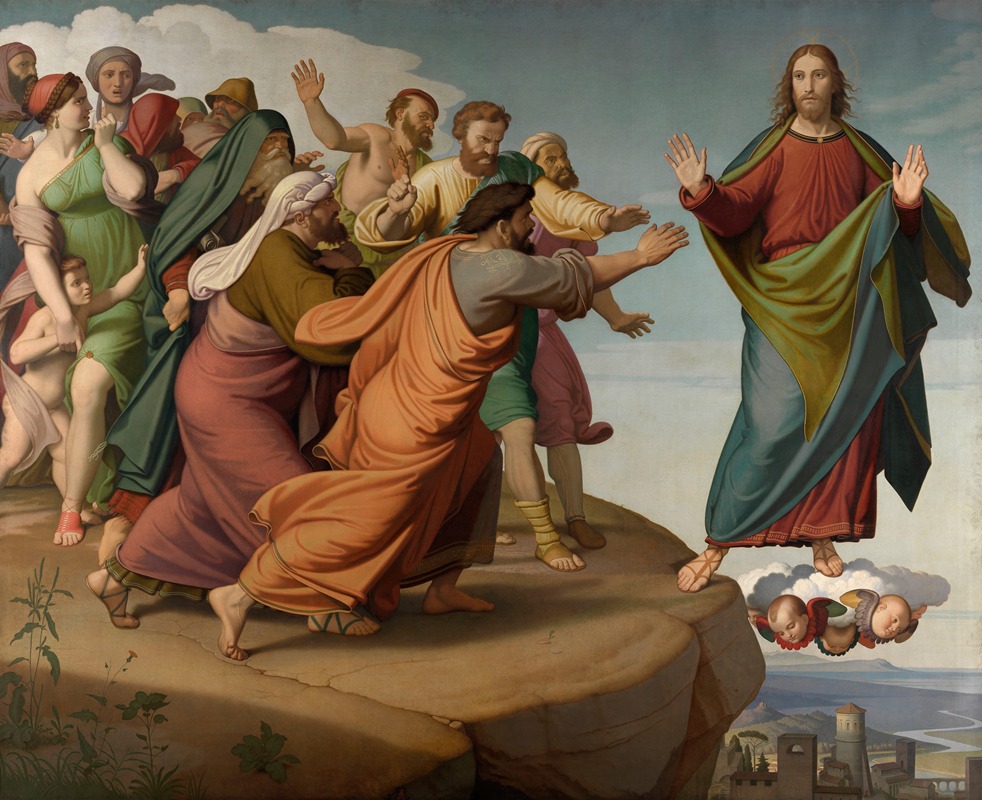
Christ Escapes the Pharisees
Friedrich Overbeck (1789 – 1869)
7
posted on
10/16/2025 5:11:13 AM PDT
by
annalex
(fear them not)
To: annalex
St. Hedwig of Silesia: The Devout Princess Who Walked Barefoot in Faith
•Religious
•Feast day: October 16
•1174-1243
St. Hedwig of Silesia, born in 1174 in Bavaria, Germany, was a remarkable figure whose life exemplified charity, devotion, and humility. She was the daughter of Berthold IV, Duke of Merania (Croatia and Dalmatia), and Agnes of Rochlitz, making her part of an influential and powerful noble lineage. Despite her privileged background, she dedicated her life to serving others and practicing deep religious devotion.
Early Life and Marriage
At the young age of 12, Hedwig was married to Henry I, Duke of Silesia, later known as Henry the Bearded. Together, they had seven children, including Henry II, known as Henry the Pious, who succeeded his father as Duke. Despite being deeply involved in the governance of Silesia, Hedwig lived a life marked by intense piety and austerity. Her marriage to Henry was a happy one, based on mutual respect and shared religious zeal. Henry supported his wife’s charitable works and allowed her to make many sacrifices for the benefit of others.
A Devout Life Amidst Nobility
Hedwig led a devout life amidst her husband’s court, practicing penance, mortification, and fasting. She displayed her humility by participating in the everyday work of serving the needy. Hedwig was known for her extreme acts of penance, such as walking barefoot to Mass every day, even in the harsh winter months, across snow and ice. Her response to a priest who insisted she wear shoes—stating that she “always wore them under her arms”—reveals her dedication to self-denial.
Charity and Dedication to the Needy
Hedwig’s charitable work extended beyond her household. She used her position and resources to serve the poor, the widowed, and the orphaned. Together with her husband, she founded several hospitals to care for the sick and lepers, including the prominent hospital at Wroclaw. Her compassion knew no bounds; Hedwig ensured that those who sought her assistance received comfort and help. She famously spent ten weeks teaching the “Our Father” to a poor woman, demonstrating her patient commitment to the spiritual welfare of others.
The Monastery of Trebnitz
Following the tragic deaths of several of her children and later, her beloved husband in 1238, Hedwig embraced these losses with remarkable faith. She responded to her husband’s passing by saying: “Would you oppose the will of God? Our lives are his.” This profound acceptance reflects her deep understanding of divine providence.
After her husband’s death, Hedwig chose to withdraw from courtly life and entered the Cistercian Monastery of Trebnitz, the very monastery she had helped to establish. However, she did not take formal vows as a nun but lived according to monastic customs, dedicating herself entirely to prayer, penance, and service. Trebnitz Monastery, now known as Trzebnica in Poland, became the center of Hedwig’s final years of devotion.
Miracles and Legacy
St. Hedwig’s reputation for holiness extended beyond her lifetime. Numerous miracles were reported at her tomb following her death in 1243, including healings of the sick and comforting of the afflicted. She was canonized by Pope Clement IV in 1267, just 24 years after her death, a testament to her widespread veneration.
St. Hedwig is remembered as the patroness of Silesia, and her legacy endures in Poland and Germany. She is also known as the patron of brides, widows, and those in exile. The Monastery of Trebnitz became an important pilgrimage site, drawing those seeking inspiration from her life of sacrifice, humility, and unshakable faith.
Feast Day and Iconography
The feast day of St. Hedwig is celebrated on October 16. She is often depicted in religious art wearing simple attire, a symbol of her humility, and sometimes holding shoes in her hand or under her arm, representing her choice to walk barefoot as an act of devotion. In other depictions, she is shown alongside her husband or children, highlighting her roles as both a mother and a duchess who maintained an intense sense of spirituality.
A Model of Humility and Charity
St. Hedwig’s life is an inspiring example of how power and privilege can be used selflessly to serve others. She was a woman who, despite the splendor of court life, chose to live in poverty and serve the needy. She was deeply loved by her people, who saw her as a mother and protector, and her contributions to Silesian society were immense. Her life continues to be a beacon of humility, charity, and faith, inspiring generations to find Christ in acts of service and sacrifice.
thecatholicheroes.com
8
posted on
10/16/2025 5:15:52 AM PDT
by
annalex
(fear them not)
To: annalex
9
posted on
10/16/2025 5:17:37 AM PDT
by
annalex
(fear them not)
To: annalex
NAVARRE BIBLE COMMENTARY(RSV)
Ad Majorem Dei Gloriam (To the Greater Glory of God)
First Reading:
From: Romans 3:21-30
Righteousness, a Free Gift through Faith in Christ
--------------------------------------------------
[21] But now the righteousness of God has been manifested apart from law, although the law and the prophets bear witness to it, [22] the righteousness of God through faith in Jesus Christ for all who believe. For there is no distinction [23] since all have sinned and fall short of the glory of God, [24] they are justified by his grace as a gift, through the redemption which is in Christ Jesus, [25] whom God put forward as an expiation by his blood, to be received by faith. This was to show God's righteousness, because in his divine forbearance he had passed over former sins; [26] it was to prove at the present time that he himself is righteous and that he justifies him who has faith in Jesus.
[27] Then what becomes of our boasting? It is excluded. On what principle? On the principle of works? No, but on the principle of faith. [28] For we hold that a man is justified by faith apart from works of law. [29] 0r is God the God of Jews only? Is he not the God of Gentiles also? Yes, of Gentiles also, [30] since God is one; and he will justify the circumcised on the ground of their faith and the uncircumcised through their faith.
***********************************************************************
Commentary:
21-22. The doctrinal richness of this text and of the whole passage (vv. 21-26) is here condensed in a way very typical of St Paul's style. He explains how justification operates: God the Father, the source of all good, by his redemptive decree is the "efficient cause" of our salvation; Jesus Christ, by shedding his blood on the Cross, merits this salvation for us; faith is the instrument by which the Redemption becomes effective in the individual person.
The righteousness of God is the action by which God makes people righteous, or just (cf. St Augustine, "De Spiritu Et Littera", IX, 15). This righteousness was originally proclaimed in the books of the Old Testament--the Law and the Prophets--but it has now been made manifest in Christ and in the Gospel. Salvation does not depend on fulfillment of the Mosaic Law, for that Law is not sufficient to justify anyone: only faith in Jesus Christ can work salvation.
"If anyone says that, without divine grace through Jesus Christ, man can be justified before God by his own works, whether they were done by his natural powers or by the light of the teaching of the Law: let him be anathema" (Council of Trent, "De Iustificatione", can. 1).
It is not the law, then, which saves, but "faith in Jesus Christ". This expression should be interpreted in line with the unanimous and constant teaching of the Church, which is that "faith is the beginning of human salvation", and a person's will must cooperate with faith to prepare the ground for the grace of justification (cf. ibid., chap. 8 and can. 9).
23-26. The Apostle first describes the elements that go to make up the mystery of faith (vv. 23-25): all men need to be liberated from sin; God the Father has a redemptive plan, which is carried out by the atoning and bloody sacrifice of Christ's death; faith is a necessary condition for sharing in the Redemption wrought by Christ; the sacrifice of the Cross is part and parcel of the History of Salvation: before the Incarnation of the Word, God patiently put up with men's sins; in the fullness of time he chose--through Christ's sacrifice--to require full satisfaction for those sins so that men might be enabled to become truly righteous in God's eyes and God's perfections become more manifest.
"The Cross of Christ, on which the Son, consubstantial with the Father, renders full justice to God, is also a radical revelation of mercy, that is, of the love that goes against what constitutes the very root of evil in the history of man--against sin and death" (John Paul II, "Dives In Misericordia", 8).
23. "Fall short of the glory of God": this shows the position man is in when he is in a state of sin. Because he has not the life of grace in him, he is not properly orientated towards his supernatural end, is deprived of the right to heaven that sanctifying grace confers, and consequently does not have these divine perfections which supernatural life gives him.
24. All have been justified, that is, all have been made "righteous" (cf. 1 :17). This justification is the result of a gratuitous gift of God which St Paul describes in a way which reinforces his point ("grace", "as a gift"): this identifies the source of the gift as God's loving-kindness and it also shows the new state in which justification places a person so important is this statement--that grace is a gift which God gives without merit on our part--that the Council of Trent, when using this text from St Paul, made a point of explaining what it meant: that is, that nothing which precedes justification (whether it be faith, or morals) merits the grace by which man is justified (cf. Rom 11:16; Council of Trent, "De Iustificatione", chap. 8).
This new kind of life, whose motor is grace, requires free and active cooperation on man's part; by that cooperation a person in the state of grace obtains merit through his actions: "For such is God's goodness to men that he wills that his gifts be our merits, and that he will grant us an eternal reward for what he has given us" ("Indiculus", chap. 9). The fact that grace is a gratuitous gift of God does not mean that man does not have an obligation to respond to it: we are not justified by keeping the Law or by a decision of our free will; however, justification does not happen without our cooperation; grace strengthens our will and helps it freely to keep the Law (cf. St Augustine, "De Spiritu Et Littera", IX, 15).
Justification by grace is attained "through the redemption which is in Jesus Christ". The Council of Trent teaches that when a sinner is justified there is "a passing from the state in which man is born a son of the first Adam, to the state of grace and adoption as sons of God through the second Adam, Jesus Christ our Savior" ("De Iustificatione", chap. 4). This has been made possible because our Lord saved us by giving himself up as our ransom. The Greek word translated as "redemption" refers to the ransom money paid to free a person from slavery. Christ has freed us from the slavery of sin, paying the necessary ransom (cf. Rom 6:23). By sacrificing himself for us, Christ has become our master or owner, who mediates between the Father and the whole human race: "Let us all take refuge in Christ; let us have recourse to God to free us from sin: let us put ourselves up for sale in order to be redeemed by his blood. For the Lord says, 'You were sold for nothing, and you shall be redeemed without money' (Is 52:3); without spending a penny of your inheritance, for I have paid on your behalf. This is what the Lord says: He paid the price, not with silver but with his blood" (St Augustine, "In Ioann. Evang.", 41, 4).
Our very creation means that we belong totally to God the Father and therefore also to Christ, insofar as he is God, but "as man, he is also for many reasons appropriately called 'Lord'. First, because he is our Redeemer, who delivered us from sin, he deservedly acquired the power by which he truly is and is called our Lord" ("St Pius V Catechism", I, 3, 11).
And so, through the Incarnation, whose climax was Christ's redemptive sacrifice, "God gave human life the dimension that he intended man to have from his first beginning; he has granted that dimension definitively [...] and he has granted it also with the bounty that enables us, in considering the original sin and the whole history of the sins of humanity, and in considering the errors of the human intellect, will and heart, to repeat with amazement the words of the sacred Liturgy: 'O happy fault...which gained us so great a Redeemer!'"(John Paul II, "Redemptor Hominis", 1).
25. The "expiation" was the cover or mercy seat of the Ark, which stood in the center of the Holy of Holies in the Temple (cf. Exod 25:17-22). It was made of beaten gold and had a cherub at either end, each facing the other. It had two functions: one was to act as God's throne (cf. Ps 80:2; 99:1), from which he spoke to Moses during the time of the exodus from Egypt (cf. Num 7:89; Exod 37:6); the other was to entreat God to pardon sin through a rite of expiatory sacrifice on the feast of the Day of Atonement (cf. Lev 16): on that day the High Priest sprinkled the mercy seat with the blood of animals sacrificed as victims, to obtain forgiveness of sins for priest and people.
St Paul asserts that God has established Jesus as the true expiation, of which the mercy seat in the Old Testament was merely a figure.
No angel or man could ever atone for the immense evil that sin is--an offense to the infinite majesty of God. The Blessed Trinity decided "that the Son of God, whose power is infinite, clothed in the weakness of our flesh, should remove the infinite weight of sin and reconcile us to God in his Blood" ("St Pius V Catechism", I, 3, 3).
This expiatory sacrifice, prefigured in the bloody sacrificial rites of the Old Testament (cf. Lev 16:1 ff), was announced by John the Baptist when he pointed to Jesus as the Lamb of God (cf. Jn 1:29 and note); and Jesus himself referred to the sacrifice of the Cross when he said that the Son of man had come "to give his life as a ransom for many" (Mt 20:28).
This sacrifice is renewed daily in the Holy Mass, one of the purposes of which is atonement, as the Liturgy itself states: "Lord, may this sacrifice once offered on the cross to take away the sins of the world now free us from our sins" ("Roman Missal", Feast of the Triumph of the Cross, prayer over the gifts).
26. In the time prior to Christ's coming the sins of mankind remained unatoned for: neither the rites designed by man to placate God's anger, nor those established by God himself in the Old Law, were in any way equal to atoning for the offense offered to God by sin. Therefore, the just of the Old Testament were really justified by virtue of their faith in the future Messiah, a faith which expressed itself in observance of the rites established by God.
During all this period the Lord kept deferring punishment ("passing over former sins"). This time of "God's forbearance" lasted until the messianic era "the present time", that is, the period between the first and second comings of Christ. On the righteousness of God and God as the Justifier of man, see note on Rom 1:17.
27-31. These words are addressed to the same imaginary interlocutor as appeared at the beginning of the chapter. Although he is Lord of all nations, God showed special preference for the people of Israel. Relying on this, the Jews wrongly thought that only they could attain blessedness because only they enjoyed God's favor. This led them to look down on other peoples. After the coming of Christ, they no longer have any basis for this pride: St John Chrysostom explains that it had simply become outdated, superseded (cf. "Hom. On Rom", 7), for God had set up a single way of salvation for all men--the "principle of faith" which the Apostle refers to. This new way means that Jews must forget their ancient pride and become humble, for God has opened the gates of salvation to all mankind.
Consequently, no one--not even the Jew--is justified by works of the Law. What justifies a person is faith: not faith alone, as Luther wrongly argued, but the faith which works through charity (cf. Gal 5:6); faith which is not presumptuous self-confidence in one's own merits, but a firm and ready acceptance of all that God has revealed, faith which moves one to place one's hope in Christ's merits and to repent of one's sins. Therefore it will be "by faith"--not by circumcision--that the Jews will be justified, and it will be "through their faith" that the uncircumcised will attain salvation. From this it might appear as though the Law had been revoked; but that is not the case: faith ratifies the Law gives it its true meaning and raises it to perfection. For, through being a preparation for the Gospel, the Mosaic Law receives from Christ the fullness it was lacking: the precept of charity reveals the meaning which God gave the law but which lay hidden until Christ made it manifest, for "love is the fulfilling of the law" (Rom 13:10). St Paul in a way summarizes all this teaching in v. 28, which is the key statement in the passage.
10
posted on
10/16/2025 9:20:33 AM PDT
by
fidelis
(Ecce Crucem Domini! Fugite partes adversae! Vicit Leo de tribu Juda, Radix David! Alleluia!)
Gospel Reading: Luke 11:47-54
The Hypocrisy of the Scribes and Pharisees (Continuation)
---------------------------------------------------------
(Jesus said to the Pharisees,) [47] "Woe to you! for you build the tombs of the prophets whom your fathers killed. [48] So you are witnesses and consent to the deeds of your fathers; for they killed them, and you build their tombs. [49] Therefore also the Wisdom of God said, `I will send them prophets and apostles, some of whom they will kill and persecute,' [50] that the blood of all the prophets, shed from the foundation of the world, may be required of this generation, [51] from the blood of Abel to the blood of Zechariah, who perished between the altar and the sanctuary. Yes, I tell you, it shall be required of this generation. [52] Woe to you lawyers! for you have taken away the key of knowledge; you did not enter yourselves, and you hindered those who were entering."
[53] As He went away from there, the scribes and the Pharisees began to press Him hard, and to provoke Him to speak of many things, [54] lying in wait for Him, to catch at something He might say.
***********************************************************************
Commentary:
51. Zechariah was a prophet who died by being stoned in the temple of Jerusalem around the year 800 B.C. because he accused the people of Israel of being unfaithful to God's law (cf. 2 Chronicles 24:20-22). The murder of Abel (Genesis 4:8) and that of Zechariah were, respectively, the first and last murders reported in these books which the Jews regarded as Sacred Scripture. Jesus refers to a Jewish tradition which, in His own time and even later, pointed out the stain of the blood of Zechariah.
The altar referred to here was the altar of holocausts, located outside, in the courtyard of the priests, in front of the temple proper.
52. Jesus severely reproaches these doctors of the Law who, given their study and meditation on Scripture, were the very ones who should have recognized Jesus as the Messiah, since His coming had been foretold in the sacred books. However, as we learn from the Gospel, the exact opposite happened. Not only did they not accept Jesus: they obstinately opposed Him. As teachers of the Law they should have taught the people to follow Jesus; instead, they blocked the way.
53-54. St. Luke frequently records this attitude of our Lord's enemies (cf. 6:11; 19:47-48; 20:19-20; 22:2). The people followed Jesus and were enthusiastic about His preaching and miracles, whereas the Pharisees and scribes would not accept Him and would not allow the people to follow Him; they tried in every way to discredit Him in the eyes of the people (cf. John 11:48).
11
posted on
10/16/2025 9:20:52 AM PDT
by
fidelis
(Ecce Crucem Domini! Fugite partes adversae! Vicit Leo de tribu Juda, Radix David! Alleluia!)
12
posted on
10/16/2025 9:21:35 AM PDT
by
fidelis
(Ecce Crucem Domini! Fugite partes adversae! Vicit Leo de tribu Juda, Radix David! Alleluia!)
Disclaimer:
Opinions posted on Free Republic are those of the individual
posters and do not necessarily represent the opinion of Free Republic or its
management. All materials posted herein are protected by copyright law and the
exemption for fair use of copyrighted works.
FreeRepublic.com is powered by software copyright 2000-2008 John Robinson

