Catena Aurea by St. Thomas Aguinas
11:37–44
37. And as he spake, a certain Pharisee besought him to dine with him, and he went in, and sat down to meat.
38. And when the Pharisee saw it, he marvelled that he had not first washed before dinner.
39. And the Lord said unto him, Now do ye Pharisees make clean the outside of the cup and the platter; but your inward part is full of ravening and wickedness.
40. Ye fools, did not he that made that which is without make that which is within also?
41. But rather give alms of such things as ye have; and, behold, all things are clean unto you.
42. But woe unto you, Pharisees! for ye tithe mint and rue and all manner of herbs, and pass over judgment and the love of God: these ought ye to have done, and not to leave the other undone.
43. Woe unto you, Pharisees! for ye love the uppermost seats in the synagogues, and greetings in the markets.
44. Woe unto you, Scribes and Pharisees, hypocrites! for ye are as graves which appear not, and the men that walk over them are not aware of them.
CYRIL OF ALEXANDRIA. The Pharisee, while our Lord still continued on speaking, invites Him to his own house. As it is said, And while he was speaking, a certain Pharisee besought him to dine with him.
BEDE. Luke expressly says, And as he spake these things, to shew that He had not quite finished what He had purposed to say, but was somewhat interrupted by the Pharisee asking Him to dine.
AUGUSTINE. (de Con. Evan. lib. ii. c. 40.) For in order to relate this, Luke has made a variation from Matthew, at that place where both had mentioned what our Lord said concerning the sign of Jonah, and the queen of the south, and the unclean spirit; after which discourse Matthew says, While he yet talked to the people, behold his mother and his brethren stood without desiring to speak to him; but Luke having also in that discourse of our Lord related some of our Lord’s sayings which Matthew omitted, now departs from the order which he had hitherto kept with Matthew.
BEDE. Accordingly, after that it was told Him that His mother and brethren stood without, and He said, For he that doeth the will of God, the same is my brother, and sister, and mother, we are given to understand that He by the request of the Pharisee went to the dinner.
CYRIL OF ALEXANDRIA. For Christ, knowing the wickedness of those Pharisees, Himself purposely condescends to be occupied in admonishing them, after the manner of the best physicians, who bring remedies of their own making to those who are dangerously ill. Hence it follows, And he went in and sat down to meat. But what gave occasion for the words of Christ was, that the ignorant Pharisees were offended, that while men thought Him to be a great man and a prophet, He conformed not to their unreasonable customs. Therefore it is added, But the Pharisee began to think and say within himself, Why had he not first washed before dinner?
AUGUSTINE. (Serm. 106.) For every day before dinner the Pharisees washed themselves with water, as if a daily washing could be a cleansing of the heart. But the Pharisee thought within himself, yet did not give utterance to a word; nevertheless, He heard who perceived the secrets of the heart. Hence it follows, And the Lord said unto him, Now do ye Pharisees make clean the outside of the cup and the platter; but your inward part is full of ravening and wickedness.
CYRIL OF ALEXANDRIA. Now our Lord might also have used other words to admonish the foolish Pharisee, but he seizes the opportunity and framed his reproof from the things that were ready before him. At the hour, namely, of meals He takes for His example the cup and the platter, pointing out that it became the sincere servants of God to be washed and clean, not only from bodily impurity, but also from that which lies concealed within the power of the soul, just as any of the vessels which are used for the table ought to be free from all inward defilement.
AMBROSE. Now mark that our bodies are signified by the mention of earthly and fragile things, which when let fall a short distance are broken to pieces, and those things which the mind meditates within, it easily expresses through the senses and actions of the body, just as those things which the cup contains within make a glitter without. Hence also hereafter, by the word cup doubtless the passion of the body is spoken of. You perceive then, that not the outside of the cup and platter defiles us, but the inner parts. For he said, But your inward part is full of ravening and wickedness.
AUGUSTINE. (Serm. 106.) But how was it that He spared not the man by whom He was invited? Yea rather, He spared him by reproof, that when corrected He might spare him in the judgment. Further, He shews us that baptism also which is once given cleanses by faith; but faith is something within, not without. The Pharisees despised faith, and used washings which were without; while within they remained full of pollution. The Lord condemns this, saying, Ye fools, did not he that made that which is without make that which is within also?
BEDE. As if He says, He who made both natures of man, will have each to be cleansed. This is against the Manicheans, who think the soul only was created by God, but the flesh by the devil. It is also against those who abominate the sins of the flesh, such as fornication, theft, and the like; while those of the Spirit, which are no less condemned by the Apostle, they disregard as trifling.
AMBROSE. Now our Lord as a good Master taught us how we ought to purify our bodies from defilement, saying, But rather give alms of such things as ye have over: and, behold, all things are clean unto you. You see what the remedies are; almsgiving cleanseth us, the word of God cleanseth us, according to that which is written, Now ye are clean through the word which I have spoken unto you. (John 15:3.)
CYPRIAN. (de Op. et Eleem.) The Merciful bids us to shew mercy; and because He seeks to save those whom He has redeemed at a great price, He teaches that they who have been defiled after the grace of baptism may again be made clean.
CHRYSOSTOM. (Hom. 72. in Joan.) Now He says, give alms, not injury. For almsgiving is that which is free from all injury. It makes all things clean, and is more excellent than fasting; which though it be the more painful, the other is the more profitable. It enlightens the soul, enriches it, and makes it good and beautiful, He who resolves to have compassion on the needy, will sooner cease from sin. For as the physician who is in the habit of healing the diseased is easily grieved by the misfortunes of others; so we, if we have devoted ourselves to the relief of others, shall easily despise things present, and be raised up to heaven. The unction of almsgiving then is no slight good, since it is capable of being applied to every wound.
BEDE. (quod superest.) He speaks of “what is over and above” our necessary food and clothing. For you are not commanded to give alms so as to consume yourself by want, but that after satisfying your wants, you should supply the poor to the utmost of your power. Or it must be taken in this way. Do that which remains within your power, that is, which is the only remedy remaining to those who have been hitherto engaged in so much wickedness; give alms. Which word applies to every thing which is done with profitable compassion. For not he alone gives alms who gives food to the hungry and things of that kind, but he also who gives pardon to the sinner, and prays for him, and reproves him, visiting him with some correcting punishment.
THEOPHYLACT. Or He means, “That which is uppermost.” For wealth rules the covetous man’s heart.
AMBROSE. The whole then of this beautiful discourse is directed to this end, that while it invites us to the study of simplicity, it should condemn the luxury and worldliness of the Jews. And yet even they are promised the abolition of their sins if they will follow mercy.
AUGUSTINE. (Serm. 106.) But if they cannot be cleansed except they believe on Him who cleanses the heart by faith, what is this which He says, Give alms, and behold all things are clean to you? Let us give heed, and perhaps He Himself explains it to us.
For the Jews withdrew a tenth part from all their produce, and gave it in alms, which rarely a Christian does. Therefore they mocked Him, for saying this to them as to men who did not give alms. God knowing this adds, But woe unto you, Pharisees! for ye tithe mint and rue and all manner of herbs, and pass over judgment and the love of God. This then is not giving alms. For to give alms is to shew mercy. If thou art wise, begin with thyself: for how art thou merciful to another, if cruel to thyself? Hear the Scripture, which says unto thee, Have mercy on thy own soul, and please God. (Ecclus. 30:23.) Return unto thy conscience, thou that livest in evil or unbelief, and then thou findest thy soul begging, or perhaps struck dumb with want. In judgment and love give alms to thy soul. What is judgment? Do what is displeasing to thyself. What is charity? Love God, love thy neighbour. If thou neglectest this alms, love as much you like, thou doest nothing, since thou doest it not to thyself.
CYRIL OF ALEXANDRIA. Or He says it by way of censure upon the Pharisees, who ordered those precepts only to be strictly observed by their people, which were the cause of fruitful returns to themselves. Hence they omitted not even the smallest herbs, but despised the work of inspiring love to God, and the just awarding of judgment.
THEOPHYLACT. For because they despised God, treating sacred things with indifference, He commands them to have love to God; but by judgment He implies the love of our neighbour. For when a man judges his neighbour justly, it proceeds from his love to him.
AMBROSE. Or judgment, because they do not bring to examination every thing that they do; charity, because they love not God with their heart. But that He might not make us zealous of the faith, to the neglect of good works, He sums up the perfection of a good man in a few words, these ought ye to have done, and not to leave the other undone.
CHRYSOSTOM. (Hom. 73. in Matt.) Where indeed the subject treated was the Jewish cleansing, He altogether passed it by, but as the tithe is a kind of almsgiving, and the time was not yet come for absolutely destroying the customs of the law, therefore He says, these ought ye to have done.
AMBROSE. He reproves also the arrogance of the boasting Jews in seeking the preeminence: for it follows, Woe unto you, Pharisees, for ye love the uppermost seats in the synagogues, &c.
CYRIL OF ALEXANDRIA. By means of those things for which He blames us He makes us better. For He would have us be free from ambition, and not desire after vain show rather than the reality, which the Pharisees were then doing. For the greetings of men, and the rule over them, do not move us to be really useful, for these things fall to men though they be not good men. Therefore he adds, Woe unto you, who are as graves which appear not. For in wishing to receive greetings from men and to exercise authority over them, that they might be accounted great, they differ not from hidden graves, which glitter indeed with outward ornaments, but within are full of all uncleanness.
AMBROSE. And like graves which appear not, they deceive by their outside beauty, and by their look impose upon the passers by; as it follows, And the men that walk over them are not aware of them; so much that in truth, though they give outward promise of what is beautiful, inwardly they enclose all manner of pollution.
CHRYSOSTOM. (Hom. 73.) But that the Pharisees were so, cannot be wondered at. But if we who are counted worthy to be the temples of God suddenly become graves full only of corruption, this is indeed the lowest wretchedness.
CYRIL OF ALEXANDRIA. (con. Julian. lib. 10.) Now here the apostate Julian says, that we must avoid graves which Christ says are unclean; but he knew not the force of our Saviour’s words, for He did not command us to depart from the graves, but likened to them the hypocritical people of the Pharisees.
11:45–54
45. Then answered one of the Lawyers, and said unto him, Master, thus saying thou reproachest us also.
46. And he said, Woe unto you also, ye Lawyers! for ye lade men with burdens grievous to be borne, and ye yourselves touch not the burdens with one of your fingers.
47. Woe unto you! for ye build the sepulchres of the prophets, and your fathers killed them.
48. Truly ye bear witness that ye allow the deeds of your fathers: for they indeed killed them, and ye build their sepulchres.
49. Therefore also said the wisdom of God, I will send them prophets and apostles, and some of them they shall slay and persecute:
50. That the blood of all the prophets, which was shed from the foundation of the world, may be required of this generation;
51. From the blood of Abel unto the blood of Zacharias, which perished between the altar and the temple: verily I say unto you, It shall be required of this generation.
52. Woe unto you, Lawyers! for ye have taken away the key of knowledge: ye enter not in yourselves, and them that were entering in ye hindered.
53. And as he said these things unto them, the Scribes and Pharisees began to urge him vehemently, and to provoke him to speak of many things:
54. Laying wait for him, and seeking to catch something out of his mouth, that they might accuse him.
CYRIL OF ALEXANDRIA. A reproof which exalts the meek is generally hateful to the proud man. When therefore our Saviour was blaming the Pharisees for transgressing from the right path, the body of Lawyers were struck with consternation. Hence it is said, Then answered one of the Lawyers, and said unto him, Master, thus saying thou reproachest us also.
BEDE. In what a grievous state is that conscience, which hearing the word of God thinks it a reproach against itself, and in the account of the punishment of the wicked perceives its own condemnation.
THEOPHYLACT. Now the Lawyers were different from the Pharisees. For the Pharisees being separated from the rest had the appearance of a religious sect; but those skilled in the Law were the Scribes and Doctors who solved legal questions.
CYRIL OF ALEXANDRIA. But Christ brings a severe charge against the Lawyers, and subdues their foolish pride, as it follows, And he said, Woe unto you also, ye Lawyers, for ye lade men, &c. He brings forward an obvious example for their direction. The Law was burdensome to the Jews as the disciples of Christ confess, but these Lawyers binding together legal burdens which could not be borne, placed them upon those under them, taking care themselves to have no toil whatever.
THEOPHYLACT. As often also as the teacher does what he teaches, he lightens the load, offering himself for an example. But when he does none of the things which he teaches others, the loads appear heavy to those who learn his teaching, as being what even their teacher is not able to bear.
BEDE. Now they are rightly told that they would not touch the burdens of the Law even with one of their fingers, that is, they fulfil not in the slightest point that law which they pretend to keep and transmit to the keeping of others, contrary to the practice of their fathers, without faith and the grace of Christ.
GREGORY OF NYSSA. So also are there now many severe judges of sinners, yet weak combatants; burdensome imposers of laws, yet weak bearers of burdens; who wish neither to approach nor to touch strictness of life, though they sternly exact it from their subjects.
CYRIL OF ALEXANDRIA. Having then condemned the burdensome dealing of the Lawyer, He brings a general charge against all the chief men of the Jews, saying, Woe to you who build the tombs of the prophets, and your fathers killed them.
AMBROSE. This is a good answer to the foolish superstition of the Jews, who in building the tombs of the prophets condemned the deeds of their fathers, but by rivalling their fathers’ wickedness, throw back the sentence upon themselves. For not the building but the imitation of their deeds is looked upon as a crime. Therefore He adds, Truly ye bear witness that ye allow, &c.
BEDE. They pretended indeed, in order to win the favour of the multitude, that they were shocked at the unbelief of their fathers, since by splendidly honouring the memories of the prophets who were slain by them they condemned their deeds. But in their very actions they testify how much they coincide with their fathers’ wickedness, by treating with insult that Lord whom the prophets foretold. Hence it is added, Therefore also said the wisdom of God, I will send them prophets and apostles, and some of them they shall slay and persecute.
AMBROSE. The wisdom of God is Christ. The words indeed in Matthew are, Behold I send unto you prophets and wise men.
BEDE. But if the same Wisdom of God sent prophets and Apostles, let heretics cease to assign to Christ a beginning from the Virgin; let them no longer declare one God of the Law and Prophets, another of the New Testament. For although the Apostolic Scripture often calls by the name of prophets not only those who foretell the coming Incarnation of Christ, but those also who foretell the future joys of the kingdom of heaven, yet I should never suppose that these were to be placed before the Apostles in the order of enumeration.
ATHANASIUS. (Apol. 1. de fuga sua.) Now if they kill, the death of the slain will cry out the louder against them; if they pursue, they send forth memorials of their iniquity, for flight makes the pursuit of the sufferers to redound to the great disgrace of the pursuers. For no one flees from the merciful and gentle, but rather from the cruel and evil-minded man. And therefore it follows, That the blood of all the prophets who have been slain from the foundation of the world may be required of this generation.
BEDE. It is asked, How comes it that the blood of all the prophets and just men is required of the single generation of the Jews; whereas many of the saints, both before the Incarnation and after, have been slain by other nations? But it is the manner of the Scriptures frequently to reckon two generations of men, one of the good, and the other of the evil.
CYRIL OF ALEXANDRIA. Although then He says pointedly of this generation, He expresses not merely those who were then standing by Him and listening, but every manslayer. For like is attributed to like.
CHRYSOSTOM. (Hom. 74. in Matt.) But if He means that the Jews are about to suffer worse things, this will not be undeserved, for they have dared to do worse than all. And they have been corrected by none of their past calamities, but when they saw others sin, and punished, they were not made better, but did likewise; yet it will not be that one shall suffer punishment for the sins of others.
THEOPHYLACT. But our Lord shews that the Jews have inherited the malice of Cain, since he adds, From the blood of Abel, to the blood of Zacharias, &c. Abel, inasmuch as he was slain by Cain; but Zacharias, whom they slew between the temple and the altar, some say was the Zacharias of old time, the son of Jehoiadah the Priest.
BEDE. Why He begins from the blood of Abel, who was the first martyr, we need not wonder; but why, to the blood of Zacharias, is a question, since many were slain after him even up to our Lord’s birth, and soon after His birth the Innocents, unless perhaps it was because Abel was a shepherd, Zacharias a Priest. And the one was killed in the field, the other in the court of the temple, martyrs of each class, that is, under their names are shadowed both laymen, and those engaged in the office of the altar.
GREGORY OF NYSSA. (Orat. in Diem Nat. Christi.) But some say that Zacharias, the father of John, by the spirit of prophecy forecasting the mystery of the immaculate virginity of the mother of God, in no wise separated her from the part of the temple set apart for virgins, wishing to shew that it was in the power of the Creator of all things to manifest a new birth, while he did not deprive the mother of the glory of her virginity. Now this part was between the altar and the temple, in which was placed the brazen altar, where for this reason they slew him. It is said also, that when they heard the King of the world was about to come, from fear of subjection they designedly attacked him who bore witness to His coming, and slew the priest in the temple.
GREEK EXPOSITOR. (Geometer.) But others give another reason for the destruction of Zacharias. For at the murder of the children the blessed John was to be slain with the rest of the same age, but Elisabeth, snatching up her son from the midst of the slaughter, sought the desert. And so when Herod’s soldiers could not find Elisabeth and the child, they turn their wrath against Zacharias, killing him as he was ministering in the temple.
It follows, Woe to you, lawyers, for ye have taken away the key of knowledge.
BASIL. (in Esai. 1.) This word woe, which is uttered with pain intolerable, is suited to those who were shortly after to be cast out into grievous punishment.
CYRIL OF ALEXANDRIA. Now we say, the law itself is the key of knowledge. For it was both a shadow and a figure of the righteousness of Christ, therefore it became the Lawyers, as instructors of the Law of Moses and the words of the Prophets, to reveal in a certain measure to the Jewish people the knowledge of Christ. This they did not, but on the contrary detracted from the divine miracles, and spoke against His teaching, Why hear ye him? So then they took away the key of knowledge. Hence it follows, Ye entered not in yourselves, and them that were entered in ye hindered. But faith also is the key of knowledge. For by faith comes also the knowledge of truth, according to that of Isaiah, Unless ye have believed, ye will not understand. (Isa. 7:9. LXX.) The Lawyers then have taken away the key of knowledge, not permitting men to believe in Christ.
AUGUSTINE. (de qu. Ev. l. ii. q. 23.) But the key of knowledge is also the humility of Christ, which they would neither themselves understand, nor let be understood by others.
AMBROSE. Those also are even now condemned under the name of Jews, and made subject to future punishment, who, while usurping to themselves the teaching of divine knowledge, both hinder others, and do not themselves acknowledge that which they profess.
AUGUSTINE. (de con. Ev. lib. ii. c. 75.) Now all these things Matthew records to have been said after our Lord had come into Jerusalem. But Luke relates them here, when our Lord was yet on His journey to Jerusalem. From which they appear to me to be similar discourses, of which Matthew has given one, Luke the other.
BEDE. But how true were the charges of unbelief, hypocrisy, and impiety, brought against the Pharisees and Lawyers they themselves testify, striving not to repent, but to entrap the Teacher of truth; for it follows, And as he said these things to them, the Pharisees and Lawyers began to urge him vehemently.
CYRIL OF ALEXANDRIA. Now this urging is taken to mean pressing upon Him, or threatening Him, or waxing furious against Him. But they began to interrupt His words in many ways, as it follows, And to force him to speak of many things.
THEOPHYLACT. For when several are questioning a man on different subjects, since he can not reply to all at once, foolish people think he is doubting. This also was part of their wicked design against Him; but they sought also in another way to control His power of speech, namely, by provoking Him to say something by which He might be condemned; whence it follows, Laying in wait for him, and seeking to catch something out of his mouth, that they might accuse him. Having first spoken of “forcing,” Luke now says to catch or seize something from His mouth; at one time indeed they asked Him concerning the Law, that they might convict as a blasphemer Him who accused Moses; but at another time concerning Cæsar, that they might accuse Him as a traitor and rebel against the majesty of Cæsar.
Catena Aurea Luke 11
Catena Aurea by St. Thomas Aguinas
John CHAP. 15
15:1–3
1. I am the true vine, and my Father is the husbandman.
2. Every branch in me that beareth not fruit he taketh away: and every branch that beareth fruit, he purgeth it, that it may bring forth more fruit.
3. Now ye are clean through the word which I have spoken unto you.
HILARY. (ix. de Trin) He rises in haste to perform the sacrament of His final passion in the flesh, (such is His desire to fulfil His Father’s commandment:) and therefore takes occasion to unfold the mystery of His assumption of His flesh, whereby He supports us, as the vine doth its branches: I am the true vine.
AUGUSTINE. (Tr. lxxx. 2) He says this as being the Head of the Church, of which we are the members, the Man Christ Jesus; for the vine and the branches are of the same nature. When He says, I am the true vine, He does not mean really a vine; for He is only called so metaphorically, not literally, even as He is called the Lamb, the Sheep, and the like; but He distinguishes Himself from that vine to whom it is said, How art thou turned into the degenerate plant of a strange vine unto me. (Jer. 11:21) For how is that a true vine, which when grapes are expected from it, produces only thorns?
HILARY. (ix. de Trin) But He wholly separates this humiliation in the flesh from the form of the Paternal Majesty, by setting forth the Father as the diligent Husbandman of this vine: And My Father is the Husbandman.
AUGUSTINE. (de Verb. Dom. serm. lix) For we cultivate God, and God cultivates us. But our culture of God does not make Him better: our culture is that of adoration, not of ploughing: His culture of us makes us better. His culture consists in extirpating all the seeds of wickedness from our hearts, in opening our heart to the plough, as it were, of His word, in sowing in us the seeds of His commandments, in waiting for the fruits of piety.
CHRYSOSTOM. (Hom. lxxvi) And forasmuch as Christ was sufficient for Himself, but His disciples needed the help of the Husbandman, of the vine He says nothing, but adds concerning the branches, Every branch in Me that beareth not fruit, He taketh away. By fruit is meant life, i. e. that no one can be in Him without good works.
HILARY. (ix. de Trin) The useless and deceitful branches He cuts down for burning.
CHRYSOSTOM. (Hom. lxxvi. 1) And inasmuch as even the best of men require the work of the husbandman, He adds, And every branch that beareth fruit, He purgeth it, that it may bring forth more fruit. He alludes here to the tribulations and trials which were coming upon them, the effect of which would be to purge, and so to strengthen them. By pruning the branches we make the tree shoot out the more.
AUGUSTINE. (Tr. lxxx. 3) And who is there in this world so clean, that he cannot be more and more changed? Here, if we say that we have no sin, we deceive ourselves. (1 John 1:8) He cleanseth then the clean, i. e. the fruitful, that the cleaner they be, the more fruitful they may be. Christ is the vine, in that He saith, My Father is greater than I; but in that He saith, I and My Father are one, He is the husbandman; not like those who carry on an external ministry only; for He giveth increase within. Thus He calls Himself immediately the cleanser of the branches: Now ye are clean through the word, which I have spoken unto you. He performs the part of the husbandman then, as well as of the vine. But why does He not say, ye are clean by reason of the baptism wherewith ye are washed? Because it is the word in the water which cleanseth. Take away the word, and what is the water, but water? Add the word to the element, and you have a sacrament. Whence hath the water such virtue as that by touching the body, it cleanseth the heart, but by the power of the word, not spoken only, but believed? For in the word itself, the passing sound is one thing, the abiding virtue another. This word of faith is of such avail in the Church of God, that by Him who believes, presents, blesses, sprinkles the infant, it cleanseth that infant, though itself is unable to believe.
CHRYSOSTOM. Ye are clean through the word which I have spoken unto you, i. e. ye have been enlightened by My doctrine, and been delivered from Jewish error.
15:4–7
4. Abide in me, and I in you. As the branch cannot bear fruit of itself, except it abide in the vine; no more can ye, except ye abide in me.
5. I am the vine, ye are the branches: He that abideth in me, and I in him, the same bringeth forth much fruit: for without me ye can do nothing.
6. If a man abide not in me, he is cast forth as a branch, and is withered; and men gather them, and cast them into the fire, and they are burned.
7. If ye abide in me, and my words abide in you, ye shall ask what ye will, and it shall be done unto you.
CHRYSOSTOM. (Hom. lxxvi non occ.) Having said that they were clean through the word which He had spoken unto them, He now teaches them that they must do their part.
AUGUSTINE. (Tract. lxxxi. 1) Abide in Me, and I in you: not they in Him, as He in them; for both are for the profit not of Him, but them. The branches do not confer any advantage upon the vine, but receive their support from it: the vine supplies nourishment to the branches, takes none from them: so that the abiding in Christ, and the having Christ abiding in them, are both for the profit of the disciples, not of Christ; according to what follows, As the branch cannot bear fruit of itself, except it abide in the vine, no more can ye, except ye abide in Me. Great display of grace! He strengtheneth the hearts of the humble, stoppeth the mouth of the proud. They who hold that God is not necessary for the doing of good works, the subverters, not the assertors, of free will, contradict this truth. For he who thinks that he bears fruit of himself, is not in the vine; he who is not in the vine, is not in Christ; he who is not in Christ, is not a Christian.
ALCUIN. All the fruit of good works proceeds from this root. He who hath delivered us by His grace, also carries us onward by his help, so that we bring forth more fruit. Wherefore He repeats, and explains what He has said: I am the vine, ye are the branches. He that abideth in Me, by believing, obeying, persevering, and I in Him, by enlightening, assisting, giving perseverance, the same, and none other, bringeth forth much fruit.
AUGUSTINE. (Tract. lxxxi. 3) But lest any should suppose that a branch could bring forth a little fruit of itself, He adds, For without Me ye can do nothing. He does not say, ye can do little. Unless the branch abides in the vine, and lives from the root, it can bear no fruit whatever. Christ, though He would not be the vine, except He were man, yet could not give this grace to the branches, except He were God.
CHRYSOSTOM. (Hom. lxxvi. 1) The Son then contributes no less than the Father to the help of the disciples. The Father changeth, but the Son keepeth them in Him, which is that which makes the branches fruitful. And again, the cleansing is attributed to the Son also, and the abiding in the root to the Father who begat the root. (c. 2.). It is a great loss to be able to do nothing, but He goes on to say more than this: If a man abide not in Me, he is cast forth as a branch, i. e. shall not benefit by the care of the husbandman, and withereth, i. e. shall lose all that it desires from the root, all that supports its life, and shall die.
ALCUIN. And men gather them, i. e. the reapers, the Angels, and cast them into the fire, everlasting fire, and they are burned.
AUGUSTINE. (Tract. lxxxi. 3) For the branches of the vine are as contemptible, if they abide not in the vine, as they are glorious, if they abide. One of the two the branch must be in, either the vine, or the fire: if it is not in the vine, it will be in the fire.
CHRYSOSTOM. (Hom. lxxvi. 2) Then He shews what it is to abide in Him. If ye abide in Me, and My words abide in you, ye shall ask what ye will, and it shall be done unto you. It is to be shewn by their works.
AUGUSTINE. (Tract. lxxxi. 4) For then may His words be said to abide in us, when we do what He has commanded, and love what He has promised. But when His words abide in the memory, and are not found in the life, the branch is not accounted to be in the vine, because it derives no life from its root. So far as we abide in the Saviour we cannot will any thing that is foreign to our salvation. We have one will, in so far as we are in Christ, another, in so far as we are in this world. And by reason of our abode in this world, it sometimes happens that we ask for that which is not expedient, through ignorance. But never, if we abide in Christ, will He grant it us, Who does not grant except what is expedient for us. And here we are directed to the prayer, Our Father. Let us adhere to the words and the meaning of this prayer in our petitions, and whatever we ask will be done for us.
15:8–11
8. Herein is my Father glorified, that ye bear much fruit; so shall ye be my disciples.
9. As the Father hath loved me, so have I loved you: continue ye in my love.
10. If ye keep my commandments, ye shall abide in my love: even as I have kept my Father’s commandments, and abide in his love.
11. These things have I spoken unto you, that my joy might remain in you, and that your joy might be full.
CHRYSOSTOM. (Hom. lxxvi. 2) Our Lord shewed above, that those who plotted against them should be burned, inasmuch as they abode not in Christ: now He shews that they themselves would be invincible, bringing forth much fruit; Herein is My Father glorified, that ye bear much fruit: as if He said, If it appertains to My Father’s glory that ye bring forth fruit, He will not despise His own glory. And he that bringeth forth fruit is Christ’s disciple: So shall ye be My disciples.
THEOPHYLACT. The fruit of the Apostles are the Gentiles, who through their teaching were converted to the faith, and brought into subjection to the glory of God.
AUGUSTINE. (Tract. lxxxii. 1) Made bright or glorified; the Greek word may be translated in either way. Δόξα signifies glory; not our own glory, we must remember, as if we had it of ourselves: it is of His grace that we have it; and therefore it is not our own but His glory. For from whom shall we derive our fruitfulness, but from His mercy preventing us. Wherefore He adds, As My Father hath loved Me, even so love I you. This then is the source of our good works. Our good works proceed from faith which worketh by love: but we could not love unless we were loved first: As My Father hath loved Me, even so love I you. This does not prove that our nature is equal to His, as His is to the Father’s, but the grace, whereby He is the Mediator between God and man, the man Christ Jesus. The Father loves us, but in Him.
CHRYSOSTOM. (Hom. lxxvi. 2) If then I love you, be of good cheer; if it is the Father’s glory that ye bring forth good fruit, bear no evil. Then to rouse them to exertion, He adds, Continue ye in My love; and then shews how this is to be done: If ye keep My commandments, ye shall abide in My love.
AUGUSTINE. (Tract. lxxxii. 3. et seq.) Who doubts that love precedes the observance of the commandments? For who loves not, has not that whereby to keep the commandments. These words then do not declare whence love arises, but how it is shewn, that no one might deceive himself into thinking that he loved our Lord, when he did not keep His commandments. Though the words, Continue ye in My love, do not of themselves make it evident which love He means, ours to Him, or His to us, yet the preceding words do: I love you, He says: and then immediately after, Continue ye in My love. Continue ye in My love, then, is, continue in My grace: and, If ye keep My commandments, ye shall abide in My love, is, Your keeping of My commandments, will be evidence to you that ye abide in My love. It is not that we keep His commandments first, and that then He loves; but that He loves us, and then we keep His commandments. This is that grace, which is revealed to the humble, but hidden from the proud. But what means the next words, Even as I have kept My Father’s commandments, and abide in His love: i. e. the Father’s love, wherewith He loveth the Son. Must this grace, wherewith the Father loves the Son, be understood to be like the grace wherewith the Son loveth us? No; for whereas we are sons not by nature, but by grace, the Only Begotten is Son not by grace, but by nature. We must understand this then to refer to the manhood in the Son, even as the words themselves imply: As My Father hath loved Me, even so love I you. The grace of a Mediator is expressed here; and Christ is Mediator between God and man, not as God, but as man. This then we may say, that since human nature does not pertain to the nature of God, but does by grace pertain to the Person of the Son, grace also pertains to that Person; such grace as has nothing superior, nothing equal to it. For no merits on man’s part preceded the assumption of that nature.
ALCUIN. Even as I have kept My Father’s commandments. The Apostle explains what these commandments were: Christ became obedient unto death, even the death of the cross. (Phil. 2:8)
CHRYSOSTOM. (Hom. lxxvii. 1) Then because the Passion was now approaching to interrupt their joy, He adds, These things have I spoken unto you, that my joy may remain in you: as if He said, And if sorrow fall upon you, I will take it away; so that ye shall rejoice in the end.
AUGUSTINE. (Tract. lxxxiii. 1) And what is Christ’s joy in us, but that He deigns to rejoice on our account? And what is our joy, which He says shall be full, but to have fellowship with Him? He had perfect joy on our account, when He rejoiced in foreknowing, and predestinating us; but that joy was not in us, because then we did not exist: it began to be in us, when He called us And this joy we rightly call our own, this joy wherewith we shall be blessed; which is begun in the faith of them who are born again, and shall be fulfilled in the reward of them who rise again.
Catena Aurea John 15




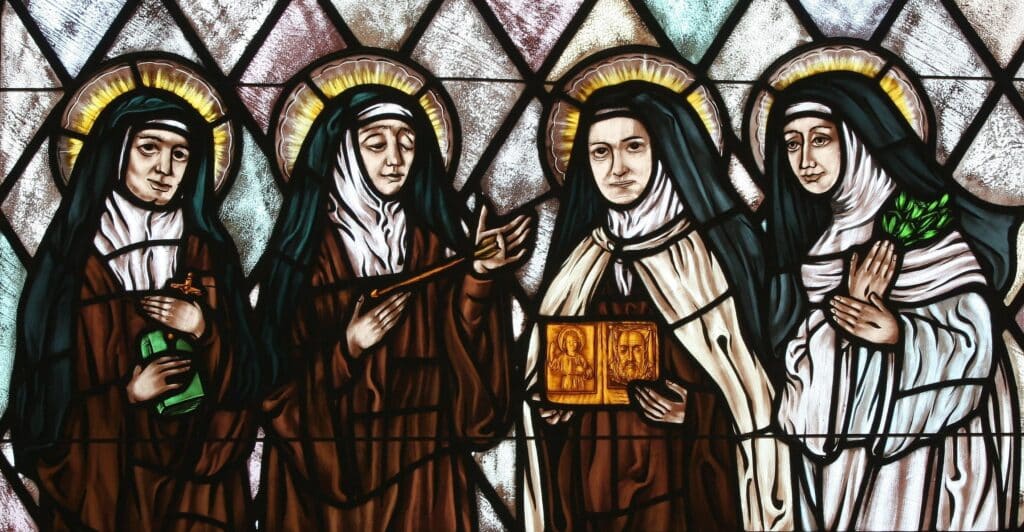 Depicted from left are Teresa Benedicta of the Cross, Teresa of Avila, Therese of Lisieux and Catherine of Siena.