Skip to comments.
Catholic Caucus: Daily Mass Readings 3-October-2025
Universalis/Jerusalem Bible ^
Posted on 10/03/2025 5:00:54 PM PDT by annalex
3 October 2025
Friday of week 26 in Ordinary Time
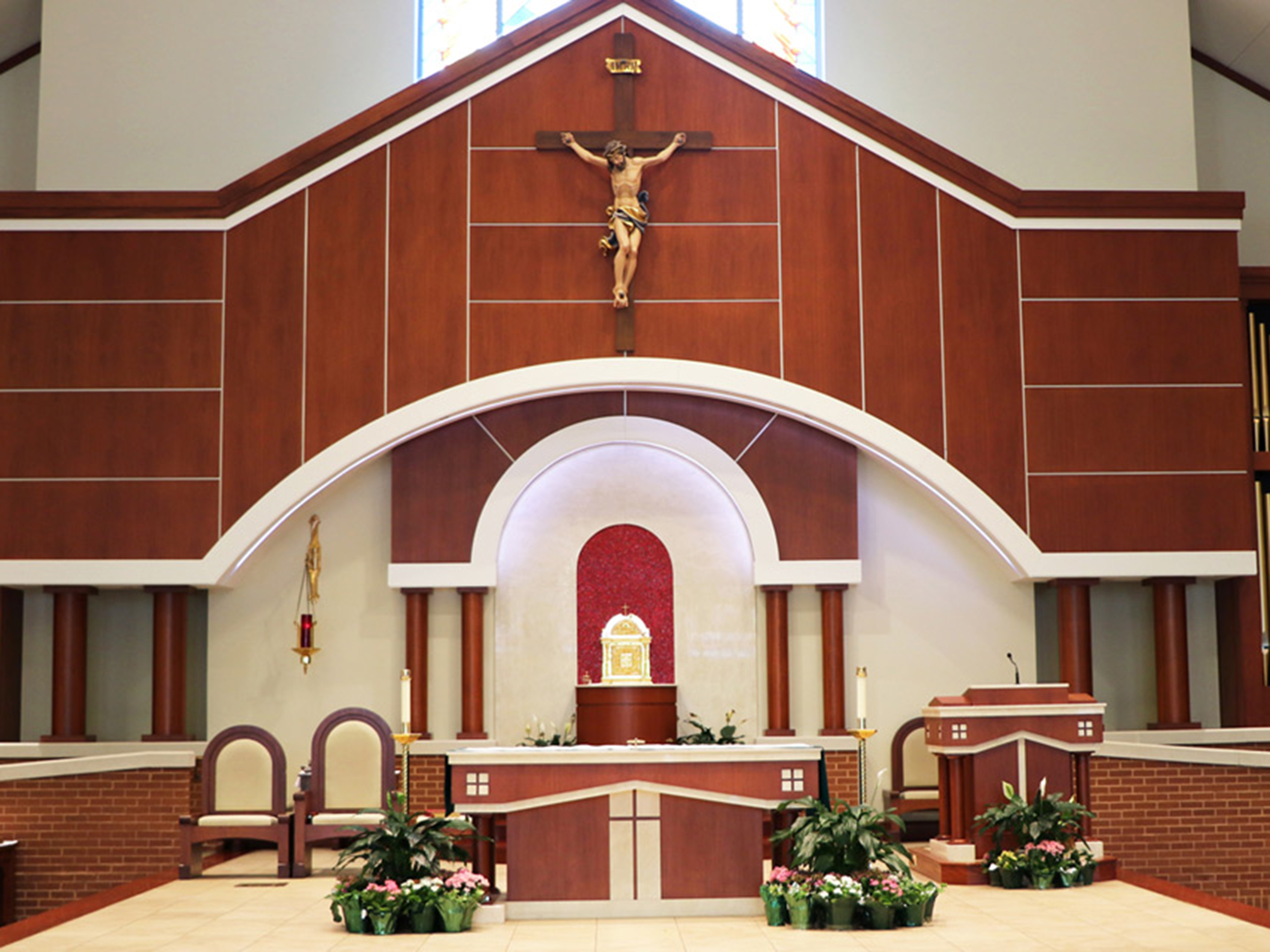
All Saints Church, Old Town Manassas Readings at MassLiturgical Colour: Green. Year: C(I).
| First reading | Baruch 1:15-22 |
|---|
We have been disobedient to the Lord our GodIntegrity belongs to the Lord our God; to us the look of shame we wear today, to us, the people of Judah and the citizens of Jerusalem, to our kings and princes, our priests, our prophets, as to our ancestors, because we have sinned in the sight of the Lord, have disobeyed him, and have not listened to the voice of the Lord our God telling us to follow the commandments which the Lord had ordained for us. From the day when the Lord brought our ancestors out of the land of Egypt until today we have been disobedient to the Lord our God, we have been disloyal, refusing to listen to his voice. And so the disasters, and the curse which the Lord pronounced through his servant Moses the day he brought our fathers out of Egypt to give us a land where milk and honey flow, have seized on us, disasters we experience today. Despite all the words of those prophets whom he sent us, we have not listened to the voice of the Lord our God, but, each following the dictates of his evil heart, we have taken to serving alien gods, and doing what is displeasing to the Lord our God.
| Responsorial Psalm |
|---|
| Psalm 78(79):1-5,8-9 |
|---|
Rescue us, O Lord, for the glory of your name. O God, the nations have invaded your land, they have profaned your holy temple. They have made Jerusalem a heap of ruins. They have handed over the bodies of your servants as food to feed the birds of heaven and the flesh of your faithful to the beasts of the earth. Rescue us, O Lord, for the glory of your name. They have poured out blood like water in Jerusalem; no one is left to bury the dead. We have become the taunt of our neighbours, the mockery and scorn of those who surround us. How long, O Lord? Will you be angry for ever; how long will your anger burn like fire? Rescue us, O Lord, for the glory of your name. Do not hold the guilt of our fathers against us. Let your compassion hasten to meet us; we are left in the depths of distress. Rescue us, O Lord, for the glory of your name. O God our saviour, come to our help. Come for the sake of the glory of your name. O Lord our God, forgive us our sins; rescue us for the sake of your name. Rescue us, O Lord, for the glory of your name.
| Gospel Acclamation | Ps144:13 |
|---|
Alleluia, alleluia! The Lord is faithful in all his words and loving in all his deeds. Alleluia! Alleluia, alleluia! Harden not your hearts today, but listen to the voice of the Lord. Alleluia!
Anyone who rejects me rejects the one who sent meJesus said to his disciples: ‘Alas for you, Chorazin! Alas for you, Bethsaida! For if the miracles done in you had been done in Tyre and Sidon, they would have repented long ago, sitting in sackcloth and ashes. And still, it will not go as hard with Tyre and Sidon at the Judgement as with you. And as for you, Capernaum, did you want to be exalted high as heaven? You shall be thrown down to hell. ‘Anyone who listens to you listens to me; anyone who rejects you rejects me, and those who reject me reject the one who sent me.’ You can also view this page with the New Testament in Greek and English. Universalis podcast: The week ahead – from 5 to 11 OctoberThe prophet Jonah. Saint Abraham. Saint John Henry Newman. (21 minutes)
Episode notes.Play Christian Art Each day, The Christian Art website gives a picture and reflection on the Gospel of the day. The readings on this page are from the Jerusalem Bible, which is used at Mass in most of the English-speaking world. The New American Bible readings, which are used at Mass in the United States, are available in the Universalis apps, programs and downloads.
You can also view this page with the Gospel in Greek and English. |
TOPICS: Catholic; General Discusssion; Prayer; Worship
KEYWORDS: catholic; lk10; ordinarytime; prayer
For your reading, reflection, faith-sharing, comments, questions, discussion.
1
posted on
10/03/2025 5:00:54 PM PDT
by
annalex
To: All
KEYWORDS: catholic; lk10; ordinarytime; prayer
2
posted on
10/03/2025 5:01:21 PM PDT
by
annalex
(fear them not)
To: nickcarraway; NYer; ELS; Pyro7480; livius; ArrogantBustard; Catholicguy; RobbyS; marshmallow; ...

Alleluia Ping Please FReepmail me to get on/off the Alleluia Ping List.
3
posted on
10/03/2025 5:03:04 PM PDT
by
annalex
(fear them not)
To: nickcarraway; NYer; ELS; Pyro7480; livius; ArrogantBustard; Catholicguy; RobbyS; marshmallow; ...
Alleluia Ping Please FReepmail me to get on/off the Alleluia Ping List.
4
posted on
10/03/2025 5:03:05 PM PDT
by
annalex
(fear them not)
To: annalex
5
posted on
10/03/2025 5:03:32 PM PDT
by
annalex
(fear them not)
To: annalex
| Luke |
| | English: Douay-Rheims | Latin: Vulgata Clementina | Greek NT: Byzantine/Majority Text (2000) |
| | Luke 10
|
| 13. | Woe to thee, Corozain, woe to thee, Bethsaida. For if in Tyre and Sidon had been wrought the mighty works that have been wrought in you, they would have done penance long ago, sitting in sackcloth and ashes. | Væ tibi Corozain ! væ tibi Bethsaida ! quia si in Tyro et Sidone factæ fuissent virtutes quæ factæ sunt in vobis, olim in cilicio et cinere sedentes pœniterent. | ουαι σοι χοραζιν ουαι σοι βηθσαιδα οτι ει εν τυρω και σιδωνι εγενοντο αι δυναμεις αι γενομεναι εν υμιν παλαι αν εν σακκω και σποδω καθημεναι μετενοησαν |
| 14. | But it shall be more tolerable for Tyre and Sidon at the judgement, than for you. | Verumtamen Tyro et Sidoni remissius erit in judicio, quam vobis. | πλην τυρω και σιδωνι ανεκτοτερον εσται εν τη κρισει η υμιν |
| 15. | And thou, Capharnaum, which art exalted unto heaven, thou shalt be thrust down to hell. | Et tu Capharnaum, usque ad cælum exaltata, usque ad infernum demergeris. | και συ καπερναουμ η εως του ουρανου υψωθεισα εως αδου καταβιβασθηση |
| 16. | He that heareth you, heareth me; and he that despiseth you, despiseth me; and he that despiseth me, despiseth him that sent me. | Qui vos audit, me audit : et qui vos spernit, me spernit. Qui autem me spernit, spernit eum qui misit me. | ο ακουων υμων εμου ακουει και ο αθετων υμας εμε αθετει ο δε εμε αθετων αθετει τον αποστειλαντα με |
6
posted on
10/03/2025 5:05:32 PM PDT
by
annalex
(fear them not)
To: annalex

Catena Aurea by St. Thomas Aguinas
10:13–16
13. Woe unto thee, Chorazin! woe unto thee, Bethsaida! for if the mighty works had been done in Tyre and Sidon, which have been done in you, they had a great while ago repented, sitting in sackcloth and ashes.
14. But it shall be more tolerable for Tyre and Sidon at the judgment, than for you.
15. And thou, Capernaum, which art exalted to heaven, shalt be thrust down to hell.
16. He that heareth you heareth me; and he that despiseth you despiseth me; and he that despiseth me despiseth him that sent me.
AMBROSE. Our Lord warns us that they will meet with a heavier punishment who have refused to follow the Gospel than those who have chosen to break the law; saying, Woe unto thee, Chorazin! woe unto thee, Bethsaida!
BEDE. Chorazin, Bethsaida, and Capernaum, Tiberias also which John mentions, are cities of Galilee situated on the shore of the lake of Gennesaret, which is called by the Evangelists the sea of Galilee or Tiberias. Our Lord thus mourns over these cities which after such great miracles and wonders repented not, and are worse than the Gentiles who break through the law of nature only, seeing that after despising the written law, they feared not to despise also the Son of God and His glory. Hence it follows, For if the mighty works had been done in Tyre and Sidon which have been done in you, they had a great while ago repented sitting in sackcloth and ashes, &c. By sackcloth, which is woven together from the hairs of goats, he signifies a sharp remembrance of previous sin. But by ashes, he hints at the consideration of death, by which we are reduced to dust. Again, by the sitting down, he implies the lowliness of our conscience. Now we have seen in this day the word of the Saviour fulfilled, since Chorazin and Bethsaida, though our Lord was present among them, believed not, and Tyre and Sidon were friendly both to David and Solomon, (1 Kings 5.) and afterwards believed in the disciples of Christ who preached the Gospel there.
CHRYSOSTOM. (Hom. 38. in Matt.) Our Lord mourns over these cities for our example, because shedding tears and bitter lamentations over those who are insensible to grief, is no slight antidote, tending both to the correction of the insensible, and to the remedy and consolation of those who mourn over them. Again, He draws them over to what is good, not only by lamenting over them, but also by alarming them. Hence it follows, But it shall be more tolerable for Tyre and Sidon, &c. This we ought also to listen to. For not upon them alone, but upon us also, He hath passed sentence, if we receive not the guests who come to us, since He commanded them to shake off the very dust from their feet. And in another place: Now when our Lord had done many mighty works in Capernaum, and had Himself dwelt there, it seemed to be exalted above the other cities, but through unbelief fell to destruction. Hence it follows, And thou, Capernaum, which art exalted to heaven, shall be thrust down to hell; that, in fact, the judgment might be in proportion to the honour.
BEDE. This sentence admits of two meanings: Either for this reason shalt thou be thrust down into hell, because thou proudly resisted My preaching; that in truth she might be understood to have raised herself up to heaven by her pride. Or, because thou art exalted to heaven by My dwelling in thee, and by My miracles, shalt thou be beaten with more stripes, since even these thou refusedst to believe. And that no one should suppose that this interpretation applied only either to the cities or the persons who, seeing our Lord in the flesh despised Him, and not to all also who now despise the words of the Gospel, He proceeds to add these words, He that heareth you, heareth me.
CYRIL OF ALEXANDRIA. Whereby He teaches, that whatever is said by the holy Apostles must be received, since he who heareth them heareth Christ, and an inevitable punishment therefore hangs over heretics who neglect the words of the Apostles; for it follows, and he who despises you despises me.
BEDE. That is, that every one indeed on hearing or despising the preaching of the Gospel might learn that he is not despising or hearing the mere individual preacher, but our Lord and Saviour, nay the Father Himself; for it follows, And he that despiseth me, despiseth him that sent me. For the Master is heard in His disciple, the Father honoured in His Son.
AUGUSTINE. (Serm. 102.) But if the word of God reaches to us also, and appoints us in the Apostles place, beware of despising us, lest that reach unto Him which you have done unto us.
BEDE. It may also be understood as follows, He who despiseth you, despiseth me, that is, he who shews not mercy to one of the least of My brethren, neither shews it to Me. But he who despiseth me, (refusing to believe on the Son of God,) despiseth him that sent me. (Matt. 25:40.) For I and my Father are one. (John 10:30.)
TITUS BOSTRENSIS. But at the same time He herein consoles His disciples, as if He said, Say not why are we about to suffer reproach. Let your speech be with moderation. I give you grace, upon Me your reproaches fall.
Catena Aurea Luke 10
7
posted on
10/03/2025 5:06:31 PM PDT
by
annalex
(fear them not)
To: annalex

Last Judgement
Mosaic in basilica Santa Maria Assunta. Torcello, Venice
12c.
8
posted on
10/03/2025 5:07:06 PM PDT
by
annalex
(fear them not)
To: annalex
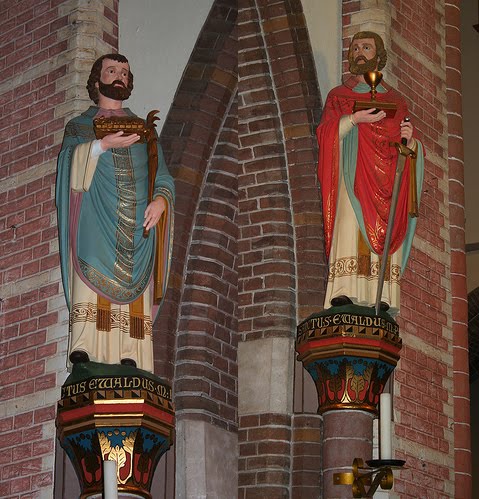
Ewald, Saints
Two English priests and martyrs of the same name in Old Saxony about 695
Ewald (or HEWALD), SAINTS, Martyrs in Old Saxony about 695. They were two priests and natives of Northumbria, England. Both bore the same name, but were distinguished as Ewald the Black and Ewald the Fair, from the difference in the color of their hair and complexions. According to the example of many at that time, they spent several years as students in the schools of Ireland. Ewald the Black was the more learned of the two, but both were equally renowned for holiness of life. They were apparently acquainted with St. Willibrord, the Apostle of Friesland, and were animated with his zeal for the conversion of the Germans. Indeed, by some they have been actually numbered among the eleven companions of that saint, but it is more probable they did not set out from England till after St. Willibrord’s departure. They entered upon their mission about 690. The scene of their labors was the country of the ancient Saxons, now part of Westphalia, and covered by the dioceses of Munster, Osnabruck, and Paderborn. At first the Ewalds took up their abode in the house of the steward of a certain Saxon earl or ealdorman (satrapa). Bede remarks that “the old Saxons have no king, but they are governed by several ealdormen [satrapas] who during war cast lots for leadership, but who in time of peace are equal in power” (Hist. Eccl., V, 10). The steward entertained his two guests for several days, and promised to conduct them to the chieftain, as they affirmed they had a message of considerable importance to deliver to him.
Meanwhile, the Ewalds omitted nothing of their religious exercises. They prayed often, recited the canonical hours, and celebrated Mass, for they carried with them all that was necessary for the Holy Sacrifice. The pagan Saxons, understanding from these things that they had Christian priests and missionaries in their midst, began to suspect that their aim was to convert their over-lord, and thus destroy their temples and their religion. Inflamed with jealousy and anger, they resolved that the Ewalds should die. Ewald the Fair they quickly despatched with the sword, but Ewald the Black they subjected to torture, because he was the spokesman and showed greater boldness. He was torn limb from limb, after which the two bodies were cast into the Rhine. This is understood to have happened on October 3 at a place called Aplerbeck, where a chapel still stands.
When the ealdorman heard of what had been done he was exceedingly angry, and took vengeance by ordering the murderers to be put to death and their village to be destroyed by fire. Meanwhile the martyred bodies were miraculously carried against the stream up the Rhine, for the space of forty miles, to the place in which the companions of the Ewalds were residing. As they floated along, a heavenly light, like a column of fire, was seen to shine above them. Even the murderers are said to have witnessed he miraculous brightness. Moreover, one of the martyrs appeared in vision to the monk Tilmon (a companion of the Ewalds), and told him where the bodies would be found: “that the spot would be there where he should see a pillar of light reaching from earth to heaven”. Tilmon arose and found the bodies, and interred them with the honors due to martyrs. From that time onwards, the memory of the Ewalds was annually celebrated in those parts. A spring of water is said to have gushed forth in the place of the martyrdom.
Pepin, Duke of Austrasia, having heard of the wonders that had occurred, caused the bodies to be translated to Cologne, where they were solemnly enshrined in the collegiate church of St. Cunibert. The heads of the martyrs were bestowed on Frederick, Bishop of Münster, by Archbishop Anno of Cologne, at the opening of the shrine in 1074. These relics were probably destroyed by the Anabaptists in 1534. When St. Norbert visited Cologne, in 1121, he obtained two small vessels containing the relics of several saints, and among them were bones of the sainted Ewalds. These were deposited either at Premontre, or at Florennes, a Premonstratensian monastery in the province of Namur. The two Ewalds are honored as patrons in Westphalia, and are mentioned in the Roman Martyrology on October 3. Their feast is celebrated in the dioceses of Cologne and Münster.
COLUMBA EDMONDS
Catholic Answers is pleased to provide this unabridged entry from the original Catholic Encyclopedia, published between 1907 and 1912. It is a valuable resource for subjects related to theology, philosophy, history, culture, and more. Like most works that are more than a century old, though, it may occasionally use anachronistic language or present outdated scientific information. Accordingly, in offering this resource Catholic Answers does not thereby endorse every assertion or phrase in it.
catholic.com/
9
posted on
10/03/2025 5:11:25 PM PDT
by
annalex
(fear them not)
To: annalex
10
posted on
10/03/2025 5:13:31 PM PDT
by
annalex
(fear them not)
To: annalex
NAVARRE BIBLE COMMENTARY(RSV)
Ad Majorem Dei Gloriam (To the Greater Glory of God)
First Reading:
From: Baruch 1:15-22
Admission of sin
------------------------
[15] And you shall say: ‘Righteousness belongs to the Lord our God, but confusion of face, as at this day, to us, to the men of Judah, to the inhabitants of Jerusalem, [16] and to our kings and our princes and our priests and our prophets and our fathers, [17] because we have sinned before the Lord, [18] and have disobeyed him, and have not heeded the voice of the Lord our God, to walk in the statutes of the Lord which he set before us. [19] From the day when the Lord brought our fathers out of the land of Egypt until today, we have been disobedient to the Lord our God, and we have been negligent, in not heeding his voice. [20] So to this day there have clung to us the calamities and the curse which the Lord declared through Moses his servant at the time when he brought our fathers out of the land of Egypt to give to us a land flowing with milk and honey. [21] We did not heed the voice of the Lord our God in all the words of the prophets whom he sent to us, but we each followed the intent of his own wicked heart by serving other gods and doing what is evil in the sight of the Lord our God.
*******************************************************************
Commentary:
1:15-22. This passage marks the start of a prayer of lamentation and contrition – themes that take up a large part of the book. Similar sentiments are to be found in Daniel 9:5-11. A chorus is repeated at three points: “We have not heeded the voice of the Lord” (cf. vv. 18, 19, 21; cf. 2:5). Three sins are singled out – disobedience to the Lord’s commandments (v. 18); failure to listen to the message of the prophets sent by God (v. 21); and lapsing into idolatry (v. 22).
11
posted on
10/03/2025 5:41:08 PM PDT
by
fidelis
(Ecce Crucem Domini! Fugite partes adversae! Vicit Leo de tribu Juda, Radix David! Alleluia!)
Gospel Reading: From: Luke 10:13-16
Jesus Condemns Cities for Their Unbelief
----------------------------------------
(Jesus said,) [13] "Woe to you, Chorazin! woe to you, Bethsaida! for if the mighty works done in you had been done in Tyre and Sidon, they would have repented long ago, sitting in sackcloth and ashes. [14] But it shall be more tolerable in the judgment for Tyre and Sidon than for you. [15] And you, Capernaum, will you be exalted to Heaven? You shall be brought down to Hades.
[16] "He who hears you hears Me, and he who rejects you rejects Me, and he who rejects Me rejects Him who sent Me."
***********************************************************************
Commentary:
16. On the evening of the day of His resurrection, our Lord entrusts His Apostles with the mission received from the Father, endowing them with powers similar to His own (John 20:21). Some days later He will confer on Peter the primacy He had already promised him (John 21:15-17). The Pope is the successor of Peter, and the bishops the successor of the Apostles (cf. "Lumen Gentium", 20). Therefore, "Bishops who teach in communion with the Roman Pontiff are to be revered by all as witnesses of divine and Catholic truth [...]. This loyal submission of the will and intellect must be given, in a special way, to the authentic teaching authority of the Roman Pontiff, even when he does not speak "ex cathedra" (Vatican II, "Lumen Gentium", 25).
12
posted on
10/03/2025 5:41:23 PM PDT
by
fidelis
(Ecce Crucem Domini! Fugite partes adversae! Vicit Leo de tribu Juda, Radix David! Alleluia!)
13
posted on
10/03/2025 5:42:31 PM PDT
by
fidelis
(Ecce Crucem Domini! Fugite partes adversae! Vicit Leo de tribu Juda, Radix David! Alleluia!)
Disclaimer:
Opinions posted on Free Republic are those of the individual
posters and do not necessarily represent the opinion of Free Republic or its
management. All materials posted herein are protected by copyright law and the
exemption for fair use of copyrighted works.
FreeRepublic.com is powered by software copyright 2000-2008 John Robinson