Catena Aurea by St. Thomas Aguinas
9:57–62
57. And it came to pass, that, as they went in the way, a certain man said unto him, Lord, I will follow thee whithersoever thou goest.
58. And Jesus said unto him, Foxes have holes, and birds of the air have nests; but the Son of man hath not where to lay his head.
59. And he said unto another, Follow me. But he said, Lord, suffer me first to go and bury my father.
60. Jesus said unto him, Let the dead bury their dead; but go thou and preach the kingdom of God.
61. And another also said, Lord, I will follow thee; but let me first go bid them farewell, which are at home at my house.
62. And Jesus said unto him, No man, having put his hand to the plough, and looking back, is fit for the kingdom of God.
CYRIL OF ALEXANDRIA. (non occ.) Although the Almighty Lord is bountiful, He does not grant to every one absolutely and indiscriminately heavenly and divine gifts, but to those only who are worthy to receive them, who free themselves and their souls from the stains of wickedness. And this we are taught by the force of the angelic words, And it came to pass, that, us they went in the way, a certain man said unto him, Lord, I will follow thee. First indeed there is much tardiness implied in the manner of his coming. It is next shewn that he is filled with too great presumption. For he sought not to follow Christ simply as several others of the people, but rather caught at the honour of the Apostleship. Whereas Paul says, No one taketh the honour to himself but he that is called of God. (Heb. 5:4.)
ATHANASIUS. (non occ.) He dared also to match himself with the incomprehensible power of the Saviour, saying, I will follow thee whithersoever thou goest; for to follow the Saviour simply to hear His teaching is possible to human nature, as it directs itself towards men, but it is not possible to go with Him wherever He is; for He is incomprehensible, and is not confined by place.
CYRIL OF ALEXANDRIA. In another respect also our Lord deservedly gives him a refusal, for He taught that to follow the Lord, a man must take up his cross, and renounce the affection of this present life. And our Lord finding this lacking in him does not blame him, but corrects him.
It follows, And Jesus says to him, The foxes have holes, &c.
THEOPHYLACT. For having seen our Lord drawing much people to Him, he thought that he received reward from them, and that if he followed our Lord, he might obtain money.
BEDE. Therefore it is said to him, Why do you seek to follow Me for the riches and gain of this world, when so great is My poverty that I have not even a place of rest, and take shelter under another man’s roof.
CHRYSOSTOM. See how our Lord sets forth by his works the poverty which he taught. For him was no table spread, no lights, no house, nor any such thing.
CYRIL OF ALEXANDRIA. Now under a mystical signification He applies the name of foxes and birds of the air to the wicked and crafty powers of evil spirits. As if He said, Since foxes and birds of the air have their abode in thee, how shall Christ rest in thee? What fellowship has light with darkness? (2 Cor. 6:14.)
ATHANASIUS. Or herein our Lord teaches the greatness of His gift, as if He said, All created things may be confined by place, but the Word of God has incomprehensible power. Say not then, I will follow thee whithersoever thou goest. But if thou wouldest be a disciple, cast off 1 foolish things, for it is impossible for him who remains in foolishness to become a disciple of the Word.
AMBROSE. Or, He compares foxes to heretics, because they are indeed a wily animal, and, ever intent upon fraud, commit their robberies by stealth. They let nothing be safe, nothing be at rest, nothing secure, for they hunt their prey into the very abodes of men. The fox again, an animal full of craft, makes no hole for itself, yet likes to lie always concealed in a hole. So the heretics, who know not how to construct a house for themselves, circumscribe and deceive others. This animal is never tamed, nor is it of use to man. Hence the Apostle, A heretic after the first and second admonition reject. (Tit. 3:10.) But the birds of the air, which are frequently brought in to represent spiritual wickedness, build as it were their nests in the breasts of the wicked, and as long as deceit reigns over the affections, the divine principle has no opportunity to take possession. But when a man has proved his heart to be innocent, upon him Christ leans in some measure the weight of His greatness, for by a more abundant shedding of grace He is planted in the breasts of good men. So then it does not seem reasonable that we should think him faithful and simple, who is rejected by the judgment of the Lord, notwithstanding that he promised the service of unwearied attendance; but our Lord cares not for this kind of service, but only purity of affection, nor is his attendance accepted whose sense of duty is not proved. For the hospitality of faith should be given with circumspection, lest while opening the interior of our house to the unbelieving, through our imprudent credulity we fall a snare to the treachery of others. Therefore that you may be aware that God despises not attendance upon him but deceit, He who rejected the deceitful man chose the innocent. For it follows, And he said unto another, Follow me. But He says this to him, whose father He knew to be dead. Hence it follows, But he said, Lord, suffer me first to go and bury my father.
BEDE. He did not refuse the discipleship, but his wish was, having fulfilled the filial duty of burying his father, to follow Christ more freely.
AMBROSE. But the Lord calls those upon whom He has compassion. Hence it follows, And Jesus said, Let the dead bury their dead. Since we have received as a religious duty the burial of the human body, how is it thus that the burial even of a father’s dead body is forbidden, unless you are to understand that human things are to be postponed to divine? It is a good employment, but the hindrance is greater, for he who divides his pursuits, draws down his affections; he who divides his care, delays his advances. We must first set about the things which are most important. For the Apostles also, that they might not be occupied in the office of distributing alms, ordained ministers for the poor.
CHRYSOSTOM. (Hom. 27. in Matt.) But what more necessary than the burial of his father, what more easy, seeing that there would not be much time given to it? We are then hereby taught that it becomes us not to spend even the slightest portion of our time in vain, although we have a thousand things to compel us, nay to prefer spiritual things to even our greatest necessities. For the devil watchfully presses close upon us, wishing to find any opening, and if he causes a slight negligence, he ends in producing a great weakness.
AMBROSE. The performance of a father’s burial is not then prohibited, but the observance of religious duty is preferred to the ties of relationship. The one is left to those in like condition, the other is commanded to those who are left. But how can the dead bury the dead? unless you here understand a twofold death, one a natural death, the other the death of sin. (Rom. 9:11.) There is also a third death, by which we die unto sin, live unto God.
CHRYSOSTOM. (ubi sup.) By thus saying, their dead, he shews that this man’s father was not his dead, for I suppose that the deceased was of the number of the unbelieving.
AMBROSE. Or because the throat of the ungodly is an open sepulchre, their memory is ordered to be forgotten whose services die together with their bodies. Nor is the son recalled from his duty to his father, but the faithful is separated from the communion of the unbelieving; there is no prohibition of duty, but a mystery of religion, that is, that we should have no fellowship with the dead Gentiles.
CYRIL OF ALEXANDRIA. Or else, his father was borne down with years, and he thought he was doing an honourable act in proposing to pay the kind offices which were due to him, according to Exodus, Honour thy father and thy mother. (Exod. 20:12.) Hence when calling him to the ministry of the Gospel, our Lord said, Follow me, he sought for a time of respite, which should suffice for the support of his decrepit father, saying, Permit me first to go and bury my father, not that he asked to bury his deceased father, for Christ would not have hindered the wish to do this, but he said, Bury, that is, support in old age even till death. But the Lord said to him, Let the dead bury their dead. For there were other attendants also bound by the same tie of relationship, but as I consider dead, because they had not yet believed Christ. Learn from this, that our duty to God is to be preferred to our love for our parents, to whom we shew reverence, because through them have we been born. But the God of all, when as yet we were not, brought us into being, our parents were made the ministers of our introduction.
AUGUSTINE. (de Con. Ev. l. ii. c. 23.) Our Lord spoke this to the man to whom He had said, Follow me. But another disciple put himself forward, to whom no one had spoken any thing, saying, I will follow thee, O Lord; but let me first go and bid them farewell who are at home, lest perchance they look for me as they are wont.
CYRIL OF ALEXANDRIA. Now this promise is worthy of our admiration and full of all praise, but to bid farewell to those who are at home, to get leave from them, shews that he was still somehow divided from the Lord, in that he had not yet resolved, to make this venture with his whole heart. For to wish to consult relations who would not agree to his proposal betokens one somewhat wavering. Wherefore our Lord condemns this, saying, No man, having put his hand to the plough, and looking back, is fit for the kingdom of God. He puts his hand to the plough who is ambitious to follow, yet looks back again who seeks an excuse for delay in returning home, and consulting with his friends.
AUGUSTINE. (Serm. 100.) As if he said to him, The East calls thee, and thou turnest to the West.
BEDE.: To put one’s hand to the plough, is also, (as it were by a certain sharp instrument,) by the wood and iron of our Lord’s passion, to wear away the hardness of our heart, and to open it to bring forth the fruits of good works. But if any one, having begun to exercise this, delights to look back with Lot’s wife to the things which he had left, he is deprived of the gift of the kingdom to come.
GREEK EXPOSITOR. (Nilus Monac.) For the frequent looking upon the things which we have forsaken, through the force of habit draws us back to our past way of life. For practice has great power to retain to itself. Is not habit generated of use, and nature of habit? But to get rid of or change nature is difficult; for although when compelled it for a while turns aside, it very rapidly returns to itself.
BEDE. But if the disciple about to follow our Lord is reproved for wishing even to bid farewell at home, what will be done to such as for no advantage-sake frequently visit the houses of those whom they have left in the world?
Catena Aurea Luke 9
Catena Aurea by St. Thomas Aguinas
CHAP. 18
18:1–6
1. At the same time came the disciples unto Jesus, saying, Who is the greatest in the kingdom of heaven?
2. And Jesus called a little child unto him, and set him in the midst of them,
3. And said, Verily I say unto you, Except ye be converted, and become as little children, ye shall not enter into the kingdom of heaven.
4. Whosoever therefore shall humble himself as this little child, the same is greatest in the kingdom of heaven.
5. And whoso shall receive one such little child in my name receiveth me.
6. But whoso shall offend one of these little ones which believe in me, it were better for him that a millstone were hanged about his neck, and that he were drowned in the depth of the sea.
JEROME. The disciples seeing one piece of money paid both for Peter and the Lord, conceived from this equality of ransom that Peter was preferred before all the rest of the Apostles.
CHRYSOSTOM. Thus they suffered a human passion, which the Evangelist denotes by saying, At the same time come the disciples to Jesus, saying, Who, we pray thee, is the greatest in the kingdom of heaven? Ashamed to shew the feeling which was working within, they do not say openly, Why have you honoured Peter above us? but they ask in general, Who is the greatest? When in the transfiguration they saw three distinguished, namely, Peter, James, and John, they had no such feeling, but now that one is singled out for especial honour, then they are grieved. But do you remember, first, that it was nothing in this world that they sought; and, secondly, that they afterwards laid aside this feeling? Even their failings are above us, whose enquiry is not, Who is the greatest in the kingdom of heaven? but, Who is greatest in the kingdom of the world?
ORIGEN. Herein we ought to be imitators of the disciples, that when any question of doubt arises among us, and we find not how to settle it, We should with one consent go to Jesus, Who is able to enlighten the hearts of men to the explication of every perplexity. We shall also consult some of the doctors, who are thought most eminent in the Churches. But in that they asked this question, the disciples knew that there was not an equality among the saints in the kingdom of heaven; what they yet sought to learn was, how they were so, and lived as greater and less. Or, from what the Lord had said above, they knew Who was the best and who was great; but out of many great, who was the greatest, this Was not clear to them.
JEROME. Jesus seeing their thoughts would heal their ambitious strivings, by arousing an emulation in lowliness; whence it follows, And Jesus calling a little child, set him in the midst of them.
CHRYSOSTOM. He chose, I suppose, quite an infant, devoid of any of the passions.
JEROME. One whose tender age should express to them the innocence which they should have. But truly He set Himself in the midst of them, a little one who had come not to be ministered unto, but to minister; (Mat. 20:28.) that He might be a pattern of holiness. Others interpret the little one of the Holy Spirit, whom He set in the hearts of His disciples, to change their pride into humility. (Vid. Origen. in loc.) And he said. Verily I say unto you, Except ye be converted, and become as little children, ye shall not enter into the kingdom of heaven. He does not enjoin on the Apostles the age, but the innocence of infants, which they have by virtue of their years, but to which these might attain by striving; that they should be children in malice, not in understanding. As though He had said, As this child, whom I set before you as a pattern, is not obstinate in anger, when injured does not bear it in mind, has no emotion at the sight of a fair woman, does not think one thing while he speaks another; so ye, unless ye have the like innocence and purity of mind, shall not be able to enter into the kingdom of heaven.
HILARY. He calls infants all who believe through the hearing of faith; for such follow their father, love their mother, know not to will that which is evil, do not bear hate, or speak lies, trust what is told them, and believe what they hear to be true. But the letter is thus interpreted.
GLOSS. (interlin.) Except ye be converted from this ambition and jealousy in which you are at present, and become all of you as innocent and humble in disposition as you are weak, in your years, ye shall not enter into the kingdom of heaven; and since there is none other road to enter in, whoso shall humble himself as this little child, the same is greatest in the kingdom of heaven; for by how much a man is humble now, by so much shall he be exalted in the kingdom of heaven.
REMIGIUS. In the understanding of grace, or in ecclesiastical dignity, or at least in everlasting blessedness.
JEROME. Or otherwise; Whoso shall humble himself as this little child, that is, whoso shall humble himself after My example, he shall enter into the kingdom of heaven. It follows, And whoso receiveth one such little one in my name, receiveth me.
CHRYSOSTOM. Not only if ye become such yourselves, but also if for My sake you shall pay honour to other such, ye receive reward; and as the return for the honour you pay them, I entail upon you the kingdom. He puts indeed what is far greater, Receiveth me.
JEROME. For whoever is such that he imitates Christ’s humility and innocence, Christ is received by him; and by way of caution, that the Apostles should not think, when such are come to them, that it is to themselves that the honour is paid, He adds, that they are to be received not for their own desert, but in honour of their Master.
CHRYSOSTOM. And to make this word the rather received. He subjoins a penalty in what follows, Whoso offendeth one of these little ones, & c. as though he had said, As those who for My sake honour one of these, have their reward, so they who dishonour shall undergo the extreme punishment. And marvel not that He calls an evil word an offence, for many of feeble spirit are offended by only being despised,
JEROME. Observe that he who is offended is a little one, for the greater hearts do not take offences. And though it may be a general declaration against all who scandalize any, yet from the connection of the discourse it may be said specially to the Apostles; for in asking who should be greatest in the kingdom of heaven, they seemed to be contending for preeminence among themselves; and if they had persisted in this fault, they might have scandalized those whom they called to the faith, seeing the Apostles contending among themselves for the preference.
ORIGEN. But how can he who has been converted, and become as a little child, be yet liable to be scandalized? This may be thus explained. Every one who believes on the Son of God, and walks after evangelic acts, is converted and walks as a little child; but he who is not converted that he may become as a child, it is impossible that he should enter into the kingdom of heaven. But in every congregation of believers, there are some only newly converted that they may become as little children, but not yet made such; these are the little ones in Christ, and these are they that receive offence.
JEROME. When it is said, It is better for him that a mill-stone be hanged about his neck, He speaks according to the custom of the province; for among the Jews this was the punishment of the greater criminals, to drown them by a stone tied to them. It is better for him, because it is far better to receive a brief punishment for a fault, than to be reserved for eternal torments.
CHRYSOSTOM. To correspond with the foregoing, He should have said here, Receiveth not Me, which were bitterer than any punishment; but because they were dull, and the before-named punishment did not move them, by a familiar instance He shews that punishment awaited them; for He therefore says, it were better for him, because another more grievous punishment awaits him.
HILARY. Mystically; The work of the mill is a toil of blindness, for the beasts having their eyes closed are driven round in a circle, and under the type of an ass we often find the Gentiles figured, who are held in the ignorance of blind labour; while the Jews have the path of knowledge set before them in the Law, who if they offend Christ’s Apostles it were better for them, that having their necks made fast to a mill-stone, they should be drowned in the sea, that is, kept under labour and in the depths of ignorance, as the Gentiles; for it were better for them that they should have never known Christ, than not to have received the Lord of the Prophets.
GREGORY. (Mor. vi. 37.) Otherwise; What is denoted by the sea, but the world, and what by the mill-stone, but earthly action? which, when it binds the neck in the yoke of vain desires, sends it to a dull round of toil. There arc some who leave earthly action, and bond themselves to aims of contemplation beyond the reach of intellect, laying aside humility, and so not only throw themselves into error, but also cast many weak ones out of the bosom of truth. Whoso then offends one of the least of mine, it were better for him that a mill-stone be tied about his neck, and he be cast into the sea; that is, it were better for a perverted heart to be entirely occupied with worldly business, than to be at leisure for contemplative studies to the hurt of many.
AUGUSTINE. (Quæst. Ev. i. 24) Otherwise; Whoso offendeth one of these little ones, that is so humble as He would have his disciples to be, by not obeying, or by opposing, (as the Apostle says of Alexander,) it were better for him, that a millstone should be hanged about his neck, and he be drowned in the depths of the sea, (2 Tim. 4:15.) that is, it were better for him that desire of the things of the world, to which the blind and foolish are tied down, should sink him by its load to destruction.
Catena Aurea Matthew 18
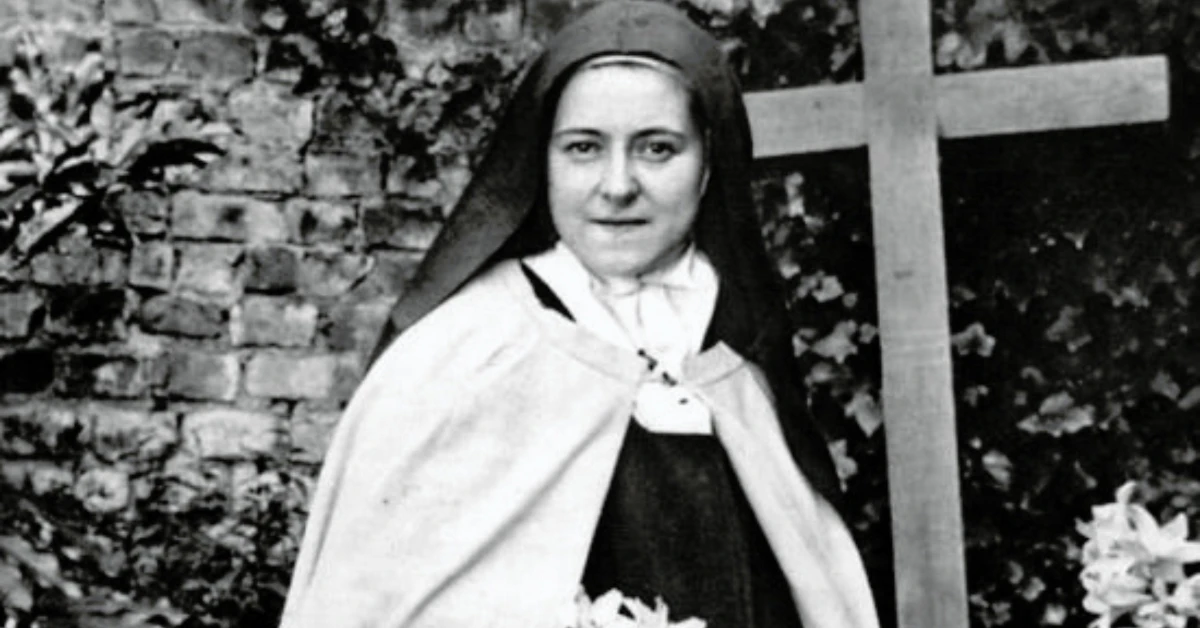
Saint of the Day for October 1
(January 2, 1873 – September 30, 1897)
Saint Thérèse of Lisieux’s Story
“I prefer the monotony of obscure sacrifice to all ecstasies. To pick up a pin for love can convert a soul.”
These are the words of Thérèse of Lisieux, a Carmelite nun called the “Little Flower,” who lived a cloistered life of obscurity in the convent of Lisieux, France. And her preference for hidden sacrifice did indeed convert souls. Few saints of God are more popular than this young nun. Her autobiography, The Story of a Soul, is read and loved throughout the world. Thérèse Martin entered the convent at the age of 15 and died in 1897 at the age of 24.
Life in a Carmelite convent is indeed uneventful and consists mainly of prayer and hard domestic work. But Thérèse possessed that holy insight that redeems the time, however dull that time may be. She saw in quiet suffering a redemptive suffering, suffering that was indeed her apostolate. Thérèse said she came to the Carmel convent “to save souls and pray for priests.” And shortly before she died, she wrote: “I want to spend my heaven doing good on earth.”
Thérèse of Lisieux was canonized in 1925. On October 19, 1997, Pope John Paul II proclaimed her a Doctor of the Church, the third woman to be so recognized in light of her holiness and the influence of her teaching on spirituality in the Church.
Her parents, Louis and Zélie, were beatified in 2008 and canonized in 2015.
Celebrating October’s Saints
Reflection
Thérèse has much to teach our age of the image, the appearance, the “self.” We have become a dangerously self-conscious people, painfully aware of the need to be fulfilled, yet knowing we are not. Thérèse, like so many saints, sought to serve others, to do something outside herself, to forget herself in quiet acts of love. She is one of the great examples of the gospel paradox that we gain our life by losing it, and that the seed that falls to the ground must die in order to live.
Preoccupation with self separates modern men and women from God, from their fellow human beings, and ultimately from themselves. We must re-learn to forget ourselves, to contemplate a God who draws us out of ourselves, and to serve others as the ultimate expression of selfhood. These are the insights of Saint Thérèse, and they are more valid today than ever.
Saint Thérèse is the Patron Saint of:
Florists
Missionaries
Pilots
Priests
franciscanmedia.org
Gospel Reading: From: Luke 9:57-62
The Calling of Three Disciples
------------------------------
[57] As they were going along the way, a man said to Him (Jesus), "I will follow you wherever You go." [58] And Jesus said to him, "Foxes have holes, and birds of the air have nests; but the Son of Man has nowhere to lay His head." [59] To another He said, "Follow Me." But he said, "Lord, let me first go and bury my father." [60] But He said to him, "Leave the dead to bury their own dead; but as for you, go and proclaim the Kingdom of God." [61] Another said, "I will follow You, Lord; but let me first say farewell to those at my home." [62] Jesus said to him, "No one who puts his hand to the plough and looks back is fit for the Kingdom of God."
***********************************************************************
Commentary:
57-62. Our Lord spells out very clearly what is involved in following Him. Being a Christian is not an easy or comfortable affair: it calls for self-denial and for putting God before everything else. See the notes on Matthew 8:18-22 and Matthew 8:22.
[Notes on Matthew 8:18:22 and 8:22: 18-22. From the very outset of His messianic preaching, Jesus rarely stays in the same place; He is always on the move. He "has nowhere to lay His head" (Matthew 8:20). Anyone who desires to be with him has to "follow Him". This phrase "following Jesus" has a very precise meaning: it means being His disciple (cf. Matthew 19:28). Sometimes the crowds "follow Him"; but Jesus' true disciples are those who "follow Him" in a permanent way, that is, who keep on following Him: being a "disciple of Jesus" and "following Him" amount to the same thing. After our Lord's ascension, "following Him" means being a Christian (cf. Acts 8:26). By the simple and sublime fact of Baptism, every Christian is called, by a divine vocation, to be a full disciple of our Lord, with all that that involves.
The evangelist here gives two specific cases of following Jesus. In the case of the scribe our Lord explains what faith requires of a person who realizes that he has been called; in the second case—that of the man who has already said "yes" to Jesus--He reminds him of what His commandment entails. The soldier who does not leave his position on the battlefront to bury his father, but instead leaves that to those in the rearguard, is doing his duty. If service to one's country makes demands like that on a person, all the more reason for it to happen in the service of Jesus Christ and His Church.
Following Christ, then, means we should make ourselves totally available to Him; whatever sacrifice He asks of us we should make: the call to follow Christ means staying up with Him, not falling behind; we either follow Him or lose Him. In the Sermon on the Mount (Matthew 5-7) Jesus explained what following Him involves--a teaching which we find summarized in even the most basic catechism of Christian doctrine: a Christian is a man who believes in Jesus Christ--a faith he receives at Baptism--and is duty bound to serve Him. Through prayer and friendship with the Lord every Christian should try to discover the demands which this service involves as far as he personally is concerned.
20. "The Son of Man": this is one of the expressions used in the Old Testament to refer to the Messiah. It appeared first in Daniel 7:14 and was used in Jewish writings in the time of Jesus. Until our Lord began to preach it had not been understood in all its depth. The title "the Son of man" did not fit in very well with Jewish hopes of an earthly Messiah; this was why it was Jesus' favorite way of indicating that He was the Messiah--thereby avoiding any tendency to encourage Jewish nationalism. In the prophecy of Daniel just mentioned this messianic title has a transcendental meaning; by using it Jesus was able discreetly to proclaim that He was the Messiah and yet avoid people interpreting His role in a political sense. After the Resurrection the Apostles at last realized that "Son of Man" meant nothing less than "Son of God".
22. "Leave the dead to bury their own dead": although this sounds very harsh, it is a style of speaking which Jesus did sometimes use: here the "dead" clearly refers to those whose interest is limited to perishable things and who have no aspirations towards the things that last forever.
"If Jesus forbade him," St. John Chrysostom comments, "it was not to have us neglect the honor due to our parents, but to make us realize that nothing is more important than the things of Heaven and that we ought to cleave to these and not to put them off even for a little while, though our engagements be ever so indispensable and pressing" ("Hom. on St. Matthew", 27).]