Free Republic
Browse · Search
Religion
Topics · Post Article

Skip to comments.

Catholic Caucus: Daily Mass Readings 27-September-2025
Universalis/Jerusalem Bible ^

Posted on 09/28/2025 8:42:10 AM PDT by annalex

27 September 2025

Saint Vincent de Paul, Priest
on Saturday of week 25 in Ordinary Time


St. Vincent de Paul in Kansas City

Readings at Mass

Liturgical Colour: White. Year: C(I).

Readings for the feria

Readings for the memorial

These are the readings for the feria


First reading
Zechariah 2:5-9,14-15

'I will be the glory of Jerusalem'

Raising my eyes, I saw a vision. It was this: there was a man with a measuring line in his hand. I asked him, ‘Where are you going?’ He said, ‘To measure Jerusalem, to find out her breadth and her length.’ And then, while the angel who was talking to me stood still, another angel came forward to meet him. He said to him, ‘Run, and tell that young man this, “Jerusalem is to remain unwalled, because of the great number of men and cattle there will be in her. But I – it is the Lord who speaks – I will be a wall of fire for her all round her, and I will be her glory in the midst of her.”’
Sing, rejoice,
daughter of Zion;
for I am coming
to dwell in the middle of you
– it is the Lord who speaks.
Many nations will join the Lord,
on that day;
they will become his people.


Responsorial Psalm
Jeremiah 31:10-12,13
The Lord will guard us, as a shepherd guards his flock.
O nations, hear the word of the Lord,
  proclaim it to the far-off coasts.
Say: ‘He who scattered Israel will gather him,
  and guard him as a shepherd guards his flock.’
The Lord will guard us, as a shepherd guards his flock.
For the Lord has ransomed Jacob,
  has saved him from an overpowering hand.
They will come and shout for joy on Mount Zion,
  they will stream to the blessings of the Lord.
The Lord will guard us, as a shepherd guards his flock.
Then the young girls will rejoice and will dance,
  the men, young and old, will be glad.
I will turn their mourning into joy,
  I will console them, give them gladness for grief.
The Lord will guard us, as a shepherd guards his flock.

Gospel Acclamationcf.Ac16:14
Alleluia, alleluia!
Open our heart, O Lord,
to accept the words of your Son.
Alleluia!
Or:cf.2Tim1:10
Alleluia, alleluia!
Our Saviour Jesus Christ abolished death
and he has proclaimed life through the Good News.
Alleluia!

GospelLuke 9:43-45

They were afraid to ask him what he meant

At a time when everyone was full of admiration for all he did, Jesus said to his disciples, ‘For your part, you must have these words constantly in your mind: “The Son of Man is going to be handed over into the power of men.”’ But they did not understand him when he said this; it was hidden from them so that they should not see the meaning of it, and they were afraid to ask him about what he had just said.

Continue

These are the readings for the memorial


First reading
1 Corinthians 1:26-31

God chose what is foolish by human reckoning, to shame the wise

Take yourselves for instance, brothers, at the time when you were called: how many of you were wise in the ordinary sense of the word, how many were influential people, or came from noble families? No, it was to shame the wise that God chose what is foolish by human reckoning, and to shame what is strong that he chose what is weak by human reckoning; those whom the world thinks common and contemptible are the ones that God has chosen – those who are nothing at all to show up those who are everything. The human race has nothing to boast about to God, but you, God has made members of Christ Jesus and by God’s doing he has become our wisdom, and our virtue, and our holiness, and our freedom. As scripture says: if anyone wants to boast, let him boast about the Lord.


Responsorial Psalm
Psalm 111(112):1-9
Happy the man who fears the Lord.
or
Alleluia!
Happy the man who fears the Lord,
  who takes delight in all his commands.
His sons will be powerful on earth;
  the children of the upright are blessed.
Happy the man who fears the Lord.
or
Alleluia!
Riches and wealth are in his house;
  his justice stands firm for ever.
He is a light in the darkness for the upright:
  he is generous, merciful and just.
Happy the man who fears the Lord.
or
Alleluia!
The good man takes pity and lends,
  he conducts his affairs with honour.
The just man will never waver:
  he will be remembered for ever.
Happy the man who fears the Lord.
or
Alleluia!
He has no fear of evil news;
  with a firm heart he trusts in the Lord.
With a steadfast heart he will not fear;
  he will see the downfall of his foes.
Happy the man who fears the Lord.
or
Alleluia!
Open-handed, he gives to the poor;
  his justice stands firm for ever.
  His head will be raised in glory.
Happy the man who fears the Lord.
or
Alleluia!

Gospel AcclamationJn10:14
Alleluia, alleluia!
I am the good shepherd, says the Lord;
I know my own sheep and my own know me.
Alleluia!

GospelMatthew 9:35-37

The harvest is rich but the labourers are few

Jesus made a tour through all the towns and villages, teaching in their synagogues, proclaiming the Good News of the kingdom and curing all kinds of diseases and sickness.
  And when he saw the crowds he felt sorry for them because they were harassed and dejected, like sheep without a shepherd. Then he said to his disciples, ‘The harvest is rich but the labourers are few, so ask the Lord of the harvest to send labourers to his harvest.’

Continue


You can also view this page with the New Testament in Greek and English.

Universalis podcast: The week ahead – from 28 September to 4 October

The week of the angels and the crack in the clouds. Michael, Gabriel and Raphael, and the Guardian Angels. St Jerome; the Brazilian Martyrs of Natal. St Thérèse of Lisieux and St Francis of Assisi. A report on the Southwark Day for Catechists. (22 minutes)
Episode notes.Play

Christian Art

Illustration

Each day, The Christian Art website gives a picture and reflection on the Gospel of the day.

The readings on this page are from the Jerusalem Bible, which is used at Mass in most of the English-speaking world. The New American Bible readings, which are used at Mass in the United States, are available in the Universalis apps, programs and downloads.

You can also view this page with the Gospel in Greek and English.


TOPICS: Catholic; General Discusssion; Prayer; Worship
KEYWORDS: catholic; lk9; mt9; ordinarytime; prayer
For your reading, reflection, faith-sharing, comments, questions, discussion.

1 posted on 09/28/2025 8:42:10 AM PDT by annalex
[ Post Reply | Private Reply | View Replies]

To: All

KEYWORDS: catholic; lk9; mt9; ordinarytime; prayer;


2 posted on 09/28/2025 8:43:21 AM PDT by annalex (fear them not)
[ Post Reply | Private Reply | To 1 | View Replies]

To: nickcarraway; NYer; ELS; Pyro7480; livius; ArrogantBustard; Catholicguy; RobbyS; marshmallow; ...


Alleluia Ping

Please FReepmail me to get on/off the Alleluia Ping List.


3 posted on 09/28/2025 8:44:37 AM PDT by annalex (fear them not)
[ Post Reply | Private Reply | To 2 | View Replies]

To: annalex
My dad is back in the hospital. [JimRob update at 242]
Jim still needs our prayers. Thread 2
Prayer thread for Salvation's recovery
Pray for Ukraine
Prayer thread for Fidelis' recovery
Update on Jim Robinson's health issues
4 posted on 09/28/2025 8:45:09 AM PDT by annalex (fear them not)
[ Post Reply | Private Reply | To 3 | View Replies]

To: annalex
Luke
 English: Douay-RheimsLatin: Vulgata ClementinaGreek NT: Byzantine/Majority Text (2000)
 Luke 9
42.........επετιμησεν δε ο ιησους τω πνευματι τω ακαθαρτω και ιασατο τον παιδα και απεδωκεν αυτον τω πατρι αυτου
43And Jesus rebuked the unclean spirit, and cured the boy, and restored him to his father. Et increpavit Jesus spiritum immundum, et sanavit puerum, et reddidit illum patri ejus.εξεπλησσοντο δε παντες επι τη μεγαλειοτητι του θεου παντων δε θαυμαζοντων επι πασιν οις εποιησεν ο ιησους ειπεν προς τους μαθητας αυτου
44And all were astonished at the mighty power of God. But while all wondered at all the things he did, he said to his disciples: Lay you up in your hearts these words, for it shall come to pass, that the Son of man shall be delivered into the hands of men. Stupebant autem omnes in magnitudine Dei : omnibusque mirantibus in omnibus quæ faciebat, dixit ad discipulos suos : Ponite vos in cordibus vestris sermones istos : Filius enim hominis futurum est ut tradatur in manus hominum.θεσθε υμεις εις τα ωτα υμων τους λογους τουτους ο γαρ υιος του ανθρωπου μελλει παραδιδοσθαι εις χειρας ανθρωπων
45But they understood not this word; and it was hid from them, so that they perceived it not. And they were afraid to ask him concerning this word. At illi ignorabant verbum istud, et erat velatum ante eos ut non sentirent illud : et timebant eum interrogare de hoc verbo.οι δε ηγνοουν το ρημα τουτο και ην παρακεκαλυμμενον απ αυτων ινα μη αισθωνται αυτο και εφοβουντο ερωτησαι αυτον περι του ρηματος τουτου

(*) The Greek passage at the first half of verse 43; "εξεπλησσοντο δε παντες επι τη μεγαλειοτητι του θεου" begins verse 44 in the translations.

5 posted on 09/28/2025 8:48:01 AM PDT by annalex (fear them not)
[ Post Reply | Private Reply | To 4 | View Replies]

To: annalex

Catena Aurea by St. Thomas Aguinas

9:43–45

43.—But while they wondered every one at all things which Jesus did, he said unto his disciples,

44. Let these sayings sink down into your ears: for the Son of man shall be delivered into the hands of men.

45. But they understood not this saying, and it was hid from them, that they perceived it not: and they feared to ask him of that saying.

CYRIL OF ALEXANDRIA. (non occ.) Every thing that Jesus did claimed admiration from all men for a peculiar and divine light reflected upon each of His works, according to the Psalms, honour and majesty wilt thou lay upon him. (Ps. 21:5.) Although all indeed marvelled at those things which He did, He however addresses what follows, not to all, but to His disciples; as it is said, But while they wondered every one, &c. He had shewn His glory on the mount to His disciples, and after this delivered a man from an evil spirit, but it was necessary for Him to undergo His passion for our salvation. Now His disciples might have been perplexed, saying, “Have we then been deceived in that we thought him to be God?” That they might know then what was to happen to Him, He bids them lay up in their minds as a certain deposit the mystery of His passion, saying, Let these sayings sink down in your hearts. By the word your, He distinguishes them from others. For the multitude were not to know that He was about to suffer, but were rather to be assured that the dead would rise again, destroying death, lest they should be offended.

TITUS BOSTRENSIS. While all thus were wondering at the miracles, He foretels His passion. For miracles do not save, but the cross conveys the benefit. Hence he adds, For the Son of man shall he delivered into the hands of men.

ORIGEN. (in Matt. tom. 13.) But it is not clearly expressed by whom He is to be delivered, for one says, that He is to be delivered up by Judas, another by the devil; but Paul says, that God the Father delivered Him up for us all; (Rom. 8:32.) but Judas, as he delivered Him up for money, did it traitorously, the Father for His mercies’ sake.

THEOPHYLACT. Now our Lord in condescension to their infirmities and governing them with a kind of economy, did not permit them to understand what was said of the cross; as it follows, But they understood not.

BEDE. This ignorance of the disciples proceeds not so much from slowness of understanding as from affection, for since they were yet carnal and ignorant of the mystery of the cross, they could not believe that He whom they thought to be really God would suffer death. And because they were often accustomed to hear Him speak by figure, they thought that He meant figuratively something else, by what He said of His betrayal.

CYRIL OF ALEXANDRIA. Now some one perhaps will say, How were the disciples ignorant of the mystery of the cross, seeing that it was touched upon in several places by the shadows of the Law? But as Paul relates, Even unto this day, when Moses is read, the vail is upon their hearts. (2 Cor. 3:15.) It becomes then those who approach Christ, to say, Open thou my eyes, that I may behold the wonderful things out of thy law. (Ps. 119:18.)

THEOPHYLACT. Mark also the reverence of the disciples in what follows, And they feared to ask him of that saying. For fear is the first step to reverence.

Catena Aurea Luke 9


6 posted on 09/28/2025 8:49:19 AM PDT by annalex (fear them not)
[ Post Reply | Private Reply | To 5 | View Replies]

To: annalex


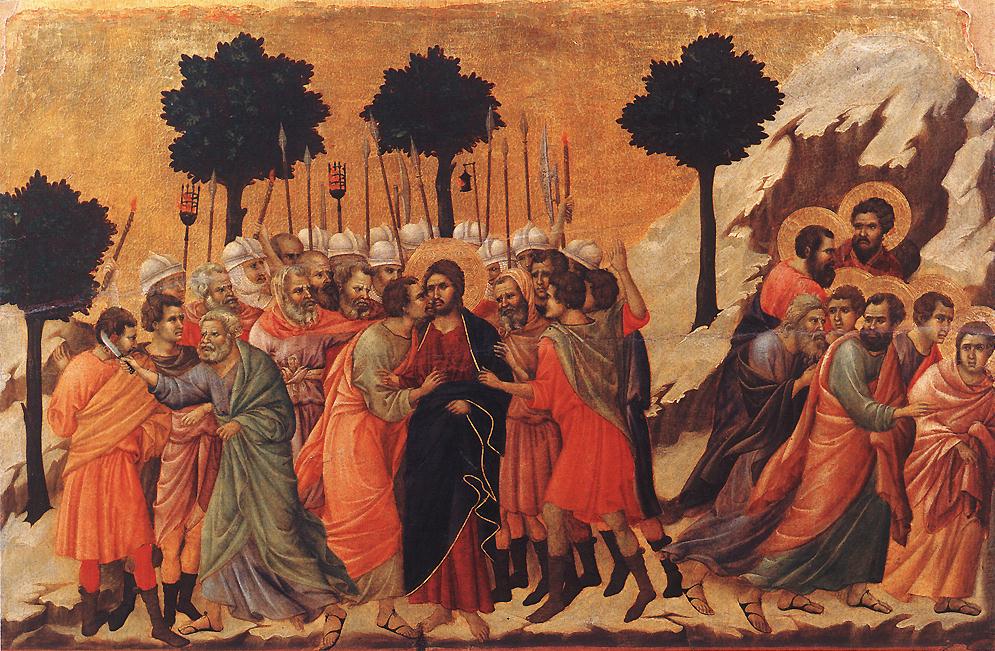
Christ Taken Prisoner

Duccio di Buoninsegna

1308-11
Tempera on wood, 51 x 76 cm
Museo dell'Opera del Duomo, Siena

7 posted on 09/28/2025 8:49:36 AM PDT by annalex (fear them not)
[ Post Reply | Private Reply | To 6 | View Replies]

To: annalex
Matthew
 English: Douay-RheimsLatin: Vulgata ClementinaGreek NT: Byzantine/Majority Text (2000)
 Matthew 9
35And Jesus went about all the cities, and towns, teaching in their synagogues, and preaching the gospel of the kingdom, and healing every disease, and every infirmity. Et circuibat Jesus omnes civitates, et castella, docens in synagogis eorum, et prædicans Evangelium regni, et curans omnem languorem, et omnem infirmitatem.και περιηγεν ο ιησους τας πολεις πασας και τας κωμας διδασκων εν ταις συναγωγαις αυτων και κηρυσσων το ευαγγελιον της βασιλειας και θεραπευων πασαν νοσον και πασαν μαλακιαν εν τω λαω
36And seeing the multitudes, he had compassion on them: because they were distressed, and lying like sheep that have no shepherd. Videns autem turbas, misertus est eis : quia erant vexati, et jacentes sicut oves non habentes pastorem.ιδων δε τους οχλους εσπλαγχνισθη περι αυτων οτι ησαν εσκυλμενοι και ερριμμενοι ωσει προβατα μη εχοντα ποιμενα
37Then he saith to his disciples, The harvest indeed is great, but the labourers are few. Tunc dicit discipulis suis : Messis quidem multa, operarii autem pauci.τοτε λεγει τοις μαθηταις αυτου ο μεν θερισμος πολυς οι δε εργαται ολιγοι
38Pray ye therefore the Lord of the harvest, that he send forth labourers into his harvest. Rogate ergo Dominum messis, ut mittat operarios in messem suam.δεηθητε ουν του κυριου του θερισμου οπως εκβαλη εργατας εις τον θερισμον αυτου

8 posted on 09/28/2025 8:52:43 AM PDT by annalex (fear them not)
[ Post Reply | Private Reply | To 7 | View Replies]

To: annalex

Catena Aurea by St. Thomas Aguinas

9:32–35

32. As they went out, behold, they brought to him a dumb man possessed with a devil.

33. And when the devil was east out, the dumb spake: and the multitudes marvelled, saying, It was never so seen in Israel.

34. But the Pharisees said, He casteth out devils through the prince of the devils.

35. And Jesus went about all the cities and villages, teaching in their synagogues, and preaching the Gospel of the kingdom, and healing every sickness and every disease among the people.

REMIGIUS. Observe the beautiful order of His miracles; how after He had given sight to the blind, He restored speech to the dumb, and healed the possessed of the dæmon; by which He shews Himself the Lord of power, and the author of the heavenly medicine. For it was said by Isaiah, Then shall the eyes of the blind be opened, the ears of the deaf shall be unstopped, and the tongue of the dumb loosed. (Is. 35:6.) Whence it is said, When they were gone forth, they brought unto him a man dumb, and possessed with a dæmon.

JEROME. The Greek word here (κωφὸς) is more frequent in common speech in the sense of ‘deaf,’ but it is the manner of Scripture to use it indifferently as either.

CHRYSOSTOM. This was not a mere natural defect; but was from the malignity of the dæmon; and therefore he needed to be brought of others, for he could not ask any thing of others as living without voice, and the dæmon chaining his spirit together with his tongue. Therefore Christ does not require faith of him, but immediately healed his disorder; as it follows, And when the dæmon was cast out, the dumb spake.

HILARY. The natural order of things is here preserved; the dæmon is first cast out, and there the functions of the members proceed. And the multitude marvelled, saying, It was never so seen in Israel.

CHRYSOSTOM. They set Him thus above others, because He not only healed, but with such ease, and quickness; and cured diseases both infinite in number, and in quality incurable. This most grieved the Pharisees, that they set Him before all others, not only those that then lived, but all who had lived before, on which account it follows, But the Pharisees said, He casteth out dæmons through the Prince of dæmons.

REMIGIUS. Thus the Scribes and Pharisees denied such of the Lord’s miracles as they could deny; and such as they could not they explained by an evil interpretation, according to that, In the multitude of thy excellency thy enemies shall lie unto thee. (Ps. 66:3.)

CHRYSOSTOM. What can be more foolish than this speech of theirs? For it cannot be pretended that one dæmon would cast out another; for they are wont to consent to one another’s deeds, and not to be at variance among themselves. But Christ not only cast out dæmons, but healed the lepers, raised the dead, forgave sins, preached the kingdom of God, and brought men to the Father, which a dæmon neither could nor would do.

RABANUS. Figuratively; As in the two blind men were denoted both nations, Jews and Gentiles, so in the man dumb and afflicted with the dæmon is denoted the whole human race.

HILARY. Or; By the dumb and deaf, and dæmoniae, is signified the Gentile world, needing health in every part; for sunk in evil of every kind, they are afflicted with disease of every part of the body.

REMIGIUS. For the Gentiles were dumb; not being able to open their mouth in the confession of the true faith, and the praises of the Creator, or because in paying worship to dumb idols they were made like unto them. They were afflicted with a dæmon, because by dying in unbelief they were made subject to the power of the Devil.

HILARY. But by the knowledge of God the frenzy of superstition being chased away, the sight, the hearing, and the word of salvation is brought in to them.

JEROME. As the blind receive light, so the tongue of the dumb is loosed, that he may confess Him whom before he denied. The wonder of the multitude is the confession of the nations. The scoff of the Pharisees is the unbelief of the Jews, which is to this day.

HILARY. The wonder of the multitude is followed up by the confession, It was never so seen in Israel; because he, for whom there was no help under the Law, is saved by the power of the Word.

REMIGIUS. They who brought the dumb to be healed by the Lord, signify the Apostles and preachers, who brought the Gentile people to be saved before the face of divine mercy.

AUGUSTINE. (De Cons. Ev. ii. 29.) This account of the two blind men and the dumb dæmon is read in Matthew only. The two blind men of whom the others speak are not the same as these, though something similar was done with them. So that even if Matthew had not also recorded their cure, we might have seen that this present narrative was of a different transaction. And this we ought diligently to remember, that many actions of our Lord are very much like one another, but are proved not to be the same action, by being both related at different times by the same Evangelist. So that when we find cases in which one is recorded by one Evangelist, and another by another, and some difference which we cannot reconcile between their accounts, we should suppose that they are like, but not the same, events.

9:36–38

36. But when he saw the multitudes, he was moved with compassion on them, because they fainted, and were scattered abroad, as sheep having no shepherd.

37. Then saith he unto his disciples, The harvest truly is plenteous, but the labourers are few;

38. Pray ye therefore the Lord of the harvest, that he will send forth labourers into his harvest.

CHRYSOSTOM. The Lord would refute by actions the charge of the Pharisees, who said, He casteth out dæmons by the Prince of the dæmons; for a dæmon having suffered rebuke, does not return good but evil to those who have not shewn him honour. But the Lord on the other hand, when He has suffered blasphemy and contumely, not only does not punish, but does not utter a hard speech, yea He shews kindness to them that did it, as it here follows, And Jesus went about all their towns and villages. Herein He teaches us not to return accusations to them that accuse us, but kindness. For he that ceases to do good because of accusation, shews that his good has been done because of men. But if for God’s sake you do good to your fellow-servants, you will not cease from doing good whatever they do, that your reward may be greater.

JEROME. Observe how equally in villages, cities, and towns, that is to great as well as small, He preaches the Gospel, not respecting the might of the noble, but the salvation of those that believe. It follows, Teaching in their synagogues; this was His meat, going about to do the will of His Father, and saving by His teaching such as yet believed not.

GLOSS. (non occ.) He taught in their synagogues the Gospel of the Kingdom, as it follows, Preaching the Gospel of the Kingdom.

REMIGIUS. Understand, ‘of God;’ for though temporal blessings are also proclaimed, yet they are not called The Gospel. Hence the Law was not called a Gospel, because to such as kept it, it held out not heavenly, but earthly, goods.

JEROME. He first preached and taught, and then proceeded to heal sicknesses, that the works might convince those who would not believe the words. Hence it follows, Healing every sickness and every disease, for to Him alone nothing is impossible.

GLOSS. (ap. Anselm.) By disease we may understand complaints of long standing, by sickness any lesser infirmity.

REMIGIUS. It should be known that those whom He healed outwardly in their bodies, He also healed inwardly in their souls. Others cannot do this of their own power, but can by God’s grace.

CHRYSOSTOM. Nor does Christ’s goodness rest here, but He manifests His care for them, opening the bowels of His mercy towards them; whence it follows, And seeing the multitudes, he had compassion upon them.

REMIGIUS. Herein Christ shews in Himself the disposition of the good shepherd and not that of the hireling. Why He pitied them is added, Because they were troubled1, and sick1 as sheep that have no shepherd—troubled either by dæmons, or by divers sicknesses and infirmities.

GLOSS. (ap. Anselm.) Or, troubled by dæmons, and sick, that is, benumbed and unable to rise; and though they had shepherds, yet they were as though they had them not.

CHRYSOSTOM. This is an accusation against the rulers of the Jews, that being shepherds they appeared like wolves; not only not improving the multitude, but hindering their progress. For when the multitude marvelled and said, It was never so seen in Israel, these opposed themselves, saying, He casteth out dæmons by the prince of the dæmons. (vid. Ps. 102:19.)

REMIGIUS. But when the Son of God looked down from heaven upon the earth, to hear the groans of the captives, straight a great harvest began to ripen; for the multitude of the human race would never have come near to the faith, had not the Author of human salvation looked down from heaven; and it follows, Then said he unto his disciples, The harvest truly is great, but the labourers are few.

GLOSS. (ap. Anselm.) The harvest are those men who can be reaped by the preachers, and separated from the number of the damned, as grain is beaten out from the chaff that it may be laid up in granaries.

JEROME. The great harvest denotes the multitude of the people; the few labourers, the want of instructors.

REMIGIUS. For the number of the Apostles was small in comparison of so great crops to be reaped. The Lord exhorts His preachers, that is, the Apostles and their followers, that they should daily desire an increase of their number; Pray ye therefore the Lord of the harvest, that he would send forth labourers into his harvest.

CHRYSOSTOM. He privately insinuates Himself to be the Lord; for it is He Himself who is Lord of the harvest. For if He sent the Apostles to reap what they had not sown, it is manifest that He sent them not to reap the things of others, but what He had sown by the Prophets. But since the twelve Apostles are the labourers, He said, Pray ye the Lord of the harvest, that he would send labourers into his harvest; and notwithstanding He added none to their number, but rather He multiplied those twelve many times, not by increasing their numbers, but by giving them more abundant grace.

REMIGIUS. Or, He then increased their number when He chose the seventy and two, and then when many preachers were made what time the Holy Spirit descended upon the believers.

CHRYSOSTOM. He shews us that it is a great gift that one should have the power of rightly preaching, in that He tells them that they ought to pray for it. Also we are here reminded of the words of John concerning the threshing-floor, and the fan, the chaff, and the wheat.

HILARY. Figuratively; When salvation was given to the Gentiles, then all cities and towns were enlightened by the power and entrance of Christ, and escaped every former sickness and infirmity. The Lord pities the people troubled with the violence of the unclean Spirit, and sick under the burden of the Law, and having no shepherd at hand to bestow on them the guardianship of the Holy Spirit. But of that gift there was a most abundant fruit, whose plenty far exceeded the multitude of those that drank thereof; how many soever take of it, yet an inexhaustible supply remains; and because it is profitable that there should be many to minister it, He bids us ask the Lord of the harvest, that God would provide a supply of reapers for the ministration of that gift of the Holy Spirit which was made ready; for by prayer this gift is poured out upon us from God.

Catena Aurea Matthew 9

9 posted on 09/28/2025 8:54:57 AM PDT by annalex (fear them not)
[ Post Reply | Private Reply | To 8 | View Replies]

To: annalex


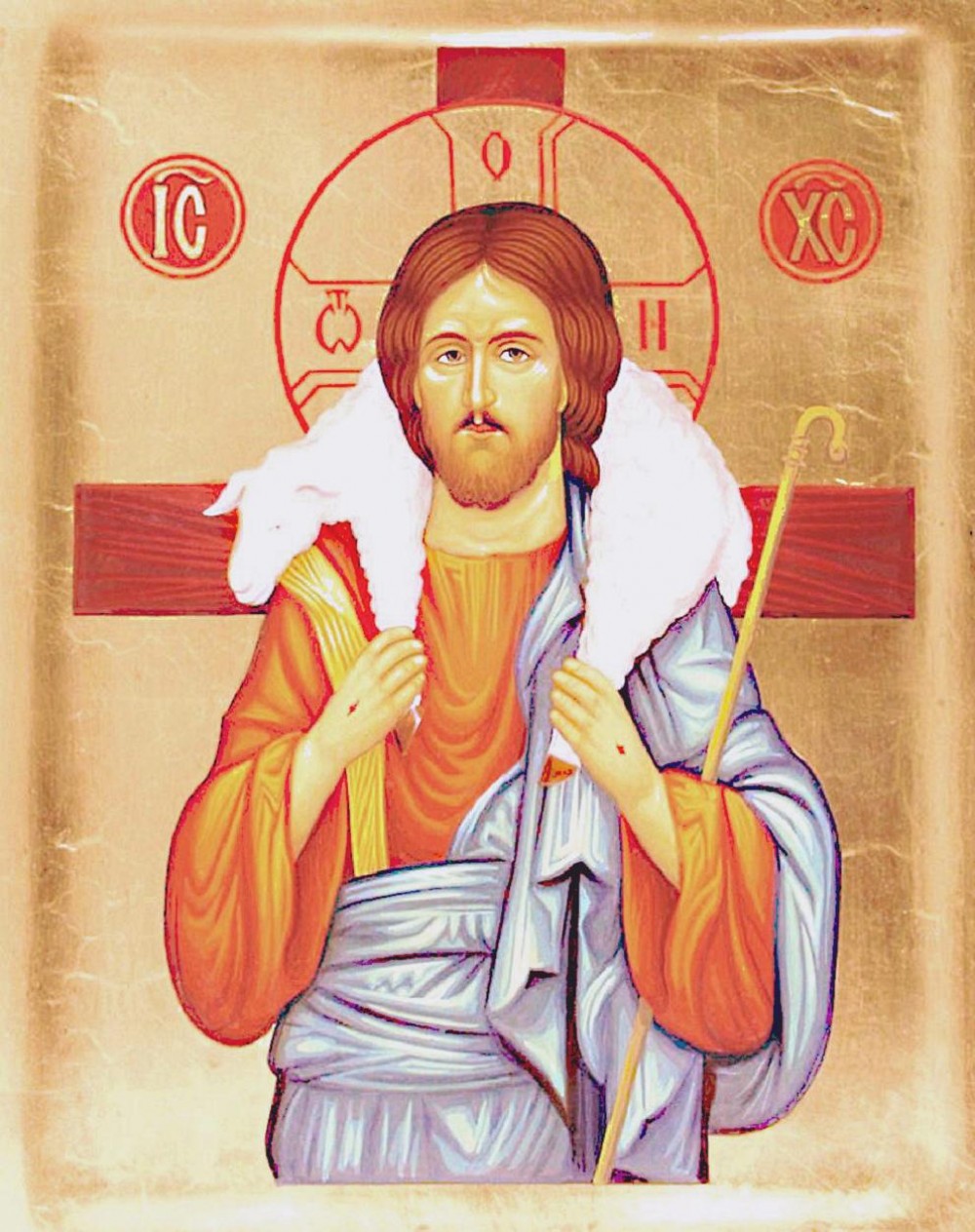
Christ the Seeker of the Lost Sheep

Unknown Artist
2000s. Butyrki Prison Chapel (Moscow, Russia)

10 posted on 09/28/2025 8:55:27 AM PDT by annalex (fear them not)
[ Post Reply | Private Reply | To 9 | View Replies]

To: annalex

Saint of the Day for September 27

(1580 – September 27, 1660)


Saint Vincent de Paul’s Story

The deathbed confession of a dying servant opened Saint Vincent de Paul’s eyes to the crying spiritual needs of the peasantry of France. This seems to have been a crucial moment in the life of the man from a small farm in Gascony, France, who had become a priest with little more ambition than to have a comfortable life.

The Countess de Gondi—whose servant he had helped—persuaded her husband to endow and support a group of able and zealous missionaries who would work among poor tenant farmers and country people in general. Vincent was too humble to accept leadership at first, but after working for some time in Paris among imprisoned galley slaves, he returned to be the leader of what is now known as the Congregation of the Mission, or the Vincentians. These priests, with vows of poverty, chastity, obedience, and stability, were to devote themselves entirely to the people in smaller towns and villages.

Later, Saint Vincent de Paul established confraternities of charity for the spiritual and physical relief of the poor and sick of each parish. From these, with the help of Saint Louise de Marillac, came the Daughters of Charity, “whose convent is the sickroom, whose chapel is the parish church, whose cloister is the streets of the city.”

He organized the rich women of Paris to collect funds for his missionary projects, founded several hospitals, collected relief funds for the victims of war, and ransomed over 1,200 galley slaves from North Africa. He was zealous in conducting retreats for clergy at a time when there was great laxity, abuse, and ignorance among them. He was a pioneer in clerical training and was instrumental in establishing seminaries.

Most remarkably, Saint Vincent de Paul was by temperament a very irascible person—even his friends admitted it. He said that except for the grace of God he would have been “hard and repulsive, rough and cross.” But he became a tender and affectionate man, very sensitive to the needs of others.

Pope Leo XIII made him the patron of all charitable societies. Outstanding among these, of course, is the Society of St. Vincent de Paul, founded in 1833 by his admirer Blessed Frédéric Ozanam.


Reflection

The Church is for all God’s children, rich and poor, peasants and scholars, the sophisticated and the simple. But obviously the greatest concern of the Church must be for those who need the most help—those made helpless by sickness, poverty, ignorance, or cruelty. Vincent de Paul is a particularly appropriate patron for all Christians today, when hunger has become starvation, and the high living of the rich stands in more and more glaring contrast to the physical and moral degradation in which many of God’s children are forced to live.


Saint Vincent de Paul is the Patron Saint of:

Charitable Societies


franciscanmedia.org
11 posted on 09/28/2025 8:59:00 AM PDT by annalex (fear them not)
[ Post Reply | Private Reply | To 10 | View Replies]

To: annalex


Vincent de Paul

Simon François de Tours (1606-1671)

12 posted on 09/28/2025 9:01:39 AM PDT by annalex (fear them not)
[ Post Reply | Private Reply | To 11 | View Replies]

To: annalex

NAVARRE BIBLE COMMENTARY(RSV)

Ad Majorem Dei Gloriam (To the Greater Glory of God)

Click here for the Navarre Bible Commentary for September 27, 2025.

13 posted on 09/28/2025 12:16:43 PM PDT by fidelis (Ecce Crucem Domini! Fugite partes adversae! Vicit Leo de tribu Juda, Radix David! Alleluia!)
[ Post Reply | Private Reply | To 12 | View Replies]

Disclaimer: Opinions posted on Free Republic are those of the individual posters and do not necessarily represent the opinion of Free Republic or its management. All materials posted herein are protected by copyright law and the exemption for fair use of copyrighted works.

Free Republic
Browse · Search
Religion
Topics · Post Article

FreeRepublic, LLC, PO BOX 9771, FRESNO, CA 93794
FreeRepublic.com is powered by software copyright 2000-2008 John Robinson