Skip to comments.
Catholic Caucus: Daily Mass Readings xx-September-2025
Universalis/Jerusalem Bible ^
Posted on 09/16/2025 4:44:28 AM PDT by annalex
16 September 2025
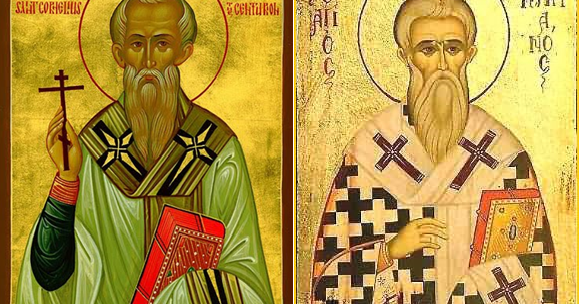
Saints Cornelius, Pope, and Cyprian, Bishop, Martyrs
on Tuesday of week 24 in Ordinary Time Using calendar: Unite

Memorial of Saints, Cornelius, Pope, and Cyprian, Bishop, Martyrs at St. Catherine of Siena parish, Toledo, OHReadings at MassLiturgical Colour: Red. Year: C(I). Readings for the feria Readings for the memorial These are the readings for the feria
| First reading |
|---|
| 1 Timothy 3:1-13 |
|---|
The president must be of impeccable characterHere is a saying that you can rely on: To want to be a presiding elder is to want to do a noble work. That is why the president must have an impeccable character. He must not have been married more than once, and he must be temperate, discreet and courteous, hospitable and a good teacher; not a heavy drinker, nor hot-tempered, but kind and peaceable. He must not be a lover of money. He must be a man who manages his own family well and brings his children up to obey him and be well-behaved: how can any man who does not understand how to manage his own family have responsibility for the church of God? He should not be a new convert, in case pride might turn his head and then he might be condemned as the devil was condemned. It is also necessary that people outside the Church should speak well of him, so that he never gets a bad reputation and falls into the devil’s trap. In the same way, deacons must be respectable men whose word can be trusted, moderate in the amount of wine they drink and with no squalid greed for money. They must be conscientious believers in the mystery of the faith. They are to be examined first, and only admitted to serve as deacons if there is nothing against them. In the same way, the women must be respectable, not gossips but sober and quite reliable. Deacons must not have been married more than once, and must be men who manage their children and families well. Those of them who carry out their duties well as deacons will earn a high standing for themselves and be rewarded with great assurance in their work for the faith in Christ Jesus.
| Responsorial Psalm |
|---|
| Psalm 100(101):1-3,5,6 |
|---|
I will walk with blameless heart. My song is of mercy and justice; I sing to you, O Lord. I will walk in the way of perfection. O when, Lord, will you come? I will walk with blameless heart. I will walk with blameless heart within my house; I will not set before my eyes whatever is base. I will walk with blameless heart. The man who slanders his neighbour in secret I will bring to silence. The man of proud looks and haughty heart I will never endure. I will walk with blameless heart. I look to the faithful in the land that they may dwell with me. He who walks in the way of perfection shall be my friend. I will walk with blameless heart.
| Gospel Acclamation | cf.2Tim1:10 |
|---|
Alleluia, alleluia! Our Saviour Jesus Christ abolished death and he has proclaimed life through the Good News. Alleluia! Alleluia, alleluia! A great prophet has appeared among us; God has visited his people. Alleluia!
The only son of his mother, and she a widowJesus went to a town called Nain, accompanied by his disciples and a great number of people. When he was near the gate of the town it happened that a dead man was being carried out for burial, the only son of his mother, and she was a widow. And a considerable number of the townspeople were with her. When the Lord saw her he felt sorry for her. ‘Do not cry’ he said. Then he went up and put his hand on the bier and the bearers stood still, and he said, ‘Young man, I tell you to get up.’ And the dead man sat up and began to talk, and Jesus gave him to his mother. Everyone was filled with awe and praised God saying, ‘A great prophet has appeared among us; God has visited his people.’ And this opinion of him spread throughout Judaea and all over the countryside. Continue These are the readings for the memorial
| First reading |
|---|
| 2 Corinthians 4:7-15 |
|---|
Such an overwhelming power comes from God and not from usWe are only the earthenware jars that hold this treasure, to make it clear that such an overwhelming power comes from God and not from us. We are in difficulties on all sides, but never cornered; we see no answer to our problems, but never despair; we have been persecuted, but never deserted; knocked down, but never killed; always, wherever we may be, we carry with us in our body the death of Jesus, so that the life of Jesus, too, may always be seen in our body. Indeed, while we are still alive, we are consigned to our death every day, for the sake of Jesus, so that in our mortal flesh the life of Jesus, too, may be openly shown. So death is at work in us, but life in you. But as we have the same spirit of faith that is mentioned in scripture – I believed, and therefore I spoke – we too believe and therefore we too speak, knowing that he who raised the Lord Jesus to life will raise us with Jesus in our turn, and put us by his side and you with us. You see, all this is for your benefit, so that the more grace is multiplied among people, the more thanksgiving there will be, to the glory of God.
| Responsorial Psalm |
|---|
| Psalm 125(126):1-6 |
|---|
Those who are sowing in tears will sing when they reap. When the Lord delivered Zion from bondage, it seemed like a dream. Then was our mouth filled with laughter, on our lips there were songs. Those who are sowing in tears will sing when they reap. The heathens themselves said: ‘What marvels the Lord worked for them!’ What marvels the Lord worked for us! Indeed we were glad. Those who are sowing in tears will sing when they reap. Deliver us, O Lord, from our bondage as streams in dry land. Those who are sowing in tears will sing when they reap. Those who are sowing in tears will sing when they reap. They go out, they go out, full of tears, carrying seed for the sowing: they come back, they come back, full of song, carrying their sheaves. Those who are sowing in tears will sing when they reap.
| Gospel Acclamation | 2Co1:3-4 |
|---|
Alleluia, alleluia! Blessed be God, a gentle Father and the God of all consolation, who comforts us in all our sorrows. Alleluia!
Father, keep those you have given me true to your nameJesus raised his eyes to heaven and said: ‘Holy Father, keep those you have given me true to your name, so that they may be one like us. While I was with them, I kept those you had given me true to your name. I have watched over them and not one is lost except the one who chose to be lost, and this was to fulfil the scriptures. But now I am coming to you and while still in the world I say these things to share my joy with them to the full. I passed your word on to them, and the world hated them, because they belong to the world no more than I belong to the world. I am not asking you to remove them from the world, but to protect them from the evil one. They do not belong to the world any more than I belong to the world. Consecrate them in the truth; your word is truth. As you sent me into the world, I have sent them into the world, and for their sake I consecrate myself so that they too may be consecrated in truth.’ Continue You can also view this page with the New Testament in Greek and English. Christian Art Each day, The Christian Art website gives a picture and reflection on the Gospel of the day. The readings on this page are from the Jerusalem Bible, which is used at Mass in most of the English-speaking world. The New American Bible readings, which are used at Mass in the United States, are available in the Universalis apps, programs and downloads.
You can also view this page with the Gospel in Greek and English. |
TOPICS: Catholic; General Discusssion; Prayer; Worship
KEYWORDS: catholic; jn17; lk7; ordinarytime; prayer
For your reading, reflection, faith-sharing, comments, questions, discussion.
1
posted on
09/16/2025 4:44:28 AM PDT
by
annalex
To: All
KEYWORDS: catholic; jn17; lk7; ordinarytime; prayer;
2
posted on
09/16/2025 4:45:17 AM PDT
by
annalex
(fear them not)
To: nickcarraway; NYer; ELS; Pyro7480; livius; ArrogantBustard; Catholicguy; RobbyS; marshmallow; ...

Alleluia Ping Please FReepmail me to get on/off the Alleluia Ping List.
3
posted on
09/16/2025 4:46:31 AM PDT
by
annalex
(fear them not)
To: annalex
4
posted on
09/16/2025 4:47:19 AM PDT
by
annalex
(fear them not)
To: annalex
| Luke |
| | English: Douay-Rheims | Latin: Vulgata Clementina | Greek NT: Byzantine/Majority Text (2000) |
| | Luke 7
|
| 11. | And it came to pass afterwards, that he went into a city that is called Naim; and there went with him his disciples, and a great multitude. | Et factum est : deinceps ibat in civitatem quæ vocatur Naim : et ibant cum eo discipuli ejus et turba copiosa. | και εγενετο εν τω εξης επορευετο εις πολιν καλουμενην ναιν και συνεπορευοντο αυτω οι μαθηται αυτου ικανοι και οχλος πολυς |
| 12. | And when he came nigh to the gate of the city, behold a dead man was carried out, the only son of his mother; and she was a widow: and a great multitude of the city was with her. | Cum autem appropinquaret portæ civitatis, ecce defunctus efferebatur filius unicus matris suæ : et hæc vidua erat : et turba civitatis multa cum illa. | ως δε ηγγισεν τη πυλη της πολεως και ιδου εξεκομιζετο τεθνηκως υιος μονογενης τη μητρι αυτου και αυτη [ην] χηρα και οχλος της πολεως ικανος συν αυτη |
| 13. | Whom when the Lord had seen, being moved with mercy towards her, he said to her: Weep not. | Quam cum vidisset Dominus, misericordia motus super eam, dixit illi : Noli flere. | και ιδων αυτην ο κυριος εσπλαγχνισθη επ αυτη και ειπεν αυτη μη κλαιε |
| 14. | And he came near and touched the bier. And they that carried it, stood still. And he said: Young man, I say to thee, arise. | Et accessit, et tetigit loculum. (Hi autem qui portabant, steterunt.) Et ait : Adolescens, tibi dico, surge. | και προσελθων ηψατο της σορου οι δε βασταζοντες εστησαν και ειπεν νεανισκε σοι λεγω εγερθητι |
| 15. | And he that was dead, sat up, and began to speak. And he gave him to his mother. | Et resedit qui erat mortuus, et cœpit loqui. Et dedit illum matri suæ. | και ανεκαθισεν ο νεκρος και ηρξατο λαλειν και εδωκεν αυτον τη μητρι αυτου |
| 16. | And there came a fear on them all: and they glorified God, saying: A great prophet is risen up among us: and, God hath visited his people. | Accepit autem omnes timor : et magnificabant Deum, dicentes : Quia propheta magnus surrexit in nobis : et quia Deus visitavit plebem suam. | ελαβεν δε φοβος παντας και εδοξαζον τον θεον λεγοντες οτι προφητης μεγας εγηγερται εν ημιν και οτι επεσκεψατο ο θεος τον λαον αυτου |
| 17. | And this rumour of him went forth throughout all Judea, and throughout all the country round about. | Et exiit hic sermo in universam Judæam de eo, et in omnem circa regionem. | και εξηλθεν ο λογος ουτος εν ολη τη ιουδαια περι αυτου και εν παση τη περιχωρω |
5
posted on
09/16/2025 4:49:34 AM PDT
by
annalex
(fear them not)
To: annalex

Catena Aurea by St. Thomas Aguinas
7:11–17
11. And it came to pass the day after, that he went into a city called Nain; and many of his disciples went with him, and much people.
12. Now when he came nigh to the gate of the city, behold, there was a dead man carried out, the only son of his mother, and she was a widow: and much people of the city was with her.
13. And when the Lord saw her, he had compassion on her, and said unto her, Weep not.
14. And he came and touched the bier: and they that bare him stood still. And he said, Young man, I say unto thee, Arise.
15. And he that was dead sat up, and began to speak. And he delivered him to his mother.
16. And there came a fear on all: and they glorified God, saying, That a great prophet is risen up among us; and, That God hath visited his people.
17. And this rumour of him went forth throughout all Judæa, and throughout all the region round about.
CYRIL OF ALEXANDRIA. The Lord joins one miracle upon another. In the Former instance He came indeed when called for, but in this He came self-invited; as it is said, And it came to pass the day after that he went into a city called Nain.
BEDE. Nain is a city of Galilee, within two miles of mount Tabor. But by the divine counsel there were large multitudes accompanying the Lord, that there might be many witnesses of so great a miracle. Hence it follows, And his disciples went with him, and much people.
GREGORY OF NYSSA. (Tract. de Anima et Res. Post med.) Now the proof of the resurrection we learn not so much from the words as from the works of our Saviour, who, beginning His miracles with the less wonderful, reconciled our faith to far greater. First indeed in the grievous sickness of the centurion’s servant, He verged upon the power of resurrection; afterwards with a higher power he led men to the belief in a resurrection, when He raised the widow’s son, who was carried out to be buried; as it is said, Now when he came nigh to the gate of the city, behold, there was a dead man carried out, the only son of his mother.
TITUS BOSTRENSIS. But some one will say of the centurion’s servant, that he was not going to die. That such an one might restrain his rash tongue, the Evangelist explains that the young man whom Christ came upon was already dead, the only son of a widow. For it follows, And she was a widow, and much people of the city was. with her.
GREGORY OF NYSSA. (de hom. Opif. c. 25.) He has told us the sum of misery in a few words. The mother was a widow, and had no further hope of having children, she had no one upon whom she might look in the place of him that was dead. To him alone she had given suck, he alone made her home cheerful. All that is sweet and precious to a mother, was he alone to her.
CYRIL OF ALEXANDRIA. These were sufferings to excite compassion, and which might well affect to mourning and tears, as it follows, And when the Lord saw her, he had compassion on her, saying, Weep not.
BEDE. As if He said, Cease to weep for one as dead, whom you shall soon see rise again alive.
CHRYSOSTOM. (Tit. Bost.) But when He bids us cease from weeping Who consoles the sorrowful, He tells us to receive consolation from those who are now dead, hoping for their resurrection. But life meeting death stops the bier, as it follows, And he came.
CYRIL OF ALEXANDRIA. He performs the miracle not only in word, but also touches the bier, to the end that you might know that the sacred body of Christ is powerful to the saving of man. For it is the body of Life and the flesh of the Omnipotent Word, whose power it possesses. For as iron applied to fire does the work of fire, so the flesh, when it is united to the Word, which quickens all things, becomes itself also quickening, and the banisher of death.
TITUS BOSTRENSIS. (non occ.) But the Saviour is not like to Elias mourning over the son of the widow of Sarepta, (1 Kings 17) nor as Elisha who laid his own body upon the body of the dead, (2 Kings 4) nor as Peter who prayed for Tabitha, (Acts 9:40) but is none other than He who calls those things which be not, as though they were, who can speak to the dead as to the living, (Rom. 4:17) as it follows, And he said, Young man
GREGORY OF NYSSA. (ubi sup.) When He said, Young man, He signified that he was in the flower of his age, just ripening into manhood, who but a little while before was the sight of his mother’s eyes, just entering upon the time of marriage, the scion of her race, the branch of succession, the staff of her old age.
TITUS BOSTRENSIS. But straightway he arose to whom the command was made. For the Divine power is irresistible; there is no delay, no urgency of prayer, as it follows, And he that was dead sat up, and began to speak, and he gave him to his mother. These are the signs. of a true resurrection, for the lifeless body cannot speak, nor would the mother have carried back to her house her dead and lifeless son.
BEDE. But well does the Evangelist testify that the Lord is first moved with compassion for the mother, and then raises her son, that in the one case He might set before us for our imitation an example of piety, in the other He might build up our belief in His wonderful power. Hence it follows. And there came a fear upon all, and they glorified God, &c.
CYRIL OF ALEXANDRIA. This was a great thing in an insensible and ungrateful people. For in a short time afterward they would neither esteem Him as a prophet, nor allow that He did aught for the public good. But none of those that dwelt in Judæa were ignorant of this miracle, as it follows, And this rumour of him went forth throughout all Judæa.
MAXIMUS. (non occ.) But it is worthy of remark, that seven resurrections are related before our Lord’s, of which the first was that of the son of the widow of Sarepta, (1 Kings 17) the second of the Shunamite’s son, (2 Kings 4) the third which was caused by the remains of Elisha, (2 Kings 13) the fourth which took place at Nain, as is here related, the fifth of the ruler of the Synagogue’s daughter, (Mark 5) the sixth of Lazarus, (John 11) the seventh at Christ’s passion, for many bodies of the saints arose. (Mat. 27.) The eighth is that of Christ, who being free from death remained beyond for a sign that the general resurrection which is to come in the eighth age shall not be dissolved by death, but shall abide never to pass away.
BEDE. But the dead man who was carried without the gate of the city in the sight of many, signifies a man rendered senseless by the deadening power of mortal sin, and no longer concealing his soul’s death within the folds of his heart, but proclaiming it to the knowledge of the world, through the evidence of words or deeds as through the gate of the city. For the gate of the city, I suppose, is some one of the bodily senses. And he is well said to be the only son of his mother, for there is one mother composed of many individuals, the Church, but every soul that remembers that it is redeemed by the death of the Lord, knows the Church to be a widow.
AMBROSE. For this widow surrounded by a great multitude of people seems to be more than the woman who was thought worthy by her tears to obtain the resurrection of her only son, because the Church recalls the younger people from the funeral procession to life by the contemplation of her tears, who is forbid to weep for him to whom resurrection was promised.
BEDE. Or the dogma of Novatus is crushedb, who endeavouring to do away with the purifying of the penitent, denies that the mother Church, weeping for the spiritual extinction of her sons, ought to be consoled by the hope of their restoration to life.
AMBROSE. This dead man was borne on the bier by the four material elements to the grave, but there was a hope of his rising again because he was borne on wood, which though before it did not benefit us, yet after Christ had touched it, began to profit unto life, that it might be a sign that salvation was to be extended to the people by the wood of the cross. For we lie lifeless on the bier when either the fire of immoderate desire bursts forth, or the cold moisture breaks out, and through the sluggish state of our earthly body the vigour of our minds waxes dull.
BEDE. Or the coffin on which the dead is carried is the ill at ease conscience of a desperate sinner. But they who carry him to be buried are either unclean desires, or the allurements of companions, who stood when our Lord touched the bier, because the conscience, when touched by dread of the judgment from on high, often checking its carnal lusts, and those who unjustly praise, returns to itself, and answers its Saviour’s call to life.
AMBROSE. If then thy sin is so heavy that by thy penitential tears thou canst not thyself wash it out, let the mother Church weep for thee, the multitude standing by; soon shalt thou rise from the dead and begin to speak the words of life; they all shall fear, (for by the example of one all are corrected;) they shall also praise God who has given us such great remedies for escaping death.
BEDE. But God has visited His people not only by the one incarnation of His Word, but by ever sending It into our hearts.
THEOPHYLACT. By the widow also you may understand a soul that has lost her husband in the divine word. Her son is the understanding, which is carried out beyond the city of the living. Its coffin is the body, which some indeed have called the tomb. But the Lord touching him raises him up, causing him to become young, and rising from sin he begins to speak and teach others. For before he would not have been believed.
Catena Aurea Luke 7
6
posted on
09/16/2025 4:51:04 AM PDT
by
annalex
(fear them not)
To: annalex
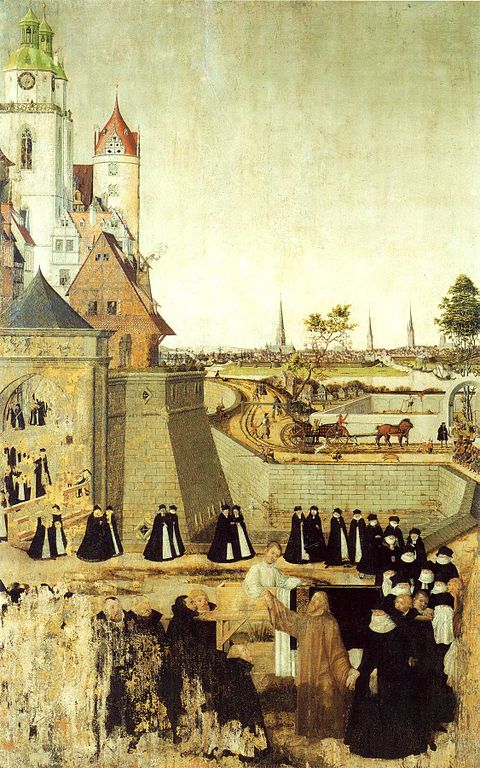
Raising of the son of the widow of Nain
Attributed to Lucas Cranach the Younger (1515–1586)
7
posted on
09/16/2025 4:51:33 AM PDT
by
annalex
(fear them not)
To: annalex
| John |
| | English: Douay-Rheims | Latin: Vulgata Clementina | Greek NT: Byzantine/Majority Text (2000) |
| | John 17
|
| 11. | And now I am not in the world, and these are in the world, and I come to thee. Holy Father, keep them in thy name whom thou has given me; that they may be one, as we also are. | Et jam non sum in mundo, et hi in mundo sunt, et ego ad te venio. Pater sancte, serva eos in nomine tuo, quos dedisti mihi : ut sint unum, sicut et nos. | και ουκετι ειμι εν τω κοσμω και ουτοι εν τω κοσμω εισιν και εγω προς σε ερχομαι πατερ αγιε τηρησον αυτους εν τω ονοματι σου ω δεδωκας μοι ινα ωσιν εν καθως ημεις |
| 12. | While I was with them, I kept them in thy name. Those whom thou gavest me have I kept; and none of them is lost, but the son of perdition, that the scripture may be fulfilled. | Cum essem cum eis, ego servabam eos in nomine tuo. Quos dedisti mihi, custodivi : et nemo ex eis periit, nisi filius perditionis, ut Scriptura impleatur. | οτε ημην μετ αυτων εν τω κοσμω εγω ετηρουν αυτους εν τω ονοματι σου ους δεδωκας μοι εφυλαξα και ουδεις εξ αυτων απωλετο ει μη ο υιος της απωλειας ινα η γραφη πληρωθη |
| 13. | And now I come to thee; and these things I speak in the world, that they may have my joy filled in themselves. | Nunc autem ad te venio : et hæc loquor in mundo, ut habeant gaudium meum impletum in semetipsis. | νυν δε προς σε ερχομαι και ταυτα λαλω εν τω κοσμω ινα εχωσιν την χαραν την εμην πεπληρωμενην εν αυτοις |
| 14. | I have given them thy word, and the world hath hated them, because they are not of the world; as I also am not of the world. | Ego dedi eis sermonem tuum, et mundus eos odio habuit, quia non sunt de mundo, sicut et ego non sum de mundo. | εγω δεδωκα αυτοις τον λογον σου και ο κοσμος εμισησεν αυτους οτι ουκ εισιν εκ του κοσμου καθως εγω ουκ ειμι εκ του κοσμου |
| 15. | I pray not that thou shouldst take them out of the world, but that thou shouldst keep them from evil. | Non rogo ut tollas eos de mundo, sed ut serves eos a malo. | ουκ ερωτω ινα αρης αυτους εκ του κοσμου αλλ ινα τηρησης αυτους εκ του πονηρου |
| 16. | They are not of the world, as I also am not of the world. | De mundo non sunt, sicut et ego non sum de mundo. | εκ του κοσμου ουκ εισιν καθως εγω εκ του κοσμου ουκ ειμι |
| 17. | Sanctify them in truth. Thy word is truth. | Sanctifica eos in veritate. Sermo tuus veritas est. | αγιασον αυτους εν τη αληθεια σου ο λογος ο σος αληθεια εστιν |
| 18. | As thou hast sent me into the world, I also have sent them into the world. | Sicut tu me misisti in mundum, et ego misi eos in mundum : | καθως εμε απεστειλας εις τον κοσμον καγω απεστειλα αυτους εις τον κοσμον |
| 19. | And for them do I sanctify myself, that they also may be sanctified in truth. | et pro eis ego sanctificabo meipsum : ut sint et ipsi sanctificati in veritate. | και υπερ αυτων εγω αγιαζω εμαυτον ινα και αυτοι ωσιν ηγιασμενοι εν αληθεια |
8
posted on
09/16/2025 4:53:40 AM PDT
by
annalex
(fear them not)
To: annalex
Catena Aurea by St. Thomas Aguinas
11. And now I am no more in the world, but these are in the world, and I come to thee. Holy Father, keep through thine own name those whom thou hast given me, that they may be one, as we are.
12. While I was with them in the world, I kept them in thy name: those that thou gavest me I have kept, and none of them is lost, but the son of perdition; that the scripture might be fulfilled.
13. And now come I to thee; and these things I speak in the world, that they might have my joy fulfilled in themselves.
CHRYSOSTOM. (Hom. lxxxi) As the disciples were still sad in spite of all our Lord’s consolations, henceforth He addresses Himself to the Father to shew the love which He had for them; I pray for them; He not only gives them what He has of His own, but entreats another for them, as a still further proof of His love.
AUGUSTINE. (Tr. cvi) When He adds, I pray not for the world, by the world He means those who live according to the lust of the world, and have not the lot to be chosen by grace out of the world, as those had for whom He prayed: But for them which Thou hast given Me. It was because the Father had given Him them, that they did not belong to the world. Nor yet had the Father, in giving them to the Son, lost what He had given: For they are Thine.
CHRYSOSTOM. (Hom. lxxxi. 1) He often repeats, Thou hast given Me, to impress on them that it was all according to the Father’s will, and that He did not come to rob another, but to take unto Him His own. Then to shew them that this power1 had not been lately received from the Father, He adds, And all Mine are Thine, and Thine are Mine: as if to say, Let no one, hearing Me say, Them which Thou hast given Me, suppose that they are separated from the Father; for Mine are His: nor because I said, They are Thine, suppose that they are separate from Me: for whatever is His is Mine.
AUGUSTINE. (Tr. cvi. 6) It is sufficiently apparent from hence, that all things which the Father hath, the Only-Begotten Son hath; hath in that He is God, born from the Father, and equal with the Father; not in the sense in which the elder son is told, All that I have is thine. (Luke 15:31) For all there means all creatures below the holy rational creature, but here it means the very rational creature itself, which is only subjected to God. Since this is God the Father’s, it could not at the same time be God the Son’s, unless the Son were equal to the Father. For it is impossible that saints, of whom this is said, should be the property of any one, except Him who created and sanctified them. When He says above in speaking of the Holy Spirit, All things that the Father hath are Mine, (c. 16:15) He means all things which pertain to the divinity of the Father; for He adds, He (the Holy Ghost) shall receive of Mine; and the Holy Ghost would not receive from a creature which was subject to the Father and the Son.
CHRYSOSTOM. (Hom. lxxxi) Then He gives proof of this, I am glorified in them. If they glorify Me, believing in Me and Thee, it is certain that I have power over them: for no one is glorified by those amongst whom he has no power.
AUGUSTINE. (Tr. cvii. 3) He speaks of this as already done, meaning that it was predestined, and sure to be. But is this the glorifying of which He speaks above, And now, O Father, glorify Thou Me with Thine own Self? If then with Thyself, what meaneth here, In them? Perhaps that this very thing, i. e. His glory with the Father, was made known to them, and through them to all that believe.
CHRYSOSTOM. (Hom. lxxxi) And now I am no more in the world: i. e. though I no longer appear in the flesh, I am glorified by those who die for Me, as for the Father, and preach Me as the Father.
AUGUSTINE. (Tr. cvii. 4) At the time at which He was speaking, both were still in the world. Yet we must not understand, I am no more in the world, metaphorically of the heart and life; for could there ever have been a time when He loved the things of the world? It remains then that He means that He was not in the world, as He had been before; i. e. that He was soon going away. Do we not say every day, when any one is going to leave us, or going to die, such an one is gone? This is shewn to be the sense by what follows; for He adds, And now I come to Thee. And then He commends to His Father those whom He was about to leave: Holy Father, keep through Thine own name those whom Thou hast given Me. As man He prays God for His disciples, whom He received from God. But mark what follows: That they may be one, as We are: He does not say, That they may be one with Us, as We are one; but, that they may be one: that they may be one in their nature, as We are one in Ours. For, in that He was God and man in one person, as man He prayed, as God He was one with Him to Whom He prayed.
AUGUSTINE. (iv. de Trin. c. ix) He does not say, That I and they maybe one, though He might have said so in the sense, that He was the head of the Church, and the Church His body; not one thing, but one person: the head and the body being one Christ. But shewing something else, viz. that His divinity is consubstantial with the Father, He prays that His people may in like manner be one; but one in Christ, not only by the same nature, in which mortal man is made equal to the Angels, but also by the same will, agreeing most entirely in the same mind, and melted into one Spirit by the fire of love. This is the meaning of, That they may be one as We are: viz. that as the Father and the Son are one not only by equality of substance, but also in will, so they, between whom and God the Son is Mediator, may be one not only by the union of nature, but by the union of love.
CHRYSOSTOM. (Hom. lxxxi) Again He speaks as man: While I was with them in the world, I kept them in Thy name; i. e. by Thy help. He speaks in condescension to the minds of His disciples, who thought they were more safe in His presence.
AUGUSTINE. (Tr. cvii. 6) The Son as man kept His disciples in the Father’s name, being placed among them in human form: the Father again kept them in the Son’s name, in that He heard those who asked in the Son’s name. But we must not take this carnally, as if the Father and Son kept us in turns, for the Father, Son, and Holy Ghost guard us at the same time: but Scripture does not raise us, except it stoop to us. Let us understand then that when our Lord says this, He is distinguishing the persons, not dividing the nature, so that when the Son was keeping His disciples by His bodily presence, the Father was waiting to succeed Him on His departure; but both kept them by spiritual power, and when the Son withdrew His bodily presence, He still held with the Father the spiritual keeping. For when the Son as man received them into His keeping, He did not take them from the Father’s keeping, and when the Father gave them into the Son’s keeping, it was to the Son as man, who at the same time was God. Those that Thou gavest Me I have kept, and none of them is lost but the son of perdition; i. e. the betrayer of Christ, predestined to perdition; that the Scripture might be fulfilled, especially the prophecy in Psalm 108.
CHRYSOSTOM. (Hom. lxxxi) He was the only one indeed who perished then, but there were many after. None of them is lost, i. e. as far as I am concerned; as He says above more clearly; I will in no wise cast out. But when they cast themselves out, I will not draw them to Myself by dint of compulsion. It follows: And now I come to Thee. But some one might ask, Canst Thou not keep them? I can. Then why sayest Thou this? That they may have My joy fulfilled in them, i. e. that they may not be alarmed in their as yet imperfect state.
AUGUSTINE. (Tr. cvii) Or thus: That they might have the joy spoken of above: That they may be one, as We are one. This His joy, i. e. bestowed by Him, He says, is to be fulfilled in them: on which account He spoke thus in the world. This joy is the peace and happiness of the life to come. He says He spoke in the world, though He had just now said, I am no more in the world. For, inasmuch as He had not yet departed, He was still here; and inasmuch as He was going to depart, He was in a certain sense not here.
17:14–19
14. I have given them thy word; and the world hath hated them, because they are not of the world, even as I am not of the world.
15. I pray not that thou shouldest take them out of the world, but that thou shouldest keep them from the evil.
16. They are not of the world, even as I am not of the world.
17. Sanctify them through thy truth; thy word is truth.
18. As thou hast sent me into the world, even so have I also sent them into the world.
19. And for their sakes I sanctify myself, that they also might be sanctified through the truth.
CHRYSOSTOM. (Hom. lxxxii) Again, our Lord gives a reason why the disciples are worthy of obtaining such favour from the Father: I have given them Thy word; and the world hath hated them; i. e. They are had in hatred for Thy sake, and on account of Thy word.
AUGUSTINE. (Tr. cviii) They had not yet experienced these sufferings which they afterwards met with; but, after His custom, He puts the future into the past tense. Then He gives the reason why the world haled them; viz. Because they are not of the world. This was conferred upon them by regeneration; for by nature they were of the world. It was given to them that they should not be of the world, even as He was not of the world; as it follows; Even as I am not of the world. He never was of the world; for even His birth of the form of a servant He received from the Holy Ghost, from Whom they were born again. But though they were no longer of the world, it was still necessary that they should be in the world: I pray not that Thou shouldest take them out of the world.
BEDE. As if to say, The time is now at hand, when I shall be taken out of the world; and therefore it is necessary that they should be still left in the world, in order to preach Me and Thee to the world. But that Thou shouldest keep them from the evil; every evil, but especially the evil of schism.
AUGUSTINE. (Tr. cviii) He repeats the same thing again; They are not of the world, even as I am not of the world.
CHRYSOSTOM. (Hom. lxxxii. 1) Above, when He said, Them whom Thou gavest Me out of the world, He meant their nature; here He means their actions. They are not of the world; because they have nothing in common with earth, they are made citizens of heaven. Wherein He shews His love for them, thus praising them to the Father. The word as when used with respect to Him and the Father expresses likeness of nature; but between us and Christ there is immense distance. Keep them from the evil, i. e. not from dangers only, but from falling away from the faith.
AUGUSTINE. (Tr. cviii) Sanctify them through Thy truth: for thus were they to be kept from the evil. But it may be asked, how it was that they were not of the world, when they were not yet sanctified in the truth? Because the sanctified have still to grow in sanctity, and this by the help of God’s grace. The heirs of the New Testament are sanctified in that truth, the shadows of which were the sanctification of the Old Testament; they are sanctified in Christ, Who said above, I am the way, the truth, and the life. (c. 14:6) It follows, Thy discourse is truth. The Greek is λόγος, i. e. word. The Father then sanctified them in the truth, i. e. in His Word the Only-Begotten, them, i. e. the heirs of God, and joint-heirs with Christ.
CHRYSOSTOM. (Hom. lxxxii) Or thus: Sanctify them in Thy truth; i. e. Make them holy, by the gift of the Holy Spirit, and sound doctrines: for sound doctrines give knowledge of God, and sanctify the soul. And as He is speaking of doctrines, He adds, Thy word is truth, i. e. there is in it no lie, nor any thing typical, or bodily. Again, Sanctify them in Thy truth, may mean, Separate them for the ministry of the word, and preaching.
GLOSS. As Thou hast sent Me into the world, even so have I also sent them into the world. For what Christ was sent into the world, for the same end were they; as saith Paul, God was in Christ reconciling the world unto Himself; and hath given to us the word of reconciliation. (2 cor. 5:19) As does not express perfect likeness between our Lord and His Apostles, but only as much as was possible in men. Have sent them, He says, according to His custom of putting the past for the future.
AUGUSTINE. (Tr. cviii) It is manifest by this, that He is still speaking of the Apostles; for the very word Apostle means in the Greek, sent. But since they are His members, in that He is the Head of the Church, He says, And for their sakes I sanctify Myself; i. e. I in Myself sanctify them, since they are Myself. And to make it more clear that this was His meaning, He adds, That they also might be sanctified through the truth, i. e. in Me; inasmuch as the Word is truth, in which the Son of man was sanctified from the time that the Word was made flesh. For then He sanctified Himself in Himself, i. e. Himself as man, in Himself as the Word: the Word and man being one Christ. But of His members it is that He saith, And for their sakes I sanctify Myself, i. e. them in Me, since in Me both they and I are. That they also might be sanctified in truth: they also, i. e. even as Myself; and in the truth, i. e. Myself.
CHRYSOSTOM. (Hom. lxxxii) Or thus: For their sakes I sanctify Myself, i. e. I offer Myself as a sacrifice to Thee; for all sacrifices, and things that are offered to God, are called holy. And whereas this sanctification was of old in figure, (a sheep being the sacrifice,) but now in truth, He adds, That they also might be sanctified through the truth; i. e. For I make them too an oblation to Thee; either meaning that He who was offered up was their head, or that they would be offered up too: as the Apostle saith, Present your bodies a living sacrifice, holy. (Rom. 12:1)
Catena Aurea John 17
9
posted on
09/16/2025 4:55:09 AM PDT
by
annalex
(fear them not)
To: annalex

Communion of Saints (Revelation 5:8)
Limbourg brothers
Très Riches Heures du Duc de Berry
between 1411 and 1416
10
posted on
09/16/2025 4:56:08 AM PDT
by
annalex
(fear them not)
To: annalex
September 16: Saints Cornelius and Cyprian, Martyrs
United in love for the Church
Cornelius, possibly a member of the noble Cornelii family, was elected Pope in 251 for his renowned qualities of kindness, prudence, and humility. Before his election, during the period of the Sede Vacante, Novatian, an educated and influential priest, had temporarily led the Church. When Cornelius was appointed, Novatian opposed him, accusing him of being too lenient toward those Christians who, during the persecutions, had renounced the faith (the so-called lapsi), thus causing a rigorist schism.
The Bishop of Carthage, Cyprian, supported Cornelius, sharing his approach of mercy and defending him against those who threatened the unity of the Church. Cornelius died in exile at Civitavecchia in 253, during the persecution under Emperor Gallus; in 258 his body was transferred to Rome and buried in the Catacombs of Saint Callistus.
Cyprian, born in Carthage around 210, was a rhetorician and lawyer before his conversion to Christianity in 246. He became Bishop in 249. He devoted himself to the organization of the Church in Africa and was involved in the issue of the lapsi during the persecution under Emperor Decius. He remained faithful to Cornelius’ pastoral approach and, together with him, condemned—through a council—those who sowed division within the Church.
He was an important teacher of Christian morality and his writings, especially his letters, offer valuable testimony to the faith and liturgy of the 3rd century. Along with Tertullian, he contributed to the birth of Christian Latin.
The letters exchanged between Cyprian and Cornelius reveal an extraordinary harmony between the two Churches, particularly in their vision of the Church as a community founded on the Eucharist.
During the persecution under Valerian, Cyprian withdrew for a time, but in 251 he returned to Carthage to publicly resume his role as pastor. He was arrested and executed on September 14, 258, in front of his people.
The Church remembers Cornelius and Cyprian together in the First Eucharistic Prayer, celebrating them as martyrs united in love for the Church and its unity. Their joint veneration underscores the deep unity between the ancient Churches, especially between Rome and Carthage.
vaticanstate.va
11
posted on
09/16/2025 4:59:33 AM PDT
by
annalex
(fear them not)
To: annalex
12
posted on
09/16/2025 5:00:54 AM PDT
by
annalex
(fear them not)
To: annalex
NAVARRE BIBLE COMMENTARY(RSV)
Ad Majorem Dei Gloriam (To the Greater Glory of God)
First Reading:
From: 1 Timothy 3:1-13
Qualifications for Bishops
--------------------------
[1] The saying is sure: If any one aspires to the office of bishop, he desires a noble task. [2] Now a bishop must be above reproach, the husband of one wife, temperate, sensible, dignified, hospitable, an apt teacher, [3] no drunkard, not violent but gentle, not quarrelsome, and no lover of money. [4] He must manage his own household well, keeping children submissive and respectful in every way; [5] for if a man does not know how to manage his own household, how can he care for God's church? [6] He must not be a recent convert, or he may be puffed up with conceit and fall into the condemnation of the devil; [7] moreover he must be well thought of by outsiders, or he may fall into reproach and the snare of the devil.
Qualifications for Deacons
--------------------------
[8] Deacons likewise must be serious, not double-tongued, not addicted to much wine, not greedy for gain; [9] they must hold the mystery of the faith with a clear conscience. [10] And let them also be tested first; then if they prove blameless let them serve as deacons. [11] The women likewise must be serious, no slanderers, but temperate, faithful in all things. [12] Let deacons be the husband of one wife, and let them manage their children and their households well; [13] for those who serve well as deacons gain a good standing for themselves and also great confidence in the faith which is in Christ Jesus.
***********************************************************************
Commentary:
1. "The office of bishop": as explained in the "Introduction to the Pastoral Epistles", above, when these epistles were written the titles and responsibilities of the various church offices had not yet become fixed. The "bishop" (in Greek "episcopos" = overseer) was a priest who was in charge of some particular community. As a minister of the Church, his role was one of teaching (cf. v. 2) and governance (cf. v.5); his task was a demanding one and called for self-sacrifice, because any office in a Christian community is essentially a form of service: "The holders of office, who are invested with a sacred power, are, in fact, dedicated to promoting the interests of their brethren, so that all who belong to the people of God, and are consequently endowed with true Christian dignity, may, through their free and well-ordered efforts towards a common goal, attain to salvation" (Vatican II, "Lumen Gentium", 18).
In spite of the regard in which those "bishops" were held by the faithful, there seems to have been a shortage of candidates for the office. Hence St Paul's stressing that it is a "noble task"—to encourage a generous response by those who feel the Lord's call. From the very beginning, both pastors of the Church and many other members of the faithful have striven to nurture the germs of vocation which God places in people's souls. "Beyond question, the society founded by Christ will never lack priests. But we must all be vigilant and do our part, remembering the word: 'The harvest is plentiful, but the laborers are few' (Lk 10:2). We must do all that we can to secure as many holy ministers of God as possible" (Pius XII, "Menti Nostrae", 36).
2-7. The quality and virtues required for a "bishop" are similar to those for "elders" given in Titus 1:5-9. In the Pastoral Epistles "bishop" and "elder" (or priest) mean almost the same thing. In listing qualifications St Paul is not giving a complete list; he is simply saying that candidates for Church office should have qualities which make them suited to the work and should be morally irreproachable.
The Church, in its legislation, has always tried to see that suitable people are chosen as ministers. The Second Vatican Council lays it down that before the priesthood is conferred on anyone careful inquiry should be made "concerning his right intention and freedom of choice, his spiritual, moral and intellectual fitness etc." ("Optatam Totius", 6). In other words, a person needs qualifications in the form of human qualities and ability if he is to live up to the demands of Church office.
"This need for the secular priest to develop human virtues stems from the nature of his apostolic ministry which must be carried out in the everyday world and in direct contact with people who tend to be stern judges of a priest and who watch particularly his behavior as a man. There is nothing new about all this--but it does seem useful now to emphasize it again. From St Paul to the most recent doctors of the Church (take the teaching of St Francis de Sales, for example) one finds this question dealt with. It is none other than that of the contact between nature and supernature to achieve both the death of that man which must die under the sign of the Cross, and the perfect development of all the nobility and virtue which exists in man, and its direction towards the service of God" (A. del Portillo, "On Priesthood", p. 12).
2. "The husband of one wife": this is also a requirement of "elders" (cf. Tit 1:6) and "deacons" (1 Tim 3:12); it does not mean that the person is under an obligation to marry, but he must not have married more than once. From the context it clearly does not mean that candidates are forbidden to be polygamous (polygamy is forbidden to everyone); the condition that one be married only once ensures that candidates will be very respectable, exemplary people; in the culture of the time second marriages, except in special circumstances, were looked at askance, among Gentiles as well as Jews.
In the apostolic age celibacy was not a requirement for those who presided over the early Christian communities. However, it very soon became customary to require celibacy. "In Christian antiquity the Fathers and ecclesiastical writers testify to the spread through the East and the West of the voluntary practice of celibacy by sacred ministers because of its profound suitability for their total dedication to the service of Christ and his Church. The Church of the West, from the beginning of the fourth century, strengthened, spread, and approved this practice by means of various provincial councils and through the Supreme Pontiffs" (Paul VI, "Sacerdotalis Caelibatus", 35-36).
From then on all priests of the Latin rite were required to be celibate. Celibacy is appropriate to the priesthood for many reasons: "By preserving virginity or celibacy for the sake of the kingdom of heaven priests are consecrated in a new and excellent way to Christ. They more readily cling to him with undivided heart and dedicate themselves more freely in him and through him to the service of God and of men. They are less encumbered in their service of his kingdom and of the task of heavenly regeneration. In this way they become better fitted for a broader acceptance of fatherhood in Christ" (Vatican II, "Presbyterorum Ordinis", 16).
6. "He must not be a recent convert": one of the functions of the "bishop" was to preside over the community; therefore, it would be imprudent to expose the office-holder to the danger of vanity and pride. As St Thomas says in his commentary, it is not wise to appoint young people and recent converts to positions of honor and responsibility, because they can easily begin to think that they are better than the others and cannot be done without (cf. "Commentary on l Tim, ad loc.").
"Fall into the condemnation of the devil" or "fall into the same condemnation as the devil": the original text is not very clear. It may mean that it is the devil who is doing the condemning, in which case it would be the same as saying "fall into the power of the devil" or "fall into enslavement by the devil". At any rate it is fairly clear that St Paul wants to warn about the danger of committing the same sin as the fallen angel, that is, becoming proud and thereby earning damnation.
7. Another function of the "bishop" was to represent the Church to "outsiders", that is, non-Christians. All believers should give good example (cf. Mt 5:16; Col 4:5; 1 Pet 2:13; 3:1), but those who hold Church office have a special duty to avoid giving scandal or providing grounds for gossip.
8-13. Deacons were ministers under bishops and priests. "The origin of the diaconate probably goes back to the "seven men of good repute" who were elected to help the Apostles (cf. Acts 6:1-6 and note); we do know that those men had an administrative role in aiding the poor and the sick (Acts 6:1); they also preached (Acts 6:8-14; 8:6) and administered Baptism (Acts 8:26-40). Later on mention is made of deacons alongside "bishops" in certain important communities (cf. Phil 1:1), which suggests that they were part of the Church hierarchy.
This letter shows them to be ministers subordinate to the "bishop"; in these verses, which some commentators call "the deacons' statute", their specific functions are not stated (they probably performed a wide range of tasks); however, it does appear that, unlike the bishop, they did not represent the Church to outsiders and they could be drawn from among recent converts
The requirements given here are very like those for the "bishop": as ministers of the Church they would naturally be required to live exemplary lives. The Second Vatican Council is in line with this text when it says that deacons, "waiting upon the mysteries of Christ and of the Church, should keep themselves free from every vice, should please God and give a good example to all in everything" ("Lumen Gentium", 41).
10. "Let them also be tested first": it is up to bishops (then and now) to ensure that holy orders are conferred on suitable candidates; probably even in St Paul's time candidates had to undergo a period of training, in the course of which their suitability could be checked.
The Church always tries to see that only people who are really suitable are given Church office, even if that means fewer people are ordained, for "God never so abandons his Church that suitable ministers are not to be found sufficient for the needs of the people; provided the worthy are promoted and the unworthy are set aside" ("Summa Theologiae", Supplement, q. 36, a. 4 ad 1).
11. The text says so little that it is difficult to work out who these women were. Many authors, St Thomas among them, think that they were deacons' wives because the reference to them interrupts the list of qualifications for deacons. Many other commentators think that they were women who performed some function or ministry in the early Church; this would explain why nothing is said about the wife of the bishop (when the qualifications for bishops are given at the start of this chapter) and it would also explain why the comportment of the deacons and of these women is referred to using the same adverb--"likewise", similarly--in v. 8 and v. 11. We do know (from a fourth-century document, "Apostolic Constitutions", 2, 26; 3, 15) that some women did help in the instruction of catechumens, in their Baptism, in care of the sick, etc. In the Letter to the Romans, Phoebe is described as a "deaconess" (cf. Rom 16:1) though she was not a sacred minister in the strict sense.
13. "Gain a good standing for themselves": this may mean that being a deacon could be a step towards the higher office of "bishop"; or it could mean that the diaconate itself is a noble position, just as the office of "bishop" is "a noble task" (v. 1). Perhaps St Paul uses this vague expression because it covers both these things: it is an honorable ministry and also it can be a step to a higher position in the service of the community.
"Great confidence": the original text uses a word which, in classical Greek refers to the right of free citizens to speak at public assemblies--with full freedom, confident, afraid of no one, with self-assurance, etc. A good deacon should expound the doctrine of the faith in the same kind of way: he should be well versed in it, he should stress those aspects which are most apposite at the time, and he should not be affected by what others may think of him.
13
posted on
09/16/2025 5:57:12 AM PDT
by
fidelis
(Ecce Crucem Domini! Fugite partes adversae! Vicit Leo de tribu Juda, Radix David! Alleluia!)
Gospel Reading: From: Luke 7:11-17
The Son of the Widow in Nain Restored to Life
---------------------------------------------
[11] Soon afterwards He (Jesus) went to a city called Nain, and His disciples and a great crowd went with Him. [12] As He drew near to the gate of the city, behold, a man who had died was being carried out, the only son of his mother, and she was a widow; and a large crowd from the city was with her. [13] And when the Lord saw her, He had compassion on her and said to her, "Do not weep." [14] And He came and touched the bier, and the bearers stood still. And He said, "Young man, I say to you, arise." [15] And the dead man sat up, and began to speak. And He gave him to his mother. [16] Fear seized them all; and they glorified God, saying, "A great prophet has arisen among us!" and "God has visited His people!" [17] And this report concerning Him spread through the whole of Judea and all the surrounding country.
***********************************************************************
Commentary:
11-17. "Jesus crosses paths again with a crowd of people. He could have passed by or waited until they called Him. But He didn't. He took the initiative, because He was moved by a widow's sorrow. She had just lost all she had, her son.
"The evangelist explains that Jesus was moved. Perhaps He even showed signs of it, as when Lazarus died. Christ was not, and is not, insensitive to the suffering that stems from love. He is pained at seeing children separated from their parents. He overcomes death so as to give life, to reunite those who love one another. But at the same time, He requires that we first admit the pre-eminence of divine love, which alone can inspire genuine Christian living.
"Christ knows He is surrounded by a crowd which will be awed by the miracle and will tell the story all over the countryside. But He does not act artificially, merely to create an effect. Quite simply He is touched by that woman's suffering and cannot but console her. So He goes up to her and says, `Do not weep.' It is like saying, `I don't want to see you crying; I have come on earth to bring joy and peace.' And then comes the miracle, the sign of the power of Christ who is God. But first came His compassion, an evident sign of the tenderness of the heart of Christ the man" (St. J. Escriva, "Christ Is Passing By", 166).
15. This mother's joy on being given back her son reminds us of the joy of our Mother the Church when her sinful children return to the life of grace. "The widowed mother rejoiced at the raising of that young man," St. Augustine comments. "Our Mother the Church rejoices every day when people are raised again in spirit. The young man had been dead physically; the latter, dead spiritually. The young man's death was mourned visibly; the death of the latter was invisible and unmourned. He seeks them out Who knew them to be dead; only He can bring them back to life" ("Sermon", 98, 2).
14
posted on
09/16/2025 5:57:27 AM PDT
by
fidelis
(Ecce Crucem Domini! Fugite partes adversae! Vicit Leo de tribu Juda, Radix David! Alleluia!)
15
posted on
09/16/2025 5:58:09 AM PDT
by
fidelis
(Ecce Crucem Domini! Fugite partes adversae! Vicit Leo de tribu Juda, Radix David! Alleluia!)
Disclaimer:
Opinions posted on Free Republic are those of the individual
posters and do not necessarily represent the opinion of Free Republic or its
management. All materials posted herein are protected by copyright law and the
exemption for fair use of copyrighted works.
FreeRepublic.com is powered by software copyright 2000-2008 John Robinson