Skip to comments.
Catholic Caucus: Daily Mass Readings 9-September-2025
Universalis/Jerusalem Bible ^
Posted on 09/09/2025 4:48:41 AM PDT by annalex
9 September 2025
Saint Peter Claver
on Tuesday of week 23 in Ordinary Time

Church of St Peter Claver, West Hartford CTReadings at MassLiturgical Colour: White. Year: C(I). Readings for the feria Readings for the memorial These are the readings for the feria
| First reading |
|---|
| Colossians 2:6-15 |
|---|
The Lord has brought you to life with himYou must live your whole life according to the Christ you have received – Jesus the Lord; you must be rooted in him and built on him and held firm by the faith you have been taught, and full of thanksgiving. Make sure that no one traps you and deprives you of your freedom by some second-hand, empty, rational philosophy based on the principles of this world instead of on Christ. In his body lives the fullness of divinity, and in him you too find your own fulfilment, in the one who is the head of every Sovereignty and Power. In him you have been circumcised, with a circumcision not performed by human hand, but by the complete stripping of your body of flesh. This is circumcision according to Christ. You have been buried with him, when you were baptised; and by baptism, too, you have been raised up with him through your belief in the power of God who raised him from the dead. You were dead, because you were sinners and had not been circumcised: he has brought you to life with him, he has forgiven us all our sins. He has overridden the Law, and cancelled every record of the debt that we had to pay; he has done away with it by nailing it to the cross; and so he got rid of the Sovereignties and the Powers, and paraded them in public, behind him in his triumphal procession.
| Responsorial Psalm |
|---|
| Psalm 144(145):1-2,8-11 |
|---|
How good is the Lord to all. I will give you glory, O God my king, I will bless your name for ever. I will bless you day after day and praise your name for ever. How good is the Lord to all. The Lord is kind and full of compassion, slow to anger, abounding in love. How good is the Lord to all, compassionate to all his creatures. How good is the Lord to all. All your creatures shall thank you, O Lord, and your friends shall repeat their blessing. They shall speak of the glory of your reign and declare your might, O God. How good is the Lord to all.
| Gospel Acclamation | Ph2:15-16 |
|---|
Alleluia, alleluia! You will shine in the world like bright stars because you are offering it the word of life. Alleluia! Alleluia, alleluia! I chose you from the world to go out and bear fruit, fruit that will last, says the Lord. Alleluia!
Jesus chooses his twelve apostlesJesus went out into the hills to pray; and he spent the whole night in prayer to God. When day came he summoned his disciples and picked out twelve of them; he called them ‘apostles’: Simon whom he called Peter, and his brother Andrew; James, John, Philip, Bartholomew, Matthew, Thomas, James son of Alphaeus, Simon called the Zealot, Judas son of James, and Judas Iscariot who became a traitor. He then came down with them and stopped at a piece of level ground where there was a large gathering of his disciples with a great crowd of people from all parts of Judaea and from Jerusalem and from the coastal region of Tyre and Sidon who had come to hear him and to be cured of their diseases. People tormented by unclean spirits were also cured, and everyone in the crowd was trying to touch him because power came out of him that cured them all. Continue These are the readings for the memorial
| First reading | Tobit 12:6-13 |
|---|
Bless God and utter his praise before all the livingRaphael took Tobit and his son Tobias aside and said, ‘Bless God, utter his praise before all the living for all the favours he has given you. Bless and extol his name. Proclaim before all men the deeds of God as they deserve, and never tire of giving him thanks. It is right to keep the secret of a king, yet right to reveal and publish the works of God. Thank him worthily. Do what is good, and no evil can befall you. ‘Prayer with fasting and alms with right conduct are better than riches with iniquity. Better to practise almsgiving than to hoard up gold. Almsgiving saves from death and purges every kind of sin. Those who give alms have their fill of days; those who commit sin and do evil, bring harm on themselves. ‘I am going to tell you the whole truth, hiding nothing from you. I have already told you that it is right to keep the secret of a king, yet right too to reveal in worthy fashion the works of God. So you must know that when you and Sarah were at prayer, it was I who offered your supplications before the glory of the Lord and who read them; so too when you were burying the dead. When you did not hesitate to get up and leave the table to go and bury a dead man, I was sent to test your faith, and at the same time God sent me to heal you and your daughter-in-law Sarah.’
| Responsorial Psalm | Psalm 1:1-4,6 |
|---|
His delight is the law of the Lord. or Happy the man who has placed his trust in the Lord. or The just will flourish like the palm-tree in the courts of our God. Happy indeed is the man who follows not the counsel of the wicked; nor lingers in the way of sinners nor sits in the company of scorners, but whose delight is the law of the Lord and who ponders his law day and night. His delight is the law of the Lord. or Happy the man who has placed his trust in the Lord. or The just will flourish like the palm-tree in the courts of our God. He is like a tree that is planted beside the flowing waters, that yields its fruit in due season and whose leaves shall never fade; and all that he does shall prosper. His delight is the law of the Lord. or Happy the man who has placed his trust in the Lord. or The just will flourish like the palm-tree in the courts of our God. Not so are the wicked, not so! For they like winnowed chaff shall be driven away by the wind: for the Lord guards the way of the just but the way of the wicked leads to doom. His delight is the law of the Lord. or Happy the man who has placed his trust in the Lord. or The just will flourish like the palm-tree in the courts of our God.
Alleluia, alleluia! How happy are the poor in spirit: theirs is the kingdom of heaven. Alleluia! Alleluia, alleluia! Happy those who hunger and thirst for what is right: they shall be satisfied. Alleluia! Alleluia, alleluia! Happy the pure in heart: they shall see God. Alleluia! Alleluia, alleluia! Blessed are you, Father, Lord of heaven and earth, for revealing the mysteries of the kingdom to mere children. Alleluia! Alleluia, alleluia! The greatest among you must be your servant, says the Lord: the man who humbles himself will be exalted. Alleluia! Alleluia, alleluia! Come to me, all you who labour and are overburdened and I will give you rest, says the Lord. Alleluia! Alleluia, alleluia! Stay awake, praying at all times for the strength to stand with confidence before the Son of Man. Alleluia! Alleluia, alleluia! I am the light of the world, says the Lord; anyone who follows me will have the light of life. Alleluia! Alleluia, alleluia! If you make my word your home you will indeed be my disciples, and you will learn the truth, says the Lord. Alleluia! Alleluia, alleluia! I give you a new commandment: love one another just as I have loved you, says the Lord. Alleluia! Alleluia, alleluia! If anyone loves me he will keep my word, and my Father will love him, and we shall come to him. Alleluia! Alleluia, alleluia! Make your home in me, as I make mine in you, says the Lord; whoever remains in me bears fruit in plenty. Alleluia! Alleluia, alleluia! Remain in my love, says the Lord; whoever remains in me, with me in him, bears fruit in plenty. Alleluia!
I was naked and you clothed me; sick, and you visited meJesus said to his disciples: ‘When the Son of Man comes in his glory, escorted by all the angels, then he will take his seat on his throne of glory. All the nations will be assembled before him and he will separate men one from another as the shepherd separates sheep from goats. He will place the sheep on his right hand and the goats on his left. ‘Then the King will say to those on his right hand, “Come, you whom my Father has blessed, take for your heritage the kingdom prepared for you since the foundation of the world. For I was hungry and you gave me food; I was thirsty and you gave me drink; I was a stranger and you made me welcome; naked and you clothed me, sick and you visited me, in prison and you came to see me.” Then the virtuous will say to him in reply, “Lord, when did we see you hungry and feed you; or thirsty and give you drink? When did we see you a stranger and make you welcome; naked and clothe you; sick or in prison and go to see you?” And the King will answer, “I tell you solemnly, in so far as you did this to one of the least of these brothers of mine, you did it to me.” ‘Next he will say to those on his left hand, “Go away from me, with your curse upon you, to the eternal fire prepared for the devil and his angels. For I was hungry and you never gave me food; I was thirsty and you never gave me anything to drink; I was a stranger and you never made me welcome, naked and you never clothed me, sick and in prison and you never visited me.” Then it will be their turn to ask, “Lord, when did we see you hungry or thirsty, a stranger or naked, sick or in prison, and did not come to your help?” Then he will answer, “I tell you solemnly, in so far as you neglected to do this to one of the least of these, you neglected to do it to me.” ‘And they will go away to eternal punishment, and the virtuous to eternal life.’ Continue You can also view this page with the New Testament in Greek and English. Christian Art Each day, The Christian Art website gives a picture and reflection on the Gospel of the day. The readings on this page are from the Jerusalem Bible, which is used at Mass in much of the English-speaking world. The English Standard Version, which is used at Mass in Great Britain, will be shown here if you set this page to use a calendar for Great Britain. The New American Bible readings, which are used at Mass in the United States, are available in the Universalis apps, programs and downloads. The readings on this page are from the Jerusalem Bible, which is used at Mass in most of the English-speaking world. The New American Bible readings, which are used at Mass in the United States, are available in the Universalis apps, programs and downloads.
You can also view this page with the Gospel in Greek and English. |
TOPICS: Catholic; General Discusssion; Prayer; Worship
KEYWORDS: catholic; lk6; mt25; ordinarytime; prayer
For your reading, reflection, faith-sharing, comments, questions, discussion.
1
posted on
09/09/2025 4:48:41 AM PDT
by
annalex
To: All
KEYWORDS: catholic; lk6; mt25; ordinarytime; prayer;
2
posted on
09/09/2025 4:49:25 AM PDT
by
annalex
(fear them not)
To: nickcarraway; NYer; ELS; Pyro7480; livius; ArrogantBustard; Catholicguy; RobbyS; marshmallow; ...

Alleluia Ping Please FReepmail me to get on/off the Alleluia Ping List.
3
posted on
09/09/2025 4:50:24 AM PDT
by
annalex
(fear them not)
To: annalex
4
posted on
09/09/2025 4:50:52 AM PDT
by
annalex
(fear them not)
To: annalex
| Luke |
| | English: Douay-Rheims | Latin: Vulgata Clementina | Greek NT: Byzantine/Majority Text (2000) |
| | Luke 6
|
| 12. | And it came to pass in those days, that he went out into a mountain to pray, and he passed the whole night in the prayer of God. | Factum est autem in illis diebus, exiit in montem orare, et erat pernoctans in oratione Dei. | εγενετο δε εν ταις ημεραις ταυταις εξηλθεν εις το ορος προσευξασθαι και ην διανυκτερευων εν τη προσευχη του θεου |
| 13. | And when day was come, he called unto him his disciples; and he chose twelve of them (whom also he named apostles): | Et cum dies factus esset, vocavit discipulos suos : et elegit duodecim ex ipsis (quos et apostolos nominavit) : | και οτε εγενετο ημερα προσεφωνησεν τους μαθητας αυτου και εκλεξαμενος απ αυτων δωδεκα ους και αποστολους ωνομασεν |
| 14. | Simon, whom he surnamed Peter, and Andrew his brother, James and John, Philip and Bartholomew, | Simonem, quem cognominavit Petrum, et Andream fratrem ejus, Jacobum, et Joannem, Philippum, et Bartholomæum, | σιμωνα ον και ωνομασεν πετρον και ανδρεαν τον αδελφον αυτου ιακωβον και ιωαννην φιλιππον και βαρθολομαιον |
| 15. | Matthew and Thomas, James the son of Alpheus, and Simon who is called Zelotes, | Matthæum, et Thomam, Jacobum Alphæi, et Simonem, qui vocatur Zelotes, | ματθαιον και θωμαν ιακωβον τον του αλφαιου και σιμωνα τον καλουμενον ζηλωτην |
| 16. | And Jude, the brother of James, and Judas Iscariot, who was the traitor. | et Judam Jacobi, et Judam Iscariotem, qui fuit proditor. | ιουδαν ιακωβου και ιουδαν ισκαριωτην ος και εγενετο προδοτης |
| 17. | And coming down with them, he stood in a plain place, and the company of his disciples, and a very great multitude of people from all Judea and Jerusalem, and the sea coast both of Tyre and Sidon, | Et descendens cum illis, stetit in loco campestri, et turba discipulorum ejus, et multitudo copiosa plebis ab omni Judæa, et Jerusalem, et maritima, et Tyri, et Sidonis, | και καταβας μετ αυτων εστη επι τοπου πεδινου και οχλος μαθητων αυτου και πληθος πολυ του λαου απο πασης της ιουδαιας και ιερουσαλημ και της παραλιου τυρου και σιδωνος οι ηλθον ακουσαι αυτου και ιαθηναι απο των νοσων αυτων |
| 18. | Who were come to hear him, and to be healed of their diseases. And they that were troubled with unclean spirits, were cured. | qui venerant ut audirent eum, et sanarentur a languoribus suis. Et qui vexabantur a spiritibus immundis, curabantur. | και οι οχλουμενοι υπο πνευματων ακαθαρτων και εθεραπευοντο |
| 19. | And all the multitude sought to touch him, for virtue went out from him, and healed all. | Et omnis turba quærebat eum tangere : quia virtus de illo exibat, et sanabat omnes. | και πας ο οχλος εζητει απτεσθαι αυτου οτι δυναμις παρ αυτου εξηρχετο και ιατο παντας |
(*) "οι ηλθον ακουσαι αυτου και ιαθηναι απο των νοσων αυτων" begins verse 18 in the translations.
5
posted on
09/09/2025 4:52:26 AM PDT
by
annalex
(fear them not)
To: annalex

Catena Aurea by St. Thomas Aguinas
6:12–16
12. And it came to pass in those days, that he went out into a mountain to pray, and continued all night in prayer to God.
13. And when it was day, he called unto him his disciples: and of them he chose twelve, whom also he named apostles;
14. Simon, (whom he also named Peter,) and Andrew his brother, James and John, Philip and Bartholomew,
15. Matthew and Thomas, James the son of Alphæus, and Simon called Zelotes,
16. And Judas the brother of James, and Judas Iscariot, which also was the traitor.
GLOSS. (non occ.) When adversaries rose up against the miracles and teaching of Christ, He chose Apostles as defenders and witnesses of the truth, and prefaces their election with prayer; as it is said, And it came to pass, &c.
AMBROSE. Let not thy ears be open to deceit, that thou shouldest think that the Son of God prays from want of strength, that He may obtain what He could not perform; for being Himself the Author of power, the Master of obedience, He leads us by His own example to the precepts of virtue.
CYRIL OF ALEXANDRIA. Let us examine then in the actions which Jesus did, how He teaches us to be instant in prayer to God, going apart by ourselves, and in secret, no one seeing us; putting aside also our worldly cares, that the mind may be raised up to the height of divine contemplation; and this we have marked in the fact, that Jesus went in to a mountain apart to pray.
AMBROSE. Every where also He prays alone, for human wishes comprehend not the wisdom of God; and no one can be a partaker of the secrets of Christ. But not every one who prays ascends a mountain, he only who prays advancing from earthly things to higher, who is not anxious for the riches or honours of the world. All whose minds are raised above the world ascend the mountain. In the Gospel therefore you will find, that the disciples alone ascend the mountain with the Lord. But thou, O Christian, hast now the character given, the form prescribed which thou shouldest imitate; as it follows, And he continued all night in prayer to God. For what oughtest thou to do for thy salvation, when Christ continues all night in prayer for thee?
CHRYSOSTOM. (Hom. ad Pop. Ant. 42. et in Act. c. 16. Ed. Lat.) Rise then thou also at night time. The soul is then purer, the very darkness and great silence are in themselves enough to lead us to sorrow for our sins. But if thou lookest upon the heaven itself studded with stars as with unnumbered eyes, if thou thinkest that they who wanton and do unjustly in day time are then nothing different from the dead, thou wilt loathe all human undertakings. All these things serve to raise the mind. Vain-glory then disquiets not, no tumult of passion has the mastery; fire does not so destroy the rust of iron as nightly prayer the blight of sin. He whom the heat of the sun has fevered by day is refreshed by the dew; nightly tears are better than any dew, and are proof against desire and fear. But if a man is not cherished by the dew we speak of, he withers in the day. Wherefore although thou prayest not much at night, pray once with watching, and it is enough; shew that the night belongs not only to the body, but to the soul.
AMBROSE. But what does it become thee to do when thou wouldest commence any work of piety, when Christ, about to send out His disciples, first prayed? for it follows, And when it was day, he called his disciples, &c. whom truly He destined to be the means of spreading the salvation of man through the world. Turn thy eyes also to the heavenly council. Not the wise men, not the rich, not the noble, but He chose to send out fishermen and publicans, that they might not seem to turn men to their grace by riches or by the influence of power and rank, and that the force of truth, not the graces of oratory, might prevail.
CYRIL OF ALEXANDRIA. (ut sup.) But mark the great carefulness of the Evangelist. He not only says that the holy Apostles were chosen, but he enumerates them by name, that no one should dare to insert any others in the catalogue; Simon, whom he also called Peter, and Andrew his brother.
BEDE. He not only surnamed Peter first, but long before this, when he was brought by Andrew, it is said, Thou shall be called Cephas, which is by interpretation, a stone (John 1:42.). But Luke, wishing to mention the names of the disciples, since it was necessary to call him Peter, wished shortly to imply that this was not his name before, but the Lord had given it to him.
EUSEBIUS. The two next are James and John, as it follows, James and John, both indeed sons of Zebedee, who were also fishermen. After them he mentions Philip and Bartholomew. John says Philip was of Bethsaida, of the city of Andrew and Peter. Bartholomew was a simple man, devoid of all worldly knowledge and guile. But Matthew was called from those who used to collect taxes; concerning whom he adds Matthew and Thomas.
BEDE. Matthew places himself after his fellow-disciple Thomas, from humility, whereas by the other Evangelists he is put before him. It follows, James the son of Alphæus, and Simon who is called Zelotes.
GLOSS. Because in truth he was of Cana in Galilee, which is interpreted zeal; and this is added to distinguish him from Simon Peter. It follows, Judas the brother of James, and Judas Iscariot, who also betrayed him.
AUGUSTINE. (de Con. Ev. lib. ii. c. 30.) With respect to the name of Judas the brother of James, Luke seems to differ from Matthew, who calls him Thaddæus. But what prevented a man from being called by two or three names? Judas the traitor is chosen, not unwittingly but knowingly, for Christ had indeed taken to Himself the weakness of man, and therefore refused not even this share of human infirmity. He was willing to be betrayed by His own Apostle, that thou when betrayed by thy friend mayest bear calmly thy mistaken judgment, thy kindness thrown away.
BEDE. But in a mystical sense the mountain on which our Lord chose His disciples represents the loftiness of justice in which they were to be instructed, and which they were to preach to others; so also the law was given on a mountain.
CYRIL OF ALEXANDRIA. But if we may learn the interpretation of the Apostles’ names, know that Peter means, “loosening or knowing;” Andrew, “glorious power,” or “answering;” but James, “apostle of grief;” John, “the grace of the Lord;” Matthew, “given;” Philip, “large mouth,” or the “orifice of a torch;” Bartholomew, “the son of him who lets down water;” Thomas, “deep or twin;” James the son of Alphæus, “supplanter of the step of life;” Judas, “confession;” Simon, “obedience.”
6:17–19
17. And he came down with them, and stood in the plain, and the company of his disciples, and a great multitude of people out of all Judæa, and Jerusalem, and from the sea coast of Tyre and Sidon, which came to hear him, and to be healed of their diseases;
18. And they that were vexed with unclean spirits: and they were healed.
19. And the whole multitude sought to touch him: for there went virtue out of him, and healed them all.
CYRIL OF ALEXANDRIA. When the ordination of the Apostles was accomplished, and great numbers were collected together from the country of Judæa, and from the sea coast of Tyre and Sidon, (who were idolaters,) he gave the Apostles their commission to be the teachers of the whole world, that they might recal the Jews from the bondage of the law, but the worshippers of devils from their Gentile errors to the knowledge of the truth. Hence it is said, And he came down with them, and stood in the plain, and a great multitude from Judæa, and the sea coast, &c.
BEDE. By the sea coast he does not refer to the neighbouring sea of Galilee, because this would not be accounted wonderful, but it is so called from the great sea, and therein also Tyre and Sidon may be comprehended, of which it follows, Both of Tyre and Sidon. And these states being Gentile, are purposely named here, to indicate how great was the fame and power of the Saviour which had brought even the citizens of the coast to receive His healing and teaching. Hence it follows, Which came to hear him.
THEOPHYLACT. That is, for the cure of their souls; and that they might be healed of their diseases, that is, for the cure of their bodies.
CYRIL OF ALEXANDRIA. But after that the High Priest had made publicly known His choice of Apostles, He did many and great miracles, that the Jews and Gentiles who had assembled might know that these were invested by Christ with the dignity of the Apostleship, and that He Himself was not as another man, but rather was God, as being the Incarnate Word. Hence it follows, And the whole multitude sought to touch him, for there went virtue out of him. For Christ did not receive virtue from others, but since he was by nature God, sending out His own virtue upon the sick, He healed them all.
AMBROSE. But observe all things carefully, how He both ascends with His Apostles and descends to the multitude; for how could the multitude see Christ but in a lowly place. It follows him not to the lofty places, it ascends not the heights. Lastly, when He descends, He finds the sick, for in the high places there can be no sick.
BEDE. You will scarcely find any where that the multitudes follow our Lord to the higher places, or that a sick person is healed on a mountain; but having quenched the fever of lust and lit the torch of knowledge, each man approaches by degrees to the height of the virtues. But the multitudes which were able to touch the Lord are healed by the virtue of that touch, as formerly the leper is cleansed when our Lord touched him. The touch of the Saviour then is the work of salvation, whom to touch is to believe on Him, to be touched is to be healed by His precious gifts.
Catena Aurea Luke 6
6
posted on
09/09/2025 4:53:01 AM PDT
by
annalex
(fear them not)
To: annalex
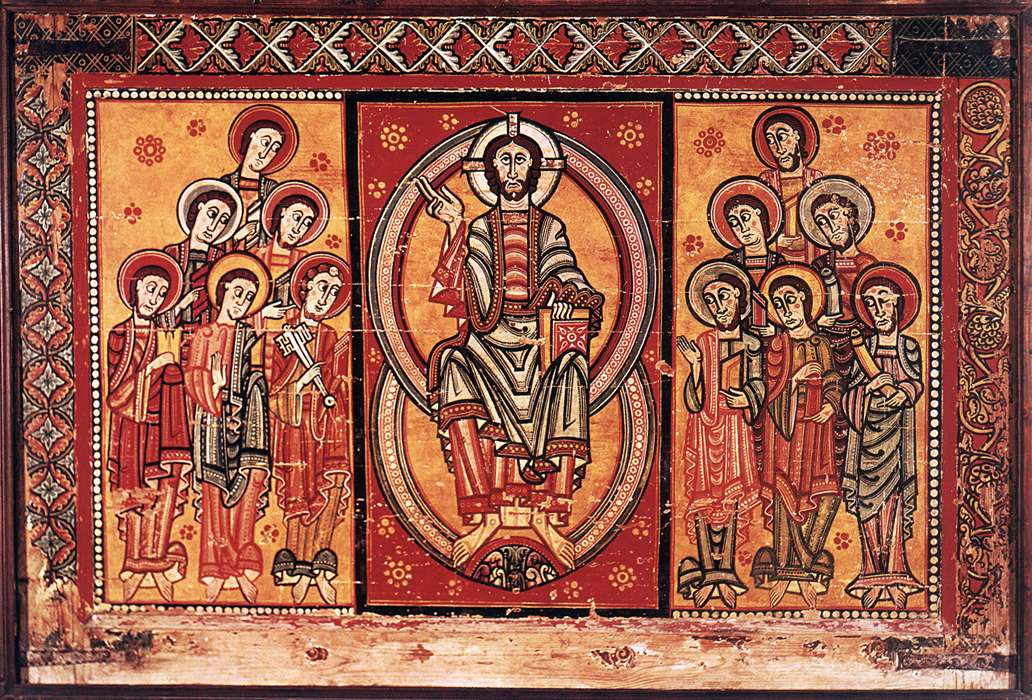
Christ and the Twelve Apostles
c. 1100
Tempera on wood, 130 x 150 cm
Museu Nacional d'Art de Catalunya, Barcelona
7
posted on
09/09/2025 4:53:31 AM PDT
by
annalex
(fear them not)
To: annalex
Saint of the Day for September 9
(June 26, 1581 – September 8, 1654)
Saint Peter Claver’s Story
A native of Spain, young Jesuit Saint Peter Claver left his homeland forever in 1610 to be a missionary in the colonies of the New World. He sailed into Cartagena, a rich port city washed by the Caribbean. He was ordained there in 1615.
By this time the slave trade had been established in the Americas for nearly 100 years, and Cartagena was a chief center for it. Ten thousand slaves poured into the port each year after crossing the Atlantic from West Africa under conditions so foul and inhuman that an estimated one-third of the passengers died in transit. Although the practice of slave-trading was condemned by Pope Paul III and later labeled “supreme villainy” by Pope Pius IX, it continued to flourish.
Saint Peter Claver’s predecessor, Jesuit Father Alfonso de Sandoval, had devoted himself to the service of the slaves for 40 years before Claver arrived to continue his work, declaring himself “the slave of the Negroes forever.”
As soon as a slave ship entered the port, Peter Claver moved into its infested hold to minister to the ill-treated and exhausted passengers. After the slaves were herded out of the ship like chained animals and shut up in nearby yards to be gazed at by the crowds, Claver plunged in among them with medicines, food, bread, brandy, lemons, and tobacco. With the help of interpreters he gave basic instructions and assured his brothers and sisters of their human dignity and God’s love. During the 40 years of his ministry, Claver instructed and baptized an estimated 300,000 slaves.
Saint Peter Claver’s apostolate extended beyond his care for slaves. He became a moral force, indeed, the apostle of Cartagena. He preached in the city square, gave missions to sailors and traders as well as country missions, during which he avoided, when possible, the hospitality of the planters and owners and lodged in the slave quarters instead.
After four years of sickness, which forced the saint to remain inactive and largely neglected, Saint Peter Claver died on September 8, 1654. The city magistrates, who had previously frowned at his solicitude for the black outcasts, ordered that he should be buried at public expense and with great pomp.
Peter Claver was canonized in 1888, and Pope Leo XIII declared him the worldwide patron of missionary work among black slaves.
Reflection
The Holy Spirit’s might and power are manifested in the striking decisions and bold actions of Peter Claver. A decision to leave one’s homeland never to return reveals a gigantic act of will difficult for us to imagine. Peter’s determination to serve forever the most abused, rejected, and lowly of all people is stunningly heroic. When we measure our lives against such a man’s, we become aware of our own barely used potential and of our need to open ourselves more to the jolting power of Jesus’ Spirit.
Saint Peter Claver is the Patron Saint of:
African Diaspora
African Missions
Colombia
Interracial Justice
franciscanmedia.org
8
posted on
09/09/2025 4:55:38 AM PDT
by
annalex
(fear them not)
To: annalex
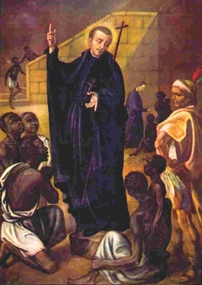
Saint Peter Claver, Church of st. Ignatius, Bogotà, Colombia
9
posted on
09/09/2025 4:58:16 AM PDT
by
annalex
(fear them not)
To: annalex
NAVARRE BIBLE COMMENTARY(RSV)
Ad Majorem Dei Gloriam (To the Greater Glory of God)
First Reading:
From: Colossians 2:6-15
A Warning About Empty Philosophies
----------------------------------
[6] As therefore you received Christ Jesus the Lord, so live in him, [7] rooted and built up in him and established in the faith, just as you were taught, abounding in thanksgiving.
[8] See to it that no one makes a prey of you by philosophy and empty deceit, according to human tradition, according to the elemental spirits of the universe, and not according to Christ.
Defense of Sound Teaching in the Face of Heresy
-----------------------------------------------
[9] For in him the whole fullness of deity dwells bodily, [10] and you have come to fullness of life in him, who is the head of all rule and authority. [11] In him also you were circumcised with a circumcision made without hands, by putting off the body of flesh in the circumcision of Christ; [12] and you were buried with him in baptism, in which you were also raised with him through faith in the working of God, who raised him from the dead. [13] And you, who were dead in trespasses and the uncircumcision of your flesh, God made alive together with him, having forgiven us all our trespasses, [14] having canceled the bond which stood against us with its legal demands; this he set aside, nailing it to the cross. [15] He disarmed the principalities and powers and made a public example of them, triumphing over them in him.
***********************************************************************
Commentary:
4-8. These verses reveal the Apostle's pastoral solicitude for the faithful of Colossae. Although physically absent, he is with them in spirit. He rejoices and gives thanks to God for their steadfastness, but he leaves them in no doubt about the dangers which threaten their faith. Clearly he is referring to those who were adulterating the Colossians' faith by intruding erroneous ideas. By sophistry and deceit they were trying to convince the faithful that it was better to have recourse to angels rather than to Christ, arguing that angels were the chief mediators between God and men.
The Christian faith is not opposed to human scholarship and science, it rejects only vain philosophy, that is, philosophy which boasts that it relies on reason alone and which fails to respect revealed truths.
Over the centuries, people have often tried to adapt the truths of faith to the philosophies or ideologies which happen to be in vogue. In this connection Leo Xlll said: "As the Apostle warns, 'philosophy and empty deceit' can deceive the minds of Christians and corrupt the sincerity of men's faith; the supreme pastors of the Church, therefore, always see it as part of their role to foster as much as they can sciences which merit that name, and at the same time to ensure by special watchfulness, that human sciences are taught in keeping with the criteria of Catholic faith--particularly philosophy, because proper methodology in the other sciences is largely dependent on [correctness in] philosophy" ("Aeterni Patris", 1).
"The elemental spirits of the universe": see the note on Gal 4:3.
9. This is such an important verse that it deserves close analysis. "Dwell": the Greek word means a stable way of living or residing, as distinct from a transitory presence: in other words, the union of Christ's human nature with his divine nature is not just something which lasts for a while; it is permanent. "Deity": the Greek word can also be translated as "divinity"; in either case, the sentence means that God has taken up a human nature, in such a way that, although it was only the second divine Person, the Son, who became incarnate, by virtue of the unity of the divine essence, where one divine person is present the other two persons are also present.
This verse enunciates the profound mystery of the Incarnation in a different way to John 1:14: "And the word became flesh and dwelt among us, full of grace and truth; we have beheld his glory; glory as of the only Son from the Father" (cf. also 1 in 1:1-2).
When the sacred text says that in Christ "the whole fullness of deity dwells bodily", it means, St John of Avila explains, "that it does not dwell in him merely by grace-as in the case of the saints (men and angels both), but in another way of greater substance and value, that is, by way of personal union" ("Audi, "Filia", 84).
In Jesus Christ, then, there are two natures, divine and human, united in one person, who is divine. This "hypostatic union" does not prevent each nature from having all its own proper characteristics, for, as St Leo the Great defined, "the Word has not changed into flesh, nor has flesh changed into Word; but each remains, in a unity" ("Licet Per Nostros", 2).
10. Since Christ is head of angels and men, the head of all creation (cf. Eph 1:10) and especially head of the Church (cf. Col 1:18), all fullness is said to reside in him (cf. note on Col 1:19). Hence, not only is he pre-eminent over all things but "he fills the Church, which is his body and fullness, with his divine gifts (cf. Eph 1:22-23), so that it may increase and attain to all the fullness of God (cf. Eph 3:19)" (Vatican II, "Lumen Gentium", 7).
Union with Christ makes Christians sharers in his "fullness", that is, in divine grace (of which he is absolutely full and we have a partial share), in a word, in his perfections.
That is why the members of the Church who "through the sacraments are united in a hidden and real way to Christ" ("Lumen Gentium", 7) can attain the fullness of the Christian life.
It was very appropriate for St Paul to be instructing the Colossians in these truths at this time, because it put them on their guard against preachers who were arguing for exaggerated worship of angels, to the detriment of Christ's unique, pre-eminent mediation.
11-12. This is a reference to another error which the Judaizers were trying to spread at Colossae and which was already treated in detail in the letters to the Galatians and the Romans--the idea that it was necessary for Christians to be circumcised. Physical circumcision affects the body, whereas what the Apostle, by analogy, calls "the circumcision of Christ", that is, Baptism, puts off the "body of flesh" (an expression which seems to refer to whatever is sinful in man). "We, who by means of (Christ) have reached God, have not been given fleshly circumcision but rather spiritual circumcision [...]; we receive it by the mercy of God in Baptism" (St Justin, "Dialogue with Trypho", 43, 2). "By the sacrament of Baptism, whenever it is properly conferred in the way the Lord determined and received with the proper dispositions of soul, man becomes truly incorporated into the crucified and glorified Christ and is reborn to a sharing of the divine life, as the Apostle says: [Col 2:12 follows]" (Vatican II, "Unitatis Redintegratio", 22).
As on other occasions (cf. Rom 6:4), St Paul, evoking the rite of immersion in water, speaks of Baptism as a kind of burial (a sure sign that someone has died to sin), and of resurrection to a new life, the life of grace. By this sacrament we are associated with Christ's death and burial so as to be able to rise with him. "Christ by his resurrection signified our new life, which was reborn out of the old death which submerged us in sin. This is what is brought about in us by the great sacrament of Baptism: all those who receive this grace die to sin [...] and are reborn to the new life" (St Augustine, "Enchiridion", 41-42).
13-14. This is one of the central teachings of the epistle--that Jesus Christ is the only mediator between God and men. The basic purpose of his mediation is to reconcile men with God, through the forgiveness of their sins and the gift of the life of grace, which is a sharing in God's own life.
Verse 14 indicates how Christ achieved this purpose--by dying on the Cross. All who were under the yoke of sin and the Law have been set free through his death.
The Mosaic Law, to which the scribes and Pharisees added so many precepts as to make it unbearable, had become (to use St Paul's comparison) like a charge sheet against man, because it imposed heavy burdens but did not provide the grace needed for bearing them. The Apostle very graphically says that this charge sheet or "bond" was set aside and nailed on the Cross--making it perfectly clear to all that Christ made more than ample satisfaction for our crimes. "He has obliterated them," St John Chrysostom comments, "not simply crossed them out; he has obliterated them so effectively that no trace of them remains in our soul. He has completely canceled them out, he has nailed them to the Cross [...]. We were guilty and deserved the most rigorous of punishments because we were all of us in sin! What, then, does the Son of God do? By his death on the Cross he removes all our stains and exempts us from the punishment due to them. He takes our charge-sheet, nails it to the Cross through his own person and destroys it" ("Hom. On Col, ad loc.").
15. Jesus is the only mediator between God and man. The angelic principalities and powers are insignificant by comparison with him: God has overpowered them and publicly exposed them through the death of his Son. The sentence seems to evoke the idea of the parade of a victorious general complete with trophies, booty and prisoners.
Some scholars interpret this passage differently; the "public spectacle", according to their interpretation, would refer to the fact that the good angels had been mediators in the revelation of the Mosaic Law (cf. Gal 3:19) and were being venerated by some contemporary Jews (among them some converts from Colossae) with a form of worship bordering on superstition. God would have caused them to become "a public spectacle" when they acted as a kind of escort in Christ's victory parade. Thus, both interpretations lead to the conclusion that angels, who are Christ's servants, should not be rendered the worship due to him alone, even though they do play an important part in God's plan of salvation. One of the missions entrusted to them is that of continually interceding on behalf of mankind.
At the time this epistle was being written there was need to emphasize first that Jesus Christ is the only mediator. The mediation of angels depends on him (it is something revealed in fact in the Old Testament: cf. Tob 12:3, 12ff; Dan 9:2ff; 10:13; Ezek 49:3; Zech 1:9; etc.). The Blessed Virgin Mary's mediation, also subordinate to that of Christ, is something which becomes clearer as the events of the New Testament unfold. Mary's mediation is, however, on a higher level than that of the angels. Pope Pius XII says this, echoing earlier teachings: "If, as he does, the Word works miracles and infuses grace by means of the human nature he has taken on, if he uses the sacraments, and his Saints, as instruments for the saving of souls, how could he not use the office and action of his most blessed Mother to distribute the fruits of the Redemption?
"With a truly maternal spirit (our predecessor Pius IX of immortal memory says), having in her hands the business of our salvation, she concerns herself with all mankind, for she has been made by the Lord Queen of heaven and earth and is raised above all the choirs of Angels and all the degrees of the Saints in heaven; she is there at the right hand of her only Son, Jesus Christ, our Lord, in most effective supplication, obtaining whatever she asks; she cannot but be heard" ("Ad Caeli Reginam", 17). "Principalities and powers": see the note on Eph 6:12.
10
posted on
09/09/2025 8:58:06 AM PDT
by
fidelis
(Ecce Crucem Domini! Fugite partes adversae! Vicit Leo de tribu Juda, Radix David! Alleluia!)
Gospel Reading: From: Luke 6:12-19
The Calling of the Apostles
---------------------------
[12] In these days He (Jesus) went out into the hills to pray; and all night He continued in prayer to God. [13] And when it was day, He called His disciples, and chose from them twelve, whom He named Apostles: [14] Simon, whom He named Peter, and Andrew, his brother, and James and John, and Philip and Bartholomew, [15] and Matthew, and Thomas, and James the son of Alphaeus, and Simon who was called the Zealot, [16] and Judas the son of James, and Judas Iscariot, who became a traitor.
The Sermon on the Plain
-----------------------
[17] And He came down with them and stood on a level place, with a great crowd of His disciples and a great multitude of people from all Judea and Jerusalem and the sea coast of Tyre and Sidon, who came to hear Him and to be healed of their diseases; [18] and those who were troubled with unclean spirits were cured. [19] And all the crowd sought to touch Him, for power came forth from Him and healed them all.
***********************************************************************
Commentary:
12-13. The evangelist writes with a certain formality when describing this important occasion on which Jesus chooses the Twelve, constituting them as the apostolic college: "The Lord Jesus, having prayed at length to the Father, called to Himself those whom He willed and appointed twelve to be with Him, whom He might send to preach the Kingdom of God (cf. Mark 2:13-19; Matthew 10:1-42). These Apostles (cf. Luke 6:13) He constituted in the form of a college or permanent assembly, at the head of which He placed Peter, chosen from among them (cf. John 21:15-17). He sent them first of all to the children of Israel and then to all peoples (cf. Romans 1:16), so that, sharing in His power, they might make all peoples His disciples and sanctify and govern them (cf. Matthew 28:16-20; and par.) and thus spread the Church and, administering it under the guidance of the Lord, shepherd it all days until the end of the world (cf. Matthew 28:20). They were fully confirmed in this mission on the day of Pentecost (cf. Act 2:1-26) [...]. Through their preaching the Gospel everywhere (cf. Mark 16:20), and through its being welcomed and received under the influence of the Holy Spirit by those who hear it, the Apostles gather together the universal Church, which the Lord founded upon the Apostles and built upon Blessed Peter their leader, the chief cornerstone being Christ Jesus Himself (cf. Revelation 21:14; Matthew 16:18; Ephesians 2:20). That divine mission, which was committed by Christ to the Apostles, is destined to last until the end of the world (cf. Matthew 28:20), since the Gospel, which they were charged to hand on, is, for the Church, the principle of all its life for all time. For that very reason the Apostles were careful to appoint successors in this hierarchically constituted society" (Vatican II, "Lumen Gentium", 19-20).
Before establishing the apostolic college, Jesus spent the whole night in prayer. He often made special prayer for His Church (Luke 9:18; John 17:1ff), thereby preparing His Apostles to be its pillars (cf. Galatians 2:9). As His Passion approaches, He will pray to the Father for Simon Peter, the head of the Church, and solemnly tell Peter that He has done so: "But I have prayed for you that your faith may not fail" (Luke 22:32). Following Christ's example, the Church stipulates that on many occasions liturgical prayer should be offered for the pastors of the Church (the Pope, the bishops in general, and priests) asking God to give them grace to fulfill their ministry faithfully.
Christ is continually teaching us that we need to pray always (Luke 18:1). Here He shows us by His example that we should pray with special intensity at important moments in our lives. "`Pernoctans in oratione Dei. He spent the whole night in prayer to God.' So St. Luke tells of our Lord. And you? How often have you persevered like that? Well, then...." (St J. Escriva, "The Way", 104).
On the need for prayer and the qualities our prayer should have, see the notes on Matthew 6:5-6; 7:7-11; 14:22-23; Mark 1:35; Luke 5:16; 11:1-4; 22:41-42.
12. Since Jesus is God, why does He pray? There were two wills in Christ, one divine and one human (cf. "St. Pius X Catechism", 91), and although by virtue of His divine will He was omnipotent, His human will was not omnipotent. When we pray, what we do is make our will known to God; therefore Christ, who is like us in all things but sin (Hebrews 4:15), also had to pray in a human way (cf. "Summa Theologiae", III, q. 21, a. 1). Reflecting on Jesus at prayer, St. Ambrose comments: "The Lord prays not to ask things for Himself, but to intercede on my behalf; for although the Father has put everything into the hands of the Son, still the Son, in order to behave in accordance with His condition as man, considers it appropriate to implore the Father for our sake, for He is our Advocate [...]. A Master of obedience, by His example He instructs us concerning the precepts of virtue: `We have an advocate with the Father' (1 John 2:1)" ("Expositio Evangelii sec. Lucam, in loc.").
14-16. Jesus chose for Apostles very ordinary people, most of them poor and uneducated; apparently only Matthew and the brothers James and John had social positions of any consequence. But all of them gave up whatever they had, little or much as it was, and all of them, bar Judas, put their faith in the Lord, overcame their shortcomings and eventually proved faithful to grace and became saints, veritable pillars of the Church. We should not feel uneasy when we realize that we too are low in human qualities; what matters is being faithful to the grace God gives us.
19. God became man to save us. The divine person of the Word acts through the human nature which He took on. The cures and casting out of devils which He performed during His life on earth are also proof that Christ actually brings redemption and not just hope of redemption. The crowds of people from Judea and other parts of Israel who flock to Him, seeking even to touch Him, anticipate, in a way, Christians' devotion to the holy Humanity of Christ.
11
posted on
09/09/2025 8:58:30 AM PDT
by
fidelis
(Ecce Crucem Domini! Fugite partes adversae! Vicit Leo de tribu Juda, Radix David! Alleluia!)
12
posted on
09/09/2025 8:59:26 AM PDT
by
fidelis
(Ecce Crucem Domini! Fugite partes adversae! Vicit Leo de tribu Juda, Radix David! Alleluia!)
Disclaimer:
Opinions posted on Free Republic are those of the individual
posters and do not necessarily represent the opinion of Free Republic or its
management. All materials posted herein are protected by copyright law and the
exemption for fair use of copyrighted works.
FreeRepublic.com is powered by software copyright 2000-2008 John Robinson
