Skip to comments.
Catholic Caucus: Daily Mass Readings 2-September-2025
Universalis/Jerusalem Bible ^
Posted on 09/02/2025 5:22:05 AM PDT by annalex
2 September 2025
Tuesday of week 22 in Ordinary Time

Saint-Just in Lyon, FranceReadings at MassLiturgical Colour: Green. Year: C(I).
| First reading |
|---|
| 1 Thessalonians 5:1-6,9-11 |
|---|
Keep strengthening one anotherYou will not be expecting us to write anything to you, brothers, about ‘times and seasons’, since you know very well that the Day of the Lord is going to come like a thief in the night. It is when people are saying, ‘How quiet and peaceful it is’ that the worst suddenly happens, as suddenly as labour pains come on a pregnant woman; and there will be no way for anybody to evade it. But it is not as if you live in the dark, my brothers, for that Day to overtake you like a thief. No, you are all sons of light and sons of the day: we do not belong to the night or to darkness, so we should not go on sleeping, as everyone else does, but stay wide awake and sober. God never meant us to experience the Retribution, but to win salvation through our Lord Jesus Christ, who died for us so that, alive or dead, we should still live united to him. So give encouragement to each other, and keep strengthening one another, as you do already.
| Responsorial Psalm |
|---|
| Psalm 26(27):1,4,13-14 |
|---|
I am sure I shall see the Lord’s goodness in the land of the living. The Lord is my light and my help; whom shall I fear? The Lord is the stronghold of my life; before whom shall I shrink? I am sure I shall see the Lord’s goodness in the land of the living. There is one thing I ask of the Lord, for this I long, to live in the house of the Lord, all the days of my life, to savour the sweetness of the Lord, to behold his temple. I am sure I shall see the Lord’s goodness in the land of the living. I am sure I shall see the Lord’s goodness in the land of the living. Hope in him, hold firm and take heart. Hope in the Lord! I am sure I shall see the Lord’s goodness in the land of the living.
| Gospel Acclamation | Heb4:12 |
|---|
Alleluia, alleluia! The word of God is something alive and active: it can judge secret emotions and thoughts. Alleluia! Alleluia, alleluia! A great prophet has appeared among us; God has visited his people. Alleluia!
'I know who you are: the Holy One of God'Jesus went down to Capernaum, a town in Galilee, and taught them on the sabbath. And his teaching made a deep impression on them because he spoke with authority. In the synagogue there was a man who was possessed by the spirit of an unclean devil, and it shouted at the top of its voice, ‘Ha! What do you want with us, Jesus of Nazareth? Have you come to destroy us? I know who you are: the Holy One of God.’ But Jesus said sharply, ‘Be quiet! Come out of him!’ And the devil, throwing the man down in front of everyone, went out of him without hurting him at all. Astonishment seized them and they were all saying to one another, ‘What teaching! He gives orders to unclean spirits with authority and power and they come out.’ And reports of him went all through the surrounding countryside. You can also view this page with the New Testament in Greek and English. Christian Art Each day, The Christian Art website gives a picture and reflection on the Gospel of the day. The readings on this page are from the Jerusalem Bible, which is used at Mass in most of the English-speaking world. The New American Bible readings, which are used at Mass in the United States, are available in the Universalis apps, programs and downloads.
You can also view this page with the Gospel in Greek and English. |
TOPICS: Catholic; General Discusssion; Prayer; Worship
KEYWORDS: catholic; lk4; ordinarytime; prayer
For your reading, reflection, faith-sharing, comments, questions, discussion.
1
posted on
09/02/2025 5:22:05 AM PDT
by
annalex
To: All
KEYWORDS: catholic; lk4; ordinarytime; prayer;
2
posted on
09/02/2025 5:22:34 AM PDT
by
annalex
(fear them not)
To: nickcarraway; NYer; ELS; Pyro7480; livius; ArrogantBustard; Catholicguy; RobbyS; marshmallow; ...

Alleluia Ping Please FReepmail me to get on/off the Alleluia Ping List.
3
posted on
09/02/2025 5:23:31 AM PDT
by
annalex
(fear them not)
To: annalex
4
posted on
09/02/2025 5:23:55 AM PDT
by
annalex
(fear them not)
To: annalex
| Luke |
| | English: Douay-Rheims | Latin: Vulgata Clementina | Greek NT: Byzantine/Majority Text (2000) |
| | Luke 4
|
| 31. | And he went down into Capharnaum, a city of Galilee, and there he taught them on the sabbath days. | Et descendit in Capharnaum civitatem Galilææ, ibique docebat illos sabbatis. | και κατηλθεν εις καπερναουμ πολιν της γαλιλαιας και ην διδασκων αυτους εν τοις σαββασιν |
| 32. | And they were astonished at his doctrine: for his speech was with power. | Et stupebant in doctrina ejus, quia in potestate erat sermo ipsius. | και εξεπλησσοντο επι τη διδαχη αυτου οτι εν εξουσια ην ο λογος αυτου |
| 33. | And in the synagogue there was a man who had an unclean devil, and he cried out with a loud voice, | Et in synagoga erat homo habens dæmonium immundum, et exclamavit voce magna, | και εν τη συναγωγη ην ανθρωπος εχων πνευμα δαιμονιου ακαθαρτου και ανεκραξεν φωνη μεγαλη |
| 34. | Saying: Let us alone, what have we to do with thee, Jesus of Nazareth? art thou come to destroy us? I know thee who thou art, the holy one of God. | dicens : Sine, quid nobis et tibi, Jesu Nazarene ? venisti perdere nos ? scio te quis sis, Sanctus Dei. | λεγων εα τι ημιν και σοι ιησου ναζαρηνε ηλθες απολεσαι ημας οιδα σε τις ει ο αγιος του θεου |
| 35. | And Jesus rebuked him, saying: Hold thy peace, and go out of him. And when the devil had thrown him into the midst, he went out of him, and hurt him not at all. | Et increpavit illum Jesus, dicens : Obmutesce, et exi ab eo. Et cum projecisset illum dæmonium in medium, exiit ab illo, nihilque illum nocuit. | και επετιμησεν αυτω ο ιησους λεγων φιμωθητι και εξελθε εξ αυτου και ριψαν αυτον το δαιμονιον εις μεσον εξηλθεν απ αυτου μηδεν βλαψαν αυτον |
| 36. | And there came fear upon all, and they talked among themselves, saying: What word is this, for with authority and power he commandeth the unclean spirits, and they go out? | Et factus est pavor in omnibus, et colloquebantur ad invicem, dicentes : Quod est hoc verbum, quia in potestate et virtute imperat immundis spiritibus, et exeunt ? | και εγενετο θαμβος επι παντας και συνελαλουν προς αλληλους λεγοντες τις ο λογος ουτος οτι εν εξουσια και δυναμει επιτασσει τοις ακαθαρτοις πνευμασιν και εξερχονται |
| 37. | And the fame of him was published into every place of the country. | Et divulgabatur fama de illo in omnem locum regionis. | και εξεπορευετο ηχος περι αυτου εις παντα τοπον της περιχωρου |
5
posted on
09/02/2025 5:26:20 AM PDT
by
annalex
(fear them not)
To: annalex

Catena Aurea by St. Thomas Aguinas
4:31–37
31. And came down to Capernaum, a city of Galilee, and taught them on the sabbath days.
32. And they were astonished at his doctrine: for his word was with power.
33. And in the synagogue there was a man, which had a spirit of an unclean devil, and cried out with a loud voice,
34. Saying, Let us alone; what have we to do with thee, thou Jesus of Nazareth? art thou come to destroy us? I know thee who thou art; the Holy One of God.
35. And Jesus rebuked him, saying, Hold thy peace, and come out of him. And when the devil had thrown him in the midst, he came out of him, and hurt him not.
36. And they were all amazed, and spake among themselves, saying, What a word is this! for with authority and power he commandeth the unclean spirits, and they come out.
37. And the fame of him went out into every place of the country round about.
AMBROSE. Neither indignation at their treatment, nor displeasure at their wickedness, caused our Lord to abandon Judæa, but unmindful of His injuries, and remembering mercy, at one time by teaching, at another by healing, He softens the hearts of this unbelieving people, as it is said, And he went down to Capernaum.
CYRIL OF ALEXANDRIA. For although He knew that they were disobedient and hard of heart, He nevertheless visits them, as a good Physician tries to heal those who are suffering from a mortal disease. But He taught them boldly in the synagogues, as Esaias saith, I have not spoken in secret, in a dark place of the earth. (Isa. 45:19.) On the sabbath day also He disputed with them, because they were at leisure. They wondered therefore at the mightiness of His teaching, His virtue, and His power, as it follows, And they were astonished at his doctrine, for his word was with power. That is, not soothing, but urging and exciting them to seek salvation. Now the Jews supposed Christ to be one of the saints or prophets. But in order that they might esteem Him higher, He passes beyond the prophetic limits. For he said not, “Thus saith the Lord,” but being the Master of the Law, He uttered things which were above the Law, changing the letter to the truth, and the figures to the spiritual meaning.
BEDE. The word of the teacher is with power, when he performs that which he teaches. But he who by his actions belies what he preaches is despised.
CYRIL OF ALEXANDRIA. But He generally intermingles with His teaching the performance of mighty works. For those whose reason does not incline to knowledge, are roused by the manifestation of miracles. Hence it follows, And there was in the synagogue a man which had a devil.
AMBROSE. The work of divine healing commenced on the sabbath, signifying thereby that he began anew where the old creation ceased, in order that He might declare at the very beginning that the Son of God was not under the Law, but above the Law. Rightly also He began on the sabbath, that He might shew Himself the Creator, who interweaves His works one within another, and follows up that which He had before begun; just as a builder determining to reconstruct a house, begins to pull down the old one, not from the foundation, but from the top, so as to apply his hand first to that part, where he had before left off. Holy men may through the word of God deliver from evil spirits, but to bid the dead rise again, is the work of Divine power alone.
CYRIL OF ALEXANDRIA. But the Jews spoke falsely of the glory of Christ, saying, He casteth out devils by Beelzebub the prince of the devils. To remove this charge, when the devils came beneath His invincible power, and endured not the Divine Presence, they sent forth a savage cry, as it follows: And he cried with a loud voice, saying, Let us alone; what have we to do with thee, &c.
BEDE. As if he said, Abstain a while from troubling me, thou who hast no fellowship with our designs.
AMBROSE. It ought not to shock any one that the devil is mentioned in this book as the first to have spoken the name of Jesus of Nazareth. For Christ received not from him that name which an Angel brought down from heaven to the Virgin. The devil is of such effrontery, that he is the first to use a thing among men and bring it as something new to them, that he may strike people with terror at his power. Hence it follows: For I know thee who thou art, the Holy One of God.
ATHANASIUS. (ad Epise. Æg. et Lib.) He spoke of Him not as a Holy One of God, as if He were like to the other saints, but as being in a remarkable manner the Holy One, with the addition of the article. For He is by nature holy by partaking of whom all others are called holy. Nor again did He speak this as if He knew it, but He pretended to know it.
CYRIL OF ALEXANDRIA. (et Tit. Bost.) For the devils thought by praises of this sort to make Him a lover of vainglory, that He might be induced to abstain from opposing or destroying them by way of grateful return.
CHRYSOSTOM. The devil wished also to disturb the order of things, and to deprive the Apostles of their dignity, and to incline the many to obey Him.
ATHANASIUS. (ut sup.) Although he confessed the truth he controlled his tongue, lest with the truth he should also publish his own disgrace, which should teach us not to care for such, although they speak the truth, for we who know the divine Scripture, must not be taught by the devil, as it follows: And Jesus rebuked him, saying, Be silent, &c.
BEDE. But by the permission of God, the man who was to be delivered from the devil is thrown into the midst, that the power of the Saviour being manifested might bring over many to the way of salvation. As it follows: And when he had thrown him in the midst. But this seems to be opposed to Mark, who says, And the unclean spirit tearing him, and crying with a loud voice, went out of him, unless we understand that Mark meant by tearing him the same as Luke by these words, And when he had thrown him in the midst, so that what follows, and hurt him not, might be understood to mean, that that twisting of limbs, and sore troubling, did not weaken him, as is often the case when devils depart from a man, leaving him with limbs cut and torn off. Well then do they wonder at such complete restoration of health. For it follows: And fear came upon all.
THEOPHYLACT. As if they said, What is this word by which he commands, Go out, and he went out?
BEDE. Holy men were able by the word of God to cast out devils, but the Word Himself does mighty works by His own power.
AMBROSE. In a mystery, the man in the synagogue with the unclean spirit is the Jewish people, which being fast bound in the wiles of the devil, defiled its vaunted cleanliness of body by the pollution of the heart. And truly it had an unclean spirit, because it had lost the Holy Spirit. For the devil entered whence Christ had gone out.
THEOPHYLACT. We must know also that many now have devils, namely, such as fulfil the desires of devils, as the furious have the dæmon of anger; and so of the rest. But the Lord came into the synagogue when the thoughts of the man were collected, and then says to the dæmon that dwelt there, Hold thy peace, and immediately throwing him into the middle he departs out of him. For it becomes not a man always to be angry, (that is, like the brutes,) nor always to be without anger, (for that is want of feeling,) but he must take the middle path, and have anger against what is evil; and so the man is thrown into the midst when the unclean spirit departs from him.
Catena Aurea Luke 4
6
posted on
09/02/2025 5:27:33 AM PDT
by
annalex
(fear them not)
To: annalex
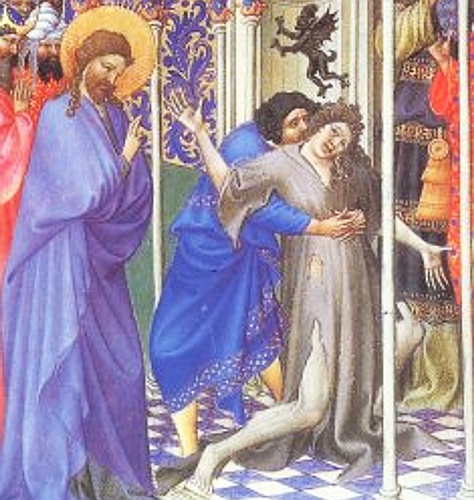
Exorcism of the demon-possessed in Capernaum
Très Riches Heures du Duc de Berry
ca. 1410
7
posted on
09/02/2025 5:27:56 AM PDT
by
annalex
(fear them not)
To: annalex
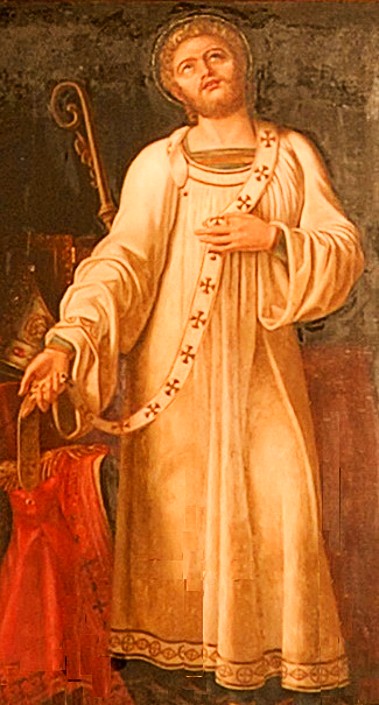
Saint of the Day – 2 September – St Justus of Lyons (Died c390) Bishop, Confessor
Saint of the Day – 2 September – St Justus of Lyons (Died c390) the 13th Bishop of Lyons, Confessor, Monk, Hermit, a man of learning, of meek, gentle and kind nature. Born in Tournon-sur-Rhône, Gaul (in modern France) and died in 390 in the Egyptian desert of natural causes. Also known as – Just, Justo, Giusto. The Latin name Justus means “one who helps.”
The Roman Martyrology states of him today: “At Lyons in France, St Justus, Bishop and Confessor, who was endowed with extraordinary sanctity and, a prophetic spirit, He resigned his Bishopric and retired into a desert of Egypt with his Lector, Viator, When he had, for some years, led an almost angelic life and the end of his meritorious labours had come, he went to our Lord to receive the crown of justice, on the 14th day of October, His holy body together with the Relics of his blessed Lector Viator, was afterwards taken to Lyons on this day, 2 September, becoming the remembrance of his birthday into Heaven.”
Justus was born in the first half of the 4th Century in Tournon-sur-Rhône and came from an aristocratic family. He followed the religious teaching of Saint Paschasius, the Archbishop of Vienne at the time, and became a Deacon of the Church of Vienne. A contemporary biographer describes him as being a meek and merciful man.
Around 350, Justus was Consecrated as the Bishop of Lyons. As the Bishop of the Capital City of Gaul, he was among the participants of the Council of Valencia in 374, regarding religious discipline of the Clergy and the faithful.
In 381, He assisted at the Council of Aquileia, organised by St Ambrose of Milan. A general Council had been requested by Arian bishops Palladius and Secundianus, supported by the Empress Justina, to review the Church’s position on Arianism. St Ambrose refused to hold a General Council, agreeing only to a Provincial Council but the Emperor Gratian allowed other Bishops to attend. The Bishops of Gaul sent delegates including Justus, who was one of 32 Bishops at the Council which rejected Arianism and condemned Palladius and Secundianus. (They must have regretted have requested the Council!)
At that time, Justus maintained a correspondence with St Ambrose of which there remain only two letters from St Ambrose discussing sections of Scripture. The two letters suggest that Justus was a man respected for his learning.
Some time after the Council of Aquileia, an incident took place where an insane individual in a violent fit, had attacked and killed several people in the streets of the City with a sword. Although eventually restrained, he managed to escape and take refuge in the Church, at that time located on the side of the present Church of St Nizier. Despite threats, the Bishop maintained the right of sanctuary. At length a City Magistrate arrived and persuaded Bishop Justus to hand the accused over to him, giving his word that the matter would be handled according to law. Relying on the Magistrate’s assurances, Justus delivered the man over; but scarcely had the man left the Church when the mob overpowered the guard and seizing the prisoner, put him to death.
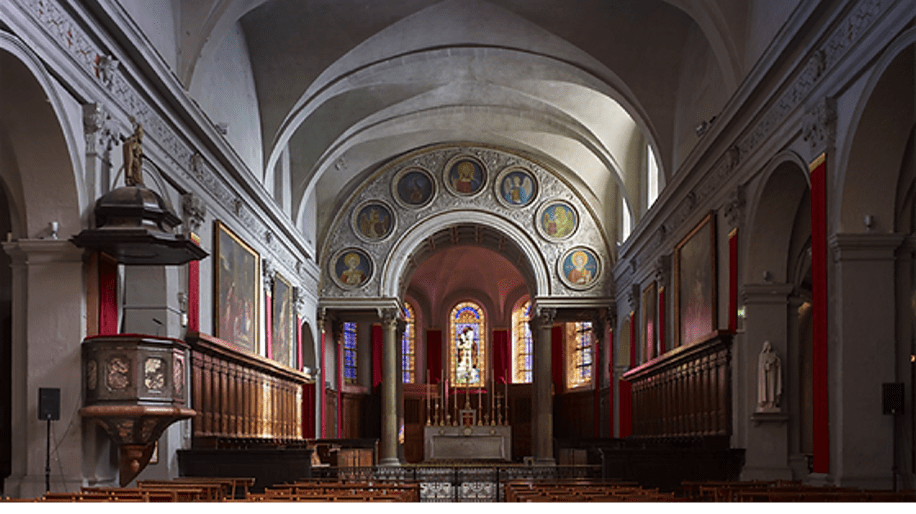
The interior of the Church of St Justus in Lyons
The Bishop came to believe that his failure to adequately protect the murderer had made him unworthy to continue to lead the Christian community and he resolved to devote the remainder of his life to doing penance. Disillusioned, Justus resigned his See and retired to his house at Tournon. His friends could neither convince him that he was not responsible for the unfortunate man’s death, nor to reconsider his decision of being unworthy to be Bishop. One night, he secretly left to take up the ascetical life of a Hermit. He travelled to Arles and then on to Marseilles where he planned to embark for Alexandria. The Cathedral Lector, Viator suspected the Bishop’s intentions and decided to follow his master. He caught up with Justus at Marseilles and together they boarded ship for Egypt.
Once there, they joined the community of Monks in the desert of Scetes, about 40 or 50 miles south of Alexandria, beyond the mountains of Nitria, in the Libyan Desert. At that time the leader or Abbot of this community was St Macarius of Egypt († 390), a disciple of St Anthony († 356). St Macarius had a reputation for great holiness and a fierce asceticism. Most of the Monks lived in cells, either dug in the ground or built of stones and each out of sight of others. They came together only on Sundays to celebrate the liturgy. They supported themselves by manual labour and ate only the poorest of foods. Fasting, prayer, silence and the keeping of night vigils, characterised their lives.
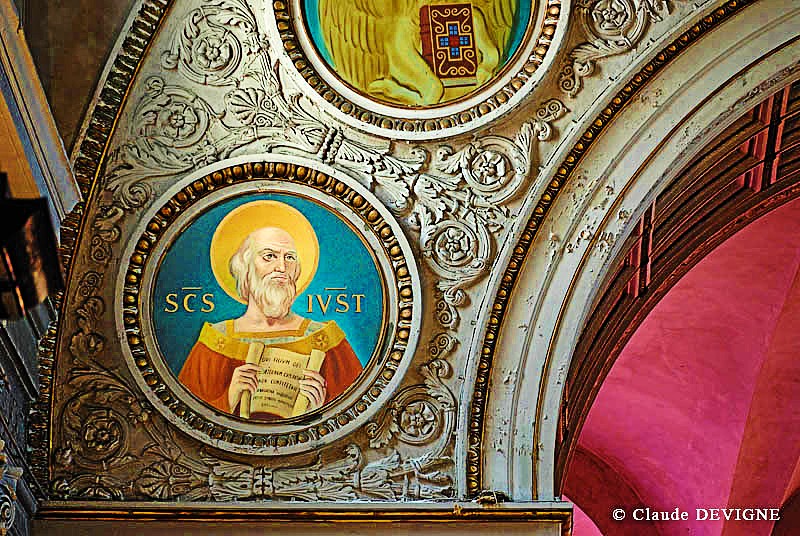
You can vaguely see this above in the interior of the St Justus Church in Lyons
The story is told then of a pilgrim in North Africa who some years later recognised Justus and reported this on his return to Lyons. The City folk being eager to regain their Bishop, sent a delegation led by Antiochus, a Priest of Lyons, to find him and bring him back to his Diocese. Antiochus found but could not convince the Hermit Bishop to return, so Antiochus returned to Gaul and was later himself appointed Bishop of Lyons.
Justus died at a Monastery of Scetes in c390. Upon his death, Antiochus, now himself Bishop of Lyons, made arrangements to repatriate the body of the Bishop and that of his companion Viator, who died shortly after and interred them in the Basilica of the Maccabees which Antiochus renamed the Saint-Just Basilica.
At the end of the 4th Century, a Vita Sancti Justi, Lugdunensis Episcopi, retracing in a hagiographic style the life of Justus, was written by a Priest of Lyons.
The Lyons Church celebrates a Mass for Saint Justus one to four times a year – on the date of his Ordination on 14 July (also Bastille Day); the translation of his Relics to Lyons on 4 August; his death on 2 September and his visit to Egypt on 14 October. The Feast of the translation of his Relics is still celebrated in the Diocese of Lyons, in addition to the regular September Feast.
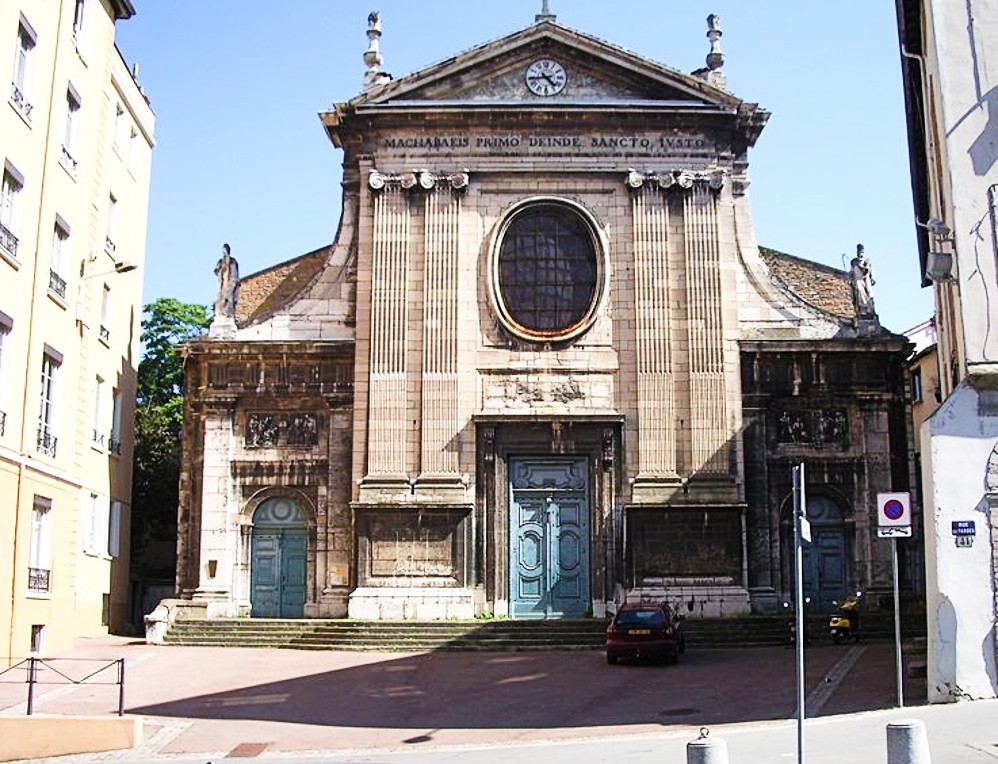
St Justus Church in Lyons
In Lyons, the Basilica of Saint Justus, now destroyed, was replaced by the Church of Saint-Just. Around the Basilica developed a village of the same name which, in the 19th Century, became a suburb of Lyons.
The Chapel of the School of Tournon, St Justus’ birth Town, also bears his name.
anastpaul.com
8
posted on
09/02/2025 5:34:47 AM PDT
by
annalex
(fear them not)
To: annalex
NAVARRE BIBLE COMMENTARY(RSV)
Ad Majorem Dei Gloriam (To the Greater Glory of God)
First Reading:
From: 1 Thessalonians 5:1-6, 9-11
The Second Coming of the Lord (Continuation)
--------------------------------------------
[1] But as to the times and the seasons, brethren, you have no need to have anything written to you. For you yourselves know well that the day of the Lord will come like a thief in the night. [3] When people say, "There is peace and security," then sudden destruction will come upon them as travail comes upon a woman with child, and there will be no escape. [4] But you are not in darkness, brethren, for that day to surprise you like a thief. [5] For you are all sons of light and sons of the day; we are not of the night or of darkness. [6] So then let us not sleep, as others do, but let us keep awake and be sober. [9] For God has not destined us for wrath, but to obtain salvation through our Lord Jesus Christ, [10] who died for us so that whether we wake or sleep we might live with him. [11] Therefore encourage one another and build one another up, just as you are doing.
***********************************************************************
Commentary:
1-3. "The day of the Lord" is an expression used a number of times in Sacred Scripture to refer to that point at which God will intervene decisively and irreversibly. The prophets speak of the "day of Yahweh" sometimes fearfully (cf. Amos 5:18-20), sometimes hopefully (cf. Is 6: 13). In his eschatological sermon (cf. Mt 24; Mk 13; Lk 21), Jesus foretold the destruction of Jerusalem in a style very reminiscent of that used by the prophets (cf. Amos 8:9ff) when speaking of the "day of Yahweh". The destruction of the city brings to an end the Jewish era in the history of salvation and prefigures the second coming of Christ as Judge of all. In St Paul's letters, as in other New Testament writings, the "day of the Lord" is the day of the general judgment when Christ will appear in the fullness of glory as Judge (cf. 1 Cor 1:8; 2 Cor 1:14). The Apostle brings in some examples used by our Lord in his preaching about the fall of Jerusalem and the end of the world (the "thief in the night": cf. Mt 24:43; the pains of childbirth: cf. Mt 24:19) to warn people that that day will come unexpectedly, and to exhort them to be always ready.
The Christian, therefore, should always be on the watch, for he never knows for sure when the last day of his life will be. The second coming of the Lord will take people by surprise; it will catch them doing good or doing evil. So, it would be rash to postpone repentance to some time in the future.
4-6. A thief works by night because he thinks that darkness will find the householder unprepared. Our Lord also used this metaphor when he said that if the father of the family had known when the thief would come, he would have kept a look-out (cf. Mt 24:43)—in other words, we need to be always alert, in the state of grace, surrounded by light. So, "if we walk in the light, as he is in the light, we have fellowship with one another, and the blood of Jesus his Son cleanses us from all sin" (1 Jn 1:7).
On the same subject the Church teaches that our souls are "illumined by the light of faith" ("St Pius V Catechism", II, 2, 4).
We should therefore live a transparent life, with the divine light shining clearly through it; if we do, the "day of the Lord" (which can also be applied to the day each person dies) will not find us unprepared, even if it comes suddenly. "A true Christian is always ready to appear before God. Because, if he is fighting to live as a man of Christ, he is ready at every moment to fulfill his duty" (St J. Escriva, "Furrow", 875).
9-10. "Wrath" refers to the condemnation earned by those who die in sin; and "salvation", in the New Testament, means being protected from danger and able to live free from anxiety. Being saved from wrath means obtaining eternal salvation.
Salvation comes to us "through our Lord Jesus Christ". The name Jesus ("God saves") conveys this mission which Christ attributed to himself (cf. Mt 1:21): "The Son of man came to seek and to save the lost" (Lk 19:10). Christ is the Savior: "there is no salvation in no one else, for there is no other name under heaven given among men by which we must be saved" (Acts 4:12). He will give us forgiveness of sins (cf. Acts 5:31); that was why he "died for us". "Through suffering" (Heb 2:10) he fulfilled the mission entrusted to him. By dying in obedience to the Father "he became the source of eternal salvation" (Heb 5:9). "Therefore he had to be made like his brethren in every respect, so that he might become a merciful and faithful high priest in the service of God, to make expiation for the sins of the people. For because he himself has suffered and been tempted, he is able to help those who are tempted (Heb 2:17-18). So it is that Jesus intercedes for all believers until the end of time (cf. Heb 7:25).
When he receives the sacrament of Baptism, the Christian becomes identified with Christ, the eternal high priest, in a special way: the "character" or mark conferred by the sacrament indicates that he is destined to live with Christ. As he makes his pilgrim way through this life he is able to enjoy, through grace, a foretaste of that divine life which he will enjoy permanently and much more fully in heaven.
Verse 10 contains another of St Paul's plays on words. The word "sleep" here (unlike vv. 6-7) means "die", and "being awake" means "being alive". For a Christian, death is a step which enables him to "live with Christ" forever, in eternal beatitude.
9
posted on
09/02/2025 8:28:03 AM PDT
by
fidelis
(Ecce Crucem Domini! Fugite partes adversae! Vicit Leo de tribu Juda, Radix David! Alleluia!)
Gospel Reading: From: Luke 4:31-37
Jesus Preaches in Capernaum
---------------------------
[31] And He (Jesus) went down to Capernaum, a city of Galilee. And He was teaching them on the Sabbath; [32]and they were astonished at His teaching, for His word was with authority.
The Cure of the Demoniac
------------------------
[33] And in the synagogue there was a man who had the spirit of an unclean demon; and he cried out with a loud voice, [34] "Ah! What have You to do with us, Jesus of Nazareth? Have You come to destroy us? I know who You are, the Holy One of God." [35] But Jesus rebuked him, saying, "Be silent, and come out of him!" And when the demon had thrown him down in the midst, he came out of him, having done him no harm. [36] And they were all amazed and said to one another, "What is this word? For with authority and power He commands the unclean spirits, and they come out." [37] And reports of Him went out into every place in the surrounding region.
***********************************************************************
Commentary:
33-37. Jesus now demonstrates by His actions that authority which was evident in His words.
34. The demons tells the truth here when he calls Jesus "the Holy One of God", but Jesus does not accept this testimony from the "father of lies" (John 8:44). This shows that the devil usually says something partially true in order to disguise untruth; by sowing confusion in this way, he can more readily deceive people. By silencing and expelling the demon, Jesus teaches us to be prudent and not let ourselves by deceived by half-truths.
10
posted on
09/02/2025 8:28:28 AM PDT
by
fidelis
(Ecce Crucem Domini! Fugite partes adversae! Vicit Leo de tribu Juda, Radix David! Alleluia!)
11
posted on
09/02/2025 8:29:05 AM PDT
by
fidelis
(Ecce Crucem Domini! Fugite partes adversae! Vicit Leo de tribu Juda, Radix David! Alleluia!)
Disclaimer:
Opinions posted on Free Republic are those of the individual
posters and do not necessarily represent the opinion of Free Republic or its
management. All materials posted herein are protected by copyright law and the
exemption for fair use of copyrighted works.
FreeRepublic.com is powered by software copyright 2000-2008 John Robinson