Posted on 08/31/2025 10:21:05 AM PDT by annalex
22nd Sunday in Ordinary Time ![]() Lindisfarne Priory, Holy Island, England Readings at MassLiturgical Colour: Green. Year: C(I).
Behave humbly, and you will find favour with the LordMy son, be gentle in carrying out your business, and you will be better loved than a lavish giver. The greater you are, the more you should behave humbly, and then you will find favour with the Lord; for great though the power of the Lord is, he accepts the homage of the humble. There is no cure for the proud man’s malady, since an evil growth has taken root in him. The heart of a sensible man will reflect on parables, an attentive ear is the sage’s dream.
In your goodness, O God, you prepared a home for the poor. The just shall rejoice at the presence of God, they shall exult and dance for joy. O sing to the Lord, make music to his name; rejoice in the Lord, exult at his presence. In your goodness, O God, you prepared a home for the poor. Father of the orphan, defender of the widow, such is God in his holy place. God gives the lonely a home to live in; he leads the prisoners forth into freedom: In your goodness, O God, you prepared a home for the poor. You poured down, O God, a generous rain: when your people were starved you gave them new life. It was there that your people found a home, prepared in your goodness, O God, for the poor. In your goodness, O God, you prepared a home for the poor.
You have come to Mount Zion and to the city of the living GodWhat you have come to is nothing known to the senses: not a blazing fire, or a gloom turning to total darkness, or a storm; or trumpeting thunder or the great voice speaking which made everyone that heard it beg that no more should be said to them. But what you have come to is Mount Zion and the city of the living God, the heavenly Jerusalem where the millions of angels have gathered for the festival, with the whole Church in which everyone is a ‘first-born son’ and a citizen of heaven. You have come to God himself, the supreme Judge, and been placed with spirits of the saints who have been made perfect; and to Jesus, the mediator who brings a new covenant.
Alleluia, alleluia! If anyone loves me he will keep my word, and my Father will love him, and we shall come to him. Alleluia!
Alleluia, alleluia! Shoulder my yoke and learn from me, says the Lord, for I am gentle and humble in heart. Alleluia!
Everyone who exalts himself shall be humbledOn a sabbath day Jesus had gone for a meal to the house of one of the leading Pharisees; and they watched him closely. He then told the guests a parable, because he had noticed how they picked the places of honour. He said this, ‘When someone invites you to a wedding feast, do not take your seat in the place of honour. A more distinguished person than you may have been invited, and the person who invited you both may come and say, “Give up your place to this man.” And then, to your embarrassment, you would have to go and take the lowest place. No; when you are a guest, make your way to the lowest place and sit there, so that, when your host comes, he may say, “My friend, move up higher.” In that way, everyone with you at the table will see you honoured. For everyone who exalts himself will be humbled, and the man who humbles himself will be exalted.’ Then he said to his host, ‘When you give a lunch or a dinner, do not ask your friends, brothers, relations or rich neighbours, for fear they repay your courtesy by inviting you in return. No; when you have a party, invite the poor, the crippled, the lame, the blind; that they cannot pay you back means that you are fortunate, because repayment will be made to you when the virtuous rise again.’ You can also view this page with the New Testament in Greek and English. Universalis podcast: The week ahead – from 31 August to 6 SeptemberConfirmation, catechesis and the Creed. "I" and "we" revisited. Saint Gregory the Great; bishops as icebergs. Mother Teresa and why people hate her. More saints to hate! Differing views of judgement. The Litany of Loreto. (27 minutes) Christian Art![]() Each day, The Christian Art website gives a picture and reflection on the Gospel of the day. The readings on this page are from the Jerusalem Bible, which is used at Mass in most of the English-speaking world. The New American Bible readings, which are used at Mass in the United States, are available in the Universalis apps, programs and downloads. |
KEYWORDS: catholic; lk14; ordinarytime; prayer;

Please FReepmail me to get on/off the Alleluia Ping List.
| Luke | |||
| English: Douay-Rheims | Latin: Vulgata Clementina | Greek NT: Byzantine/Majority Text (2000) | |
| Luke 14 | |||
| 1. | AND it came to pass, when Jesus went into the house of one of the chief of the Pharisees, on the sabbath day, to eat bread, that they watched him. | Et factum est cum intraret Jesus in domum cujusdam principis pharisæorum sabbato manducare panem, et ipsi observabant eum. | και εγενετο εν τω ελθειν αυτον εις οικον τινος των αρχοντων των φαρισαιων σαββατω φαγειν αρτον και αυτοι ησαν παρατηρουμενοι αυτον |
| [...] | |||
| 7. | And he spoke a parable also to them that were invited, marking how they chose the first seats at the table, saying to them: | Dicebat autem et ad invitatos parabolam, intendens quomodo primos accubitus eligerent, dicens ad illos : | ελεγεν δε προς τους κεκλημενους παραβολην επεχων πως τας πρωτοκλισιας εξελεγοντο λεγων προς αυτους |
| 8. | When thou art invited to a wedding, sit not down in the first place, lest perhaps one more honourable than thou be invited by him: | Cum invitatus fueris ad nuptias, non discumbas in primo loco, ne forte honoratior te sit invitatus ab illo. | οταν κληθης υπο τινος εις γαμους μη κατακλιθης εις την πρωτοκλισιαν μηποτε εντιμοτερος σου η κεκλημενος υπ αυτου |
| 9. | And he that invited thee and him, come and say to thee, Give this man place: and then thou begin with shame to take the lowest place. | Et veniens is, qui te et illum vocavit, dicat tibi : Da huic locum : et tunc incipias cum rubore novissimum locum tenere. | και ελθων ο σε και αυτον καλεσας ερει σοι δος τουτω τοπον και τοτε αρξη μετ αισχυνης τον εσχατον τοπον κατεχειν |
| 10. | But when thou art invited, go, sit down in the lowest place; that when he who invited thee, cometh, he may say to thee: Friend, go up higher. Then shalt thou have glory before them that sit at table with thee. | Sed cum vocatus fueris, vade, recumbe in novissimo loco : ut, cum venerit qui te invitavit, dicat tibi : Amice, ascende superius. Tunc erit tibi gloria coram simul discumbentibus : | αλλ οταν κληθης πορευθεις αναπεσε εις τον εσχατον τοπον ινα οταν ελθη ο κεκληκως σε ειπη σοι φιλε προσαναβηθι ανωτερον τοτε εσται σοι δοξα ενωπιον των συνανακειμενων σοι |
| 11. | Because every one that exalteth himself, shall be humbled; and he that humbleth himself, shall be exalted. | quia omnis, qui se exaltat, humiliabitur : et qui se humiliat, exaltabitur. | οτι πας ο υψων εαυτον ταπεινωθησεται και ο ταπεινων εαυτον υψωθησεται |
| 12. | And he said to him also that had invited him: When thou makest a dinner or a supper, call not thy friends, nor thy brethren, nor thy kinsmen, nor thy neighbours who are rich; lest perhaps they also invite thee again, and a recompense be made to thee. | Dicebat autem et ei, qui invitaverat : Cum facis prandium, aut cœnam, noli vocare amicos tuos, neque fratres tuos, neque cognatos, neque vicinos divites : ne forte te et ipsi reinvitent, et fiat tibi retributio ; | ελεγεν δε και τω κεκληκοτι αυτον οταν ποιης αριστον η δειπνον μη φωνει τους φιλους σου μηδε τους αδελφους σου μηδε τους συγγενεις σου μηδε γειτονας πλουσιους μηποτε και αυτοι σε αντικαλεσωσιν και γενηται σοι ανταποδομα |
| 13. | But when thou makest a feast, call the poor, the maimed, the lame, and the blind; | sed cum facis convivium, voca pauperes, debiles, claudos, et cæcos : | αλλ οταν ποιης δοχην καλει πτωχους αναπηρους χωλους τυφλους |
| 14. | And thou shalt be blessed, because they have not wherewith to make thee recompense: for recompense shall be made thee at the resurrection of the just. | et beatus eris, quia non habent retribuere tibi : retribuetur enim tibi in resurrectione justorum. | και μακαριος εση οτι ουκ εχουσιν ανταποδουναι σοι ανταποδοθησεται γαρ σοι εν τη αναστασει των δικαιων |

14:1–6
1. And it came to pass, as he went into the house of one of the chief Pharisees to eat bread on the sabbath day, that they watched him.
2. And, behold, there was a certain man before him which had the dropsy.
3. And Jesus answering spake unto the Lawyers and Pharisees, saying, Is it lawful to heal on the sabbath day?
4. And they held their peace. And he took him, and healed him, and let him go;
5. And answered them, saying, Which of you shall have an ass or an ox fallen into a pit, and will not straightway pull him out on the sabbath day?
6. And they could not answer him again to these things.
CYRIL OF ALEXANDRIA. Although our Lord knew the malice of the Pharisees, yet He became their guest, that He might benefit by His words and miracles those who were present. Whence it follows, And it came to pass, as he went into the house of one of the chief Pharisees to eat bread on the sabbath day, that they watched him; to see whether He would despise the observance of the law, or do any thing that was forbidden on the sabbath day. When then the man with the dropsy came into the midst of them, He rebukes by a question the insolence of the Pharisees, who wished to detect Him; as it is said, And, behold, there was a certain man before him which had the dropsy. And Jesus answering, &c.
BEDE. When it is said that Jesus answered, there is a reference to the words which went before, And they watched him. For the Lord knew the thoughts of men.
THEOPHYLACT. But by His question He exposes their folly. For while God blessed the sabbath, (Gen. 2:1.) they forbade to do good on the sabbath; but the day which does not admit the works of the good is accursed.
BEDE. But they who were asked, are rightly silent, for they perceived that whatever they said, would be against themselves. For if it is lawful to heal on the sabbath day, why did they watch the Saviour whether He would heal? If it is not lawful, why do they take care of their cattle on the sabbath? Hence it follows, But they held their peace.
CYRIL OF ALEXANDRIA. Disregarding then the snares of the Jews, He cures the dropsical, who from fear of the Pharisees did not ask to be healed on account of the sabbath, but only stood up, that when Jesus beheld him, He might have compassion on him and heal him. And the Lord knowing this, asked not whether he wished to be made whole, but forthwith healed him. Whence it follows; And he took him, and healed him, and let him go. Wherein our Lord took no thought not to offend the Pharisees, but only that He might benefit him who needed healing. For it becomes us, when a great good is the result, not to care if fools take offence.
CYRIL OF ALEXANDRIA. But seeing the Pharisees awkwardly silent, Christ baffles their determined impudence by some important considerations. As it follows; And he answered and said unto them, Which of you shall have an ass or an ox fallen into a pit, and will not straightway pull him out on the sabbath day?
THEOPHYLACT. As though He said, If the law forbids to have mercy on the sabbath-day, have no care of thy son when in danger on the sabbath-day. But why speak I of a son, when thou dost not even neglect an ox if thou seest it in danger?
BEDE. By these words He so refutes His watchers, the Pharisees, as to condemn them also of covetousness, who in the deliverance of animals consult their own desire of wealth. How much more then ought Christ to deliver a man, who is much better than cattle!
AUGUSTINE. (de Quæst. Evan. lib. 2. cap. 29.) Now He has aptly compared the dropsical man to an animal which has fallen into a ditch, (for he is troubled by water,) as He compared that woman, whom He spoke of as bound, and whom He Himself loosed, to a beast which is let loose to be led to water.
BEDE. By a suitable example then He settles the question, shewing that they violate the sabbath by a work of covetousness, who contend that he does so by a work of charity. Hence it follows, And they could not answer him again to these things. Mystically, the dropsical man is compared to him who is weighed down by an overflowing stream of carnal pleasures. For the disease of dropsy derives the name from a watery humour.
AUGUSTINE. (ubi sup.) Or we rightly compare the dropsical man to a covetous rich man. For as the former, the more he increases in unnatural moisture the greater his thirst; so also the other, the more abundant his riches, which he does not employ well, the more ardently he desires them.
GREGORY. (14 Mor. c. 6.) Rightly then is the dropsical man healed in the Pharisees’ presence, for by the bodily infirmity of the one, is expressed the mental disease of the other.
BEDE. In this example also He well refers to the ox and the ass; so as to represent either the wise and the foolish, or both nations; that is, the Jew oppressed by the burden of the law, the Gentile not subject to reason. For the Lord rescues from the pit of concupiscence all who are sunk therein.
14:7–11
7. And he put forth a parable to those which were bidden, when he marked how they chose out the chief rooms; saying unto them,
8. When thou art bidden of any man to a wedding, sit not down in the highest room; lest a more honourable man than thou be bidden of him;
9. And he that bade thee and him come and say to thee, Give this man place; and thou begin with shame to take the lowest room.
10. But when thou art bidden, go and sit down in the lowest room; that when he that bade thee cometh, he may say unto thee, Friend, go up higher: then shalt thou have worship in the presence of them that sit at meat with thee.
11. For whosoever exalteth himself shall be abased; and he that humbleth himself shall be exalted.
AMBROSE. First the dropsical man is cured, in whom the abundant discharges of the flesh crushed down the powers of the soul, quenched the ardour of the Spirit. Next, humility is taught, when at the nuptial feast the desire of the highest place is forbidden. As it is said, And he spake, Sit not down in the highest room.
CYRIL OF ALEXANDRIA. For to rush forward hastily to honours which are not fitting for us, indicates rashness and casts a slur upon our actions. Hence it follows, lest a more honourable man than thou be invited, &c.
CHRYSOSTOM. (non occ.) And so the seeker of honour obtained not that which he coveted, but suffered a defeat, and busying himself how he might be loaded with honours, is treated with dishonour. And because nothing is of so much worth as modesty, He leads His hearer to the opposite of this seeking; not only forbidding him to seek the highest place, but bidding him search for the lowest. As it follows; But when thou art bidden, go and sit down in the lowest room.
CYRIL OF ALEXANDRIA. For if a man wishes not to be set before others, he obtains this honour according to the divine word. As it follows; That when he that bade thee cometh, he may say unto thee, Friend, go up higher. In these words He does not harshly chide, but gently admonishes; for a word of advice is enough for the wise. And thus for their humility men are crowned with honours; as it follows, Then shall thou have worship.
BASIL. (in reg. fus. ad inter. 12.) To take then the lowest place at a feast, according to our Lord’s command, is becoming to every man, but again to rush contentiously after this is to be condemned as a breach of order and cause of tumult; and a strife raised about it, will place you on a level with those who dispute concerning the highest place. Wherefore, as our Lord here says, it becomes him who makes the feast to arrange the order of sitting down. Thus in patience and love should we mutually bear ourselves, following all things decently according to order, not for external appearance or public display; nor should we seem to study or affect humility by violent contradiction, but rather gain it by condescension or by patience. For resistance or opposition is a far stronger token of pride than taking the first seat at meat, when we obtain it by authority.
THEOPHYLACT. Now let no one deem the above precepts of Christ to be trifling, and unworthy of the sublimity and grandeur of the Word of God. For you would not call him a merciful physician who professed to heal the gout, but refused to cure a scar on the finger or a tooth-ache. Besides, how can that passion of vainglory appear slight, which moved or agitated those who sought the first seats. It became then the Master of humility to cut off every branch of the bad root. But observe this also, that when the supper was ready, and the wretched guests were contending for precedency before the eyes of the Saviour, there was a fit occasion for advice.
CYRIL OF ALEXANDRIA. Having shewn therefore from so slight an example the degradation of the ambitious and the exaltation of the humbleminded, He adds a great thing to a little, pronouncing a general sentence, as it follows, For every one who exalts himself shall be abased, and he that humbleth himself shall be exalted. This is spoken according to the divine judgment, not after human experience, in which they who desire after glory obtain it, while others who humble themselves remain inglorious.
THEOPHYLACT. Moreover, he is not to be respected in the end, nor by all men, who thrusts himself into honours; but while by some he is honoured, by others he is disparaged, and sometimes even by the very men who outwardly honour him.
BEDE. But as the Evangelist calls this admonition a parable, we must briefly examine what is its mystical meaning. Whosoever being bidden has come to the marriage feast of Christ’s Church, being united to the members of the Church by faith, let him not exalt himself as higher than others by boasting of his merits. For he will have to give place to one more honourable who is bidden afterwards, seeing that he is overtaken by the activity of those who followed him, and with shame he occupies the lowest place, now that knowing better things of the others he brings low whatever high thoughts he once had of his own works. But a man sits in the lowest place according to that verse, The greater thou art, humble thyself in all things. (Eccles. 3:18.) But the Lord when He cometh, whomsoever He shall find humble, blessing him with the name of friend, He will command him to go up higher. For whoever humbleth himself as a little child, he is the greatest in the kingdom of heaven. But it is well said, Then shalt thou have glory, that thou mayest not begin to seek now what is kept for thee in the end. It may also be understood, even in this life, for daily does God come to His marriage feast, despising the proud; and often giving to the humble such great gifts of His Spirit, that the assembly of those who sit at meat, i. e. the faithful, glorify them in wonder. But in the general conclusion which is added, it is plainly declared that the preceding discourse of our Lord must be understood typically. For not every one who exalts himself before men is abased; nor is he who humbleth himself in their sight, exalted by them. But whoever exalteth himself because of his merits, the Lord shall bring low, and him who humbleth himself on account of his mercies, shall He exalt.
Catena Aurea Luke 14

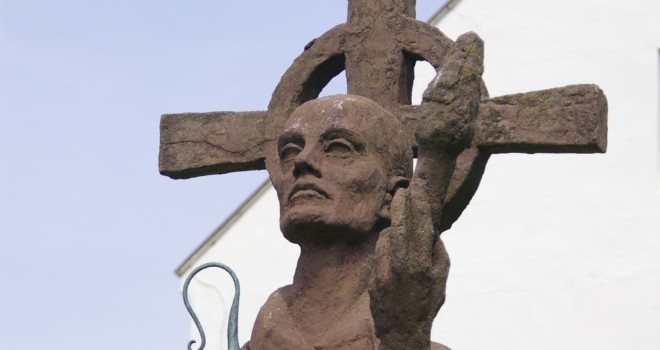
On this day in 651 AD, St. Aidan of Lindisfarne, among the greatest missionaries of the early medieval period, died while on one of his frequent preaching missions in Northern England. However, as with many great saints, St. Aidan’s legacy continues to live on. For from his monastery on Lindisfarne the light of Christ would permeate Great Britain and much of Europe.
For all his great influence, we actually know very little about this early Apostle to the Britons. What we do know largely comes from the Venerable Bede in his unmatched Ecclesiastical History of the English People.
To celebrate his feast day, and to call for his intercession when we need many more missionaries with his zeal, here are a five things you should know about St. Aidan of Lindisfarne.
St. Aidan began his life of service on the Isle of Iona, just off the coast of Scotland. The monastery at Iona was established by Irish monks under St. Columba, another great Celtic missionary during the so-called “dark ages.” About a century later, in St. Aidan’s time, the monastery had become a major center of Gaelic Christianity and was receiving and sending monks across Europe.
By this time, Christianity in Northern England was largely replaced by the paganism of both native Britons and the Anglo-Saxon conquerors. The Kingdom of Northumbria (northern England and south-east Scotland) had just been reconquered by King St. Oswald of Northumbria. Oswald took back his father’s throne at the Battle of Heavenfield, where he prepared by praying before a wooden cross, and possibly a relic of the True Cross. Next, Oswald beheld a vision of St. Columba who promised victory if his generals would be baptized. At council, all agreed to be baptized the night before and victory came to Oswald.
Oswald’s Northumbrian kingdom was small but remarkably diverse. One could hear at least four languages within the kingdom’s borders and there was a mix of church ruins and pagan sites dotting the landscape. While Christianity was initially brought to Britain by Roman saints, and strengthened by Sts. Gregory and Augustine of Canterbury, it had fallen away from the Britons with the Anglo-Saxon invasions.
Meanwhile, Ireland had been converted by St. Patrick and then the Scots and Picts were converted by St. Columba. Among the Kingdoms of Ireland and Scotland, Christianity had established great monasteries, libraries, and schools and it was now their time to bring Christianity back to England.
It was in this context that St. Oswald wished to make his kingdom Christian again. Thus, the victorious king asked the monks of St. Columba’s Iona to send him a missionary to be an Apostle to Northumbria.
Sometimes, missions don’t work out. In the case of Northumbria, the Abbott of Iona responded to Oswald’s request by sending a monk who was known to be harsh and severe. He had some trouble with the languages and he found that the people refused to listen to him. He made no progress in converting people and returned to Iona, reporting that the people of Iona were too barbarous and stubborn to be reached.
St. Aidan heard this discouraging report and rose to chastise a bishop and brother monk. Aidan ended his remarks by saying,
“You should have followed the practice of the Apostles, and begun by giving them the milk of simpler teaching, and gradually nourished them with the word of God until they were capable of greater perfection and able to follow the loftier precepts of Christ.”
St. Aidan was known to have the grace of discretion, and he was showing it here with his insight into preaching. If the people had forgotten Christ, they would need loving patience and instruction. Upon hearing these words, the Abbot knew that he found their next missionary.
According to Bede, St. Aidan’s “course of life was so different from the slothfulness of our times.” When you consider that Bede was an 8th century monk, we can begin to imagine the great monastic discipline of Aidan. Even before he left for England, St. Aidan was well-known for both his ascetic practices but also his great gentleness. His gentle example actually encouraged his fellow monks to extend their fasts on Wednesdays and Friday and to spend more time in prayer and learning.
For his new monastery and diocese, St. Aidan chose the rocky island of Lindisfarne which greatly appealed to his sensibilities. The island is cut off from the mainland at high tide but pilgrims can walk the causeway at high tide. Even today, the holy island feels remote.
Any wealth that was given to St. Aidan was almost immediately given to the poor or used to free slaves. Some of these slaves followed Aidan back to Lindisfarne and were educated by him, and a few even became priests.
Feeling that a horse might be too decadent, Aidan preferred to walk. He was known for conversing with anyone he encountered on the road, whether they were a peasant or a noble. From these trips he had converted and baptized countless people and earned more monks for his missions. Soon, he had established (or re-established) parishes all over Northern England.
Along with St. Florian, Aidan of Lindisfarne is the patron saint of firefighters. You’re not alone if that surprises you, but there is a story behind this.
St. Aidan was praying in his monastery when a pagan army attacked the royal town of Bamburgh. The invaders piled up on the walls, which the invaders set ablaze. St. Aidan saw the fire and could smell the smoke from Lindisfarne. At once, St. Aidan began to pray for the town and all who dwelt inside.
The cries of St. Aidan were heard for the wind abruptly changed and sent the flames and smoke towards the invaders. By the prayers of St. Aidan, Bamburgh and the royal house was saved from destruction. This not only makes him a patron of Northumbria, but also of firefighters. With wildfires raging everywhere, St. Aidan is a patron we can call upon to protect the firefighters who are risking their lives.
St. Aidan’s fame spread far and wide due to his humility, kindness, and the great number of miracles that he brought about. King Oswald thus invited St. Aidan to his castle for various feasts, although the bishop rarely attended and then would only eat in silence before returning to his prayers. On one particular Easter feast, Aidan got to observe the effect he had on the king.
As a silver platter full of rich foods was placed on their table, a servant entered the dining hall to inform the king and bishop of a multitude begging for alms outside the gates. Before Aidan could speak, Oswald immediately ordered all the food to be distributed to the beggars and for the silver plates to be broken into pieces and given to them. Seeing such an act of generosity, Aidan grasped the king’s right hand and blessed him, saying, “May this hand never decay.” And it never did.
Bede records that even after Oswald was struck down in battle his right arm never corrupted and was kept in a shrine where many people reported miraculous cures from the king’s relics. img src=https://upload.wikimedia.org/wikipedia/commons/thumb/7/79/Meister_des_Book_of_Lindisfarne_001.jpg/369px-Meister_des_Book_of_Lindisfarne_001.jpg>The Lindisfarne Gospels.
A loving bishop with a missionary zeal can seem a rare thing these days. St. Aidan of Lindisfarne shows us that such a bishop can change history. From his rocky monastery, missionaries would travel throughout Britain and parts of Europe with the same missionary zeal of their founder. Along with numerous parishes and monasteries, the monks of Lindisfarne also gave us The Lindisfarne Gospels, an illuminated manuscript and medieval treasure.
On his feast day, and every day, we can turn to St. Aidan in prayer for a renewal of our Church and in hopes that God can send us another missionary saint.

First Reading:
From: Sirach 3:17-21 (20 NAB), 29-30 (28-29 NAB)
Humility
-------------
[17] My son, perform your tasks in meekness; then you will be
loved by those whom God accepts.
[18] The greater you are, the more you must humble yourself;
so you will find favour in the sight of the Lord.
[21] Seek not what is too difficult for you,
nor investigate what is beyond your power.
[29] The mind of the intelligent man will ponder a parable,
and an attentive ear is the wise man’s desire.
[30] Water extinguishes a blazing fire:
so almsgiving atones for sin.
************************************************
Commentary:
3:1-16:23. Throughout the book each doctrinal passage is followed by a section to do with practical applications, sapiential thoughts on moral conduct, eulogies of virtues and sapiential advice on where to seek things that are truly good, etc. This is the first such section. In it the reader will find an exhortation to prudence in all its various forms.
3:17-29. In line with scholastic custom, the author addresses the reader as a teacher would his pupil: “My son” (v. 17; cf. Prov 1:8; etc.). He is about to deal with a virtue essential for a lover of wisdom – the humility of recognizing one’s shortcomings and being ready to learn from others. At the same time Ben Sirach wrote his work, Greek philosophy and new learning were proving very influential. Some Jews turned their backs on the Law of God and the traditional teaching of Israel, to follow foreign teachers. Reason, in its pride, thought it could find the answer to everything – which made it difficult to accept in all simplicity truths that God put within the reach of those who sincerely sought true wisdom.
Part of the legacy of the Old Testament is the idea that God shows his favour to the humble (Prov. 3:34; Ps 25:14). In the New Testament the Blessed Virgin experiences this, and her joy overflows in the Magnificat. She considers herself the humble handmaid of the Lord, and proclaims that God “has regarded her low estate” (cf. Lk 1:48) and uses her to bring salvation to his people. Very much in line with what Ben Sirach says here, great thinkers such as St Bonaventure have seen that humble devotion is necessary for getting to the truth of things: “Spiritual reading without repentance is not sufficient; nor knowledge without devotion; nor inquiry without the capacity to be surprised; nor prudence without openness to joy; nor any activity devoid of a religious spirit; nor wisdom without charity, intelligence without humility; study without divine grace, or reflection without the wisdom inspired by God” (“Itinerarium mentis in Deum, prol”., 4).
3:30—4:10. The Law of God contains calls to help those in need (Deut 15:7-11) and, indeed, almsgiving was a favourite work of mercy among observant Jews. The book of Tobit contains nice examples and teachings in this regard (cf. Tob 1:3, 16; 4:7-16; 12:8-9; 14:2, 8-11). Almsgiving “is one of the chief witnesses to fraternal charity; it is also a work of justice pleasing to God (cf. Mt 6:2-4). “He who has two coats, let him share with him who has none; and he who has food must do likewise” (Lk 3:11). “But give for alms those things which are within, and behold, everything is clean for you” (Lk 11:41), If a brother of sister is ill-clad and in lack of daily food, and one of you says to them, “Go in peace, be warmed and filled” without giving them the things needed for the body, what does it profit?” (Jas 2:15-16; cf. 1 Jn 3:17)” (“Catechism of the Catholic Church”, 2447)
Readiness to help the needy stems ultimately from the fact that every person is a child of God. And, if one could put it like this, God is moved to see his children show love to one another. The last verse in this section very forcefully describes the reward God will give someone who acts in that way; he will love him/her more than our own mother loves us.
From: Hebrews 12:18-24
Striving for Peace; Purity; Reverent Worship (Continuation)
-----------------------------------------------------------
[18] For you have not come to what may be touched, a blazing fire, and darkness, and gloom, and a tempest, [19] and the sound of a trumpet, and a voice whose words made the hearers entreat that no further messages be spoken to them. [20] For they could not endure the order that was given, "If even a beast touches the mountain, it shall be stoned." [21] Indeed, so terrifying was the sight that Moses said, "I tremble with fear." [22] But you have come to Mount Zion and to the city of the living God, the heavenly Jerusalem, and to innumerable angels in festal gathering, [23] and to the assembly of the first-born who are enrolled in heaven, and to a judge who is God of all, and to the spirits of just men made perfect, [24] and to Jesus, the mediator of a new covenant, and to the sprinkled blood that speaks more graciously than the blood of Abel.
***********************************************************************
Commentary:
18-21. The text recalls in detail all the physical signs which accompanied the manifestation of God on the heights of Sinai (cf. Ex 19:12-16; 20:18), and to these it adds other things taken from Jewish oral tradition.
All this helps to inspire feelings of religious reverence and fear, which explains why the people begged God not to speak further, for they were afraid they would die. To assert his transcendence God forbade anyone to put foot on the mountain (Ex 19:12, 21); this was a way of showing this as yet uncivilized people the difference between the true God and idols.
There is no mention in the Pentateuch of Moses being frightened of the vision he saw when God manifested himself on Sinai; when his fear is mentioned (Deut 9:19) it is in the context of the second time he went up the mountain to be given replacements for the tables he had broken in a fit of rage (Deut 9:15-18; Ex 32:19-20). His fear was that God would punish with death those who had adored the golden calf. When telling (cf. Acts 7:32) the story of God's first revelation to Moses in the burning bush, St Stephen says that "Moses trembled and did not dare to look": thus, the presence of divinity provokes in him the deepest feelings of reverence and fear (cf. the attitude of Abraham: Gen 15:12; of Zechariah: Lk 1:12; of Isaiah: Is 6:4-5; of Jeremiah: Jer 1:6; of Gideon: Judg 6:22-23; etc.).
22-24. The sacred text dramatically contrasts two scenes--that of the establishment of the Covenant on Sinai, and the vision of the heavenly city, the dwelling-place of the angels and saints. The comparison implies a rhetorical question: if the setting of the Old Covenant was so solemn and awesome, and if the Covenant itself was so supernatural and divine, what must not be said of the New Covenant?
We have therefore overwhelming reasons for staying faithful: what awaits us is not an austere and vengeful God but, rather, the joy and splendor of the heavenly city. For the Hebrew people Mount Sinai was the most important symbol of their special connection with God, reminding them that the Almighty was also the Supreme Judge who claimed their exclusive devotion and who abominated idolatry. Similarly, another mountain, Mount Zion, on which the Temple was built, represented God's protective presence in the midst of his people. Both mountains, Sinai and Zion, prefigured the mountain from which the Messiah-King would reign and towards which all peoples would flock to worship the true God (cf. Ps 2:6; Is 2:2).
The vision which Judaism, on the basis of Scripture, had elaborated of heaven as the "new Jerusalem" is now extended: not only is it the holy mountain, the source of the light and glory of Yahweh (cf. Is 8:18; 28:16; 60: 1-11; Ps 50:2; 74:2; Joel 3: 17), the city of peace (cf. Is 33:20); it is the city where the angels and saints dwell and rejoice, the demesne of the living God and of Jesus--the heavenly and everlasting Jerusalem, which is also illustrated in the Book of Revelation (cf. Rev 21:15-17; 22:1-5).
The text once more recalls the Exodus (cf. Heb 3:16-18; 4:1-2; 9:18-20; 10:19-22). Christians are making their way to heaven, their lasting homeland, their true place of rest, just as the ancient Israelites made their way out of Egypt and crossed the desert to reach the land promised to their forefathers.
However, despite this parallel there are differences: the Old Covenant, although it did include expressions and promises of joy and jubilation, was set in an atmosphere of religious fear and trembling; whereas the New Covenant is full of joy and exultation, although in the midst of suffering.
"It is a question [...] of the glorious and supernatural joy, prophesied for the new Jerusalem redeemed from the exile and loved with a mystical love by God himself [...]. Through the course of many centuries and in the midst of most terrible trials, these promises wonderfully sustained the mystical hope of ancient Israel. And it is ancient Israel that transmitted them to the Church of Jesus Christ, in such a way that we are indebted to ancient Israel for some of the purest expressions of our hymn of joy. And yet, according to faith and the Christian experience of the Holy Spirit, this peace which is given by God and which spreads out like an overflowing torrent when the time of 'consolation' comes, is linked to the coming and presence of Christ" (Paul VI, "Gaudete In Domino", 2-3).
22. The mention of Zion recalls the other mountain on which the Covenant was made (Sinai), as also the many prophetical texts which proclaimed that the Messiah's reign would begin on Zion, his holy mountain (cf. Ps 2:6; Is 2:2-4:25:6; Zech 14:4). Thus, Mount Zion, the city of the living God, and the heavenly Jerusalem all mean the Church in triumph in heaven.
St Thomas emphasizes that part of eternal happiness in heaven consists in the vision of the heavenly assembly: "for in the glory of heaven there are two things which most cause the blessed to rejoice: enjoyment of the Godhead and the fellowship of the saints" ("Commentary on Heb., ad loc.").
"Proceeding from the love of the eternal Father (cf. Tit 3:4), the Church was founded by Christ in time and gathered into one by the Holy Spirit (cf. Eph 1:3, 5, 6, 13-14, 23). It has a saving and eschatological purpose which can be fully attained only in the next life. But it is now present here on earth and is composed of men; they, the members of the earthly city, are called to form the family of the children of God in this present history of mankind and to increase it continually until the Lord comes" (Vatican II, "Gaudium Et Spes", 40).
23. "The assembly of the first-born who are enrolled in heaven": the blessed, including the righteous of the Old Testament, the Apostles and all Christians who have attained the beatific vision. They are called first-born because, as in the case of the Patriarchs, they were the first to have faith; because, as in the case of the Apostles, it was they who received Christ's call initially, to pass it on to others; and, finally, because, as in the case of faithful Christians, they were chosen by God from among the pagans (cf. Rom 8:29; Phil 3:20; Col 1:18; Rev 1:S; 14:4). Their names are written in heaven (cf. Lk 10:20; Rev 2:17; 3:5; 13:8; 17:8).
24. As Incarnate Word and High Priest, Jesus is the mediator of the New Covenant (cf. Heb 8:6; 9:15; 1 Tim 2:5; cf. Heb 2:17; 13:1; 7:25). The letter focuses for a moment on the most significant point in the alliance--the shedding of our Lord's blood, which ratifies the Covenant and cleanses mankind (cf. Ex 24:8; Heb 9:12-14, 20; 10:19, 28-29; 13:20; 1 Pet 1:2). This blood "speaks more graciously than the blood of Abel", "for the shedding of Christ's blood was represented figuratively by the shedding of the blood of all the just there have been since the beginning of the world [...]. Therefore, the spilling of Abel's blood was a sign of this new spilling of blood. But the blood of Christ is more eloquent than that of Abel, because Abel's called for vengeance whereas the blood of Christ claims forgiveness" (St Thomas Aquinas, "Commentary On Heb., ad loc."). The confidence the blood of Christ gives us makes us feel happy to be sinners who, repentant, take refuge in his wounds.
"Sinners, says the Epistle, you are fortunate indeed, for after you sin you have recourse to the crucified Jesus, who shed all his blood so that he might stand as mediator to make peace between God and sinners, and win you forgiveness from him. If your evildoing shouts against you, the Redeemer's blood cries aloud in your favor, and divine justice cannot but listen to what this blood says" (St Alphonsus, "The Love of Jesus Christ Reduced to Practice", 3).
From: Luke 14:1, 7-14
---------------------------------
[1] One Sabbath when He (Jesus) went to dine at the house of a ruler who belonged to the Pharisees, they were watching Him.
A Lesson About Humility
------------------------------------
[7] Now He told a parable to those who were invited, when He marked how they chose the places of honor, saying to them, [8] "When you are invited by any one to a marriage feast, do not sit down in a place of honor, lest a more eminent man than you be invited by him; [9] and he who invited you both will come and say to you, 'Give place to this man' and then you will begin with shame to take the lowest place. [10] But when you are invited, go and sit in the lowest place, so that when your host comes he may say to you, 'Friend, go up higher'; then you will be honored in the presence of all who sit at table with you. [11] For every one who exalts himself will be humbled, and he who humbles himself will be exalted.
Attitude to the Poor
-----------------------------
[12] He (Jesus) said to the man who had invited Him, "When you give a dinner or a banquet, do not invite your friends or your brothers or your kinsmen or rich neighbours, lest they also invite you in return, and you be repaid. [13] But when you give a feast, invite the poor, the maimed, the lame, the blind, [14] and you will be blessed, because they cannot repay you. You will be repaid at the resurrection of the just."
**********************************************************************
Commentary:
11. Humility is necessary for salvation that Jesus takes every opportunity to stress its importance. Here He uses the attitudes of people at banquet to remind us again that it is God who assigns the places at the Heavenly banquet. "Together with humility, the realization of the greatness of man's dignity--and of the overwhelming fact that, by grace, we are made children of God--forms a single attitude. It is not our own efforts that save us and gives us life; it is the grace of God. This is a truth which must never be forgotten" (St. J. Escriva, "Christ Is Passing By", 133).
14. A Christian acts in the world in the same way anyone else does; but his dealings with his colleagues and others should not be based on pursuit of reward or vainglory: the first thing he should seek is God's glory, desiring Heaven as his only reward (cf. Luke 6:32-34).
Disclaimer: Opinions posted on Free Republic are those of the individual posters and do not necessarily represent the opinion of Free Republic or its management. All materials posted herein are protected by copyright law and the exemption for fair use of copyrighted works.