Free Republic
Browse · Search
Religion
Topics · Post Article

Skip to comments.

Catholic Caucus: Daily Mass Readings 23-August-2025
Universalis/Jerusalem Bible ^

Posted on 08/23/2025 8:30:49 AM PDT by annalex

23 August 2025

Saturday of week 20 in Ordinary Time


Saint Rose of Lima, Freehold, NJ

Readings at Mass

Liturgical Colour: Green. Year: C(I).


First reading
Ruth 2:1-3,8-11,4:13-17

Ruth gives birth to Obed, the grandfather of David

Naomi had a kinsman on her husband’s side, well-to-do and of Elimelech’s clan. His name was Boaz.
  Ruth the Moabitess said to Naomi, ‘Let me go into the fields and glean among the ears of corn in the footsteps of some man who will look on me with favour.’ And she said to her, ‘Go, my daughter.’ So she set out and went to glean in the fields after the reapers. And it chanced that she came to that part of the fields which belonged to Boaz of Elimelech’s clan.
  Boaz said to Ruth, ‘Listen, my daughter, and understand this. You are not to glean in any other field, do not leave here but stay with my servants. Keep your eyes on whatever part of the field they are reaping and follow behind. I have ordered my servants not to molest you. And if you are thirsty, go to the pitchers and drink what the servants have drawn.’ Then she fell on her face, bowing to the ground. And she said to him, ‘How have I so earned your favour that you take notice of me, even though I am a foreigner?’ And Boaz answered her, ‘I have been told all you have done for your mother-in-law since your husband’s death, and how you left your own father and mother and the land where you were born to come among a people whom you knew nothing about before you came here.’
  So Boaz took Ruth and she became his wife. And when they came together, the Lord made her conceive and she bore a son. And the women said to Naomi, ‘Blessed be the Lord who has not left the dead man without next of kin this day to perpetuate his name in Israel. The child will be a comfort to you and the prop of your old age, for your daughter-in-law who loves you and is more to you than seven sons has given him birth.’ And Naomi took the child to her own bosom and she became his nurse.
  And the women of the neighbourhood gave him a name. ‘A son has been born for Naomi’ they said; and they named him Obed. This was the father of David’s father, Jesse.


Responsorial Psalm
Psalm 127(128):1-5
Indeed thus shall be blessed the man who fears the Lord.
O blessed are those who fear the Lord
  and walk in his ways!
By the labour of your hands you shall eat.
  You will be happy and prosper.
Indeed thus shall be blessed the man who fears the Lord.
Your wife will be like a fruitful vine
  in the heart of your house;
your children like shoots of the olive,
  around your table.
Indeed thus shall be blessed the man who fears the Lord.
Indeed thus shall be blessed
  the man who fears the Lord.
May the Lord bless you from Zion
  all the days of your life!
Indeed thus shall be blessed the man who fears the Lord.

Gospel AcclamationPs118:36,29
Alleluia, alleluia!
Bend my heart to your will, O Lord,
and teach me your law.
Alleluia!
Or:Mt23:9,10
Alleluia, alleluia!
You have only one Father,
  and he is in heaven;
you have only one Teacher,
  the Christ.
Alleluia!

GospelMatthew 23:1-12

They do not practise what they preach

Addressing the people and his disciples Jesus said, ‘The scribes and the Pharisees occupy the chair of Moses. You must therefore do what they tell you and listen to what they say; but do not be guided by what they do: since they do not practise what they preach. They tie up heavy burdens and lay them on men’s shoulders, but will they lift a finger to move them? Not they! Everything they do is done to attract attention, like wearing broader phylacteries and longer tassels, like wanting to take the place of honour at banquets and the front seats in the synagogues, being greeted obsequiously in the market squares and having people call them Rabbi.
  ‘You, however, must not allow yourselves to be called Rabbi, since you have only one master, and you are all brothers. You must call no one on earth your father, since you have only one Father, and he is in heaven. Nor must you allow yourselves to be called teachers, for you have only one Teacher, the Christ. The greatest among you must be your servant. Anyone who exalts himself will be humbled, and anyone who humbles himself will be exalted.’

Universalis podcast: The week ahead – from 24 to 30 August

The end of the world and the Day of the Lord. Zephaniah and how to read a prophet. ‘Whom the Lord loveth, he chastiseth.’ Saint Louis. St John Chrysostom. Saints Monica and Augustine. Our Lady of Częstochowa (and Hilaire Belloc). (23 minutes)
Episode notes.Play

Christian Art

Illustration

Each day, The Christian Art website gives a picture and reflection on the Gospel of the day.

The readings on this page are from the Jerusalem Bible, which is used at Mass in most of the English-speaking world. The New American Bible readings, which are used at Mass in the United States, are available in the Universalis apps, programs and downloads.

You can also view this page with the Gospel in Greek and English.


TOPICS: Catholic; General Discusssion; Prayer; Worship
KEYWORDS: catholic; mt23; ordinarytime; prayer
For your reading, reflection, faith-sharing, comments, questions, discussion.

1 posted on 08/23/2025 8:30:49 AM PDT by annalex
[ Post Reply | Private Reply | View Replies]

To: All

KEYWORDS: catholic; mt23; ordinarytime; prayer


2 posted on 08/23/2025 8:31:23 AM PDT by annalex (fear them not)
[ Post Reply | Private Reply | To 1 | View Replies]

To: nickcarraway; NYer; ELS; Pyro7480; livius; ArrogantBustard; Catholicguy; RobbyS; marshmallow; ...


Alleluia Ping

Please FReepmail me to get on/off the Alleluia Ping List.


3 posted on 08/23/2025 8:32:21 AM PDT by annalex (fear them not)
[ Post Reply | Private Reply | To 2 | View Replies]

To: annalex
My dad is back in the hospital. [JimRob update at 242]
Jim still needs our prayers. Thread 2
Prayer thread for Salvation's recovery
Pray for Ukraine
Prayer thread for Fidelis' recovery
Update on Jim Robinson's health issues
4 posted on 08/23/2025 8:33:02 AM PDT by annalex (fear them not)
[ Post Reply | Private Reply | To 3 | View Replies]

To: annalex
Matthew
 English: Douay-RheimsLatin: Vulgata ClementinaGreek NT: Byzantine/Majority Text (2000)
 Matthew 23
1THEN Jesus spoke to the multitudes and to his disciples, Tunc Jesus locutus est ad turbas, et ad discipulos suos,τοτε ο ιησους ελαλησεν τοις οχλοις και τοις μαθηταις αυτου
2Saying: The scribes and the Pharisees have sitten on the chair of Moses. dicens : Super cathedram Moysi sederunt scribæ et pharisæi.λεγων επι της μωσεως καθεδρας εκαθισαν οι γραμματεις και οι φαρισαιοι
3All things therefore whatsoever they shall say to you, observe and do: but according to their works do ye not; for they say, and do not. Omnia ergo quæcumque dixerint vobis, servate, et facite : secundum opera vero eorum nolite facere : dicunt enim, et non faciunt.παντα ουν οσα εαν ειπωσιν υμιν τηρειν τηρειτε και ποιειτε κατα δε τα εργα αυτων μη ποιειτε λεγουσιν γαρ και ου ποιουσιν
4For they bind heavy and insupportable burdens, and lay them on men's shoulders; but with a finger of their own they will not move them. Alligant enim onera gravia, et importabilia, et imponunt in humeros hominum : digito autem suo nolunt ea movere.δεσμευουσιν γαρ φορτια βαρεα και δυσβαστακτα και επιτιθεασιν επι τους ωμους των ανθρωπων τω δε δακτυλω αυτων ου θελουσιν κινησαι αυτα
5And all their works they do for to be seen of men. For they make their phylacteries broad, and enlarge their fringes. Omnia vero opera sua faciunt ut videantur ab hominibus : dilatant enim phylacteria sua, et magnificant fimbrias.παντα δε τα εργα αυτων ποιουσιν προς το θεαθηναι τοις ανθρωποις πλατυνουσιν δε τα φυλακτηρια αυτων και μεγαλυνουσιν τα κρασπεδα των ιματιων αυτων
6And they love the first places at feasts, and the first chairs in the synagogues, Amant autem primos recubitus in cœnis, et primas cathedras in synagogis,φιλουσιν τε την πρωτοκλισιαν εν τοις δειπνοις και τας πρωτοκαθεδριας εν ταις συναγωγαις
7And salutations in the market place, and to be called by men, Rabbi. et salutationes in foro, et vocari ab hominibus Rabbi.και τους ασπασμους εν ταις αγοραις και καλεισθαι υπο των ανθρωπων ραββι ραββι
8But be not you called Rabbi. For one is your master; and all you are brethren. Vos autem nolite vocari Rabbi : unus est enim magister vester, omnes autem vos fratres estis.υμεις δε μη κληθητε ραββι εις γαρ εστιν υμων ο καθηγητης ο χριστος παντες δε υμεις αδελφοι εστε
9And call none your father upon earth; for one is your father, who is in heaven. Et patrem nolite vocare vobis super terram : unus est enim pater vester qui in cælis est.και πατερα μη καλεσητε υμων επι της γης εις γαρ εστιν ο πατηρ υμων ο εν τοις ουρανοις
10Neither be ye called masters; for one is you master, Christ. Nec vocemini magistri : quia magister vester unus est, Christus.μηδε κληθητε καθηγηται εις γαρ υμων εστιν ο καθηγητης ο χριστος
11He that is the greatest among you shall be your servant. Qui major est vestrum, erit minister vester.ο δε μειζων υμων εσται υμων διακονος
12And whosoever shall exalt himself shall be humbled: and he that shall humble himself shall be exalted. Qui autem se exaltaverit, humiliabitur : et qui se humiliaverit, exaltabitur.οστις δε υψωσει εαυτον ταπεινωθησεται και οστις ταπεινωσει εαυτον υψωθησεται

5 posted on 08/23/2025 8:36:15 AM PDT by annalex (fear them not)
[ Post Reply | Private Reply | To 4 | View Replies]

To: annalex

Catena Aurea by St. Thomas Aguinas

23:1–4

1. Then spake Jesus to the multitude, and to his disciples,

2. Saying, The Scribes and the Pharisees sit in Moses’ seat:

3. All therefore whatsoever they bid you observe, that observe and do; but do not ye after their works: for they say, and do not.

4. For they bind heavy burdens and grievous to be borne, and lay them on men’s shoulders; but they themselves will not move them with one of their fingers.

PSEUDO-CHRYSOSTOM. When the Lord had overthrown the Priests by His answer, and shewn their condition to be irremediable, forasmuch as clergy, when they do wickedly, cannot be amended, but laymen who have gone wrong are easily set right, He turns His discourse to His Apostles and the people. For that is an unprofitable word which silences one, without conveying improvement to another.

ORIGEN. The disciples of Christ are better than the common herd; and you may find in the Church such as with more ardent affection come to the word of God; these are Christ’s disciples, the rest are only His people. And sometimes He speaks to His disciples alone, sometimes to the multitudes and His disciples together, as here. The Scribes and Pharisees sit in Moses’ seat, as professing his Law, and boasting that they can interpret it. Those that do not depart from the letter of the Law are the Scribes; those who make high professions, and separate themselves from the vulgar as better than they, are called Pharisees, which signifies ‘separate.’ Those who understand and expound Moses according to his spiritual meaning, these sit indeed on Moses’ seat, but are neither Scribes nor Pharisees, but better than either, Christ’s beloved disciples. Since His coming these have sat upon the seat of the Church, which is the seat of Christ.

PSEUDO-CHRYSOSTOM. But regard must be had to this, after what sort each man fills his seat; for not the seat makes the Priest, but the Priest the seat; the place does not consecrate the man, but the man the place. A wicked Priest derives guilt and not honour from his Priesthood.

CHRYSOSTOM. (Hom. lxxii.) But that none should say, For this cause am I slack to practise, because my instructor is evil, He removes every such plea, saying, All therefore whatsoever they say unto you, that observe and do, for they speak not their own, but God’s, which things He taught through Moses in the Law. And look with how great honour He speaks of Moses, shewing again what harmony there is with the Old Testament.

ORIGEN. But if the Scribes and Pharisees who sit in Moses’ seat are the teachers of the Jews, teaching the commandments of the Law according to the letter, how is this that the Lord bids us do after all things which they say; but the Apostles in the Acts forbid the believers to do according to the letter of the Law. (Acts 15:19.) These indeed taught after the letter, not understanding the Law spiritually. Whatsoever they say to us out of the Law, with understanding of its sense, that we do and keep, not doing after their works, for they do not what the law enjoins, nor perceive the veil that is upon the letter of the Law. Or by all we are not to understand every thing in the Law, many things for example relating to the sacrifices, and the like, but such as concern our conduct. But why did He command this not of the Law of grace, but of the doctrine of Moses? Because truly it was not the time to publish the commandments of the New Law before the season of His passion. I think also that He had herein something further in view. He was about to bring many things against the Scribes and Pharisees in His discourse following, wherefore that vain men might not think that He coveted their place of authority, or spoke thus out of enmity to them, he first puts away from Himself this suspicion, and then begins to reprove them, that the people might not fall into their faults; and that, because they ought to hear them, they should not think that therefore they ought to imitate them in their works, He adds, But do ye not after their works. What can be more pitiable than such a teacher, whose life to imitate is ruin, to refuse to follow is salvation for his disciples?

PSEUDO-CHRYSOSTOM. But as gold is picked out of the dross, and the dross is left, so hearers may take doctrine and leave practice, for good doctrine oft comes from an evil man. But as Priests judge it better to teach the bad for the sake of the good, rather than to neglect the good for the sake of the bad; so also let those who are set under them pay respect to the bad Priests for the sake of the good, that the good may not be despised because of the bad; for it is better to give the bad what is not their due, rather than to defraud the good of what is justly theirs.

CHRYSOSTOM. Look with what He begins His reproof of them, For they say, and do not. Every one who transgresses the Law is deserving of blame, but especially he who has the post of instruction. And this for a threefold cause; first, because he is a transgressor; secondly, because when he ought to set others right, be himself halts; thirdly, because, being in the rank of a teacher, his influence is more corrupting. Again, He brings a further charge against them, that they oppress those that are put under them; They bind heavy burdens; in this He shews a double evil in them; that they exacted without any allowance the utmost rigour of life from those that were put under them, while they allowed themselves large licence herein. But a good ruler should do the contrary of this, to be to himself a severe judge, to others a merciful one. Observe in what forcible words He utters His reproof; He says not they cannot, but they will not; and not, lift them, but touch them with one of their fingers.

PSEUDO-CHRYSOSTOM. And to the Scribes and Pharisees of whom He is now speaking, heavy burdens not to be borne are the commandments of the Law; as St. Peter speaks in the Acts, Why seek ye to put a yoke upon the neck of the disciples, which neither we nor our fathers were able to bear? (Acts 15:10.) For commending the burdens of the Law by fabulous proofs, they bound as it were the shoulders of the heart of their hearers with bands, that thus tied as though with proof of reason to them, they might not fling them off; but themselves did not in the least measure fulfil them, that is, not only did not wholly, but did not so much as attempt to.

GLOSS. (interlin.) Or, bind burdens, that is, gather traditions from all sides, not to aid, but to burden the conscience.

JEROME. But all these things, the shoulders, the finger, the burdens, and the bands with which they bind the burdens, have a spiritual meaning. Herein also the Lord speaks generally against all masters who enjoin high things, but do not even little things.

PSEUDO-CHRYSOSTOM. Such also are they who lay a heavy burden upon those who come to penitence, so that while men would avoid present punishment, they overlook that which is to come. For if you lay upon a boy’s shoulders a burden more than he can bear, he must needs cither cast it off, or be broken down by it; so the man on whom you lay too grievous a burden of penance must either wholly refuse it, or if he submit himself to it will find himself unable to bear it, and so be offended, and sin worse. Also, if we should be wrong in imposing too light a penance, is it not better to have to answer for mercy than for severity? Where the master of the household is liberal, the steward should not be oppressive. If God be kind, should His Priest be harsh? Do you seek thereby the character of sanctity? Be strict in ordering your own life, in that of others lenient; let men hear of you as enjoining little, and performing much. The Priest who gives licence to himself, and exacts the utmost from others, is like a corrupt tax-gatherer in the state, who to ease himself taxes others heavily.

23:5–12

5. But all their works they do for to be seen of men: they make broad their phylacteries, and enlarge the borders of their garments,

6. And love the uppermost rooms at feasts, and the chief seats in the synagogues,

7. And greetings in the markets, and to be called of men, Rabbi, Rabbi.

8. But be not ye called Rabbi: for one is your Master, even Christ; and all ye are brethren.

9. And call no man your father upon the earth: for one is your Father, which is in heaven.

10. Neither be ye called masters: for one is your Master, even Christ.

11. But he that is greatest among you shall be your servant.

12. And whosoever shall exalt himself shall be abased; and he that shall humble himself shall be exalted.

CHRYSOSTOM. The Lord had charged the Scribes and Pharisees with harshness and neglect; He now brings forward their vain-glory, which made them depart from God.

PSEUDO-CHRYSOSTOM. Every substance breeds in itself that which destroys it, as wood the worm, and garments the moth; so the Devil strives to corrupt the ministry of the Priests, who are ordained for the edification of holiness, endeavouring that this good, while it is done to be seen of men, should be turned into evil. Take away this fault from the clergy, and you will have no further labour in their reform, for of this it comes that a clergyman who has sinned can hardly perform penance. Also the Lord here points out the cause why they could not believe in Christ, because nearly all they did was in order to be seen of men; for he whose desire is for earthly glory from men, cannot believe on Christ who preaches things heavenly. I have read one who interprets this place thus. In Moses’ seat, that is, in the rank and degree instituted by Moses, the Scribes and Pharisees are seated unworthily, forasmuch as they preached to others the Law which foretold Christ’s coming, but themselves did not receive Him when come. For this cause He exhorts the people to hear the Law which they preached, that is, to believe in Christ who was preached by the Law, but not to follow the Scribes and Pharisees in their disbelief of Him. And He shews the reason why they preached the coming of Christ out of the Law, yet did not believe on Him; namely, because they did not preach that Christ should come through any desire of His coming, but that they might be seen by men to be doctors of the Law.

ORIGEN. And their works likewise they do to be seen of men, using outward circumcision, taking away actual leaven out of their houses, and doing such like things. But Christ’s disciples fulfil the Law in things secret, being Jews inwardly, as the Apostle speaks. (Rom. 2:29.)

CHRYSOSTOM. Note the intensive force of the words of His reproofs. He says not merely that they do their works to be seen of men, but added, all their works. And not only in great things but in some things trivial they were vainglorious, They make broad their phylacteries and enlarge the borders of their garments.

JEROME. For the Lord, when He had given the commandments of the Law through Moses, added at the end, And thou shalt bind them for a sign upon thine hand, and they shall be ever before thine eyes; (Deut. 6:8.) the meaning of which is, Let my precepts be in thine hand so as to be fulfilled in thy works; let them be before thine eyes so as that thou shalt meditate upon them day and night. This the Pharisees misinterpreting, wrote on parchments the Decalogue of Moses, that is, the Ten Commandments, and folding them up, tied them on their forehead, so making them a crown for their head, that they should be always before their eyes. Moses had in another place given command that they should make fringes of blue in the borders of their garments, to distinguish the people of Israel (Numb. 15:39.); that as in their bodies circumcision, so in their garments the fringe, might discriminate the Jewish nation. But these superstitious teachers, catching at popular favour, and making gain of silly women, made broad hems, and fastened them with sharp pins, that as they walked or sat they might be pricked, and by such monitors be recalled to the duties of God’s ministry. This embroidery then of the Decalogue they called phylacteries, that is, conservatories, because those who wore them, wore them for their own protection and security. So little did the Pharisees understand that they were to be worn on the heart and not on the body; for in equal degree may cases and chests be said to have books, which assuredly have not the knowledge of God.

PSEUDO-CHRYSOSTOM. But after their example do many invent Hebrew names of Angels, and write them, and bind them on themselves, and they seem dreadful to such as are without understanding. Others again wear round their neck a portion of the Gospel written out. But is not the Gospel read every day in the Church, and heard by all? Those therefore who receive no profit from the Gospel sounded in their ears, how shall the having them hung about their neck save them? Further, wherein is the virtue of the Gospel? in the shape of its letters, or in the understanding its meaning? If in the characters, you do well to hang them round your neck; if in their meaning, they are of more profit when laid up in the heart, than hung round the neck. But others explain this place thus, That they made broad their teachings concerning special observances, as phylacteries, or preservatives of salvation, preaching them continually to the people. And the broad fringes of their garments they explain of the same undue stress upon such commandments.

JEROME. Seeing they thus make broad their phylacteries, and make them broad fringes, desiring to have glory of men, they are convicted also in other things; For they love the uppermost rooms at feasts, and the chief seats in the synagogues.

RABANUS. It should be noted, that He does not forbid those to whom this belongs by right of rank to be saluted in the forum, or to sit or recline in the highest room; but those who unduly desire these things, whether they obtain them or not, these He enjoins the believers to shun as wicked.

PSEUDO-CHRYSOSTOM. For He rebukes not those who recline in the highest place, but those who love such places, blaming the will not the deed. For to no purpose does he humble himself in place who exalts himself in heart. For some vain men hearing that it was a commendable thing to seat himself in the lowest place, chooses so to do; and thus not only does not put away the vanity of his heart, but adds this additional vain ostentation of his humility, as one who would be thought righteous and humble. For many proud men take the lowest place in their bodies, but in haughtiness of heart think themselves to be seated among the highest; and there are many humble men who, placed among the highest, are inwardly in their own esteem among the lowest.

CHRYSOSTOM. Observe where vain glory governed them, to wit, in the synagogues, whither they entered to guide others. It had been tolerable to have felt thus at feasts, notwithstanding that a doctor ought to be had in honour in all places alike, and not in the Churches only. But if it be blameworthy to love such things, how wrong is it to seek to attain them?

PSEUDO-CHRYSOSTOM. They love the first salutations, first, that is, not in time only, before others; but in tone, that we should say with a loud voice, Hail, Rabbi; and in body that we should bow low our head; and in place, that the salutation should be in public.

RABANUS. And herein they are not without fault, that the same men should be concerned in the litigations of the forum, who in the synagogue in Moses’ seat, seek to be called Rabbi by men.

PSEUDO-CHRYSOSTOM. That is, they wish to be called, not to be such; they desire the name, and neglect the duties.

ORIGEN. And in the Church of Christ are found some who take to themselves the uppermost places, that is, become deacons; next they aspire to the chief seats of those that are called presbyters; and some intrigue to be styled among men Bishop, that is, to be called Rabbi. But Christ’s disciple loves the uppermost place indeed, but at the spiritual banquet, where he may feed on the choicer morsels of spiritual food, for, with the Apostles who sit upon twelve thrones, he loves the chief seats, and hastes by his good works to render himself worthy of such seats; and he also loves salutations made in the heavenly market-place, that is, in the heavenly congregations of the primitive. But the righteous man would be called Rabbi, neither by man, nor by any other, because there is One Master of all men.

CHRYSOSTOM. Or otherwise; Of the foregoing things with which He had charged the Pharisees, He now passes over many as of no weight, and such as His disciples needed not to be instructed in; but that which was the cause of all evils, namely, ambition of the master’s seat, that He insists upon to instruct His disciples.

PSEUDO-CHRYSOSTOM. Be not ye called Rabbi, that ye take not to yourselves what belongs to God. And call not others Rabbi, that ye pay not to men a divine honour. For One is the Master of all, who instructs all men by nature. For if man were taught by man, all men would learn that have teachers; but seeing it is not man that teaches, but God, many are taught, but few learn. Man cannot by teaching impart an understanding to man, but that understanding which is given by God man calls forth

HILARY. And that the disciples may ever remember that they are the children of one parent, and that by their new birth they have passed the limits of their earthly origin.

JEROME. (cont. Helvid. 15.) All men may be called brethren in affection, which is of two kinds, general and particular. Particular, by which all Christians are brethren; general, by which all men being born of one Father are bound together by like tie of kindred.

PSEUDO-CHRYSOSTOM. And call no man your Father upon earth; because in this world though man begets man, yet there is one Father who created all men. For we have not beginning of life from our parents, but we have our life transmitted through them.a

ORIGEN. But who calls no man father upon earth? He who in every action done as before God, says, Our Father, which art in Heaven.

GLOSS. (non occ.) Because it was clear who was the Father of all, by this which was said, Which art in Heaven, He would teach them who was the Master of all, and therefore repeats the same command concerning a master, Neither be ye called masters; for one is your Master, even Christ.

CHRYSOSTOM. Not that when Christ is here said to be our Master, the Father is excluded, as neither when God is said to be our Father, is Christ excluded, Who is the Father of men.

JEROME. It is a difficulty that the Apostle against this command calls himself the teacher of the Gentiles; and that in monasteries in their common conversation, they call one another, Father. It is to be cleared thus. It is one thing to be father or master by nature, another by sufferance. Thus when we call any man our father, we do it to shew respect to his age, not as regarding him as the author of our being. We also call men ‘Master,’ from resemblance to a real master; and, not to use tedious repetition, as the One God and One Son, who are by nature, do not preclude us from calling others gods and sons by adoption, so the One Father and One Master, do not preclude us from speaking of other fathers and masters by an abuse of the terms.

CHRYSOSTOM. Not only does the Lord forbid us to seek supremacy, but would lead His hearer to the very opposite; He that is greatest among you shall be your servant.

ORIGEN. Or otherwise; And if one minister the divine word, knowing that it is Christ that makes it to be fruitful, such a one professes himself a minister and not a master; whence it follows, He that is greatest among you, let him be your servant. As Christ Himself, who was in truth our Master, professed Himself a minister, saying, I am in the midst of you as one that ministers. (Luke 22:27.) And well does He conclude this prohibition of all vain-glory with the words, And whosoever shall exalt himself shall be abased; and he that shall humble himself shall be exalted.

REMIGIUS. Which means that every one who thinks highly of his own deserts, shall be humbled before God; and every one who humbles himself concerning his good deeds, shall be exalted with God.

Catena Aurea Matthew 23


6 posted on 08/23/2025 8:37:42 AM PDT by annalex (fear them not)
[ Post Reply | Private Reply | To 5 | View Replies]

To: annalex


Crucifixion

Guido da Siena

1270s
Tempera on wood
Pinacoteca Nazionale, Siena

7 posted on 08/23/2025 8:38:11 AM PDT by annalex (fear them not)
[ Post Reply | Private Reply | To 6 | View Replies]

To: annalex

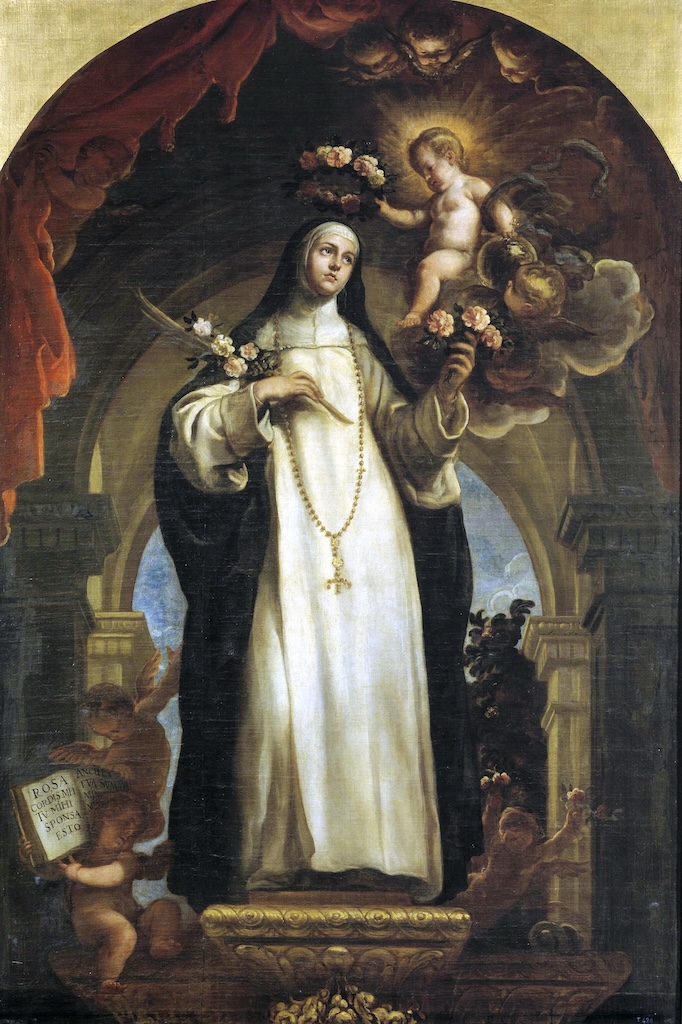
August 23: Saint Rose of Lima

She was the first canonized saint to be born in the Americas. A great mystic, she sought to imitate the example of Saint Catherine of Siena and entered the Dominican Third Order. She is Saint Rose of Lima, whose birth name was Isabel de Flores.

Saint Rose was born in Lima, Peru, on April 20, 1586. Her father, originally from Puerto Rico, had arrived in Peru in 1548 with the Spanish conquistadors. Her family was of humble social standing. The name “Rose” was given to her by a servant who, upon seeing her as a newborn, exclaimed: “She is as beautiful as a rose.” Her mother decided to call her Rosa from then on.

From a very young age—only four years old—Rosa learned to read without anyone teaching her. As soon as she was able, she read with great interest the lives of the saints, especially that of Saint Catherine of Siena, who became her spiritual model.

From her youth, she chose to live a life of austerity, marked by fasting and penance. Her parents would not allow her to enter a convent and since she refused to marry, she was often misunderstood by both family and friends. Nevertheless, she remained at home, living a withdrawn and contemplative life. To help support her family, she dedicated herself to embroidery and sold the flowers she grew.

In 1606, at the age of twenty, she entered the Dominican Third Order and converted a small hut in her family’s garden into a hermitage where she withdrew for prayer. She also set up a room in the house as a sort of infirmary where she cared for poor children, indigenous people, the sick, and the elderly in need.

She also received mystical graces and was even investigated by the Inquisitors, who were struck by the depth of her spiritual answers removing any doubt in her authenticity. She died in 1617 at the age of 31 and the people of Lima were deeply moved by her passing, already venerating her as a saint. She was canonized by Pope Clement X in 1671.


vaticanstate.va
8 posted on 08/23/2025 8:41:09 AM PDT by annalex (fear them not)
[ Post Reply | Private Reply | To 7 | View Replies]

To: annalex

by Claudio Coello

9 posted on 08/23/2025 8:43:20 AM PDT by annalex (fear them not)
[ Post Reply | Private Reply | To 8 | View Replies]

NAVARRE BIBLE COMMENTARY(RSV)

Ad Majorem Dei Gloriam (To the Greater Glory of God)

First Reading:

From: Ruth 2:1-3, 8-11; 4:13-17

Ruth is well received by Boaz
----------------------------------
[1] Now Naomi had a kinsman of her husband’s, a man of wealth, of the family of Elimelech, whose name was Boaz. [2] And Ruth the Moabitess said to Naomi, “Let me go to the field, and glean among the ears of grain after him in whose sight I shall find favour.” And she said to her, “Go, my daughter. [3] So she set forth and went and gleaned in the field after the reapers; and she happened to come to the part of the field belonging to Boaz, who was of the family of Elimelech.

[8] Then Boaz said to Ruth, “Now, listen, my daughter, do not go to glean in another field or leave this one, but keep close to my maidens. [9] Let your eyes be upon the field which they are reaping, and go after them. Have I not charged the young men not to molest you? And when you are thirsty, go to the vessels and drink what the young men have drawn.” [10] Then she fell on her face, bowing to the ground, and said to him, “Why have I found favour in your eyes, that you should take notice of me, when I am a foreigner?” [11] But Boaz answered her, “All that you have done for your mother-in-law since the death of your husband has been fully told me, and how you left your father and mother and your native land and came to a people that you did not know before.

Marriage of Boaz and Ruth
---------------------------------------
[13] So Boaz took Ruth and she became his wife; and he went into to her, and the Lord gave her conception, and she bore a son. [14] Then the women said to Naomi, “Blessed be the Lord, who has not left you this day without next of kin, and may his name be renowned in Israel! [15] He shall be to you a restorer of life and a nourisher of your old age; for your daughter-in-law who loves you, who is more to you than seven sons, has borne him.” [16] Then Naomi took the child and laid him in her bosom, and became his nurse. [17] And the women of the neighbourhood gave him a name, saying, “A son has been born to Naomi.” They named him Obed; he was the father of Jesse, the father of David.

*******************************************
Commentary:

2:1-17. The Lord richly rewards Ruth. These pages speak of the providence of God who, very discreetly, as if everything happened naturally, was disposing events to ensure that Naomi and Ruth would have everything they needed. “The witness of Scripture is unanimous that the solicitude of divine providence is concrete and immediate; God cares for all, from the least things to the great events of the world and its history. The sacred books powerfully affirm God’s absolute sovereignty over the course of events: ‘Our God is in the heavens; he does whatever he pleases’ (Ps 115:3). And so it is with Christ, ‘who opens and no one shall shut, who shuts and no one opens’ (Rev 3:7). As the book of Proverbs states: ‘Many are the plans in the mind of a man, but it is the purpose of the Lord that will be established’ (Prov 19:21)” (Catechism of the Catholic Church, 303).

The Law laid down that once a field was reaped, it should not be gone back over to gather grain that had fallen or been missed by the reapers; this would allow needy people to pick up any grains that still lay on the ground (cf. Lev 19:9-10 and Deut 24:19). Ruth avails herself of this humanitarian stipulation and follows the reapers in search of food; this takes her into Boaz’ field. When visiting his men, Boaz notices Ruth and is kind to her when he hears who she is.

This kindness is a sign of the protection given her by “the Lord, the God of Israel, under whose wing you have come to take refuge” (2:12), as Boaz will tell her. The idea of having recourse to the Lord in order to shelter under his wings occurs often in the Bible (cf. Deut 32:10-11; Ps 17:8; 36:8; 61:5; 63:8; and 91:4); it is a very poetic way of describing the tenderness with which God takes care of those who have recourse to him. Our Lord Jesus Christ uses the image to show how much he loves the Holy City, and yet his love is not returned: “How often would I have gathered your children together as a hen gathers her brood under her wings, and you would not!” (Mt 23:37).

4:13-22. Ruth has benefitted from the redemption performed by Boaz has become a member of the people of God. God blessed their union with a son, Obed, who in time would be the grandfather of David the king. And so it happened that this Moabite woman who left her family and country out of faithfulness to the God of her first husband, was generously rewarded by that God: he made her one of the great women who played leading roles in salvation history (cf. 4:11-12). Ruth became a forebear of David (vv. 18-22; cf. 1 Chron 2:5-15).

In St. Matthew’s Gospel the name of Ruth appears as a direct forebear of Jesus Christ (Mt 1:5). “It is only right that St Matthew should record in his Gospel that the Lord, who came to call Gentiles to form part of the Church, became man in a lineage which included foreigners” (St Ambrose, Expositio Evangelium secundum Lucam, 3, 33).

10 posted on 08/23/2025 10:20:34 AM PDT by fidelis (Ecce Crucem Domini! Fugite partes adversae! Vicit Leo de tribu Juda, Radix David! Alleluia!)
[ Post Reply | Private Reply | To 9 | View Replies]

Gospel Reading:

From: Matthew 23:1-12

Vices of the Scribes and Pharisees
----------------------------------
[1] Then said Jesus to the crowds and to His disciples, [2] "The scribes and the Pharisees sit on Moses' seat; [3] so practice and observe whatever they tell you, but not what they do; for they preach, but do not practice. [4] They bind heavy burdens, hard to bear, and lay them on men's shoulders; but they themselves will not move them with their finger. [5] They do all their deeds to be seen by men; for they make their phylacteries broad and their fringes long, [6] and they love the place of honor at feasts and the best seats in the synagogues, [7] and salutations in the market places, and being called rabbi by men. [8] But you are not to be called rabbi, for you have one teacher, and you are all brethren. [9] And call no man your father on earth, for you have one Father, who is in Heaven. [10] Neither be called masters, for you have one master, the Christ. [11] He who is greatest among you shall be your servant; [12] whoever exalts himself will be humbled, and whoever humbles himself will be exalted."

***********************************************************************
Commentary:

1-39. Throughout this chapter Jesus severely criticizes the scribes and Pharisees and demonstrates the sorrow and compassion He feels towards the ordinary mass of the people, who have been ill-used, "harassed and helpless, like sheep without a shepherd" (Matthew 9:36). His address may be divided into three parts: in the first (verses 1-12) He identifies their principal vices and corrupt practices; in the second (verses 13-36) He confronts them and speaks His famous "woes", which in effect are the reverse of the Beatitudes He preached in Chapter 5: no one can enter the Kingdom of Heaven--no one can escape condemnation to the flames--unless he changes his attitude and behavior; in the third part (verses 37-39) He weeps over Jerusalem, so grieved is He by the evils into which the blind pride and hardheartedness of the scribes and Pharisees have misled the people.

2-3. Moses passed on to the people the Law received from God. The scribes, who for the most part sided with the Pharisees, had the function of educating the people in the Law of Moses; that is why they were said to "sit on Moses' seat". Our Lord recognized that the scribes and Pharisees did have authority to teach the Law; but He warns the people and His disciples to be sure to distinguish the Law as read out and taught in the synagogues from the practical interpretations of the Law to be seen in their leaders' lifestyles. Some years later, St. Paul--a Pharisee like his father before him--faced his former colleagues with exactly the same kind of accusations as Jesus makes here: "You then who teach others, will you not teach yourself? While you preach against stealing, do you steal? You who say that one must not commit adultery, do you commit adultery? You who abhor idols, do you rob temples? You who boast in the law, do you dishonor God by breaking the law? For, as it is written, `The name of God is blasphemed among the Gentiles because of you'" (Romans 2:21-24).

5. "Phylacteries": belts or bands carrying quotations from sacred Scripture which the Jews used to wear fastened to their arms or foreheads. To mark themselves out as more religiously observant than others, the Pharisees used to wear broader phylacteries. The fringes were light-blue stripes on the hems of cloaks; the Pharisees ostentatiously wore broader fringes.

8-10. Jesus comes to teach the truth; in fact, He is the Truth (John 14:6). As a teacher, therefore, He is absolutely unique and unparalleled. "The whole of Christ's life was a continual teaching: His silences, His miracles, His gestures, His prayer, His love for people, His special affection for the little and the poor, His acceptance of the total sacrifice on the cross for the redemption of the world, and His resurrection are the actualization of His word and the fulfillment of revelation. Hence for Christians the crucifix is one of the most sublime and popular images of Christ the Teacher.

"These considerations are in line with the great traditions of the Church and they all strengthen our fervor with regard to Christ, the Teacher who reveals God to man and man to himself, the Teacher who saves, sanctifies and guides, who lives, who speaks, rouses, moves, redresses, judges, forgives, and goes with us day by day on the path of history, the Teacher who comes and will come in glory" (John Paul II, "Catechesi Tradendae", 9).

11. The Pharisees were greedy for honor and recognition: our Lord insists that every form of authority, particularly in the context of religion, should be exercised as a form of service to others; it must not be used to indulge personal vanity or greed. "He who is the greatest among you shall be your servant".

12. A spirit of pride and ambition is incompatible with being a disciple of Christ. Here our Lord stresses the need for true humility, for anyone who is to follow Him. The verbs "will be humbled", "will be exalted" have "God" as their active agent. Along the same lines, St. James preaches that "God opposes the proud, but gives grace to the humble" (James 4:6). And in the "Magnificat", the Blessed Virgin explains that the Lord "has put down the mighty from their thrones, and exalted those of low degree [the humble]" (Luke 1:52).

11 posted on 08/23/2025 10:20:49 AM PDT by fidelis (Ecce Crucem Domini! Fugite partes adversae! Vicit Leo de tribu Juda, Radix David! Alleluia!)
[ Post Reply | Private Reply | To 10 | View Replies]

Click here to go to the My Catholic Life! Devotional thread for a meditation on today’s Gospel Reading.

12 posted on 08/23/2025 10:21:32 AM PDT by fidelis (Ecce Crucem Domini! Fugite partes adversae! Vicit Leo de tribu Juda, Radix David! Alleluia!)
[ Post Reply | Private Reply | To 11 | View Replies]

Disclaimer: Opinions posted on Free Republic are those of the individual posters and do not necessarily represent the opinion of Free Republic or its management. All materials posted herein are protected by copyright law and the exemption for fair use of copyrighted works.

Free Republic
Browse · Search
Religion
Topics · Post Article

FreeRepublic, LLC, PO BOX 9771, FRESNO, CA 93794
FreeRepublic.com is powered by software copyright 2000-2008 John Robinson