Posted on 08/22/2025 4:52:21 AM PDT by annalex
Our Lady, Mother and Queen on Friday of week 20 in Ordinary Time The Church at Veryan, Cornwall: St. Symphorian Readings at MassLiturgical Colour: White. Year: C(I). These are the readings for the feria
Ruth the Moabitess is brought to Bethlehem by NaomiIn the days of the Judges famine came to the land and a certain man from Bethlehem of Judah went – he, his wife and his two sons – to live in the country of Moab. Elimelech, Naomi’s husband, died, and she and her two sons were left. These married Moabite women: one was named Orpah and the other Ruth. They lived there about ten years. Then both Mahlon and Chilion also died and the woman was bereft of her two sons and her husband. So she and her daughters-in-law prepared to return from the country of Moab, for she had heard that the Lord had visited his people and given them food. Then Orpah kissed her mother-in-law and went back to her people. But Ruth clung to her. Naomi said to her, ‘Look, your sister-in-law has gone back to her people and to her god. You must return too; follow your sister-in-law.’ But Ruth said, ‘Do not press me to leave you and to turn back from your company, for ‘wherever you go, I will go, wherever you live, I will live. Your people shall be my people, and your God, my God.’ This was how Naomi, she who returned from the country of Moab, came back with Ruth the Moabitess her daughter-in-law. And they came to Bethlehem at the beginning of the barley harvest.
My soul, give praise to the Lord. or Alleluia! He is happy who is helped by Jacob’s God, whose hope is in the Lord his God, who alone made heaven and earth, the seas and all they contain. My soul, give praise to the Lord. or Alleluia! It is he who keeps faith for ever, who is just to those who are oppressed. It is he who gives bread to the hungry, the Lord, who sets prisoners free, My soul, give praise to the Lord. or Alleluia! the Lord who gives sight to the blind, who raises up those who are bowed down, the Lord, who protects the stranger and upholds the widow and orphan. My soul, give praise to the Lord. or Alleluia! It is the Lord who loves the just but thwarts the path of the wicked. The Lord will reign for ever, Zion’s God, from age to age. My soul, give praise to the Lord. or Alleluia!
Alleluia, alleluia! Open my eyes, O Lord, that I may consider the wonders of your law. Alleluia!
Alleluia, alleluia! Teach me your paths, my God, make me walk in your truth. Alleluia!
The commandments of loveWhen the Pharisees heard that Jesus had silenced the Sadducees they got together and, to disconcert him, one of them put a question, ‘Master, which is the greatest commandment of the Law?’ Jesus said, ‘You must love the Lord your God with all your heart, with all your soul, and with all your mind. This is the greatest and the first commandment. The second resembles it: You must love your neighbour as yourself. On these two commandments hang the whole Law, and the Prophets also.’ These are the readings for the memorial
A Son is given to usThe people that walked in darkness has seen a great light; on those who live in a land of deep shadow a light has shone. You have made their gladness greater, you have made their joy increase; they rejoice in your presence as men rejoice at harvest time, as men are happy when they are dividing the spoils. For the yoke that was weighing on him, the bar across his shoulders, the rod of his oppressor, these you break as on the day of Midian. For all the footgear of battle, every cloak rolled in blood, is burnt, and consumed by fire. For there is a child born for us, a son given to us and dominion is laid on his shoulders; and this is the name they give him: Wonder-Counsellor, Mighty-God, Eternal-Father, Prince-of-Peace. Wide is his dominion in a peace that has no end, for the throne of David and for his royal power, which he establishes and makes secure in justice and integrity. From this time onwards and for ever, the jealous love of the Lord of Hosts will do this.
May the name of the Lord be blessed for evermore! or Alleluia! Praise, O servants of the Lord, praise the name of the Lord! May the name of the Lord be blessed both now and for evermore! May the name of the Lord be blessed for evermore! or Alleluia! From the rising of the sun to its setting praised be the name of the Lord! High above all nations is the Lord, above the heavens his glory. May the name of the Lord be blessed for evermore! or Alleluia! Who is like the Lord, our God, who has risen on high to his throne yet stoops from the heights to look down, to look down upon heaven and earth? May the name of the Lord be blessed for evermore! or Alleluia! From the dust he lifts up the lowly, from the dungheap he raises the poor to set him in the company of princes, yes, with the princes of his people. May the name of the Lord be blessed for evermore! or Alleluia!
Alleluia, alleluia! Hail Mary, full of grace, the Lord is with thee! Blessed art thou among women. Alleluia!
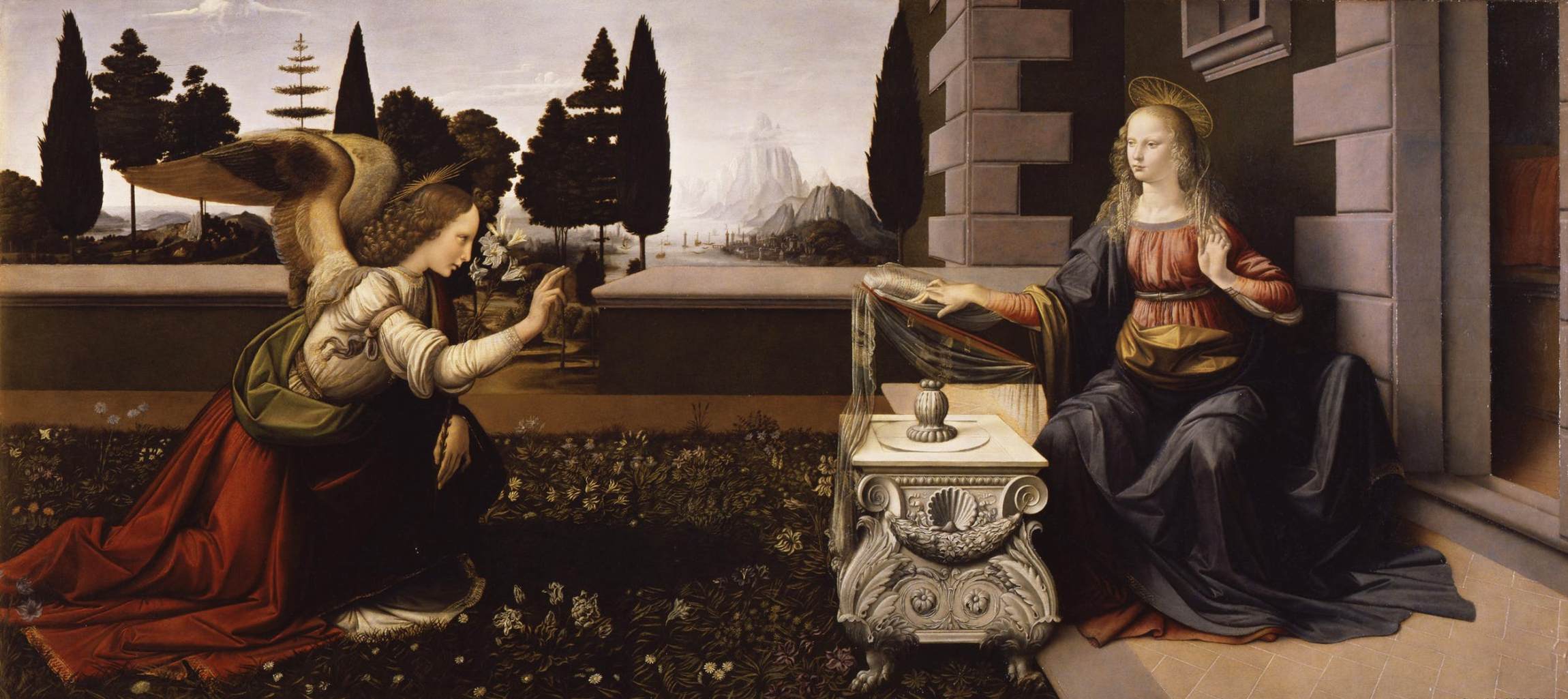
'I am the handmaid of the Lord'The angel Gabriel was sent by God to a town in Galilee called Nazareth, to a virgin betrothed to a man named Joseph, of the House of David; and the virgin’s name was Mary. He went in and said to her, ‘Rejoice, so highly favoured! The Lord is with you.’ She was deeply disturbed by these words and asked herself what this greeting could mean, but the angel said to her, ‘Mary, do not be afraid; you have won God’s favour. Listen! You are to conceive and bear a son, and you must name him Jesus. He will be great and will be called Son of the Most High. The Lord God will give him the throne of his ancestor David; he will rule over the House of Jacob for ever and his reign will have no end.’ Mary said to the angel, ‘But how can this come about, since I am a virgin?’ ‘The Holy Spirit will come upon you’ the angel answered ‘and the power of the Most High will cover you with its shadow. And so the child will be holy and will be called Son of God. Know this too: your kinswoman Elizabeth has, in her old age, herself conceived a son, and she whom people called barren is now in her sixth month, for nothing is impossible to God.’ ‘I am the handmaid of the Lord,’ said Mary ‘let what you have said be done to me.’ And the angel left her.
Christian Art![]() Each day, The Christian Art website gives a picture and reflection on the Gospel of the day. The readings on this page are from the Jerusalem Bible, which is used at Mass in most of the English-speaking world. The New American Bible readings, which are used at Mass in the United States, are available in the Universalis apps, programs and downloads. |
KEYWORDS: catholic; lk1; mt22; ordinarytime; prayer;

Please FReepmail me to get on/off the Alleluia Ping List.
| Matthew | |||
| English: Douay-Rheims | Latin: Vulgata Clementina | Greek NT: Byzantine/Majority Text (2000) | |
| Matthew 22 | |||
| 34. | But the Pharisees hearing that he had silenced the Sadducees, came together: | Pharisæi autem audientes quod silentium imposuisset sadducæis, convenerunt in unum : | οι δε φαρισαιοι ακουσαντες οτι εφιμωσεν τους σαδδουκαιους συνηχθησαν επι το αυτο |
| 35. | And one of them, a doctor of the law, asking him, tempting him: | et interrogavit eum unus ex eis legis doctor, tentans eum : | και επηρωτησεν εις εξ αυτων νομικος πειραζων αυτον και λεγων |
| 36. | Master, which is the greatest commandment in the law? | Magister, quod est mandatum magnum in lege ? | διδασκαλε ποια εντολη μεγαλη εν τω νομω |
| 37. | Jesus said to him: Thou shalt love the Lord thy God with thy whole heart, and with thy whole soul, and with thy whole mind. | Ait illi Jesus : Diliges Dominum Deum tuum ex toto corde tuo, et in tota anima tua, et in tota mente tua. | ο δε ιησους εφη αυτω αγαπησεις κυριον τον θεον σου εν ολη καρδια σου και εν ολη ψυχη σου και εν ολη τη διανοια σου |
| 38. | This is the greatest and the first commandment. | Hoc est maximum, et primum mandatum. | αυτη εστιν πρωτη και μεγαλη εντολη |
| 39. | And the second is like to this: Thou shalt love thy neighbor as thyself. | Secundum autem simile est huic : Diliges proximum tuum, sicut teipsum. | δευτερα δε ομοια αυτη αγαπησεις τον πλησιον σου ως σεαυτον |
| 40. | On these two commandments dependeth the whole law and the prophets. | In his duobus mandatis universa lex pendet, et prophetæ. | εν ταυταις ταις δυσιν εντολαις ολος ο νομος και οι προφηται κρεμανται |

22:3440
34. But when the Pharisees had heard that he had put the Sadducees to silence, they were gathered together.
35. Then one of them, which was a Lawyer, asked him a question, tempting him, and saying,
36. Master, which is the great commandment in the Law?
37. Jesus said unto him, Thou shalt love the Lord thy God with all thy heart, and with all thy soul, and with all thy mind.
38. This is the first and great commandment.
39. And the second is like unto it, Thou shalt love thy neighbour as thyself.
40. On these two commandments hang all the Law and the Prophets.
JEROME. The Pharisees having been themselves already confuted (in the matter of the denarius), and now seeing their adversaries also overthrown, should have taken warning to attempt no further deceit against Him; but hate and jealousy are the parents of impudence.
ORIGEN. Jesus had put the Sadducees to silence, to shew that the tongue of falsehood is silenced by the brightness of truth. For as it belongs to the righteous man to be silent when it is good to be silent, and to speak when it is good to speak, and not to hold his) peace; so it belongs to every teacher of a the Not indeed to be silent, but to be silent as far as any good purpose is concerned.
JEROME. The Pharisees and Sadducees, thus foes to one another, unite in one common purpose to tempt Jesus.
PSEUDO-CHRYSOSTOM. Or the Pharisees meet together, that their numbers may silence Him whom their reasonings could not confute; thus, while they array numbers against Him, shewing that truth failed them; they said among themselves, Let one speak for all, and all speak, through one, so if He prevail, the victory may seem to belong to all; if He be overthrown, the defeat may rest with Him alone; so it follows, Then one of them, a teacher of the Law, asked him a question, tempting him.
ORIGEN. All who thus ask questions of any teacher to try him, and not to learn of him, we must regard as brethren of this Pharisee, according to what is said below, Inasmuch as ye have done it unto one of the least of mine, ye have done it unto me. (Matt. 25:40.)
AUGUSTINE. (de Cons. Ev. ii. 73.) Let no one find a difficulty in this, that Matthew speaks of this man as putting his question to tempt the Lord, whereas Mark does not mention this, but concludes with what the Lord said to him upon his answering wisely, Thou art not far from the kingdom of God. (Mark 12:34.) For it is possible that, though he came to tempt, yet the Lords answer may have wrought correction within him. Or, the tempting here meant need not be that of one designing to deceive an enemy, but rather the cautious approach of one making proof of a stranger. And that is not written in vain, Whoso believeth lightly, he is of a vain heart. (Ecclus. 19:4.)
ORIGEN. He said Master tempting Him, for none but a disciple would thus address Christ. Whoever then does not learn of the Word, nor yields himself wholly up to it, yet calls it Master, he is brother to this Pharisee thus tempting Christ. Perhaps while they read the Law before the Saviours coming, it was a question among them which was the great commandment in it; nor would the Pharisee have asked this, if it had not been long time enquired among themselves, but never found till Jesus came and declared it.
PSEUDO-CHRYSOSTOM. He who now enquires for the greatest commandment had not observed the least. He only ought to seek for a higher righteousness who has fulfilled the lower.
JEROME. Or he enquires not for the sake of the commands, but which is the first and great commandment, that seeing all that God commands is great, he may have occasion to cavil whatever the answer be.
PSEUDO-CHRYSOSTOM. But the Lord so answers him, as at once to lay bare the dissimulation of his enquiry, Jesus saith unto him, Thou shalt love the Lord thy God with all thy heart, with all thy soul, and with all thy mind. Thou shalt love, not fear, for to love is more than to fear; to fear belongs to slaves, to love to sons; fear is in compulsion, love in freedom. Whoso serves God in fear escapes punishment, but has not the reward of righteousness because he did well unwillingly through fear. God does not desire to be served servilely by men as a master, but to be loved as a father, for that He has given the spirit of adoption to men. But to love God with the whole heart, is to have the heart inclined to the love of no one thing more than of God. To love God again with the whole soul is to have the mind stayed upon the truth, and to be firm in the faith. For the love of the heart and the love of the soul are different. The first is in a sort carnal, that we should love God even with our flesh, which we cannot do unless we first depart from the love of the things of this world. The love of the heart is felt in the heart, but the love of the soul is not felt, but is perceived because it consists in a judgment of the soul. For he who believes that all good is in God, and that without Him is no good, he loves God with his whole soul. But to love God with the whole mind, is to have all the faculties open and unoccupied for Him. He only loves God with his whole mind, whose intellect ministers to God, whose wisdom is employed about God, whose thoughts travail in the things of God, and whose memory holds the things which are good.
AUGUSTINE. (de Doctr. Christ. i. 22.) Or otherwise; You are commanded to love God with all thy heart, that your whole thoughtswith all thy soul, that your whole lifewith all thy mind, that your whole understandingmay be given to Him from whom you have that you give. Thus He has left no part of our life which may justly be unfilled of Him, or give place to the desire after any other final good1; but if aught else present itself for the souls love, it should be absorbed into that channel in which the whole current of love runs. For man is then the most perfect when his whole life tends towards the life2 unchangeable, and clings to it with the whole purpose of his soul.
GLOSS. Or, with all thy heart, i. e. understanding; with all thy soul, i.e. thy will; with all thy mind, i.e. memory; so you shall think, will, remember nothing contrary to Him.
ORIGEN. Or otherwise; With all thy heart, that is, in all recollection, act, thought; with all thy soul, to be ready, that is, to lay it down for Gods religion; with all thy mind, bringing forth nothing but what is of God. And consider whether you cannot thus take the heart of the understanding, by which we contemplate things intellectual, and the mind of that by which we utter thoughts, walking as it were with the mind through each expression, and uttering it. If the Lord had given no answer to the Pharisee who thus tempted Him, we should have judged that there was no commandment greater than the rest. But when the Lord adds, This is the first and great commandment, we learn how we ought to think of the commandments, that there is a great one, and that there are less down to the least. And the Lord says not only that it is a great, but that it is the first commandment, not in order of Scripture, but in supremacy of value. They only take upon them the greatness and supremacy of this precept, who not only love the Lord their God, but add these three conditions. Nor did He only teach the first and great commandment, but added that there was a second like unto the first, Thou shall love thy neighbour as thyself. But if Whoso loveth iniquity hath hated his own soul, (Ps. 11:5.) it is manifest that he does not love his neighbour as himself, when he does not love himself.
AUGUSTINE. (de Doctr. Christ. i. 30.) It is clear that every man is to be regarded as a neighbour, because evil is to be done to no man. Further, if every one to whom we are bound to shew service of mercy, (vid. Rom. 13:10.) or who is bound to shew it to us, be rightly called our neighbour, it is manifest that in this precept are comprehended the holy Angels who perform for us those services of which we may read in Scripture. Whence also our Lord Himself would be called our neighbour; for it was Himself whom He represents as the good Samaritan, who gave succour to the man who was left half-dead by the way.
AUGUSTINE. (de Trin. viii. 6.) He that loves men ought to love them either because they are righteous, or that they may be righteous; and so also ought he to love himself either for that he is, or that he may be righteous. And thus without peril he may love his neighbour as himself.
AUGUSTINE. (de Doctr. Christ, i. 22.) But if even yourself you ought not to love for your own sake, but because of Him in whom is the rightful end of your love, let not another man be displeased that you love even him for Gods sake. Whoso then rightly loves his neighbour, ought to endeavour with him that he also with his whole heart love God.
PSEUDO-CHRYSOSTOM. But who loves man is as who loves God; for man is Gods image, wherein God is loved, as a King is honoured in his statue. For this cause this commandment is said to be like the first.
HILARY. Or otherwise; That the second command is like the first signifies that the obligation and merit of both are alike; for no love of God without Christ, or of Christ without God, can profit to salvation.
It follows, On these two commandments hang all the Law and the Prophets.
AUGUSTINE. (Quæst. Ev. i. 33.) Hang, that is, refer thither as their end.
RABANUS. For to these two commandments belongs the whole decalogue; the commandments of the first table to the love of God, those of the second to the love of our neighbour.
ORIGEN. Or, because he that has fulfilled the things that are written concerning the love of God and our neighbour, is worthy to receive from God the great reward, that he should be enabled to understand the Law and the Prophets.
AUGUSTINE. (de Trin. viii. 7.) Since there are two commandments, the love of God and the love of our neighbour, on which hang the Law and the Prophets, not without reason does Scripture put one for both; sometimes the love of God; as in that, We know that all tilings work together for good to them that love God; (Rom. 8:28.) and sometimes the love of our neighbour; as in that, All the law is fulfilled in one word, even in this, Thou shall love thy neighbour as thyself. (Gal. 5:14.) And that because if a man love his neighbour, it follows therefrom that he loves God also; for it is the selfsame affection by which we love God, and by which we love our neighbour, save that we love God for Himself, but ourselves and our neighbour for Gods sake.
AUGUSTINE. (De Doctr. Christ. i. 30. et 26.) But since the Divine substance is more excellent and higher than our nature, the command to love God is distinct from that to love our neighbour. But if by yourself, you understand your whole self, that is both your soul and your body, and in like manner of your neighbour, there is no sort of things to be loved omitted in these commands. The love of God goes first, and the rule thereof is so set out to us as to make all other loves center in that, so that nothing seems said of loving yourself. But then follows, Thou shall love thy neighbour as thyself, so that love of yourself is not omitted.
Catena Aurea Matthew 22

| Luke | |||
| English: Douay-Rheims | Latin: Vulgata Clementina | Greek NT: Byzantine/Majority Text (2000) | |
| Luke 1 | |||
| 26. | And in the sixth month, the angel Gabriel was sent from God into a city of Galilee, called Nazareth, | In mense autem sexto, missus est angelus Gabriel a Deo in civitatem Galilææ, cui nomen Nazareth, | εν δε τω μηνι τω εκτω απεσταλη ο αγγελος γαβριηλ υπο του θεου εις πολιν της γαλιλαιας η ονομα ναζαρετ |
| 27. | To a virgin espoused to a man whose name was Joseph, of the house of David; and the virgin's name was Mary. | ad virginem desponsatam viro, cui nomen erat Joseph, de domo David : et nomen virginis Maria. | προς παρθενον μεμνηστευμενην ανδρι ω ονομα ιωσηφ εξ οικου δαυιδ και το ονομα της παρθενου μαριαμ |
| 28. | And the angel being come in, said unto her: Hail, full of grace, the Lord is with thee: blessed art thou among women. | Et ingressus angelus ad eam dixit : Ave gratia plena : Dominus tecum : benedicta tu in mulieribus. | και εισελθων ο αγγελος προς αυτην ειπεν χαιρε κεχαριτωμενη ο κυριος μετα σου ευλογημενη συ εν γυναιξιν |
| 29. | Who having heard, was troubled at his saying, and thought with herself what manner of salutation this should be. | Quæ cum audisset, turbata est in sermone ejus, et cogitabat qualis esset ista salutatio. | η δε ιδουσα διεταραχθη επι τω λογω αυτου και διελογιζετο ποταπος ειη ο ασπασμος ουτος |
| 30. | And the angel said to her: Fear not, Mary, for thou hast found grace with God. | Et ait angelus ei : Ne timeas, Maria : invenisti enim gratiam apud Deum. | και ειπεν ο αγγελος αυτη μη φοβου μαριαμ ευρες γαρ χαριν παρα τω θεω |
| 31. | Behold thou shalt conceive in thy womb, and shalt bring forth a son; and thou shalt call his name Jesus. | Ecce concipies in utero, et paries filium, et vocabis nomen ejus Jesum : | και ιδου συλληψη εν γαστρι και τεξη υιον και καλεσεις το ονομα αυτου ιησουν |
| 32. | He shall be great, and shall be called the Son of the most High; and the Lord God shall give unto him the throne of David his father; and he shall reign in the house of Jacob for ever. | hic erit magnus, et Filius Altissimi vocabitur, et dabit illi Dominus Deus sedem David patris ejus : et regnabit in domo Jacob in æternum, | ουτος εσται μεγας και υιος υψιστου κληθησεται και δωσει αυτω κυριος ο θεος τον θρονον δαυιδ του πατρος αυτου |
| 33. | And of his kingdom there shall be no end. | et regni ejus non erit finis. | και βασιλευσει επι τον οικον ιακωβ εις τους αιωνας και της βασιλειας αυτου ουκ εσται τελος |
| 34. | And Mary said to the angel: How shall this be done, because I know not man? | Dixit autem Maria ad angelum : Quomodo fiet istud, quoniam virum non cognosco ? | ειπεν δε μαριαμ προς τον αγγελον πως εσται τουτο επει ανδρα ου γινωσκω |
| 35. | And the angel answering, said to her: The Holy Ghost shall come upon thee, and the power of the most High shall overshadow thee. And therefore also the Holy which shall be born of thee shall be called the Son of God. | Et respondens angelus dixit ei : Spiritus Sanctus superveniet in te, et virtus Altissimi obumbrabit tibi. Ideoque et quod nascetur ex te sanctum, vocabitur Filius Dei. | και αποκριθεις ο αγγελος ειπεν αυτη πνευμα αγιον επελευσεται επι σε και δυναμις υψιστου επισκιασει σοι διο και το γεννωμενον αγιον κληθησεται υιος θεου |
| 36. | And behold thy cousin Elizabeth, she also hath conceived a son in her old age; and this is the sixth month with her that is called barren: | Et ecce Elisabeth cognata tua, et ipsa concepit filium in senectute sua : et hic mensis sextus est illi, quæ vocatur sterilis : | και ιδου ελισαβετ η συγγενης σου και αυτη συνειληφυια υιον εν γηρει αυτης και ουτος μην εκτος εστιν αυτη τη καλουμενη στειρα |
| 37. | Because no word shall be impossible with God. | quia non erit impossibile apud Deum omne verbum. | οτι ουκ αδυνατησει παρα τω θεω παν ρημα |
| 38. | And Mary said: Behold the handmaid of the Lord; be it done to me according to thy word. And the angel departed from her. | Dixit autem Maria : Ecce ancilla Domini : fiat mihi secundum verbum tuum. Et discessit ab illa angelus. | ειπεν δε μαριαμ ιδου η δουλη κυριου γενοιτο μοι κατα το ρημα σου και απηλθεν απ αυτης ο αγγελος |
(*) Verses 32-33 breakdown differs in the translations.

1:26–27
26. And in the sixth month the angel Gabriel was sent from God unto a city of Galilee, named Nazareth,
27. To a virgin espoused to a man whose name was Joseph, of the house of David; and the virgin’s name was Mary.
BEDE. Because either the Incarnation of Christ was to be in the sixth age of the world, or because it was to serve to the fulfilling of the law, rightly in the sixth month of John’s conception was an angel sent to Mary, to tell her that a Saviour should be born. Hence it is said, And in the sixth month, &c. We must understand the sixth month to be March, on the twenty-fifth day of which our Lord is reported to have been conceived, and to have suffered, as also to have been born on the twenty-fifth day of December. But if either the one day we believe to be the vernal equinox, or the other the winter solstice, it happens that with the increase of light He was conceived or born Who lighteneth every man that cometh into the world. But if any one shall prove, that before the time of our Lord’s nativity or conception, light began either to increase, or supersede the darkness, we then say, that it was because John, before the appearance of His coming, began to preach the kingdom of heaven.
BASIL. (in Esai. 6.) The heavenly spirits visit us, not as it seems fit to them, but as the occasion conduces to our advantage, for they are ever looking upon the glory and fulness of the Divine Wisdom; hence it follows, The angel Gabriel was sent.
GREGORY. (Hom. 34, in Evan.) To the virgin Mary was sent, not any one of the angels, but the archangel Gabriel; for upon this service it was meet that the highest angel should come, as being the bearer of the highest of all tidings. He is therefore marked by a particular name, to signify what was his effectual part in the work. For Gabriel is interpreted, “the strength of God.” By the strength of God then was He to be announced Who was coming as the God of strength, and mighty in battle, to put down the powers of the air.
GLOSS. (interlin.) But the place is also added whither he is sent, as it follows, To a city, Nazareth. For it was told that He would come a Nazarite, (i. e. the holy of the holy.)
BEDE. (in Homil. de fest Annunt.) It was a fit beginning for man’s restoration, that an angel should be sent down from God to consecrate a virgin by a divine birth, for the first cause of man’s perdition was the Devil sending a serpent to deceive a woman by the spirit of pride.
AUGUSTINE. (de san. Virg. cap. vi.) To a virgin, for Christ could be born from virginity alone, seeing He could not have an equal in His birth. It was necessary for our Head by this mighty miracle to be born according to the flesh of a virgin, that He might signify that his members were to be born in the spirit of a virgin Church.
PSEUDO-JEROME. (Hieron. vol. xi. 92. De Assumpt.) And rightly an angel is sent to the virgin, because the virgin state is ever akin to that of angels. Surely in the flesh to live beyond the flesh is not a life on earth but in heaven.
CHRYSOSTOM. (sup. Mat. Hom. 4.) The angel announces the birth to the virgin not after the conception, lest she should be thereby too much troubled, but before the conception he addresses her, not in a dream, but standing by her in visible shape. For as great indeed were the tidings she receives, she needed before the issue of the event an extraordinary visible manifestation.
AMBROSE. Scripture has rightly mentioned that she was espoused, as well as a virgin, a virgin, that she might appear free from all connexion with man; espoused, that she might not be branded with the disgrace of sullied virginity, whose swelling womb seemed to bear evident marks of her corruption. But the Lord had rather that men should cast a doubt upon His birth than upon His mother’s purity. He knew how tender is a virgin’s modesty, and how easily assailed the reputation of her chastity, nor did He think the credit of His birth was to be built up by His mother’s wrongs. It follows therefore, that the holy Mary’s virginity was of as untainted purity as it was also of unblemished reputation. Nor ought there, by an erroneous opinion, to be left the shadow of an excuse to living virgins, that the mother of our Lord even seemed to be evil spoken of. But what could be imputed to the Jews, or to Herod, if they should seem to have persecuted an adulterous offspring? And how could He Himself say, I came not to abolish the law, but to fulfil it, (Matt. 5:18.) if He should seem to have had his beginning from a violation of the law, for the issue of an unmarried person is condemned by the law? (Deut. 23:17.) Not to add that also greater credit is given to the words of Mary, and the cause of falsehood removed? For it might seem that unmarried becoming pregnant, she had wished to shade her guilt by a lie; but an espoused person has no reason for lying, since to women child-birth is the reward of wedlock, the grace of the marriage bed. Again, the virginity of Mary was meant to baffle the prince of the world, who, when he perceived her espoused to a man, could cast no suspicion on her offspring.
ORIGEN. For if she had had no husband, soon would the thought have stolen into the Devil’s mind, how she who had known no man could be pregnant. It was right that the conception should be Divine, something more exalted than human nature.
AMBROSE. But still more has it baffled the princes of the world, for the malice of devils soon detects even hidden things, while they who are occupied in worldly vanities, can not know the things of God. But moreover, a more powerful witness of her purity is adduced, her husband, who might both have been indignant at the injury, and revenged the dishonour, if he also had not acknowledged the mystery; of whom it is added, Whose name was Joseph, of the house of David.
BEDE. (in Homil. de Annunt. sup.) Which last applies not only to Joseph, but also to Mary, for the Law commanded that every one should take a wife out of his own tribe or family. It follows, And the virgin’s name was Mary.
BEDE. Maria, in Hebrew, is the star of the sea; but in Syriac it is interpreted Mistress, and well, because Mary was thought worthy to be the mother of the Lord of the whole world, and the light of endless ages.
1:28–29
28. And the angel came in unto her, and said, Hail, thou that art highly favoured, the Lord is with thee: blessed art thou among women.
29. And when she saw him, she was troubled at his saying, and cast in her mind what manner of salutation this should be.
AMBROSE. Mark the virgin by her manner of life. Alone in an inner chamber, unseen by the eyes of men, discovered only by an angel; as it is said, And the angel came in unto her. That she might not be dishonoured by any ignoble address, she is saluted by an angel.
GREGORY OF NYSSA. (Diem Nat. Orat. in Christi.) Far different then to the news formerly addressed to the woman, is the announcement now made to the Virgin. In the former, the cause of sin was punished by the pains of childbirth; in the latter, through gladness, sorrow is driven away. Hence the angel not unaptly proclaims joy to the Virgin, saying, Hail.
GREEK EXPOSITOR. (Geometer) But that she was judged worthy of the nuptials is attested by his saying, Full of grace. For it is signified as a kind of token or marriage gift of the bridegroom, that she was fruitful in graces. For of the things which he mentions, the one appertains to the bride, the other to the bridegroom.
PSEUDO-JEROME. (Jerome sup.) And it is well said, Full of grace, for to others, grace comes in part; into Mary at once the fulness of grace wholly infused itself. She truly is full of grace through whom has been poured forth upon every creature the abundant rain of the Holy Spirit. But already He was with the Virgin Who sent the angel to the Virgin. The Lord preceded His messenger, for He could not be confined by place Who dwells in all places. Whence it follows, The Lord is with thee.
PSEUDO-AUGUSTINE. (Aug. in Serm. de Annunt. iii. app. 195.) More than with me, for He Himself is in thy heart, He is (made) in thy womb, He fills thy soul, He fills thy womb.
GREEK EXPOSITOR. (Geometer) But this is the sum of the whole message. The Word of God, as the Bridegroom, effecting an incomprehensible union, Himself, as it were, the same both planting, and being planted, hath moulded the whole nature of man into Himself. But comes last the most perfect and comprehensive salutation; Blessed art thou among women. i. e. Alone, far before all other women; that women also should be blessed in thee, as men are in thy Son; but rather both in both. For as by one man and one woman came at once both sin and sorrow, so now also by one woman and one man hath both blessing and joy been restored, and poured forth upon all.
AMBROSE. But mark the Virgin by her bashfulness, for she was afraid, as it follows; And when she heard, she was troubled, It is the habit of virgins to tremble, and to be ever afraid at the presence of man, and to be shy when he addresses her. Learn, O virgin, to avoid light talking. Mary feared even the salutation of an angel.
GREEK EXPOSITOR. (sup.) But as she might be accustomed to these visions, the Evangelist ascribes her agitation not to the vision, but to the things told her, saying, she was troubled at his words. Now observe both the modesty and wisdom of the Virgin; the soul, and at the same time the voice. When she heard the joyful words, she pondered them in her mind, and neither openly resisted through unbelief, nor forthwith lightly complied; avoiding equally the inconstancy of Eve, and the insensibility of Zacharias. Hence it is said, And she cast in her mind what manner of salutation this was, it is not said conception, for as yet she knew not the vastness of the mystery. But the salutation, was there aught of passion in it as from a man to a virgin? or was it not of God, seeing that he makes mention of God, saying, The Lord is with thee.
AMBROSE. She wondered also at the new form of blessing, unheard of before, reserved for Mary alone.
ORIGEN. For if Mary had known that similar words had been addressed to others, such a salutation would never have appeared to her so strange and alarming.
1:30–33
30. And the angel said unto her, Fear not, Mary: for thou hast found favour with God.
31. And, behold, thou shalt conceive in thy womb, and bring forth a son, and shalt call his name JESUS.
32. He shall be great, and shall be called the Son of the Highest: and the Lord God shall give unto him the throne of his father David:
33. And he shall reign over the house of Jacob for ever; and of his kingdom there shall be no end.
When the angel saw that she was troubled at this unusual salutation, calling her by her name as if she was well known to him, he tells her she must not fear, as it follows; And the angel said, Fear not, Mary.
GREEK EXPOSITOR. (Photius.) As if he said, I came not to deceive you, nay rather to bring down deliverance from deception; I came not to rob you of your inviolable virginity, but to open a dwelling-place for the Author and Guardian of thy purity; I am not a servant of the Devil, but the ambassador of Him that destroyeth the Devil. I am come to form a marriage treaty, not to devise plots. So far then was he from allowing her to be harassed by distracting thoughts, lest he should be counted a servant unfaithful to his trust.
CHRYSOSTOM. But he who earns favour in the sight of God has nothing to fear. Hence it follows, For thou hast found favour before God. But how shall any one find it, except through the means of his humility. For God giveth grace to the humble. (James 4:6, 1 Pet. 5:5.)
GREEK EXPOSITOR. (ubi sup.) For the Virgin found favour with God, in that decking her own soul in the bright robes of chastity, she prepared a dwelling-place pleasing to God. Not only did she retain her virginity inviolate, but her conscience also she kept from stain. As many had found favour before Mary, he goes on to state what was peculiar to her. Behold, thou shall conceive in thy womb.
GREEK EXPOSITOR. (Geometer.) By the word behold, he denotes rapidity and actual presence, implying that with the utterance of the word the conception is accomplished.
GREEK EXPOSITOR. (Sev. Antiochenus.) Thou shalt conceive in thy womb, that he might shew that our Lord from the very Virgin’s womb, and of our substance, took our flesh upon Him. For the Divine Word came to purify man’s nature and birth, and the first elements of our generation. And so without sin and human seed, passing through every stage as we do, He is conceived in the flesh, and carried in the womb for the space of nine months.
GREEK EXPOSITOR. (Geometer.) But since it happens also that to the spiritual mind is given in an especial manner to conceive the Divine Spirit, and bring forth the Spirit of salvation, as says the Prophet; therefore he added, And thou shalt bring forth a Son. (Is. 26:18.)
AMBROSE. But all are not as Mary, that when they conceive the word of the Holy Spirit, they bring forth; for some put forth the word prematurely, others have Christ in the womb, but not yet formed.
GREGORY OF NYSSA. (Orat. in Diem Nat.) While the expectation of child-birth strikes a woman with terror, the sweet mention of her offspring calms her, as it is added, And thou shall call his name Jesus. The coming of the Saviour is the banishing of all fear.
BEDE. Jesus is interpreted Saviour, or Healing.
GREEK EXPOSITOR. (Geom. sup.) And he says, Thou shalt call, not His father shall call, for He is without a father as regards His lower birth, as He is without a mother in respect of the higher.
CYRIL OF ALEXANDRIA. (de fide ad Theod.) But this name was given anew to the Word in adaptation to His nativity in the flesh; as that prophecy saith, Thou shalt be called by a new name which the mouth of the Lord hath named. (Is. 62:2.)
GREEK EXPOSITOR. (sup.) But as this name was common to Him with the successor of Moses, the angel therefore implying that He should not be after Joshua’s likeness, adds, He shall be great. (Josh. 1.)
AMBROSE. It was said also of John, that he shall be great, but of him indeed as of a great man, of Christ, as of the great God. For abundantly is poured forth the power of God; widely the greatness of the heavenly substance extended, neither confined by place, nor grasped by thought; neither determined by calculation, nor altered by age.
ORIGEN. See then the greatness of the Saviour, how it is diffused over the whole world. Go up to heaven, see there how it has filled the heavenly places; carry thy thoughts down to the deep, behold, there too He has descended. If thou seest this, then, in like manner, beholdest thou fulfilled in very deed, He shall be great.
GREEK EXPOSITOR. (Photius.) The assumption of our flesh does not diminish ought from the loftiness of the Deity, but rather exalts the lowness of man’s nature. Hence it follows, And he shall be called the Son of the Highest. Not, Thou shalt give Him the name, but He Himself shall be called. By whom, but His Father of like substance with Himself? For no one hath known the Son but the Father. (Matt. 11:27.) But He in Whom exists the infallible knowledge of His Son, is the true interpreter as to the name which should be given Him, when He says, This is my beloved Son; (Matt. 17:5.) for such indeed from everlasting He is, though His name was not revealed till now; therefore he says, He shall be called, not shall be made or begotten. For before the worlds He was of like substance with the Father. Him therefore thou shalt conceive; His mother thou shalt become; Him shall thy virgin shrine enclose, Whom the heavens were not able to contain.
CHRYSOSTOM. (non occ.) But since it seems shocking or unworthy to some men that God should inhabit a body, is the Sun, I would ask, the heat whereof is felt by each body that receives its rays, at all sullied as to its natural purity? Much more then does the Sun of Righteousness, in taking upon Himself a most pure body from the Virgin’s womb, escape not only defilement, but even shew forth His own mother in greater holiness.
GREEK EXPOSITOR. (Severus Antiochenus.) And to make the Virgin mindful of the prophets, he adds, And the Lord God shall give unto him the seat of David, that she might know clearly, that He Who is to be born of her is that very Christ, Whom the prophets promised should be born of the seed of David.
CYRIL OF ALEXANDRIA. (contra Julian lib. viii.) Not however from Joseph proceeded the most pure descent of Christ. For from one and the same line of connexion had sprung both Joseph and the Virgin, and from this the only-begotten had taken the form of man.
BASIL. (Epist. 236. ad Amphil.) Our Lord sat not on the earthly throne of David, the Jewish kingdom having been transferred to Herod. The seat of David is that on which our Lord reestablished His spiritual kingdom which should never be destroyed. Hence it follows, And he shall reign over the house of Jacob.
CHRYSOSTOM. (Hom. vii. in Matt.) Now He assigns to the present house of Jacob all those who were of the number of the Jews that believed on Him. For as Paul says, They are not all Israel which are of Israel, but the children of the promise are counted for the seed.
BEDE. Or by the house of Jacob he means the whole Church which either sprang from a good root, or though formerly a wild olive branch, has yet been for a reward of its faith grafted into the good olive tree. (Rom. 11:17.)
GREEK EXPOSITOR. (Geometer.) But to reign for ever is of none save God alone; and hence though because of the incarnation Christ is said to receive the seat of David, yet as being Himself God He is acknowledged to be the eternal King. It follows, And, his kingdom shall have no end, not in that He is God, but in that He is man also. Now indeed He has the kingdom of many nations, but finally he shall reign over all, when all things shall be put under Him. (1 Cor. 15:25.)
BEDE. Let Nestorius then cease to say that the Virgin’s Son is only man, and to deny that He is taken up by the Word of God into the unity of the Person. For the Angel when he says that the very same has David for His father whom he declares is called the Son of the Highest, demonstrates the one Person of Christ in two natures. The Angel uses the future tense (vocabitur, regnabit) not because, as the Heretics say, Christ was not before Mary, but because in the same person, man with God shares the same name of Son.
1:34–35
34. Then said Mary unto the angel, How shall this be, seeing I know not a man?
35. And the angel answered and said unto her, The Holy Ghost shall come upon thee, and the power of the Highest shall overshadow thee: therefore also that holy thing which shall be born of thee shall be called the Son of God.
AMBROSE. It was Mary’s part neither to refuse belief in the Angel, nor too hastily take unto herself the divine message. How subdued her answer is, compared with the words of the Priest. Then said Mary to the Angel, How shall this be? She says, How shall this be? He answers, Whereby shall I know this? He refuses to believe that which he says he does not know, and seeks as it were still further authority for belief. She avows herself willing to do that which she doubts not will be done, but how, she is anxious to know. Mary had read, Behold, she shall conceive and bear a son. (Is. 7:14.) She believed therefore that it should be, but how it was to take place she had never read, for even to so great a prophet this had not been revealed. So great a mystery was not to be divulged by the mouth of man, but of an Angel.
GREGORY OF NYSSA. (Orat. in Diem Nat. Christi.) Hear the chaste words of the Virgin. The Angel tells her she shall bear a son, but she rests upon her virginity, deeming her inviolability a more precious thing than the Angel’s declaration. Hence she says, Seeing that I know not a man.
BASIL. (235. Ep. Amph.) Knowledge is spoken of in various ways. The wisdom of our Creator is called knowledge, and an acquaintance with His mighty works, the keeping also of His commandments, and the constant drawing near to Him; and besides these the marriage union is called knowledge, as it is here.
GREGORY OF NYSSA. (sup.) These words of Mary are a token of what she was pondering in the secrets of her heart; for if for the sake of the marriage union she had wished to be espoused to Joseph, why was she seized with astonishment when the conception was made known unto her? seeing in truth she might herself be expecting at the time to become a mother according to the law of nature. But because it was meet that her body being presented to God as an holy offering-should be kept inviolate, therefore she says, Seeing that I know not a man. As if she said, Notwithstanding that thou who speakest art an Angel, yet that I should know a man is plainly an impossible thing. How then can I be a mother, having no husband? For Joseph I have acknowledged as my betrothed.
GREEK EXPOSITOR. (Geometer.) But mark, how the Angel solves the Virgin’s doubts, and shews to her the unstained marriage and the unspeakable birth. And the Angel answered, and said unto her, The Holy Spirit shall come upon thee.
CHRYSOSTOM. (Hom. 49 in Gen.) As if he said, Look not for the order of nature in things which transcend and overpower nature. Dost thou say, How shall this be, seeing I know not a man? Nay rather, shall it happen to thee for this very reason, that thou hast never known a husband. For if thou hadst, thou wouldest not have been thought worthy of the mystery, not that marriage is unholy, but virginity more excellent. It became the common Lord of all both to take part with us, and to differ with us in His nativity; for the being born from the womb, He shared in common with us, but in that He was born without cohabitation, He was exalted far above us.
GREGORY OF NYSSA. (Orat. in Diem Nat.) O blessed is that womb which because of the overflowing purity of the Virgin Mary has drawn to itself the gift of life! For in others scarcely indeed shall a pure soul obtain the presence of the Holy Spirit, but in her the flesh is made the receptacle of the Spirit.
GREGORY OF NYSSA. (Lib. de Vita Moysis.) For the tables of our nature which guilt had broken, the true Lawgiver has formed anew to Himself from our dust without cohabitation, creating a body capable of taking His divinity, which the finger of God hath carved, that is to say, the Spirit coming upon the Virgin.
GREGORY OF NYSSA. (in Diem Natal.) Moreover, the power of the Highest shall overshadow thee. Christ is the power of the most high King, who by the coming of the Holy Spirit is formed in the Virgin.
GREGORY. (18 Moral. c. 20. super Job 27:21.) By the term overshadowing, both natures of the Incarnate God are signified. For shadow is formed by light and matter. But the Lord by His Divine nature is light. Because then immaterial light was to be embodied in the Virgin’s womb, it is well said unto her, The power of the Highest shall overshadow thee, that is, the human body in thee shall receive an immaterial light of divinity. For this is said to Mary for the heavenly refreshing of her soul.
BEDE. Thou shalt conceive then not by the seed of man whom thou knowest not, but by the operation of the Holy Spirit, with which thou art filled. There shall be no flame of desire in thee when the Holy Spirit shall overshadow thee.
GREGORY OF NYSSA. (Orat. in Diem Nat.) Or he says, overshadow thee, because as a shadow takes its shape from the character of those bodies which go before it, so the signs of the Son’s Deity will appear from the power of the Father. (non occ. in Greg. Nyss.). For as in us a certain life-giving power is seen in the material substance, by which man is formed; so in the Virgin, has the power of the Highest in like manner, by the life-giving Spirit, taken from the Virgin’s body a fleshly substance inherent in the body to form a new man. Hence it follows, Therefore also that holy thing which shall be born of thee.
ATHANASIUS. (Ep. ad Epictetum.) For we confess that which then was taken up from Mary to be of the nature of man and a most real body, the very same also according to nature with our own body. For Mary is our sister, seeing we have all descended from Adam.
BASIL. (Lib. de Spirit. Sanct. c. v.) Hence also, St. Paul says, God sent forth his Son, born not (through a woman) but of a woman. For the words through a woman might convey only a notion of birth as a passing through, but when it is said, of a woman, (Gal. 4:4.) there is openly declared a communion of nature between the son and the parent.
GREGORY. (18 Moral. c. 52. super Job 28:19.) To distinguish His holiness from ours, Jesus is stated in an especial manner to be born holy. For we although indeed made holy, are not born so, for we are constrained by the very condition of our corruptible nature to cry out with the Prophet, Behold, I was conceived in iniquity. (Ps. 51:5.) But He alone is in truth holy, who was not conceived by the cementing of a fleshly union, nor as the heretics rave, one person in His human nature, another in His divine; not conceived and brought forth a mere man, and afterwards by his merits, obtained that He should be God, but the Angel announcing and the Spirit coming, first the Word in the womb, afterwards within the womb the Word made flesh. Whence it follows, Shall be called the Son of God.
GREEK EXPOSITOR. (Victor Presbyter.) But observe, how the Angel has declared the whole Trinity to the Virgin, making mention of the Holy Spirit, the Power, and the Most High, for the Trinity is indivisible.c
1:36–38
36. And, behold, thy cousin Elisabeth, she hath also conceived a son in her old age: and this is the sixth month with her, who was called barren.
37. For with God nothing shall be impossible.
38. And Mary said, Behold the handmaid of the Lord; be it unto me according to thy word. And the angel departed from her.
CHRYSOSTOM. (49 in Gen.) Seeing that his previous words had overcome the mind of the virgin, the angel drops his discourse to a humbler subject, persuading her by reference to sensible things. Hence he says, And, behold, Elisabeth thy cousin, &c. Mark the discretion of Gabriel; he did not remind her of Sarah, or Rebecca, or Rachel, because they were examples of ancient times, but he brings forward a recent event, that he might the more forcibly strike her mind. For this reason also he noticed the age, saying, She also hath conceived a son in her old age; and the natural infirmity also. As it follows, And this is the sixth month with her who was called barren. For not immediately at the beginning of Elisabeth’s conception did he make this announcement, but after the space of six months, that the swelling of her womb might confirm its truth.
GREGORY NAZIANZEN. (Carm. 18. de Geneal. Christi.) But some one will ask, How is Christ related to David, since Mary sprang from the blood of Aaron, the angel having declared Elisabeth to be her kinswoman? But this was brought about by the Divine counsel, to the end that the royal race might be united to the priestly stock; that Christ, Who is both King and Priest, might be descended from both according to the flesh. For it is written, that Aaron, the first High Priest according to the law, took from the tribe of Judah for his wife Elisabeth, the daughter of Aminadab. (Exod. 6:23.) And observe the most holy administration of the Spirit, in ordering that the wife of Zacharias should be called Elisabeth, so bringing us back to that Elisabeth whom Aaron married.
BEDE. So it was then, lest the virgin should despair of being able to bear a son, that she received the example of one both old and barren about to bring forth, in order that she might learn that all things are possible with God, even those which seem to be opposed to the order of nature. Whence it follows, For there shall be no word (verbum) impossible with God.
CHRYSOSTOM. For the Lord of nature can do all things as He will, Who executes and disposes all things, holding the reins of life and death.
AUGUSTINE. (contra Faust. l. xxvi. c. 5.) But whoever says, “If God is omnipotent, let Him cause those things which have been done to have not been done,” does not perceive that he says, “Let Him cause those things which are true, in that very respect in which they are true to be false.” For He may cause a thing not to be which was, as when He makes a man who began to be by birth, not to be by death. But who can say that He makes not to be that which no longer is in being? For whatever is past is no longer in being. But if aught can happen to a thing, that thing is still in being to which any thing happens, and if it is, how is it past? Therefore that is not in being which we have truly said has been, because the truth is, in our opinions, not in that thing which no longer is. But this opinion God can not make false; and we do not so call God omnipotent as supposing also that He could die. He plainly is alone truly called omnipotent, who truly is, and by whom alone that is, whatever in any wise exists, whether spirit or body.
AMBROSE. Behold now the humility, the devotion of the virgin. For it follows, But Mary said, Behold the handmaid of the Lord. She calls herself His handmaid, who is chosen to be His mother, so far was she from being exalted by the sudden promise. At the same time also by calling herself handmaid, she claimed to herself in no other way the prerogative of such great grace than that she might do what was commanded her. For about to bring forth One meek and lowly, she was bound herself to shew forth lowliness. As it follows, Be it unto me according to thy word. You have her submission, you see her wish. Behold the handmaid of the Lord, signifies the readiness of duty. Be it unto me according to thy word, the conception of the wish.
GREEK EXPOSITOR. (Geometer.) Some men will highly extol one thing, some another, in these words of the virgin. One man, for example, her constancy, another her willingness of obedience; one man her not being tempted by the great and glorious promises of the great archangel; another, her self-command in not giving an instant assent, equally avoiding both the heedlessness of Eve and the disobedience of Zacharias. But to me the depth of her humility is an object no less worthy of admiration
GREGORY. (sup.) Through an ineffable sacrament of a holy conception and a birth inviolable, agreeable to the truth of each nature, the same virgin was both the handmaid and mother of the Lord.
BEDE. Having received the consent of the virgin, the angel soon returns heavenward, as it follows, And the angel departed from her.
EUSEBIUS. (vel Geometer.) Not only having obtained what he wished, but wondering at her virgin beauty, and the ripeness of her virtue.
Catena Aurea Luke 1

Timotheus and Symphorian, SAINTS, martyrs whose feast is observed on August 22. During the pontificate of Melchiades (311-13), St. Timotheus came from Antioch to Rome, where he preached for fifteen months and lived with Sylvester, who later became pope. The prefect of the city, Tarquinus Perpenna, threw him into prison, tortured, and finally beheaded him in 311. A Christian woman named Theon buried him in her garden, This is related in the legend of Sylvester. The name of Timotheus occurs in the earliest martyrologies.
According to a legend of the early fifth century, St. Symphorian of Autun was beheaded, while still a young man, during the reign of Marcus Aurelius. His mother, the Blessed Augusta (?), encouraged him on his way to execution, August 22, 178. Bishop Euphronius (d. 490) built a handsome church over his grave, connected with a monastery, which belonged to the Congregation of Sainte-Geneviève from 1656 until its suppression in 1791. Abbot Germanus later became Bishop of Paris, where he dedicated a chapel to the saint. St. Symphorian is the patron saint of Autun. His veneration spread at an early date through the empire of the Franks. His cult was especially popular at Tours; St. Gregory relates a miracle wrought by the saint.
GABRIEL MEIER

First Reading:
From: Ruth 1:1, 3-6, 14b-16, 22
Elimelech and his family migrate from Israel
---------------------------------------------------------------
[1] In the days when the judges ruled there was a famine in the land, and a certain man of Bethlehem in Judah went to sojourn in the country of Moab, he and his wife and his two sons.
[3] But Elimelech, the husband of Naomi, died, and she was left with her two sons. [4] These took Moabite wives; the name of the one was Orpah and the name of the other Ruth. They lived there about ten years; [5] and both Mahlon and Chilion died, so that the woman was bereft of her two sons and her husband.
Ruth the Moabitess leaves her land and goes to Judah
-------------------------------------------------------------------------------
[6] Then she started with her daughters-in-law to return from the country of Moab, for she had heard in the country of Moab that the Lord had visited his people and given them food.
[14] Then they lifted up their voices and wept again; and Orpah kissed her mother-in-law, but Ruth clung to her. [15] And she said, "See, your sister-in-law has gone back to her people and to her gods; return after your sister-in-law." [16] But Ruth said, "Entreat me not to leave you or to return from following you; for where you go I will go, and where you lodge I will lodge; your people shall be my people, and your God my God;
[22] So Naomi returned, and Ruth the Moabitess her daughter-in-law with her, who returned from the country of Moab. And they came to Bethlehem at the beginning of barley harvest.
*********************************************************************************
Commentary:
1-5. We are told why a family from Bethlehem in Judah had to leave their country and migrate to Moab. The book of Judges reported on how the Moabites oppressed the Benjaminite’s at the time of Eglon of Moab (Judg 3:12-14); however, there is no sign here of Elimelech and his family being anyway wary of the Moabites. They settle down in Moab peacefully and the two boys take Moabite wives. A similar mutual respect is to be seen in David's friendship with the king of Moab which is recorded in some traditions (cf. 1 Sam 22:3-4).
The name Elimelech means "my God is king", and that of Naomi, "my delight"; Mahlon means "pain"; Chilion, "destruction"; Orpah, "she who turns her back"; Ruth, "she who comforts". All the names say something about the people who bear them.
1:6-22. Naomi does not mislead her daughters-in-laws, to get them to go with her. On the contrary, she spells out exactly what they find if they stay with her. In the explanations she gives (vv. 11-13) one can see that she is thinking of the law of levirate whereby if a man died without issue, his brother was supposed to take his wife and the first born-son of that marriage would be the son of the first husband in the eyes of the law (cf. Deut 25:5-10). This means that if Naomi were to marry again and have another son, he would be a new brother-in-law to Ruth and Orpah and, through the law of levirate, he would take them as wives. But that law could be of no help in this particular situation.
Orpah makes a perfectly reasonable decision; she sorrowfully says goodbye to Naomi and returns home. Maybe this makes Ruth's decision all the more impressive: she opts to leave her land and her family and accompany Naomi; back to her dead husband's country, where she (Ruth) had never been. Her determination says much for her fidelity to the God she came to know in her husband's family: "Where you go, I go, and where you lodge, I will lodge" (v. 16). Ruth did not belong to Israel by birth; the text repeatedly mentions that she was a Moabitess (1:4, 22; 2:2, 6, 21; 4:5, 10), a foreigner (2:10). But when she comes to know the people of God, she decides to become a member of it and makes a binding oath to this effect (v. 17). It was customary to spell out the penalties that would apply if one failed to keep an oath. However, in the sacred text, those words, which were usually rather chilling, are replaced by a general form of words such as "May the Lord do so to me and more also" (v. 17; cf. 1 Sam 3:17; 2 Sam 3:9; etc.).
Christian tradition has seen in Ruth the Church of the Gentiles -- all those men and women of every background who, coming to know the Lord through the witness borne by others, become part of the People of God: "In her [Ruth] we are given a symbol of all of us who have been drawn from among all the peoples to form part of the Church" ("Expositio Evangelii secundum Lucam, 3, 30)
From: Matthew 22:34-40
The Greatest Commandment of All
---------------------------------------------
[34] But when the Pharisees heard that He (Jesus) had silenced the Sadducees, they came together. [35] And one of them, a lawyer, asked Him a question, to test Him. [36] "Teacher, which is the greatest commandment in the law?" [37] And He said to him, "You shall love the Lord your God with all your heart, and with all your soul, and with all your mind. [38] This is the great and first commandment. [39] And a second is like it, You shall love your neighbor as yourself. [40] On these two commandments depend all the law and the prophets."
***********************************************************************
Commentary:
34-40. In reply to the question, our Lord points out that the whole law can be condensed into two commandments: the first and more important consists in unconditional love of God; the second is a consequence and result of the first, because when man is loved, St. Thomas says, God is loved, for man is the image of God (cf. "Commentary on St. Matthew", 22:4).
A person who genuinely loves God also loves his fellows because he realizes that they are his brothers and sisters, children of the same Father, redeemed by the same blood of our Lord Jesus Christ: "this commandment we have from Him, that he who loves God should love his brother also" (1 John 4:21). However, if we love man for man's sake without reference to God, this love will become an obstacle in the way of keeping the first commandment, and then it is no longer genuine love of our neighbor. But love of our neighbor for God's sake is clear proof that we love God: "If anyone says, `I love God', but hates his brother, he is a liar" (1 John 4:20).
"You shall love your neighbor as yourself": here our Lord establishes as the guideline for our love of neighbor the love each of us has for himself; both love of others and love of self are based on love of God. Hence, in some cases it can happen that God requires us to put our neighbor's need before our own; in others, not: it depends on what value, in the light of God's love, needs to be put on the spiritual and material factors involved.
Obviously spiritual goods take absolute precedence over material ones, even over life itself. Therefore, spiritual goods, be they our own or our neighbor's, must be the first to be safeguarded. If the spiritual good in question is the supreme one of the salvation of the soul, no one is justified in putting his own soul into certain danger of being condemned in order to save another, because given human freedom we can never be absolutely sure what personal choice another person may make: this is the situation in the parable (cf. Matthew 25:1-13), where the wise virgins refuse to give oil to the foolish ones; similarly St. Paul says that he would wish himself to be rejected if that could save his brothers (cf. Romans 9:3)--an unreal theoretical situation. However, what is quite clear is that we have to do all we can to save our brothers, conscious that, if someone helps to bring a sinner back to the Way, he will save himself from eternal death and cover a multitude of his own sins (James 5:20). From all this we can deduce that self-love of the right kind, based on God's love for man, necessarily involves forgetting oneself in order to love God and our neighbor for God.
37-38. The commandment of love is the most important commandment because by obeying it man attains his own perfection (cf. Colossians 3:14). "The more a soul loves," St. John of the Cross writes, "the more perfect is it in that which it loves; therefore this soul that is now perfect is wholly love, if it may thus be expressed, and all its actions are love and it employs all its faculties and possessions in loving, giving all that it has, like the wise merchant, for this treasure of love which it has found hidden in God [...]. For, even as the bee extracts from all plants the honey that is in them, and has no use for them for aught else save for that purpose, even so the soul with great facility extracts the sweetness of love that is in all the things that pass through it; it loves God in each of them, whether pleasant or unpleasant; and being, as it is, informed and protected by love, it has neither feeling nor taste nor knowledge of such things, for, as we have said, the soul knows naught but love, and its pleasure in all things and occupations is ever, as we have said, the delight of the love of God" ("Spiritual Canticle", Stanza 27, 8).
Vatican City, Aug 20, 2025 / 10:00 am
Pope Leo XIV on Wednesday continued his catechesis on “Jesus Christ Our Hope” and invited Catholics around the world to dedicate the Aug. 22 feast of the Queenship of Mary to a day of prayer and fasting for world peace.
After delivering his Aug. 20 catechesis to approximately 6,000 international pilgrims gathered inside the Vatican’s Paul VI Audience Hall, the Holy Father urged his listeners to ask the Mother of God and “Queen of Peace” to intercede for those suffering due to war and violence.
“As our world continues to be wounded by wars in the Holy Land, in Ukraine, and in other parts of the world, I invite all the faithful to live the day of Aug. 22 as a day of prayer and fasting, imploring the Lord to grant us peace and justice, and to wipe away the tears of those who suffer because of ongoing armed conflicts,” he said.
“May Mary, Queen of Peace, intercede so that peoples may find the path of peace,” he prayed.
Pope Leo XIV invites Church to pray and fast for peace on Queenship of Mary feast day
Disclaimer: Opinions posted on Free Republic are those of the individual posters and do not necessarily represent the opinion of Free Republic or its management. All materials posted herein are protected by copyright law and the exemption for fair use of copyrighted works.