Catena Aurea by St. Thomas Aguinas
CHAP. 22
22:114
1. And Jesus answered and spake unto them again by parables, and said,
2. The kingdom of heaven is like unto a certain king, which made a marriage for his son,
3. And sent forth his servants to call them that were bidden to the wedding: and they would not come.
4. Again, he sent forth other servants, saying, Tell them which are bidden, Behold, I have prepared my dinner: my oxen and my fatlings are killed, and all things are ready: come unto the marriage.
5. But they made light of it, and went their ways, one to his farm, another to his merchandise:
6. And the remnant took his servants, and entreated them spitefully, and slew them.
7. But when the king heard thereof, he was wroth: and he sent forth his armies, and destroyed those murderers, and burned up their city.
8. Then saith he to his servants, The wedding is ready, but they which were bidden were not worthy.
9. Go ye therefore into the highways, and as many as ye shall find, bid to the marriage.
10. So those servants went out into the highways, and gathered together all as many as they found, both bad and good: and the wedding was furnished with guests.
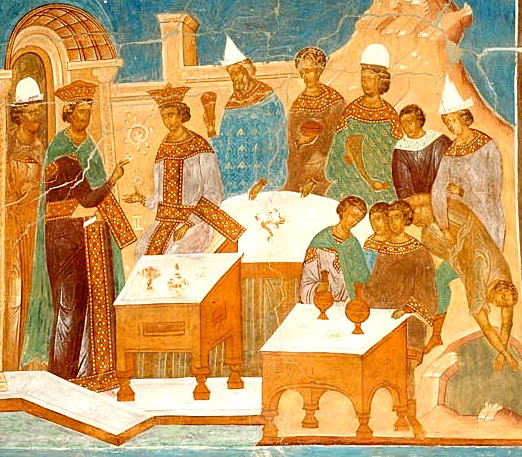
11. And when the king came in to see the guests, he saw there a man which had not on a wedding garment:
12. And he saith unto him, Friend, how camest thou in hither not having a wedding garment? And he was speechless.
13. Then said the king to the servants, Bind him hand and foot, and take him away, and cast him into outer darkness; there shall be weeping and gnashing of teeth.
14. For many are called, but few are chosen.
CHRYSOSTOM. (Hom. lxix.) Forasmuch as He had said, And it shall be given to a nation bringing forth the fruits thereof, He now proceeds to shew what nation that is.
GLOSS. (interlin.) Answered, that is, meeting their evil thoughts of putting Him to death.
AUGUSTINE. (de Cons. Ev. ii. 71.) This parable is related only by Matthew. Luke gives one like it, but it is not the same, as the order shews.
GREGORY. (Hom. in Ev. xxxviii. 2.) Here, by the wedding-feast is denoted the present Church; there, by the supper, the last and eternal feast. For into this enter some who shall perish; into that whosoever has once entered in shall never be put forth. But if any should maintain that these are the same lessons, we may perhaps explain that that part concerning the guest who had come in without a wedding garment, which Luke has not mentioned, Matthew has related. That the one calls it supper, the other dinner, makes no difference; for with the ancients the dinner was at the ninth hour, and was therefore often called supper.
ORIGEN. The kingdom of heaven, in respect of Him who reigns there, is like a king; in respect of Him who shares the kingdom, it is like a kings son; in respect of those things which are in the kingdom, it is like servants and guests, and among them the kings armies. It is specified, A man that is a king, that what is spoken may be as by a man to men, and that a man may regulate men unwilling to be regulated by God. But the kingdom of heaven will then cease to be like a man, when zeal and contention and all other passions and sins having ceased, we shall cease to walk after men, and shall see Him as He is. For now we see Him not as He is, but as He has been made for us in our dispensation.
GREGORY. (ubi sup.) G marriage feast for God the Son, when He joined Him to human nature in the womb of the Virgin. But far be it from us to conclude, that because marriage takes place between two separate persons, that therefore the person of our Redeemer was made up of two separate persons. We say indeed that He exists of two natures, and in two natures, but we hold it unlawful to believe that He was compounded of two persons. It is safer therefore to say, that the marriage feast was made by the King the Father for the King the Son when He joined to Him the Holy Church in the mystery of His incarnation. The womb of the Virgin Mother was the bride-chamber of this Bridegroom.
PSEUDO-CHRYSOSTOM. Otherwise; When the resurrection of the saints shall be, then the life, which is Christ, shall revive man, swallowing up his mortality in its own immortality. For now we receive the Holy Spirit as a pledge of the future union, but then we shall have Christ Himself more fully in us.
ORIGEN. Or, by the marriage of Bridegroom with Bride, that is, of Christ with the soul, understand the Assumption of the Word, the produce whereof is good works.
HILARY. Rightly has the Father already made this wedding, because this eternal union and espousal of the new body is already perfect in Christ.
PSEUDO-CHRYSOSTOM. When the servants were sent to call them, they must have been invited before. Men have been invited from the time of Abraham, to whom was promised Christs incarnation.
JEROME. He sent his servant, without doubt Moses, by whom I le gave the Law, to those who had been invited. But if you read servants as most copies have, it must be referred to the Prophets, by whom they were invited, but neglected to come. By the servants who were sent the second time, we may better understand the Prophets than the Apostles; that is to say, if servant is read in the first place; but if servants, then by the second servants are to be understood the Apostles;
PSEUDO-CHRYSOSTOM. whom He sent when He said unto them, Go not into the way of the Gentiles, but rather go to the lost sheep of the house of Israel. (Mat. 10:5.)
ORIGEN. Or; The servants who were first sent to call them that were bidden to the wedding, are to be taken as the Prophets converting the people by their prophecy to the festival of the restoration of the Church to Christ. They who would not come at the first message are they who refused to hear the words of the Prophets. The others who were sent a second time were another assembly of Prophets.
HILARY. Or; The servants who were first sent to call them that were bidden, are the Apostles; they who, being before bidden, are now invited to come in, are the people of Israel, who had before been bidden through the Law to the glories of eternity. To the Apostles therefore it belonged to remind those whom the Prophets had invited. Those sent with the second injunction are the Apostolic men their successors.
GREGORY. (ubi sup.) But because these who were first invited would not come to the feast, the second summons says, Behold, I have prepared my dinner.
JEROME. The dinner that is prepared, the oxen and the fatlings that are killed, is either a description of regal magnificence by the way of metaphor, that by carnal things spiritual may be understood; or the greatness of the doctrines, and the manifold teaching of God in His law, may be understood.
PSEUDO-CHRYSOSTOM. When therefore the Lord bade the Apostles, Go ye and preach, saying, The kingdom of heaven is at hand, it was the same message as is here given, I have prepared my dinner; i. e. I have set out the table of Scripture out of the Law and the Prophets.
GREGORY. (ubi sup.) By the oxen are signified the Fathers of the Old Testament; who by sufferance of the Law gored their enemies with the horn of bodily strength. By fatlings are meant fatted animals, for from alere, comes altilia, as it were alitilia or alita. By the fatlings are intended the Fathers of the New Testament; who while they receive sweet grace of inward fattening, are raised by the wing of contemplation from earthly desires to things above. He says therefore, My oxen and my fallings are killed; as much as to say, Look to the deaths of the Fathers who have been before you, and desire some amendment of your lives.
PSEUDO-CHRYSOSTOM. Otherwise; He says oxen and fatlings, not as though the oxen were not fatted, but because all the oxen were not fat. Therefore the fatlings denote the Prophets who were filled with the Holy Spirit; the oxen those who were both Priests and Prophets, as Jeremiah and Ezekiel; for as the oxen are the leaders of the herd, so also the Priests are leaders of the people.
HILARY. Or otherwise; The oxen are the glorious army of Martyrs, offered, like choice victims, for the confession of God; the fatlings are spiritual men, as birds fed for flight upon heavenly food, that they may fill others with the abundance of the food they have eaten.
GREGORY. (ubi sup.) It is to be observed, that in the first invitation nothing was said of the oxen or fatlings, but in the second it is announced that they are already killed, because Almighty God when we will not hear His words gives examples, that what we suppose impossible may become easy to us to surmount, when we hear that others have passed through it before us.
ORIGEN. Or; The dinner which is prepared is the oracle of God; and so the more mighty of the oracles of God are the oxen; the sweet and pleasant are the fatlings. For if any one bring forward feeble words, without power, and not having strong force of reason, these are the lean things; the fatlings are when to the establishment of each proposition many examples are brought forward backed by reasonable proofs. For example, supposing one holding discourse of chastity, it might well be represented by the turtle-dove; but should he bring forward the same holy discourse full of reasonable proof out of Scripture, so as to delight and strengthen the mind of his hearer, then he brings the dove fatted.
PSEUDO-CHRYSOSTOM. That He says, And all things are now ready, means, that all that is required to salvation is already filled up in the Scriptures; there the ignorant may find instruction; the self-willed may read of terrors; he who is in difficulty may there find promises to rouse him to activity.
GLOSS. (interlin.) Or, All things are now ready, i. e. The entrance into the kingdom, which had been hitherto closed, is now ready through faith in My incarnation.
PSEUDO-CHRYSOSTOM. (non occ. sed vid. Gloss. ord.) Or He says, All things are now ready which belong to the mystery of the Lords Passion, and our redemption. He says, Come to the marriage, not with your feet, but with faith, and good conduct. But they made light of it; why they did so He shews when He adds, And they went their way, one to his farm, another to his merchandize.
CHRYSOSTOM. These occupations seem to be entirely reasonable; but we learn hence, that however necessary the things that take up our time, we ought to prefer spiritual things to every thing beside. But it seems to me that they only pretended these engagements as a cloak for their disregard of the invitation.
HILARY. For men are taken up with worldly ambition as with a farm; and many through covetousness are engrossed with trafficking.
PSEUDO-CHRYSOSTOM. Or otherwise; When we work with the labour of our hands, for example, cultivating our field or our vineyard, or any manufacture of wood or iron, we seem to be occupied with our farm; any other mode of getting money unattended with manual labour is here called merchandize. O most miserable world! and miserable ye that follow it! The pursuits of this world have ever shut men out of life.
GREGORY. Whosoever then intent upon earthly business, or devoted to the actions of this world, feigns to be meditating upon the mystery of the Lords Passion, and to be living accordingly, is he that refuses to come to the Kings wedding on pretext of going to his farm or his merchandize. Nay often, which is worse, some who are called not only reject the grace, but become persecutors, And the remnant took his servants, and entreated them despitefully, and slew them.
PSEUDO-CHRYSOSTOM. Or, by the business of a farm, He denotes the Jewish populace, whom the delights of this world separated from-Christ; by the excuse of merchandize, the Priests and other ministers of the Temple, who, coming to the service of the Law and the Temple through greediness of gain, have been shut out of the faith by covetousness. Of these He said not, They were filled with envy, but They made light of it. For they who through hate and spite crucified Christ, are they who were filled with envy; but they who being entangled in business did not believe on Him, are not said to have been filled with envy, but to have made light of it. The Lord is silent respecting His own death, because He had spoken of it in the foregoing parable, but He shews forth the death of His disciples, whom after His ascension the Jews put to death, stoning Stephen and executing James the son of Alphæus, for which things Jerusalem was destroyed by the Romans. And it is to be observed, that anger is attributed to God figuratively and not properly; He is then said to be angry when He punishes.
JEROME. When He was doing works of mercy, and bidding to His marriage-feast, He was called a man; (homini regi) now when He comes to vengeance, the man is dropped, and He is called only a King.
ORIGEN. Let those who sin against the God of the Law, and the Prophets, and the whole creation, declare whether He who is here called man, and is said to be angry, is indeed the Father Himself. If they allow this, they will be forced to own that many things are said of Him applicable to the passible nature of man; not for that He has passions, but because He is represented to us after the manner of passible human nature. In this way we take Gods anger, repentance, and the other things of the like sort in the Prophets.
JEROME. By His armies we understand the Romans under Vespasian and Titus, who having slaughtered the inhabitants of Judæa, laid in ashes the faithless city.
PSEUDO-CHRYSOSTOM. The Roman army is called Gods army; because The earth is the Lords, and the fulness thereof; (Ps. 24:1.) nor would the Romans have come to Jerusalem, had not the Lord stirred them thither.
GREGORY. (ubi sup.) Or, The armies of our King are the legions of His Angels. He is said therefore to have sent His armies, and to have destroyed those murderers, because all judgment is executed upon men by the Angels. He destroys those murderers, when He cuts off persecutors; and burns up their city, because not only their souls, but the body of flesh they had tenanted, is tormented in the everlasting fire of hell.
ORIGEN. Or, the city of those wicked men is in each doctrine the assembly of those who meet in the wisdom of the rulers of this world; which the King sets fire to and destroys, as consisting of evil buildings.
GREGORY. (ubi sup.) But when He sees that His invitation is spurned at, He will not have His Sons marriage-feast empty; the word of God will find where it may stay itself.
ORIGEN. He saith to His servants, that is, to the Apostles; or to the Angels, who were set over the calling of the Gentiles, The wedding is ready.
REMIGIUS. That is, the whole sacrament of the human dispensation is completed and closed. But they which, were bidden, (Rom. 10:3.) that is, the Jews, were not worthy, because, ignorant of the righteousness of God, and going about to establish their own righteousness, they have not submitted themselves to the righteousness of God. The Jewish nation then being rejected, the Gentile people were taken in to the marriage-feast; whence it follows, Go ye out into the crossings of the streets, and as many as ye shall find, bid to the wedding.
JEROME. For the Gentile nation was not in the streets, but in the crossings of the streets.
REMIGIUS. These are the errors of the Gentiles.
PSEUDO-CHRYSOSTOM. Or; The streets are all the professions of this world, as philosophy, soldiery, and the like. And therefore He says, Go out into the crossings of the streets, that they may call to the faith men of every condition. Moreover, as chastity is the way that leads to God, so fornication is the way that leads to the Devil; and so it is in the other virtues and vices. Thus He bids them invite to the faith men of every profession or condition.
HILARY. By the street also is to be understood the time of this world, and they are therefore bid to go to the crossings of the streets, because the past is remitted to all.
GREGORY. (ubi sup.) Or otherwise; In holy Scripture, way is taken to mean actions; so that the crossings of the ways we understand as failure in action, for they usually come to God readily, who have had little prosperity in worldly actions.
ORIGEN. Or otherwise; I suppose this first bidding to the wedding to have been a bidding of some of the more noble minds. For God would have those before all come to the feast of the divine oracles who are of the more ready wit to understand them; and forasmuch as they who are such are loth to come to that kind of summons, other servants are sent to move them to come, and to promise that they shall find the dinner prepared. For as in the things of the body, one is the bride, others the inviters to the feast, and they that are bidden are others again; so God knows the various ranks of souls, and their powers, and the reasons why these are taken into the condition of the Bride, others in the rank of the servants that call, and others among the number of those that are bidden as guests. But they who had been thus especially invited contemned the first inviters as poor in understanding, and went their way, following their own devices, as more delighting in them than in those things which the King by his servants promised. Yet are these more venial than they who ill-treat and put to death the servants sent unto them; those, that is, who daringly assail with weapons of contentious words the servants sent, who are unequal to solve their subtle difficulties, and those are illtreated or put to death by them. The servants going forth are either Christs Apostles going from Judæa and Jerusalem, or the Holy Angels from the inner worlds, and going to the various ways of various manners, gathered together whomsoever they found, not caring whether before their calling they had been good or bad. By the good here we may understand simply the more humble and upright of those who come to the worship of God, to whom agreed what the Apostle says, When the Gentiles which have not the Law do by nature the things contained in the Law, they are a law unto themselves. (Rom. 2:14.)
JEROME. For there is an infinite difference among the Gentiles themselves; some are more prone to vice, others are endowed with more incorrupt and virtuous manners.
GREGORY. (ubi sup.) Or; He means that in this present Church there cannot be bad without good, nor good without bad. He is not good who refuses to endure the bad.
ORIGEN. The marriage-feast of Christ and the Church is filled, when they who were found by the Apostles, being restored to God, sat down to the feast. But since it behoved that both bad and good should be called, not that the bad should continue bad, but that they should put off the garments unmeet for the wedding, and should put on the marriage garments, to wit, bowels of mercy and kindness, for this cause the King goes out, that He may see them set down before the supper is set before them, that they may be detained who have the wedding garment in which He is delighted, and that he may condemn the opposite.
PSEUDO-CHRYSOSTOM. The King came in to see the guests; not as though there was any place where He is not; but where He will look to give judgment, there He is said to be present; where He will not, there He seems to be absent. The day of His coming to behold is the day of judgment, when He will visit Christians seated at the board of the Scriptures.
ORIGEN. But when He was come in, He found there one who had not put off his old behaviour; He saw there a man which had not on a wedding garment. He speaks of one only, because all, who after faith continue to serve that wickedness which they had before the faith, are but of one kind.
GREGORY. (ubi sup.) What ought we to understand by the wedding garment, but charity? For this the Lord had upon Him, when He came to espouse the Church to Himself. He then enters in to the wedding feast, but without the wedding garment, who has faith in the Church, but not charity.
AUGUSTINE. (cont. Faust. xxii. 19.) Or, he goes to the feast without a garment, who goes seeking his own, and not the Bridegrooms honour.
HILARY. Or; The wedding garment is the grace of the Holy Spirit, and the purity of that heavenly temper, which taken up on the confession of a good enquiry is to be preserved pure and unspotted for the company of the kingdom of heaven.
JEROME. Or; The marriage garment is the commandments of the Lord, and the works which are done under the Law and the Gospel, and form the clothing of the new man. Whoso among the Christian body shall be found in the day of judgment not to have these, is straightway condemned. He saith unto him, Friend, how camest thou in hither, not having a wedding garment? He calls him friend, because he was invited to the wedding as being a friend by faith; but He charges him with want of manners in polluting by his filthy dress the elegance of the wedding entertainment.
ORIGEN. And forasmuch as he who is in sin, and puts not on the Lord Jesus Christ, has no excuse, it follows, But he was speechless.
JEROME. For in that day there will be no room for blustering manner1, nor power of denial, when all the Angels and the world itself are witnesses against the sinner.
ORIGEN. He who has thus insulted the marriage feast is not only cast out therefrom, but besides by the Kings officers, who are set over his prisons, is chained up from that power of walking which he employed not to walk to any good thing, and that power of reaching forth his hand, wherewith he had fulfilled no work for any good; and is sentenced to a place whence all light is banished, which is called outer darkness.
GREGORY. (ubi sup.) The hands and feet are then bound by a severe sentence of judgment, which before refused to be bound from wicked actions by amendment of life. Or punishment binds them, whom sin had before bound from good works.
AUGUSTINE. (de Trin. xi. 6.) The bonds of wicked and depraved desires are the chains which bind him who deserves to be cast out into outer darkness.
GREGORY. (ubi sup.) By inward darkness we express blindness, of heart; outer darkness signifies the everlasting night of damnation.
PSEUDO-CHRYSOSTOM. Or, it points to the difference of punishment inflicted on sinners. Outer darkness being the deepest, inward darkness the lesser, as it were the outskirts of the place.
JEROME. By a metaphor taken from the body, there shall be weeping and gnashing of teeth, is shewn the greatness of the torments. The binding of the hands and feet also, and the weeping of eyes, and the gnashing of teeth, understand as proving the truth of the resurrection of the body.
GREGORY. (ubi sup.) There shall gnash those teeth which here delighted in gluttony; there shall weep those eyes which here roamed in illicit desire; every member shall there have its peculiar punishment, which here was a slave to its peculiar vice.
JEROME. And because in the marriage and supper the chief thing is the end and not the beginning, therefore He adds, For many are called, but few chosen.
HILARY. For to invite all without exception is a courtesy of public benevolence; but out of the invited or called, the election will be of worth, by distinction of merit.
GREGORY. (ubi sup.) For some never begin a good course, and some never continue in that good course which they have begun. Let each ones care about himself be in proportion to his ignorance of what is yet to come.
PSEUDO-CHRYSOSTOM. Or otherwise; Whenever God will try His Church, He enters into it that He may see the guests; and if He finds any one not having on the wedding garment, He enquires of him, How then were you made a Christian, if you neglect these works? Such a one Christ gives over to His ministers, that is, to seducing leaders, who bind his hands, that is, his works, and his feet, that is, the motions of his mind, and cast him into darkness, that is, into the errors of the Gentiles or the Jews, or into heresy. The nigher darkness is that of the Gentiles, for they have never heard the truth which they despise; the outer darkness is that of the Jews, who have heard but do not believe; the outermost is that of the heretics, who have heard and have learned.
Catena Aurea Matthew 22
Catena Aurea by St. Thomas Aguinas
John CHAP. 21
21:15–17
15. So when they had dined, Jesus saith to Simon Peter, Simon, son of Jonas, lovest thou me more than these? He saith unto him, Yea, Lord; thou knowest that I love thee. He saith unto him, Feed my lambs.
16. He saith to him again the second time, Simon, son of Jonas, lovest thou me? He saith unto him, Yea, Lord; thou knowest that I love thee. He saith unto him, Feed my sheep.
17. He saith unto him the third time, Simon, son of Jonas, lovest thou me? Peter was grieved because he said unto him the third time, Lovest thou me? And he said unto him, Lord, thou knowest all things; thou knowest that I love thee. Jesus saith unto him, Feed my sheep.
THEOPHYLACT. The dinner being ended, He commits to Peter the superintendence over the sheep of the world, not to the others: So when they had dined, Jesus saith to Simon Peter, Simon, son of Jonas, lovest thou Me more than these?
AUGUSTINE. Our Lord asked this, knowing it: He knew that Peter not only loved Him, but loved Him more than all the rest.
ALCUIN. He is called Simon, son of John, John being his natural father. But mystically, Simon is obedience, John grace, a name well befitting him who was so obedient to God’s grace, that he loved our Lord more ardently than any of the others. Such virtue arising from divine gift, not mere human will.
AUGUSTINE. While our Lord was being condemned to death, he feared, and denied Him. But by His resurrection Christ implanted love in his heart, and drove away fear. Peter denied, because he feared to die: but when our Lord was risen from the dead, and by His death destroyed death, what should he fear? He saith unto Him, Yea, Lord; Thou knowest that I love Thee. On this confession of his love, our Lord commends His sheep to him: He saith unto him, Feed My lambs: as if there were no way of Peter’s shewing his love for Him, but by being a faithful shepherd, under the chief Shepherd.
CHRYSOSTOM. (Hom. lxxxviii. 1) That which most of all attracts the Divine love is care and love for our neighbour. Our Lord passing by the rest, addresses this command to Peter: he being the chief of the Apostles, the mouth of the disciples, and head of the college. Our Lord remembers no more his sin in denying Him, or brings that as a charge against him, but commits to him at once the superintendence over his brethren. If thou lovest Me, have rule over thy brethren, shew forth that love which thou hast evidenced throughout, and that life which thou saidst thou wouldest lay down for Me, lay down for the sheep.
He saith to him again the second time, Simon, son of Jonas, lovest thou Me? He saith unto Him, Yea, Lord; Thou knowest that I love Thee.
AUGUSTINE. (Tract. cxxii) Well doth He say to Peter, Lovest thou Me (ἀγαπᾶς diligis), and Peter answer, Amo Te (φελῶ amo), and our Lord replies again, Feed My lambs. Whereby, it appears that amor and dilectio are the same thing: especially as our Lord the third time He speaks does not say, Diligis Me, but Amas Me. He saith unto him the third time, Simon, son of Jonas, lovest thou Me? A third time our Lord asks Peter whether he loves Him. Three confessions are made to answer to the three denials; that the tongue might shew as much love as it had fear, and life gained draw out the voice as much as death threatened.
CHRYSOSTOM. (Hom. lxxxviii) A third time He asks the same question, and gives the same command; to shew of what importance He esteems the superintendence of His own sheep, and how He regards it as the greatest proof of love to Him.
THEOPHYLACT. Thence is taken the custom of threefold confession in baptism.
CHRYSOSTOM. (Hom. lxxxviii) The question asked for the third time disturbed him: Peter was grieved because He said unto him the third time, Lovest thou Me? He was afraid perhaps of receiving a reproof again for professing to love more than he did. So he appeals to Christ Himself: And he said unto Him, Lord, Thou knowest all things, i. e. the secrets of the heart, present and to come.
AUGUSTINE. (de Verb. Dom. serm. 50) He was grieved because he was asked so often by Him Who knew what He asked, and gave the answer. He replies therefore from his inmost heart; Thou knowest that I love Thee.
AUGUSTINE. (Tract. cxxiv) He says no more, He only replies what he knew himself; he knew he loved Him; whether any else loved Him he could not tell, as he could not see into another’s heart: (non occ.). Jesus saith unto him, Feed My sheep; as if to say, Be it the office of love to feed the Lord’s flock, as it was the resolution of fear to deny the Shepherd.
THEOPHYLACT. There is a difference perhaps between lambs and sheep. The lambs are those just initiated, the sheep are the perfected.
ALCUIN. To feed the sheep is to support the believers in Christ from falling from the faith, to provide earthly sustenance for those under us, to preach and exemplify withal our preaching by our lives, to resist adversaries, to correct wanderers.
AUGUSTINE. (Tract. cxxiii) They who feed Christ’s sheep, as if they were their own, not Christ’s, shew plainly that they love themselves, not Christ; that they are moved by lust of glory, power, gain, not by the love of obeying, ministering, pleasing God. Let us love therefore, not ourselves, but Him, and in feeding His sheep, seek not our own, but the things which are His. For whoso loveth himself, not God, loveth not himself: man that cannot live of himself, must die by loving himself; and he cannot love himself, who loves himself to his own destruction. Whereas when He by Whom we live is loved, we love ourselves the more, because we do not love ourselves; because we do not love ourselves in order that we may love Him by Whom we live.
AUGUSTINE. (Serm. Pass.) But unfaithful servants arose, who divided Christ’s flock, and handed down the division to their successors: and you hear them say, Those sheep are mine, what seekest thou with my sheep, I will not let thee come to my sheep. If we call our sheep ours, as they call them theirs, Christ hath lost His sheep.
21:18–19
18. Verily, verily, I say unto thee, When thou wast young, thou girdedst thyself, and walkedst whither thou wouldest: but when thou shalt be old, thou shalt stretch forth thy hands, and another shall gird thee, and carry thee whither thou wouldest not.
19. This spake he, signifying by what death he should glorify God.
CHRYSOSTOM. (Hom. lxxxvii) Our Lord having made Peter declare his love, informs him of his future martyrdom; an intimation to us how we should love: Verily, verily, I say unto thee, When thou wast young, thou girdedst thyself, and walkedst whither thou wouldest. He reminds him of his former life, because, whereas in worldly matters a young man has powers, an old man none; in spiritual things, on the contrary, virtue is brighter, manliness stronger, in old age; age is no hindrance to grace. Peter had all along desired to share Christ’s dangers; so Christ tells him, Be of good cheer; I will fulfil thy desire in such a way, that what thou hast not suffered when young, thou shalt suffer when old: But when thou art old. Whence it appears, that he was then neither a young nor an old man, but in the prime of life.
ORIGEN. (super. Matt.) It is not easy to find any ready to pass at once from this life; and so he says to Peter, When thou art old, thou shalt stretch forth thy hand.
AUGUSTINE. (Tract. cxxiii. 5) That is, shalt be crucified. And to come to this end, Another shall gird thee, and carry thee whither thou wouldest not. First He said what would come to pass, secondly, how it would come to pass. For it was not when crucified, but when about to be crucified, that he was led whither he would not. He wished to be released from the body, and be with Christ; but, if it were possible, he wished to attain to eternal life without the pains of death: to which he went against his will, but conquered by the force of his will, and triumphing over the human feeling, so natural a one, that even old age could not deprive Peter of it. But whatever be the pain of death, it ought to be conquered by the strength of love for Him, Who being our life, voluntarily also underwent death for us. For if there is no pain in death, or very little, the glory of martyrdom would not be great.
CHRYSOSTOM. (Hom. lxxxviii) He says, Whither thou wouldest not, with reference to the natural reluctance of the soul to be separated from the body; an instinct implanted by God to prevent men putting an end to themselves. Then raising the subject, the Evangelist says, This spake He, signifying by what death he should glorify God: not, should die: he expresses himself so, to intimate that to suffer for Christ was the glory of the sufferer. (non occ.). But unless the mind is persuaded that He is very God, the sight of Him can in no way enable us to endure death. Wherefore the death of the saints is certainty of divine glory.
AUGUSTINE. (Tract. cxxiii) He who denied and loved, died in perfect love for Him, for Whom he had promised to die with wrong haste. It was necessary that Christ should first die for Peter’s salvation, and then Peter die for Christ’s Gospel.
Catena Aurea John 21


.jpg)