Skip to comments.
Catholic Caucus: Daily Mass Readings 17-August-2025
Universalis/Jerusalem Bible ^
Posted on 08/17/2025 2:28:50 PM PDT by annalex
17 August 2025
20th Sunday in Ordinary Time

Saint Hyacinth Roman Catholic Church, Detroit, MI Readings at MassLiturgical Colour: Green. Year: C(I).
| First reading |
|---|
| Jeremiah 38:4-6,8-10 |
|---|
'Do not let the prophet die'The king’s leading men spoke to the king. ‘Let Jeremiah be put to death: he is unquestionably disheartening the remaining soldiers in the city, and all the people too, by talking like this. The fellow does not have the welfare of this people at heart so much as its ruin.’ ‘He is in your hands as you know,’ King Zedekiah answered ‘for the king is powerless against you.’ So they took Jeremiah and threw him into the well of Prince Malchiah in the Court of the Guard, letting him down with ropes. There was no water in the well, only mud, and into the mud Jeremiah sank. Ebed-melech came out from the palace and spoke to the king. ‘My lord king,’ he said ‘these men have done a wicked thing by treating the prophet Jeremiah like this: they have thrown him into the well, where he will die.’ At this the king gave Ebed-melech the Cushite the following order: ‘Take three men with you from here and pull the prophet Jeremiah out of the well before he dies.’
| Responsorial Psalm |
|---|
| Psalm 39(40):2-4,18 |
|---|
Lord, come to my aid! I waited, I waited for the Lord and he stooped down to me; he heard my cry. Lord, come to my aid! He drew me from the deadly pit, from the miry clay. He set my feet upon a rock and made my footsteps firm. Lord, come to my aid! He put a new song into my mouth, praise of our God. Many shall see and fear and shall trust in the Lord. Lord, come to my aid! As for me, wretched and poor, the Lord thinks of me. You are my rescuer, my help, O God, do not delay. Lord, come to my aid!
| Second reading | Hebrews 12:1-4 |
|---|
We should keep running steadily in the race we have startedWith so many witnesses in a great cloud on every side of us, we too, then, should throw off everything that hinders us, especially the sin that clings so easily, and keep running steadily in the race we have started. Let us not lose sight of Jesus, who leads us in our faith and brings it to perfection: for the sake of the joy which was still in the future, he endured the cross, disregarding the shamefulness of it, and from now on has taken his place at the right of God’s throne. Think of the way he stood such opposition from sinners and then you will not give up for want of courage. In the fight against sin, you have not yet had to keep fighting to the point of death.
| Gospel Acclamation | cf.Ac16:14 |
|---|
Alleluia, alleluia! Open our heart, O Lord, to accept the words of your Son. Alleluia! Alleluia, alleluia! The sheep that belong to me listen to my voice, says the Lord, I know them and they follow me. Alleluia!
How I wish it were blazing already!Jesus said to his disciples: ‘I have come to bring fire to the earth, and how I wish it were blazing already! There is a baptism I must still receive, and how great is my distress till it is over! ‘Do you suppose that I am here to bring peace on earth? No, I tell you, but rather division. For from now on a household of five will be divided: three against two and two against three; the father divided against the son, son against father, mother against daughter, daughter against mother, mother-in-law against daughter-in-law, daughter-in-law against mother-in-law.’ Universalis podcast: The week ahead – from 17 to 23 AugustOur Lady, Mother and Queen. The Rosary, Scripture verses, Danish and Latin. Southwark Cathedral and its catechists. We are all catechists of a kind: here's how Universalis and The Creed in Slow Motion can help. (21 minutes)
Episode notes.Play Christian Art Each day, The Christian Art website gives a picture and reflection on the Gospel of the day. The readings on this page are from the Jerusalem Bible, which is used at Mass in most of the English-speaking world. The New American Bible readings, which are used at Mass in the United States, are available in the Universalis apps, programs and downloads.
You can also view this page with the Gospel in Greek and English. |
TOPICS: Catholic; General Discusssion; Prayer; Worship
KEYWORDS: catholic; lk12; ordinarytime; prayer
For your reading, reflection, faith-sharing, comments, questions, discussion.
1
posted on
08/17/2025 2:28:50 PM PDT
by
annalex
To: All
KEYWORDS: catholic; lk12; ordinarytime; prayer
2
posted on
08/17/2025 2:29:23 PM PDT
by
annalex
(fear them not)
To: nickcarraway; NYer; ELS; Pyro7480; livius; ArrogantBustard; Catholicguy; RobbyS; marshmallow; ...

Alleluia Ping Please FReepmail me to get on/off the Alleluia Ping List.
3
posted on
08/17/2025 2:30:03 PM PDT
by
annalex
(fear them not)
To: annalex
4
posted on
08/17/2025 2:30:26 PM PDT
by
annalex
(fear them not)
To: annalex
| Luke |
| | English: Douay-Rheims | Latin: Vulgata Clementina | Greek NT: Byzantine/Majority Text (2000) |
| | Luke 12
|
| 49. | I am come to cast fire on the earth; and what will I, but that it be kindled? | Ignem veni mittere in terram, et quid volo nisi ut accendatur ? | πυρ ηλθον βαλειν εις την γην και τι θελω ει ηδη ανηφθη |
| 50. | And I have a baptism wherewith I am to be baptized: and how am I straitened until it be accomplished? | Baptismo autem habeo baptizari : et quomodo coarctor usque dum perficiatur ? | βαπτισμα δε εχω βαπτισθηναι και πως συνεχομαι εως ου τελεσθη |
| 51. | Think ye, that I am come to give peace on earth? I tell you, no; but separation. | Putatis quia pacem veni dare in terram ? non, dico vobis, sed separationem : | δοκειτε οτι ειρηνην παρεγενομην δουναι εν τη γη ουχι λεγω υμιν αλλ η διαμερισμον |
| 52. | For there shall be from henceforth five in one house divided: three against two, and two against three. | erunt enim ex hoc quinque in domo una divisi, tres in duos, et duo in tres | εσονται γαρ απο του νυν πεντε εν οικω ενι διαμεμερισμενοι τρεις επι δυσιν και δυο επι τρισιν |
| 53. | The father shall be divided against the son, and the son against his father, the mother against the daughter, and the daughter against the mother, the mother in law against her daughter in law, and the daughter in law against her mother in law. | dividentur : pater in filium, et filius in patrem suum, mater in filiam, et filia in matrem, socrus in nurum suam, et nurus in socrum suam. | διαμερισθησεται πατηρ επι υιω και υιος επι πατρι μητηρ επι θυγατρι και θυγατηρ επι μητρι πενθερα επι την νυμφην αυτης και νυμφη επι την πενθεραν αυτης |
5
posted on
08/17/2025 2:31:54 PM PDT
by
annalex
(fear them not)
To: annalex

Catena Aurea by St. Thomas Aguinas
12:49–53
49. I am come to send fire on the earth; and what will I, if it be already kindled?
50. But I have a baptism to be baptized with; and how am I straitened till it be accomplished!
51. Suppose ye that I am come to give peace on earth? I tell you, Nay; but rather division:
52. For from henceforth there shall be five in one house divided, three against two, and two against three.
53. The father shall be divided against the son, and the son against the father; the mother against the daughter, and the daughter against the mother; the mother in law against her daughter in law, and the daughter in law against her mother in law.
AMBROSE. To stewards, that is, to Priests, the preceding words seem to have been addressed, that they may thereby know that hereafter a heavier punishment awaits them, if, intent upon the world’s pleasures, they have neglected the charge of their Lord’s household, and the people entrusted to their care. But as it profiteth little to be recalled from error by the fear of punishment, and far greater is the privilege of charity and love, our Lord therefore kindles in men the desire of acquiring the divine nature, saying, I came to send fire on earth, not indeed that He is the Consumer of good men, but the Author of good will, who purifies the golden vessels of the Lord’s house, but burns up the straw and stubble.
CYRIL OF ALEXANDRIA. Now it is the way of holy Scripture to use sometimes the term fire, of holy and divine words. For as they who know how to purify gold and silver, destroy the dross by fire, so the Saviour by the teaching of the Gospel in the power of the Spirit cleanses the minds of those who believe in Him. This then is that wholesome and useful fire by which the inhabitants of earth, in a manner cold and dead through sin, revive to a life of piety.
CHRYSOSTOM. For by the earth He now means not that which we tread under our feet, but that which was fashioned by His hands, namely, man, upon whom the Lord pours out fire for the consuming of sins, and the renewing of souls.
TITUS BOSTRENSIS. And we must here believe that Christ came down from heaven. For if He had come from earth to earth, He would not say, I came to send fire upon the earth.
CYRIL OF ALEXANDRIA. But our Lord was hastening the kindling of the fire, and hence it follows, And what will I, save that it be kindleda? (nisi ut accendatur) For already some of the Jews believed, of whom the first were the holy Apostles, but the fire once lighted in Judæa was about to take possession of the whole world, yet not till after the dispensation of His Passion had been accomplished. Hence it follows, But I have a baptism to be baptized with. For before the holy cross and His resurrection from the dead, in Judæa only was the news told of His preaching and miracles; but after that the Jews in their rage had slain the Prince of life, then commanded He His Apostles, saying, Go and teach all nations. (Matt. 28:19.)
GREGORY. (in Ezech. lib. i. Hom. 2.) Or else, fire is sent upon the earth, when by the fiery breath of the Holy Spirit, the earthly mind has all its carnal desires burnt up, but inflamed with spiritual love, bewails the evil it has done; and so the earth is burnt, when the conscience accusing itself, the heart of the sinner is consumed in the sorrow of repentance.
BEDE. But He adds, I have a baptism to be baptized with, that is, I have first to be sprinkled with the drops of My own Blood, and then to inflame the hearts of believers by the fire of the Spirit.
AMBROSE. But so great was our Lord’s condescension, that He tells us He has a desire of inspiring us with devotion, of accomplishing perfection in us, and of hastening His passion for us; as it follows, And how am I straitened till it be accomplished?
BEDE. Some manuscripts have, “And how am I anguished,” (coangor) that is, grieved. For though He had in Himself nothing to grieve Him, yet was He afflicted by our woes, and at the time of death He betrayed the anguish which He underwent not from the fear of His death, but from the delay of our redemption. For he who is troubled until he reaches perfection, is secure of perfection, for the condition of bodily affections not the dread of death offends him. For ho who has put on the body must suffer all things which are of the body, hunger, thirst, vexation, sorrow; but the Divine nature knows no change from such feelings. At the same time He also shews, that in the conflict of suffering consists the death of the body, peace of mind has no struggle with grief.
BEDE. But the manner in which after the baptism of His passion and the coming of the spiritual fire the earth will be burnt, He declares as follows, Suppose ye that I am to give peace, &c.
CYRIL OF ALEXANDRIA. What sayest thou, O Lord? Didst thou not come to give peace, Who art made peace for us? (Eph. 2:14.) making peace by Thy cross with things in earth and things in heaven; (Col. 1:20.) Who saidst, My peace I give unto you. (John 14:27.) But it is plain that peace is indeed a good, but sometimes hurtful, and separating us from the love of God, that is, when by it we unite with those who keep away from God. And for this reason we teach the faithful to avoid earthly bonds. Hence it follows, For from henceforth there shall be five in one house divided, three against two, &c.
AMBROSE. Though the connexion would seem to be of six persons, father and son, mother and daughter, mother in law and daughter in law, yet are they five, for the mother and the mother in law may be taken as the same, since she who is the mother of the son, is the mother in law of his wife.
CHRYSOSTOM. (non occ.) Now hereby He declared a future event, for it so happened in the same house that there have been believers whose fathers wished to bring them to unbelief; but the power of Christ’s doctrines has so prevailed, that fathers were left by sons, mothers by daughters, and children by parents. For the faithful in Christ were content not only to despise their own, but at the same time also to suffer all things as long as they were not without the worship of their faith. But if He were mere man, how would it have occurred to Him to conceive it possible that He should be more loved by fathers than their children were, by children than their fathers, by husbands than their wives, and they too not in one house or a hundred, but throughout the world? And not only did he predict this, but accomplish it in deed.
AMBROSE. Now in a mystical sense the one house is one man, but by two we often mean the soul and the body. But if two things meet together, each one has its part; there is one which obeys, another which rules. But there are three conditions of the soul, one concerned with reason, another with desire, the third with anger. Two then are divided against three, and three against two. For by the coming of Christ, man who was material became rational. We were carnal and earthly, God sent His Spirit into our hearts, and we became spiritual children. (Gal. 4:6.) We may also say, that in the house there are five others, that is, smell, touch, taste, sight, and hearing. If then with respect to those things which we hear or see, separating the sense of sight and hearing, we shut out the worthless pleasures of the body which we take in by our taste, touch, and smell, we divide two against three, because the mind is not carried away by the allurements of vice. Or if we understand the five bodily senses, already are the vices and sins of the body divided among themselves. The flesh and the soul may also seem separated from the smell, touch, and taste of pleasure, for while the stronger sex of reason is impelled, as it were, to manly affections, the flesh strives to keep the reason more effeminate. Out of these then there spring up the motions of different desires, but when the soul returns to itself it renounces the degenerate offspring. The flesh also bewails that it is fastened down by its desires (which it has borne to itself,) as by the thorns of the world. But pleasure is a kind of daughter in law of the body and soul, and is wedded to the motions of foul desire. As long then as there remained in one house the vices conspiring together with one consent, there seemed to be no division; but when Christ sent fire upon the earth which should burn out the offences of the heart, or the sword which should pierce the very secrets of the heart, then the flesh and the soul renewed by the mysteries of regeneration cast off the bond of connection with their offspring. So that parents are divided against their children, while the intemperate man gets rid of his intemperate desires, and the soul has no more fellowship with crime. Children also are divided against parents when men having become regenerate renounce their old vices, and younger pleasure flies from the rule of piety, as from the discipline of a strict house.
BEDE. Or in another way. By three are signified those who have faith in the Trinity, by two the unbelievers who depart from the unity of the faith. But the father is the devil, whose children we were by following him, but when that heavenly fire came down, it separated us from one another, and shewed us another Father who is in heaven. The mother is the Synagogue, the daughter is the Primitive Church, who had to bear the persecution of that same synagogue, from whom she derived her birth, and whom she did herself in the truth of the faith contradict. The mother in law is the Synagogue, the daughter in law the Gentile Church, for Christ the husband of the Church is the son of the Synagogue, according to the flesh. The Synagogue then was divided both against its daughter in law, and its daughter, persecuting believers of each people. But they also were divided against their mother in law and mother, because they wished to abolish the circumcision of the flesh.
Catena Aurea Luke 12
6
posted on
08/17/2025 2:33:06 PM PDT
by
annalex
(fear them not)
To: annalex

Christ the Pantocrator and the Last Judgment
1300
Mosaic in the baptistry of San Giovanni, Florence, Italy.
7
posted on
08/17/2025 2:33:25 PM PDT
by
annalex
(fear them not)
To: annalex
St. HyacinthFeast day: Aug 17
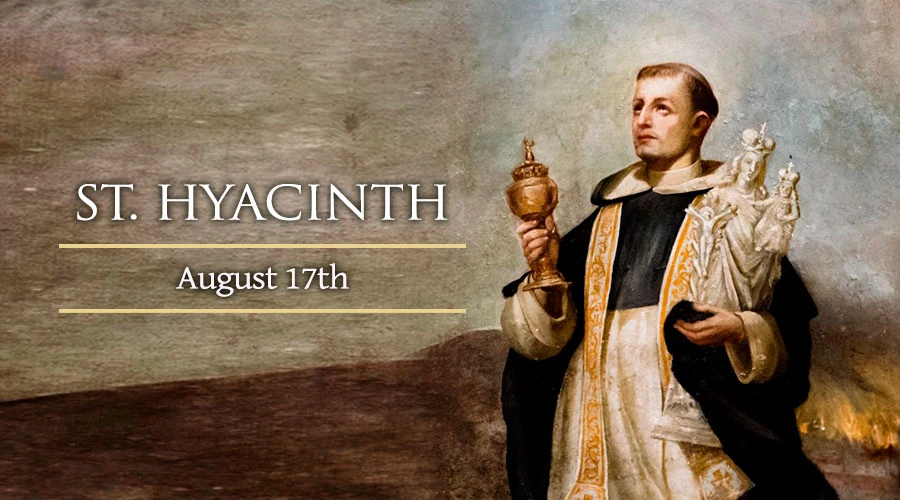
St. Hyacinth was one of the first members of the Dominicans (the Order of Preachers) and the "apostle of the North", and is also called the "Apostle of Poland."
Hyacinth was born into nobility in 1185 at the castle of Lanka, at Kamin, in Silesia, Poland, and received an impressive education, becoming a Doctor of Law and Divinity before traveling to Rome with his uncle, Ivo Konski, the Bishop of Krakow.
In Rome he met St. Dominic and decided to join the Order of Preachers immediately, receiving his habit from Dominic himself in 1220.
After his novitiate he made his religious profession, and was made superior of the little band of missionaries sent to Poland to preach. In Poland the new preachers were well received and their sermons produced a deep conversion in the people.
Hyacinth also founded communities in Sandomir, Kracow, and at Plocko on the Vistula in Moravia. He extended his missionary work through Prussia, Pomerania, and Lithuania. Then, crossing the Baltic Sea, he preached in Denmark, Sweden, Norway, and Russia, reaching the shores of the Black Sea.
On his return to Krakow he died, on August 15, 1257.
Some of his relics can be found at the Dominican church in Paris.
St. Hyacinth is a patron of Poland.
catholicnewsagency.com
8
posted on
08/17/2025 2:38:54 PM PDT
by
annalex
(fear them not)
To: annalex
9
posted on
08/17/2025 2:41:08 PM PDT
by
annalex
(fear them not)
To: annalex
NAVARRE BIBLE COMMENTARY(RSV)
Ad Majorem Dei Gloriam (To the Greater Glory of God)
First Reading:
From: Jeremiah 38:4-6, 8-10
Jeremiah and the Cistern of Malchiah
---------------------------------------------
[4] Then the princes said to the king, “Let this man be put to death, for he is weakening the hands of the soldiers who are left in this city, and the hands of all the people, by speaking such words to them. For this man is not seeking the welfare of this people, but their harm.” [5] King Zedekiah said, “Behold, he is in your hands; for the king can do nothing against you.” So they took Jeremiah and cast him into the cistern of Malchiah, the king’s son, which was in the court of the guard, letting Jeremiah down by ropes. And there was no water in the cistern, but only mire, and Jeremiah sank in the mire.
[8] Ebed-melech went from the king’s house and said to the king, [9] “My Lord the king, these men have done evil in all that they did to Jeremiah the prophet by casting him into the cistern; and he will die there of hunger, for there is no bread left in the city.” [1-] Then the king commanded Ebed-melech, the Ethiopian,”Take three men with you from here, and lift Jeremiah the prophet out of the cistern before he dies.”
**********************************************************************
Commentary:
38:1-28. Like the previous chapter, this one also contains an account concerning Jeremiah’s arrest (vv. 1-13) and a conversation that he had with the king (vv. 14-28). Jeremiah keeps on urging submission to Babylon and personal conversion; the princes, or nobles, will hear none of this. Wary, perhaps, about putting an envoy of God to death, they put him into a big water-tank, from which he is rescued by a court official, a foreigner. Having escaped in this way, the prophet manages to stay in the hall of the court guard without anyone observing him, it seems (v. 13). One ecclesiastical writer, Olympiodorus, interpreted Jeremiah’s imprisonment as a prefigurement of Jesus’ passion and death. Commenting on v. 6, he said: “The prophet becomes a figure of the mystery of Christ, who was handed over by Pilate to the Jews, descended into hell, and was raised from the dead. Jeremiah climbs out of the cistern he was cast into; Scripture often refers to hell as a cistern” (“Fragmenta in Jeremiam”, 38, 6).
In his conversation with the king, Jeremiah re-affirms his message (vv. 17-18); Zedekiah is afraid of what will happen if he surrenders (v. 19), but the prophet tells him he should trust in the Lord. If he fails to do so, his humiliation will be great; even the women will despise him (v. 22). Zedekiah will be stuck in the mire (v. 22) – and will suffer more than Jeremiah has suffered (v. 6).
Without saying why, the king asks the prophet not to reveal his prophecy (vv. 24-26); and so Jeremiah keeps quiet a about it when the princes interrogate him about his interview with the king (v. 27). The prophet’s response does not mean that he is deceiving them (they had no right to be party to Jeremiah’s conversation with the king) or that he fears them; we know that his courage was never in question.
These verses show how very different in attitude Zedekiah and Jeremiah were. Zedekiah used all his ingenuity and political skill to save himself and Judah from their enemies; but he lost both life and land. Jeremiah, however, preached the word of God without diluting it in any way – even though people clamoured for his death (v. 4); and when the Babylonians won the day, he was released from prison and survived (v. 28). It is very much what Jesus taught: “Whoever would save his life will lose it, and whoever loses his life for my sake will find it” (Mt 16:25).
Most of this passage forms a reading in the Divine Office for the 23rd Sunday in Ordinary Time, and the response to that reading is a call to serve the Lord, no matter what trials that involves. It links some words from Judith 8:23 (Vg) with others from St Paul to do with predicaments he encountered that were similar to the prophet’s: “as servants of God we commend ourselves in every way: through great endurance, in afflictions, hardships, calamities, beatings, imprisonments (2 Cor 6:4-5a).
10
posted on
08/17/2025 5:56:50 PM PDT
by
fidelis
(Ecce Crucem Domini! Fugite partes adversae! Vicit Leo de tribu Juda, Radix David! Alleluia!)
Second Reading:From: Hebrews 12:1-4
The Example of Christ
---------------------
[1] Therefore, since we are surrounded by so great a cloud of witnesses, let us also lay aside every weight, and sin which clings so closely, and let us run with perseverance the race that is set before us, [2] looking to Jesus the pioneer and perfecter of our faith, who for the joy that was set before him endured the cross, despising the shame, and is seated at the right hand of the throne of God.
[3] Consider him who endured from sinners such hostility against himself, so that you may not grow weary or faint-hearted. [4] In your struggle against sin you have not yet resisted to the point of shedding your blood.
***********************************************************************
Commentary:
1-3. After recalling the exemplary faith and fidelity of the righteous of the Old Testament, a moral lesson is now drawn: Christians should be no less faithful--particularly since they have as a model not only patriarchs, kings and prophets but also Christ Jesus himself, "the pioneer and perfecter of our faith", in other words, he is the perfect example of obedience, of faithfulness to his mission, of union with the Father, and of endurance in suffering.
Christ is depicted as the strong, generous athlete who runs a good race (cf. 1 Cor 9:24; 1 Tim 6:12; 2 Tim 2:6), who starts and finishes well, who does not flag and who wins the race. A Christian should live in the same way (cf. Gal 2:2; Phil 2:16; 5:7). It is as if we were listening again to what St Paul says in Philippians 2:5-9: "Have this mind among yourselves, which was in Christ Jesus." Christ's example helps us to overcome contempt and it reminds us that we should not be surprised to meet up with humiliation and hostility rather than success and rejoicing (cf. Mt 10:24; Lk 6:40). "Cross, toil, anguish: such will be your lot as long as you live. That was the way Christ went, and the disciple is not above his Master" (St J. Escriva, "The Way", 699).
1. This verse contains three remarkable expressions which stress the need to be faithful in spite of difficulties. The first is the "cloud of witnesses", a reference to the multitude of holy people in the course of the history of Israel who stayed faithful to God (cf. 11:2, 4, 5, 39); they are a cloud, a huge number filling the sky. In classical literature one often finds an army advancing in battle array being compared with a storm forming in the sky. Also, the image of the cloud suggests that these witnesses are high up, near the sun, a sign of their spiritual stature.
They are "witnesses", that is, active spectators of the combat in which Christians are involved. This evokes the idea of spectators at the Games who follow the events from the stands, applauding, shouting and gesticulating. "Sin which clings so closely": one interpretation of the original is "sin which watches us closely, like an enemy, to see where he can attack us". It is the same kind of idea as occurs in 1 Pet 5:8, where it says that the devil prowls around like a roaring lion seeking whom he may devour, and as in Gen 4:7 where God describes sin as couching at the door (like a hungry wild animal ready to pounce). The verb used to describe sin indicates it is something which surrounds one on all sides (cf. RSV) and can easily get a foothold and is persistent. "We may have here an allusion to occasions of sin, to the fact that sin is present all around us, that is, in the world, in the flesh, in our neighbor and in the devil" (St Thomas, "Commentary on Heb.", ad loc.). Sin is also a "weight" which hinders our movements and reduces our agility; there may also be a reference here to being overweight. The athlete needs to shed any surplus weight and keep to a strict training schedule involving many small renunciations (cf. 1 Cor 9:25). His only hope of success in the Games depends on this.
Finally, Christians are invited to "run with perseverance". Theirs is not a short race but a long test which calls for endurance and an ability to cope with pain and fatigue. "Just as in a race and in combat we need to shed everything that cramps our movements, the same happens in the struggle of tribulation. 'I have fought the good fight, I have finished the race,' St Paul says (2 Tim 4:7). So, he who wants to run well towards God in the midst of tribulation should shed all useless weight. The Apostle describes this encumbrance as 'weight, and sin which clings so closely'. This weight is the sins we have committed, which pull the soul downwards and incline it to sin again" ("Commentary on Heb, ad loc.").
Essentially, the verse emphasizes the need for detachment if one is to win in the struggle of life: "Anything that does not lead to God is a hindrance. Root it out and throw it far from you" (St J. Escriva, "The Way", 189).
2. The Christian should fix his gaze on Jesus, in the same way as a runner, once the race has begun, lets nothing distract him from his determination to reach his goal.
"If you want to be saved," St Thomas writes, "look at the face of your Christ. He is the pioneer of our faith, in two senses. He teaches it through his preaching and he also impresses it on our heart. In two senses also is he the perfecter of our faith: he consigns faith by his miracles and it is he who gives faith its reward" ("Commentary on Heb, ad loc.").
Christ is the "pioneer" of our faith in the sense that he has marked out the path Christians should take. He is the captain and guide of all the faithful, the champion who takes the lead and opens the way, setting the pace. The reference evokes what Hebrews 6:20 says about Jesus being our "forerunner".
Christ is the "pioneer" of our faith, the cause of our faith; it is he that we first believe in and, as author of grace, it is he who infuses this virtue into our souls. The title of "pioneer", initiator, may also indicate that Christ is for the Christian--and for the universe--beginning and end, alpha and omega (cf. Rev 1:17; 2:8; 22:13). In the same line, Jesus is also the "perfecter" of our faith, for it is he who will lead us to perfection in faith and will transform it into the perfection of glory. He will crown his work in us (cf. St Augustine, "Letter 194", 5), for if we believe it is because he has moved us to faith, and if we are glorified it will be because he has helped us to stay true to the end.
Everything Christ did in his life is a perfect example for us to follow particularly the way he underwent his passion. "In the passion of Christ there are three things to consider: in the first place what he gave up, then what he suffered, and thirdly what he merited. As far as the first is concerned, (Hebrews) speaks of his leaving 'the joy that was set before him', that is, joy or happiness here on earth, as when the crowd sought him out to make him king and he fled to the mountain despising that honor [...]. Then describing the happiness of eternal life as his reward, he 'endured the cross': that is the second thing, namely, that he suffered the cross. 'He humbled himself and became obedient unto death, even death on a cross' (Phil 2:8). In this the terrible severity of his suffering is manifested, for he was nailed to the cross by his hands and feet, and the opprobrium of this death, for it was an ignominious death [...]. The third thing, that is, what he merited, is being seated at the right hand of the Father. Thus, the exaltation of Christ's human nature was the reward for his passion" ("Commentary on Heb, ad loc.").
Christ is the pioneer of our faith by his death on the Cross, and its perfecter by his glorification. Only those who share in Christ's sufferings will be raised up like him in glory (cf. Rom 6:8). The Christian life begins in Christ and finds its climax in him.
To bring about our redemption any form of suffering would have sufficed; but such was our Lord's love for us that he accepted the ignominy of death on a cross.
"By now they have fastened Jesus to the wooden cross. The executioners have ruthlessly carried out the sentence. Our Lord, with infinite meekness, has let them have their way.
"It was not necessary for him to undergo so much torment. He could have avoided those trials, those humiliations, that ill-usage, that iniquitous judgment, and the shame of the gallows, and the nails and the lance.... But he wanted to suffer all this for you and for me. And we, are we not going to respond?
"Very likely there will be times, when alone in front of a crucifix, you find tears coming to your eyes. Don't try to hold them back.... But try to ensure that those tears give rise to a resolution" ([St] J. Escriva, "The Way of the Cross", XI, 1).
3. "What does Christ teach you from the height of the Cross, from which he chose not to come down, but that you should arm yourself with valor against those who revile you, and be strong with the strength of God?" (St Augustine, "Enarrationes in Psalmos", 70, 1). The difficulties Jesus had to contend with were quite exceptional: Jews and Gentiles opposed him; he suffered every kind of humiliation, to the extreme of his passion and death; but what pained him most was the hardheartedness, spiritual blindness and impenitence of those who had come to save. The "sinners" who proved "hostile" to Jesus are not only Caiaphas, Herod, Pilate, etc. but also those who continue to sin despite his redemptive sacrifice. Yet our Lord bore all this patiently and exhibited to a supreme degree the virtues and qualities he asks of his disciples.
In Christ, and in Christians, weakness becomes strength, humiliation and glory. "(Jesus) dies nailed to the Cross. But if at the same time in this weakness there is accomplished his "lifting up", confirmed by the power of the Resurrection, then this means that the weaknesses of all human sufferings are capable of being infused with the same power of God manifested in Christ's Cross" (St Pope John Paul II, "Salvifici Doloris", 23).
The sacred text seeks to inspire the faithful with hope and strength by suggesting that they contemplate Christ's sufferings. That in fact has led many Christians to turn over a new leaf. St Teresa of Avila describes how it changed her: "By this time my soul was growing weary, and, though it desired to rest, the miserable habits which now enslaved it would not allow it to do so. It happened that, entering the oratory one day, I saw an image which had been procured for a certain festival that was observed in the house and had been taken there to be kept for that purpose. It represented Christ sorely wounded; and so conducive was it to devotion that when I looked at it I was deeply moved to see him thus, so well did it picture what he suffered for us. So great was my distress when I thought how ill I had repaid him for those wounds that I felt as if my heart were breaking, and I threw myself down beside him, shedding floods of tears and begging him to give me strength once for all so that I might not offend him" ("Life", IX, 1).
4-13. Following Christ's example, Christians should struggle to avoid sin; they should put up with tribulation and persecution because if such adversity arises it means that the Lord permits it for our good. The letter's tone of encouragement seems to change here to one of reproach. It is as if the writer were saying, "Christ gave his life for your sins, contending even to the point of dying for you; how is it that you do not put up with suffering, out of love for him? It is true that you are being persecuted: God is disciplining you as a Father disciplines his children. But you are children of God and therefore your attitude should be one of abandonment to his will even when it seems hard. That is the way a Father brings up his children."
The main point is that the only important thing is fidelity to God, and that the sin of apostasy is the greatest of all misfortunes. "Don't forget, my son, that for you on earth there is but one evil, which you must fear and avoid with the grace of God: sin" (St J. Escriva, "The Way", 386).
11
posted on
08/17/2025 5:57:11 PM PDT
by
fidelis
(Ecce Crucem Domini! Fugite partes adversae! Vicit Leo de tribu Juda, Radix David! Alleluia!)
Gospel Reading:From: Luke 12:49-53
Jesus the Cause of Dissension
-----------------------------
(Jesus said to His disciples,) [49] "I came to cast fire upon the earth; and would that it were already kindled! [50] I have a baptism to be baptized with; and how I am constrained until it is accomplished! [51] Do you think that I have come to give peace on earth? No, I tell you, but rather division; [52] for henceforth in one house there will be five divided, three against two and two against three; [53] they will be divided, father against son and son against father, mother against daughter and daughter against her mother, mother-in-law against daughter-in-law and daughter-in-law against her mother-in-law."
***********************************************************************
Commentary:
49-50. In the Bible, fire is often used to describe God's burning love for men. This divine love finds its highest expression in the Son of God become man: "God so loved the world that He gave His only Son" (John 3:16). Jesus voluntarily gave up His life out of love for us, and "greater love has no man than this, that a man lays down his life for his friends" (John 15:13).
In these words reported by St. Luke, Jesus Christ reveals His abounding desire to give His life for love of us. He calls His death a baptism, because from it He will arise victorious never to die again. Our Baptism is a submersion in Christ's death, in which we die to sin and are reborn to the new life of grace: "We were buried therefore with Him by baptism into death, so that as Christ was raised from the dead by the glory of the Father, we too might walk in newness of life" (Romans 6:4).
Through this new life, we Christians should become set on fire in the same way as Jesus set His disciples on fire: "With the amazing naturalness of the things of God, the contemplative soul is filled with apostolic zeal. `My heart became hot within me, a fire blazed forth from my thoughts' (Psalm 38:4). What could this fire be if not the fire that Christ talks about: `I came to cast fire upon the earth, and would that it were already kindled' (Luke 12:49). An apostolic fire that acquires its strength in prayer: there is no better way than this to carry on, throughout the whole world, the battle of peace to which every Christian is called to fill up what is lacking in the sufferings of Christ (cf. Colossians 1:24)" ([St] J. Escriva, "Christ Is Passing By", 120).
51-53. God has come into the world with a message of peace (cf. Luke 2:14) and reconciliation (cf. Romans 5:11). By resisting, through sin, the redeeming work of Christ, we become His opponents. Injustice and error lead to division and war. "Insofar as men are sinners, the threat of war hangs over them and will so continue until the coming of Christ; but insofar as they can vanquish sin by coming together in charity, violence itself will be vanquished" (Vatican II, "Gaudium Et Spes", 78).
During His own life on earth, Christ was a sign of contradiction (cf. Luke 2:34). Our Lord is forewarning His disciples about the contention and division which will accompany the spread of the Gospel (cf. Luke 6:20-23; Matthew 10:24).
12
posted on
08/17/2025 5:57:47 PM PDT
by
fidelis
(Ecce Crucem Domini! Fugite partes adversae! Vicit Leo de tribu Juda, Radix David! Alleluia!)
13
posted on
08/17/2025 6:02:04 PM PDT
by
fidelis
(Ecce Crucem Domini! Fugite partes adversae! Vicit Leo de tribu Juda, Radix David! Alleluia!)
14
posted on
08/17/2025 6:06:07 PM PDT
by
fidelis
(Ecce Crucem Domini! Fugite partes adversae! Vicit Leo de tribu Juda, Radix David! Alleluia!)
Disclaimer:
Opinions posted on Free Republic are those of the individual
posters and do not necessarily represent the opinion of Free Republic or its
management. All materials posted herein are protected by copyright law and the
exemption for fair use of copyrighted works.
FreeRepublic.com is powered by software copyright 2000-2008 John Robinson


