Skip to comments.
Catholic Caucus: Daily Mass Readings 4-August-2025
Universalis/Jerusalem Bible ^
Posted on 08/04/2025 4:59:21 PM PDT by annalex
4 August 2025
Saint John Mary Vianney, Priest
on Monday of week 18 in Ordinary Time

St. John Vianney Catholic Church, Houston, TX BReadings at MassLiturgical Colour: White. Year: C(I). Readings for the feria Readings for the memorial These are the readings for the feria
| First reading | Numbers 11:4-15 |
|---|
The sons of Israel complain in the desertThe sons of Israel began to wail, ‘Who will give us meat to eat?’ they said. ‘Think of the fish we used to eat free in Egypt, the cucumbers, melons, leeks, onions and garlic! Here we are wasting away, stripped of everything; there is nothing but manna for us to look at!’ The manna was like coriander seed, and had the appearance of bdellium. The people went round gathering it, and ground it in a mill or crushed it with a pestle; it was then cooked in a pot and made into pancakes. It tasted like cake made with oil. When the dew fell on the camp at night-time, the manna fell with it. Moses heard the people wailing, every family at the door of its tent. The anger of the Lord flared out, and Moses greatly worried over this. And he spoke to the Lord: ‘Why do you treat your servant so badly? Why have I not found favour with you, so that you load on me the weight of all this nation? Was it I who conceived all this people, was it I who gave them birth, that you should say to me, “Carry them in your bosom, like a nurse with a baby at the breast, to the land that I swore to give their fathers”? Where am I to find meat to give to all this people, when they come worrying me so tearfully and say, “Give us meat to eat”? I am not able to carry this nation by myself alone; the weight is too much for me. If this is how you want to deal with me, I would rather you killed me! If only I had found favour in your eyes, and not lived to see such misery as this!’
| Responsorial Psalm |
|---|
| Psalm 80(81):12-17 |
|---|
Ring out your joy to God our strength. My people did not heed my voice and Israel would not obey, so I left them in their stubbornness of heart to follow their own designs. Ring out your joy to God our strength. O that my people would heed me, that Israel would walk in my ways! At once I would subdue their foes, turn my hand against their enemies. Ring out your joy to God our strength. The Lord’s enemies would cringe at their feet and their subjection would last for ever. But Israel I would feed with finest wheat and fill them with honey from the rock. Ring out your joy to God our strength.
Alleluia, alleluia! I am the Way, the Truth and the Life, says the Lord; No one can come to the Father except through me. Alleluia! Alleluia, alleluia! Man does not live on bread alone, but on every word that comes from the mouth of God. Alleluia!
The feeding of the five thousandWhen Jesus received the news of John the Baptist’s death he withdrew by boat to a lonely place where they could be by themselves. But the people heard of this and, leaving the towns, went after him on foot. So as he stepped ashore he saw a large crowd; and he took pity on them and healed their sick. When evening came, the disciples went to him and said, ‘This is a lonely place, and the time has slipped by; so send the people away, and they can go to the villages to buy themselves some food.’ Jesus replied, ‘There is no need for them to go: give them something to eat yourselves.’ But they answered ‘All we have with us is five loaves and two fish.’ ‘Bring them here to me’ he said. He gave orders that the people were to sit down on the grass; then he took the five loaves and the two fish, raised his eyes to heaven and said the blessing. And breaking the loaves handed them to his disciples who gave them to the crowds. They all ate as much as they wanted, and they collected the scraps remaining; twelve baskets full. Those who ate numbered about five thousand men, to say nothing of women and children. Continue These are the readings for the memorial
| First reading | Ezekiel 3:17-21 |
|---|
Warn the wicked man, and you will liveThe word of the Lord was addressed to me as follows, ‘Son of man, I have appointed you as sentry to the House of Israel. Whenever you hear a word from me, warn them in my Name. If I say to a wicked man, “You are to die,” and you do not warn him; if you do not speak and warn him to renounce his evil ways and so live, then he shall die for his sin, but I will hold you responsible for his death. If, however, you do warn a wicked man and he does not renounce his wickedness and his evil ways, then he shall die for his sin, but you yourself will have saved your life. When the upright man renounces his integrity to do evil and I set a trap for him, he too shall die; since you failed to warn him, he shall die for his sin and the integrity he practised will no longer be remembered; but I will hold you responsible for his death. If, however, you warn the upright man not to sin and he abstains from sinning, he shall live, thanks to your warning, and you too will have saved your life.’
| Responsorial Psalm |
|---|
| Psalm 116(117):1-2 |
|---|
Go out to the whole world; proclaim the Good News. or Alleluia! O praise the Lord, all you nations, acclaim him all you peoples! Go out to the whole world; proclaim the Good News. or Alleluia! Strong is his love for us; he is faithful for ever. Go out to the whole world; proclaim the Good News. or Alleluia!
Alleluia, alleluia! The Lord has sent me to bring the good news to the poor, to proclaim liberty to captives. Alleluia!
The harvest is rich but the labourers are fewJesus made a tour through all the towns and villages, teaching in their synagogues, proclaiming the Good News of the kingdom and curing all kinds of diseases and sickness. And when he saw the crowds he felt sorry for them because they were harassed and dejected, like sheep without a shepherd. Then he said to his disciples, ‘The harvest is rich but the labourers are few, so ask the Lord of the harvest to send labourers to his harvest.’ He summoned his twelve disciples, and gave them authority over unclean spirits with power to cast them out and to cure all kinds of diseases and sickness. Continue Christian Art Each day, The Christian Art website gives a picture and reflection on the Gospel of the day. The readings on this page are from the Jerusalem Bible, which is used at Mass in most of the English-speaking world. The New American Bible readings, which are used at Mass in the United States, are available in the Universalis apps, programs and downloads.
You can also view this page with the Gospel in Greek and English. |
TOPICS: Catholic; General Discusssion; Prayer; Worship
KEYWORDS: catholic; mt14; mt9; ordinarytime; prayer
For your reading, reflection, faith-sharing, comments, questions, discussion.
1
posted on
08/04/2025 4:59:21 PM PDT
by
annalex
To: All
KEYWORDS: catholic; mt14; mt9; ordinarytime; prayer
2
posted on
08/04/2025 5:00:21 PM PDT
by
annalex
(fear them not)
To: nickcarraway; NYer; ELS; Pyro7480; livius; ArrogantBustard; Catholicguy; RobbyS; marshmallow; ...

Alleluia Ping Please FReepmail me to get on/off the Alleluia Ping List.
3
posted on
08/04/2025 5:01:05 PM PDT
by
annalex
(fear them not)
To: annalex
| Matthew |
| | English: Douay-Rheims | Latin: Vulgata Clementina | Greek NT: Byzantine/Majority Text (2000) |
| | Matthew 14
|
| 13. | Which when Jesus had heard, he retired from thence by boat, into a desert place apart, and the multitudes having heard of it, followed him on foot out of the cities. | Quod cum audisset Jesus, secessit inde in navicula, in locum desertum seorsum : et cum audissent turbæ, secutæ sunt eum pedestres de civitatibus. | και ακουσας ο ιησους ανεχωρησεν εκειθεν εν πλοιω εις ερημον τοπον κατ ιδιαν και ακουσαντες οι οχλοι ηκολουθησαν αυτω πεζη απο των πολεων |
| 14. | And he coming forth saw a great multitude, and had compassion on them, and healed their sick. | Et exiens vidit turbam multam, et misertus est eis, et curavit languidos eorum. | και εξελθων ο ιησους ειδεν πολυν οχλον και εσπλαγχνισθη επ αυτοις και εθεραπευσεν τους αρρωστους αυτων |
| 15. | And when it was evening, his disciples came to him, saying: This is a desert place, and the hour is now past: send away the multitudes, that going into the towns, they may buy themselves victuals. | Vespere autem facto, accesserunt ad eum discipuli ejus, dicentes : Desertus est locus, et hora jam præteriit : dimitte turbas, ut euntes in castella, emant sibi escas. | οψιας δε γενομενης προσηλθον αυτω οι μαθηται αυτου λεγοντες ερημος εστιν ο τοπος και η ωρα ηδη παρηλθεν απολυσον τους οχλους ινα απελθοντες εις τας κωμας αγορασωσιν εαυτοις βρωματα |
| 16. | But Jesus said to them, They have no need to go: give you them to eat. | Jesus autem dixit eis : Non habent necesse ire : date illis vos manducare. | ο δε ιησους ειπεν αυτοις ου χρειαν εχουσιν απελθειν δοτε αυτοις υμεις φαγειν |
| 17. | They answered him: We have not here, but five loaves, and two fishes. | Responderunt ei : Non habemus hic nisi quinque panes et duos pisces. | οι δε λεγουσιν αυτω ουκ εχομεν ωδε ει μη πεντε αρτους και δυο ιχθυας |
| 18. | He said to them: Bring them hither to me. | Qui ait eis : Afferte mihi illos huc. | ο δε ειπεν φερετε μοι αυτους ωδε |
| 19. | And when he had commanded the multitudes to sit down upon the grass, he took the five loaves and the two fishes, and looking up to heaven, he blessed, and brake, and gave the loaves to his disciples, and the disciples to the multitudes. | Et cum jussisset turbam discumbere super fœnum, acceptis quinque panibus et duobus piscibus, aspiciens in cælum benedixit, et fregit, et dedit discipulis panes, discipuli autem turbis. | και κελευσας τους οχλους ανακλιθηναι επι τους χορτους λαβων τους πεντε αρτους και τους δυο ιχθυας αναβλεψας εις τον ουρανον ευλογησεν και κλασας εδωκεν τοις μαθηταις τους αρτους οι δε μαθηται τοις οχλοις |
| 20. | And they did all eat, and were filled. And they took up what remained, twelve full baskets of fragments. | Et manducaverunt omnes, et saturati sunt. Et tulerunt reliquias, duodecim cophinos fragmentorum plenos. | και εφαγον παντες και εχορτασθησαν και ηραν το περισσευον των κλασματων δωδεκα κοφινους πληρεις |
| 21. | And the number of them that did eat, was five thousand men, besides women and children. | Manducantium autem fuit numerus quinque millia virorum, exceptis mulieribus et parvulis. | οι δε εσθιοντες ησαν ανδρες ωσει πεντακισχιλιοι χωρις γυναικων και παιδιων |
4
posted on
08/04/2025 5:02:02 PM PDT
by
annalex
(fear them not)
To: annalex

Catena Aurea by St. Thomas Aguinas
14:13–14
13. When Jesus heard of it, he departed thence by ship into a desert place apart: and when the people had heard thereof, they followed him on foot out of the cities.
14. And Jesus went forth, and saw a great multitude, and was moved with compassion toward them, and he healed their sick.
GLOSS. (ap. Anselm.) The Saviour having heard the death of His Baptist, retired into the desert; as it follows, which when Jesus had heard, he departed thence by ship into a desert place.
AUGUSTINE. (De Cons. Ev. ii. 45.) This the Evangelist relates to have been done immediately after the passion of John, therefore after this were those things done that were spoken of above, and moved Herod to say, This is John. For we must suppose those things to have been after his death which report carried to Herod, and which moved him to doubt who he could be concerning whom he heard such things; for himself had put John to death.
JEROME. He did not retire into the desert through fear of death, as some suppose, but in mercy to His enemies, that they might not add murder to murder; putting off His death till the day of His passion; on which day the lamb is to be slain as the sacrament, and the posts of them that believe to be sprinkled with the blood. Or, He retired to leave us an example to shun that rashness which leads men to surrender themselves voluntarily, because not all persevere with like constancy under torture with the which they offered themselves to it. For this reason He says in another place, When they shall persecute you in one city, flee ye to another. Whence the Evangelist says not ‘fled,’ but elegantly, departed thence, (or, ‘withdrew,’) shewing that He shunned rather than feared persecution. Or for another reason He might have withdrawn into a desert place on hearing of John’s death, namely, to prove the faith of the believers.
CHRYSOSTOM. Or; He did this because He desired to prolong the œconomy of His humanity, the time not being yet come for openly manifesting His deity; wherefore also He charged His disciples that they should tell no man that He was the Christ. But after His resurrection He would have this made manifest. Therefore although He knew of Himself what was done, yet before it was told Him He withdrew not, that He might shew the verity of His incarnation in all things; for He would that this should be assured not by sight only, but by His actions. And when He withdrew, He did not go into the city, but into the desert by ship that none might follow Him. Yet do not the multitudes leave Him even for this, but still follow after Him, not deterred by what had been done concerning John; whence it follows, And when the multitudes had heard thereof, they followed him on foot out of the cities.
JEROME. They followed on foot, not riding, or in carriages, but with the toil of their own legs, to shew the ardour of their mind.
CHRYSOSTOM. And they immediately reap the reward of this; for it follows, And he went out and saw a great multitude, and he had compassion upon them, and healed their sick. For though great was the affection of those who had left their cities, and sought Him carefully, yet the things that were done by Him surpassed the reward of any zeal. Therefore he assigns compassion as the cause of this healing. And it is great compassion to heal all, and not to require faith.
HILARY. Mystically; The Word of God, on the close of the Law, entered the ship, that is, the Church; and departed into the desert, that is, leaving to walk with Israel, He passes into breasts void of Divine knowledge. The multitude learning this, follows the Lord out of the city into the desert, going, that is, from the Synagogue to the Church. The Lord sees them, and has compassion upon them, and heals all sickness and infirmity, that is, He cleanses their obstructed minds, and unbelieving hearts for the understanding of the new preaching.
JEROME. It is to be observed moreover, that when the Lord came into the desert, great crowds followed Him; for before He went into the wilderness of the Gentiles, He was worshipped by only one people. They leave their cities, that is, their former conversation, and various dogmas. That Jesus went out, shews that the multitudes had the will to go, but not the strength to attain, therefore the Saviour departs out of His place and goes to meet them.
14:15–21
15. And when it was evening, his disciples came to him, saying, This is a desert place, and the time is now past; send the multitude away, that they may go into the villages, and buy themselves victuals.
16. But Jesus said unto them, They need not depart; give ye them to eat.
17. And they say unto him, We have here but five loaves, and two fishes.
18. He said, Bring them hither to me.
19. And he commanded the multitude to sit down on the grass, and took the five loaves, and the two fishes, and looking up to heaven, he blessed, and brake, and gave the loaves to his disciples, and the disciples to the multitude.
20. And they did all eat, and were filled: and they took up of the fragments that remained twelve baskets full.
21. And they that had eaten were about five thousand men, beside women and children.
CHRYSOSTOM. It is a proof of the faith of these multitudes that they endured hunger in waiting for the Lord even till evening; to which purpose it follows, And when it was evening, his disciples came unto him, saying, This is a desert place, and the time is now past. The Lord purposing to feed them waits to be asked, as always not stepping forward first to do miracles, but when called upon. None out of the crowd approached Him, both because they stood in great awe of Him, and because in their zeal of love they did not feel their hunger. But even the disciples do not come and say, Give them to eat; for the disciples were as yet in an imperfect condition; but they say, This is a desert place. So that what was proverbial among the Jews to express a miracle, as it is said, Can he spread a table in the wilderness? (Ps. 78:19.) this also He shews among his other works. For this cause also He leads them out into the desert, that the miracle might be clear of all suspicion, and that none might suppose that any thing was supplied towards the feast from any neighbouring town. But though the place be desert, yet is He there who feeds the world; and though the hour is, as they say, past, yet He who now commanded was not subjected to hours. And though the Lord had gone before His disciples in healing many sick, yet they were so imperfect that they could not judge what He would do concerning food for them, wherefore they add, Send the multitude away, that they may go into the towns, and buy themselves food. Observe the wisdom of the Master; He says not straightway to them, ‘I will give them to eat;’ for they would not easily have received this, but, Jesus said unto them, They need not depart, Give ye them to eat.
JEROME. Wherein He calls the Apostles to breaking of bread, that the greatness of the miracle might be more evident by their testimony that they had none.
AUGUSTINE. (De Cons. Ev. ii. 46.) It may perplex some how, if the Lord, according to the relation of John, asked Philip whence bread was to be found for them, that can be true which Matthew here relates, that the disciples first prayed the Lord to send the multitudes away, that they might buy food from the nearest towns. Suppose then that after these words the Lord looked upon the multitude and said what John relates, but Matthew and the others have omitted. And by such cases as this none ought to be perplexed, when one of the Evangelists relates what the rest have omitted.
CHRYSOSTOM. Yet not even by these words were the disciples set right, but speak yet to Him as to man; They answered unto Him, We have here but five loaves and two fishes. From this we learn the philosophy of the disciples, how far they despised food; they were twelve in number, yet they had but five loaves and two fishes; for things of the body were contemned by them, they were altogether possessed by spiritual things. But because the disciples were yet attracted to earth, the Lord begins to introduce the things that were of Himself; He saith unto them, Bring them hither to me. Wherefore does He not create out of nothing the bread to feed the multitude with? That He might put to silence the mouth of Marcion and Manichæus, who take away from God His creatures, (i. e. deny that God created the visible world.) and by His deeds might teach that all things that are seen are His works and creation, and that it is He that has given us the fruits of the earth, who said in the beginning, Let the earth bring forth the green herb; (Gen. 1:11.) for this is no less a deed than that. For of five loaves to make so many loaves, and fishes in like manner, is no less a thing than to bring fruits from the earth, reptiles and other living things from the waters; which shewed Him to be Lord both of land and sea. By the example of the disciples also we ought to be taught, that though we should have but little, we ought to give that to such as have need. For they when bid to bring their five loaves say not, Whence shall we satisfy our own hunger? but immediately obey; And He commanded the multitude to sit down on the grass, and took the five loaves and the two fishes, and looking up to heaven blessed them, and brake. Why did He look to heaven and bless? For it should be believed concerning Him that He is from the Father, and that He is equal with the Father. His equality He shews when He does all things with power. That He is from the Father He shews by referring to Him whatsoever He does, and calling upon Him on all occasions. To prove these two things therefore, He works His miracles at times with power, at other times with prayer. It should be considered also that in lesser things He looks to heaven, but in greater He does all with power. When He forgave sins, raised the dead, stilled the sea, opened the secrets of the heart, opened the eyes of him that was born blind, which were works only of God, He is not seen to pray; but when He multiplies the loaves, a work less than any of these, He looks up to heaven, that you may learn that even in little things He has no power but from His Father. And at the same time He teaches us not to touch our food, until we have returned thanks to Him who gives it us. For this reason also He looks up to heaven, because His disciples had examples of many other miracles, but none of this.
JEROME. While the Lord breaks there is a sowing of food; for had the loaves been whole and not broken into fragments, and thus divided into a manifold harvest, they could not have fed so great a multitude. The multitude receives the food from the Lord through the Apostles; as it follows, And he gave the loaves to his disciples, and the disciples to the multitude.
CHRYSOSTOM. In doing which He not only honoured them, but would that upon this miracle they should not be unbelieving, nor forget it when it was past, seeing their own hands had borne witness to it. Therefore also He suffers the multitudes first to feel the sense of hunger, and His disciples to come to Him, and to ask Him, and He took the loaves at their hands, that they might have many testimonies of that that was done, and many things to remind them of the miracle. From this that He gave them, nothing more than bread and fish, and that He set this equally before all, He taught them moderation, frugality, and that charity by which they should have all things in common. This He also taught them in the place, in making them sit down upon the grass; for He sought not to feed the body only, but to instruct the mind. But the bread and fish multiplied in the disciples’ hands; whence it follows, And they did all eat, and were filled. But the miracle ended not here; for He caused to abound not only whole loaves, but fragments also; to shew that the first loaves were not so much as what was left, and that they who were not present might learn what had been done, and that none might think that what had been done was a phantasy; And they took up fragments that were left, twelve baskets full.
JEROME. Each of the Apostles fills his basket of the fragments left by his Saviour, that these fragments might witness that they were true loaves that were multiplied.
CHRYSOSTOM. For this reason also He caused twelve baskets to remain over and above, that Judas might bear his basket. He took up the fragments, and gave them to the disciples and not to the multitudes, who were yet more imperfectly trained than the disciples.
JEROME. To the number of loaves, five, the number of the men that ate is apportioned, five thousand; And the number of them that had eaten was about five thousand men, besides women and children.
CHRYSOSTOM. This was to the very great credit of the people, that the women and the men stood up when these remnants still remained.
HILARY. The five loaves are not multiplied into more, but fragments succeed to fragments; the substance growing whether upon the tables, or in the hands that took them up, I know not.
RABANUS. When John is to describe this miracle, he first tells us that the passover is at hand; Matthew and Mark place it immediately after the execution of John. Hence we may gather, that he was beheaded when the paschal festival was near at hand, and that at the passover of the following year, the mystery of the Lord’s passion was accomplished.
JEROME. But all these things are full of mysteries; the Lord does these things not in the morning, nor at noon, but in the evening, when the Sun of righteousness was set.
REMIGIUS. By the evening the Lord’s death is denoted; and after He, the true Sun, was set on the altar of the cross, He filled the hungry. Or by evening is denoted the last age of this world, in which the Son of God came and refreshed the multitudes of those that believed on Him.
RABANUS. When the disciples ask the Lord to send away the multitudes that they might buy food in the towns, it signifies the pride of the Jews towards the multitudes of the Gentiles, whom they judged rather fit to seek for themselves food in the assemblies of the Pharisees than to use the pasture of the Divine books.
HILARY. But the Lord answered, They have no need to go, shewing that those whom He heals have no need of the food of mercenary doctrine, and have no necessity to return to Judæa to buy food; and He commands the Apostles that they give them food. Did He not know then that there was nothing to give them? But there was a complete series of types to be set forth; for as yet it was not given the Apostles to make and minister the heavenly bread, the food of eternal life; and their answer thus belongs to the chain of spiritual interpretation; they were as yet confined to the five loaves, that is, the five books of the Law, and the two fishes, that is, the preaching of the Prophets and of John.
RABANUS. Or, by the two fishes we may understand the Prophets, and the Psalms, for the whole of the Old Testament was comprehended in these three, the Law, the Prophets, and the Psalms.
HILARY. These therefore the Apostles first set forth, because they were yet in these things; and from these things the preaching of the Gospel grows to its more abundant strength and virtue. Then the people is commanded to sit down upon the grass, as no longer lying upon the ground, but resting upon the Law, each one reposing upon the fruit of his own works as upon the grass of the earth.
JEROME. Or, they are bid to lie down on the grass, and that, according to another Evangelist, by fifties and by hundreds, that after they have trampled upon their flesh, and have subjugated the pleasures of the world as dried grass under them, then by the presencea of the number fifty, they ascend to the eminent perfection of a hundred. He looks up to heaven to teach us that our eyes are to be directed thither. The Law with the Prophets is broken, and in the midst of them are brought forward mysteries., that whereas they partook not of it whole, when broken into pieces it may be food for the multitude of the Gentiles.
HILARY. Then the loaves are given to the Apostles, because through them the gifts of divine grace were to be rendered. And the number of them that did eat is found to be the same as that of those who should believe; for we find in the book of Acts that out of the vast number of the people of Israel, five thousand men believed.
JEROME. There partook five thousand who had reached maturity; for women and children, the weaker sex, and the tender age, were unworthy of number; thus in the book of Numbers, slaves, women, children, and an undistinguished crowd, are passed over unnumbered.
RABANUS. The multitude being hungry, He creates no new viands, but having taken what the disciples had, He gave thanks. In like manner when He came in the flesh, He preached no other things than what had been foretold, but shewed that the writings of the Law and the Prophets were big with mysteries. That which, the multitude leave is taken up by the disciples, because the more secret mysteries which cannot be comprehended by the uninstructed, are not to be treated with neglect, but are to be diligently sought out by the twelve Apostles (who are represented by the twelve baskets) and their successors. For by baskets servile offices are performed, and God has chosen the weak things of the world to confound the strong. The five thousand for the five senses of the body are they who in a secular condition know how to use rightly things without.
Catena Aurea Matthew 14
5
posted on
08/04/2025 5:02:35 PM PDT
by
annalex
(fear them not)
To: annalex

Multiplication of the Loaves and Fishes
Early XIVth century
Church of the Holy Savior
Chora, Constantinople
6
posted on
08/04/2025 5:03:00 PM PDT
by
annalex
(fear them not)
To: annalex
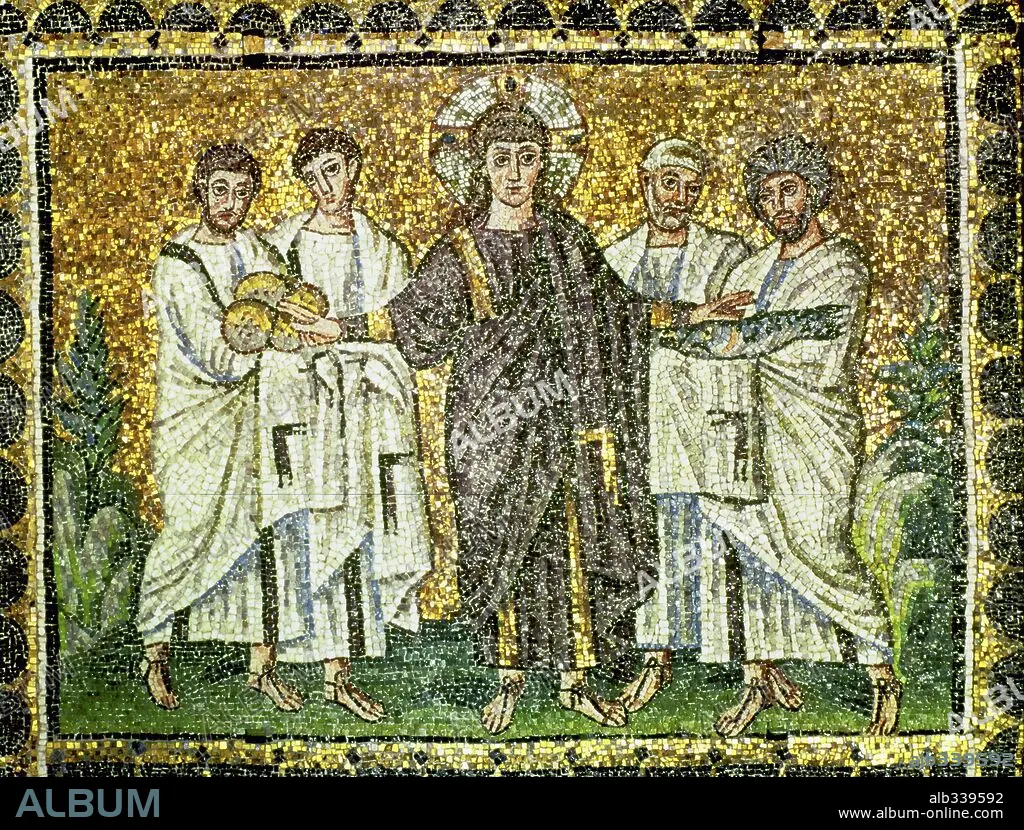
Saint Apollinare Nuovo Ravenna 6th century, AD
7
posted on
08/04/2025 5:05:28 PM PDT
by
annalex
(fear them not)
To: annalex
| Matthew |
| | English: Douay-Rheims | Latin: Vulgata Clementina | Greek NT: Byzantine/Majority Text (2000) |
| | Matthew 9
|
| 35. | And Jesus went about all the cities, and towns, teaching in their synagogues, and preaching the gospel of the kingdom, and healing every disease, and every infirmity. | Et circuibat Jesus omnes civitates, et castella, docens in synagogis eorum, et prædicans Evangelium regni, et curans omnem languorem, et omnem infirmitatem. | και περιηγεν ο ιησους τας πολεις πασας και τας κωμας διδασκων εν ταις συναγωγαις αυτων και κηρυσσων το ευαγγελιον της βασιλειας και θεραπευων πασαν νοσον και πασαν μαλακιαν εν τω λαω |
| 36. | And seeing the multitudes, he had compassion on them: because they were distressed, and lying like sheep that have no shepherd. | Videns autem turbas, misertus est eis : quia erant vexati, et jacentes sicut oves non habentes pastorem. | ιδων δε τους οχλους εσπλαγχνισθη περι αυτων οτι ησαν εσκυλμενοι και ερριμμενοι ωσει προβατα μη εχοντα ποιμενα |
| 37. | Then he saith to his disciples, The harvest indeed is great, but the labourers are few. | Tunc dicit discipulis suis : Messis quidem multa, operarii autem pauci. | τοτε λεγει τοις μαθηταις αυτου ο μεν θερισμος πολυς οι δε εργαται ολιγοι |
| 38. | Pray ye therefore the Lord of the harvest, that he send forth labourers into his harvest. | Rogate ergo Dominum messis, ut mittat operarios in messem suam. | δεηθητε ουν του κυριου του θερισμου οπως εκβαλη εργατας εις τον θερισμον αυτου |
| | Matthew 10
|
| 1. | AND having called his twelve disciples together, he gave them power over unclean spirits, to cast them out, and to heal all manner of diseases, and all manner of infirmities. | Et convocatis duodecim discipulis suis, dedit illis potestatem spirituum immundorum, ut ejicerent eos, et curarent omnem languorem, et omnem infirmitatem. | και προσκαλεσαμενος τους δωδεκα μαθητας αυτου εδωκεν αυτοις εξουσιαν πνευματων ακαθαρτων ωστε εκβαλλειν αυτα και θεραπευειν πασαν νοσον και πασαν μαλακιαν |
8
posted on
08/04/2025 5:06:22 PM PDT
by
annalex
(fear them not)
To: annalex
Catena Aurea by St. Thomas Aguinas
9:32–35
32. As they went out, behold, they brought to him a dumb man possessed with a devil.
33. And when the devil was east out, the dumb spake: and the multitudes marvelled, saying, It was never so seen in Israel.
34. But the Pharisees said, He casteth out devils through the prince of the devils.
35. And Jesus went about all the cities and villages, teaching in their synagogues, and preaching the Gospel of the kingdom, and healing every sickness and every disease among the people.
REMIGIUS. Observe the beautiful order of His miracles; how after He had given sight to the blind, He restored speech to the dumb, and healed the possessed of the dæmon; by which He shews Himself the Lord of power, and the author of the heavenly medicine. For it was said by Isaiah, Then shall the eyes of the blind be opened, the ears of the deaf shall be unstopped, and the tongue of the dumb loosed. (Is. 35:6.) Whence it is said, When they were gone forth, they brought unto him a man dumb, and possessed with a dæmon.
JEROME. The Greek word here (κωφὸς) is more frequent in common speech in the sense of ‘deaf,’ but it is the manner of Scripture to use it indifferently as either.
CHRYSOSTOM. This was not a mere natural defect; but was from the malignity of the dæmon; and therefore he needed to be brought of others, for he could not ask any thing of others as living without voice, and the dæmon chaining his spirit together with his tongue. Therefore Christ does not require faith of him, but immediately healed his disorder; as it follows, And when the dæmon was cast out, the dumb spake.
HILARY. The natural order of things is here preserved; the dæmon is first cast out, and there the functions of the members proceed. And the multitude marvelled, saying, It was never so seen in Israel.
CHRYSOSTOM. They set Him thus above others, because He not only healed, but with such ease, and quickness; and cured diseases both infinite in number, and in quality incurable. This most grieved the Pharisees, that they set Him before all others, not only those that then lived, but all who had lived before, on which account it follows, But the Pharisees said, He casteth out dæmons through the Prince of dæmons.
REMIGIUS. Thus the Scribes and Pharisees denied such of the Lord’s miracles as they could deny; and such as they could not they explained by an evil interpretation, according to that, In the multitude of thy excellency thy enemies shall lie unto thee. (Ps. 66:3.)
CHRYSOSTOM. What can be more foolish than this speech of theirs? For it cannot be pretended that one dæmon would cast out another; for they are wont to consent to one another’s deeds, and not to be at variance among themselves. But Christ not only cast out dæmons, but healed the lepers, raised the dead, forgave sins, preached the kingdom of God, and brought men to the Father, which a dæmon neither could nor would do.
RABANUS. Figuratively; As in the two blind men were denoted both nations, Jews and Gentiles, so in the man dumb and afflicted with the dæmon is denoted the whole human race.
HILARY. Or; By the dumb and deaf, and dæmoniae, is signified the Gentile world, needing health in every part; for sunk in evil of every kind, they are afflicted with disease of every part of the body.
REMIGIUS. For the Gentiles were dumb; not being able to open their mouth in the confession of the true faith, and the praises of the Creator, or because in paying worship to dumb idols they were made like unto them. They were afflicted with a dæmon, because by dying in unbelief they were made subject to the power of the Devil.
HILARY. But by the knowledge of God the frenzy of superstition being chased away, the sight, the hearing, and the word of salvation is brought in to them.
JEROME. As the blind receive light, so the tongue of the dumb is loosed, that he may confess Him whom before he denied. The wonder of the multitude is the confession of the nations. The scoff of the Pharisees is the unbelief of the Jews, which is to this day.
HILARY. The wonder of the multitude is followed up by the confession, It was never so seen in Israel; because he, for whom there was no help under the Law, is saved by the power of the Word.
REMIGIUS. They who brought the dumb to be healed by the Lord, signify the Apostles and preachers, who brought the Gentile people to be saved before the face of divine mercy.
AUGUSTINE. (De Cons. Ev. ii. 29.) This account of the two blind men and the dumb dæmon is read in Matthew only. The two blind men of whom the others speak are not the same as these, though something similar was done with them. So that even if Matthew had not also recorded their cure, we might have seen that this present narrative was of a different transaction. And this we ought diligently to remember, that many actions of our Lord are very much like one another, but are proved not to be the same action, by being both related at different times by the same Evangelist. So that when we find cases in which one is recorded by one Evangelist, and another by another, and some difference which we cannot reconcile between their accounts, we should suppose that they are like, but not the same, events.
9:36–38
36. But when he saw the multitudes, he was moved with compassion on them, because they fainted, and were scattered abroad, as sheep having no shepherd.
37. Then saith he unto his disciples, The harvest truly is plenteous, but the labourers are few;
38. Pray ye therefore the Lord of the harvest, that he will send forth labourers into his harvest.
CHRYSOSTOM. The Lord would refute by actions the charge of the Pharisees, who said, He casteth out dæmons by the Prince of the dæmons; for a dæmon having suffered rebuke, does not return good but evil to those who have not shewn him honour. But the Lord on the other hand, when He has suffered blasphemy and contumely, not only does not punish, but does not utter a hard speech, yea He shews kindness to them that did it, as it here follows, And Jesus went about all their towns and villages. Herein He teaches us not to return accusations to them that accuse us, but kindness. For he that ceases to do good because of accusation, shews that his good has been done because of men. But if for God’s sake you do good to your fellow-servants, you will not cease from doing good whatever they do, that your reward may be greater.
JEROME. Observe how equally in villages, cities, and towns, that is to great as well as small, He preaches the Gospel, not respecting the might of the noble, but the salvation of those that believe. It follows, Teaching in their synagogues; this was His meat, going about to do the will of His Father, and saving by His teaching such as yet believed not.
GLOSS. (non occ.) He taught in their synagogues the Gospel of the Kingdom, as it follows, Preaching the Gospel of the Kingdom.
REMIGIUS. Understand, ‘of God;’ for though temporal blessings are also proclaimed, yet they are not called The Gospel. Hence the Law was not called a Gospel, because to such as kept it, it held out not heavenly, but earthly, goods.
JEROME. He first preached and taught, and then proceeded to heal sicknesses, that the works might convince those who would not believe the words. Hence it follows, Healing every sickness and every disease, for to Him alone nothing is impossible.
GLOSS. (ap. Anselm.) By disease we may understand complaints of long standing, by sickness any lesser infirmity.
REMIGIUS. It should be known that those whom He healed outwardly in their bodies, He also healed inwardly in their souls. Others cannot do this of their own power, but can by God’s grace.
CHRYSOSTOM. Nor does Christ’s goodness rest here, but He manifests His care for them, opening the bowels of His mercy towards them; whence it follows, And seeing the multitudes, he had compassion upon them.
REMIGIUS. Herein Christ shews in Himself the disposition of the good shepherd and not that of the hireling. Why He pitied them is added, Because they were troubled1, and sick1 as sheep that have no shepherd—troubled either by dæmons, or by divers sicknesses and infirmities.
GLOSS. (ap. Anselm.) Or, troubled by dæmons, and sick, that is, benumbed and unable to rise; and though they had shepherds, yet they were as though they had them not.
CHRYSOSTOM. This is an accusation against the rulers of the Jews, that being shepherds they appeared like wolves; not only not improving the multitude, but hindering their progress. For when the multitude marvelled and said, It was never so seen in Israel, these opposed themselves, saying, He casteth out dæmons by the prince of the dæmons. (vid. Ps. 102:19.)
REMIGIUS. But when the Son of God looked down from heaven upon the earth, to hear the groans of the captives, straight a great harvest began to ripen; for the multitude of the human race would never have come near to the faith, had not the Author of human salvation looked down from heaven; and it follows, Then said he unto his disciples, The harvest truly is great, but the labourers are few.
GLOSS. (ap. Anselm.) The harvest are those men who can be reaped by the preachers, and separated from the number of the damned, as grain is beaten out from the chaff that it may be laid up in granaries.
JEROME. The great harvest denotes the multitude of the people; the few labourers, the want of instructors.
REMIGIUS. For the number of the Apostles was small in comparison of so great crops to be reaped. The Lord exhorts His preachers, that is, the Apostles and their followers, that they should daily desire an increase of their number; Pray ye therefore the Lord of the harvest, that he would send forth labourers into his harvest.
CHRYSOSTOM. He privately insinuates Himself to be the Lord; for it is He Himself who is Lord of the harvest. For if He sent the Apostles to reap what they had not sown, it is manifest that He sent them not to reap the things of others, but what He had sown by the Prophets. But since the twelve Apostles are the labourers, He said, Pray ye the Lord of the harvest, that he would send labourers into his harvest; and notwithstanding He added none to their number, but rather He multiplied those twelve many times, not by increasing their numbers, but by giving them more abundant grace.
REMIGIUS. Or, He then increased their number when He chose the seventy and two, and then when many preachers were made what time the Holy Spirit descended upon the believers.
CHRYSOSTOM. He shews us that it is a great gift that one should have the power of rightly preaching, in that He tells them that they ought to pray for it. Also we are here reminded of the words of John concerning the threshing-floor, and the fan, the chaff, and the wheat.
HILARY. Figuratively; When salvation was given to the Gentiles, then all cities and towns were enlightened by the power and entrance of Christ, and escaped every former sickness and infirmity. The Lord pities the people troubled with the violence of the unclean Spirit, and sick under the burden of the Law, and having no shepherd at hand to bestow on them the guardianship of the Holy Spirit. But of that gift there was a most abundant fruit, whose plenty far exceeded the multitude of those that drank thereof; how many soever take of it, yet an inexhaustible supply remains; and because it is profitable that there should be many to minister it, He bids us ask the Lord of the harvest, that God would provide a supply of reapers for the ministration of that gift of the Holy Spirit which was made ready; for by prayer this gift is poured out upon us from God.
CHAP. 10
10:1–4
1. And when he had called unto him his twelve disciples, he gave them power against unclean spirits, to cast them out, and to heal all manner of sickness and all manner of disease.
2. Now the names of the twelve apostles are these; The first, Simon, who is called Peter, and Andrew his brother; James the son of Zebedee, and John his brother;
3. Philip, and Bartholomew; Thomas, and Matthew the Publican; James the son of Alphæus, and Lebbæus, whose surname was Thaddæus;
4. Simon the Canaanite, and Judas Iscariot, who also betrayed him.
GLOSS. (ord.) From the healing of Peter’s wife’s mother to this place there has been a continued succession of miracles; and they were done before the Sermon upon the Mount, as we know for certain from Matthew’s call, which is placed among them; for he was one of the twelve chosen to the Apostleship upon the mount. He here returns to the order of events, taking it up again at the healing of the centurion’s servant; saying, And calling to him his twelve disciples.
REMIGIUS. The Evangelist had related above that the Lord exhorted His disciples to pray the Lord of the harvest to send labourers into His vineyard; and He now seems to be fulfilling what He had exhorted them to. For the number twelve is a perfect number, being made up of the number six, which has perfection because it is formed of its own parts, one, two, three, multiplied into one another; and the number six when doubled amounts to twelve.
GLOSS. (vid. Greg. Hom. in Ev. xvii. 1.) And this doubling seems to have some reference to the two precepts of charity, or to the two Testaments.
BEDE. For the number twelve, which is made up of three into four, denotes that through the four quarters of the world they were to preach the faith of the holy Trinity.
RABANUS. (cf. Tertull. cont. Marc. iv. 13.) This number is typified by many things in the Old Testament; by the twelve sons of Jacob, by the twelve princes of the children of Israel, by the twelve running springs in Helim, by the twelve stones in Aaron’s breastplate, by the twelve loaves of the shew-bread, by the twelve spies sent by Moses, by the twelve stones of which the altar was made, by the twelve stones taken out of Jordan, by the twelve oxen which bare the brazen sea. Also in the New Testament, by the twelve stars in the bride’s crown, by the twelve foundations of Jerusalem which John saw, and her twelve gates.
CHRYSOSTOM. He makes them confident not only by calling their ministry a sending forth to the harvest, but by giving them strength for the ministry; whence it follows, He gave them power over all unclean spirits to cast them out, and to heal every sickness and every disease.
REMIGIUS. Wherein is openly shewed that the multitude were troubled not with one single kind of affliction, but with many, and this was His pity for the multitude, to give His disciples power to heal and cleanse them.
JEROME. A kind and merciful Lord and Master does not envy His servants and disciples a share in His powers. As Himself had cured every sickness and disease, He imparted the same power to His Apostles. But there is a wide difference between having and imparting, between giving and receiving. Whatever He does He does with the power of a master, whatever they do it is with confession of their own weakness, as they speak, In the name of Jesus rise and walk. (Acts 3:6.) A catalogue of the names of the Apostles is given, that all false Apostles might be excluded. The names of the twelve Apostles are these; First, Simon who is called Peter, and Andrew his brother. To arrange them in order according to their merit is His alone who searches the secrets of all hearts. But Simon is placed first, having the surname of Peter given to distinguish him from the other Simon surnamed Chananæus, from the village of Chana in Galilee where the Lord turned the water into wine.
RABANUS. (e Beda.) The Greek or Latin ‘Petrus’ is the same as the Syriac Cephas, in both tongues the word is derived from a rock; undoubtedly that of which Paul speaks, And that rock was Christ. (1 Cor. 10:4.)
REMIGIUS. (ap. Raban.) There have been some who in this name Peter, which is Greek and Latin, have sought a Hebrew interpretation, and would have it to signify, ‘Taking off the shoe,’ ‘or unloosing,’ or ‘acknowledging.’ But those that say this are contradicted by two facts. First, that the Hebrew has no letter P, but uses PH instead. Thus Pilate they call Philate. Secondly, that one of the Evangelists has used the word as an interpretation of Cephas; The Lord said, Thou shalt be called Cephas, (John 1:42.) on which the Evangelist adds, which being interpreted is Petrus. Simon is interpreted ‘obedient,’ for he obeyed the words of Andrew, and with him came to Christ, or because he obeyed the divine commands, and at one word of bidding followed the Lord. Or as some will have it, it is to be interpreted, ‘Laying aside grief,’ and, ‘hearing painful things;’ for that on the Lord’s resurrection he laid aside the grief he had for His death; and he heard sorrowful things when the Lord said to him, Another shall gird thee, and shall carry thee whither thou wouldest not. (John 21:18.)
And Andrew his brother.
CHRYSOSTOM. This is no small honour (done to Peter), He places Peter from his merit, Andrew from the nobility he had in being the brother of Peter. Mark names Andrew next after the two heads, namely, Peter and John; but this one not so; for Mark has arranged them in order of dignity.
REMIGIUS. Andrew is interpreted ‘manly;’ for as in Latin ‘virilis’ is derived from ‘vir,’ so in Greek Andrew is derived from ἀνὴρ. Rightly is he called manly, who left all and followed Christ, and manfully persevered in His commands.
JEROME. The Evangelist couples the names throughout in pairs. So he puts together Peter and Andrew, brothers not so much according to the flesh as in spirit; James and John who left their father after the flesh to follow their true Father; James the son of Zebedee and John his brother. He calls him the son of Zebedee, to distinguish him from the other James the son of Alphæus.
CHRYSOSTOM. Observe that he does not place them according to their dignity; for to me John would seem to be greater not than others only, but even than his brother.
REMIGIUS. (e Beda.) James is interpreted ‘The supplanter,’ or ‘that supplanteth;’ for he not only supplanted the vices of the flesh, but even contemned the same flesh when Herod put him to death. John is interpreted ‘The grace of God,’ because he deserved before all to be loved by the Lord; whence also in the favour of His especial love, he leaned at supper in the Lord’s bosom.
Philip and Bartholomew. (e Beda.) Philip is interpreted, ‘The mouth of a lamp,’ or ‘of lamps,’ because when he had been enlightened by the Lord, he straightway sought to communicate the light to his brother by the means of his mouth. Bartholomew is a Syriac, not a Hebrew, name, and is interpreted ‘The son of him that raiseth watera,’ that is, of Christ, who raises the hearts of His preachers from earthly to heavenly things, and hangs them there, that the more they penetrate heavenly things, the more they should steep and inebriate the hearts of their hearers with the droppings of holy preaching.
Thomas, and Matthew the Publican.
JEROME. The other Evangelists in this pair of names put Matthew before Thomas; and do not add, the Publican, that they should not seem to throw scorn upon the Evangelist by bringing to mind his former life. But writing of himself he both puts Thomas first in the pair, and styles himself the Publican; because, where sin hath abounded, there grace shall much more abound. (Rom. 5:20.)
REMIGIUS. (e Beda.) Thomas is interpreted ‘an abyss,’ or ‘a twin,’ which in Greek is Didymus. Rightly is Didymus interpreted an abyss, for the longer he doubted the more deeply did he believe the effect of the Lord’s passion, and the mystery of His Divinity, which forced him to cry, My Lord and my God. (John 20:28.) Matthew is interpreted ‘given,’ because by the Lord’s bounty he was made an Evangelist of a Publican.
James the son of Alphæus, and Thaddæus.
RABANUS. (e Beda.) This James is he who in the Gospels, and also in the Epistle to the Galatians, is called the Lord’s brother. For Mary the wife of Alphæus was the sister of Mary the mother of the Lord; John the Evangelist calls her Mary the wife of Cleophas, probably because Cleophas and Alphæus were the same person. Or Mary herself on the death of Alphæus after the birth of James married Cleophas.
REMIGIUS. It is well said, the son of Alphæus, that is, ‘of the just,’ or ‘the learned;’ for he not only overthrew the vices of the flesh, but also despised all care of the same. And of what he was worthy the Apostles are witness, who ordained him Bishop of the Church of Jerusalemb. And ecclesiastical history (Hegesippus. ap. Euseb. ii. 23.) among other things tells of him, that he never ate flesh, drunk neither wine nor strong drink, abstained from the bath and linen garments, and night and day prayed on his bended knees. And so great was his merit, that he was called by all men, ‘The just.’ Thaddæus is the same whom Luke calls Jude of James, (that is, the brother of James,) whose Epistle is read in the Church, in which he calls himself the brother of James.
AUGUSTINE. (De Cons. Ev. ii. 30.) Some copies have Lebbæus; but whoever prevented the same man from having two, or even three different names?
REMIGIUS. Jude is interpreted ‘having confessed,’ because he confessed the Son of God.
RABANUS. Thaddæus or Lebbæus is interpreted ‘a little heart,’ that is, a heart-worshipper.
Simon Chananæus, and Judas Scarioth, who also betrayed him.
JEROME. Simon Chananæus is the same who in the other Evangelist is called Zelotes. Chana signifies ‘Zeal.’ Judas is named Scarioth, either from the town in which he was born, or from the tribe of Issachar, a prophetic omen of his sin; for Issachar means ‘a booty,’ thus signifying the reward of the betrayer.
REMIGIUS. Scarioth is interpreted ‘The memory of the Lord,’ because he followed the Lord; or ‘The memorial of death,’ because he plotted in his heart how he might betray the Lord to death; or ‘strangling,’ because he went and hanged himself. It should be known that there are two disciples of this name, who are types of all Christians; Jude the brother of James, of such as persevere in the confession of the faith; Jude Scarioth of such as leave the faith; and turn back again.
GLOSS. (non occ.) They are named two and two to express their union as yoke-fellows.
AUGUSTINE. (De Civ. Dei, xviii. 49.) These therefore He chose for His disciples, whom also He named Apostles, humbly born without honour, without learning, that whatever they should do that was great, it was He that should be in them and should do it. He had among them one that was evil, whom He should use in the accomplishment of His Passion, and who should be an example to His Church of suffering evil men.
AMBROSE. (in Luc. 6.) He was not chosen among the Apostles unwittingly; for that truth is great, which cannot be harmed even by having an adversary in one of its own ministers.
RABANUS. Also He willed to be betrayed by a disciple, that you when betrayed by your intimate might bear patiently that your judgment has erred, that your favours have been thrown away.
Catena Aurea Matthew 9
Catena Aurea Matthew 10
9
posted on
08/04/2025 5:07:00 PM PDT
by
annalex
(fear them not)
To: annalex

The Harrowing of Hell
St Albans Psalter
12th century
10
posted on
08/04/2025 5:07:48 PM PDT
by
annalex
(fear them not)
To: annalex
Saint of the Day for August 4
(May 8, 1786 – August 4, 1859)
Saint John Vianney (Saint Jean Vianney), also known as the Curé d’Ars, is considered the patron saint of parish priests. He is known for his deep devotion to the Church and his dedication to the sacrament of confession. His life inspires all priests, as he exemplified a genuinely holy priest through his humility, selflessness, and unwavering faith.
Early Life and Calling to Priesthood
St John Vianney, also known as the Cure of Ars, was born on May 8, 1786, in the small village of Dardilly, near Lyon, France. His childhood coincided with significant political and social upheaval in France as the French Revolution unfolded. This era was marked by widespread conflict and change, impacting many aspects of society, including the Catholic Church. Despite these tumultuous conditions, John Vianney’s family remained firmly rooted in their faith. His parents were devout Catholics and instilled in him a strong and unwavering commitment to his religion from an early age. This foundation would later guide him in his vocation and shape his path toward the priesthood, ultimately leading him to become a beloved figure in the Church.
The Challenges of Becoming a Priest
A man with vision overcomes obstacles and performs deeds that seem impossible. Saint Vianney was a man with a vision: He wanted to become a priest. But he had to overcome his meager formal schooling, which inadequately prepared him for seminary studies. He also had to overcome the reluctance of the bishop, who questioned his abilities. John almost ended up a farmer instead of a priest. His failure to comprehend Latin lectures forced him to discontinue. But his vision of being a priest urged him to seek private tutoring. After a lengthy battle with the books, John was ordained. Due to his lack of education, he struggled with understanding theology and often faced difficulties preparing his homilies. Despite these challenges, John persevered and became a priest who touched the hearts of many through his humble and authentic faith.
John Vianney’s Role as Curé d’Ars
Situations calling for “impossible” deeds followed him everywhere. As pastor of the parish at Ars, St Vianney encountered people who were indifferent and quite comfortable with their style of living. His vision led him through severe fasts and short nights of sleep. John spent much of his time in the confessional, hearing the confessions of countless penitents. His deep understanding of human nature and compassion for sinners made him an effective confessor, and many experienced spiritual conversion through his guidance and prayers.
Miracles and Spiritual Leadership
With Catherine Lassagne and Benedicta Lardet, he established La Providence, a home for girls. Only a man of vision could have such trust that God would provide for the spiritual and material needs of all those who came to make La Providence their home. His deep devotion to the Blessed Virgin Mary earned him the title “Mary’s Priest” or “Maria of Ars.” Many miracles were also attributed to John Vianney during his lifetime and after his death. He became a popular figure in France and beyond, with many seeking his intercession for healing and other spiritual needs. One of his famed miracles was the ability to read the souls of his parishioners and offer them the perfect penance for their sins.
The Power of Confession: John Vianney’s Legacy
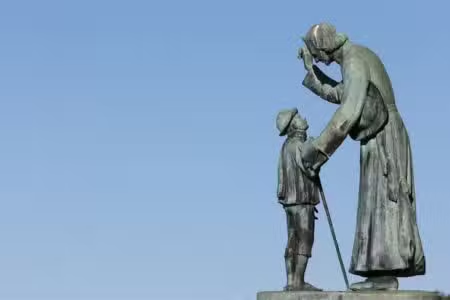
His work as a confessor is John Vianney’s most remarkable accomplishment. He was to spend 11 to 12 hours daily reconciling people with God in the winter months. In the summer months, this time was increased to 16 hours. Unless a man was dedicated to his vision of a priestly vocation, he could not have endured this giving of self day after day. His devotion to the sacrament of confession inspired many to return to their faith and receive God’s forgiveness. He is known as the patron saint of confessors and is a role model for all priests in their duty to shepherd their flock and lead them towards God’s mercy.
St. John Vianney’s Devotion and Fasting
Many people look forward to retirement and taking it easy, doing the things they always wanted but never had the time. But John Vianney had no thoughts of retirement. As his fame spread, more hours were consumed in serving God’s people. The devil frequently disturbed even the few hours he would allow himself to sleep. He became known as a holy priest. More people came to seek his counsel and guidance. Despite these challenges, John Vianney remained steadfast in his devotion to God and continued to fast and sacrifice for the sake of others, following the example of Jesus.
The Final Years: Fame and Spiritual Battles
John Vianney’s fame spread beyond France, and people worldwide came to seek his spiritual guidance. However, with this fame came many spiritual battles for John, as he faced attacks from the devil and endured physical ailments. Despite these trials, he remained steadfast in his faith and continued to serve God’s people until his death on August 4, 1859. He was canonized by Pope Pius XI in 1925.
St. John Vianney Feast Day and Legacy
The feast of St John Vianney is celebrated on August 4th, the anniversary of his death. He is remembered as a model of holiness and dedication to the priesthood, with many priests looking to him for guidance and inspiration in their ministry. His legacy continues as he exemplifies true sanctity and devotion to God. Saint John Vianney’s life serves as a reminder that with determination, faith, and trust in God, one can overcome any obstacle and fulfill one’s calling with great love and humility. May we all strive to follow in his footsteps and become holy instruments of God’s mercy and grace.
Reflection: The Vision of Saint John Vianney
Indifference toward religion and a love for material comfort seem to be common signs of our times. A person from another planet observing us would not likely judge us as pilgrims on our way elsewhere. On the other hand, John Vianney was a man on a journey, with his goal before him at all times.
Saint John Vianney is the Patron Saint of:
- Diocesan Priests
- Parish Priests
franciscanmedia.org
11
posted on
08/04/2025 5:09:58 PM PDT
by
annalex
(fear them not)
To: annalex
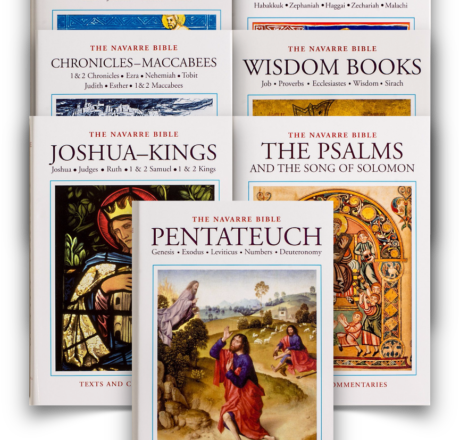
NAVARRE BIBLE COMMENTARY(RSV)
Ad Majorem Dei Gloriam (To the Greater Glory of God)
First Reading:
From: Numbers 11:4b-15
Craving for Egyptian Food
-----------------------------------
[4b] And the people of Israel also wept again, and said, "O that we had meat to eat! [5] We remember the fish we ate in Egypt for nothing, the cucumbers, the melons, the leeks, the onions, and the garlic; [6] but now our strength is dried up, and there is nothing at all but this manna to look at."
[7] Now the manna was like coriander seed, and its appearance like that of bdellium. [8] The people went about and gathered it, and ground it in mills or beat it in mortars, and boiled it in pots, and made cakes of it; and the taste of it was like the taste of cake baked with oil. [9] When the dew fell upon the camp in the night, the manna fell with it.
Moses' Prayer
------------------
[10] Moses heard the people weeping throughout their families every man at the door of his tent; and the anger of the LORD blazed hotly, and Moses was displeased. [11] Moses said to the LORD, "Why hast thou dealt ill with thy servant? And why have I not found favor in thy sight, that thou dost lay the burden of aIl this people upon me? [12] Did I conceive all this people? Did I bring them forth, that thou shouldst say to me, 'Carry them in your bosom, as a nurse carries the sucking child, to the land which thou didst swear to give their fathers?' [13] Where am I to get meat to give to all this people? For they weep before me and say, 'Give us meat, that we may eat.' [14] I am not able to carry all this people alone, the burden is too heavy for me. [15] If thou wilt deal thus will me, kill me at once, if I find favor in thy sight, that I may not see my wretchedness."
***********************************************************************
Commentary:
11:7-9. The people dream of the sort of food they had in Egypt. The manna was a sign of the providence of God, who supplied his people with food in the arid desert. Therefore, their lack of appreciation for the manna, and on top of that their protest against God, show their blindness, their inability to appreciate the gifts God is giving them. Regarding the manna, cf. the note on Exodus 16:1-36.
[The note on Exodus 16:1-36 states: 16:1-36. The prodigy of the manna and the quails was a very important sign of God's special providence towards his people while they were in the desert. It is recounted here and in Numbers 11, but in both accounts facts are interwoven with interpretation of same and with things to do with worship and ethics.
Some scholars have argued that the manna is the same thing as a sweet secretion that comes from the tamarisk ("tamarix mannifera") when punctured by a particular insect commonly found in the mountains of Sinai. The drops of this resin solidify in the coldness of the night and some fall to the ground. They have to be gathered up early in the morning because they deteriorate at twenty-four degrees temperature (almost eighty degrees Celsius). Even today desert Arabs collect them and use them for sucking and as a sweetener in confectionery. As we know, quails cross the Sinai peninsula on their migrations back and forth between Africa and Europe or Asia. In May or June, when they return from Africa they usually rest in Sinai, exhausted after a long sea crossing; they can be easily trapped at this point.
Although these phenomenon can show where the manna and the quail come from, the important thing is that the Israelites saw them as wonders worked by God. The sacred writer stops to describe the impact the manna had on the sons of Israel. They are puzzled by it, as can be seen from their remarks when it comes for the first time: "What is it?" they ask, which in Hebrew sounds like "man hu", that is, manna (v. 15), which is how the Greek translation puts it. Indeed, the need to collect it every day gave rise to complaints about some people being greedy (v. 20) and who did not understand the scope of God's gift (v. 15). And just as manna is a divine gift to meet a basic human need (nourishment), so too the divine precepts, specifically that of the sabbath, are a free gift from the Lord (v. 28). So, obedience is not a heavy burden but the exercise of a capacity to receive the good things that God gives to those who obey him.
The prodigy of the manna will resound right through the Bible: in the "Deuteronomic" tradition it is a test that God gives his people to show them that "man does not live by bread alone, but [...] by everything that proceeds from the mouth of the Lord" (Deut 8:3). The psalmist discovers that manna is "the bread of the strong" ("of angels", says the Vulgate and the RSV), which God sent in abundance (Ps 78:23ff; cf. Ps 105:40). The book of Wisdom spells out the features of this bread from heaven "ready to eat, providing every pleasure and suited to every taste" (Wis 16:20-29). And the New Testament reveals the full depth of this "spiritual" food (1 Cor 10:3), for, as the "Catechism" teaches, "manna in the desert prefigured the Eucharist, 'the true bread from heaven' (Jn 6:32)" ("Catechism of the Catholic Church", 1094).]
11:10-15. Despite the tone of complaint, in Moses' words we can glimpse God's relationship to his people: he is their father, he made them into a people. And the passage also shows the heavy responsibility he put on Moses' shoulders—to the point that he feels unable to carry it any longer.
The imagery used here to describe God's concern for his people will later be used by St Paul when he speaks of his concern for all the Christian communities which grew from his preaching and which he has to guide towards Christ (cf. I Thess 2:7-11).
12
posted on
08/04/2025 6:37:39 PM PDT
by
fidelis
(Ecce Crucem Domini! Fugite partes adversae! Vicit Leo de tribu Juda, Radix David! Alleluia!)
Gospel Reading: From: Matthew 14:13-21
First Miracle of the Loaves and Fish
------------------------------------
[13] Now when Jesus heard this, He withdrew from there in a boat to a lonely place apart. But when the crowds heard it, they followed Him on foot from the towns. [14] As He went ashore He saw a great throng; and He had compassion on them, and healed their sick. [15] When it was evening, the disciples came to Him and said, "This is a lonely place, and the day is now over; send the crowds away to go into the villages and buy food for themselves." [16] Jesus said, "They need not go away; you give them something to eat." [17] They said to Him, "We have only five loaves here and two fish." [18] And He said, "Bring them here to Me." [19] Then He ordered the crowds to sit down on the grass; and taking the five loaves and the two fish He looked up to heaven, and blessed, and broke and gave the loaves to the disciples, and the disciples gave them to the crowds. [20] And they all ate and were satisfied. And they took up twelve baskets full of the broken pieces left over. [21] And those who ate were about five thousand men, besides women and children.
***********************************************************************
Commentary:
14-21. This episode must have occurred in the middle of springtime, because the grass was green (Mark 6:40; John 6:10). In the Near East loaves were usually made very thin, which meant it was easy to break them by hand and distribute them to those at table; this was usually done by the head of the household or the senior person at the meal. Our Lord follows this custom, and the miracle occurs when Jesus breaks the bread. The disciples then distribute it among the crowd. Here again we can see Jesus' desire to have people cooperate with Him.
13
posted on
08/04/2025 6:37:56 PM PDT
by
fidelis
(Ecce Crucem Domini! Fugite partes adversae! Vicit Leo de tribu Juda, Radix David! Alleluia!)
14
posted on
08/04/2025 6:39:23 PM PDT
by
fidelis
(Ecce Crucem Domini! Fugite partes adversae! Vicit Leo de tribu Juda, Radix David! Alleluia!)
Disclaimer:
Opinions posted on Free Republic are those of the individual
posters and do not necessarily represent the opinion of Free Republic or its
management. All materials posted herein are protected by copyright law and the
exemption for fair use of copyrighted works.
FreeRepublic.com is powered by software copyright 2000-2008 John Robinson
