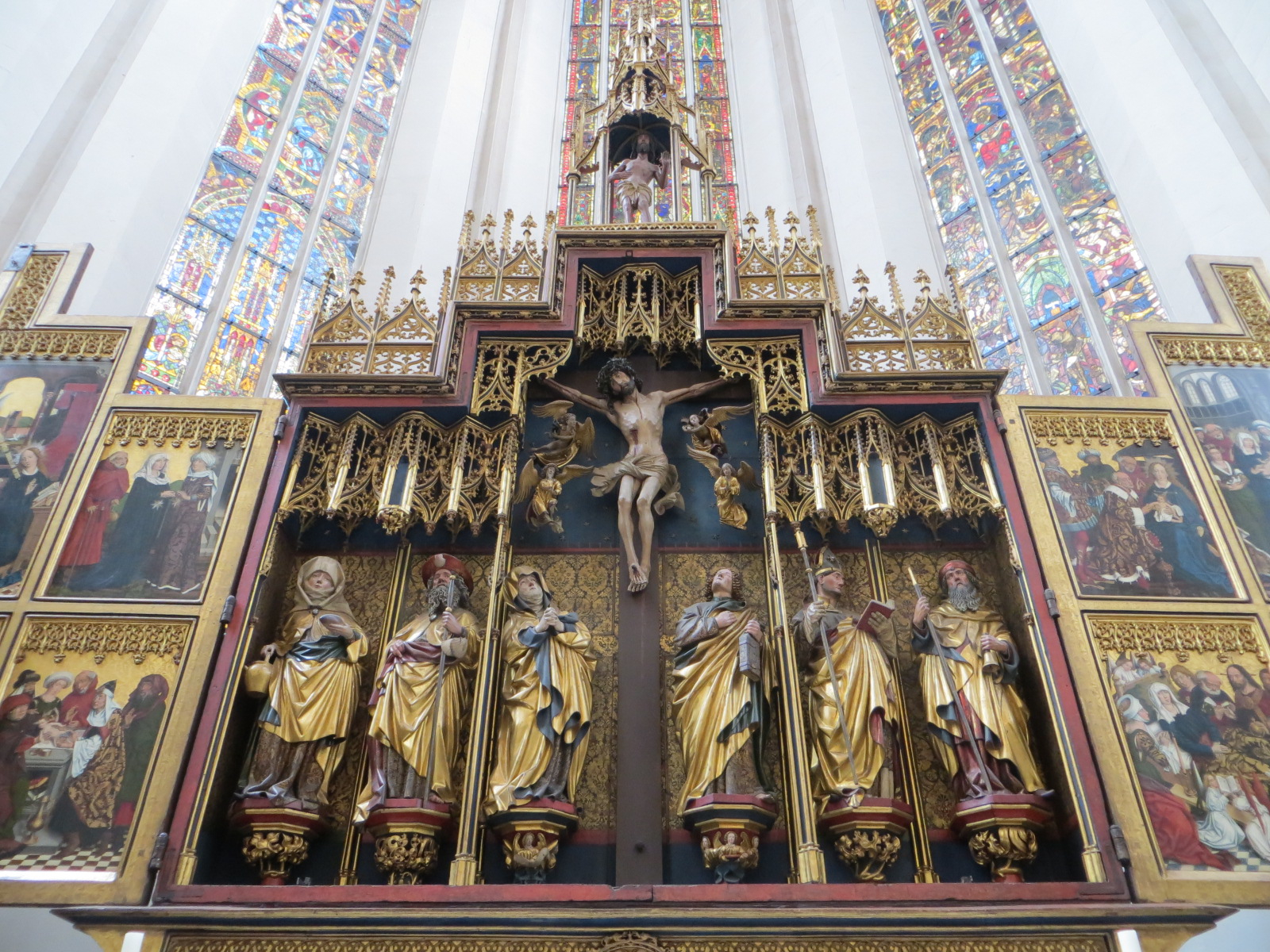
Catena Aurea by St. Thomas Aguinas
20:20–23
20. Then came to him the mother of Zebedee’s children with her sons, worshipping him, and desiring a certain thing of him.
21. And he said unto her, What wilt thou? She saith unto him, Grant that these my two sons may sit, the one on thy right hand, and the other on the left, in thy kingdom.
22. But Jesus answered and said, Ye know not what ye ask. Are ye able to drink of the cup that I shall drink of, and to be baptized with the baptism that I am baptized with? They say unto him, We are able.
23. And he saith unto them, Ye shall drink indeed of my cup, and be baptized with the baptism that I am baptized with: but to sit on my right hand, and on my left, is not mine to give, but it shall be given to them for whom it is prepared of my Father.
JEROME. The Lord having concluded by saying, And shall rise again the third day; the woman thought that after His resurrection He should forthwith reign, and with womanish eagerness grasps at what is present, forgetful of the future.
PSEUDO-CHRYSOSTOM. This mother of the sons of Zebedee is Salome, as her name is given by another Evangelist (Mark 15:40; 16:1.), herself truly peaceful, and the mother of sons of peace. From this place we learn the eminent merit of this woman; not only had her sons left their father, but she had left her husband, and had followed Christ; for He could live without her, but she could not be saved without Christ. Except any will say that between the time of the Apostle’s calling, and the suffering of Christ, Zebedee was dead, and that thus her sex helpless, her age advanced, she was following Christ’s steps; for faith never grows old, and religion feels never weary. Her maternal affection made her bold to ask, whence it is said, She worshipped Him, and desired a certain thing of Him; i. e. she did Him reverence, requesting that what she should ask, should be granted her. It follows, He said unto her, What wouldest thou? He asks not because He knows not, but that by its very statement, the unreasonableness of her petition might be shewn, She saith unto him, Grant that these my two sons may sit.
AUGUSTINE. (Cons. Ev. ii. 64.) What Matthew has here represented as being said by the mother, Mark (Mark 10:35) relates that the two sons of Zebedee spake themselves, when she had presented their wish before the Lord; so that from Mark’s brief notice it should rather seem, that they, and not she, had said that which was said.
CHRYSOSTOM. They saw the disciples honoured before others, and had heard that ye shall sit upon twelve thrones, (Mat. 19:28.) whereupon they sought to have the primacy of that seat. And that others were in greater honour with Christ they knew, and they feared that Peter was preferred before them; wherefore (as is mentioned by another Evangelist) because they were now near to Jerusalem, they thought that the kingdom of God was at the door, that is, was something to be perceived by sense. Whence it is clear that they sought nothing spiritual, and had no conception of a kingdom above.
ORIGEN. For if in an earthly kingdom they are thought to be in honour who sit with the king, no wonder if a woman with womanish simplicity or want of experience conceived that she might ask such things, and that the brethren themselves being not perfect, and having no more lofty thoughts concerning Christ’s kingdom, conceived such things concerning those who shall sit with Jesus.
PSEUDO-CHRYSOSTOM. Or otherwise. We affirm not that this woman’s request was a lawful one; but this we affirm, that it was not earthly things, but heavenly things that she asked for her sons. For she felt not as ordinary mothers, whose affection is to the bodies of their children, while they neglect their minds; they desire that they should prosper in this world, not caring what they shall suffer in the next, thereby shewing themselves to be mothers of their bodies only, but not of their souls. And I imagine that these brethren, having heard the Lord prophesying of His passion and resurrection, began to say among themselves, seeing they believed; Behold, the King of heaven is going down to the realms of Tartarus, that He may destroy the king of death. But when the victory shall be completed, what remains but that the glory of the kingdom shall follow?
ORIGEN. For when sin is destroyed, which reigned in men’s mortal bodies, with the entire dynasty of malignant powers, Christ shall receive exaltation of His kingdom among men; that is, His sitting on the throne of His glory. That God disposes all things both on His right hand and on His left, this is that there shall be then no more evil in His presence. They that are the more excellent among such as draw near to Christ, are they on His right hand; they that are inferior, are they on His left hand. Or by Christ’s right hand look if you may understand the invisible creation; by His left hand the visible and bodily. For of those who are brought nigh to Christ, some obtain a place on His right hand, as the intelligent, some on His left hand, as the sentient creation.
PSEUDO-CHRYSOSTOM. He that gave Himself to man, how shall He not give them the fellowship of His kingdom? The supineness of the petitioner is in fault, where the graciousness of the giver is undoubted. But if we ourselves ask our master, perchance we wound the hearts of the rest of our brethren, who though they can no longer be overcome by the flesh, seeing they are now spiritual, may yet be wounded as carnal. Let us therefore put forward our mother, that she may make her petition for us in her own person. For though she be to be blamed therein, yet she will readily obtain forgiveness, her sex pleading for her. For the Lord Himself, who has filled the souls of mothers with affection to their offspring, will more readily listen to their desires. Then the Lord, who knows secrets, makes answer not to the words of the mother’s petition, but to the design of the sons who suggested it. Their wish was commendable, but their request inconsiderate; therefore, though it was not right that it should be granted to them, yet the simplicity of their petition did not deserve a harsh rebuke, forasmuch as it proceeded of love of the Lord. Wherefore it is their ignorance that the Lord finds fault with; Jesus answered and said unto them, Ye know not what ye ask.
JEROME. And no wonder, if she is convicted of inexperience, seeing it is said of Peter, Not knowing what he said. (Luke 9:33.)
PSEUDO-CHRYSOSTOM. For ofttimes the Lord suffers His disciples either to do or to think somewhat amiss, that from their error He may take occasion to set forth a rule of piety; knowing that their fault harms not when the Master is present, while His doctrine edifies them not for the present only, but for the future.
CHRYSOSTOM. This He says to shew either that they sought nothing spiritual, or that had they known for what they asked, they would not have asked that which was so far beyond their faculties.
HILARY. They know not what they ask, because there was no doubt of the future glory of the Apostles; His former discourse had assured them that they should judge the world.
PSEUDO-CHRYSOSTOM. Or, Ye know not what ye ask; as much as to say, I have called you to My right hand away from My left, and now you wilfully desire to be on My left. Hence perhaps they did this through the mother. For the devil betook him to his well-known tool the woman, that as he made prey of Adam by his wife, so he should sever these by their mother. But now that the salvation of all had proceeded from a woman, destruction could no longer enter in among the saints by a woman. Or He says, Ye know not what ye ask, seeing we ought not only to consider the glory to which we may attain, but how we may escape the ruin of sin. For so in secular war, he who is ever thinking of the plunder, hardly wins the fight; they should have asked, Give us the aid of Thy grace, that we may overcome all evil.
RABANUS. They knew not what they asked, for they were asking of the Lord a seat in glory, which they had not yet merited. The honourable eminence liked them well, but they had first to practise the laborious path thereto; Can ye drink of the cup that, I shall drink of?
JEROME. By the cup in the divine Scriptures we understand suffering, as in the Psalm, I will take the cup of salvation; (Ps. 116:13, 15.) and straightway He proceeds to shew what is the cup, Precious in the sight of the Lord is the death of his saints.
PSEUDO-CHRYSOSTOM. The Lord knew that they were able to follow His passion, but He puts the question to them that we may all hear, that no man can reign with Christ, unless he is conformed to Christ in His passion, for that which is precious is only to be purchased at a costly price. The Lord’s passion we may call not only the persecution of the Gentiles, but all the hardships we go through in struggling against our sins.
CHRYSOSTOM. He says therefore, Can ye drink it? as much as to say, You ask me of honours and crowns, but I speak to you of labour and travail, for this is no time for rewards. He draws their attention by the manner of His question, for He says not, Are ye able to shed your blood? but, Are ye able to drink of the cup? then He adds, which I shall drink of?
REMIGIUS. That by such partaking they may burn with the more zeal towards Him. But they, already sharing the readiness and constancy of martyrdom, promise that they would drink of it; whence it follows, They say unto him, We are able.
PSEUDO-CHRYSOSTOM. Or, they say this not so much out of reliance on their own fortitude, as out of ignorance; for to the inexperienced the trial of suffering and death appears slight.
CHRYSOSTOM. Or they offer this in the eagerness of their desire, expecting that for their thus speaking they should have what they desired. But He foretels great blessings for them, to wit, that they should be made worthy of martyrdom. He saith unto them, Ye shall indeed drink of my cup.
ORIGEN. Christ does not say, Ye are able to drink of My cup, but looking to their future perfection He said, Ye shall indeed drink of my cup.
JEROME. It is made a question how the sons of Zebedee, James, and John, did drink the cup of martyrdom, seeing Scripture relates that James only was beheaded by Herod, (Acts 12:2.) while John ended his life by a peaceful death. But when we read in ecclesiastical history that John himself was thrown into a cauldron of boiling oil with intent to martyr him, and that he was banished to the isle of Patmos, we shall see that he lacked not the will for martyrdom, and that John had drunk the cup of confession, the which also the Three Children in the fiery furnace did drink of, albeit the persecutor did not shed their blood.
HILARY. The Lord therefore commends their faith, in that He says that they are able to suffer martyrdom together with Him; but, To sit on my right hand and on my left is not mine to give, but for whom it is prepared of my Father, Though indeed, as far as we can judge, that honour is so set apart for others, as that the Apostles shall not be strangers to it, who shall sit on the throne of the Twelve Patriarchs to judge Israel; also, as may be collected out of the Gospels themselves, Moses and Elias shall sit with them in the kingdom of heaven, seeing that it was in their company that He appeared on the mount in His apparel of splendour.
JEROME. But to me this seems not so. Rather the names of them that shall sit in the kingdom of heaven are not named, lest that, if some few were named, the rest should think themselves shut out; for the kingdom of heaven is not of him that gives it, but of him that receives it. Not that there is respect of persons with God, but whosoever shall shew himself such as to be worthy of the kingdom of heaven, shall receive it, for it is prepared not for condition, but for conduct. Therefore if you shall be found to be such as to be fit for that kingdom of heaven which My Father has made ready for the conquerors, ye shall receive the same. He said not, Ye shall not sit there, that He might not discourage the two brethren; while He said not, Ye shall sit there, that He might not stir the others to envy.
CHRYSOSTOM. Or otherwise. That seat seems to be unapproachable to all, not only men, but Angels also; for so Paul assigns it peculiarly to the Only-Begotten, saying, To which of the Angels said he at any time, Sit thou on my right hand? (Heb. 1:13.) The Lord therefore makes answer, not as though in verity there were any that should sit there, but as condescending to the apprehensions of the petitioners. They asked but this one grant, to be before others near Him; but the Lord answers, Ye shall die for My sake, yet is not that sufficient to make you obtain the first rank. For if there shall come another with martyrdom, and having virtue greater than yours, I will not, because I love you, put him out, and give you precedence. But that they should not suppose that he lacked power, He said not absolutely, It is not Mine to give, but, It is not mine to give to you, but to those for whom it is prepared; that is, to those who are made illustrious by their deeds.
REMIGIUS. Or otherwise; It is not mine to give to you, that is, to proud men such as you are, but to the lowly in heart, for whom it is prepared of my Father.
AUGUSTINE. (de Trin i. 12.) Or otherwise; The Lord makes answer to His disciples in His character of servant; though whatever is prepared by the Father is also prepared by the Son, for He and the Father are one.
20:24–28
24. And when the ten heard it, they were moved with indignation againt the two brethren.
25. But Jesus called them unto him, and said, Ye know that the princes of the Gentiles exercise dominion over them, and they that are great exercise authority upon them.
26. But it shall not be so among you: but whosoever will be great among you, let him be your minister;
27. And whosoever will be chief among you, let him be your servant:
28. Even as the Son of man came not to be ministered unto, but to minister, and to give his life a ransom for many.
CHRYSOSTOM. So long as the judgment of Christ upon this request was in suspense, the other disciples were not indignant; but when they heard Him rebuke them, they were sorrowful; whence it is said, And when the ten heard it, they had indignation against the two brethren.
JEROME. They do not lay it upon the forwardness of the mother who spoke the request, but upon her sons, who, not knowing their measure, burned with so immoderate desires.
CHRYSOSTOM. For when the Lord rebuked them, then they perceived that this request was from the disciples. For though they were grieved in their hearts when they saw them so especially honoured in the transfiguration, they yet dared not so express themselves, out of respect to their teacher.
PSEUDO-CHRYSOSTOM. But as the two had asked carnally, so now the ten are grieved carnally. For as to seek to be above all is blame-worthy, so to have another above us is mortifying to our vanity.
JEROME. But the meek and lowly Master neither charges the two with ambition, nor rebukes the ten for their spleen and jealousy; but, Jesus called them unto him.
CHRYSOSTOM. By thus calling them to Him, and speaking to them face to face, he sooths them in their discomposure; for the two had been speaking with the Lord apart by themselves. But not now as before does He it by bringing forward a child, but He proves it to them by reasoning from contraries; Ye know that the princes of the Gentiles exercise dominion over them.
ORIGEN. That is, not content merely to rule over their subjects, they are severe and oppressive. But among you who are Mine these things shall not be so; for as all carnal things are done by compulsion, but spiritual things by free-will, so those rulers who are spiritual ought to rest their power in the love of their subjects, not in their fears.
CHRYSOSTOM. He shews here that it is of the Gentiles to desire preeminence; and by this comparison of the Gentiles He calms their troubled souls.
PSEUDO-CHRYSOSTOM. Indeed, to desire a good work is good, for it is within our will, and ours is the reward; but to desire a primacy of honour is vanity. For when we attain this we are judged of God, because we know not whether in our precedence of honour we deserve the reward of righteousness. For not even an Apostle will have praise with God, because he is an Apostle, but if he has well fulfilled the duties of his Apostleship; nor was an Apostle placed in honour as an Apostle, for any previous merit of his; but was judged meet for that ministry, on account of the disposition of his mind. For high place courts him who flies from it, and shuns him who courts it. A better life then, and not a more worthy degree, should be our object. The Lord therefore, willing to check the ambition of the two sons of Zebedee, and the indignation of the others, points out this distinction between the chief men of the world, and those of the Church, shewing that the primacy in Christ is neither to be sought by him who has it not, nor envied by him who has it. For men become masters in this world that they may exercise domination over their inferiors, and reduce them to slavery, and rob them, and employ them even to death for their own profit and glory. But men become governors in the Church, that they may serve those who are under them, and minister to them whatever they have received of Christ, that they may postpone their own convenience, and mind that of others, and not refuse even to die for the sake of those beneath them. To seek therefore a command in the Church is neither righteous, nor profitable. No prudent man will voluntarily subject himself to slavery, nor to stand in such peril wherein he will have to render account for the whole Church; unless it be one perchance who fears not God’s judgment, who abuses His ecclesiastical primacy to a secular end, so that He converts it into a secular primacy.
JEROME. Lastly, He sets before them His own example, that so should they little weigh His words, His deeds might shame them, whence He adds, As also the Son of Man cometh not to be ministered unto, but to minister.
ORIGEN. For though the Angels and Martha ministered to Him, (Mat. 4:11), yet did He not come to be ministered unto, but to minister (John 12:2); yea, His ministry extended so far, that He fulfilled even what follows, And to give his life a ransom for many, they, that is, who believed on Him; and gave it, i. e. to death. But since He was alone free among the dead, and mightier than the power of death, He has set free from death all who were willing to follow Him. The heads of the Church ought therefore to imitate Christ in being affable, adapting Himself to women, laying His hands on children, and washing His disciples’ feet, that they also should do the same to their brethren. But we are such, that we seem to go beyond the pride even of the great ones of this world; as to the command of Christ, either not understanding it, or setting it at nought. Like princes we seek hosts to go before us, we make ourselves awful and difficult of access, especially to the poor, neither approaching them, nor suffering them to approach us.
CHRYSOSTOM. How much soever you humble yourself, you cannot descend so far as did your Lord.
Catena Aurea Matthew 20
NAVARRE BIBLE COMMENTARY(RSV)
Ad Majorem Dei Gloriam (To the Greater Glory of God)
First Reading:
From: 2 Corinthians 4:7-15
The Trials He Has Experienced
-----------------------------
[7] But we have this treasure in earthen vessels, to show that the transcendent power belongs to God and not to us. [8] We are afflicted in every way, but not crushed; perplexed, but not driven to despair; [9] persecuted, but not forsaken; struck down, but not destroyed; [10] always carrying in the body the death of Jesus, so that the life of Jesus may also be manifested in our bodies. [11] For while we live we are always being given up to death for Jesus' sake, so that the life of Jesus may be manifested in our mortal flesh. [12] So death is at work in us, but life in you.
He Is Sustained by Hope in Heaven
---------------------------------
[13] Since we have the same spirit of faith as he had who wrote, "I believed, and so I spoke," we too believe, and so we speak, [14] knowing that he who raised the Lord Jesus will raise us also with Jesus and bring us with you into his presence. [15] For it is all for your sake, so that as grace extends to more and more people it may increase thanksgiving, to the glory of God.
********************************************
Commentary:
7-12. In contrast to the greatness of the Gospel--the "treasure" entrusted to them by God--St. Paul emphasizes the limitations of its ministers: they are "earthen vessels" (v. 7). To illustrate this he describes the afflictions and persecution to which he finds himself subjected and in which God's grace always comes to his aid.
In some way these sufferings of the Apostles and of all Christians reproduce in their lives the sufferings of Christ in his passion and death. In his case his suffering opened the way to his glorification after the Resurrection; similarly his servants, even in this life, are experiencing an anticipation of the life they will attain in heaven; this helps them overcome every kind of affliction.
7. St. Paul again stresses that the effectiveness of all his apostolic activity comes from God (cf., e.g., 1 Cor 1:26-31; 2 Cor 3:5); he it is who places his treasures in poor earthenware vessels. The image the Apostle uses--which is reminiscent of the clay which God used to make Adam (cf. Gen 2:7)—helps Christians realize that through grace they bear in their souls a wonderful treasure, God himself; like earthen vessels they are very fragile and they need to be put together again in the sacrament of Confession. As a gloss on these ideas St J. Escriva taught that Christians by bearing God in their souls are enabled to live at one and the same time "in heaven and on earth, divinized: but knowing that we are of the world and made of clay, with the frailty that is typical of clay--an earthenware pot which our Lord has deigned to use in his service. And whenever it has got broken, we have gone and riveted the bits together again, like the prodigal son: 'I have sinned against heaven and against you...'" (quoted in Bernal, "Monsignor Escriva de Balaguer").
8-9. The Apostle's words assure the Christian that he or she can always count on God's help: no matter what trials they have to undergo, victory can be attained with the grace of God as happened in St. Paul's case. "God is faithful, and he will not let you be tempted beyond your strength, but with temptation will also provide you the way of escape, that you may be able to endure it" (1 Cor 10:13). Moreover, St. Paul's example reminds us that more or less severe suffering and tribulation will be a normal thing in the lives of Christ's followers; theirs will never be a comfortable, trouble-free life. "If it is your ambition to win the esteem of men, if your desire to be well-regarded and seek only a life of ease, you have gone astray [...]. In the city of the saints, entrance is given and rest and eternal rule with the King, only to those who have made their way along the rough, narrow way of tribulation" (Pseudo-Macarius, "Homilies", XII, 5).
10-11. As happened in St. Paul's case, in their daily lives Christians must relive the sufferings of Christ through self-denial and penance: this is part of following Christ and imitating him. "The Christian vocation is one of sacrifice, penance, expiation. We must make reparation for our sins--for the many times we turned our face aside so as to avoid the gaze of God--and all the sins of mankind. We must try to imitate Christ, 'always carrying in the body the death of Christ', his abnegation, his suffering on the cross, 'so that the life of Jesus may be manifested in our bodies' (2 Cor 4:10). Our way is one of immolation and, in this denial, we find "gaudium cum pace", both joy and peace" (St J. Escriva, "Christ Is Passing By", 9).
Self-denial, mortification, does not have to be something overt; it should be practiced in the ordinary circumstances of life--for example, by being punctual for appointments, carefully fulfilling one's duties, treating everyone with as much charity as possible, accepting little setbacks in a good-humored way (cf. St J. Escriva, "Friends of God", 138).
10. "The death of Jesus": more exactly, the "dying" of Christ: the Greek word refers to the situation of someone who is dying.
12. In the Apostles, and also in other Christians, the paradox of Jesus' life is verified: his death is the cause of life for all men. "Unless a grain of wheat falls into the earth and dies, it remains alone, but if it dies, it bears much fruit" (Jn 12:24). Afflictions and tribulations, physical and moral pain, daily self-denial and penance, cause Christ's disciple to die to himself and, if united to the sufferings of his Master, they become a source of life for others through the communion of saints.
13-18. The Apostle explains where he gets the strength to bear all the tribulations of life--from his hope in the resurrection and his expectation of being in heaven with those to whom he is writing (v. 14). There is nothing selfish about this desire for heaven: it helps us to stay true to the faith and it enables us to see all the sufferings of this life as something transitory and slight (v. 17), a necessary step to heaven and a way to obtain incomparably greater happiness. "If we wish to enjoy the pleasures of eternity," St. Alphonsus reminds us, "we must deprive ourselves of the pleasures of time. 'Whoever would save his life will lose it' (Mt 16:25) [...]. If we wish to be saved, we must all be martyrs, either by the tyrant's sword or through our own mortification. Let us have this conviction--that everything we suffer is nothing compared with the eternal glory that awaits us. 'I consider the sufferings of this present time are not worth comparing with the glory that is to be revealed to us' (Rom 8:18). These momentary afflictions will bring us eternal happiness (cf. 2 Cor 4:17)" ("Treasury of Preaching Material", II, 9).
13. The Apostle's faith leads him to keep on preaching, despite all the difficulties this may involve. There is nothing else he can do: he is convinced that his faith is what can save the world and he cannot but strive to spread it. If he acted otherwise it would mean his faith was asleep and he did not truly love others. "When you find that something has done you good," St. Gregory the Great explains, "try to bring it to the attention of others. You should, therefore, desire others to join you on the ways of the Lord. If you are going to the forum or the baths, and you meet someone who is not doing anything, you invite him to go along with you. Apply this earthly custom to the spiritual sphere, and as you make your way to God, do not do so alone" ("In Evangelia Homiliae", 6, 6).
14. What inspires St. Paul's apostolic activity and enables him to bear all the difficulties it involves, is his firm belief in resurrection in glory, the basis and cause of which is Christ's resurrection. He also has the hope of sharing this happiness in heaven, in the presence of God, with all the faithful for whose salvation he is working on earth.
15. After reminding the Corinthians that all the sufferings he has been speaking about he has borne for their sake (cf. 4:5), St. Paul tells them what motivates him most--the greater glory of God, to whom the faithful should turn in deep gratitude (cf. 1:11; 9:12). This should be man's primary attitude to God--one of profound adoration and thanksgiving for all his benefits, as we are daily reminded in the Preface of the Mass.
"If life's purpose were not to give glory to God, how contemptible, how hateful it would be" (St J. Escriva, "The Way", 783).