To: annalex
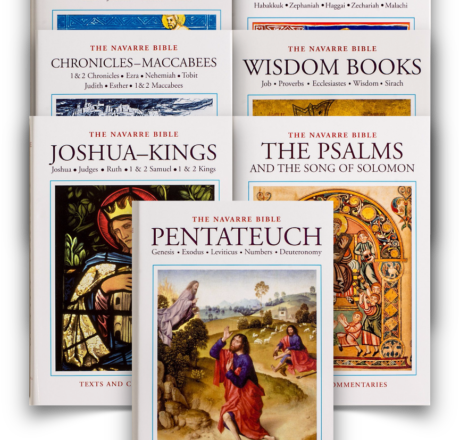
NAVARRE BIBLE COMMENTARY(RSV)
Ad Majorem Dei Gloriam (To the Greater Glory of God)
From: Exodus 1:8-14, 22
The Sons of Israel are Oppressed
--------------------------------
[8] Now there arose a new king over Egypt who did not know Joseph. [9] And he said to his people, "Behold, the people of Israel are too many and too mighty for us. [10] Come, let us deal shrewdly with them, lest they multiply, and, if war befall us, they join our enemies and fight against us and escape from the land." [11] Therefore they set taskmasters over them to afflict them with heavy burdens; and they built for Pharaoh store-cities, Pithom and Ra-amses. [12] But the more they were oppressed, the more they multiplied and the more they spread abroad. And the Egyptians were in dread of the people of Israel. [13] So they made the people of Israel serve with rigor, [14] and made their lives bitter with hard service, in mortar and brick, and in all kinds of work in the field; in all their work they made them serve with rigor.
[22] Then Pharaoh commanded all his people, "Every son that is born to the Hebrews you shall cast into the Nile, but you shall let every daughter live."
***********************************************************************
Commentary:
1:8-14 The situation of the children of Israel is dramatically portrayed: the more they are oppressed, the stronger they become (v. 12). The frequent contrasts In the account and the fact that no names are supplied give the impression that God himself (even though he is yet not named) is on the Israelites' side and is against the pharaoh and his people. From the very beginning, over and above the comings and goings of men, God is at work; a religious event is taking shape.
For the first time the Bible here speaks of the "people [of the Sons] of Israel" (v. 9). The sacred book counter-poses two peoples--the people of the pharaoh, cruel and oppressive, and the people of Israel, the victims of oppression. Over the course of their struggle to leave Egypt, the children of Israel will gradually become conscious of this--that they form a people chosen by God and released from bondage in order to fulfill an important historical mission. They are not a motley collection of tribes or families, but a people. "God, with loving concern contemplating, and making preparation for, the salvation of the whole human race, in a singular undertaking chose for himself a people to whom he would entrust his promises" (Vatican II, "Del Verbum", 14). At the same time the religious framework of this inspired book is established: on one side stand the enemies of God, on the other the people of the children of the Covenant (cf. Acts 3:25; "Catechism of the Catholic Church", 527).
1:8. We do not know who exactly this new king" was. He was probably Rameses II (early 13th century BC), who belonged to the nineteenth dynasty. This pharaoh sought to restore imperial control over foreigners and invaders. The phrase "did not know Joseph" indicates how helpless and alone the "sons of Israel" were. The people of Israel never did count for very much politically, and yet God wills them to have an essential place in his plans.
Many Fathers of the Church saw in this pharaoh a personification of those who are opposed to the establishment of the Kingdom of Christ. St Bede, for example, reminds the Christian that if, having been baptized and having listened to the teachings of the faith, he goes back to living in a worldly way, "another king who knows not Joseph" will come to birth in him, that is, the selfishness which opposes the plans of God (cf. "Commentaria In Pentateuchum", 2,1).
1:11. Pithom and Ra-amses are called "store-cities" because provisions for the frontier garrisons were stored in the silos of their temples. Reliable archeological studies identify Pithom (which in Egyptian means "dwelling of Athon") with some ruins a few kilometers from present-day Ishmailia, not far from the Suez canal. A temple of Athon has been discovered there, and huge stores of bricks. It is more difficult to say where Ra-amses was. The balance of probability is that it was the earlier city of Avaris, a capital during the dynasties of invader pharaohs. It would later be called Tanis, and nowadays it is just a series of big ruins near a fishing village, San el-Hagar, near Port Said, on the eastern part of the Nile delta. Archeologists have discovered there the remains of an elaborate temple built by Rameses II (1279-1212 BC), probably the pharaoh mentioned here.
1:14. In ancient Egypt it was normal for people, particularly foreigners, to work for the pharaoh. This was not regarded as a form of slavery or "oppression"; we know, for example, there were towns or entire cities which accommodated the workers engaged in building the tombs or temples of the pharaohs. The oppression the sacred writer refers to lay in the fact that the Egyptians imposed particularly hard tasks on the Israelites--such as brick-making, building and agricultural labor--and treated them cruelly.
St lsidore of Seville, commenting on this passage, compares it with the situation of mankind which, after original sin, is subject to the tyranny of the devil, who often manages to turn work into slavery.
Just as the pharaoh imposed the hard labor of mortar and brick, so too the devil forces sinful man to engage in "earthly, dusty tasks which are moreover mixed with straw, that is to say, with frivolous and irrational acts" (cf. "Quaestiones In Exodum", 3).
1:22. The original text always refers to "the River" because the entire life of ancient Egypt depended on it. Obviously it is referring to the Nile.
14 posted on
07/14/2025 5:22:40 PM PDT by
fidelis
(Ecce Crucem Domini! Fugite partes adversae! Vicit Leo de tribu Juda, Radix David! Alleluia!)
From: Matthew 10:34-11:1Jesus' Instructions to the Apostles (Continuation)
--------------------------------------------------
(Jesus said to His disciples) [34] "Do not think that I have come to bring peace on earth; I have not come to bring peace, but a sword. [35] For I have come to set a man against his father, and a daughter against her mother, and a daughter-in-law against her mother-in-law; [36] and a man's foes will be those of his own household. [37] He who loves father or mother more than Me is not worthy of Me; and he who loves son or daughter more than Me is not worthy of Me; [38] and he who does not take his cross and follow Me is not worthy of Me. [39] He who finds his life will lose it, and he who loses his life for My sake will find it.
[40] He who receives you receives Me, and he who receives Me receives Him who sent Me. [41] He who receives a prophet because he is a prophet shall receive a prophet's reward, and he who receives a righteous man because he is a righteous man shall receive a righteous man's reward. [42] And whoever gives to one of these little ones even a cup of cold water because he is a disciple, truly, I say to you, he shall not lose his reward."
The Mission of John the Baptist. Jesus' Reply
----------------------------------------------
[1] And when Jesus had finished instructing His twelve disciples, He went on from there to teach and preach in their cities.
***********************************************************************
Commentary:
34-37. Our Lord has not come to bring a false and earthly peace—the sort of tranquility the self-seeking person yearns for; He wants us to struggle against our own passions and against sin and its effects. The sword He equips us with for this struggle is, in the words of Scripture, "the sword of the Spirit which is the word of God" (Ephesians 6:17), "lively and active, sharper than any two-edged sword, piercing to the division of soul and spirit, of joints and marrow, and discerning the thoughts and intentions of the heart" (Hebrews 4:12).
The word of God in fact leads to these divisions mentioned here. It can lead, even within families, to those who embrace the faith being regarded as enemies by relatives who resist the word of truth. This is why our Lord goes on (verse 37) to say that nothing should come between Him and His disciple--not even father, mother, son or daughter: any and every obstacle (cf. Matthew 5:29-30) must be avoided.
Obviously these words of Jesus do not set up any opposition between the first and fourth commandments (love for God above all things and love for one's parents): He is simply indicating the order of priorities. We should love God with all our strength (cf. Matthew 22:37), and make a serious effort to be saints; and we should also love and respect—in theory and in practice--the parents God has given us; they have generously cooperated with the creative power of God in bringing us into the world and there is so much that we owe them. But love for our parents should not come before love of God; usually there is no reason why these two loves should clash, but if that should happen, we should be quite clear in our mind and in heart about what Jesus says here. He has in fact given us an example to follow on this point: "How is it that you sought Me? Did you not know that I must be in My Father's house?" (Luke 2:49)--His reply when, as a youth, Mary and Joseph found Him in the Temple of Jerusalem after a long search. This event in our Lord's life is a guideline for every Christian--parent or child. Children should learn from it that their affection for their parents should never come before their love for God, particularly when our Creator asks us to follow Him in a way which implies special self-giving on our part; parents should take the lesson that their children belong to God in the first place, and therefore He has a right to do with them what He wishes, even if this involves sacrifice, even heroic sacrifice. This teaching of our Lord asks us to be generous and to let God have His way. In fact, however, God never lets Himself be outdone in generosity. Jesus has promised a hundredfold gain, even in this life, and later on eternal life (cf. Matthew 19:29), to those who readily respond to His will.
38-39. The teaching contained in the preceding verses is summed up in these two succinct sentences. Following Christ, doing what He asks, means risking this present life to gain eternal life.
"People who are constantly concerned with themselves, who act above all for their own satisfaction, endanger their eternal salvation and cannot avoid being unhappy even in this life. Only if a person forgets himself and gives himself to God and to others, in marriage as well as in any other aspect of life, can he be happy on this earth, with a happiness that is a preparation for, and a foretaste of, the joy of Heaven" (St. J. Escriva, "Christ Is Passing By", 24). Clearly, Christian life is based on self-denial: there is no Christianity without the Cross.
40. To encourage the Apostles and to persuade others to receive them, our Lord affirms that there is an intimate solidarity, or even a kind of identity, between Himself and His disciples. God in Christ, Christ in the Apostles: this is the bridge between Heaven and earth. (cf. 1 Corinthians 3:21-23).
41-42. A prophet's mission is not essentially one of announcing future events; his main role is that of communicating the word of God (cf. Jeremiah 11:2; Isaiah 1:2). The righteous man, the just man, is he who obeys the Law of God and follows His paths (cf. Genesis 6:9; Isaiah 3:10). Here Jesus tells us that everyone who humbly listens to and welcomes prophets and righteous men, recognizing God in them, will receive the reward of a prophet and a righteous man. The very fact of generously receiving God's friends will gain one the reward that they obtain. Similarly, if we should see God in the least of His disciples (verse 42), even if they do not seem very important, they are important, because they are envoys of God and of His Son. That is why he who gives them a glass of cold water--an alms, or any small service--will receive a reward, for he has shown generosity to our Lord Himself (cf. Matthew 25:40).
1. In chapters 11 and 12 the Gospel records the obduracy of the Jewish leaders toward Jesus, despite hearing His teaching (chapter 5-7) and seeing the miracles which bear witness to the divine nature of His person and His doctrine (chapters 8 and 9).
15 posted on
07/14/2025 5:23:10 PM PDT by
fidelis
(Ecce Crucem Domini! Fugite partes adversae! Vicit Leo de tribu Juda, Radix David! Alleluia!)
FreeRepublic.com is powered by software copyright 2000-2008 John Robinson