Free Republic
Browse · Search
Religion
Topics · Post Article

Skip to comments.

Catholic Caucus: Daily Mass Readings 13-February-2025
Universalis/Jerusalem Bible ^

Posted on 02/13/2025 6:46:07 AM PST by annalex

13 February 2025

Thursday of week 5 in Ordinary Time


Convent of St Vincent in Prato, Tuscany

Readings at Mass

Liturgical Colour: Green. Year: C(I).


First readingGenesis 2:18-25

Man and wife become one body

The Lord God said, ‘It is not good that the man should be alone. I will make him a helpmate.’ So from the soil the Lord God fashioned all the wild beasts and all the birds of heaven. These he brought to the man to see what he would call them; each one was to bear the name the man would give it. The man gave names to all the cattle, all the birds of heaven and all the wild beasts. But no helpmate suitable for man was found for him. So the Lord God made the man fall into a deep sleep. And while he slept, he took one of his ribs and enclosed it in flesh. The Lord God built the rib he had taken from the man into a woman, and brought her to the man. The man exclaimed:
‘This at last is bone from my bones,
and flesh from my flesh!
This is to be called woman,
for this was taken from man.’
This is why a man leaves his father and mother and joins himself to his wife, and they become one body.
  Now both of them were naked, the man and his wife, but they felt no shame in front of each other.

Responsorial Psalm
Psalm 127(128):1-5
O blessed are those who fear the Lord.
O blessed are those who fear the Lord
  and walk in his ways!
By the labour of your hands you shall eat.
  You will be happy and prosper.
O blessed are those who fear the Lord.
Your wife will be like a fruitful vine
  in the heart of your house;
your children like shoots of the olive,
  around your table.
O blessed are those who fear the Lord.
Indeed thus shall be blessed
  the man who fears the Lord.
May the Lord bless you from Zion
  all the days of your life!
O blessed are those who fear the Lord.

Gospel AcclamationPs144:13
Alleluia, alleluia!
The Lord is faithful in all his words
and loving in all his deeds.
Alleluia!
Or:Jm1:21
Alleluia, alleluia!
Accept and submit to the word
which has been planted in you
and can save your souls.
Alleluia!

GospelMark 7:24-30

The astuteness of the Syro-Phoenician woman

Jesus left Gennesaret and set out for the territory of Tyre. There he went into a house and did not want anyone to know he was there, but he could not pass unrecognised. A woman whose little daughter had an unclean spirit heard about him straightaway and came and fell at his feet. Now the woman was a pagan, by birth a Syrophoenician, and she begged him to cast the devil out of her daughter. And he said to her, ‘The children should be fed first, because it is not fair to take the children’s food and throw it to the house-dogs.’ But she spoke up: ‘Ah yes, sir,’ she replied ‘but the house-dogs under the table can eat the children’s scraps.’ And he said to her, ‘For saying this, you may go home happy: the devil has gone out of your daughter.’ So she went off to her home and found the child lying on the bed and the devil gone.

Christian Art

Illustration

Each day, The Christian Art website gives a picture and reflection on the Gospel of the day.

The readings on this page are from the Jerusalem Bible, which is used at Mass in most of the English-speaking world. The New American Bible readings, which are used at Mass in the United States, are available in the Universalis apps, programs and downloads.

You can also view this page with the Gospel in Greek and English.


TOPICS: Catholic; General Discusssion; Prayer; Worship
KEYWORDS: catholic; mk7; ordinarytime; prayer
For your reading, reflection, faith-sharing, comments, questions, discussion.

1 posted on 02/13/2025 6:46:07 AM PST by annalex
[ Post Reply | Private Reply | View Replies]

To: All

KEYWORDS: catholic; mk7; ordinarytime; prayer;


2 posted on 02/13/2025 6:46:34 AM PST by annalex (fear them not)
[ Post Reply | Private Reply | To 1 | View Replies]

To: nickcarraway; NYer; ELS; Pyro7480; livius; ArrogantBustard; Catholicguy; RobbyS; marshmallow; ...

Alleluia Ping

Please FReepmail me to get on/off the Alleluia Ping List.


3 posted on 02/13/2025 6:47:15 AM PST by annalex (fear them not)
[ Post Reply | Private Reply | To 2 | View Replies]

To: annalex
My dad is back in the hospital. [JimRob update at 242]
Jim still needs our prayers. Thread 2
Prayer thread for Salvation's recovery
Pray for Ukraine
Prayer thread for Fidelis' recovery
Update on Jim Robinson's health issues
4 posted on 02/13/2025 6:47:37 AM PST by annalex (fear them not)
[ Post Reply | Private Reply | To 3 | View Replies]

To: annalex
Mark
 English: Douay-RheimsLatin: Vulgata ClementinaGreek NT: Byzantine/Majority Text (2000)
 Mark 7
24And rising from thence he went into the coasts of Tyre and Sidon: and entering into a house, he would that no man should know it, and he could not be hid. Et inde surgens abiit in fines Tyri et Sidonis : et ingressus domum, neminem voluit scire, et non potuit latere.και εκειθεν αναστας απηλθεν εις τα μεθορια τυρου και σιδωνος και εισελθων εις οικιαν ουδενα ηθελεν γνωναι και ουκ ηδυνηθη λαθειν
25For a woman as soon as she heard of him, whose daughter had an unclean spirit, came in and fell down at his feet. Mulier enim statim ut audivit de eo, cujus filia habebat spiritum immundum, intravit, et procidit ad pedes ejus.ακουσασα γαρ γυνη περι αυτου ης ειχεν το θυγατριον αυτης πνευμα ακαθαρτον ελθουσα προσεπεσεν προς τους ποδας αυτου
26For the woman was a Gentile, a Syrophenician born. And she besought him that he would cast forth the devil out of her daughter. Erat enim mulier gentilis, Syrophœnissa genere. Et rogabat eum ut dæmonium ejiceret de filia ejus.ην δε η γυνη ελληνις συραφοινικισσα τω γενει και ηρωτα αυτον ινα το δαιμονιον εκβαλη εκ της θυγατρος αυτης
27Who said to her: Suffer first the children to be filled: for it is not good to take the bread of the children, and cast it to the dogs. Qui dixit illi : Sine prius saturari filios : non est enim bonum sumere panem filiorum, et mittere canibus.ο δε ιησους ειπεν αυτη αφες πρωτον χορτασθηναι τα τεκνα ου γαρ καλον εστιν λαβειν τον αρτον των τεκνων και βαλειν τοις κυναριοις
28But she answered and said to him: Yea, Lord; for the whelps also eat under the table of the crumbs of the children. At illa respondit, et dixit illi : Utique Domine, nam et catelli comedunt sub mensa de micis puerorum.η δε απεκριθη και λεγει αυτω ναι κυριε και γαρ τα κυναρια υποκατω της τραπεζης εσθιει απο των ψιχιων των παιδιων
29And he said to her: For this saying go thy way, the devil is gone out of thy daughter. Et ait illi : Propter hunc sermonem vade : exiit dæmonium a filia tua.και ειπεν αυτη δια τουτον τον λογον υπαγε εξεληλυθεν το δαιμονιον εκ της θυγατρος σου
30And when she was come into her house, she found the girl lying upon the bed, and that the devil was gone out. Et cum abiisset domum suam, invenit puellam jacentem supra lectum, et dæmonium exiisse.και απελθουσα εις τον οικον αυτης ευρεν το δαιμονιον εξεληλυθος και την θυγατερα βεβλημενην επι της κλινης

5 posted on 02/13/2025 6:48:28 AM PST by annalex (fear them not)
[ Post Reply | Private Reply | To 4 | View Replies]

To: annalex

Catena Aurea by St. Thomas Aguinas

7:24–30

24. And from thence he arose, and went into the borders of Tyre and Sidon, and entered in to an house, and would have no man know it: but he could not be hid.

25. For a certain woman, whose young daughter had an unclean spirit, heard of him, and came and fell at his feet:

26. The woman was a Greek, a Syrophenician by nation; and she besought him that he would cast forth the devil out of her daughter.

27. But Jesus said unto her, Let the children first be filled: for it is not meet to take the children’s bread, and to cast it unto the dogs.

28. And she answered and said unto him, Yes, Lord: yet the dogs under the table eat of the children’s crumbs.

29. And he said unto her, For this saying go thy way; the devil is gone out of thy daughter.

30. And when she was come to her house, she found the devil gone out, and her daughter laid upon the bed.

THEOPHYLACT. After that the Lord had finished His teaching concerning food, seeing that the Jews were incredulous, He enters into the country of the Gentiles, for the Jews being unfaithful, salvation turns itself to the Gentiles; wherefore it is said, And from thence he arose, and went into the borders of Tyre and Sidon.

PSEUDO-CHRYSOSTOM. (Vict. Ant. e Cat. in Marc.) Tyre and Sidon were places of the Canaanites, therefore the Lord comes to them, not as to His own, but as to men, who had nothing in common with the fathers to whom the promise was made. And therefore He comes in such a way, that His coming should not be known to the Tyrians and Sidonians. Wherefore it continues: And entered in to a house, and would have no man know it. For the time had not come for His dwelling with the Gentiles and bringing them to the faith, for this was not to be, till after His cross and resurrection.

THEOPHYLACT. (Pseudo-Aug. Quæst. e Vet. et Nov. Test. 77) Or else His reason for coming in secret was that the Jews should not find occasion of blame against Him, as if He had passed over to the unclean Gentiles. It goes on, But he could not be hid.

PSEUDO-AUGUSTINE. But if He wished to do so and could not, it appears as if His will was impotent; it is not possible however that our Saviour’s will should not be fulfilled, nor can He will a thing, which He knows ought not be. Therefore when a thing has taken place, it may be asserted that He has willed it. But we should observe that this happened amongst the Gentiles, to whom it was not time to preach; nevertheless not to receive them, when they came to the faith of their own accord, would have been to grudge them the faith. So then it came to pass that the Lord was not made known by His disciples; others, however, who had seen Him entering the house, recognised Him, and it began to be known that He was there. His will therefore was that He should not be proclaimed by His own disciples, but that others should come to seek Him, and so it took place.

BEDE. (in Marc. 2, 30) Having entered also into the house, He commanded His disciples not to betray who He was to any one in this unknown region, that they, on whom He had bestowed the grace of healing, might learn by His example, as far as they could, to shrink from the glory of human praise in the shewing forth of their miracles; yet they were not to cease from the pious work of virtue, when either the faith of the good justly deserved that miracles should be done, or the unfaithfulness of the wicked might necessarily compel them. For He Himself made known His entry into that place to the Gentile woman, and to whomsoever He would.

PSEUDO-AUGUSTINE. (ubi sup.) Lastly, the Canaanitish woman came in to Him, on hearing of Him; if she had not first submitted herself to the God of the Jews, she would not have obtained their benefit. Concerning her it continues: For a woman, whose daughter had an unclean spirit, as soon as she had heard of him, came in and fell at his feet.

PSEUDO-CHRYSOSTOM. (Vict. Ant. e Cat. in Marc.) Now by this the Lord wished to shew His disciples that He opened the door of faith even to the Gentiles, wherefore also the nation of the woman is described when it is added, The woman was a Gentile, a Syrophenician by nation, that is, from Syria of Phænice. It goes on: And she besought him that he would cast forth the devil out of her daughter.

AUGUSTINE. (de Con. Evan. 2, 49) It appears however that some question about a discrepancy may be raised, because it is said that the Lord was in the house when the woman came to her, asking about her daughter. When, however, Matthew says that His disciples had suggested to Him, Send her away, for she crieth after us, (Matt. 15:23) he appears to imply nothing less than that the woman uttered supplicating cries after the Lord, as He walked. How then do we infer that she was in the house, except by gathering it from Mark, who says that she came in to Jesus, after having before said that He was in the house? But Matthew in that he says, He answered her not a word, gave us to understand that He went out, during that silence, from the house; thus too the other events are connected together, so that they now in no way disagree. It continues; But he said unto her, Let the children be first filled.

BEDE. (ubi sup.) The time will come when even you who are Gentiles will obtain salvation; but it is right that first the Jews who deservedly are wont to be called by the name of children of God’s ancient election, should be refreshed with heavenly bread, and that so at length, the food of life should be ministered to the Gentiles. There follows: For it is not meet to take the children’s bread, and to cast it to the dogs.

PSEUDO-CHRYSOSTOM. (Vict. Ant. e Cat. in Marc.) These words He uttered not that there is in Him a deficiency of virtue, to prevent His ministering to all, but because His benefit, if ministered to both Jews and Gentiles who had no communication with each other, might be a cause of jealousy.

THEOPHYLACT. He calls the Gentiles dogs, as being thought wicked by the Jews; and He means by bread, the benefit which the Lord promised to the children, that is, to the Jews. The sense therefore is, that it is not right for the Gentiles first to be partakers of the benefit, promised principally to the Jews. The reason, therefore, why the Lord does not immediately hear, but delays His grace, is, that He may also shew that the faith of the woman was firm, and that we may learn not at once to grow weary in prayer, but to continue earnest till we obtain.

PSEUDO-CHRYSOSTOM. (Vict. Ant. e Cat. in Marc.) In like manner also to shew the Jews that He did not confer healing on foreigners in the same degree as to them, and that by the discovery of the woman’s faith, the unfaithfulness of the Jews might be the more laid bare. For the woman did not take it ill, but with much reverence assented to what the Lord had said. Wherefore it goes on, And she answered and said unto him, Truth, Lord, but the dogs under the table eat of the children’s crumbs.

THEOPHYLACT. As if she had said, The Jews have the whole of that bread which comes down from heaven, and Thy benefits also; I ask for the crumbs, that is, a small portion of the benefit.

PSEUDO-CHRYSOSTOM. (Vict. Ant. e Cat. in Marc.) Her placing herself therefore in the rank of dogs is a mark of her reverence; as if she said, I hold it as a favour to be even in the position of a dog, and to eat not from another table, but from that of the Master himself.

THEOPHYLACT. Because therefore the woman answered with much wisdom, she obtained what she wanted; wherefore there follows, And he said unto her, &c. He said not, My virtue hath made thee whole, but for this saying, that is, for thy faith, which is shewn by this saying, go thy way, the devil is gone out of thy daughter. It goes on, And when she was come into her house, she found her daughter laid upon the bed, and the devil gone out.

BEDE. (ubi sup.) On account then of the humble and faithful saying of her mother, the devil left the daughter; here is given a precedent for catechising and baptizing infants, seeing that by the faith and the confession of the parents, infants are freed in baptism from the devil, though they can neither have knowledge in themselves, or do either good or evil.

PSEUDO-JEROME. Mystically however the Gentile woman, who prays for her daughter, is our mother the Church of Rome. Her daughter afflicted with a devil, is the barbarian western race, which by faith hath been turned from a dog into a sheep. She desires to take the crumbs of spiritual understanding, not the unbroken bread of the letter.

THEOPHYLACT. The soul of each of us also, when he falls into sin, becomes a woman; and this soul has a daughter who is sick, that is, evil actions; this daughter again has a devil, for evil actions arise from devils. Again, sinners are called dogs, being filled with uncleanness. For which reason we are not worthy to receive the bread of God, or to be made partakers of the immaculate mysteries of God; if however in humility, knowing ourselves to be dogs, we confess our sins, then the daughter, that is, our evil life, shall be healed.

Catena Aurea Mark 7


6 posted on 02/13/2025 6:49:01 AM PST by annalex (fear them not)
[ Post Reply | Private Reply | To 5 | View Replies]

To: annalex


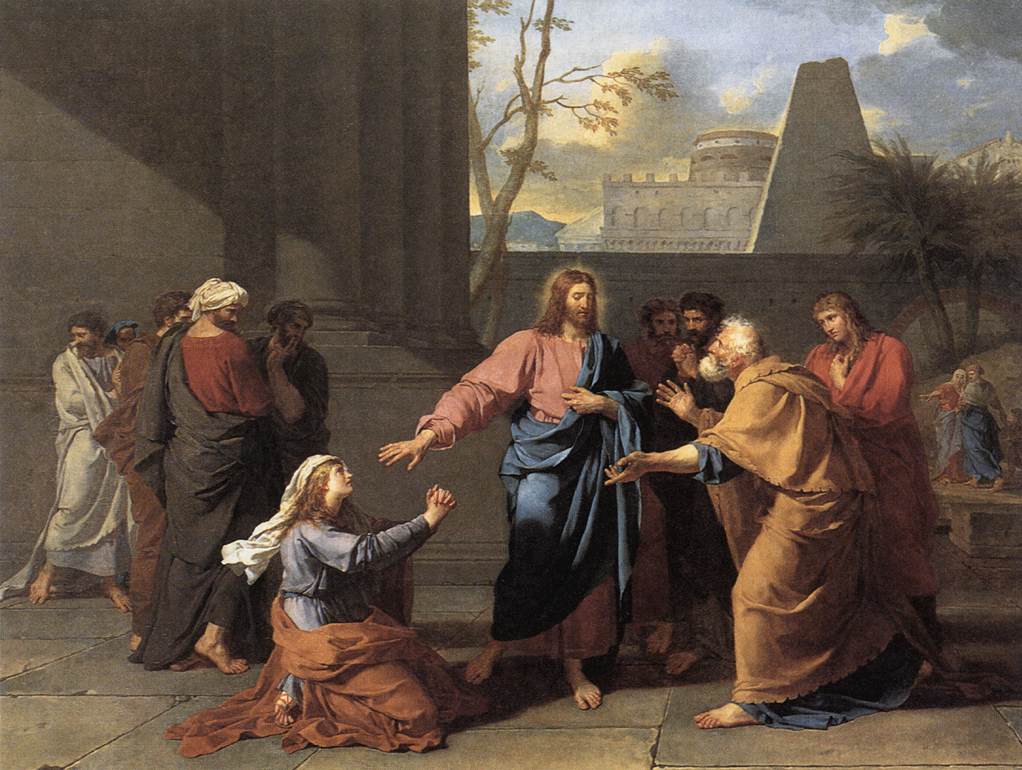
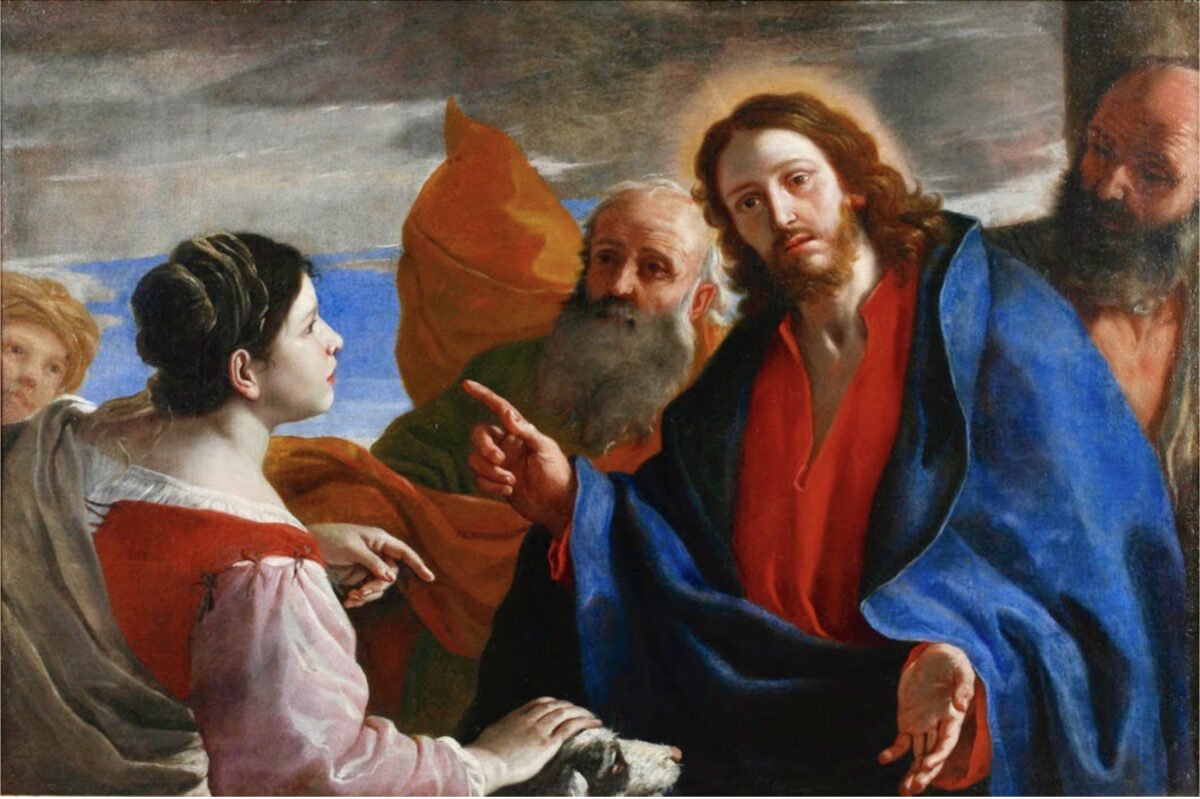
Christ and the Canaanite Woman

Germain-Jean Drouais

1784
Louvre, Paris

7 posted on 02/13/2025 6:49:30 AM PST by annalex (fear them not)
[ Post Reply | Private Reply | To 6 | View Replies]

To: annalex

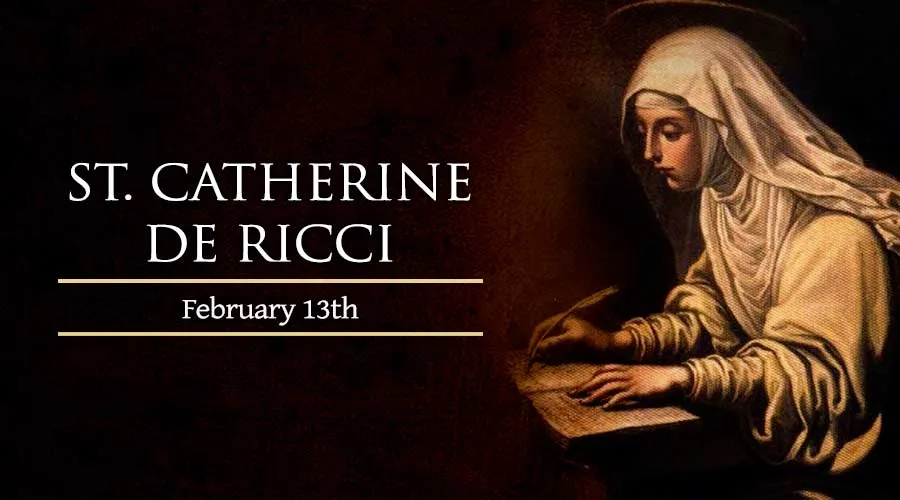
St. Catherine de Ricci
Feast day: Feb 13

St. Catherine de Ricci

The Ricci are an ancient family in Tuscany. Catherine was born at Florence in 1522, and called at her baptism Alexandrina, but she took the name of Catherine at her religious profession. Having lost her mother in her infancy, her father placed her in the Convent of Monticelli, near the gates of Florence, where her aunt, Louisa de Ricci, was a nun when she was between the age of six and seven. To her, this place was a paradise, but after some years her father took her home. Attracted to the religious life, and with the consent of her father, she received the religious veil in the convent of Dominicanesses at Prat, in Tuscany in the year 1535 at fourteen years of age.

For two years she suffered inexpressible pains under a complication of violent distempers, which remedies only seemed to increase. These sufferings she sanctified by the interior disposition with which she bore them, and which she nourished by assiduous meditation on the passion of Christ. The victory over herself, and purgation of her affections was completed by a perfect spirit of prayer; for by the union of her soul with God, and the establishment of the absolute reign of his love in her heart, she was dead to and disengaged from all earthly things.

The saint was chosen, when very young, first as mistress of the novices, then sub-prioress, and, in the twenty-fifth year of her age, was appointed as perpetual prioress. The reputation of her extraordinary sanctity and prudence drew her many visits from a great number of bishops, princes, and cardinals-among them, the Cardinals Cervini, Alexander of Medicis, and Aldobrandini, who all three were afterwards raised to St. Peter's chair, under the names of Marcellus II, Clement VIII, and Leo XI.

Most wonderful were the raptures of St. Catherine in meditating on the passion of Christ, which was her daily exercise, but to which she totally devoted herself every week from Thursday noon to three o'clock in the afternoon on Friday.

One of the miracles that was documented for her canonization was her appearance many hundreds of miles away from where she was physically located. This involved appearing in a vision St Philip Neri, a resident of Rome, with whom she had maintained a long-term correspondence. Neri, who was otherwise very reluctant to discuss miraculous events, confirmed the event.

After a long illness she passed from this mortal life to everlasting bliss and possession of the object of all her desires on the feast of the Purification of our Lady, on the 2nd of February, in 1589, the sixty-seventh year of her age. The ceremony of her beatification was performed by Clement XII in 1732, and that of her canonization by Benedict XIV in 1746.


catholicnewsagency.com

8 posted on 02/13/2025 6:52:42 AM PST by annalex (fear them not)
[ Post Reply | Private Reply | To 7 | View Replies]

To: annalex

9 posted on 02/13/2025 6:54:16 AM PST by annalex (fear them not)
[ Post Reply | Private Reply | To 8 | View Replies]

To: annalex

NAVARRE BIBLE COMMENTARY (RSV)

Ad Majorem Dei Gloriam (To the Greater Glory of God)

First Reading:

From: Genesis 2:18-25

The Creation of Eve
-------------------
[18] Then the Lord God said, "It is not good that the man should be alone; I will make him a helper fit for him." [19] So out of the ground the Lord God formed every beast of the field and every bird of the air, and brought them to the man to see what he would call them; and whatever the man called every living creature, that was its name. [20] The man gave names to all, cattle, and to the birds of the air, and to every beast of the field; but for the man there was not found a helper fit for him. [21] So the Lord God caused a deep sleep to fall upon the man, and while he slept took one of his ribs and closed up its place with flesh; [22] and the rib which the Lord God had taken from the man he made into a woman and brought her to the man. [23] Then the man said, "This at last is bone of my bones and flesh of my flesh; she shall be called Woman, because she was taken out of Man." [24] Therefore a man leaves his father and his mother and cleaves to his wife, and they be- come one flesh. [25] And the man and his wife were both naked, and were not ashamed.

***************************************************
Commentary:

2:8-15. Here we have a scenario in which God and man are friends; there is no such thing as evil or death. The garden is described as being a leafy oasis, with the special feature of having two trees in the center, the tree of life and the tree of the knowledge of good and evil--symbolizing the power to give life, and the ultimate reference-point for man's moral behavior. Out of the garden flow the four rivers the author is most familiar with; these water the entire earth and make it fertile. What the Bible is teaching here is that man was created to be happy, to enjoy the life and goodness which flow from God. "The Church interpreting the symbolism of biblical language in an authentic way, in the light of the New Testament and Tradition teaches that our first parents, Adam Eve, were constituted in an original 'state of holiness and justice' (Council of Trent, "De Peccato Originali"). This grace of original holiness was 'to share in...divine life' ("Lumen Gentium", 2)" ("Catechism the Catholic Church", 375).

From the outset, man is charged with cultivating the garden--working it, protecting it and making it bear fruit. Here again we can see that work is a commission that God gives man from the start. "From the beginning of creation man has had to work," St. J. Escriva said. 'This not something that I have invented. It is enough to turn to the opening pages the Bible. There you can read that, before sin entered the world, and in its wake death, punishment and misery (cf. Rom 5:12). God made Adam from the clay the earth, and created for him and descendants this beautiful world we live in, "ut operaretur et custodiret illum" (Gen 2:15), so that we might cultivate it and look after it" ("Friends of God", 57). But man needs to recognize God's mastery over creation and over himself by obeying the commandment God gives him as a kind of covenant, telling him not to eat the forbidden fruit. If man lost the original happiness he was created to enjoy (the writer will later explain), it was because he broke that covenant.

2:16-17. The fact that man had access to the "tree of the knowledge of good and evil" means that God left the way open to the possibility of evil in order to ensure a greater good--the freedom which is man's endowment. By using his reason and following his conscience, man is able to discern what is good and what is evil; but he himself cannot "make" something good or evil. So, God's command to our first parents implies that they have a duty to recognize that they are creatures and have a duty to reverence and respect goodness, as reflected in the laws of creation and in the dignity proper to man as a person. Were man to want to decide on good and evil for himself, ignoring the good-ness God impressed on things when he created them, it would mean man wanted to be like God. Man is always being tempted towards absolute moral autonomy--and he gives in to that temptation when he forgets that there exists a God who is the Creator and Lord of all, man included.

"The tree of the knowledge of good and evil," John Paul II comments, "was to express and constantly remind man of the 'limit' impassable for a created being" ("Dominum Et Vivificantem", 36).

2:18-25. God continues to take care of man, his creature. The sacred writer conveys this by means of a human metaphor, depicting God as a potter who realizes his creation is not yet perfect. The creation of the human being is not yet over: he needs to be able to live in a full and deep union with another of his kind. The animals were also created by God, but they cannot provide complete companionship. So God creates woman, giving her the same body as man. From now on it is possible for the human being to communicate. The creation of woman, therefore, marks the climax of God's love for the human being he created.

This passage also shows us man's interiority: he is aware of his own aloneness. Although here loneliness is more a possibility and a fear rather than a real situation, we are being told that it is through awareness of being alone that man can appreciate the benefit of communion with others.

10 posted on 02/13/2025 8:23:36 AM PST by fidelis (👈 Under no obligation to respond to rude, ignorant, abusive, bellicose, and obnoxious posts.)
[ Post Reply | Private Reply | To 9 | View Replies]

Gospel Reading:

From: Mark 7:24-30

The Curing of the Syrophoenician Woman
--------------------------------------
[24] And from there he (Jesus) arose and went away to the region of Tyre and Sidon. And he entered a house, and would not have any one know it; yet he could not be hid. [25] But immediately a woman, whose little daughter was possessed by an unclean spirit, heard of him, and came and fell down at his feet. [26] Now the woman was a Greek, a Syrophoenician by birth. And she begged him to cast the demon out of her daughter. [27] And he said to her, "Let the children first be fed, for it is not right to take the children's bread and throw it to the dogs." [28] But she answered him, "Yes, Lord; yet even the dogs under the table eat the children's crumbs." [29] And he said to her, "For this saying you may go your way; the demon has left your daughter." [30] And she went home, and found the child lying in bed, and the demon gone.

***********************************************************************
Commentary:

24. The region of Tyre and Sidon is nowadays the southern part of Lebanon--Phoenicia in ancient times. The distance from the lake of Gennesaret to the frontier of Tyre and Sidon is not more than 50 kms (30 miles). Jesus withdrew from Palestine to avoid persecution by the Jewish authorities and to give the Apostles more intensive training.

27. Our Lord actually uses the diminutive—"little dogs" to refer to the Gentiles—thereby softening a scornful expression which Jews used. On the episode of the Canaanite woman cf. notes on parallel passages, Mt 15:21-28.

[The notes on Mt 15:21-28 states: 21-22. Tyre and Sidon were Phoenician cities on the Mediterranean coast, in present-day Lebanon. They were never part of Galilee but they were near its northeastern border. In Jesus' time they were outside the territory of Herod Antipas. Jesus withdrew to this area to escape persecution from Herod and from the Jewish authorities and to concentrate on training His Apostles.

Most of the inhabitants of the district of Tyre and Sidon were pagans. St. Matthew calls this woman a "Canaanite"; according to Genesis (10:15), this district was one of the first to be settled by the Canaanites; St. Mark describes the woman as a "Syrophoenician" (Mark 7:26). Both Gospels point out that she is a pagan, which means that her faith in our Lord is more remarkable; the same applies in the case of the centurion (Matthew 8:5-13).

The Canaanite woman's prayer is quite perfect: she recognizes Jesus as the Messiah (the Son of David)--which contrasts with the unbelief of the Jews; she expresses her need in clear, simple words; she persists, undismayed by obstacles; and she expresses her request in all humility: "Have mercy on me." Our prayer should have the same qualities of faith, trust, perseverance and humility.

24. What Jesus says here does not take from the universal reference of His teaching (cf. Matthew 28:19-20; Mark 16:15-16). Our Lord came to bring His Gospel to the whole world, but He Himself addressed only the Jews; later on He will charge His Apostles to preach the Gospel to pagans. St. Paul, in his missionary journeys, also adopted the policy of preaching in the first instance to the Jews (Acts 13:46).

25-28. This dialogue between Jesus and the woman is especially beautiful. By appearing to be harsh He so strengthens the woman's faith that she deserves exceptional praise: "Great is your faith!" Our own conversation with Christ should be like that: "Persevere in prayer. Persevere, even when your efforts seem barren. Prayer is always fruitful" (St J. Escriva, "The Way", 101).]

11 posted on 02/13/2025 8:23:52 AM PST by fidelis (👈 Under no obligation to respond to rude, ignorant, abusive, bellicose, and obnoxious posts.)
[ Post Reply | Private Reply | To 10 | View Replies]

Click here to go to the My Catholic Life! Devotional thread for a meditation on today’s Gospel Reading.

12 posted on 02/13/2025 8:24:42 AM PST by fidelis (👈 Under no obligation to respond to rude, ignorant, abusive, bellicose, and obnoxious posts.)
[ Post Reply | Private Reply | To 11 | View Replies]

Disclaimer: Opinions posted on Free Republic are those of the individual posters and do not necessarily represent the opinion of Free Republic or its management. All materials posted herein are protected by copyright law and the exemption for fair use of copyrighted works.

Free Republic
Browse · Search
Religion
Topics · Post Article

FreeRepublic, LLC, PO BOX 9771, FRESNO, CA 93794
FreeRepublic.com is powered by software copyright 2000-2008 John Robinson