Skip to comments.
Catholic Caucus: Daily Mass Readings 10-February-2025
Universalis/Jerusalem Bible ^
Posted on 02/10/2025 3:43:42 AM PST by annalex
10 February 2025
Saint Scholastica, Virgin
on Monday of week 5 in Ordinary Time

St. Scholastica Parish, DetroitReadings at MassLiturgical Colour: White. Year: C(I). Readings for the feria Readings for the memorial These are the readings for the feria
| First reading | Genesis 1:1-19 |
|---|
God saw that it was goodIn the beginning God created the heavens and the earth. Now the earth was a formless void, there was darkness over the deep, and God’s spirit hovered over the water. God said, ‘Let there be light’, and there was light. God saw that light was good, and God divided light from darkness. God called light ‘day’, and darkness he called ‘night.’ Evening came and morning came: the first day. God said, ‘Let there be a vault in the waters to divide the waters in two.’ And so it was. God made the vault, and it divided the waters above the vault from the waters under the vault. God called the vault ‘heaven.’ Evening came and morning came: the second day. God said, ‘Let the waters under heaven come together into a single mass, and let dry land appear.’ And so it was. God called the dry land ‘earth’ and the mass of waters ‘seas’, and God saw that it was good. God said, ‘Let the earth produce vegetation: seed-bearing plants, and fruit trees bearing fruit with their seed inside, on the earth.’ And so it was. The earth produced vegetation: plants bearing seed in their several kinds, and trees bearing fruit with their seed inside in their several kinds. God saw that it was good. Evening came and morning came: the third day. God said, ‘Let there be lights in the vault of heaven to divide day from night, and let them indicate festivals, days and years. Let them be lights in the vault of heaven to shine on the earth.’ And so it was. God made the two great lights: the greater light to govern the day, the smaller light to govern the night, and the stars. God set them in the vault of heaven to shine on the earth, to govern the day and the night and to divide light from darkness. God saw that it was good. Evening came and morning came: the fourth day.
| Responsorial Psalm |
|---|
| Psalm 103(104):1-2,5-6,10,12,24,35 |
|---|
May the Lord rejoice in his works! Bless the Lord, my soul! Lord God, how great you are, clothed in majesty and glory, wrapped in light as in a robe! May the Lord rejoice in his works! You founded the earth on its base, to stand firm from age to age. You wrapped it with the ocean like a cloak: the waters stood higher than the mountains. May the Lord rejoice in his works! You make springs gush forth in the valleys; they flow in between the hills. On their banks dwell the birds of heaven; from the branches they sing their song. May the Lord rejoice in his works! How many are your works, O Lord! In wisdom you have made them all. The earth is full of your riches. Bless the Lord, my soul! May the Lord rejoice in his works!
Alleluia, alleluia! I am the light of the world, says the Lord; anyone who follows me will have the light of life. Alleluia! Alleluia, alleluia! Jesus proclaimed the Good News of the kingdom and cured all kinds of sickness among the people. Alleluia!
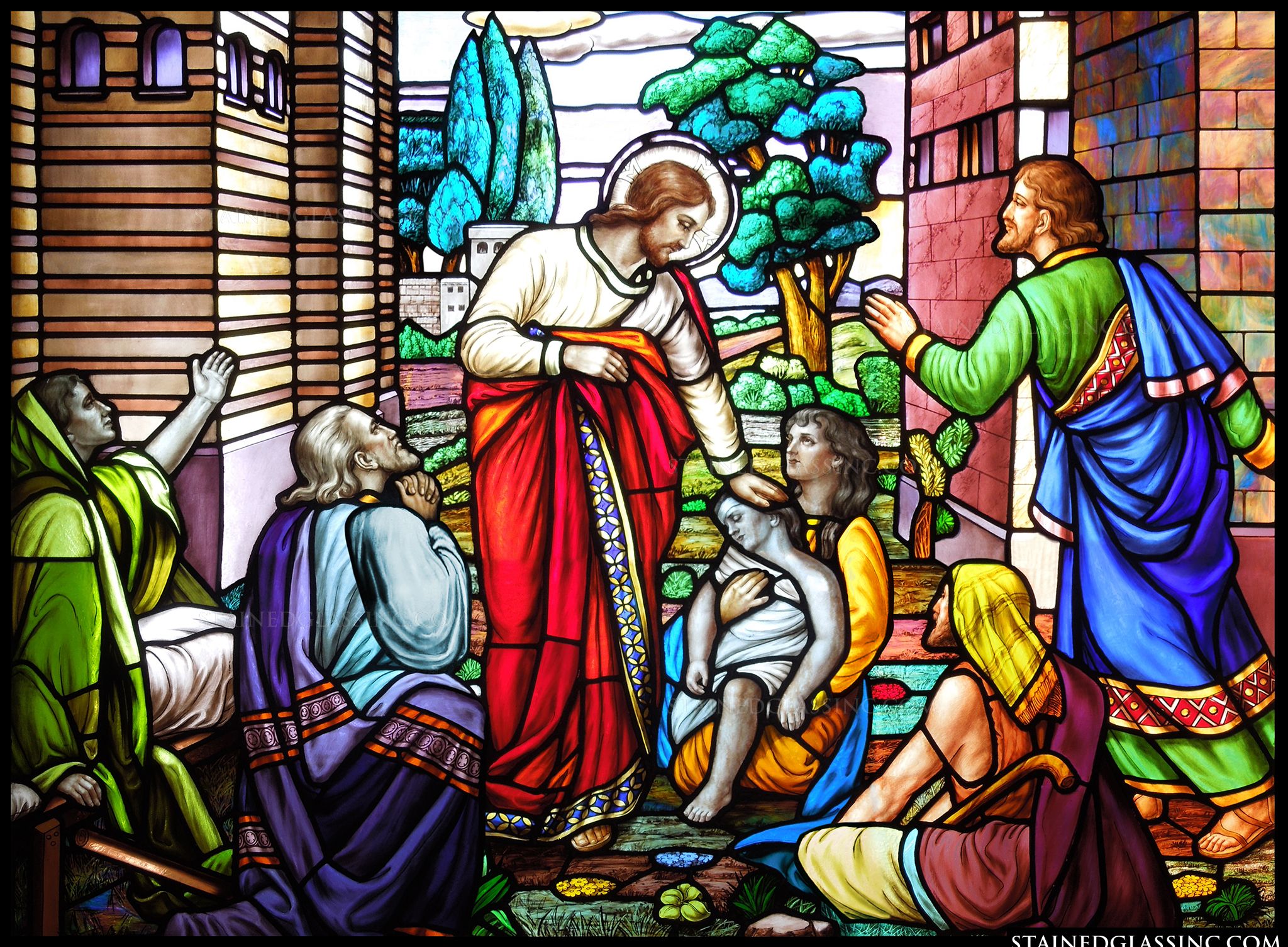
All those who touched him were curedHaving made the crossing, Jesus and his disciples came to land at Gennesaret and tied up. No sooner had they stepped out of the boat than people recognised him, and started hurrying all through the countryside and brought the sick on stretchers to wherever they heard he was. And wherever he went, to village, or town, or farm, they laid down the sick in the open spaces, begging him to let them touch even the fringe of his cloak. And all those who touched him were cured. Continue These are the readings for the memorial
| First reading |
|---|
| Song of Songs 8:6-7 |
|---|
The flash of love is a flame of the Lord himselfSet me like a seal on your heart, like a seal on your arm. For love is strong as Death, jealousy as relentless as Sheol. The flash of it is a flash of fire, a flame of the Lord himself. Love no floods can quench, no torrents drown. Were a man to offer all the wealth of his house to buy love, contempt is all he would purchase.
| Responsorial Psalm |
|---|
| Psalm 148:1-2,11-14 |
|---|
Your glory fills all heaven and earth. or Alleluia! Praise the Lord from the heavens, praise him in the heights. Praise him, all his angels, praise him, all his host. Your glory fills all heaven and earth. or Alleluia! All earth’s kings and peoples, earth’s princes and rulers, young men and maidens, old men together with children. Your glory fills all heaven and earth. or Alleluia! Let them praise the name of the Lord for he alone is exalted. The splendour of his name reaches beyond heaven and earth. Your glory fills all heaven and earth. or Alleluia! He exalts the strength of his people. He is the praise of all his saints, of the sons of Israel, of the people to whom he comes close. Your glory fills all heaven and earth. or Alleluia!
| Gospel Acclamation | Jn14:23 |
|---|
Alleluia, alleluia! If anyone loves me he will keep my word, and my Father will love him, and we shall come to him. Alleluia!
Martha works; Mary listensJesus came to a village, and a woman named Martha welcomed him into her house. She had a sister called Mary, who sat down at the Lord’s feet and listened to him speaking. Now Martha who was distracted with all the serving said, ‘Lord, do you not care that my sister is leaving me to do the serving all by myself? Please tell her to help me.’ But the Lord answered: ‘Martha, Martha,’ he said ‘you worry and fret about so many things, and yet few are needed, indeed only one. It is Mary who has chosen the better part; it is not to be taken from her.’ Continue Universalis podcast: The week ahead – from 9 to 15 FebruarySaint Scholastica; the Shipwreck of St Paul; Our Lady of Lourdes; Saints Cyril and Methodius, and the Basilica of San Clemente. (20 minutes)
Episode notes.Play Christian Art Each day, The Christian Art website gives a picture and reflection on the Gospel of the day. The readings on this page are from the Jerusalem Bible, which is used at Mass in most of the English-speaking world. The New American Bible readings, which are used at Mass in the United States, are available in the Universalis apps, programs and downloads.
You can also view this page with the Gospel in Greek and English. |
TOPICS: Catholic; General Discusssion; Prayer; Worship
KEYWORDS: catholic; lk10; mk6; ordinarytime; prayer
For your reading, reflection, faith-sharing, comments, questions, discussion.
1
posted on
02/10/2025 3:43:42 AM PST
by
annalex
To: annalex
KEYWORDS: catholic; lk10; mk6; ordinarytime; prayer
2
posted on
02/10/2025 3:44:30 AM PST
by
annalex
(fear them not)
To: nickcarraway; NYer; ELS; Pyro7480; livius; ArrogantBustard; Catholicguy; RobbyS; marshmallow; ...

Alleluia Ping Please FReepmail me to get on/off the Alleluia Ping List.
3
posted on
02/10/2025 3:45:22 AM PST
by
annalex
(fear them not)
To: annalex
4
posted on
02/10/2025 3:45:45 AM PST
by
annalex
(fear them not)
To: annalex
| Mark |
| | English: Douay-Rheims | Latin: Vulgata Clementina | Greek NT: Byzantine/Majority Text (2000) |
| | Mark 6
|
| 53. | And when they had passed over, they came into the land of Genezareth, and set to the shore. | Et cum transfretassent, venerunt in terram Genesareth, et applicuerunt. | και διαπερασαντες ηλθον επι την γην γεννησαρετ και προσωρμισθησαν |
| 54. | And when they were gone out of the ship, immediately they knew him: | Cumque egressi essent de navi, continuo cognoverunt eum : | και εξελθοντων αυτων εκ του πλοιου ευθεως επιγνοντες αυτον |
| 55. | And running through that whole country, they began to carry about in beds those that were sick, where they heard he was. | et percurrentes universam regionem illam, cœperunt in grabatis eos, qui se male habebant, circumferre, ubi audiebant eum esse. | περιδραμοντες ολην την περιχωρον εκεινην ηρξαντο επι τοις κραββατοις τους κακως εχοντας περιφερειν οπου ηκουον οτι εκει εστιν |
| 56. | And whithersoever he entered, into towns or into villages or cities, they laid the sick in the streets, and besought him that they might touch but the hem of his garment: and as many as touched him were made whole. | Et quocumque introibat, in vicos, vel in villas aut civitates, in plateis ponebant infirmos, et deprecabantur eum, ut vel fimbriam vestimenti ejus tangerent, et quotquot tangebant eum, salvi fiebant. | και οπου αν εισεπορευετο εις κωμας η πολεις η αγρους εν ταις αγοραις ετιθουν τους ασθενουντας και παρεκαλουν αυτον ινα καν του κρασπεδου του ιματιου αυτου αψωνται και οσοι αν ηπτοντο αυτου εσωζοντο |
5
posted on
02/10/2025 3:48:52 AM PST
by
annalex
(fear them not)
To: annalex
6:53–56
53. And when they had passed over, they came into the land of Gennesaret, and drew to the shore.
54. And when they were come out of the ship, straightway they knew him,
55. And ran through that whole region round about, and began to carry about in beds those that were sick, where they heard he was.
56. And whithersoever he entered, into villages, or cities, or country, they laid the sick in the streets, and besought him that they might touch if it were but the border of his garment: and as many as touched him were made whole.
GLOSS. (non occ.) The Evangelist, having shewn the danger which the disciples had sustained in their passage, and their deliverance from it, now shews the place to which they sailed, saying, And when they had passed over, they came into the land of Gennesaret, and drew to the shore.
THEOPHYLACT. The Lord remained at the above-mentioned place for some time. Therefore the Evangelist subjoins, And when they had come out of the ship, straightway they knew him, that is, the inhabitants of the country.
BEDE. (ubi sup.) But they knew Him by report, not by His features; or through the greatness of His miracles, even His person was known to some. See too how great was the faith of the men of the land of Gennesaret, so that they were not content with the healing of those who were present, but sent to other towns round about, that all might hasten to the Physician; wherefore there follows, And ran through the whole region round about, and began to carry about in beds those that were sick, where they heard he was.
THEOPHYLACT. For they did not call Him to their houses that He might heal them, but rather the sick themselves were brought to Him. Wherefore it also follows, And whithersoever he entered into villages, or cities, or country, &c. For the miracle which had been wrought on the woman with an issue of blood, had reached the ears of many, and caused in them that great faith, by which they were healed. It goes on, And as many as touched him were made whole.
BEDE. (ubi sup.) Again, in a mystical sense, do thou understand by the hem of His garment the slightest of His commandments, for whosoever shall transgress it shall be called the least in the kingdom of heaven, (Matt. 5:19) or else His assumption of our flesh, by which we have come to the Word of God, and afterwards, shall have the enjoyment of His majesty.
PSEUDO-JEROME. Furthermore that which is said, And as many as touched him were made whole, shall be fulfilled, when grief and mourning shall fly away.
Catena Aurea Mark 6
6
posted on
02/10/2025 3:50:21 AM PST
by
annalex
(fear them not)
To: annalex

Attribution unknown
7
posted on
02/10/2025 3:51:13 AM PST
by
annalex
(fear them not)
To: annalex
| Luke |
| | English: Douay-Rheims | Latin: Vulgata Clementina | Greek NT: Byzantine/Majority Text (2000) |
| | Luke 10
|
| 38. | Now it came to pass as they went, that he entered into a certain town: and a certain woman named Martha, received him into her house. | Factum est autem, dum irent, et ipse intravit in quoddam castellum : et mulier quædam, Martha nomine, excepit illum in domum suam, | εγενετο δε εν τω πορευεσθαι αυτους και αυτος εισηλθεν εις κωμην τινα γυνη δε τις ονοματι μαρθα υπεδεξατο αυτον εις τον οικον αυτης |
| 39. | And she had a sister called Mary, who sitting also at the Lord's feet, heard his word. | et huic erat soror nomine Maria, quæ etiam sedens secus pedes Domini, audiebat verbum illius. | και τηδε ην αδελφη καλουμενη μαρια η και παρακαθισασα παρα τους ποδας του ιησου ηκουεν τον λογον αυτου |
| 40. | But Martha was busy about much serving. Who stood and said: Lord, hast thou no care that my sister hath left me alone to serve? speak to her therefore, that she help me. | Martha autem satagebat circa frequens ministerium : quæ stetit, et ait : Domine, non est tibi curæ quod soror mea reliquit me solam ministrare ? dic ergo illi ut me adjuvet. | η δε μαρθα περιεσπατο περι πολλην διακονιαν επιστασα δε ειπεν κυριε ου μελει σοι οτι η αδελφη μου μονην με κατελειπεν διακονειν ειπε ουν αυτη ινα μοι συναντιλαβηται |
| 41. | And the Lord answering, said to her: Martha, Martha, thou art careful, and art troubled about many things: | Et respondens dixit illis Dominus : Martha, Martha, sollicita es, et turbaris erga plurima, | αποκριθεις δε ειπεν αυτη ο ιησους μαρθα μαρθα μεριμνας και τυρβαζη περι πολλα |
| 42. | But one thing is necessary. Mary hath chosen the best part, which shall not be taken away from her. | porro unum est necessarium. Maria optimam partem elegit, quæ non auferetur ab ea. | ενος δε εστιν χρεια μαρια δε την αγαθην μεριδα εξελεξατο ητις ουκ αφαιρεθησεται απ αυτης |
8
posted on
02/10/2025 3:54:40 AM PST
by
annalex
(fear them not)
To: annalex

Catena Aurea by St. Thomas Aguinas
10:38–42
38. Now it came to pass, as they went, that he entered into a certain village: and a certain woman named Martha received him into her house.
39. And she had a sister called Mary, which also sat at Jesus’ feet, and heard his word.
40. But Martha was cumbered about much serving, and came to him, and said, Lord, dost thou not care that my sister hath left me to serve alone? bid her therefore that she help me.
41. And Jesus answered and said unto her, Martha, Martha, thou art careful and troubled about many things:
42. But one thing is needful: and Mary hath chosen that good part, which shall not be taken away from her.
BEDE. The love of God and our neighbour, which was contained above in words and parables, is here set forth in very deed and reality; for it is said, Now it came to pass, as they went, that he entered into a certain village.
ORIGEN. The name of which village Luke indeed here omits, but John mentions, calling it Bethany. (John 11.)
AUGUSTINE. (Ser. 103.) But the Lord, who came to his own, and his own received him not, (John 1:12.) was received as a guest, for it follows, And a certain woman named Martha received him into her house, &c. as strangers are accustomed to be received. But still a servant received her Lord, the sick her Saviour, the creature her Creator. But if any should say, “O blessed are they who have been thought worthy to receive Christ into their houses,” grieve not thou, for He says, For inasmuch as ye have done it to the least of my brethren, ye have done it unto me. (Matt. 25:40.) But taking the form of a servant, He wished therein to be fed by servants, by reason of His condescension, not His condition. He had a body in which He was hungry and thirsty, but when He was hungry in the desert, Angels ministered to Him. (Matt. 4:11.) In wishing therefore to be fed, He came Himself to the feeder. Martha then, setting about and preparing to feed our Lord, was occupied in serving; but Mary her sister chose rather to be fed by the Lord, for it follows, And she had a sister called Mary, which also sat at Jesus’ feet, and heard his word.
CHRYSOSTOM. It is not said of Mary simply that she sat near Jesus, but at His feet, to shew her diligence, stedfastness, and zeal, in hearing, and the great reverence which she had for our Lord.
AUGUSTINE. (ubi sup.) Now as was her humility in sitting at His feet, so much the more did she receive from Him. For the waters pour down to the lowest part of the valley, but flow away from the rising of the hill.
BASIL. (Const. Mon. c. 1.) Now every work and word of our Saviour is a rule of piety and virtue. For to this end did He put on our body, that as much as we can we might imitate His conversation.
CYRIL OF ALEXANDRIA. By His own example then He teaches His disciples how they ought to behave in the houses of those who receive them, namely, when they come to a house, they should not remain idle, but rather fill the minds of those who receive them with sacred and divine teaching. But let those who make ready the house, go to meet their guests gladly and earnestly, for two reasons. First, indeed, they will be edified by the teaching of those whom they receive; next also they will receive the reward of charity. And hence it follows here, But Martha was cumbered about much serving, &c.
AUGUSTINE. (ubi sup.) Martha was well engaged in ministering to the bodily wants or wishes of our Lord, as of one who was mortal, but He who was clothed in mortal flesh; in the beginning was the Word. Behold then what Mary heard, The Word was made flesh. Behold then Him to whom Martha ministered. The one was labouring, the other at rest. But yet Martha, when much troubled in her occupation and business of serving, interrupted our Lord, and complained of her sister. For it follows, And said, Lord, dost thou not care that my sister hath left me to serve alone? For Mary was absorbed in the sweetness of our Lord’s words; Martha was preparing a feast for our Lord, in whose feast Mary was now rejoicing. While then she was listening with delight to those sweet words, and was feeding on them with the deepest affection, our Lord was interrupted by her sister. What must we suppose was her alarm, lest the Lord should say to her, “Rise, and help thy sister?” Our Lord therefore, who was not at a loss, for He had shewn He was the Lord, answered as follows, And Jesus answered and said unto her, Martha, Martha. The repetition of the name is a mark of love, or perhaps of drawing the attention, that she should listen more earnestly. When twice called, she hears, Thou art troubled about many things, that is, thou art busied about many things. For man wishes to meet with something when he is serving, and can not; and thus between seeking what is wanting and preparing what is at hand, the mind is distracted. For if Martha had been sufficient of herself, she would not have required the aid of her sister. There are many, there are diverse things, which are carnal, temporal, but one is preferred to many. For one is not from many, but many from one. Hence it follows, But one thing is needful. Mary wished to be occupied about one, according to that, It is good for me to cling close unto the Lord. (Ps. 73:28.) The Father, the Son, the Holy Spirit, are one. To this one he does not bring us, unless we being many have one heart. (Acts 4:32.)
CYRIL OF ALEXANDRIA. Or else, when certain brethren have received God, they will not be anxious about much service, nor ask for those things which are not in their hands, and are beyond their needs. For every where and in every thing that which is superfluous is burdensome. For it begets weariness in those who are wishing to bestow it, while the guests feel that they are the cause of trouble.
BASIL. (in reg. fus. int. 19.) It is foolish also to take food for the support of the body, and thereby in return to hurt the body, and to hinder it in the performance of the divine command. If then a poor man come, let him receive a model and example of moderation in food, and let us not prepare our own tables for their sakes, who wish to live luxuriously. For the life of the Christian is uniform, ever tending to one object, namely, the glory of God. But the life of those who are without is manifold and vacillating, changed about at will. And how in truth canst thou, when thou settest thy table before thy brother with profusion of meats, and for the pleasure of feasting sake, accuse him of luxury, and revile him as a glutton, censuring his indulgence in that which thou thyself affordest him? Our Lord did not commend Martha when busied about much serving.
AUGUSTINE. (Serm. 104.) What then? Must we think that blame was cast upon the service of Martha, who was engaged in the cares of hospitality, and rejoiced in having so great a guest? If this be true, let men give up ministering to the needy; in a word, let them be at leisure, intent only upon getting wholesome knowledge, taking no care what stranger is in the village in want of bread; let works of mercy be unheeded, knowledge only be cultivated.
THEOPHYLACT. Our Lord does not then forbid hospitality, but the troubling about many things, that is to say, hurry and anxiety. And mark the wisdom of our Lord, in that at first He said nothing to Martha, but when she sought to tear away her sister from hearing, then the Lord took occasion to reprove her. For hospitality is ever honoured as long as it keeps us to necessary things. But when it begins to hinder us from attending to what is of more importance, then it is plain that the hearing of the divine word is the more honourable.
AUGUSTINE. (Serm. 104.) Our Lord then does not blame the actions, but distinguishes between the duties. For it follows, Mary hath chosen that good part, &c. Not thine a bad one, but hers a better. Why a better? because it shall not be taken away from her. From thee the necessary burden of business shall one time be taken away. For when thou comest into that country, thou wilt find no stranger to receive with hospitality. But for thy good it shall be taken away, that what is better may be given thee. Trouble shall be taken away, that rest may be given. Thou art yet at sea; she is in port. For the sweetness of truth is eternal, yet in this life it is increased, and in the next it will be made perfect, never to be taken away.
AMBROSE. May you then like Mary be influenced by the desire of wisdom. For this is the greater, this the more perfect work. Nor let the care of ministering to others turn thy mind from the knowledge of the heavenly word, nor reprove or think indolent those whom thou seest seeking after wisdom.
AUGUSTINE. (de Qu. Evang. l. ii. q. 30.) Now mystically, by Martha’s receiving our Lord into her house is represented the Church which now receives the Lord into her heart. Mary her sister, who sat at Jesus’ feet and heard His word, signifies the same Church, but in a future life, where ceasing from labour, and the ministering to her wants, she shall delight in Wisdom alone. But by her complaining that her sister did not help her, occasion is given for that sentence of our Lord, in which he shews that Church to be anxious and troubled about much service, when there is but one thing needful, which is yet attained through the merits of her service; but He says that Mary hath chosen the good part, for through the one the other is reached, which shall not be taken away.
GREGORY. (6. Mor. c. 18.) Or by Mary who sat and heard our Lord’s words, is signified the contemplative life; by Martha engaged in more outward services, the active life. Now Martha’s care is not blamed, but Mary is praised, for great are the rewards of an active life, but those of a contemplative are far better. Hence Mary’s part it is said will never be taken away from her, for the works of an active life pass away with the body, but the joys of the contemplative life the rather begin to increase from the end.
Catena Aurea Luke 10
9
posted on
02/10/2025 3:56:03 AM PST
by
annalex
(fear them not)
To: annalex

St. Martha, Lazarus' sister
10
posted on
02/10/2025 3:57:53 AM PST
by
annalex
(fear them not)
To: annalex
Saint of the Day for February 10
(c. 480 – February 10, 542)
Saint Scholastica’s Story
Twins often share the same interests and ideas with an equal intensity. Therefore, it is no surprise that Scholastica and her twin brother, Benedict, established religious communities within a few miles from each other.
Born in 480 of wealthy parents, Scholastica and Benedict were brought up together until he left central Italy for Rome to continue his studies.
Little is known of Scholastica’s early life. She founded a religious community for women near Monte Cassino at Plombariola, five miles from where her brother governed a monastery.
The twins visited each other once a year in a farmhouse because Scholastica was not permitted inside the monastery. They spent these times discussing spiritual matters.
According to the Dialogues of St. Gregory the Great, the brother and sister spent their last day together in prayer and conversation. Scholastica sensed her death was close at hand and she begged Benedict to stay with her until the next day.
He refused her request because he did not want to spend a night outside the monastery, thus breaking his own Rule. Scholastica asked God to let her brother remain and a severe thunderstorm broke out, preventing Benedict and his monks from returning to the abbey.
Benedict cried out, “God forgive you, Sister. What have you done?” Scholastica replied, “I asked a favor of you and you refused. I asked it of God and he granted it.”
Brother and sister parted the next morning after their long discussion. Three days later, Benedict was praying in his monastery and saw the soul of his sister rising heavenward in the form of a white dove. Benedict then announced the death of his sister to the monks and later buried her in the tomb he had prepared for himself.
Reflection
Scholastica and Benedict gave themselves totally to God and gave top priority to deepening their friendship with him through prayer. They sacrificed some of the opportunities they would have had to be together as brother and sister in order better to fulfill their vocation to the religious life. In coming closer to Christ, however, they found they were also closer to each other. In joining a religious community, they did not forget or forsake their family but rather found more brothers and sisters.
Saint Scholastica is the Patron Saint of:
Cloistered Nuns
franciscanmedia.org
11
posted on
02/10/2025 4:01:44 AM PST
by
annalex
(fear them not)
To: annalex
12
posted on
02/10/2025 4:03:09 AM PST
by
annalex
(fear them not)
To: annalex
Thanks for posting! Beautiful statue. Today is also my brother John’s birthday, fallen away Catholic.
13
posted on
02/10/2025 4:17:33 AM PST
by
MomwithHope
(Forever grateful to all our patriots, past, present and future.)
To: annalex
NAVARRE BIBLE COMMENTARY (RSV)
Ad Majorem Dei Gloriam (To the Greater Glory of God)
First Reading:
From: Genesis 1:1-19
The Creation Account
---------------------------
[1] In the beginning God created the heavens and the earth. [2] The earth was without form and void, and darkness was upon the face of the deep; and the Spirit of God was moving over the face of the waters.
[3] And God said, "Let there be light"; and there was light. [4] And God saw that the light was good; and God separated the light from the darkness. [5] God called the light Day, and the darkness he called Night. And there was evening and there was morning, one day.
[6] And God said, "Let there be a firmament in the midst of the waters, and let it separate the waters from the waters." [7] And God made the firmament and separated the waters which were under the firmament from the waters which were above the firmament. And it was so. [8] And God called the firmament Heaven. And there was evening and there was morning, a second day.
[9] And God said, "Let the waters under the heavens be gathered together into one place, and let the dry land appear." And it was so. [10] God called the dry land Earth, and the waters that were gathered together he called Seas. And God saw that it was good. [11] And God said, "Let the earth put forth vegetation, plants yielding seed, and fruit trees bearing fruit in which is their seed, each according to its kind, upon the earth." And it was so. [12] The earth brought forth vegetation, plants yielding seed according to their own kinds, and trees hearing fruit in which is their seed, each according to its kind. And God saw that it was good. [13] And there was evening and there was morning, a third day.
[14] And God said, "Let there be lights in the firmament of the heavens to separate the day from the night; and let them be for signs and for seasons and for days and years, [15] and let them be lights in the firmament of the heavens to give light upon the earth." And it was so. [16] And God made the two great lights, the greater light to rule the day, and the lesser light to rule the night; he made the stars also. [17] And God set them in the firmament of the heavens to give light upon the earth, [18] to rule over the day and over the night, and to separate the light from the darkness. And God saw that it was good. [19] And there was evening and there was morning, a fourth day.
***********************************************************************
Commentary:
1:1-2:4a. Creation is the beginning of salvation history and the foundation on which are built God's salvific plans, which reach their climax in Jesus Christ. The biblical accounts of creation focus on the action of God; it is he who sets the scene and he is the creator, too, of those who will act out the drama and with whom he will enter into dialogue.
The sacred text incorporates ancient traditions about the origin of the world; scholars identify two separate accounts in the early chapters of Genesis. The first of these emphasizes God's transcendence over all created things, and is written in a very schematic style; this account (1:1-2:4a) is attributed to the "Priestly" tradition. The second, which also covers the fall and the expulsion from paradise, speaks of God in an anthropomorphic way; this more vivid, more popular account (2:4b-4:26) is considered to belong to the "Yahwistic" tradition. Here we have two different ways in which the Word of God (not intending to provide a scientific explanation of the origin of the world and of man) expounds the basic facts and truths on the subject in a way people can readily understand, inviting us to see me greatness and love of God manifested first in creation and then in the history of mankind. "Our faith teaches us," St. Josemaria Escriva writes, "that all creation, the movement of the earth and the other heavenly bodies, the good actions of creatures and all the good that has been achieved in history, in short everything, comes from God and directed toward him" ("Christ Is Passing By", 130).
In the first account the Bible offers profound teaching about God, about man and about the world. About God, who is the only God, creator of all things and man in particular; he transcends the created world and is its supreme master. About man, who is the image and likeness of God, above all other created beings and placed in the world to rule all creation. About the world, which is something good and is at the service of man.
1.1. "Three things are affirmed in these first words of Scripture: the eternal God gave a beginning to all that exists outside of himself; he alone is Creator (the verb 'create'--Hebrew "bara"--always has God for its subject). The totality of what exists (expressed by the formula 'the heavens and the earth') depends on the One who gives it being" ("Catechism of the Catholic Church", 290).
"In the beginning" means that creation marks the start of time and the course of history. Time and history have a beginning and they are headed towards a final goal, which the Bible will tell us more about, especially in its last book, Revelation. At the end, we are told: 'Then I saw a new heaven and a new earth; for the first heaven and the first earth had passed away, and the sea was no more" (Rev 21:1).
God the Creator is the same God as will manifest himself to the patriarchs, to Moses and to the prophets and make himself known to as through Jesus Christ. In the light of the New Testament we know that God created all things through his eternal Word, his beloved Son (cf. Jn 1:1; Col 1:16-17). God the Creator is Father and Son and (the relationship of love between them) the Holy Spirit. Creation is the work of the Blessed Trinity, and all of creation (particularly man, created in the image and likeness of God) in some way bears their seal. Some Fathers of the Church (Augustine, Ambrose and Basil, for example), in the light of the New Testament, saw the words "in the beginning" as having a deeper meaning--namely, "in the Son".
The "action of creating" belongs exclusively to God; man cannot create; he can only "change" or "develop" something that already exists. In the creation accounts of other Near East religions the world and gods developed out of preexistent matter. The Bible, however, records gradual revelation of the mystery of creation interpreted in the light of God's choice of Israel and his covenant with mankind; it roundly asserts that everything was made by God. Later on it will draw the conclusion that everything was created out of' nothing: "I beseech you, my child, to look at the heavens and the earth and see everything that is in them, and to recognize that God did not make them out of things that existed" (2 Mac 7:28). This creative power of God is also able to give sinful man a pure heart (cf. Ps 51:12), to restore the dead to life and to give the light of faith to those who do not know him (cf. 2 Cor 4:6).
It was God's love and wisdom that moved him to create the world, thereby communicating his goodness and making his glory manifest. The world, therefore, "is not the product of any necessity whatever, nor of blind, fate or chance. We believe that it proceeds from God's free will; he wanted to make his creatures share in his being, wisdom and goodness" ("Catechism of the Catholic Church", 295).
The expression "the heavens and the earth" means everything that exists. The earth is the world of men; the sky (or the heavens) can mean the firmament or the divine world, God's own "place", his glory and all spiritual (non-material) creatures the angels.
1:2. The Bible teaches not just that God created all things, but also that the separation and ordering of the elements of nature is something established by God once and for all. The presence of the loving power of God, symbolized by a gentle breeze or a breath (the text refers to it as a spirit; "ruah" in Hebrew) which hovers and keeps watch over the world when it is still in chaos, shows that, as the text will go on to say, the Word of God and his Breath are present in the origin of being and in the origin of every creature's life. That is why many Fathers of the Church (Jerome and Athanasaus, for example) saw this passage as reflecting the presence of the Holy Spirit as a divine Person who, along with the Father and the Son, is at work in the creation of the world, "This biblical concept of creation", John Paul II explains, "includes not only the call to existence of the very being of the cosmos, that is to say, "the giving of existence", but also the presence of the Spirit of God in creation, that is to say, the beginning of "first of all concerning man", who has been created in the image and likeness of God" ("Dominum Et Vivificantem", 12).
1:3-5. At this point strictly speaking begins the description of the creation, which, according to the literary plan of this account, is going to take place over six days. These six days are meant to indicate the orderliness with which God went about his work, and to show a rhythm of work and rest: the Jewish Law laid down Saturday, the Sabbath, as a day of rest and a day dedicated to the Lord. In the Christian Church this day was shifted to Sunday, because Sunday was the day on which our Lord rose from the dead, thereby inaugurating the new Creation: Sunday, the "dies dominica" (Latin), the Lord's day.
On the first day God creates light and separates light from darkness (the latter, being something negative--the absence of light--cannot be created). Light is seen here as being a thing in its own right (without reference to the fact that daylight comes from the sun, which will not be created until the fourth day). The fact that God puts names on things (or in this case on situations caused by some elements being separated from others) indicates that he wields absolute power over them. God is in authority, whether it be day or night.
Here we meet for the first time a phrase which is going to be used seven times over the course of the narrative: "And God saw that it was good." This means that everything that God creates is good because in some way it bears his seal and shares in his own goodness, for it has come from divine goodness. The goodness of the world proclaimed here by Holy Scripture has important consequences for the Christian: "We must love the world and work and all human things. For the world is good. Adam's sin destroyed the divine balance of creation; but God the Father sent his only Son to re-establish peace, so that we, his children by adoption, might free creation from disorder and reconcile all things to God" (St Escriva, "Christ Is Passing By", 112).
1:6-8. In line with the culture of their time, the early Hebrews thought that rain came from huge containers of water in the vault of heaven; when trapdoors were opened, the rain poured down. When it says here that God separated the water which were above the firmament from those below, what is really being taught is that God imposed order on the natural world and is responsible for the phenomenon of rain. It is also making it clear from the outset that the firmament must not be thought to involve any divinity (as was believed in the nations roundabout Israel); the firmament is part of the created world.
1:11. As the inspired author depicts here, a distinction is made between God's action in separating and ordering the elements (creating the vast spaces of sky, sea and land) and his action of filling or adorning these spaces with different kinds of creatures. These creatures introduced in an increasing order of dignity (in line with the thinking of the time)—first the vegetable kingdom, then the stellar kingdom, and, lastly, the animal kingdom. Everything is perfectly arranged; the world of Creation invites to contemplate the Creator.
1:14-17. Against the neighboring religions, which regarded the heavenly bodies as divinities exerting influence over human life, the biblical author, enlightened by inspiration, teaches that the sun, moon and stars are simply created things; their purpose is to serve man by giving him light by day and night, and to be a way of measuring time. Put in their proper, natural place heavenly bodies (like all the rest of creation) lead man to appreciate the greatness of God, and to praise him for his awesome works: "The heavens are telling the glory of God; and the firmament proclaims his handiwork..." (Ps 19:1; cf. Ps 104). It follows that all forms of divination are to be rejected--consulting horoscopes, astrology, clairvoyance etc. (cf. "Catechism of the Catholic Church", 2116).
14
posted on
02/10/2025 6:47:47 AM PST
by
fidelis
(Ecce Crucem Domini! Fugite partes adversae! Vicit Leo de tribu Juda, Radix David! Alleluia!)
Gospel Reading: From: Mark 6:53-56
Cures at Gennesaret
-------------------------
[53] And when they had crossed over, they came to land at Gennesaret, and moored to the shore. [54] And when they got out of the boat, immediately the people recognized Him (Jesus), [55] and ran about the whole neighborhood and began to bring sick people on their pallets to any place where they heard He was. [56] And wherever He came in, in villages, cities, or country, they laid the sick in the market places, and besought Him that they might touch even the fringe of His garment; and as many as touched it were made well.
***********************************************************************
Commentary:
None. Navarre Bible commentary on the parallel passage in Mathew 14:34-36 has:
34-36. Learning from the faith of these people on the shore of Lake Gennesaret, every Christian should approach the adorable humanity of the Savior. Christ--God and Man--is accessible to us in the sacrament of the Eucharist.
"When you approach the Tabernacle remember that He has been awaiting you for twenty centuries" (St J. Escriva, "The Way", 537).
15
posted on
02/10/2025 6:48:35 AM PST
by
fidelis
(Ecce Crucem Domini! Fugite partes adversae! Vicit Leo de tribu Juda, Radix David! Alleluia!)
16
posted on
02/10/2025 6:49:43 AM PST
by
fidelis
(Ecce Crucem Domini! Fugite partes adversae! Vicit Leo de tribu Juda, Radix David! Alleluia!)
Disclaimer:
Opinions posted on Free Republic are those of the individual
posters and do not necessarily represent the opinion of Free Republic or its
management. All materials posted herein are protected by copyright law and the
exemption for fair use of copyrighted works.
FreeRepublic.com is powered by software copyright 2000-2008 John Robinson