Skip to comments.
Catholic Caucus: Daily Mass Readings 6-February-2025
Universalis/Jerusalem Bible ^
Posted on 02/06/2025 8:17:10 AM PST by annalex
6 February 2025
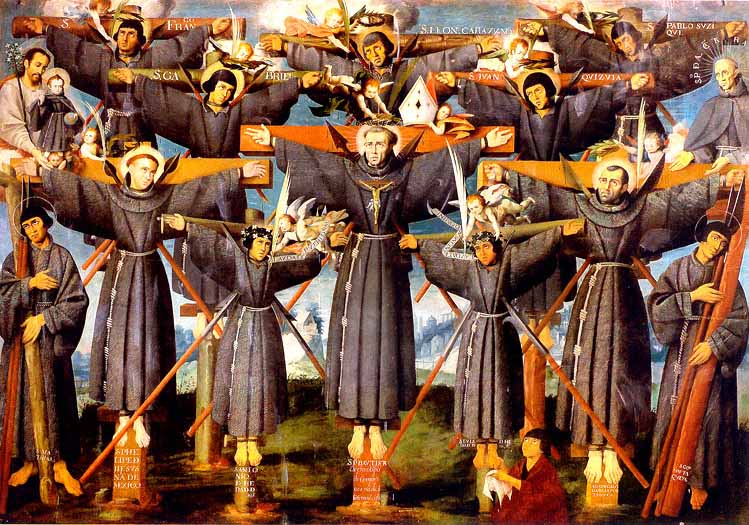
Saints Paul Miki and his Companions, Martyrs
on Thursday of week 4 in Ordinary Time

Twenty-Six Martyrs Museum and Monument in NagasakiReadings at MassLiturgical Colour: Red. Year: C(I). Readings for the feria Readings for the memorial These are the readings for the feria
| First reading |
|---|
| Hebrews 12:18-19,21-24 |
|---|
You have come to Mount Zion and the city of the living GodWhat you have come to is nothing known to the senses: not a blazing fire, or a gloom turning to total darkness, or a storm; or trumpeting thunder or the great voice speaking which made everyone that heard it beg that no more should be said to them. The whole scene was so terrible that Moses said: I am afraid, and was trembling with fright. But what you have come to is Mount Zion and the city of the living God, the heavenly Jerusalem where the millions of angels have gathered for the festival, with the whole Church in which everyone is a ‘first-born son’ and a citizen of heaven. You have come to God himself, the supreme Judge, and been placed with spirits of the saints who have been made perfect; and to Jesus, the mediator who brings a new covenant and a blood for purification which pleads more insistently than Abel’s.
| Responsorial Psalm |
|---|
| Psalm 47(48):2-4,9-11 |
|---|
O God, we ponder your love within your temple. The Lord is great and worthy to be praised in the city of our God. His holy mountain rises in beauty, the joy of all the earth. O God, we ponder your love within your temple. Mount Zion, true pole of the earth, the Great King’s city! God, in the midst of its citadels, has shown himself its stronghold. O God, we ponder your love within your temple. As we have heard, so we have seen in the city of our God, in the city of the Lord of hosts which God upholds for ever. O God, we ponder your love within your temple. O God, we ponder your love within your temple. Your praise, O God, like your name reaches the ends of the earth. With justice your right hand is filled. O God, we ponder your love within your temple.
| Gospel Acclamation | Jn15:15 |
|---|
Alleluia, alleluia! I call you friends, says the Lord, because I have made known to you everything I have learnt from my Father. Alleluia! Alleluia, alleluia! The kingdom of God is close at hand: repent and believe the Good News. Alleluia!
'Take nothing with you'Jesus made a tour round the villages, teaching. Then he summoned the Twelve and began to send them out in pairs giving them authority over the unclean spirits. And he instructed them to take nothing for the journey except a staff – no bread, no haversack, no coppers for their purses. They were to wear sandals but, he added, ‘Do not take a spare tunic.’ And he said to them, ‘If you enter a house anywhere, stay there until you leave the district. And if any place does not welcome you and people refuse to listen to you, as you walk away shake off the dust from under your feet as a sign to them.’ So they set off to preach repentance; and they cast out many devils, and anointed many sick people with oil and cured them. Continue These are the readings for the memorial
| First reading |
|---|
| Galatians 2:19-20 |
|---|
I live now with the life of Christ who lives in meThrough the Law I am dead to the Law, so that now I can live with God. I have been crucified with Christ, and I live now not with my own life but with the life of Christ who lives in me. The life I now live in this body I live in faith: faith in the Son of God who loved me and who sacrificed himself for my sake.
| Responsorial Psalm | Psalm 125(126) |
|---|
What marvels the Lord worked for us! Indeed we were glad. When the Lord delivered Zion from bondage, it seemed like a dream. Then was our mouth filled with laughter, on our lips there were songs. What marvels the Lord worked for us! Indeed we were glad. The heathens themselves said: ‘What marvels the Lord worked for them!’ What marvels the Lord worked for us! Indeed we were glad. What marvels the Lord worked for us! Indeed we were glad. Deliver us, O Lord, from our bondage as streams in dry land. Those who are sowing in tears will sing when they reap. What marvels the Lord worked for us! Indeed we were glad. They go out, they go out, full of tears, carrying seed for the sowing: they come back, they come back, full of song, carrying their sheaves. What marvels the Lord worked for us! Indeed we were glad.
| Gospel Acclamation | Mt28:19,20 |
|---|
Alleluia, alleluia! Go, make disciples of all the nations. I am with you always; yes, to the end of time. Alleluia!
Go and make disciples of all nationsThe eleven disciples set out for Galilee, to the mountain where Jesus had arranged to meet them. When they saw him they fell down before him, though some hesitated. Jesus came up and spoke to them. He said, ‘All authority in heaven and on earth has been given to me. Go, therefore, make disciples of all the nations; baptise them in the name of the Father and of the Son and of the Holy Spirit, and teach them to observe all the commands I gave you. And know that I am with you always; yes, to the end of time.’ Continue Christian Art Each day, The Christian Art website gives a picture and reflection on the Gospel of the day. The readings on this page are from the Jerusalem Bible, which is used at Mass in most of the English-speaking world. The New American Bible readings, which are used at Mass in the United States, are available in the Universalis apps, programs and downloads.
You can also view this page with the Gospel in Greek and English. |
TOPICS: Catholic; General Discusssion; Prayer; Worship
KEYWORDS: catholic; mk5; ordinarytime; prayer
For your reading, reflection, faith-sharing, comments, questions, discussion.
1
posted on
02/06/2025 8:17:10 AM PST
by
annalex
To: All
KEYWORDS: catholic; mk5; ordinarytime; prayer
2
posted on
02/06/2025 8:17:36 AM PST
by
annalex
(fear them not)
To: nickcarraway; NYer; ELS; Pyro7480; livius; ArrogantBustard; Catholicguy; RobbyS; marshmallow; ...

Alleluia Ping Please FReepmail me to get on/off the Alleluia Ping List.
3
posted on
02/06/2025 8:18:40 AM PST
by
annalex
(fear them not)
To: annalex
4
posted on
02/06/2025 8:19:04 AM PST
by
annalex
(fear them not)
To: annalex
| Mark |
| | English: Douay-Rheims | Latin: Vulgata Clementina | Greek NT: Byzantine/Majority Text (2000) |
| | Mark 6
|
| 7. | And he called the twelve; and began to send them two and two, and gave them power over unclean spirits. | Et vocavit duodecim : et cœpit eos mittere binos, et dabat illis potestatem spirituum immundorum. | και προσκαλειται τους δωδεκα και ηρξατο αυτους αποστελλειν δυο δυο και εδιδου αυτοις εξουσιαν των πνευματων των ακαθαρτων |
| 8. | And he commanded them that they should take nothing for the way, but a staff only: no scrip, no bread, nor money in their purse, | Et præcepit eis ne quid tollerent in via, nisi virgam tantum : non peram, non panem, neque in zona æs, | και παρηγγειλεν αυτοις ινα μηδεν αιρωσιν εις οδον ει μη ραβδον μονον μη πηραν μη αρτον μη εις την ζωνην χαλκον |
| 9. | But to be shod with sandals, and that they should not put on two coats. | sed calceatos sandaliis, et ne induerentur duabus tunicis. | αλλ υποδεδεμενους σανδαλια και μη ενδυσησθε δυο χιτωνας |
| 10. | And he said to them: Wheresoever you shall enter into an house, there abide till you depart from that place. | Et dicebat eis : Quocumque introieritis in domum, illic manete donec exeatis inde : | και ελεγεν αυτοις οπου εαν εισελθητε εις οικιαν εκει μενετε εως αν εξελθητε εκειθεν |
| 11. | And whosoever shall not receive you, nor hear you; going forth from thence, shake off the dust from your feet for a testimony to them. | et quicumque non receperint vos, nec audierint vos, exeuntes inde, excutite pulverem de pedibus vestris in testimonium illis. | και οσοι αν μη δεξωνται υμας μηδε ακουσωσιν υμων εκπορευομενοι εκειθεν εκτιναξατε τον χουν τον υποκατω των ποδων υμων εις μαρτυριον αυτοις αμην λεγω υμιν ανεκτοτερον εσται σοδομοις η γομορροις εν ημερα κρισεως η τη πολει εκεινη |
| 12. | And going forth they preached that men should do penance: | Et exeuntes prædicabant ut pœnitentiam agerent : | και εξελθοντες εκηρυσσον ινα μετανοησωσιν |
| 13. | And they cast out many devils, and anointed with oil many that were sick, and healed them. | et dæmonia multa ejiciebant, et ungebant oleo multos ægros, et sanabant. | και δαιμονια πολλα εξεβαλλον και ηλειφον ελαιω πολλους αρρωστους και εθεραπευον |
(*) In v.11: αμην λεγω υμιν ανεκτοτερον εσται σοδομοις η γομορροις εν ημερα κρισεως η τη πολει εκεινη -- "Verily I say unto you, It shall be more tolerable for Sodom and Gomorrha in the day of judgment, than for that city" is not in the translations
5
posted on
02/06/2025 8:21:14 AM PST
by
annalex
(fear them not)
To: annalex

Catena Aurea by St. Thomas Aguinas
Mark CHAP. 6
6:6–13
6. —And he went round about the villages, teaching.
7. And he called unto him the twelve, and began to send them forth by two and two; and gave them power over unclean spirits;
8. And commanded them that they should take nothing for their journey, save a staff only; no scrip, no bread, no money in their purse:
9. But be shod with sandals; and not put on two coats.
10. And he said unto them, In what place soever ye enter into an house, there abide till ye depart from that place.
11. And whosoever shall not receive you, nor hear you, when ye depart thence, shake off the dust under your feet for a testimony against them. Verily I say unto you, It shall be more tolerable for Sodom and Gomorrha in the day of judgment, than for that city.
12. And they went out, and preached that men should repent.
13. And they cast out many devils, and anointed with oil many that were sick, and healed them.
THEOPHYLACT. The Lord not only preached in the cities, but also in villages, that we may learn not to despise little things, nor always to seek for great cities, but to sow the word of the Lord, in abandoned and lowly villages. Wherefore it is said, And he went round about the villages, teaching.
BEDE. (in Marc. 2, 24) Now our kind and merciful Lord and Master did not grudge His servants and their disciples His own virtues, and as He Him self had healed every sickness and every infirmity, so also He gave the same power to His disciples. Wherefore it goes on: And he called unto him the twelve, and began to send them forth by two and two; and gave them power over unclean spirits. Great is the difference between giving and receiving. Whatsoever He does, is done in His own power, as Lord; if they do any thing, they confess their own weakness and the power of the Lord, saying in the name of Jesus, Arise, and walk.
THEOPHYLACT. Again He sends the Apostles two and two that they, might become more active; for, as says the Preacher, Two are better than one. (Eccl. 4:9) But if He had sent more than two, there would not have been a sufficient number to allow of their being sent to many villages.
GREGORY. (Hom. in Evan. 17) Further, the Lord sent the disciples to preach, two and two, because there are two precepts of charity, namely, the love of God, and of our neighbour; and charity cannot be between less than two; by this therefore He implies to us, that he who has not charity towards his neighbour, ought in no way to take upon himself the office of preaching. There follows, And he commanded them, that they should take nothing for their journey, save a staff only; no scrip, no bread, no money in their purse: but be shod with sandals; and not put on two coats.
BEDE. (ubi sup.) For such should be the preacher’s trust in God, that, though he takes no thought for supplying his own wants in this present world, yet he should feel most certain that these will not be left unsatisfied, lest whilst his mind is taken up with temporal things, he should provide less of eternal things to others.
PSEUDO-CHRYSOSTOM. (Vict. Ant. e Cat. in Marc.) The Lord also gives them this command, that they might shew by their mode of life, how far removed they were from the desire of riches.
THEOPHYLACT. Instructing them also by this means not to be fond of receiving gifts, in order too that those, who saw them proclaim poverty, might be reconciled to it, when they saw that the Apostles themselves possessed nothing.
AUGUSTINE. (de Con. Evan. 2, 30.) Or else; according to Matthew (Matt. 10:19), the Lord immediately subjoined, The workman is worthy of his meat, which sufficiently proves why He forbade their carrying or possessing such things; not because they were not necessary, but because He sent them in such a way as to shew, that they were due to them from the faithful, to whom they preached the Gospel. From this it is evident, that the Lord did not mean by this precept that the Evangelists ought to live only on the gifts of those to whom they preach the Gospel, else the Apostle transgressed this precept, when he procured his livelihood, by the labour of his own hands, but He meant that He had given them a power, in virtue of which, they might be assured, these things were due to them. It is also often asked, how it comes that Matthew and Luke have related that the Lord commanded His disciples not to carry even a staff, whilst Mark says, And he commanded them that they should take nothing for their journey, save a staff only. Which question is solved, by supposing that the word ‘staff’ has a meaning in Mark, who says that it ought to be carried, different from that which it bears in Matthew and Luke, who affirm the contrary. For in a concise way one might say, Take none of the necessaries of life with you, nay, not a staff, save a staff only; so that the saying, nay not a staff, may mean, nay not the smallest thing; but that which is added, save a staff only, may mean that, through the power received by them from the Lord, of which a rod is the ensign, nothing, even of those things which they do not carry, will be wanting to them. The Lord therefore said both, but because one Evangelist has not given both, men suppose, that he who has said that the staff, in one sense, should be taken, is contrary to him who again has declared, that, in another sense, it should be left behind: now however that a reason has been given, let no one think so. So also when Matthew declares that shoes are not to be worn on the journey, he forbids anxiety about them, for the reason why men are anxious about carrying them, is that they may not be without them. This is also to be understood of the two coats, that no man should be troubled about having only that with which he is clad, from anxiety lest he should need another, when he could always obtain one from the power given by the Lord. In like manner Mark, by saying that they are to be shod with sandals or soles, warns us that this mode of protecting the feet has a mystical signification, that the foot should neither be covered above nor be naked on the ground, that is, that the Gospel should neither be hid, nor rest upon earthly comforts; and in that He forbids their possessing or taking with them, or more expressly their wearing, two coats, He bids them walk simply, not with duplicity. But whosoever thinks that the Lord could not in the same discourse say some things figuratively, others in a literal sense, let him look into His other discourses, and he shall see, how rash and ignorant is his judgment.
BEDE. (ubi sup.) Again, by the two tunics He seems to me to mean two sets of clothes; not that in places like Scythia, covered with the ice and snow, a man should be content with only one garment, but by coat, I think a suit of clothing is implied, that being clad with one, we should not keep another through anxiety as to what may happen.
PSEUDO-CHRYSOSTOM. (Vict. Ant. e Cat. in Marc.) Or else, Matthew and Luke neither allow shoes nor staff, which is meant to point out the highest perfection. But Mark bids them take a staff and be shod with sandals, which (1 Cor. 7:6) is spoken by permission.
BEDE. (ubi sup.) Again, allegorically; under the figure of a scrip is pointed out the burdens of this world, by bread is meant temporal delights, by money in the purse, the hiding of wisdom; because he who receives the office of a doctor, should neither be weighed down by the burden of worldly affairs, nor be made soft by carnal desires, nor hide the talent of the word committed to him under the ease of an inactive body. It goes on, And he said unto them, In what place soever ye enter into an house, there abide till ye depart from that place. Where He gives a general precept of constancy, that they should look to what is due to the tie of hospitality, adding, that it is inconsistent with the preaching of the kingdom of heaven to run about from house to house.
THEOPHYLACT. That is, lest they should be accused of gluttony in passing from one to another. It goes on, And whoever shall not receive you, &c. This the Lord commanded them, that they might shew that they had walked a long way for their sakes, and to no purpose. Or, because they received nothing from them, not even dust, which they shake off, that it might be a testimony against them, that is, by way of convicting themv.
PSEUDO-CHRYSOSTOM. (Vict. Ant. e Cat. in Marc.) Or else, that it might be a witness of the toil of the way, which they sustained for them; or as if the dust of the sins of the preachers was turned against themselves. It goes on, And they went and preached that men should repent. And they cast out many devils, and anointed with oil many that were sick, and healed them. Mark alone mentions their anointing with oil. James however, in his canonical Epistle, says a thing similar. For oil both refreshes our labours, and gives us light and joy; but again, oil signifies the mercy of the unction of God, the healing of infirmity, and the enlightening of the heart, the whole of which is worked by prayer.
THEOPHYLACT. It also means, the grace of the Holy Ghost, by which we are eased from our labours, and receive light and spiritual joy.
BEDE. (ubi sup.) Wherefore it is evident from the Apostles themselves, that it is an ancient custom of the holy Church that persons possessed or afflicted with any disease whatever, should be anointed with oil consecrated by priestly blessing.
Catena Aurea Mark 6
6
posted on
02/06/2025 8:22:03 AM PST
by
annalex
(fear them not)
To: annalex

Sts Christopher, Jerome and Louis of Toulouse
Giovanni Bellini
1513
Oil on panel, 300 x 185 cm
San Giovanni Crisostomo, Venice
7
posted on
02/06/2025 8:22:34 AM PST
by
annalex
(fear them not)
To: annalex
| Matthew |
| | English: Douay-Rheims | Latin: Vulgata Clementina | Greek NT: Byzantine/Majority Text (2000) |
| | Matthew 28
|
| 16. | And the eleven disciples went into Galilee, unto the mountain where Jesus had appointed them. | Undecim autem discipuli abierunt in Galilæam in montem ubi consituerat illis Jesus. | οι δε ενδεκα μαθηται επορευθησαν εις την γαλιλαιαν εις το ορος ου εταξατο αυτοις ο ιησους |
| 17. | And seeing them they adored: but some doubted. | Et videntes eum adoraverunt : quidam autem dubitaverunt. | και ιδοντες αυτον προσεκυνησαν αυτω οι δε εδιστασαν |
| 18. | And Jesus coming, spoke to them, saying: All power is given to me in heaven and in earth. | Et accedens Jesus locutus est eis, dicens : Data est mihi omnis potestas in cælo et in terra : | και προσελθων ο ιησους ελαλησεν αυτοις λεγων εδοθη μοι πασα εξουσια εν ουρανω και επι γης |
| 19. | Going therefore, teach ye all nations; baptizing them in the name of the Father, and of the Son, and of the Holy Ghost. | euntes ergo docete omnes gentes : baptizantes eos in nomine Patris, et Filii, et Spiritus Sancti : | πορευθεντες μαθητευσατε παντα τα εθνη βαπτιζοντες αυτους εις το ονομα του πατρος και του υιου και του αγιου πνευματος |
| 20. | Teaching them to observe all things whatsoever I have commanded you: and behold I am with you all days, even to the consummation of the world. | docentes eos servare omnia quæcumque mandavi vobis : et ecce ego vobiscum sum omnibus diebus, usque ad consummationem sæculi. | διδασκοντες αυτους τηρειν παντα οσα ενετειλαμην υμιν και ιδου εγω μεθ υμων ειμι πασας τας ημερας εως της συντελειας του αιωνος αμην |
(*) The final "Amen" (αμην) is missing in the translations.
8
posted on
02/06/2025 8:24:18 AM PST
by
annalex
(fear them not)
To: annalex
Catena Aurea by St. Thomas Aguinas
28:16–20
16. Then the eleven disciples went away into Galilee, into a mountain where Jesus had appointed them.
17. And when they saw him, they worshipped him: but some doubted.
18. And Jesus came and spake unto them, saying, All power is given unto me in heaven and in earth.
19. Go ye therefore, and teach all nations, baptizing them in the name of the Father, and of the Son, and of the Holy Ghost:
20. Teaching them to observe all things whatsoever I have commanded you: and, lo, I am with you alway, even unto the end of the world. Amen.
BEDE. ‘Beda, in Hom.’ non occ.) When Saint Matthew has vindicated the Lord’s Resurrection as declared by the Angel, he relates the vision of the Lord which the disciples had, Then the eleven disciples went into Galilee into a mountain where Jesus had appointed them. For when coming to His Passion the Lord had said to His disciples, After I am risen I will go before you into Galilee; (Matt. 26:32.) and the Angel said the same to the women. Therefore the disciples obey the command of their Master. Eleven only go, for one had already perished.
JEROME. After His Resurrection, Jesus is seen and worshipped in the mountain in Galilee; though some doubt, their doubting confirms our faith.
REMIGIUS. This is more fully told by Luke; how when the Lord after the Resurrection appeared to the disciples, in their terror they thought they saw a spirit.
BEDE. (Hom. Æst. in Fer. vi. Pasch.)b. The Lord appeared to them in the mountain to signify, that His Body which at His Birth He had taken of the common dust of the human race, He had by His Resurrection exalted above all earthly things; and to teach the faithful that if they desire there to see the height of His Resurrection, they must endeavour here to pass from low pleasures to high desires. And He goes before His disciples into Galilee, because Christ is risen from the dead, the first fruits of them that slept. (1 Cor. 15:20.) And they that are Christ’s follow Him, and pass in their order from death to life, contemplating Him as He appears with His proper Divinity. And it agrees with this that Galilee is interpreted ‘revelation.’
AUGUSTINE. (de Cons. Ev. iii. 25.) But it is to be considered, how the Lord could be seen bodily in Galilee. For that it was not the day of the Resurrection is manifest; for He was seen that day in Jerusalem in the beginning of the night, as Luke and John evidently agree. Nor was it in the eight following days, after which John says that the Lord appeared to His disciples, and when Thomas first saw Him, who had not seen Him on the day of the Resurrection. For if within these eight days the eleven had seen Him on a mountain in Galilee, Thomas, who was one of the eleven, could not have seen Him first after the eight days. Unless it be said, that the eleven there spoken of were eleven out of the general body of the disciples, and not the eleven Apostles. But there is another difficulty. John having related that the Lord was seen not in the mountain, but at the sea of Tiberias, by seven who were fishing, adds, This is now the third time that Jesus shewed himself to his disciples after he was risen from the (John 21:14.) dead. (Mark 16:14.) So that if we understand the Lord to have been seen within those eight days by eleven of the disciples, this manifestation at the sea of Tiberias will be the fourth, and not the third, appearance. Indeed, to understand John’s account at all it must be observed, that he computes not each appearance, but each day on which Jesus appeared, though He may have appeared more than once on the same day; as He did three times on the day of His Resurrection. We are then obliged to understand that this appearance to the eleven disciples on the mountain in Galilee took place last of all. In the four Evangelists we find in all ten distinct appearances of Our Lord after His Resurrection. 1. At the sepulchre to the women. 2. To the same women on their way back from the sepulchre. 3. To Peter. 4. To two disciples as they went into the country. 5. To many together in Jerusalem; 6. when Thomas was not with them. 7. At the sea of Tiberias. 8. At the mountain in Galilee, according to Matthew. 9. To the eleven as they sat at meat, because they should not again eat with Him upon earth, related by Mark. 10. On the day of His Ascension, no longer on the earth, but raised aloft in a cloud, as related by both Mark and Luke. But all is not written, as John confesses, for He had much conversation with them during forty days before His ascension, being seen of them, and speaking unto them of the things pertaining to the kingdom of God. (Acts 1:3.)
REMIGIUS. The disciples then, when they saw Him, knew the Lord; and worshipped Him, bowing their faces to the ground. And He their affectionate and merciful Master, that He might take away all doubtfulness from their hearts, coming to them, strengthened them in their belief; as it follows, And Jesus came and spake to them, saying, All power is given unto me in heaven and in earth.
JEROME. Power is given to Him, Who but a little before was crucified, Who was buried, but Who afterwards rose again.
BEDE. (ubi sup.) This He speaks not from the Deity coeternal with the Father, but from the Humanity which He took upon Him, according to which He was made a little lower than the Angels. (Heb. 2:9.)
CHRYSOLOGUS. (Serm. 80.) The Son of God conveyed to the Son of the Virgin, the God to the Man, the Deity to the Flesh, that which He had ever together with the Father.
JEROME. Power is given in heaven and in earth, that He who before reigned in heaven, should now reign on earth by the faith of the believers.
REMIGIUS. What the Psalmist says of the Lord at His rising again, Thou madest him to have dominion over the works of thy hands (Ps. 8:6.), this the Lord now says of Himself, All power is given unto me in heaven and in earth. And here it is to be noted, that even before His resurrection the Angels knew that they were subjected to the man Christ. Christ then desiring that it should be also known to men that all power was committed to Him in heaven and in earth, sent preachers to make known the word of life to all nations; whence it follows, Go ye therefore, and teach all nations.
BEDE. (‘Beda; in Hom.’ non occ.) He who before His Passion had said, Go not into the way of the Gentiles, (Matt. 10:5.) now, when rising from the dead, says, Go and teach all nations. Hereby let the Jews be put to silence, who say that Christ’s coming is to be for their salvation only. Let the Donatists also blush, who, desiring to confine Christ to one place, have said that He is in Africa only, and not in other countries.
JEROME. They first then teach all nations, and when taught dip them in water. For it may not be that the body receive the sacrament of Baptism, unless the soul first receive the truth of the Faith. In the name of the Father, the Son, and the Holy Ghost, that they whose Godhead is one should be conferred at once, to name this Trinity, being to name One God.
CHRYSOLOGUS. (Serm. 80.) Thus all nations are created a second time to salvation by that one and the same Power, which created them to being.
JEROME. (Didymi Lib. ii. de Spir. Sanct.) And though some one there may be of so averse a spirit as to undertake to baptize in such sort as to omit one of these names, therein contradicting Christ Who ordained this for a law, his baptism will effect nothing; those who are baptized by him will not be at all delivered from their sins. From these words we gather how undivided is the substance of the Trinity, that the Father is verily the Father of the Son, and the Son verily the Son of the Father, and the Holy Spirit the Spirit of both the Father and the Son, and also the Spirit of wisdom and of truth, that is, of the Son of God. This then is the salvation of them that believe, and in this Trinity is wrought the perfect communication of ecclesiastical discipline.
HILARY. (de Trin. ii. 1 &c.) For what part of the salvation of men is there that is not contained in this Sacrament? All things are full and perfect, as proceeding from Him who is full and perfect. The nature of His relation is expressed in the title Father; but He is nothing but Father; for not after the manner of men does He derive from somewhat else that He is Father, being Himself Unbegotten, Eternal, and having the source of His being in Himself, known to none, save the Son. The Son is the Offspring of the Unbegotten, One of the One, True of the True, Living of the Living, Perfect of the Perfect, Strength of Strength, Wisdom of Wisdom, Glory of Glory; the Image of the Unseen God, the Form of the Unbegotten Father. Neither can the Holy Spirit be separated from the confession of the Father and the Son. And this consolation of our longing desires is absent from no place. He is the pledge of our hope in the effects of His gifts, He is the light of our minds, He shines in our souls. These things as the heretics cannot change, they introduce into them their human explanations. As Sabellius who identifies the Father with the Son, thinking the distinction to be made rather in name than in person, and setting forth one and the same Person as both Father and Son. As Ebion, who deriving the beginning of His existence from Mary, makes Him not Man of God, but God of man. As the Arians, who derive the form, the power, and the wisdom of God out of nothing, and in time. What wonder then that men should have diverse opinions about the Holy Spirit, who thus rashly after their own pleasure create and change the Son, by whom that Spirit is bestowed?
JEROME. Observe the order of these injunctions. He bids the Apostles first to teach all nations, then to wash them with the sacrament of faith, and after faith and baptism then to teach them what things they ought to observe; Teaching them to observe all things whatsoever I have commanded you.
RABANUS. For as the body without the spirit is dead, so faith without works is dead also. (James 2:26.)
CHRYSOSTOM. And because what He had laid upon them was great, therefore to exalt their spirits He adds, And, lo, I am with you alway, even unto the end of the world. As much as to say, Tell Me not of the difficulty of these things, seeing I am with you, Who can make all things easy. A like promise He often made to the Prophets in the Old Testament, to Jeremiah who pleaded his youth, to Moses, and to Ezekiel, when they would have shunned the office imposed upon them. And not with them only does He say that He will be, but with all who shall believe after them. For the Apostles were not to continue till the end of the world, but He says this to the faithful as to one body.
RABANUS. Hence we understand that to the end of the world shall not be wanting those who shall be worthy of the Divine indwelling.
CHRYSOSTOM. He brings before them the end of the world, that He may the more draw them on, and that they may not look merely to present inconveniences, but to the infinite goods to come. As much as to say, The grievous things which you shall undergo, terminate with this present life, seeing that even this world shall come to an end, but the good things which ye shall enjoy endure for ever.
BEDE. (‘Beda in Hom.’ non occ.) It is made a question how He says here, I am with you, John 16:5. when we read elsewhere that He said, I go unto him that sent me. What is said of His human nature is distinct from what is said of His divine nature. He is going to His Father in His human nature, He abides with His disciples in that form in which He is equal with the Father. When He says, to the end of the world, He expresses the infinite by the finite; for He who remains in this present world with His elect, protecting them, the same will continue with them after the end, rewarding them.
JEROME. He then who promises that He will be with His disciples to the end of the world, shews both that they shall live for ever, and that He will never depart from those that believe.
LEO. (Serm. 72. 3.) For by ascending into heaven He does not desert His adopted; but from above strengthens to endurance, those whom He invites upwards to glory.
Of which glory may Christ make us partakers,
Who is the King of glory,
God blessed for ever,
AMEN.
Catena Aurea Matthew 28
9
posted on
02/06/2025 8:25:34 AM PST
by
annalex
(fear them not)
To: annalex

Laudario of the Compagnia di Sant'Agnese
Pacino di Bonaguida
1320s
Tempera and gold on parchment, 444 x 318 mm
Private collection
10
posted on
02/06/2025 8:26:27 AM PST
by
annalex
(fear them not)
To: annalex
Saints of the Day for February 6
(d. 1597)
Saint Paul Miki and Companions’ Story
Nagasaki, Japan, is familiar to Americans as the city on which the second atomic bomb was dropped, immediately killing over 37,000 people. Three and a half centuries before, 26 martyrs of Japan were crucified on a hill, now known as the Holy Mountain, overlooking Nagasaki. Among them were priests, brothers, and laymen, Franciscans, Jesuits, and members of the Secular Franciscan Order; there were catechists, doctors, simple artisans, and servants, old men and innocent children—all united in a common faith and love for Jesus and his Church.
Brother Paul Miki, a Jesuit and a native of Japan, has become the best known among the martyrs of Japan. While hanging upon a cross, Paul Miki preached to the people gathered for the execution: “The sentence of judgment says these men came to Japan from the Philippines, but I did not come from any other country. I am a true Japanese. The only reason for my being killed is that I have taught the doctrine of Christ. I certainly did teach the doctrine of Christ. I thank God it is for this reason I die. I believe that I am telling only the truth before I die. I know you believe me and I want to say to you all once again: Ask Christ to help you to become happy. I obey Christ. After Christ’s example I forgive my persecutors. I do not hate them. I ask God to have pity on all, and I hope my blood will fall on my fellow men as a fruitful rain.”
When missionaries returned to Japan in the 1860s, at first they found no trace of Christianity. But after establishing themselves they found that thousands of Christians lived around Nagasaki and that they had secretly preserved the faith. Beatified in 1627, the martyrs of Japan were finally canonized in 1862.
Reflection
Today, a new era has come for the Church in Japan. Although the number of Catholics is not large, the Church is respected and has total religious freedom. The spread of Christianity in the Far East is slow and difficult. Faith such as that of the 26 martyrs is needed today as much as in 1597.
franciscanmedia.org
11
posted on
02/06/2025 8:29:01 AM PST
by
annalex
(fear them not)
To: annalex
12
posted on
02/06/2025 8:31:20 AM PST
by
annalex
(fear them not)
To: annalex
 NAVARRE BIBLE COMMENTARY (RSV) Ad Majorem Dei Gloriam (To the Greater Glory of God)
 First Reading:
From: Hebrews 12:18-24
Striving for Peace; Purity; Reverent Worship (Continuation)
-----------------------------------------------------------
[18] For you have not come to what may be touched, a blazing fire, and darkness, and gloom, and a tempest, [19] and the sound of a trumpet, and a voice whose words made the hearers entreat that no further messages be spoken to them. [20] For they could not endure the order that was given, "If even a beast touches the mountain, it shall be stoned." [21] Indeed, so terrifying was the sight that Moses said, "I tremble with fear." [22] But you have come to Mount Zion and to the city of the living God, the heavenly Jerusalem, and to innumerable angels in festal gathering, [23] and to the assembly of the first-born who are enrolled in heaven, and to a judge who is God of all, and to the spirits of just men made perfect, [24] and to Jesus, the mediator of a new covenant, and to the sprinkled blood that speaks more graciously than the blood of Abel.
***********************************************************************
Commentary:
18-21. The text recalls in detail all the physical signs which accompanied the manifestation of God on the heights of Sinai (cf. Ex 19:12-16; 20:18), and to these it adds other things taken from Jewish oral tradition.
All this helps to inspire feelings of religious reverence and fear, which explains why the people begged God not to speak further, for they were afraid they would die. To assert his transcendence God forbade anyone to put foot on the mountain (Ex 19:12, 21); this was a way of showing this as yet uncivilized people the difference between the true God and idols.
There is no mention in the Pentateuch of Moses being frightened of the vision he saw when God manifested himself on Sinai; when his fear is mentioned (Deut 9:19) it is in the context of the second time he went up the mountain to be given replacements for the tables he had broken in a fit of rage (Deut 9:15-18; Ex 32:19-20). His fear was that God would punish with death those who had adored the golden calf. When telling (cf. Acts 7:32) the story of God's first revelation to Moses in the burning bush, St Stephen says that "Moses trembled and did not dare to look": thus, the presence of divinity provokes in him the deepest feelings of reverence and fear (cf. the attitude of Abraham: Gen 15:12; of Zechariah: Lk 1:12; of Isaiah: Is 6:4-5; of Jeremiah: Jer 1:6; of Gideon: Judg 6:22-23; etc.).
22-24. The sacred text dramatically contrasts two scenes--that of the establishment of the Covenant on Sinai, and the vision of the heavenly city, the dwelling-place of the angels and saints. The comparison implies a rhetorical question: if the setting of the Old Covenant was so solemn and awesome, and if the Covenant itself was so supernatural and divine, what must not be said of the New Covenant?
We have therefore overwhelming reasons for staying faithful: what awaits us is not an austere and vengeful God but, rather, the joy and splendor of the heavenly city. For the Hebrew people Mount Sinai was the most important symbol of their special connection with God, reminding them that the Almighty was also the Supreme Judge who claimed their exclusive devotion and who abominated idolatry. Similarly, another mountain, Mount Zion, on which the Temple was built, represented God's protective presence in the midst of his people. Both mountains, Sinai and Zion, prefigured the mountain from which the Messiah-King would reign and towards which all peoples would flock to worship the true God (cf. Ps 2:6; Is 2:2).
The vision which Judaism, on the basis of Scripture, had elaborated of heaven as the "new Jerusalem" is now extended: not only is it the holy mountain, the source of the light and glory of Yahweh (cf. Is 8:18; 28:16; 60: 1-11; Ps 50:2; 74:2; Joel 3: 17), the city of peace (cf. Is 33:20); it is the city where the angels and saints dwell and rejoice, the demesne of the living God and of Jesus--the heavenly and everlasting Jerusalem, which is also illustrated in the Book of Revelation (cf. Rev 21:15-17; 22:1-5).
The text once more recalls the Exodus (cf. Heb 3:16-18; 4:1-2; 9:18-20; 10:19-22). Christians are making their way to heaven, their lasting homeland, their true place of rest, just as the ancient Israelites made their way out of Egypt and crossed the desert to reach the land promised to their forefathers.
However, despite this parallel there are differences: the Old Covenant, although it did include expressions and promises of joy and jubilation, was set in an atmosphere of religious fear and trembling; whereas the New Covenant is full of joy and exultation, although in the midst of suffering.
"It is a question [...] of the glorious and supernatural joy, prophesied for the new Jerusalem redeemed from the exile and loved with a mystical love by God himself [...]. Through the course of many centuries and in the midst of most terrible trials, these promises wonderfully sustained the mystical hope of ancient Israel. And it is ancient Israel that transmitted them to the Church of Jesus Christ, in such a way that we are indebted to ancient Israel for some of the purest expressions of our hymn of joy. And yet, according to faith and the Christian experience of the Holy Spirit, this peace which is given by God and which spreads out like an overflowing torrent when the time of 'consolation' comes, is linked to the coming and presence of Christ" (Paul VI, "Gaudete In Domino", 2-3).
22. The mention of Zion recalls the other mountain on which the Covenant was made (Sinai), as also the many prophetical texts which proclaimed that the Messiah's reign would begin on Zion, his holy mountain (cf. Ps 2:6; Is 2:2-4:25:6; Zech 14:4). Thus, Mount Zion, the city of the living God, and the heavenly Jerusalem all mean the Church in triumph in heaven.
St Thomas emphasizes that part of eternal happiness in heaven consists in the vision of the heavenly assembly: "for in the glory of heaven there are two things which most cause the blessed to rejoice: enjoyment of the Godhead and the fellowship of the saints" ("Commentary on Heb., ad loc.").
"Proceeding from the love of the eternal Father (cf. Tit 3:4), the Church was founded by Christ in time and gathered into one by the Holy Spirit (cf. Eph 1:3, 5, 6, 13-14, 23). It has a saving and eschatological purpose which can be fully attained only in the next life. But it is now present here on earth and is composed of men; they, the members of the earthly city, are called to form the family of the children of God in this present history of mankind and to increase it continually until the Lord comes" (Vatican II, "Gaudium Et Spes", 40).
23. "The assembly of the first-born who are enrolled in heaven": the blessed, including the righteous of the Old Testament, the Apostles and all Christians who have attained the beatific vision. They are called first-born because, as in the case of the Patriarchs, they were the first to have faith; because, as in the case of the Apostles, it wasnthey who received Christ's call initially, to pass it on to others; and, finally, because, as in the case of faithful Christians, they were chosen by God from among the pagans (cf. Rom 8:29; Phil 3:20; Col 1:18; Rev 1:S; 14:4). Their names are written in heaven (cf. Lk 10:20; Rev 2:17; 3:5; 13:8; 17:8).
24. As Incarnate Word and High Priest, Jesus is the mediator of the New Covenant (cf. Heb 8:6; 9:15; 1 Tim 2:5; cf. Heb 2:17; 13:1; 7:25). The letter focuses for a moment on the most significant point in the alliance--the shedding of our Lord's blood, which ratifies the Covenant and cleanses mankind (cf. Ex 24:8; Heb 9:12-14, 20; 10:19, 28-29; 13:20; 1 Pet 1:2). This blood "speaks more graciously than the blood of Abel", "for the shedding of Christ's blood was represented figuratively by the shedding of the blood of all the just there have been since the beginning of the world [...]. Therefore, the spilling of Abel's blood was a sign of this new spilling of blood. But the blood of Christ is more eloquent than that of Abel, because Abel's called for vengeance whereas the blood of Christ claims forgiveness" (St Thomas Aquinas, "Commentary on Heb., ad loc."). The confidence the blood of Christ gives us makes us feel happy to be sinners who, repentant, take refuge in his wounds.
"Sinners, says the Epistle, you are fortunate indeed, for after you sin you have recourse to the crucified Jesus, who shed all his blood so that he might stand as mediator to make peace between God and sinners, and win you forgiveness from him. If your evildoing shouts against you, the Redeemer's blood cries aloud in your favor, and divine justice cannot but listen to what this blood says" (St Alphonsus, "The Love of Jesus Christ Reduced to Practice", 3).
13
posted on
02/06/2025 8:51:00 AM PST
by
fidelis
(Ecce Crucem Domini! Fugite partes adversae! Vicit Leo de tribu Juda, Radix David! Alleluia!)
Gospel Reading: From: Mark 6:7-13
The Mission of the Twelve
-------------------------
[7] And he (Jesus) called to him the Twelve, and began to send them out two by two, and gave them authority over the unclean spirits. [8] He charged them to take nothing for their journey except a staff; no bread, no bag, no money in their belts; [9] but to wear sandals and not put on two tunics. [10] And he said to them, "Where you enter a house, stay there until you leave the place. [11] And if any place will not receive you and they refuse to hear you, when you leave, shake off the dust that is on your feet for a testimony against them." [12] So they went out and preached that men should repent. [13] And they cast out many demons, and anointed with oil many that were sick and healed them.
***********************************************************************
Commentary:
7. Cf. note on Mk 1:27; 3:14-19.
[The note on Mk 1:17 states: 27. The same authority that Jesus showed in His teaching (1:22) is now to be seen in His actions. His will is His command: He has no need of long prayers or incantations. Jesus' words and actions already have a divine power which provokes wonder and fear in those who hear and see Him. Jesus continues to impress people in this way (Mark 2:12; 5:20-42; 7:37; 15:39; Luke 19:48; John 7:46). Jesus of Nazareth is the long-awaited Savior. He knows this Himself and He lets it be known by His actions and by His words; according to the gospel accounts (Mark 1:38-39; 2:10-11; 4:39) there is complete continuity and consistency between what He says and He does. As Vatican II teaches ("Dei Verbum", 2) Revelation is realized by deeds and words intimately connected with each other: the words proclaim the deeds and clarify the mystery contained in them; the deeds confirm the teaching. In this way Jesus progressively reveals the mystery of His Person: first the people sense His exceptional authority; later on, the Apostles, enlightened by God's grace, recognize the deepest source of this authority: "You are the Christ, the Son of the living God" (Matthew 16:16). ]
[The note on Mk 3:14-19 states: 14-19. The Twelve chosen by Jesus (cf. 3:14) receive a specific vocation to be "people sent out", which is what the word "apostles" means. Jesus chooses them for a mission which He will give them later (6:6-13) and to enable them to perform this mission He gives them part of His power. The fact that He chooses "twelve" is very significant. This is the same number as the twelve Patriarchs of Israel, and the Apostles represent the new people of God, the Church founded by Christ. Jesus sought in this way to emphasize the continuity that exists between the Old and New Testaments. The Twelve are the pillars on which Christ builds His Church (cf. Gal 2:9); their mission to make disciples of the Lord (to teach) all nations, sanctifying and governing the believers (Mt 28:16-20; Mk 16:15; Lk 24:45-48; Jn 20:21-23). ]
8-9. Jesus requires them to be free of any form of attachment if they are to preach the Gospel. A disciple, who has the mission of bringing the Kingdom of God to souls through preaching, should not rely on human resources but on God's Providence. Whatever he does not in order to live with dignity as a herald of the Gospel, he must obtain from those who benefit from his preaching, for the laborer deserves his maintenance (cf. Mt 10:10).
"The preacher should so trust in God that he is convinced that he will have everything he needs to support life, even if he cannot himself obtain it; for he should not neglect eternal things worrying about temporal things" (St Bede, "In Marci Evangelium Expositio, in loc."). "By these instructions the Lord did not mean that the evangelists should not seek to live in any other way than by depending on what was offered to them by those to whom they preached the Gospel; otherwise this very Apostle (St Paul) would have acted contrary to this precept when he earned his living by the labors of his own hands" (St Augustine, "De Consensu Evangelistarum", II, 30).
13. St Mark is the only evangelist who speaks of anointing the sick with oil. Oil was often used for treating wounds (cf. Is 1:6; Lk 10:34), and the Apostles also use it for the miraculous cure of physical illnesses by virtue of the power given them by Jesus. Hence the use of oil as the matter of the sacrament of the Anointing of the Sick, which cures wounds of the soul and even, if appropriate, bodily diseases. As the Council of Trent teaches--"Doctrina De Sacramento Extremae Unctionis", chap. 1--in this verse of St Mark there can be seen a "hint" of the sacrament of the Anointing of the Sick, which our Lord will institute and which later on "is recommended and promulgated to the faithful by St James the Apostle" (cf. Jas 5:14ff).
14
posted on
02/06/2025 8:51:36 AM PST
by
fidelis
(Ecce Crucem Domini! Fugite partes adversae! Vicit Leo de tribu Juda, Radix David! Alleluia!)
15
posted on
02/06/2025 8:52:58 AM PST
by
fidelis
(Ecce Crucem Domini! Fugite partes adversae! Vicit Leo de tribu Juda, Radix David! Alleluia!)
Disclaimer:
Opinions posted on Free Republic are those of the individual
posters and do not necessarily represent the opinion of Free Republic or its
management. All materials posted herein are protected by copyright law and the
exemption for fair use of copyrighted works.
FreeRepublic.com is powered by software copyright 2000-2008 John Robinson