Free Republic
Browse · Search
Religion
Topics · Post Article

Skip to comments.

Catholic Caucus: Daily Mass Readings 28-January-2025
Universalis/Jerusalem Bible ^

Posted on 01/28/2025 3:13:18 AM PST by annalex

28 January 2025

Saint Thomas Aquinas, Priest, Doctor
on Tuesday of week 3 in Ordinary Time


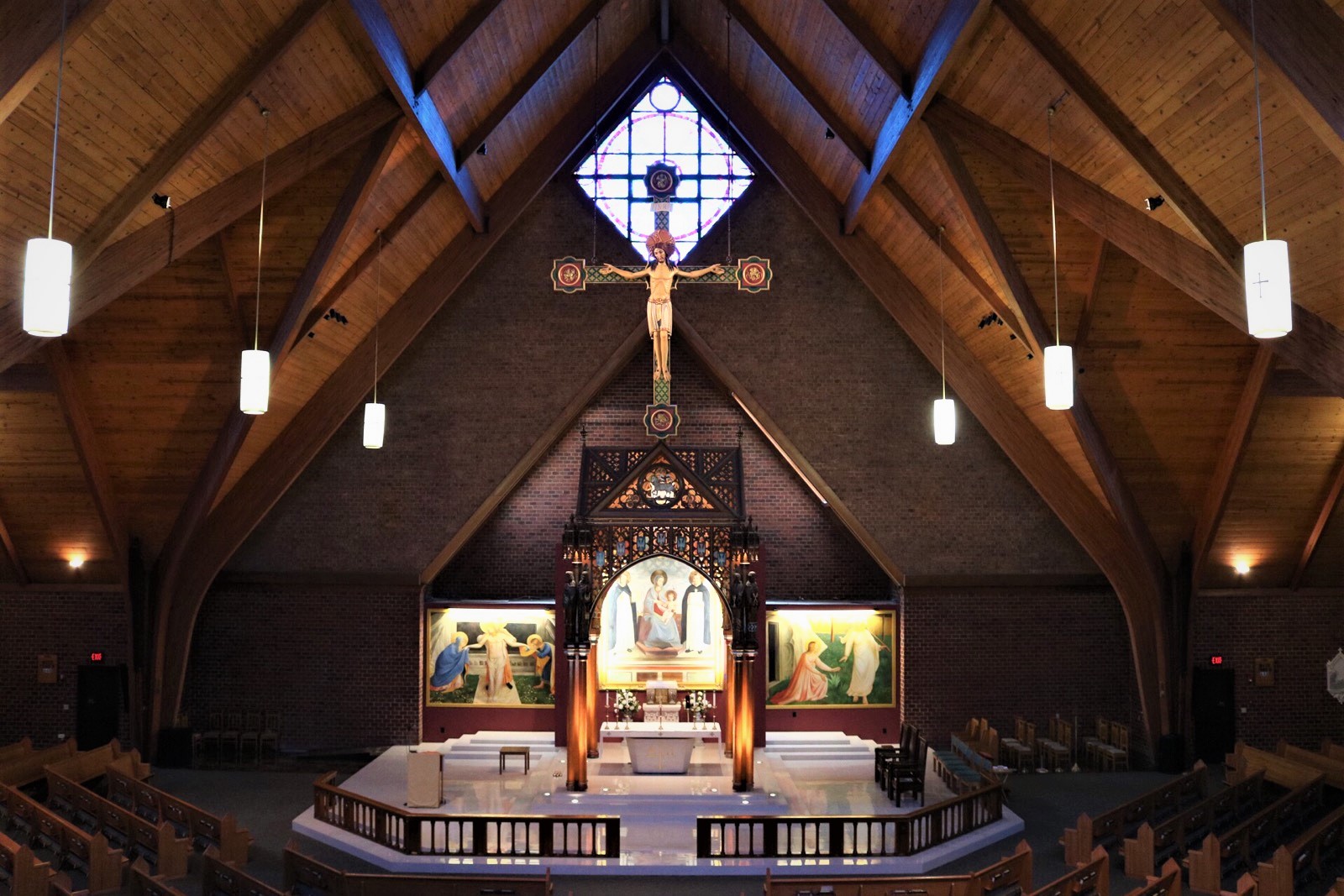
St Thomas Aquinas Catholic Church, Charlotte

Readings at Mass

Liturgical Colour: White. Year: C(I).

Readings for the feria

Readings for the memorial

These are the readings for the feria


First readingHebrews 10:1-10

Christ’s self-offering sanctifies us

Since the Law has no more than a reflection of these realities, and no finished picture of them, it is quite incapable of bringing the worshippers to perfection, with the same sacrifices repeatedly offered year after year. Otherwise, the offering of them would have stopped, because the worshippers, when they had been purified once, would have no awareness of sins. Instead of that, the sins are recalled year after year in the sacrifices. Bulls’ blood and goats’ blood are useless for taking away sins, and this is what he said, on coming into the world:
You who wanted no sacrifice or oblation,
prepared a body for me.
You took no pleasure in holocausts or sacrifices for sin;
then I said,
just as I was commanded in the scroll of the book,
‘God, here I am! I am coming to obey your will.’
Notice that he says first: You did not want what the Law lays down as the things to be offered, that is: the sacrifices, the oblations, the holocausts and the sacrifices for sin, and you took no pleasure in them; and then he says: Here I am! I am coming to obey your will. He is abolishing the first sort to replace it with the second. And this will was for us to be made holy by the offering of his body made once and for all by Jesus Christ.

Responsorial Psalm
Psalm 39(40):2,4,7-8,10,11
Here I am, Lord! I come to do your will.
I waited, I waited for the Lord
  and he stooped down to me;
  he heard my cry.
He put a new song into my mouth,
  praise of our God.
Here I am, Lord! I come to do your will.
You do not ask for sacrifice and offerings,
  but an open ear.
You do not ask for holocaust and victim.
  Instead, here am I.
Here I am, Lord! I come to do your will.
Your justice I have proclaimed
  in the great assembly.
My lips I have not sealed;
  you know it, O Lord.
Here I am, Lord! I come to do your will.
I have not hidden your justice in my heart
  but declared your faithful help.
I have not hidden your love and your truth
  from the great assembly.
Here I am, Lord! I come to do your will.

Gospel AcclamationPs118:135
Alleluia, alleluia!
Let your face shine on your servant,
and teach me your decrees.
Alleluia!
Or:Mt11:25
Alleluia, alleluia!
Blessed are you, Father,
Lord of heaven and earth,
for revealing the mysteries of the kingdom
to mere children.
Alleluia!

GospelMark 3:31-35

Who are my mother and my brothers? Those that do the will of God

The mother and brothers of Jesus arrived and, standing outside, sent in a message asking for him. A crowd was sitting round him at the time the message was passed to him, ‘Your mother and brothers and sisters are outside asking for you.’ He replied, ‘Who are my mother and my brothers?’ And looking round at those sitting in a circle about him, he said, ‘Here are my mother and my brothers. Anyone who does the will of God, that person is my brother and sister and mother.’

Continue

These are the readings for the memorial


First reading
Wisdom 7:7-10,15-16

I esteemed Wisdom more than sceptres or thrones

I prayed, and understanding was given me;
I entreated, and the spirit of Wisdom came to me.
I esteemed her more than sceptres and thrones;
compared with her, I held riches as nothing.
I reckoned no priceless stone to be her peer,
for compared with her, all gold is a pinch of sand,
and beside her silver ranks as mud.
I loved her more than health or beauty,
preferred her to the light,
since her radiance never sleeps.
May God grant me to speak as he would wish
and express thoughts worthy of his gifts,
since he himself is the guide of Wisdom,
since he directs the sages.
We are indeed in his hand, we ourselves and our words,
with all our understanding, too, and technical knowledge.

Responsorial Psalm
Psalm 118(119):9-14
Lord, teach me your statutes.
How shall the young remain sinless?
  By obeying your word.
I have sought you with all my heart;
  let me not stray from your commands.
Lord, teach me your statutes.
I treasure your promise in my heart
  lest I sin against you.
Blessed are you, O Lord;
  teach me your statutes.
Lord, teach me your statutes.
With my tongue I have recounted
  the decrees of your lips.
I rejoiced to do your will
  as though all riches were mine.
Lord, teach me your statutes.

Gospel AcclamationMt23:9,10
Alleluia, alleluia!
You have only one Father,
  and he is in heaven;
you have only one Teacher,
  the Christ.
Alleluia!

GospelMatthew 23:8-12

The greatest among you must be your servant

Jesus said to his disciples, ‘You must not allow yourselves to be called Rabbi, since you have only one master, and you are all brothers. You must call no one on earth your father, since you have only one Father, and he is in heaven. Nor must you allow yourselves to be called teachers, for you have only one Teacher, the Christ. The greatest among you must be your servant. Anyone who exalts himself will be humbled, and anyone who humbles himself will exalted.’

Continue


Christian Art

Illustration

Each day, The Christian Art website gives a picture and reflection on the Gospel of the day.

The readings on this page are from the Jerusalem Bible, which is used at Mass in most of the English-speaking world. The New American Bible readings, which are used at Mass in the United States, are available in the Universalis apps, programs and downloads.

You can also view this page with the Gospel in Greek and English.


TOPICS: Catholic; General Discusssion; Prayer; Worship
KEYWORDS: catholic; mk3; mt23; ordinarytime; prayer
For your reading, reflection, faith-sharing, comments, questions, discussion.

1 posted on 01/28/2025 3:13:18 AM PST by annalex
[ Post Reply | Private Reply | View Replies]

Comment #2 Removed by Moderator

To: annalex

mt23


3 posted on 01/28/2025 3:14:43 AM PST by annalex (fear them not)
[ Post Reply | Private Reply | To 2 | View Replies]

To: nickcarraway; NYer; ELS; Pyro7480; livius; ArrogantBustard; Catholicguy; RobbyS; marshmallow; ...

Alleluia Ping

Please FReepmail me to get on/off the Alleluia Ping List.


4 posted on 01/28/2025 3:15:54 AM PST by annalex (fear them not)
[ Post Reply | Private Reply | To 3 | View Replies]

To: annalex
My dad is back in the hospital. [JimRob update at 242]
Jim still needs our prayers. Thread 2
Prayer thread for Salvation's recovery
Pray for Ukraine
Prayer thread for Fidelis' recovery
Update on Jim Robinson's health issues
5 posted on 01/28/2025 3:16:22 AM PST by annalex (fear them not)
[ Post Reply | Private Reply | To 4 | View Replies]

To: annalex
Mark
 English: Douay-RheimsLatin: Vulgata ClementinaGreek NT: Byzantine/Majority Text (2000)
 Mark 3
31And his mother and his bretheren came; and standing without, sent unto him, calling him. Et veniunt mater ejus et fratres : et foris stantes miserunt ad eum vocantes eum,ερχονται ουν οι αδελφοι και η μητηρ αυτου και εξω εστωτες απεστειλαν προς αυτον φωνουντες αυτον
32And the multitude sat about him; and they say to him: Behold thy mother and thy brethren without seek for thee. et sedebat circa eum turba : et dicunt ei : Ecce mater tua et fratres tui foris quærunt te.και εκαθητο οχλος περι αυτον ειπον δε αυτω ιδου η μητηρ σου και οι αδελφοι σου και αι αδελφαι σου εξω ζητουσιν σε
33And answering them, he said: Who is my mother and my brethren? Et respondens eis, ait : Quæ est mater mea et fratres mei ?και απεκριθη αυτοις λεγων τις εστιν η μητηρ μου η οι αδελφοι μου
34And looking round about on them who sat about him, he saith: Behold my mother and my brethren. Et circumspiciens eos, qui in circuitu ejus sedebant, ait : Ecce mater mea et fratres mei.και περιβλεψαμενος κυκλω τους περι αυτον καθημενους λεγει ιδε η μητηρ μου και οι αδελφοι μου
35For whosoever shall do the will of God, he is my brother, and my sister, and mother. Qui enim fecerit voluntatem Dei, hic frater meus, et soror mea, et mater est.ος γαρ αν ποιηση το θελημα του θεου ουτος αδελφος μου και αδελφη μου και μητηρ εστιν

6 posted on 01/28/2025 3:18:36 AM PST by annalex (fear them not)
[ Post Reply | Private Reply | To 5 | View Replies]

To: annalex

Catena Aurea by St. Thomas Aguinas

3:31–35

31. There came then his brethren and his mother, and, standing without, sent unto him, calling him.

32. And the multitude sat about him, and they said unto him, Behold, thy mother and thy brethren without seek for thee.

33. And he answered them, saying, Who is my mother, or my brethren?

34. And he looked round about on them which sat about him, and said, Behold my mother and my brethren!

35. For whosoever shall do the will of God, the same is my brother, and my sister, and mother.

THEOPHYLACT. Because the relations of the Lord had come to seize upon Him, as if beside Himself, His mother, urged by the sympathy of her love, came to Him; wherefore it is said, And there came unto him his mother, and, standing without, sent unto him, calling him.

CHRYSOSTOM. (non occ.) From this it is manifest that His brethren and His mother were not always with Him; but because He was beloved by them, they come from reverence and affection, waiting without. Wherefore it goes on, And the multitude sat about him, &c.

BEDE. (ubi sup.) The brothers of the Lord must not be thought to be the sons of the ever-virgin Mary, as Helvidius sayp, nor the sons of Joseph by a former marriage, as some think, but rather they must be understood to be His relations.

PSEUDO-CHRYSOSTOM. (Vict. Ant. e Cat. in Marc.) But another Evangelist says, that His brethren did not believe on Him. With which this agrees, which says, that they sought Him, waiting without, and with this meaning the Lord does not mention them as relations. Wherefore it follows, And he answered them, saying, Who is my mother or my brethren? (John 7:5) But He does not here mention His mother and His brethren altogether with reproof, but to shew that a man must honour his own soul above all earthly kindred; wherefore this is fitly said to those who called Him to speak with His mother and relations, as if it were a more useful task than the teaching of salvation.

BEDE. (Ambr in Luc. 6, 36. Bede ubi sup.) Being asked therefore by a message to go out, He declines, not as though He refused the dutiful service of His mother, but to shew that He owes more to His Father’s mysteries than to His mother’s feelings. Nor does He rudely despise His brothers, but, preferring His spiritual work to fleshly relationship, He teaches us that religion is the bond of the heart rather than that of the body. Wherefore it goes on, And looking round about on them which sat about him, he said, Behold my mother and my brethren.

CHRYSOSTOM. (non occ.) By this, the Lord shews that we should honour those who are relations by faith rather than those who are relations by blood. A man indeed is made the mother of Jesus by preaching Himq; for He, as it were, brings forth the Lord, when he pours Him into the heart of his hearers.

PSEUDO-JEROME. But let us be assured that we are His brethren and His sisters, if we do the will of the Father; that we may be joint-heirs with Him, for He discerns us not by sex but by our deeds. Wherefore it goes on: Whosoever shall do the will of God, &c.

THEOPHYLACT. He does not therefore say this, as denying His mother, but as shewing that He is worthy of honour, not only because she bore Christ, but on account of her possessing every other virtue.

BEDE. (ubi sup.) But mystically, the mother and brother of Jesus means the synagogue, (from which according to the flesh He sprung,) and the Jewish people who, while the Saviour is teaching within, come to Him, and are not able to enter, because they cannot understand spiritual things. But the crowd eagerly enter, because when the Jews delayed, the Gentiles flocked to Christ; but His kindred, who stand without wishing to see the Lord, are the Jews who obstinately remained without, guarding the letter, and would rather compel the Lord to go forth to them to teach carnal things, than consent to enter in to learn spiritual things of Him. (Ambr in Luc. 6, 37.). If therefore not even His parents when standing without are acknowledged, how shall we be acknowledged, if we stand without? For the word is within and the light within.

Catena Aurea Mark 3
7 posted on 01/28/2025 3:20:01 AM PST by annalex (fear them not)
[ Post Reply | Private Reply | To 6 | View Replies]

To: annalex


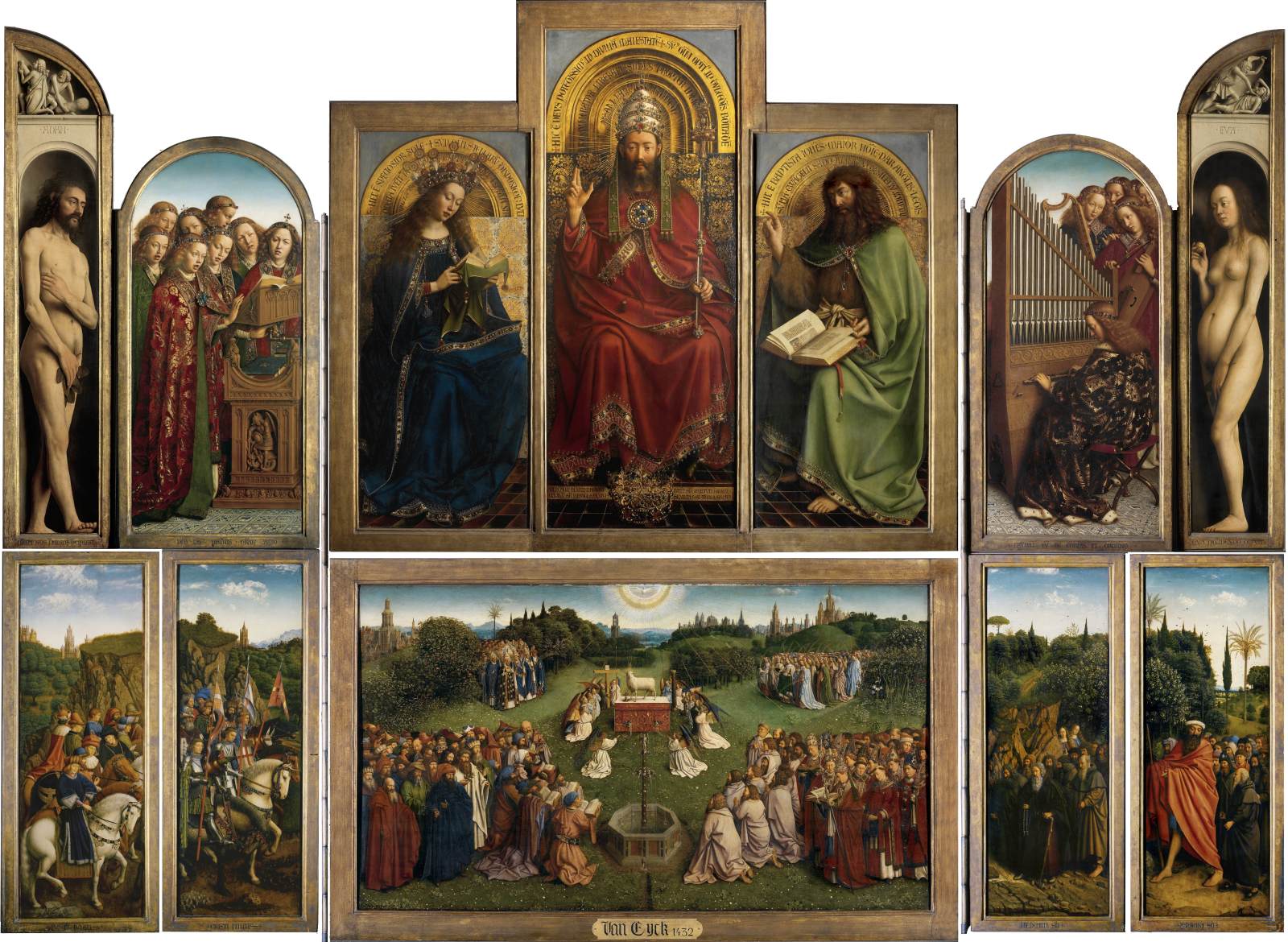
The Ghent Altarpiece (wings open)

Jan van Eyck

1432
Oil on wood, 350 x 461 cm

8 posted on 01/28/2025 3:20:32 AM PST by annalex (fear them not)
[ Post Reply | Private Reply | To 7 | View Replies]

To: annalex
Matthew
 English: Douay-RheimsLatin: Vulgata ClementinaGreek NT: Byzantine/Majority Text (2000)
 Matthew 23
8But be not you called Rabbi. For one is your master; and all you are brethren. Vos autem nolite vocari Rabbi : unus est enim magister vester, omnes autem vos fratres estis.υμεις δε μη κληθητε ραββι εις γαρ εστιν υμων ο καθηγητης ο χριστος παντες δε υμεις αδελφοι εστε
9And call none your father upon earth; for one is your father, who is in heaven. Et patrem nolite vocare vobis super terram : unus est enim pater vester qui in cælis est.και πατερα μη καλεσητε υμων επι της γης εις γαρ εστιν ο πατηρ υμων ο εν τοις ουρανοις
10Neither be ye called masters; for one is you master, Christ. Nec vocemini magistri : quia magister vester unus est, Christus.μηδε κληθητε καθηγηται εις γαρ υμων εστιν ο καθηγητης ο χριστος
11He that is the greatest among you shall be your servant. Qui major est vestrum, erit minister vester.ο δε μειζων υμων εσται υμων διακονος
12And whosoever shall exalt himself shall be humbled: and he that shall humble himself shall be exalted. Qui autem se exaltaverit, humiliabitur : et qui se humiliaverit, exaltabitur.οστις δε υψωσει εαυτον ταπεινωθησεται και οστις ταπεινωσει εαυτον υψωθησεται

9 posted on 01/28/2025 3:22:29 AM PST by annalex (fear them not)
[ Post Reply | Private Reply | To 8 | View Replies]

To: annalex

Catena Aurea by St. Thomas Aguinas

23:5–12

5. But all their works they do for to be seen of men: they make broad their phylacteries, and enlarge the borders of their garments,

6. And love the uppermost rooms at feasts, and the chief seats in the synagogues,

7. And greetings in the markets, and to be called of men, Rabbi, Rabbi.

8. But be not ye called Rabbi: for one is your Master, even Christ; and all ye are brethren.

9. And call no man your father upon the earth: for one is your Father, which is in heaven.

10. Neither be ye called masters: for one is your Master, even Christ.

11. But he that is greatest among you shall be your servant.

12. And whosoever shall exalt himself shall be abased; and he that shall humble himself shall be exalted.

CHRYSOSTOM. The Lord had charged the Scribes and Pharisees with harshness and neglect; He now brings forward their vain-glory, which made them depart from God.

PSEUDO-CHRYSOSTOM. Every substance breeds in itself that which destroys it, as wood the worm, and garments the moth; so the Devil strives to corrupt the ministry of the Priests, who are ordained for the edification of holiness, endeavouring that this good, while it is done to be seen of men, should be turned into evil. Take away this fault from the clergy, and you will have no further labour in their reform, for of this it comes that a clergyman who has sinned can hardly perform penance. Also the Lord here points out the cause why they could not believe in Christ, because nearly all they did was in order to be seen of men; for he whose desire is for earthly glory from men, cannot believe on Christ who preaches things heavenly. I have read one who interprets this place thus. In Moses’ seat, that is, in the rank and degree instituted by Moses, the Scribes and Pharisees are seated unworthily, forasmuch as they preached to others the Law which foretold Christ’s coming, but themselves did not receive Him when come. For this cause He exhorts the people to hear the Law which they preached, that is, to believe in Christ who was preached by the Law, but not to follow the Scribes and Pharisees in their disbelief of Him. And He shews the reason why they preached the coming of Christ out of the Law, yet did not believe on Him; namely, because they did not preach that Christ should come through any desire of His coming, but that they might be seen by men to be doctors of the Law.

ORIGEN. And their works likewise they do to be seen of men, using outward circumcision, taking away actual leaven out of their houses, and doing such like things. But Christ’s disciples fulfil the Law in things secret, being Jews inwardly, as the Apostle speaks. (Rom. 2:29.)

CHRYSOSTOM. Note the intensive force of the words of His reproofs. He says not merely that they do their works to be seen of men, but added, all their works. And not only in great things but in some things trivial they were vainglorious, They make broad their phylacteries and enlarge the borders of their garments.

JEROME. For the Lord, when He had given the commandments of the Law through Moses, added at the end, And thou shalt bind them for a sign upon thine hand, and they shall be ever before thine eyes; (Deut. 6:8.) the meaning of which is, Let my precepts be in thine hand so as to be fulfilled in thy works; let them be before thine eyes so as that thou shalt meditate upon them day and night. This the Pharisees misinterpreting, wrote on parchments the Decalogue of Moses, that is, the Ten Commandments, and folding them up, tied them on their forehead, so making them a crown for their head, that they should be always before their eyes. Moses had in another place given command that they should make fringes of blue in the borders of their garments, to distinguish the people of Israel (Numb. 15:39.); that as in their bodies circumcision, so in their garments the fringe, might discriminate the Jewish nation. But these superstitious teachers, catching at popular favour, and making gain of silly women, made broad hems, and fastened them with sharp pins, that as they walked or sat they might be pricked, and by such monitors be recalled to the duties of God’s ministry. This embroidery then of the Decalogue they called phylacteries, that is, conservatories, because those who wore them, wore them for their own protection and security. So little did the Pharisees understand that they were to be worn on the heart and not on the body; for in equal degree may cases and chests be said to have books, which assuredly have not the knowledge of God.

PSEUDO-CHRYSOSTOM. But after their example do many invent Hebrew names of Angels, and write them, and bind them on themselves, and they seem dreadful to such as are without understanding. Others again wear round their neck a portion of the Gospel written out. But is not the Gospel read every day in the Church, and heard by all? Those therefore who receive no profit from the Gospel sounded in their ears, how shall the having them hung about their neck save them? Further, wherein is the virtue of the Gospel? in the shape of its letters, or in the understanding its meaning? If in the characters, you do well to hang them round your neck; if in their meaning, they are of more profit when laid up in the heart, than hung round the neck. But others explain this place thus, That they made broad their teachings concerning special observances, as phylacteries, or preservatives of salvation, preaching them continually to the people. And the broad fringes of their garments they explain of the same undue stress upon such commandments.

JEROME. Seeing they thus make broad their phylacteries, and make them broad fringes, desiring to have glory of men, they are convicted also in other things; For they love the uppermost rooms at feasts, and the chief seats in the synagogues.

RABANUS. It should be noted, that He does not forbid those to whom this belongs by right of rank to be saluted in the forum, or to sit or recline in the highest room; but those who unduly desire these things, whether they obtain them or not, these He enjoins the believers to shun as wicked.

PSEUDO-CHRYSOSTOM. For He rebukes not those who recline in the highest place, but those who love such places, blaming the will not the deed. For to no purpose does he humble himself in place who exalts himself in heart. For some vain men hearing that it was a commendable thing to seat himself in the lowest place, chooses so to do; and thus not only does not put away the vanity of his heart, but adds this additional vain ostentation of his humility, as one who would be thought righteous and humble. For many proud men take the lowest place in their bodies, but in haughtiness of heart think themselves to be seated among the highest; and there are many humble men who, placed among the highest, are inwardly in their own esteem among the lowest.

CHRYSOSTOM. Observe where vain glory governed them, to wit, in the synagogues, whither they entered to guide others. It had been tolerable to have felt thus at feasts, notwithstanding that a doctor ought to be had in honour in all places alike, and not in the Churches only. But if it be blameworthy to love such things, how wrong is it to seek to attain them?

PSEUDO-CHRYSOSTOM. They love the first salutations, first, that is, not in time only, before others; but in tone, that we should say with a loud voice, Hail, Rabbi; and in body that we should bow low our head; and in place, that the salutation should be in public.

RABANUS. And herein they are not without fault, that the same men should be concerned in the litigations of the forum, who in the synagogue in Moses’ seat, seek to be called Rabbi by men.

PSEUDO-CHRYSOSTOM. That is, they wish to be called, not to be such; they desire the name, and neglect the duties.

ORIGEN. And in the Church of Christ are found some who take to themselves the uppermost places, that is, become deacons; next they aspire to the chief seats of those that are called presbyters; and some intrigue to be styled among men Bishop, that is, to be called Rabbi. But Christ’s disciple loves the uppermost place indeed, but at the spiritual banquet, where he may feed on the choicer morsels of spiritual food, for, with the Apostles who sit upon twelve thrones, he loves the chief seats, and hastes by his good works to render himself worthy of such seats; and he also loves salutations made in the heavenly market-place, that is, in the heavenly congregations of the primitive. But the righteous man would be called Rabbi, neither by man, nor by any other, because there is One Master of all men.

CHRYSOSTOM. Or otherwise; Of the foregoing things with which He had charged the Pharisees, He now passes over many as of no weight, and such as His disciples needed not to be instructed in; but that which was the cause of all evils, namely, ambition of the master’s seat, that He insists upon to instruct His disciples.

PSEUDO-CHRYSOSTOM. Be not ye called Rabbi, that ye take not to yourselves what belongs to God. And call not others Rabbi, that ye pay not to men a divine honour. For One is the Master of all, who instructs all men by nature. For if man were taught by man, all men would learn that have teachers; but seeing it is not man that teaches, but God, many are taught, but few learn. Man cannot by teaching impart an understanding to man, but that understanding which is given by God man calls forth

HILARY. And that the disciples may ever remember that they are the children of one parent, and that by their new birth they have passed the limits of their earthly origin.

JEROME. (cont. Helvid. 15.) All men may be called brethren in affection, which is of two kinds, general and particular. Particular, by which all Christians are brethren; general, by which all men being born of one Father are bound together by like tie of kindred.

PSEUDO-CHRYSOSTOM. And call no man your Father upon earth; because in this world though man begets man, yet there is one Father who created all men. For we have not beginning of life from our parents, but we have our life transmitted through them.a

ORIGEN. But who calls no man father upon earth? He who in every action done as before God, says, Our Father, which art in Heaven.

GLOSS. (non occ.) Because it was clear who was the Father of all, by this which was said, Which art in Heaven, He would teach them who was the Master of all, and therefore repeats the same command concerning a master, Neither be ye called masters; for one is your Master, even Christ.

CHRYSOSTOM. Not that when Christ is here said to be our Master, the Father is excluded, as neither when God is said to be our Father, is Christ excluded, Who is the Father of men.

JEROME. It is a difficulty that the Apostle against this command calls himself the teacher of the Gentiles; and that in monasteries in their common conversation, they call one another, Father. It is to be cleared thus. It is one thing to be father or master by nature, another by sufferance. Thus when we call any man our father, we do it to shew respect to his age, not as regarding him as the author of our being. We also call men ‘Master,’ from resemblance to a real master; and, not to use tedious repetition, as the One God and One Son, who are by nature, do not preclude us from calling others gods and sons by adoption, so the One Father and One Master, do not preclude us from speaking of other fathers and masters by an abuse of the terms.

CHRYSOSTOM. Not only does the Lord forbid us to seek supremacy, but would lead His hearer to the very opposite; He that is greatest among you shall be your servant.

ORIGEN. Or otherwise; And if one minister the divine word, knowing that it is Christ that makes it to be fruitful, such a one professes himself a minister and not a master; whence it follows, He that is greatest among you, let him be your servant. As Christ Himself, who was in truth our Master, professed Himself a minister, saying, I am in the midst of you as one that ministers. (Luke 22:27.) And well does He conclude this prohibition of all vain-glory with the words, And whosoever shall exalt himself shall be abased; and he that shall humble himself shall be exalted.

REMIGIUS. Which means that every one who thinks highly of his own deserts, shall be humbled before God; and every one who humbles himself concerning his good deeds, shall be exalted with God.

Catena Aurea Matthew 23

10 posted on 01/28/2025 3:23:05 AM PST by annalex (fear them not)
[ Post Reply | Private Reply | To 9 | View Replies]

To: annalex


Christ at the Column (detail)

15th century

Stone
Church of St Nizier, Troye, France

11 posted on 01/28/2025 3:23:45 AM PST by annalex (fear them not)
[ Post Reply | Private Reply | To 10 | View Replies]

To: annalex

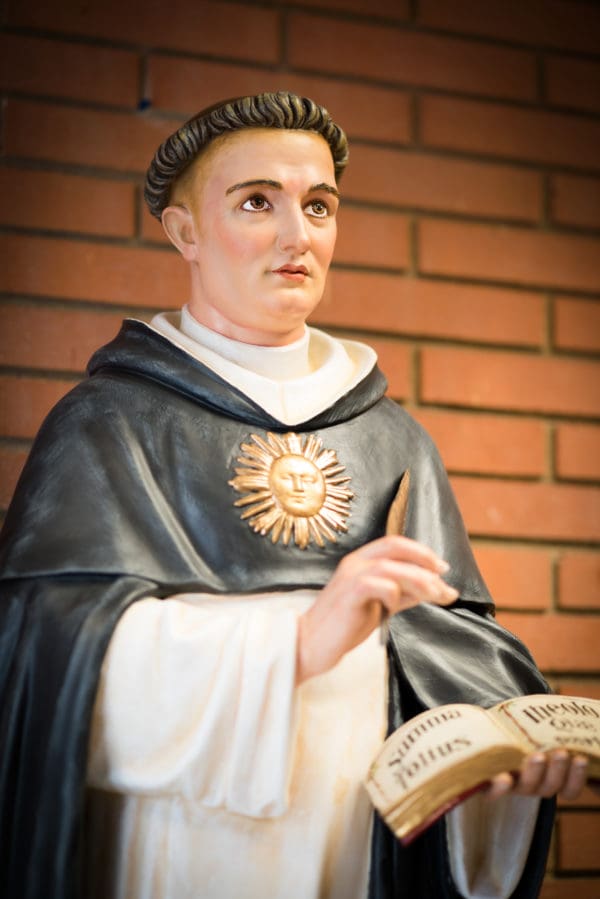
Saint Thomas Aquinas


Thomas Aquinas (1225 - 1274; of Aquino, Italy) was an Italian philosopher and theologian known as the Angelic Doctor. Born of a wealthy family at Rocca Secca, near Naples, in Italy, he disappointed his family by joining a poor order of preachers (1244) that followed the Rule of Dominic and were therefore known as Dominicans. In 1245, he began to study in Paris, France with Albertus Magnus whose favorite pupil he became.

In 1248, he accompanied Albert to Cologne, Germany. From there, Thomas returned to Paris (1252) where he became known as a great teacher and theologian. He spent some time in Rome as a papal advisor, returned to Paris to teach for a period and then returned to Naples to found a house of studies (1272). In 1274, on the way to a church council at Lyons, France, he took sick and died at the age of 49.

His works show him to be a brilliant lecturer, a clear thinker and an Aristotelian. In an age which was uncomfortable with the notion that the universe could be known apart from revelation, he pioneered the use of the Greek philosophy that featured the power of reason to demonstrate that God and his universe could be understood by reason guided by faith. His large girth and slow, deliberate style earned him the nickname "The Dumb Ox!"

He was the composer of several memorable religious hymns - O Salutaris Hostia and Pange Lingua being the most familiar to modern worshippers. His extensive writings explored the relationship between the mind of man and the mind of God and his synthesis of knowledge relating to this joining of intellect and religious belief, entitled The Summa Theologica (1267-1273), earned him a lasting reputation among scholars and religious alike. An earlier work, Summa Contra Gentiles (1258 - 1260), is written in a style that attempts to establish the truth of Christian religious belief in arguments addressed to an intelligent, but non-Christian reader.

His proofs for the existence of God, apart from faith and revelation, utilizing the power of reason are considered flawed by some 20th century historians of philosophy (Bertrand Russell, for example) because, he argues, Thomas proved what he already believed to be true. Therefore, according to Russell, his work should be viewed as an artful, concise argument, but not a decisive proof.

In spite of this reservation, Russell acknowledges Thomas's contributions to the intellectual movement called Scholasticism, which succeeded in liberating scholarship from the provincial shackles that uninformed religious censorship often created for it. Thomas also continued in the spirit of Albert the Great to lay a foundation of legitimacy for the Christian study of natural phenomena that allowed Christian Europe to proceed to the initial stages of the scientific revolution. Pope Leo XIII declared Scholasticism in 1879, in the encyclical Aeterni Patris, to be the official Roman Catholic philosophy.

Aquinas' five proofs for the existence of God might be summarized as follows:

  1. The unmoved Mover: Whatever is moved, is moved by something, and since an endless regress is not possible, a Prime Mover is required.
  2. The first Cause: Every result has a cause and since an endless regress is impossible, there must be a First Cause.
  3. The ultimate Necessity: Essentially a repeat of Reason (2.), there must be a source for all consequences which follow.
  4. Perfect Source: All perfection in the world requires, as its source, an Ultimate Perfection.
  5. Purpose: Even lifeless things have a purpose which must be defined by something outside themselves, since only living things can have an internal purpose.

Statue of St Thomas Aquinas


A statue of St. Thomas Aquinas faces the entrance to the first floor of the Academic Building. (See photo, left) It was sculpted by Sr. Phyllis Mrozinski, O.P. and was dedicated on September 16, 1990. It replaces a statue of Thomas, dedicated in the spring of 1956 that was damaged in a fire while it was being stored in what is now the Pastoral Center, or Bukowski Chapel.


Also on view in the display case is a three-volume set of the Summa Theologica.

Thomas's teacher at the University of Paris, Albert the Great, Albertus Magnus, is the man for whom the Aquinas science building is named. Albert is known to have practiced experimental science - his efforts to test the validity of the claims associated with the use of herbal medicines and folk remedies for disease was unusual for his time. Such skepticism, on the part of Albert, was adopted by his pupil, Thomas, and led both men to believe that one could be a sincere Christian and an objective observer of natural phenomena.


aquinas.edu
12 posted on 01/28/2025 3:29:02 AM PST by annalex (fear them not)
[ Post Reply | Private Reply | To 11 | View Replies]

To: annalex

13 posted on 01/28/2025 3:31:50 AM PST by annalex (fear them not)
[ Post Reply | Private Reply | To 12 | View Replies]

To: annalex

NAVARRE BIBLE COMMENTARY (RSV)

Ad Majorem Dei Gloriam (To the Greater Glory of God)

First Reading:

From: Hebrews 10:1-10

The Sacrifices of the Old Covenant Could Not Take Away Sins (Continuation)
----------------------------------------
[1] For since the law has but a shadow of the good things to come instead of the true form of these realities, it can never, by the same sacrifices which are continually offered year after year, make perfect those who draw near. Otherwise, would they not have ceased to be offered? If the worshippers had once been cleansed, they would no longer have any consciousness of sin. [3] But in these sacrifices there is a reminder of sin year after year. [4] For it is impossible that the blood of bulls and goats should take away sins.

Christ's Offering of Himself Has Infinite Value
-----------------------------------------------
[5] Consequently, when Christ came into the world, He said, "Sacrifices and offerings Thou hast not desired, but a body hast Thou prepared for Me; [6] in burnt offerings and sin offerings Thou hast taken no pleasure. [7] Then I said, `Lo, I have come to do Thy will, O God,' as it is written of Me in the roll of the book." [8] When He said above, "Thou hast neither desired nor taken pleasure in sacrifices and offerings and burnt offerings and sin offerings" (these are offered according to the law), [9] then He added, "Lo, I have come to do Thy will." He abolishes the first in order to establish the second. [10] And by that will we have been sanctified through the offering of the body of Jesus Christ once for all.

***********************************************************************
Commentary:

1. The sacred writer once more compares the Old Testament sacrifices with the sacrifice of Christ (cf. 7:27; 9:9-10, 12-13), examining them now from the point of view of their efficacy.

The Law is "a shadow", that is, something without substance. The term used to be employed by artists to describe the first sketch on a canvas, a bare outline before the application of color. Thus, the Old Law in relation to the New Testament is like a first sketch as compared with the finished painting. However, because it speaks of the New Testament as "the true form of these realities", it allows us to see the New Covenant as not yet giving possession of these "good things to come", but as being a kind of anticipation of them, a reflection of them. Yet it is a true, a faithful, reflection, insofar as the New Law already has the power to forgive sins and to link men with God through charity. "The New Law", St Thomas says, "represents the good things to come more clearly than does the Old. Firstly, because in the words of the New Testament express mention is made of the good things to come and the promise, whereas in the Old reference is made only to material good things. Secondly, because the New Testament draws its strength from charity, which is the fullness of the Law. And this charity, even if it be imperfect, is similar to Christ's charity by virtue of the faith to which it is joined. That is why the new law is called the 'law of love'. And that is also why it is called the 'true form', because it has imprinted on it the image of the good things to come" ("Commentary on Heb, ad loc.").

Moreover, an image, to some degree at least, coincides with the reality it reflects: Christ himself, for example, is the image of God. Therefore, "in Christ one already possesses, in a permanent way, these good things of heaven--both the present ones and the future ones"("Chrysostom, Hom. on Heb, ad loc.").

2-4. These verses repeat what is said in verse 1 and in 9:12-13. "Tell me, then, what is the point of having more victims and more sacrifices when a single victim would suffice for atonement for sins [...]. Multiple sacrifices in effect show that the Jews needed to atone for their sins because they had failed to find forgiveness: it points to the inefficacy of the victims offered, rather than to their power" (Chrysostom, "Hom. on Heb.", 17). The ultimate reason for this inefficacy is explained by a striking statement: "It is impossible that the blood of bulls and goats should take away sins" (verse 4). There is here an echo of those proclamations of the prophets which reminded the people that true purification comes not from external actions but from conversion of heart (cf. Jeremiah 2:22; 4:14; 11:15; Micah 6:7-8; Psalm 51:18-19; etc.).

And yet, is it not the case that the priests of the New Testament renew Jesus' sacrifice in the Mass everyday? St. John Chrysostom answers: "Yes, that is true, but not because we regard the original sacrifice, Christ's sacrifice, as ineffective or impotent. We priests repeat it to commemorate His death. We have but one victim, Christ--not many victims [...]. There is but one and the same sacrifice [...], one Christ whole and entire, here as elsewhere, the same everywhere—the same Christ on all the altars. Just as Jesus Christ, although offered in different places, has only one body, so everywhere there is but one sacrifice [...]. What we do is a commemoration of Christ's offering, for at the Supper He said, `Do this in memory of Me.' Therefore, we do not offer, as the high priest of the Law did, a new, additional victim: it is not one sacrifice more, but always the same one" ("Hom. on Heb.", 17).

The Mass "is the sacrifice of Christ, offered to the Father with the cooperation of the Holy Spirit--an offering of infinite value, which perpetuates the work of the Redemption in us and surpasses the sacrifices of the Old Law. The holy Mass brings us face to face with one of the central mysteries of our faith, because it is the gift of the Blessed Trinity to the Church. It is because of this that we can consider the Mass as the center and the source of a Christian's spiritual life. It is the final end of all the Sacraments" (St J. Escriva, "Christ Is Passing By", 86-87).

5-10. This passage carries a quotation from Psalm 40:7-8, but one taken from the Greek translation, the Septuagint, not from the Hebrew. Where the Hebrew says, "Thou hast opened My ears", the Greek reads, "a body Thou hast prepared for Me". The difference is not substantial, because the Hebrew expression points to the docility and obedience of the speaker, who is the Messiah Himself. The Greek translation gives the sentence a more general meaning: God has not only opened the ears of the Messiah; He has given Him life as a man (cf. Philippians 2:7). The words of this Psalm "allow us as it were to sound the unfathomable depths of this self-abasement of the Word, His humiliation of Himself for love of men even to death on the Cross [...]. Why this obedience, this self-abasement, this suffering? The Creed gives us the answer: 'for us men and for our salvation' Jesus came down from Heaven so as to give man full entitlement to ascend (to Heaven) and by becoming a son in the Son to regain the dignity he lost through sin [...]. Let us welcome Him. Let us say to Him, `Here I am; I have come to do Your will'" (St Pope John Paul II, "General Audience", 25 March 1981).

The author of the letter, elaborating on the text of the psalm, asserts that the Messiah's sacrifice is greater than the sacrifices of the Old Law, unbloody as well as bloody, sin-offerings as well as burnt offerings as they were called in the liturgy (cf. Leviticus 5;6; 7:27). The sacrifice of Christ, who has "come into the world", has replaced both kinds of ancient sacrifice. It consisted in perfectly doing the will of His Father (cf. John 4:34; 6:38; 8:29; 14:31), even though He was required to give His life to the point of dying on Calvary (Matthew 26:42; John 10:18; Hebrews 5:7-9). Christ "came into the world" to offer Himself up to suffering and death for the redemption of the world. "He knew that all the sacrifices of goats and bulls offered to God in ancient times were incapable of making satisfaction for the sins of men; He knew that a divine person was needed to do that [...]. My Father (Jesus Christ said), all the victims offered You up to this are not enough and never will be enough to satisfy Your justice; You gave Me a body capable of experiencing suffering, so that You might be placated by the shedding of My blood, and men thereby saved; `"ecce venio", here I am, ready; I accept everything and in all things do I submit to Your will'. The lower part of His human nature naturally felt repugnance and reacted against living and dying in so much pain and opprobrium, but its rational part, which was fully subject to the Father's will, had the upper hand; it accepted everything, and therefore Jesus Christ began to suffer, from that point onwards, all the anguish and pain which He would undergo in the course of His life. That is how our Divine Redeemer acted from the very first moments of His coming into the world. So, how should we behave towards Jesus when, come to the use of reason, we begin to know the sacred mysteries of Redemption through the light of faith?" (St. Alphonsus, "Advent Meditations", II, 5).

The Psalm speaks of "the roll of the book": this may refer to a specific book or else to the Old Testament in general (cf. Luke 24:27; John 5;39, 46, 47).

14 posted on 01/28/2025 6:47:12 AM PST by fidelis (👈 Under no obligation to respond to rude, ignorant, abusive, bellicose, and obnoxious posts.)
[ Post Reply | Private Reply | To 13 | View Replies]

Gospel Reading:

From: Mark 3:31-35

The True Kinsmen of Jesus
-------------------------
[31] And His (Jesus') mother and His brethren came; and standing outside they went to Him and called Him. [32] And a crowd was sitting about Him: and they said to Him, "Your mother and Your brethren are outside, asking for You." [33] And He replied, "Who are My mother and My brethren?" [34] And looking around on those who sat about Him, He said, "Here are My mother and My brethren! [35] Whoever does the will of God is My brother, and sister, and mother."

***********************************************************************
Commentary:

31-35. In Aramaic, the language used by the Jews, the word "brethren" is a broad term indicating kinship: nephews, first cousins, and relatives in general are called `brethren' (for further explanation cf. note on Mark 6:1-3). "Jesus did not say this to disown His mother, but to show that she is worthy of honor not only account of having given birth to Jesus, but also because she has all the virtues" (Theophylact, "Enarratio In Evangelium Marci, in loc.").

Therefore, the Church reminds us that the Blessed Virgin "in the course of her Son's preaching received the words whereby, in extolling a kingdom beyond the concerns and ties of flesh and blood, He declared blessed those who heard and kept the word of God as she was faithfully doing" (Vatican II, "Lumen Gentium", 58).

Our Lord, then, is also telling us that if we follow Him we will share His life more intimately than if we were a member of His family. St. Thomas explains this by saying that Christ "had an eternal generation and a generation in time, and gave preference to the former. Those who do the will of the Father reach Him by Heavenly generation [...]. Everyone who does the will of the Father, that is to say, who obeys Him, is a brother or sister of Christ, because he is like Him who fulfilled the will of His Father. But he who not only obeys but converts others, begets Christ in them, and thus becomes like the Mother of Christ" ("Commentary on St. Matthew", 12, 49-50.)

15 posted on 01/28/2025 6:47:31 AM PST by fidelis (👈 Under no obligation to respond to rude, ignorant, abusive, bellicose, and obnoxious posts.)
[ Post Reply | Private Reply | To 14 | View Replies]

Click here to go to the My Catholic Life! Devotional thread for a meditation on today’s Gospel Reading.

16 posted on 01/28/2025 6:48:26 AM PST by fidelis (👈 Under no obligation to respond to rude, ignorant, abusive, bellicose, and obnoxious posts.)
[ Post Reply | Private Reply | To 15 | View Replies]

Disclaimer: Opinions posted on Free Republic are those of the individual posters and do not necessarily represent the opinion of Free Republic or its management. All materials posted herein are protected by copyright law and the exemption for fair use of copyrighted works.

Free Republic
Browse · Search
Religion
Topics · Post Article

FreeRepublic, LLC, PO BOX 9771, FRESNO, CA 93794
FreeRepublic.com is powered by software copyright 2000-2008 John Robinson