Catena Aurea by St. Thomas Aguinas
Mark CHAP. 16
16:14–18
14. Afterward he appeared unto the eleven as they sat at meat, and upbraided them with their unbelief and hardness of heart, because they believed not them which had seen him after he was risen.
15. And he said unto them, Go ye into all the world, and preach the Gospel to every creature.
16. He that believeth and is baptized shall be saved; but he that believed not shall be damned.
17. And these signs shall follow them that believe; In my name shall they cast out devils; they shall speak with new tongues;
18. They shall take up serpents; and if they drink any deadly thing, it shall not hurt them; they shall lay hands on the sick, and they shall recover.
GLOSS. (non occ.) Mark, when about to finish his Gospel, relates the last appearance of our Lord to His disciples after His resurrection, saying,1 For the last time he appeared unto the eleven as they sat at meat. (Acts 1:4, 9)
GREGORY. (ubi sup.) We should observe that Luke says in the Acts, As he2 was eating with them he commanded that they should not depart from Jerusalem, and shortly afterwards, while they beheld he was taken up. For He ate, and then ascended, that by the act of eating, the truth of the flesh might be declared; wherefore it is also here said, that he appeared to them for the last time as they sat at meat.
PSEUDO-JEROME. But He appeared when all the eleven were together, that all might be witnesses, and relate to all men what they had seen and heard in common. It goes on: And upbraided them with their unbelief and hardness of heart, because they believed not them who had seen him after his resurrection.
AUGUSTINE. (ubi sup.) But how was this done the last time? The last occasion on which the Apostles saw the Lord upon earth happened forty days after the resurrection; but would He then have upbraided them for not believing those who had seen Him risen, when they themselves had so often seen Him after His resurrection? It remains therefore that we should understand that Mark wished to say it in few words, and said for the last time, because it was the last time that He shewed Himself that day, as night was coming on, when the disciples returned from the country into Jerusalem, and found, as Luke says (Luke 24:33.), the eleven and those who were with them, speaking together concerning the resurrection of our Lord. But there were some there who did not believe; when these then were sitting at meat, (as Mark says,) and were still speaking, (as Luke relates,) The Lord stood in the midst of them, and saith unto them, Peace be unto you; (Luke 24:36) as Luke and John say. (John 20:19) The rebuke therefore which Mark here mentions, must have been amongst those words, which Luke and John say, that the Lord at that time spoke to the disciples. But another question is raised, how Mark says that He appeared when the eleven sat at meat, if the time was the first part of the night on the Lord’s day, when John plainly says that Thomas was not with them, who, we believe, had gone out, before the Lord came in to them, after those two had returned from the village, and spoken with the eleven, as we find in Luke’s Gospel. But Luke in his relation leaves room for supposing that Thomas went out first, while they spoke these things, and that the Lord entered afterwards; Mark however from his saying, for the last time he appeared to the eleven as they sat at meat, forces us to believe that he was there, unless indeed, though one of them was absent, he chose to call them the eleven, because the company of the Apostles was then called by this number, before Matthias was chosen into the place of Judas. Or if this be a harsh way of understanding it, let us understand that it means that after many appearances, He shewed Himself for the last time, that is, on the fortieth day, to the Apostles, as they sat at meat, and that since He was about to ascend from them, He rather wished on that day to reprove them for not having believed those who had seen Him risen before seeing Him themselves, because after His ascension even the Gentiles on their preaching were to believe a Gospel, which they had not seen. And so the same Mark immediately after that rebuke says, And he said unto them, Go ye into all the world, and preach the Gospel to every creature. And lower down, He that believeth not shall be condemned. Since then they were to preach this, were not they themselves to be first rebuked, because before they saw the Lord they had not believed those to whom He had first appeared?
GREGORY. (ubi sup.) Another reason also why our Lord rebuked His disciples, when He left them as to His bodily presence, was, that the words which He spoke on leaving them might remain more deeply impressed upon the hearts of His hearers.
PSEUDO-JEROME. But He rebukes their want of faith, that faith might take its place; He rebukes the hardness of their stony heart, that the fleshy heart, full of love, might take its place.
GREGORY. (ubi sup.) After rebuking the hardness of their hearts, let us hear the words of advice which He speaks. For it goes on: Go ye into all the world, and preach the Gospel to every creature. Every man must be understood by every creature; for man partakes something of every creature; he has existence as have stones, life as trees, feeling as animals, understanding as have Angels. For the Gospel is preached to every creature, because he is taught by it, for whose sake all are created, whom all things are in some way like, and from whom therefore they are not alien. By the name of every creature also every nation of the Gentiles may be meant. For it had been said before, Go not into the way of the Gentiles. (Matt. 10:5) But now it is said, Preach the Gospel to every creature, so that the preaching of the Apostles which was thrust aside by Judæa, might be an assistance to us, since Judæa had haughtily rejected it, thus witnessing to her own damnation.
THEOPHYLACT. Or else; to every creature, that is, whether believing or unbelieving. It goes on: He that believeth and is baptized shall be saved. For it is not enough to believe, for he who believeth and is not baptized, but is a catechumen, has not yet attained to perfect salvation.
GREGORY. (ubi sup.) But perhaps some one may say in himself, I have already believed, I shall be saved. He says what is true, if he keeps his faith by works; for that is a true faith, which does not contradict by its deeds what it says in words. There follows: But he that believeth not shall be damned.
BEDE. (ubi sup.) What shall we say here about infants, who by reason of their age cannot yet believe; for as to older persons there is no question. In the Church then of our Saviour children believe by others, as also they drew from others the sins which are remitted to them in baptism. It goes on: And these signs shall follow them that believe; In my name shall they cast out devils; they shall speak with new tongues; they shall take up serpents.
THEOPHYLACT. That is, they shall scatter before them serpents, whether intellectual or sensible, as it is said, Ye shall tread upon serpents and scorpions, which is understood spiritually. But it may also mean sensible serpents, as when Paul received no hurt from the viper. There follows: And if they drink any deadly thing, it shall not hurt them. (Luke 10:19) We read of many such cases in history, for many persons have drank poison unhurt, by guarding themselves with the sign of Christ. It goes on: They shall lay hands on the sick, and they shall recorer.
GREGORY. (ubi sup.) Are we then without faith because we cannot do these signs? Nay, but these things were necessary in the beginning of the Church, for the faith of believers was to be nourished by miracles, that it might increase. Thus we also, when we plant groves, pour water upon them, until we see that they have grown strong in the earth; but when once they have firmly fixed their roots, we leave off irrigating them. These signs and miracles have other things which we ought to consider more minutely. For Holy Church does every day in spirit what then the Apostles did in body; for when her Priests by the grace of exorcism lay their hands on believers, and forbid the evil spirits to dwell in their minds, what do they, but cast out devils? And the faithful who have left earthly words, and whose tongues sound forth the Holy Mysteries, speak a new language; they who by their good warnings take away evil from the hearts of others, take up serpents; and when they are hearing words of pestilent persuasion, without being at all drawn aside to evil doing, they drink a deadly thing, but it will never hurt them; whenever they see their neighbours growing weak in good works, and by their good example strengthen their life, they lay their hands on the sick, that they may recover. And all these miracles are greater in proportion as they are spiritual, and by them souls and not bodies are raised.
Catena Aurea Mark 16
NAVARRE BIBLE COMMENTARY (RSV)
Ad Majorem Dei Gloriam (To the Greater Glory of God)
First Reading:
From: Acts 9:1-22
Saul on His Way to Damascus
-------------------------------------
[1] But Saul, still breathing threats and murder against the disciples of the Lord, went to the high priest [2] and asked him for letters to the synagogues at Damascus, so that if he found any belonging to the Way, men or women, he might bring them bound to Jerusalem. [3] Now a he journeyed he approached Damascus, and suddenly a light from Heaven flashed about him. [4] And he fell to the ground and heard a voice saying to him, "Saul, Saul, why do you persecute Me?" [5] And he said, "Who are you, Lord?" And He said, "I am Jesus whom you are persecuting; [6] but rise and enter the city, and you will be told what you are to do." [7] The men who were travelling with him stood speechless, hearing the voice but seeing no one. [8] Saul arose from the ground; and when his eyes were opened, he could see nothing; so they led him by the hand and brought him into Damascus. [9] And for three days he was without sight, and neither ate nor drank.
Ananias Baptizes Saul
---------------------------------
[10] Now there was a disciple at Damascus called Ananias. The Lord said to him in a vision, "Ananias." And he said, "Here I am, Lord." [11] And the Lord said to him, "Rise and go to the street called Straight, and inquire in the house of Judas for a man of Tarsus named Saul; for behold, he is praying, [12] and he has seen a man named Ananias come in and lay his hands on him so that he might regain his sight." [13] But Ananias answered, "Lord, I have heard from many about this man, how much evil he has done to Thy saints at Jerusalem; [14] and here he has authority from the chief priests to bind all who call upon Thy name." [15] But the Lord said to him, "Go for he is a chosen instrument of mine to carry My name before the Gentiles and kings and the sons of Israel; [16] for I will show him how much he must suffer for the sake of My name." [17] So Ananias departed and entered the house. And laying his hands on him he said, "Brother Saul, the Lord Jesus who appeared to you on the road by which you came, has sent me that you may regain your sight and be filled with the Holy Spirit." [18] And immediately something like scales fell from his eyes and he regained his sight. Then he rose and was baptized, [19] and took food and was strengthened.
For several days he was with the disciples at Damascus.
Paul Begins His Apostolate
--------------------------
[20] And in the synagogues immediately he proclaimed Jesus, saying, "He is the Son of God." [21] And all who heard were amazed and said, "Is not this the man who made havoc in Jerusalem of those who called on this name? And he has come here for this purpose to bring them bound before the chief priests." [22] But Saul increased all the more in strength, and confounded the Jews who lived in Damascus by proving that Jesus was the Christ.
*******************************************************************
Commentary:
1-3. Roman authorities recognized the moral authority of the Sanhedrin and even permitted it to exercise a certain jurisdiction over members of Jewish communities outside Palestine--as was the case with Damascus. The Sanhedrin even had the right to extradite Jews to Palestine (cf. I Maccabees 15:21).
Damascus was about 230-250 kilometers (150 miles) from Jerusalem, depending on which route one took. Saul and his associates, who would probably have been mounted, would have had no difficulty in doing the journey in under a week. This apparition took place towards the end of the journey, when they were near Damascus.
2. "The Way": the corresponding word in Hebrew also means religious behavior. Here it refers to both Christian lifestyle and the Gospel itself; indirectly it means all the early followers of Jesus (cf. Acts 18:25ff; 19:9, 23; 22:4) and all those who come after them and are on the way to Heaven; it reminds us of Jesus' words, "The gate is narrow and the way is hard, that leads to life, and those who find it are few" (Matthew 7:14).
3-19. This is the first of the three accounts of the calling of Saul--occurring probably between the years 34 and 36--that are given in the Acts of the Apostles (cf. Acts 22:5-16; 26:10-18); where important events are concerned, St. Luke does not mind repeating himself. Once again the Light shines in the darkness (cf. John 1:5). It does so here in a spectacular way and, as in every conversion, it makes the convert see God, himself and others in a new way.
However, the episode on the road to Damascus is not only a conversion. It marks the beginning of St. Paul's vocation: "What amazes you seems natural to me: that God has sought you out in the practice of your profession!
"This is how He sought the first, Peter and Andrew, James and John, beside their nets, and Matthew, sitting in the custom-house.
"And--wonder of wonders!--Paul, in his eagerness to destroy the seed of the Christians" (St J. Escriva, "The Way", 799).
The background to St. Luke's concise account is easy to fill in. There would have been no Hellenist Christians left in Jerusalem: they had fled the city, some going as far afield as Phoenicia, Cyprus and Antioch. Many had sought refuge in Damascus, and Saul must have realized that their evangelizing zeal would win many converts among faithful Jews in that city. Saul genuinely wanted to serve God, which explains his readiness to respond to grace. Like most Jews of his time, he saw the Messiah as a political liberator, a warrior-king, a half-Heavenly, half-earthly figure such as described in the apocryphal "Book of Enoch", 46: "It is impossible to imagine how even his glance terrifies his enemies. Wherever he turns, everything trembles; wherever his voice reaches everything is overwhelmed and those who hear it are dissolved as wax in fire." A hero of this type does not fall into the power of his enemies, much less let them crucify him; on the contrary, he is a victor, he annihilates his enemies and establishes an everlasting kingdom of peace and justice. For Saul, Jesus' death on a cross was a clear proof that He was a false messiah; and the whole notion of a brotherhood of Jews and Gentiles was inconceivable.
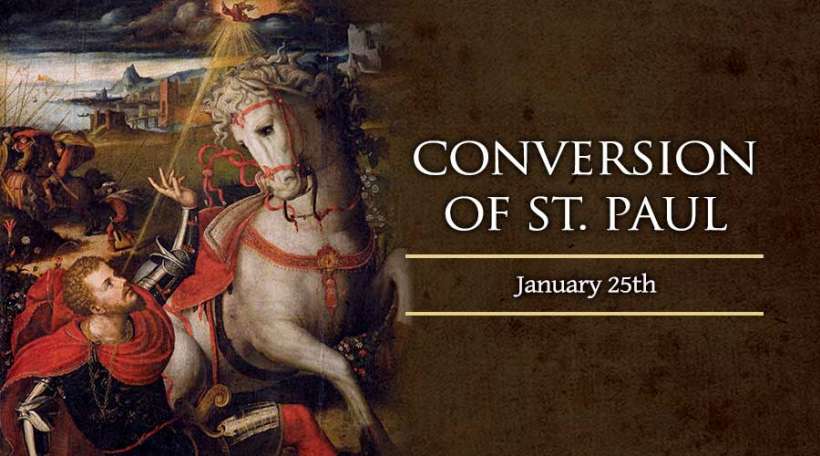
He has almost reached Damascus when a light flashes; he is thrown onto the ground and hears a voice from Heaven calling his name twice, in a tone of sad complaint.
Saul surrenders unconditionally and places himself at the Lord's service. He does not bemoan his past life; he is ready to start anew. No longer is the Cross a "scandal": it has become for him a sign of salvation, the "power of God", a throne of victory, whose praises he will sing in his epistles. Soon St. Paul will learn more about this Way and about all that Jesus did and taught, but from this moment onwards, the moment of his calling, he realizes that Jesus is the risen Messiah, in whom the prophecies find fulfillment; he believes in the divinity of Christ: he sees how different his idea of the Messiah was from the glorified, pre-existing and eternal Son of God; he understands Christ's mystical presence in His followers: "Why do you persecute me?" In other words, he realizes that he has been chosen by God, called by God, and immediately places himself at his service.
4. This identification of Christ and Christians is something which the Apostle will later elaborate on when he speaks of the Mystical Body of Christ (cf. Colossians 1:18; Ephesians 1:22f).
St. Bede comments as follows: "Jesus does not say, `Why do you persecute My members?', but, `Why do you persecute Me?', because He Himself still suffers affronts in His body, which is the Church. Similarly Christ will take account of the good actions done to His members, for He said, `I was hungry and you gave Me food...' (Matthew 25:35), and explaining these words He added `As you did it to one of the least of these My brethren, you did it to Me' (Matthew 25:40)" ("Super Act. Expositio, ad loc.").
5-6. In the Vulgate and in many other translations these words are added between the end of verse 5 and the start of verse 6: "It is hard for thee to kick against the goad. And he, trembling and astonished, said: "Lord, what will Thou have me to do? And the Lord said to him". These words do not seem to be part of the original sacred text but rather a later explanatory gloss; for this reason the New Vulgate omits them. (The first part of the addition comes from Paul's address in Acts 26:14).
6. The calling of Saul was exceptional as regards the manner in which God called him; but the effect it had on him was the same as what happens when God gives a specific calling to the apostolate to certain individual Christians, inviting them to follow Him more closely. Paul's immediate response is a model of how those who receive these specific callings should act (all Christians, of course, have a common calling to holiness and apostolate that comes with Baptism).
[Pope] Paul VI describes in this way the effects of this specific kind of vocation in a person's soul: "The apostolate is [...] an inner voice, which makes one both restless and serene, a voice that is both gentle and imperious, troublesome and affectionate, a voice which comes unexpectedly and with great events and then, at a particular point, exercises a strong attraction, as it were revealing to us our life and our destiny. It speaks prophetically and almost in a tone of victory, which eventually dispels all uncertainty, all timidity and all fear, and which facilitates-- making it easy, desirable and pleasant--the response of our whole personality, when we pronounce that word which reveals the supreme secret of love: Yes; Yes, Lord, tell what I must do and I will try to do it, I will do it. Like St. Paul, thrown to the ground at the gates of Damascus: What would You have me do?
"The roots of the apostolate run deep: the apostolate is vocation, election, interior encounter with Christ, abandonment of one's personal autonomy to His will, to His invisible presence; it is a kind of substitution of our poor, restless heart, inconstant and at times unfaithful yet hungry for love, for His heart, the heart of Christ which is beginning to pulsate in the one who has been chosen. And then comes the second act in the psychological drama of the apostolate: the need to spread, to do, to give, to speak, to pass on to others one's own treasure, one's own fire. [...]
"The apostolate becomes a continuous expansion of one's soul, the exuberance of a personality taken over by Christ and animated by His Spirit; it becomes a need to hasten, to work, to do everything one can to spread the Kingdom of God, to save other souls, to save all souls" ("Homily", 14 October 1968).
8-11. Straight Street runs through Damascus from east to west and can still be identified today.
13. Ananias refers to Christ's followers as "saints"; this was the word normally used to describe the disciples, first in Palestine and then in the world at large. God is THE Holy One (cf. Isaiah 6:3); as the Old Testament repeatedly says, those who approach God and keep His commandments share in this holiness: "The Lord said to Moses, `Say to all the congregation of the people of Israel, You shall be holy; for I the Lord your God am holy'" (Leviticus 19:1-2).
The use of this term is an example of the spiritual sensitivity of our first brothers and sisters in the faith: "What a moving name--saints! --the early Christians used to address each other!...
"Learn to be a brother to your brothers" (St J. Escriva, "The Way", 469).
15-16. Our Lord calls St. Paul His "vessel of election", which is a Hebraicism equivalent to "chosen instrument", and He tells Ananias how much the Apostle will have to suffer on His account. A Christian called to the apostolate is also, by virtue of this divine vocation, an instrument in the hands of God; to be effective he must be docile: he must let God use him and must do what God tells him.
The task God has given him is far beyond Paul's ability--"to carry My name before the Gentiles and kings and sons of Israel". In Acts we will see how Paul fulfills his mission, with the help of God's grace and suffering a great deal on account of His name. Down through the centuries, in diverse circumstance, those whom the Lord elects to carry out specific missions will also be able to perform them if they are good instruments who allow grace to act in them and who are ready to suffer for their ideals.
19. In spite of the exceptional manner in which God called St. Paul, He desired him to mature in the normal way--to be instructed by others and learn God's will through them. In this case he chose Ananias to confer Baptism on Paul and teach him the basics of the Christian faith.
In Ananias we can see a trace of the role of the spiritual director or guide in Christian asceticism. There is a principle which states that "no one can be a good judge in his own case, because everyone judges according to his own inclinations" (cf. Cassian, "Collationes", XVI, 11). A person guiding a soul has a special "grace of state" to make God's will known to him; and even if the guide makes a mistake, the person who is being guided will--if obedient--always do the right thing, always do God's will. In this connection St. Vincent Ferrer says: "Our Lord Jesus Christ, without whom we can do nothing, will not give His grace to him who, though he has access to an expert guide, rejects this precious means of sanctification, thinking that he can look after on his own everything that touches on his salvation. He who has a director, whom he obeys in everything, will reach his goal more easily and more quickly than if he had acted as his own guide, even if he be very intelligent and have the very best of spiritual books" ("Treatise on the Spiritual Life", 2, 1).
On the spiritual guidance of ordinary Christians, who seek holiness and carry out apostolate in the context of everyday life, St Escriva, writes: "A Director. You need one. So that you can give yourself to God, and give yourself fully...by obedience. A director who understands your apostolate, who knows what God wants: that way he will second the work of the Holy Spirit in your soul, without taking you from your place, filling you with peace, and teaching you how to make your work fruitful" ("The Way", 62).
20-23. In his letter to the Galatians (cf. Galatians 1:16f) St. Paul tells of how he went into Arabia after his conversion and then returned to Damascus. He spent almost three years away, and it was on his return that he preached the divinity of Jesus, using all his energy and learning, now placed at the service of Christ. This surprised and confounded the Jews, who immediately began to take action against him.
Gospel Reading: From: Mark 16:15-20
The Apostle's Mission
---------------------
[15] And He (Jesus) said to them, "Go into all the world and preach the Gospel to the whole creation. [16] He who believes and is baptized will be saved; but he who does not believe will be condemned. [17] And these signs will accompany those who believe: in My name they will cast out demons; they will speak in new tongues; [18] they will pick up serpents, and if they drink any deadly thing, it will not hurt them; they will lay their hands on the sick, and they will recover."
***********************************************************************
Commentary:
15. This verse contains what is called the "universal apostolic mandate" (paralleled by Matthew 28:19-20 and Luke 24:46-48). This is an imperative command from Christ to His Apostles to preach the Gospel to the whole world. This same apostolic mission applies, especially, to the Apostles' successors, the bishops in communion with Peter's successor, the Pope.
But this mission extends further: the whole "Church was founded to spread the Kingdom of Christ over all the Earth for the glory of God the Father, to make all men partakers in redemption and salvation.... Every activity of the Mystical Body with this in view goes by the name of `apostolate'; the Church exercises it through all its members, though in various ways. In fact, the Christian vocation is, of its nature, a vocation to the apostolate as well. In the organism of a living body no member plays a purely passive part, sharing in the life of the body it shares at the same time in its activity. The same is true for the body of Christ, the Church: `the whole body achieves full growth in dependence on the full functioning of each part' (Ephesians 4:16). Between the members of this body there exists, further, such a unity and solidarity (cf. Ephesians 4:16) that a member who does not work at the growth of the body to the extent of his possibilities must be considered useless both to the Church and to himself.
"In the Church there is diversity of ministry but unity of mission. To the Apostles and their successors Christ has entrusted the office of teaching, sanctifying and governing in His name and by His power. But the laity are made to share in the priestly, prophetical and kingly office of Christ; they have therefore, in the Church and in the world, their own assignment in the mission of the whole people of God" (Vatican II, "Apostolicam Actuositatem", 2).
It is true that God acts directly on each person's soul through grace, but it must also be said that it is Christ's will (expressed here and elsewhere) that men should be an instrument or vehicle of salvation for others.
Vatican II also teaches this: "On all Christians, accordingly, rests the noble obligation of working to bring all men throughout the whole world to hear and accept the divine message of salvation" ("ibid"., 3).
16. This verse teaches that, as a consequence of the proclamation of the Good News, faith and Baptism are indispensable pre-requisites for attaining salvation. Conversion to the faith of Jesus Christ should lead directly to Baptism, which confers on us "the first sanctifying grace, by which original sin is forgiven, and which also forgives any actual sins there may be; it remits all punishment due for these sins; it impresses on the soul the mark of the Christian; it makes us children of God, members of the Church and heirs to Heaven, and enables us to receive the other sacraments" ("St. Pius X Catechism", 553).
Baptism is absolutely necessary for salvation, as we can see from these words of the Lord. But physical impossibility of receiving the rite of Baptism can be replaced by either martyrdom (called, therefore "baptism of blood") or by a perfect act of love of God and of contrition, together with an at least implicit desire to be baptized: this is called "baptism of desire" (cf. "ibid"., 567-568).
Regarding infant Baptism, St. Augustine taught that "the custom of our Mother the Church of infant Baptism is in no way to be rejected or considered unnecessary; on the contrary, it is to be believed on the ground that it is a tradition from the Apostles" ("De Gen. ad litt"., 10, 23, 39). The new "Code of Canon Law" also stresses the need to baptize infants: "Parents are obliged to see that their infants are baptized within the first few weeks. As soon as possible after the birth, indeed even before it, they are to approach the parish priest to ask for the sacrament for their child, and to be themselves duly prepare for it" (Canon 867).
Another consequence of the proclamation of the Gospel, closely linked with the previous one, is that "the Church is necessary", as Vatican II declares: "Christ is the one mediator and way of salvation; He is present to us in His body which is the Church. He Himself explicitly asserted the necessity of faith and baptism (cf. Mark 16:16; John 3:5), and thereby affirmed at the same time the necessity of the Church which men enter through baptism as through a door. Hence they could not be saved who, knowing that the Church was founded as necessary by God through Christ, would refuse to enter it, or to remain in it" ("Lumen Gentium", 14; cf. "Presbyterorum Ordinis", 4; "Ad Gentes", 1-3; "Dignitatis Humanae", 11).
17-18. In the early days of the Church, public miracles of this kind happened frequently. There are numerous historical records of these events in the New Testament (cf., e.g., Acts 3:1-11; 28:3-6) and in other ancient Christian writings. It was very fitting that this should be so, for it gave visible proof or the truth of Christianity. Miracles of this type still occur, but much more seldom; they are very exceptional. This, too, is fitting because, on the one hand, the truth of Christianity has been attested to enough; and, on the other, it leaves room for us to merit through faith. St. Jerome comments: "Miracles were necessary at the beginning to confirm people in the faith. But, once the faith of the Church is confirmed, miracles are not necessary" ("Comm. in Marcum, in loc."). However, God still works miracles through saints in every generation, including our own.


 St. Maurus was favored by God with the gift of miracles. To show in what high degree the Saint possessed the gift of miracles, it will be sufficient to cite a few examples of how he miraculously cured the sick and restored to health those who were stricken with a grievous affliction. It has already been stated, according to the testimony of Pope St. Gregory the Great, in the Second Book of his Dialogues, how when a youth,