Mark CHAP. 3
3:1–5
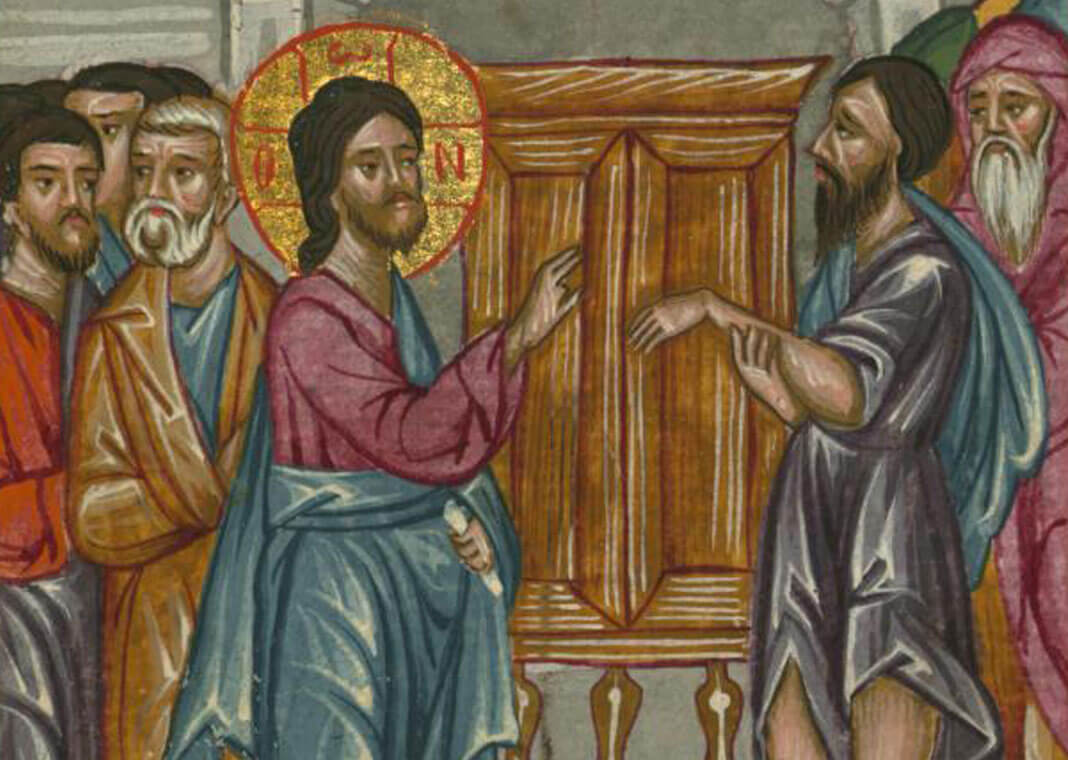
1. And he entered again into the synagogue; and there was a man there which had a withered hand.
2. And they watched him, whether he would heal him on the sabbath day; that they might accuse him.
3. And he saith unto the man which had the withered hand, Stand forth.
4. And he saith unto them, Is it lawful to do good on the sabbath days, or to do evil? to save life, or to kill? But they held their peace.
5. And when he had looked round about on them with anger, being grieved for the hardness of their hearts, he saith unto the man, Stretch forth thine hand. And he stretched it out: and his hand was restored whole as the other.
THEOPHYLACT. After confounding the Jews, who had blamed His disciples, for pulling the ears of corn on the sabbath day, by the example of David, the Lord now further bringing them to the truth, works a miracle on the sabbath; shewing that, if it is a pious deed to work miracles on the sabbath for the health of men, it is not wrong to do on the sabbath things necessary for the body: he says therefore, And he entered again into the synagogue; and there was a man there which had a withered hand. And they watched him, whether he would heal him on the sabbath-day; that they might accuse him.
BEDE. (in Marc. i. 14) For, since He had defended the breaking of the sabbath, which they objected to His disciples, by an approved example, now they wish, by watching Him, to calumniate Himself, that they might accuse Him of a transgression, if He cured on the sabbath, of cruelty or of folly, if He refused. It goes on: And he saith unto the man which had the withered hand, Stand in the midst.
PSEUDO-CHRYSOSTOM. (Vict. Ant. e Cat. in Marc. v. Chrys. Hom. in Matt. 40) He placed him in the midst, that they might be frightened at the sight, and on seeing him compassionate him, and lay aside their malice.
BEDE. (ubi sup.) And anticipating the calumny of the Jews, which they had prepared for Him, He accused them of violating the precepts of the law, by a wrong interpretation. Wherefore there follows: And he saith unto them, Is it lawful to do good on the sabbath-day, or to do evil? And this He asks, because they thought that on the sabbath they were to rest even from good works, whilst the law commands to abstain from bad, saying, Ye shall do no servile work therein; (Levit. 23:7) that is, sin: for Whosoever committeth sin is the servant of sin. (John 8:34) What He first says, to do good on the sabbath-day or to do evil, is the same as what He afterwards adds, to save a life or to lose it; that is, to cure a man or not. Not that God, Who is in the highest degree good, can be the author of perdition to us, but that His not saving is in the language of Scripture to destroy. But if it be asked, wherefore the Lord, being about to cure the body, asked about the saving of the soul, let him understand either that in the common way of Scripture the soul is put for the man; as it is said, All the souls that came out of the loins of Jacob; (Exodus 1:5) or because he did those miracles for the saving of a soul, or because the healing itself of the hand signified the saving of the soul.
AUGUSTINE. (de Con. Evan. ii. 35) But some one may wonder how Matthew could have said, that they themselves asked the Lord, if it was lawful to heal on the sabbath-day; when Mark rather relates that they were asked by our Lord, Is it lawful to do good on the sabbath-day, or to do evil? Therefore we must understand that they first asked the Lord, if it was lawful to heal on the sabbath-day, then that understanding their thoughts, and that they were seeking an opportunity to accuse Him, He placed in the middle him whom He was about to cure, and put those questions, which Mark and Luke relate. We must then suppose, that when they were silent, He propounded the parable of the sheep, and concluded, that it was lawful to do good on the sabbath-day. It goes on: But they were silent.
PSEUDO-CHRYSOSTOM. (Vict. Ant. e Cat, in Marc.) For they knew that He would certainly cure him. It goes on: And looking round about upon them with anger. His looking round upon them in anger, and being saddened at the blindness of their hearts, is fitting for His humanity, which He deigned to take upon Himself for us. He connects the working of the miracle with a word, which proves that the man is cured by His voice alone. It follows therefore, And he stretched it out, and his hand was restored. Answering by all these things for His disciples, and at the same time shewing that His life is above the law.
BEDE. (ubi sup.) But mystically, the man with a withered hand shews the human race, dried up as to its fruitfulness in good works, but now cured by the mercy of the Lord; the hand of man, which in our first parent had been dried up when he plucked the fruit of the forbidden tree, through the grace of the Redeemer, Who stretched His guiltless hands on the tree of the cross, has been restored to health by the juices of good works. Well too was it in the synagogue that the hand was withered; for where the gift of knowledge is greater, there also the danger of inexcusable guilt is greater.
PSEUDO-JEROME. Or else it means the avaricious, who, being able to give had rather receive, and love robbery rather than making gifts. And they are commanded to stretch forth their hands, that is, let him that stole steal no more, but rather let him labour, working with his hand the thing which is good, that he may have to give to him that needeth. (Eph. 4:28)
THEOPHYLACT. Or, he has his right hand withered, who does not the works which belong to the right side; for from the time that our hand is employed in forbidden deeds, from that time it is withered to the working of good. But it will be restored whenever it stands firm in virtue; wherefore Christ saith, Arise, that is, from sin, and stand in the midst; that thus it may stretch itself forth neither too little or too much.
3:6–12
6. And the Pharisees went forth, and straightway took counsel with the Herodians against him, how they might destroy him.
7. But Jesus withdrew himself with his disciples to the sea: and a great multitude from Galilee followed him, and from Judæa,
8. And from Jerusalem, and from Idumæa, and from beyond Jordan; and they about Tyre and Sidon, agr eat multitude, when they had heard what great things he did, came unto him.
9. And he spake to his disciples, that a small ship should wait on him, because of the multitude, lest they should throng him.
10. For he had healed many; insomuch that they pressed upon him for to touch him, as many as had plagues.
11. And unclean spirits, when they saw him, fell down before him, and cried, saying, Thou art the Son of God.
12. And he straitly charged them that they should not make him known.
BEDE. (in Marc. i. 15) The Pharisees, thinking it a crime that at the word of the Lord the hand which was diseased was restored to a sound state, agreed to make a pretext of the words spoken by our Saviour; wherefore it is said, And the Pharisees went forth, and straightway took counsel with the Herodians against him, how they might destroy him. As if every one amongst them did not greater things on the sabbath day, carrying food, reaching forth a cup, and whatever else is necessary for meals. Neither could He, Who said and it was done, be convicted of toiling on the sabbath day.
THEOPHYLACT. But the soldiers of Herod the king are called Herodians, because a certain new heresy had sprung up, which asserted that Herod was the Christ. For the prophecy of Jacob intimated, that when the princes of Judah failed, then Christ should come; because therefore in the time of Herod none of the Jewish princes remained, and he, an alien, was the sole ruler, some thought that he was the Christ, and set on foot this heresy. These, therefore, were with the Pharisees trying to kill Christ.
BEDE. (ubi sup.) Or else he calls Herodians the servants of Herod the Tetrarch, who on account of the hatred which their lord had for John, pursued with treachery and hate the Saviour also, Whom John preached. It goes on, But Jesus withdrew himself with his disciples to the sea; He fled from their treachery, because the hour of His passion had not yet come, and no place away from Jerusalem was proper for His Passion. By which also He gave an example to His disciples, when they suffer persecution in one city, to flee to another.
THEOPHYLACT. At the same time again, He goes away, that by quitting the ungrateful He might do good to more, for many followed him, and he healed them. For there follows, And a great multitude from Galilee, &c. Syrians and Sidonians, being foreigners, receive benefit from Christ; but His kindred the Jews persecute Him: thus there is no profit in relationship, if there be not a similarity in goodness.
BEDE. (ubi sup.) For the strangers followed Him, because they saw the works of His powers, and in order to hear the words or His teaching. But the Jews, induced solely by their opinion of His powers, in a vast multitude come to hear Him, and to beg for His aiding health; wherefore there follows, And he spake to his disciples, that they should wait, &c.
THEOPHYLACT. Consider then how He hid His glory, for He begs for a little ship, lest the crowd should hurt Him, so that entering into it, He might remain unharmed. It follows, As many as had scourges, &c. But he means by scourges, diseases, for God scourges us, as a father does His children.
BEDE. (ubi sup.) Both therefore fell down before the Lord, those who had the plagues of bodily diseases, and those who were vexed by unclean spirits. The sick did this simply with the intention of obtaining health, but the demoniacs, or rather the devils within them, because under the mastery of a fear of God they were compelled not only to fall down before Him, but also to praise His majesty; wherefore it goes on, And they cried out, saying, Thou art the Son of God. And here we must wonder at the blindness of the Arians, who, after the glory of His resurrection, deny the Son of God, Whom the devils confess to be the Son of God, though still clothed with human flesh. There follows, And he straitly charged them, that they should not make him known. (Ps. 50:16) For God said to the sinner, Why dost thou preach my laws? A sinner is forbidden to preach the Lord, lest any one listening to his preaching should follow him in his error, for the devil is an evil master, who always mingles false things with true, that the semblance of truth may cover the witness of fraud. But not only devils, but persons healed by Christ, and even Apostles, are ordered to be silent concerning Him before the Passion, lest by the preaching of the majesty of His Divinity, the economy of His Passion should be retarded. But allegorically, in the Lord’s coming out of the synagogue, and then retiring to the sea, He prefigured the salvation of the Gentiles, to whom He deigned to come through their faith, having quitted the Jews on account of their perfidy. For the nations, driven about in divers by-paths of error, are fitly compared to the unstable sea. (v. Cyprian. Ep. lxiii. Aug. de Civ. Dei, 20, 16.) Again, a great crowd from various provinces followed Him, because He has received with kindness many nations, who came to Him through the preaching of the Apostles. But the ship waiting upon the Lord in the sea is the Church, collected from amongst the nations; and He goes into it lest the crowd should throng Him, because flying from the troubled minds of carnal persons, He delights to come to those who despise the glory of this world, and to dwell within them. Further, there is a difference between thronging the Lord, and touching Him; for they throng Him, when by carnal thoughts and deeds they trouble peace, in which truth dwells; but he touches Him, who by faith and love has received Him into his heart; wherefore those who touched Him are said to have been saved.
THEOPHYLACT. Morally again, the Herodians, that is, persons who love the lusts of the flesh, wish to slay Christ. For the meaning of Herod is, ‘of skin.’ (pelliceus. v. Hier. de Nom. Hebr) But those who quit their country, that is, a carnal mode of living, follow Christ, and their plagues are healed, that is, the sins which wound their conscience. But Jesus in us is our reason, which commands that our vessel, that is, our body, should serve Him, lest the troubles of worldly affairs should press upon our reason.
Catena Aurea Mark 3