Catena Aurea by St. Thomas Aguinas
Mark CHAP. 2
2:23–28
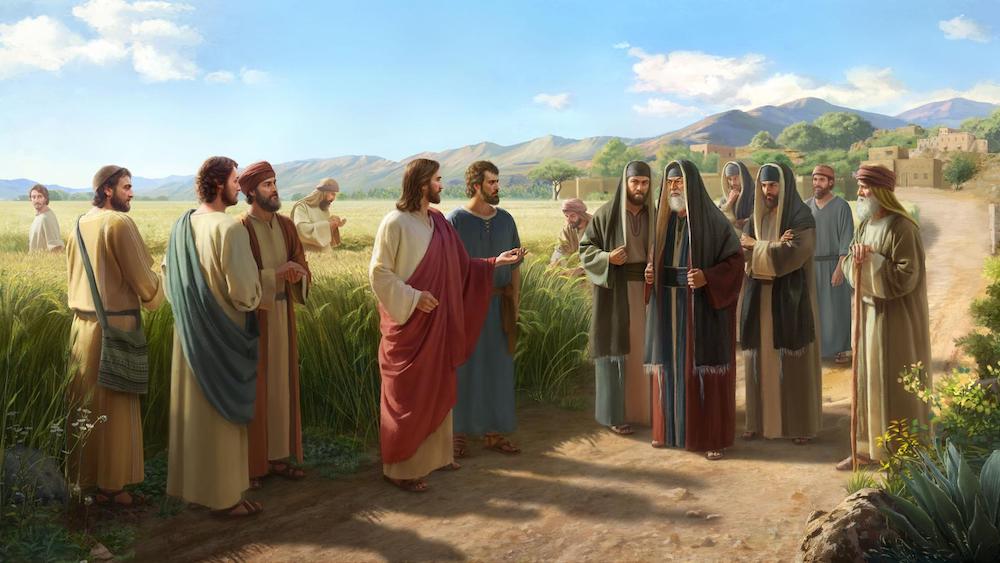
23. And it came to pass, that he went through the corn fields on the sabbath day; and his disciples began, as they went, to pluck the ears of corn.
24. And the Pharisees said unto him, Behold, why do they on the sabbath day that which is not lawful?
25. And he said unto them, Have ye never read what David did, when he had need, and was an hungred, he, and they that were with him?
26. How he went into the house of God, in the days of Abiathar the High Priest, and did eat the shewbread, which is not lawful to eat but for the priests, and gave also to them which were with him?
27. And he said unto them, The sabbath was made for man, and not man for the sabbath:
28. Therefore the Son of man is Lord also of the sabbath.
PSEUDO-CHRYSOSTOM. (Vict. Ant. e Cat. in Marc.) The disciples of Christ, freed from the figure, and united to the truth, do not keep the figurative feast of the sabbath, wherefore it is said, And it came to pass, that he went through the corn fields on the sabbath day; and his disciples began, as they went, to pluck the ears of corn.
BEDE. (in Marc. 1, 13) We read also in the following part, that they who came and went away were many, and that they had not time enough to take their food, wherefore, according to man’s nature, they were hungry.
CHRYSOSTOM. (non occ. sed v. Chrys. Hom. 39, in Matt) But being hungry, they ate simple food, not for pleasure, but on account of the necessity of nature. The Pharisees however, serving the figure and the shadow, accused the disciples of doing wrong. Wherefore there follows, But the Pharisees said unto him, Behold, why do they on the sabbath day that which is not lawful.
AUGUSTINE. (de Op. Monach. 23) For it was a precept in Israel, delivered by a written law, that no one should detain a thief found in his fields, unless he tried to take something away with him. For the man, who had touched nothing else but what he had eaten, they were commanded to allow to go away free and unpunished. Wherefore the Jews accused our Lord’s disciples, who were plucking the ears of corn, of breaking the sabbath, rather than of theft.
PSEUDO-CHRYSOSTOM. (Vict. Ant. e Cat. in Marc.) But our Lord brings forward David, to whom it once happened to eat though it was forbidden by the law, when he touched the Priest’s food, that by his example, he might do away with their accusation of the disciples. For there follows, Have ye never read, &c.
THEOPHYLACT. For David, when flying from the face of Saul, went to the Chief Priest, and ate the shew-bread, and took away the sword of Goliath, which things had been offered to the Lord. (1 Sam. 21.) But a question has been raised how the Evangelist called Abiathar at this time High Priest, when the Book of Kings calls him Abimelech.
BEDE. (ubi sup.) There is, however, no discrepancy, for both were there, when David came to ask for bread, and received it: that is to say, Abimelech, the High Priest, and Abiathar his son; but Abimelech having been slain by Saul, Abiathar fled to David, and became the companion of all his exile afterwards. When he came to the throne, he himself also received the rank of High Priest, and the son became of much greater excellence than the father, and therefore was worthy to be mentioned as the High Priest, even during his fathers life-time. It goes on: And he said to them, The sabbath was made for man, and not man for the sabbath. For greater is the care to be taken of the health and life of a man, than the keeping of the sabbath. Therefore the sabbath was ordered to be observed in such a way, that, if there were a necessity, he should not be guilty, who broke the sabbath-day; therefore it was not forbidden to circumcise on the sabbath, because that was a necessary work. And the Maccabees, when necessity pressed on them, fought on the sabbath-day. Wherefore, His disciples being hungry, what was not allowed in the law became lawful through their necessity of hunger; as now, if a sick man break a fast, he is not held guilty in any way. It goes on: Therefore the Son of man is Lord, &c. As if he said, David the king is to be excused for feeding on the food of the Priests, how much more the Son of man, the true King and Priest, and Lord of the sabbath, is free from fault, for pulling ears of corn on the sabbath-day.
PSEUDO-CHRYSOSTOM. (Vict. Ant. e Cat. in Marc.) He calls himself properly, Lord of the sabbath, and Son of man, since being the Son of God, he deigned to be called Son of man, for the sake of men. Now the law has no authority over the Lawgiver and Lord, for more is allowed the king, than is appointed by the law. The law is given to the weak indeed, but not to the perfect and to those who work above what the law enjoins.
BEDE. (ubi sup.) But in a mystical sense the disciples pass through the corn fields, when the holy doctors look with the care of a pious solicitude upon those whom they have initiated in the faith, and who, it is implied, are hungering for the best of all things, the salvation of men. But to pluck the ears of corn means to snatch men away from the eager desire of earthly things. And to rub with the hands is by examples of virtue to put from the purity of their minds the concupiscence of the flesh, as men do husks. To eat the grains is when a man, cleansed from the filth of vice by the mouths of preachers, is incorporated amongst the members of the Church. Again, fitly are the disciples related to have done this, walking before the face of the Lord, for it is necessary that the discourse of the doctor should come first, although the grace of visitation from on high, following it, must enlighten the heart of the hearer. And well, on the sabbath-day, for the doctors themselves in preaching labour for the hope of future rest, and teach their hearers to toil over their tasks for the sake of eternal repose.
THEOPHYLACT. Or else, because when they hare rest from their passions, then are they made doctors to lead others to virtue, plucking away from them earthly things.
BEDE. (ubi sup) Again, they walk through the corn fields with the Lord, who rejoice in meditating upon His sacred words. They hunger, when they desire to find in them the bread of life; and they hunger on sabbath days, as soon as their minds are in a soothing rest, and they rejoice in freedom from troubled thoughts; they pluck the ears of corn, and by rubbing, cleanse them, till they come to what is fit to eat, when by meditation they take to themselves the witness of the Scriptures, to which they arrive by reading, and discuss them continually, until they find in them the marrow of love; this refreshment of the mind is truly unpleasing to fools, but is approved by the Lord.
Catena Aurea Mark 2
Catena Aurea by St. Thomas Aguinas
Matthew CHAP. 13
13:44
44. Again, the kingdom of heaven is like unto treasure hid in a field; the which when a man hath found, he hideth, and for joy thereof goeth and selleth all that he hath, and buyeth that field.
CHRYSOSTOM. The foregoing parables of the leaven, and the grain of mustard-seed, are referred to the power of the Gospel preaching, which has subdued the whole world; in order to shew its value and splendour, He now puts forth parables concerning a pearl and a treasure, saying, The kingdom of heaven is like unto treasure hid in a field. For the Gospel preaching is hidden in this world; and if you do not sell your all you will not purchase it; and this you ought to do with joy; wherefore it follows, which when a man hath found, he hideth it.
HILARY. This treasure is indeed found without cost; for the Gospel preaching is open to all, but to use and possess the treasure with its field we may not without price, for heavenly riches are not obtained without the loss of this world.
JEROME. That he hides it, does not proceed of envy towards others, but as one that treasures up what he would not lose, he hides in his heart that which he prizes above his former possessions.
GREGORY. (Hom. in Ev. xi. 1.) Otherwise; The treasure hidden in the field is the desire of heaven; the field in which the treasure is hidden is the discipline of heavenly learning; this, when a man finds, he hides, in order that he may preserve it; for zeal and affections heavenward it is not enough that we protect from evil spirits, if we do not protect from human praises. For in this present life we are in the way which leads to our country, and evil spirits as robbers beset us in our journey. Those therefore who carry their treasure openly, they seek to plunder in the way. When I say this, I do not mean that our neighbours should not see our works, but that in what we do, we should not seek praise from without. The kingdom of heaven is therefore compared to things of earth, that the mind may rise from things familiar to things unknown, and may learn to love the unknown by that which it knows is loved when known. It follows, And for joy thereof he goeth and selleth all that he hath, and buyeth that field. He it is that selleth all he hath and buyeth the field, who, renouncing fleshly delights, tramples upon all his worldly desires in his anxiety for the heavenly discipline.
JEROME. Or, That treasure in which are hid all the treasures of wisdom and knowledge (Col. 2:3.), is either God the Word, who seems hid in Christ’s flesh, or the Holy Scriptures, in which are laid up the knowledge of the Saviour.
AUGUSTINE. (Quæst. in Ev. i. 13.) Or, He speaks of the two testaments in the Church, which, when any hath attained to a partial understanding of, he perceives how great things lie hid there, and goeth and selleth all that he hath, and buyeth that; that is, by despising temporal things he purchases to himself peace, that he may be rich in the knowledge of God.
13:45–46
45. Again, the kingdom of heaven is like unto a merchant man, seeking goodly pearls:
46. Who, when he had found one pearl of great price, went and sold all that he had, and bought it.
CHRYSOSTOM. The Gospel preaching not only offers manifold gain as a treasure, but is precious as a pearl; wherefore after the parable concerning the treasure, He gives that concerning the pearl. And in preaching, two things are required, namely, to be detached from the business of this life, and to be watchful, which are denoted by this merchantman. Truth moreover is one, and not manifold, and for this reason it is one pearl that is said to be found. And as one who is possessed of a pearl, himself indeed knows of his wealth, but is not known to others, ofttimes concealing it in his hand because of its small bulk, so it is in the preaching of the Gospel; they who possess it know that they are rich, the unbelievers, not knowing of this treasure, know not of our wealth.
JEROME; By the goodly pearls may be understood the Law and the Prophets. Hear then Marcion and Manichæus; the good pearls are the Law and the Prophets. One pearl, the most precious of all, is the knowledge of the Saviour and the sacrament of His passion and resurrection, which when the merchantman has found, like Paul the Apostle, he straightway despises all the mysteries of the Law and the Prophets and the old observances in which he had lived blameless, counting them as dung that he may win Christ. (Phil. 3:8.) Not that the finding of a new pearl is the condemnation of the old pearls, but that in omparison of that, all other pearls are worthless.
GREGORY. (Hom. in Ev. xi. 2.) Or by the pearl of price is to be understood the sweetness of the heavenly kingdom, which, he that hath found it, selleth all and buyeth. For he that, as far as is permitted, has had perfect knowledge of the sweetness of the heavenly life, readily leaves all things that he has loved on earth; all that once pleased him among earthly possessions now appears to have lost its beauty, for the splendour of that precious pearl is alone seen in his mind.
AUGUSTINE. (Quæst. in Matt. q. 13.) Or, A man seeking goodly pearls has found one pearl of great price; that is, he who is seeking good men with whom he may live profitably, finds one alone, Christ Jesus, without sin; or, seeking precepts of life, by aid of which he may dwell righteously among men, finds love of his neighbour, in which one rule, the Apostle says, (Rom. 13:9.) are comprehended all things; or, seeking good thoughts, he finds that Word in which all things are contained, In the beginning was the Word. (John 1:1.) which is lustrous with the light of truth, stedfast with the strength of eternity, and throughout like to itself with the beauty of divinity, and when we have penetrated the shell of the flesh, will be confessed as God. But whichever of these three it may be, or if there be any thing else that can occur to us, that can be signified under the figure of the one precious pearl, its preciousness is the possession of ourselves, who are not free to possess it unless we despise all things that can be possessed in this world. For having sold our possessions, we receive no other return greater than ourselves, (for while we were involved in such things we were not our own,) that we may again give ourselves for that pearl, not because we are of equal value to that, but because we cannot give any thing more.
Catena Aurea Matthew 13
NAVARRE BIBLE COMMENTARY (RSV)
Ad Majorem Dei Gloriam (To the Greater Glory of God)
First Reading:
From: Hebrews 6:10-20
The Danger of Apostasy and the Need for Perseverance (Continuation)
--------------------------------------------------------------------------------------
[10] For God is not so unjust as to overlook your work and the love which you showed for his sake in serving the saints, as you still do. [11] And we desire each one of you to show the same earnestness in realizing the full assurance of hope until the end, [12] so that you may not be sluggish, but imitators of those who through faith and patience inherit the promises.
The Promises Made to Abraham, Confirmed by Oath, Cannot Be Broken
-------------------------------------------------------------------------------------------
[13] For when God made a promise to Abraham, since he had no one greater by whom to swear, he swore by himself, [14] saying, "Surely I will bless you and multiply you." [15] And thus Abraham, having patiently endured, obtained the promise. [16] Men indeed swear by a greater than themselves, and in all their disputes an oath is final for confirmation. [17] So when God desired to show more convincingly to the heirs of the promise the unchangeable character of his purpose, he interposed with an oath, [18] so that through two unchangeable things, in which it is impossible that God should prove false, we who have fled for refuge might have strong encouragement to seize the hope set before us. [19] We have this as a sure and steadfast anchor of the soul, a hope that enters into the inner shrine behind the curtain, [20] where Jesus has gone as a forerunner on our behalf, having become a high priest for ever after the order of Melchizedek.
***********************************************************************
Commentary:
9-12. The letter now changes to a tone of encouragement. "After speaking harshly about the position of the faithful, to prevent their falling into despair he now reveals why he has written what he has: he wants to lead them well away from danger. And so, in the first place, he tells them what confidence he has in them, and then gives the reason why they should feel confident themselves--because God is not unjust" (St Thomas Aquinas, "Commentary on Heb.", 4,3).
The readers are called "beloved"; this was how St Paul normally addressed those who embraced the faith through his preaching (cf. 1 Thess 2:8; 1 Cor 10:14; 15:58; 2 Cor 7:1; 12:19; Rom 1:7; Phil 2:12; 4:1; etc.). The writer wants to see the situation improve, perhaps to see the trials pass or become easier; certainly he wants his readers to use their tribulation to help them to achieve salvation. He is moved when he recalls the charity they have shown one another: theirs has been an active fraternity, shown in deeds of service to the "saints", which was the way St Paul often referred to the brethren (cf. Rom 1:7; 1 Cor 1:2; 2 Cor 1:1; Eph 1:1; Phil 1:1; Col 1:2; etc.); their charity is practised "for his sake", for God. In their present circumstances, in the persecution they are experiencing, God will not abandon them (cf. Heb 10:33-34), for they have been generous in the almsgiving and hospitality that is so proper to Christians (cf. Rom 15:25, 31; 1 Cor 16:15; Eph 1:15; 2 Cor 8:4; 9:1, 12). "Now that we hear this--I beg you--let us serve the saints! For every member of the faithful is a saint by the mere fact of belonging to the faithful [...]. Let us not be charitable only towards monks who live in the mountains. It is true that their faith and their lives make them saints, but many of those who live here are also saints: all are saints by virtue of their faith, and many are saints by virtue of their lives too. So, if you see someone suffering, do not doubt it for one moment: his very suffering gives him the right to be helped" (St John Chrysostom, "Hom. on Heb.", 10). It is not enough, however, to have a history of doing good: it is necessary to persevere in doing good, as if to say: By seeing through to the end what you have started you shall obtain everything you hope for. They must do good right "to the end", for he who endures to the end will be saved (cf. Mt 10:22; 24:13; "Commentary on Heb.", 4, 3). "Eternal life should be set before those who persevere in good works 'to the end' (cf. Mt 10:22) and who hope in God; it should be set before them as being the grace that God, through Jesus Christ, has mercifully promised his sons and 'as the reward which, according to God's personal undertaking, most assuredly will be given them for their good works and merits (cf. St Augustine, "De Natura Et Gratia", VIII, 20)" (Council of Trent, "De Iustificatione", Chap. 16).
However, there is always the danger of slowing down: lazy people often excuse their inaction by pointing to the suffering and difficulties that doing good involves. The strength of one's resolutions is shown by the way one copes with difficulties: "You will convince me that you sincerely want to achieve your goals when I see you go forward unwaveringly. Do good [...]; practise the virtue of justice, right where you are, in your normal surroundings, even if you end up exhausted. Foster happiness among those around you by cheerfully serving the people you work with and by striving to carry out your job as perfectly as you can, showing understanding, smiling, having a Christian approach to life. And do everything for God, thinking of his glory, with your sights set high and longing for the definitive homeland, because there is no other goal worthwhile" (St. J. Escriva, "Friends of God", 211).
13-15. Abraham is an example, for every generation, of faith that is full of hope and patience; he is a man with great strength of character (cf. Rom 5:3-5). Already in the Epistle to the Romans Abraham is cited as an example of faith and hope (cf. Rom 4:18- 22). There St Paul highlights Abraham's faith in the Lord's promise that he would have innumerable descendants in spite of the fact that he was already an old man and unlikely to father children (cf. Gen 15:5; 17:1, 17). The Apostle may also have been alluding to the episode (cf. Gen 22), when God asked the patriarch to sacrifice Isaac, the son he had so yearned for: at that point Abraham did indeed "believe against hope" (cf. Rom 4:18; Gen 22:15-17). Here, on the other hand, of all the various promises made to Abraham of blessings and numerous offspring (cf. Gen 12:2-3, 7; 13:14-17; 15:5-7; 13:16; 17:4-8, 19), what is explicitly mentioned is the promise made after God prevented him from sacrificing his son. That was the first occasion the Lord "swore by himself" to a man. This divine promise, supported by an oath and seen as the most solemn "word of Yahweh", was the foundation of Israel's hope for thousands of years. Abraham himself recalled it when he was dying (cf. Gen 24:7); it was the support of Moses in all his great endeavors (cf. Ex 13:5,11; 32:13); David, too, gave thanks to God for it (1 Chron 16:16; Ps 105:9); and at the dawn of the Redemption Zechariah rejoiced over it (Lk 1:73): it was "the oath which God swore to our Father Abraham" and it was fulfilled in Christ and in the Church (cf. Gal 4:21-31).
Abraham "obtained the promise" in the sense that he was enabled to see with his own eyes his promised son, Isaac, who was born to Sarah despite her old age. Not alone that: the New Testament tells us (cf. Jn 8:56; Gal 3:8) that he was given some sort of prophetic vision which allowed him to see the day of Christ and rejoice at it.
16. Secular writers of antiquity used to define an oath as something attached to a statement which cannot be proved, to provide a divine guarantee (cf. Pseudo-Aristotle, "Speech to Alexander"). This meant that they regarded an oath as a proof at law, to be put alongside the text of the law, the evidence of witnesses, agreement between the parties, and a confession of guilt. The Jews regarded an oath as something so awesome, so solemn, that they never dared swear an oath by God directly; instead they would swear by angels or by the life of men, such as the Messiah, Moses, Solomon, or by the gates of the temple, etc. (cf. Mt 5:34-36; 23:16-22). Philo of Alexandria, an heir to Jewish tradition and Greco-Roman thought, says that "by means of oaths, matters subject to doubt before the courts are resolved; what was not clear is made clear; and what was regarded as unreliable is rendered reliable" ("De Sacrificio Abel", 91).
St Thomas Aquinas developed and combined these ideas by saying that "an oath is an act of the virtue of religion which gives reliability to something previously in doubt. For in the sphere of knowledge nothing becomes certain unless it be demonstrated from something which is more certainly known. When oaths are taken, this certainty is obtained because the oath is sworn on God, who is the greatest and surest there is, since for men nothing is truer than God" ("Commentary on Heb, ad loc."). The Thomist definition has become widely accepted because it also fits in with the commonly held view that swearing an oath is a way of honoring the sacred name of God. When an oath is properly made--meeting the necessary traditional requirements of truth justice and judgment--that is, when it is made sincerely, for good reasons and not lightly, it is a morally good and meritorious act because it does honor to God's infinite truthfulness.
On Christ's teachings concerning oath-taking see the notes on Mt 5:33-37 and 23:16-22.
17-18. "Through two unchangeable things": in promises made by God his veracity is doubly committed--as the taker of the oath and as its guarantor.
God's covenant with Abraham and his oath to give him descendants took place at separate times (cf. Gen 15:7-18; 22:16-18). However, both episodes stem from a single act of God's will, in that he wanted to reward Abraham's obedience and at the same time commit himself by the use of external formalities proper to Hebrew legal practice. Among the Hebrews, when people made a pact, they sacrificed animals; the victims were then quartered and the contracting parties walked between the carcasses to symbolize that they would die the same death if they failed to keep the pact. God passed between the pieces of the animals Abraham sacrificed, in the form of a flaming torch, thereby giving him to understand that he (God) was under a most solemn obligation to do what he promised. In the second episode this rite was not repeated, but he "interposed with an oath", renewing as it were the "passing between" rite that accompanied the covenant.
God chose to express his promise by following this human form of contract in order to make his words more intelligible and to give us greater confidence.
19-20. God's promise and oath are the gateway to our salvation, an anchor which makes us feel safe no matter what hazards threaten us. The Christian, who is, through faith, the true descendant of Abraham (cf. Rom 4:12) and the heir of the promise (cf. Gal 3:14, 16, 29), is therefore certain that God will keep his word. That is why the text says that we should "have strong encouragement to seize the hope set before us" (v. 18). Hope is a kind of hold on what is promised, a kind of anchor that is "sure and steadfast". "For just as the anchor thrown overboard prevents the ship from moving, even if it is being battered by countless winds, but instead keeps it in one place, hope has the same effect" (Chrysostom, "Hom. on Heb.", 11). Greek and Roman authors often used the simile of an anchor in connection with being steadfast in virtue and hopeful of happier times. The anchor has always been a motif in Christian art expressive of much more than a human sense of safety: it symbolizes the Christian's faith, his certainty in the resurrection of the Lord and in his own resurrection; it is a symbol of a confidence which stems from his intimate union with Christ. The sacred text brings together all those ideas: in a certain sense the anchor is Christ himself who through his redemptive sacrifice gives us the conviction that we can with him enter "into the inner shrine", that is, the heavenly sanctuary. "I have asked you to keep on lifting your eyes up to heaven as you go about your work, because hope encourages us to grasp the strong hand which God never ceases to reach out to us, to keep us from losing our supernatural point of view. Let us persevere even when our passions rear up and attack us, attempting to imprison us within the narrow confines of our selfishness; or when puerile vanity makes us think we are the center of the universe. I am convinced that unless I look upward, unless I have Jesus, I will never accomplish anything. And I know that the strength to conquer myself and to win comes from repeating that cry, 'I can do all things in him who strengthens me' (Phil 4:13), words which reflect God's firm promise not to abandon his children if they do not abandon him" (St. J. Escriva, "Friends of God", 213). "A man should be tied to hope in the same way as the anchor is tied to the ship. But there is a difference between the anchor and hope: the anchor reaches down to get its hold, whereas hope reaches upwards, laying hold of God" ("Commentary on Heb., ad loc.").
20. The sacrifice, resurrection and glorification of Christ are the grounds of our hope. In the Old Testament, the high priest entered the Holy of Holies once a year, on the Day of Atonement; this he did after offering one sacrifice in expiation of his own sins and another for the sins of the entire people. By his sacrifice on the cross, Christ entered into the true sanctuary of heaven and gave all men access to it. The reason for our firm hope is the fact that Christ has entered heaven. "It was not into the Holy of Holies (where Moses entered) but behind the curtain, into heaven, that he, Christ Jesus, went as our forerunner and was made a priest forever. He went not like Aaron, to offer the sacrificial victims, but to offer prayer for all the nations, like Melchizedek" (St Ephraem, "Com. in Epist. ad Haebreos", 6).
The description here of Christ as a "forerunner" has great depth and beauty. This is the only time this word is used in the New Testament, although Christian tradition soon came to use it, on the basis of the prophecy of Malachi (Mal 3:1), to describe St John the Baptist, the envoy sent in advance of Jesus to prepare his way (cf. Mk 1:2; Lk 1:76). Here the perspective is slightly different: it has to do not with preparing for the proclamation of the Gospel but with attaining final beatitude. Christ has gone before us into heaven to prepare a place for us (cf. Jn 14:2): he is our hope (cf. Col 1:27; 1 Tim 1:1), our life (cf. Col 3:4), our way (cf. Jn 14:6), whereby we have access to the Father (cf. Eph 2:18-2:7). Christ is a "forerunner" in the literal sense of the word--one who "runs ahead", who went on ahead of the party to announce its arrival; or it can be understood in the sense of the first one to reach the finish, the first to finish the race. For our Lord is the first-born among the dead, the first in everything (cf. Col 1:18) the first fruits of those who will arise (cf. 1 Cor 15:20). By his merits he has already obtained the prize that we hope to win. Christian hope cannot falter, for it is based on the perennial value of the sacrifice and priesthood of Christ. Thus, the last words of this chapter remind us of the main theme of the epistle.
Gospel Reading: From: Mark 2:23-28
The Law of the Sabbath
----------------------
[23] One Sabbath He (Jesus) was going through the grainfields; and as they made their way His disciples began to pluck ears of grain. [24] And the Pharisees said to Him, "Look, why are they doing what is not lawful on the Sabbath?" [25] And He said to them, "Have you never read what David did, when he was in need and hungry, he and those who were with him: [26] how he entered the house of God, when Abiathar was high priest, and ate the bread of the Presence, which it is not lawful for any but the priests to eat, and also gave it to those who were with him?" [27] And He said to them, "The Sabbath was made for man, not man for the Sabbath; [28] so the Son of Man is Lord even of the Sabbath."
***********************************************************************
Commentary:
24. Cf. note on Matthew 12:2.
[Note on Matthew 12:2 states: "The Sabbath": this was the day the Jews set aside for worshipping God. God Himself, the originator of the Sabbath (Genesis 2:3), ordered the Jewish people to avoid certain kinds of work on this day (Exodus 20:8-11; 21:13; Deuteronomy 5:14) to leave them free to give more time to God. As time went by, the rabbis complicated this Divine precept: by Jesus' time they had extended to 39 the list of kinds of forbidden work.
The Pharisees accuse Jesus' disciples of breaking the Sabbath. In the casuistry of the scribes and the Pharisees, plucking ears of corn was the same as harvesting, and crushing them was the same as milling--types of agricultural work forbidden on the Sabbath.]
26-27. The bread of the Presence consisted of twelve loaves or cakes placed each morning on the table in the sanctuary, as homage to the Lord from the twelve tribes of Israel (cf. Leviticus 24:5-9). The loaves withdrawn to make room for the fresh ones were reserved to the priests.
Abiathar's action anticipates what Christ teaches here. Already in the Old Testament God had established a hierarchy in the precepts of the Law so that the lesser ones yielded to the main ones.
This explains why a ceremonial precept (such as the one we are discussing) should yield before a precept of the natural law. Similarly, the commandment to keep the Sabbath does not come before the duty to seek basic subsistence. Vatican II uses this passage of the Gospel to underline the value of the human person over and above economic and social development: "The social order and its development must constantly yield to the good of the person, since the order of things must be subordinate to the order of persons and not the other way around, as the Lord suggested when He said that the Sabbath was made for man and not man for the Sabbath. The social order requires constant improvement: it must be founded on truth, built on justice, and enlivened by love" ("Gaudium Et Spes", 26).
Finally in this passage Christ teaches God's purpose in instituting the Sabbath: God established it for man's good, to help him rest and devote himself to Divine worship in joy and peace. The Pharisees, through their interpretation of the Law, had turned this day into a source of anguish and scruple due to all the various prescriptions and prohibitions they introduced.
By proclaiming Himself `Lord of the Sabbath', Jesus affirms His divinity and His universal authority. Because He is Lord He has the power to establish other laws, as Yahweh had in the Old Testament.
28. The Sabbath had been established not only for man's rest but also to give glory to God: that is the correct meaning of the expression "the Sabbath was made for man." Jesus has every right to say He is Lord of the Sabbath, because He is God. Christ restores to the weekly day of rest its full, religious meaning: it is not just a matter of fulfilling a number of legal precepts or of concern for physical well-being: the Sabbath belongs to God; it is one way, suited to human nature, of rendering glory and honor to the Almighty. The Church, from the time of the Apostles onwards, transferred the observance of this precept to the following day, Sunday--the Lord's Day--in celebration of the resurrection of Christ.
"Son of Man": the origin of the messianic meaning of this expression is to be found particularly in the prophecy of Daniel 7:13ff, where Daniel, in a prophetic vision, contemplates `one like the Son of Man' coming down on the clouds of Heaven, who even goes right up to God's throne and is given dominion and glory and royal power over all peoples and nations. This _expression appears 69 times in the Synoptic Gospels; Jesus prefers it to other ways of describing the Messiah--such as Son of David, Messiah, etc.--thereby avoiding the nationalistic overtones those expressions had in Jewish minds at the time (cf. "Introduction to the Gospel according to St. Mark", p. 62 above).