Free Republic
Browse · Search
Religion
Topics · Post Article

Skip to comments.

Catholic Caucus: Daily Mass Readings 16-January-2025
Universalis/Jerusalem Bible ^

Posted on 01/16/2025 3:39:55 AM PST by annalex

16 January 2025

Thursday of week 1 in Ordinary Time


Blessed Joseph Vaz Church (Shrine), Mudipu, Mangalore, India

Readings at Mass

Liturgical Colour: Green. Year: C(I).


First readingHebrews 3:7-14

Keep encouraging one another

The Holy Spirit says: If only you would listen to him today; do not harden your hearts, as happened in the Rebellion, on the Day of Temptation in the wilderness, when your ancestors challenged me and tested me, though they had seen what I could do for forty years. That was why I was angry with that generation and said: How unreliable these people who refuse to grasp my ways! And so, in anger, I swore that not one would reach the place of rest I had for them. Take care, brothers, that there is not in any one of your community a wicked mind, so unbelieving as to turn away from the living God. Every day, as long as this ‘today’ lasts, keep encouraging one another so that none of you is hardened by the lure of sin, because we shall remain co-heirs with Christ only if we keep a grasp on our first confidence right to the end.

Responsorial Psalm
Psalm 94(95):6-11
O that today you would listen to his voice! ‘Harden not your hearts.’
Come in; let us bow and bend low;
  let us kneel before the God who made us:
for he is our God and we
  the people who belong to his pasture,
  the flock that is led by his hand.
O that today you would listen to his voice! ‘Harden not your hearts.’
O that today you would listen to his voice!
  ‘Harden not your hearts as at Meribah,
  as on that day at Massah in the desert
when your fathers put me to the test;
  when they tried me, though they saw my work.
O that today you would listen to his voice! ‘Harden not your hearts.’
For forty years I was wearied of these people
  and I said: “Their hearts are astray,
  these people do not know my ways.”
Then I took an oath in my anger:
  “Never shall they enter my rest.”’
O that today you would listen to his voice! ‘Harden not your hearts.’

Gospel AcclamationPs118:88
Alleluia, alleluia!
Because of your love give me life,
and I will do your will.
Alleluia!
Or:cf.Mt4:23
Alleluia, alleluia!
Jesus proclaimed the Good News of the kingdom
and cured all kinds of sickness among the people.
Alleluia!

GospelMark 1:40-45

The leprosy left the man at once, and he was cured

A leper came to Jesus and pleaded on his knees: ‘If you want to’ he said ‘you can cure me.’ Feeling sorry for him, Jesus stretched out his hand and touched him. ‘Of course I want to!’ he said. ‘Be cured!’ And the leprosy left him at once and he was cured. Jesus immediately sent him away and sternly ordered him, ‘Mind you say nothing to anyone, but go and show yourself to the priest, and make the offering for your healing prescribed by Moses as evidence of your recovery.’ The man went away, but then started talking about it freely and telling the story everywhere, so that Jesus could no longer go openly into any town, but had to stay outside in places where nobody lived. Even so, people from all around would come to him.

Christian Art

Illustration

Each day, The Christian Art website gives a picture and reflection on the Gospel of the day.

The readings on this page are from the Jerusalem Bible, which is used at Mass in most of the English-speaking world. The New American Bible readings, which are used at Mass in the United States, are available in the Universalis apps, programs and downloads.

You can also view this page with the Gospel in Greek and English.


TOPICS: Catholic; General Discusssion; Prayer; Worship
KEYWORDS: catholic; mk1; ordinarytime; prayer
For your reading, reflection, faith-sharing, comments, questions, discussion.

1 posted on 01/16/2025 3:39:55 AM PST by annalex
[ Post Reply | Private Reply | View Replies]

To: All

KEYWORDS: catholic; mk1; ordinarytime; prayer;


2 posted on 01/16/2025 3:40:30 AM PST by annalex (fear them not)
[ Post Reply | Private Reply | To 1 | View Replies]

To: annalex
Mark
 English: Douay-RheimsLatin: Vulgata ClementinaGreek NT: Byzantine/Majority Text (2000)
 Mark 1
40And there came a leper to him, beseeching him, and kneeling down said to him: If thou wilt, thou canst make me clean. Et venit ad eum leprosus deprecans eum : et genu flexo dixit ei : Si vis, potes me mundare.και ερχεται προς αυτον λεπρος παρακαλων αυτον και γονυπετων αυτον και λεγων αυτω οτι εαν θελης δυνασαι με καθαρισαι
41And Jesus having compassion on him, stretched forth his hand; and touching him, saith to him: I will. Be thou made clean. Jesus autem misertus ejus, extendit manum suam : et tangens eum, ait illi : Volo : mundare.ο δε ιησους σπλαγχνισθεις εκτεινας την χειρα ηψατο αυτου και λεγει αυτω θελω καθαρισθητι
42And when he had spoken, immediately the leprosy departed from him, and he was made clean. Et cum dixisset, statim discessit ab eo lepra, et mundatus est.και ειποντος αυτου ευθεως απηλθεν απ αυτου η λεπρα και εκαθαρισθη
43And he strictly charged him, and forthwith sent him away. Et comminatus est ei, statimque ejecit illum,και εμβριμησαμενος αυτω ευθεως εξεβαλεν αυτον
44And he saith to him: See thou tell no one; but go, shew thyself to the high priest, and offer for thy cleansing the things that Moses commanded, for a testimony to them. et dicit ei : Vide nemini dixeris : sed vade, ostende te principi sacerdotum, et offer pro emundatione tua, quæ præcepit Moyses in testimonium illis.και λεγει αυτω ορα μηδενι μηδεν ειπης αλλ υπαγε σεαυτον δειξον τω ιερει και προσενεγκε περι του καθαρισμου σου α προσεταξεν μωσης εις μαρτυριον αυτοις
45But he being gone out, began to publish and to blaze abroad the word: so that he could not openly go into the city, but was without in desert places: and they flocked to him from all sides. At ille egressus cœpit prædicare, et diffamare sermonem, ita ut jam non posset manifeste introire in civitatem, sed foris in desertis locis esset, et conveniebant ad eum undique.ο δε εξελθων ηρξατο κηρυσσειν πολλα και διαφημιζειν τον λογον ωστε μηκετι αυτον δυνασθαι φανερως εις πολιν εισελθειν αλλ εξω εν ερημοις τοποις ην και ηρχοντο προς αυτον πανταχοθεν

3 posted on 01/16/2025 3:45:41 AM PST by annalex (fear them not)
[ Post Reply | Private Reply | To 2 | View Replies]

To: annalex

Catena Aurea by St. Thomas Aguinas

1:40–45

40. And there came a leper to him, beseeching him, and kneeling down to him, and saying unto him, If thou wilt, thou canst make me clean.

41. And Jesus, moved with compassion, put forth his hand, and touched him, and saith unto him, I will; be thou clean.

42. And as soon as he had spoken, immediately the leprosy departed from him, and he was cleansed.

43. And he straitly charged him, and forthwith sent him away;

44. And saith unto him, See thou say nothing to any man: but go thy way, shew thyself to the Priest, and offer for thy cleansing those things which Moses commanded, for a testimony unto them.

45. But he went out, and began to publish it much, and to blaze abroad the matter, insomuch that Jesus could no more openly enter into the city, but was without in desert places: and they came to him from every quarter.

BEDE. (in Marc. i. 7) After that the serpent-tongue of the devils was shut up, and the woman, who was first seduced, cured of a fever, in the third place, the man, who listened to the evil counsels of the woman, is cleansed from his leprosy, that the order of restoration in the Lord might be the same as was the order of the fall in our first parents; whence it goes on: And there came a leper to him, beseeching him.

AUGUSTINE. (de Con. Evan. ii. 19) Mark puts together circumstances, from which one may infer that he is the same as that one whom Matthew (Matt. 8:2) relates to have been cleansed, when the Lord came down from the mount, after the sermon.

BEDE. (in Marc. i. 9) And because the Lord said that He came not to destroy the Law but to fulfill, (Matt. 5:17) he who was excluded by the Law, inferring that he was cleansed by the power of the Lord, shewed that that grace, which could wash away the stain of the leper, was not from the Law, but over the Law. And truly, as in the Lord authoritative power, so in him the constancy of faith is shewn; for there follows, Lord, if thou wilt, thou canst make me clean. He falls on his face, which is at once a gesture of lowliness and of shame, to shew that every man should blush for the stains of his life. But his shame did not stifle confession; he shewed his wound, and begged for medicine, and the confession is full of devotion and of faith, for he refers the power to the will of the Lord.

THEOPHYLACT. For he said not, If thou wilt, pray unto God, but, If thou wilt, as thinking Him very God.

BEDE. (ubi sup.) Moreover, he doubted of the will of the Lord, not as disbelieving His compassion, but, as conscious of his own filth, he did not presume. It goes on; But Jesus, moved with compassion, put forth his hand, and touched him, and saith unto him, I will, be thou clean. It is not, as many of the Latins think, to be taken to mean and read, I wish to cleanse thee, but that Christ should say separately, I will, and then command, be thou clean.

CHRYSOSTOM. (Hom. 25. in Matt) Further, the reason why He touches the leper, and did not confer health upon him by word alone, was, that it is said by Moses in the Law, that he who touches a leper, shall be unclean till the evening; that is, that he might shew, that this uncleanness is a natural one, that the Law was not laid down for Him, but on account of mere men. Furthermore, He shews that He Himself is the Lord of the Law; and the reason why He touched the leper, though the touch was not necessary to the working of the cure, was to shew that He gives health, not as a servant, but as the Lord.

BEDE. (ubi sup.) Another reason why He touched him, was to prove that He could not be defiled, who freed others from pollution. At the same time it is remarkable, that He healed in the way in which He had been begged to heal. If thou will, says the leper, thou canst make me clean. I will, He answered, behold, thou hast My will, be clean; now thou hast at once the effect of My compassion.

CHRYSOSTOM. (Hom. 25. in Matt) Moreover, by this, not only did He not take away the opinion of Him entertained by the leper, but He confirmed it; for He puts to flight the disease by a word, and what the leper had said in word, He filled up in deed; wherefore there follows, And when he had spoken, immediately, &c.

BEDE. (ubi sup.) For there is no interval between the work of God and the command, because the work is in the command, for He commanded, and they were created. (Ps. 148:5) There follows: And he straitly charged him, and forthwith, &c. See thou tell no man.

CHRYSOSTOM. (Hom. 25) As if He said, It is not yet time that My works should be preached, I require not thy preaching. By which He teaches us not to seek worldly honour as a reward for our works. It goes on: But go thy way, shew thyself to the chief of the priests. Our Saviour sent him to the priest for the trial of his cure, and that he might not be cast out of the temple, but still be numbered with the people in prayer. He sends him also, that he might fulfil all the parts of the Law, in order to stop the evil-speaking tongue of the Jews. He Himself indeed completed the work, leaving them to try it.

BEDE. (ubi sup.) This He did in order that the priest might understand that the leper was not healed by the Law, but by the grace of God above the Law. There follows: And offer for thy cleansing what. Moses, &c.

THEOPHYLACT. He ordered him to offer the gift which they who were healed were accustomed to offer, as if for a testimony, that He was not against the Law, but rather confirmed the Law, inasmuch as He Himself worked out the precepts of the Law.

BEDE. (ubi sup.) If any one wonders, how the Lord seems to approve of the Jewish sacrifice, which the Church rejects, let him remember, that He had not yet offered His own holocaust in His passion. And it was not right that significative sacrifices should be taken away, before that which they signified was confirmed by the witness of the Apostles in their preaching, and by the faith of the believing people.

THEOPHYLACT. But the leper, although the Lord forbade him, disclosed the benefit, wherefore it goes on: But he having gone out, began to publish and to blaze abroad the tale; for the person benefited ought to be grateful, and to return thanks, even though his benefactor requires it not.

BEDE. (ubi sup. v. Greg. Moral. 19:22) Now it may well be asked, why our Lord ordered His action to be concealed, and yet it could not be kept hid for an hour? But it is to be observed, that the reason why, in doing a miracle, He ordered it to be kept secret, and yet for all that it was noised abroad, was, that His elect, following the example of His teaching, should wish indeed that in the great things which they do, they should remain concealed, but should nevertheless unwillingly be brought to light for the good of others. Not then that He wished any thing to be done, which He was not able to bring about, but, by the authority of His teaching, He gave an example of what His members ought to wish for, and of what should happen to them even against their will.

BEDE. Further, this perfect cure of one man brought large multitudes to the Lord; wherefore it is added, So that he could not any more openly enter into the city, but could only be without in desert places.

CHRYSOSTOM. (non occ.) For the leper every where proclaimed his wonderful cure, so that all ran to see and to believe on the Healer; thus the Lord could not preach the Gospel, but walked in desert places; wherefore there follows, And they came together to him from all places.

PSEUDO-JEROME. Mystically, our leprosy is the sin of the first man, which began from the head, when he desired the kingdoms of the world. For covetousness is the root of all evil; wherefore Gehazi, engaged in an avaritious pursuit, is covered with leprosy.

BEDE. (ubi sup.) But when the hand of the Saviour, that is, the Incarnate Word of God, is stretched out, and touches human nature, it is cleansed from the various parts of the old error.

PSEUDO-JEROME. This leprosy is cleansed on offering an oblation to the true Priest after the order of Melchisedec; for He tells us, Give alms of such things as ye have, and, behold, all things are clean unto you. (Luke 11:41) But in that Jesus could not openly enter into the city, it is meant to be conveyed, that Jesus is not manifested to those, who are enslaved to the love of praise in the broad highway, and to their own wills, but to those who with Peter go into the desert, which the Lord chose for prayer, and for refreshing His people; that is, those who quit the pleasures of the world, and all that they possess, that they may say, The Lord is my portion. But the glory of the Lord is manifested to those, who meet together on all sides, that is, through smooth ways and steep, whom nothing can separate from the love of Christ. (Rom. 8:35)

BEDE. (in Marc. i. 10) Even after working a miracle in that city, the Lord retires into the desert, to shew that He loves best a quiet life, and one far removed from the cares of the world, and that it is on account of this desire, He applied Himself to the healing of the body.

Catena Aurea Mark 1


4 posted on 01/16/2025 3:46:30 AM PST by annalex (fear them not)
[ Post Reply | Private Reply | To 3 | View Replies]

To: annalex


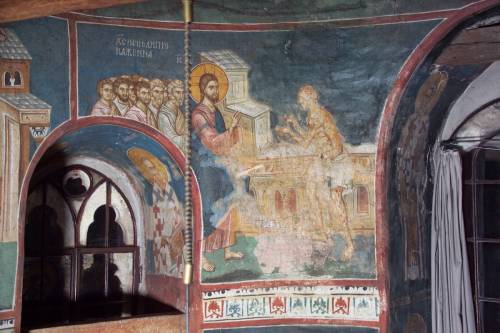
The cure of the leper

Fresco, Serbia

5 posted on 01/16/2025 3:47:13 AM PST by annalex (fear them not)
[ Post Reply | Private Reply | To 4 | View Replies]

To: annalex
class=style4>Joseph Vaz was born in Benaulim, Salcette, Goa at the ancestral home of his mother. This August event was mysteriously heralded to his pious father through the appearance of a star shining bright at noon up above the sky in his native place, Sancoale. This prompted him to record the following in his family register: "On 21st of April, 1651, a son was born to me. He was christened on the 8th day with the name of Joseph. In course of time he will achieve greatness". Right from the start the hand of the Lord molded him. The boy grew so much in the love of God that automatically he was drawn to pass this gigot on to the less fortunate and socially backward children of his surroundings by teaching them catechism and prayers. It guided him also to share his food and belongings with the poor and the destitute. Gradually the whole village became proud of such a jewel.

DoorsOpenUniqueness As A Child His deep piety made such progress that he often his parents found him praying in the advanced hours of the night, and local tradition has it that he would quietly escape to his parish church early in the morning and its doors would automatically open wide to welcome him into the sanctuary, where he would spend hours on end before the Blessed Sacrament and praying to his dear Mother Mary to whom he would later on sell himself as her slave. Born in a home where virtue was held in high esteem, where Christian ethical and morals values were much emphasized, where fixed times were set aside for family prayers and spiritual reading, Joseph Vaz grew up, gentle and kind, greatly given to piety and endowed with a singular love for the poor and a somewhat precious desire to be unseen and unobserved in his piety and alms-deeds. He had inherited the gravity of manners and earnestness from his father. His discernment was a bit superior to his age and his love for study and inclination to virtue revealed that grace rather than nature dominated in him, in such a way that, in the village of Benaulim and Sancoale where he grew up and completed his primary studies, other parents would point out to him as a "Holy Child" and exhort their children to imitate him.

From his very childhood Joseph Vaz wanted to escape from the conversations of men to be alone with God in prayer; so lively was the faith guiding him to search God in whom he believed ardently. He always insisted that at least once a day every one should make the acts of faith, hope and charity and he himself made the same acts many times a day. Moved by the love of God, the young Joseph Vaz chose to serve Him as a priest. At a very young age he cultivated the true wisdom which consisted in holy fear and love of God. His greatest aspiration was to make the Lord God known and loved by all men. He prayed ardently for the conversion of souls and wanted everyone to belong to the fold of the Church.

His Prayerful Life Right from his childhood Bl. Joseph Vaz would escape from the games and be found in solitary places alone with God, reciting some prayers according to his age. He used to get up at night while his brothers were asleep and pray on knees for a long time. Thus he was sometimes late to get up in the morning and, before knowing the cause, his parents even thought that he was a bit lazy. One day he was praying behind the door. His Father, not knowing it, pushed the door with force and the boy was hurt gravely. However he gave no signs of pain. He had tender loving devotion to Mary, the Mother of God. Even as a young boy while going to school and returning from it, he would often recite the Rosary on the way. As a child while studying in Benaulim, he used to attend daily Mass. He used to accompany the "viaticum" whenever the priest would take it for the sick. He received Holy Communion many times during the year. As soon as he had learnt to read, he would read spiritual books and lives of saints at the invitation of the two aunties he had at home. As a boy if he saw a funeral, he would accompany the procession up to the cemetery and pray for the soul of the dead. Whenever someone died in the village he would go round telling his neighbors about the dead and asking them to pray for the eternal repose of the soul. At night he would recommend the souls of the dying and the dead and offer prayers for them.

Selfless Service Fr. Joseph Vaz manifested his love towards all men but his charity towards the sick, the poor and his enemies was proverbial. At a very young age he used to teach children whatever he had learnt from school. When the teacher once asked him to box the ears of an elder student, he refused saying that being of a lower age he would not dare to punish his elders. When the teacher asked him to give a ruler stroke to those who had not studied the lesson, he struck himself with the ruler as soon as the teacher turned his back. As a child whenever he saw a poor beggar asking alms he would immediately go to the back of the house and would give him a portion of his food.

Purity When he was a child, Joseph Vaz avoided indecent language in his presence others would not dare to say anything reprehensible. When he was sent by his parents to the house of their relatives on the occasion of weddings and feasts, if he was compelled to sleep in the company of others, Joseph Vaz would retire to a corner and accommodate himself under a chair to avoid any inconveniences that could result sleeping amidst others. Fr. S. do Rego says that he was so modest that he would answer the call of nature only at night and in far off places. Fr. Francisco Vaz says that he was therefore considered by all as a youth of innocent life and pure customs, and never was any immodesty or uncouth behavior seen in him, which is quite often seen in many youth of that age. Food In his food habits too he was very mortified and austere. As a child he ate common food; he abstained from delicate and tasty food. Courage the young Joseph Vaz once noticed that his companions were getting afraid and would run away when they reached a certain spot where there was a big tree, saying that the devil was appearing there in different and fearful forms and the tree was shaken violently. The young boy Joseph Vaz started praying to God on the spot on his knees and taking discipline to do penance.

Since then the fearful sights and the violent shaking disappeared and the tree became calm. Basic Priestly Studies Joseph Vaz attended the elementary school at Sancoale, his paternal village. He was said to be a model pupil; bright, attentive in class, diligent in his lessons, obedient to the teacher and loved by his companions. When he grew up his father sent him to a school at Benaulim to learn Latin as a preparation for his priestly studies. Joseph's stay in Benaulim was a time of great joy since he could exercise better his love for prayer, charity and altar. He participated in the Mass everyday, frequented the Sacraments, recited the Rosary on the way to the Church, loved to follow processions and take part in the Stations of the Cross. Besides being deeply engaged in all the above religious practices, Joseph Vaz made such rapid progress in his studies that his father decided to send him to the city of Goa to follow a course of Rhetoric and Humanities in the Jesuit College of St. Paul.

After completing his humanistic studies with the Jesuits, Joseph Vaz entered the Academy of St. Thomas Aquinas for his philosophical and theological studies. During this time he stayed in the collegiate Church of Our Lady of the Rosary along with the other students studying for priesthood. All through these six years of study, he continued to live a serious and devout life, unshaken by all the distractions and scandals around him. Joseph Vaz was like the light of the sun which passes through clean as well as sordid places and illumines them all but does not suffer any loss in its brightness. Joseph Vaz in his 6 years sojourn through the scandalous city did not allow himself to be contaminated by the scum of those incidents but teered himself clear on wings of ever increasing holiness. His Exemplary Life For his companions in the seminary, he was an example of virtue and a mirror of perfection. He was as careful of his prayers as of the matter that he was studying, for while his companions were loitering in their sleep paying their dues to Nature, they would see him in prayer, offering the first moments of the day to God from whose hands he had received t he gift of life.

His faith in the Eucharist was so intense that even as a student whatever free time he could get after his daily classes, he would spend it studying and praying in the Church. As a student when he was staying at the Church of Our lady of the Rosary at Old Goa, he would quietly go to the Choir or in the Chapel to enjoy the presence of Christ in the Sacrament of the Altar. Joseph Vaz An extant letter shows that Blessed Joseph Vaz signed his name as Joseph Vaas, in time "Vaas" got written as Vaz. Most scholars accept that Joseph Vaz is the appropriate name by which he should be remembered. Benaulim The Arabian Sea laps monotonously against the coast throwing white sprays against the reddish earth of India. A curtain of slender and bent coconut palms stretches along the shore and covers the interior with a sea of thick, green tufts.

Beneath a magnificent, verdant nave of mighty banyan trees, twining lianas and small shrubs of various green hues, the houses of the people are concealed, houses of beaten earth or wood or little brickwork, terrace houses with the roofs of tiles or of interwoven palm leaves. They dwellings built in the best way possible, to protect the people against the heat and the heavy rains, which fall periodically on this land making it more fertile in vegetation. A tar road passes through the palm trees and connects the various groups of villages, which form the small town of Benaulim. In a green glade with huge tropical trees, rises the ancient façade of the Parish Church. Two tall spires decorated with baroque volutes frame the large portal, which opens on to the central nave with a wood barrel roof, at the end of which stands the main altar flanked on the sides by the benches of the collegiate. On the left as one enters a modest little chapel, is the baptismal font overhung by a canopy in the shape of a pointed tent. Behind that hill there is the sea, the great Arabian Sea, deep blue and rippled by the wind. In the thick coconut grove, just near the lane, which joins the dwellings of the people of Benaulim, rose one of the many houses, which on a summer day was cheered by a birth.

Benaulim had on that Friday of April 21, 1651, one more son. A child about whom much would be spoken in his country and in the far off island of Ceylon. The happy event occurred in the suffocating heat of the tropical summer, which preceded the rainy season. Eight days later a little procession of white dresses and sparkling saris of different colors passed beneath the stately palm trees and wended its way from the little reddish house to the Parish Church of St. John the Baptist. The tiny baby was introduced to the Parish Priest, the Jesuit Father Jacinto Pereira, who bestowed on him, with the baptismal water, the character of a Christian and the name of Joseph, in the Portuguese language: Jose, Sebastiano Vaz was the god-father and Speranza de Miranda was the god-mother. Joseph was the son of Christopher Vaz and Maria de Miranda; the former hailed from the nearby village of Sancoale and the latter was from Benaulim. They were both of modest means. Christopher had a smattering of education. Besides being well versed in Konkani, he could also speak and write in Portuguese. Both parents were fervent Catholics and affectionate by nature. This was their third child; little Peter and a young sister Ann had already arrived to brighten the home.

There was nothing unusual about the event and it was soon forgotten in the sleepy hollow, which consisted of only a few huts and cottages. Meanwhile little Joseph grew up and started toddling on the sands near the sea or on the banks of the Sale, the small river that flows into the Arabian Sea, not very far from Benaulim. His skin, similar to that of his countrymen, was of chocolate color, more or less dark and it contrasted with the whiteness of his simple dress. He was tall, thin and good-looking. Joseph started his life like many boys in the great land of India. But the careful attention of his family had a great influence on him, due to his docile nature. In fact, his parents and close relatives on his mother's side were really good Catholics, and as years passed by four of Maria's children and of her sister Angela Do Rego were ordained priests. They were the Oratorian Fathers Joseph, John, and Christopher Vaz and Joseph Carvalho, three of whom also became missionaries in Ceylon, with their cousin.

Thus in the male line the Vaz family became extinct. Joseph soon showed signs of gravity of manner and earnestness of disposition, which he inherited from his father, as his first biographer (his cousin Sebastian do Rego, who followed him in the priesthood and to the Oratorian Institute) records. Already in his boyhood he showed a marked tendency towards piety; he devoted much of his free time to prayer, remaining absorbed in it, when he might have gone out to play with his brothers and friends. He loved to conceal his piety and did not like to be seen praying. His desire to be alone with God absorbed in silent meditation was the occasion of an accident, which could have done him much bodily harm. Once while his father was opening a door in the house, behind which little Joseph was lost in prayer, the child was dashed inadvertently and violently against a wall; but as the local tradition has it, the door was a shield for his body and left its imprint on him. That he was not cold by nature but rather had warmth of affection is revealed in his later life. He was helped in his education by two of his aunts who, when they became widows, came to live at Christopher's house.

While he was attending the elementary school at Sancoale he was a model pupil; for he was diligent and docile, without being a plodder. The signs of the divine call became evident to him in the early years of his life; he soon expressed his desire to become a priest and at the same time showed a deep spirit of charity to others, particularly by offering to the poor the little money he was given at home. His father did not stand in the way of his noble desires; but he wanted to make sure that his son's ambitions were not those of an innocent child lacking experience. In fact, later on, when from the behavior and success of Joseph in his studies there was enough evidence to show that the young man's desire was undoubtedly a call from heaven, Christopher did not hesitate to make all the sacrifices needed in order to give his son a proper education in preparation for his exalted mission. Biographers of Fr. Joseph Vaz tell us that his father, at the time of his birth, had a sort of presentiment about the future of his son. In a notebook, after writing about the happy event in his home, recalling the baptism of his child, he jotted down the following sentence: "One day he will become a great man." Considered in the light of the events that followed this prediction acquires great value and justifies what his biographers have handed down to us, namely, that Christopher Vaz had a prophetic dream, at the time of his son's birth he saw a star rising in the sky.

Be that as it may, the fact remains that Christopher was probably influenced by this foreboding and paid particular care to the education of his son. Joseph also attended the high school at Benaulim, where he began to learn Latin. His stay in Benaulim was a source of great joy to him because he had more chances of practicing devotion and charity, and of attending Mass everyday in the beautiful church. Being unable to help the poor as he used to do in his hometown of Sancoale he practiced charity towards the souls in Purgatory, attending funerals and praying for souls of the dead or accompanying the Viaticum to the sick. When in the evening the bell rang to invite the people to pray for the souls of the dead, not only did he pray, but he also tried to induce his friends to do the same. In his dealings with his schoolmates, he inspired them by his sense or order and his good example; He always did his best to help them, since he was the most gifted in the school. He always tried to avoid becoming a prefect of discipline lest he should be called upon to inflict corporal punishment on his classmates in lieu of his teacher.

When he finished high school he went to the University of Goa and took up rhetoric and the humanities, courses that were conducted in the capital by the Fathers of the Society of Jesus. He spent six years at Goa; his residence was at the College of our Lady of the Rosary. He completed his literary studies at the Jesuit College of St. Paul. He then joined the Academy of St. Thomas Aquinas - directed by the Dominicans - for his philosophical and theological studies. He continued his austere way of life, devoting himself seriously to the preparation for the priesthood. His ardent desire to do good to others, without being observed, increased, as the time of his ordination approached. His general behavior was probably a positive reaction against the frivolities of life in Goa at the time and, of which the clergy also felt the effects.


blessedjosephvaz.org
6 posted on 01/16/2025 3:50:42 AM PST by annalex (fear them not)
[ Post Reply | Private Reply | To 5 | View Replies]

To: annalex

7 posted on 01/16/2025 3:55:09 AM PST by annalex (fear them not)
[ Post Reply | Private Reply | To 6 | View Replies]

To: annalex
NAVARRE BIBLE COMMENTARY (RSV)

Ad Majorem Dei Gloriam (To the Greater Glory of God)

First Reading:

From: Hebrews 3:7-14

The Need for Faith; the Bad Example Given by the Chosen People
--------------------------------------------------------------------------------
[7] Therefore, as the Holy Spirit says, "Today, when you hear his voice, [8] do not harden your hearts as in the rebellion, on the day of testing in the wilderness, [9] where your fathers put me to the test and saw my works for forty years. [10] Therefore I was provoked with that generation, and said, 'They always go astray in their hearts; they have not known my ways.' [11] As I swore in my wrath, 'They shall never enter my rest."' [12] Take care, brethren, lest there be in any of you an evil, unbelieving heart, leading you to fall away from the living God. [13] But exhort one another every day, as long as it is called "today", that none of you may be hardened by the deceitfulness of sin. [14] For we share in Christ, if only we hold our first confidence firm to the end.

***********************************************************************
Commentary:

7-11. A long quotation from Psalm 95 introduces the theme of that "rest" which the people of the promise will attain at the end of their wayfaring.

In the Book of Genesis we are told that when God finished his work of creation, he "rested". The "rest" prescribed in the Mosaic Law was a kind of imitation of what God did, sharing God's happiness, receiving the reward merited by a life of fidelity and hard work. The Jews had gradually come to a more spiritual understanding of "rest" or, as they termed it, "the place of rest". This idea reaches its highest form of expression in the apocryphal book of Esdras (IV Esdras), where the prayer is raised to God to grant the faithful departed "eternal rest", "Requiem aeternam dona eis, Domine". The chosen people were helped to arrive at this notion of rest by reflecting on the spiritual meaning of the Exodus and the pilgrimage to the promised land. The Exodus was also seen as a new creation, with God "creating" his people. Like the first creation, this second creation would be followed by "rest"--entry into the promised land. The Epistle to the Hebrews shares this interpretation of the Exodus but it gives it a Christian perspective by seeing the Exodus as the Redemption whereby Christ, a new Moses, leads us to eternal rest.

7. The author of the letter reaffirms that Sacred Scripture--in this case Psalm 95--is the work of the Holy Spirit. As such it always carries a contemporary message; it is a form God uses to speak to all men in all periods of history. Readiness to listen to God and do his will today and now is an important part of Christian living (cf. 3:13). A Christian should be docile to God speaking in his heart; he should be quick to respond to all the little invitations God gives him to deny himself and advance in holiness. No excuse is ever valid for delaying to give a positive response to grace. "Do your duty 'now', without looking back on 'yesterday', which has already passed, or worrying over 'tomorrow', which may never come for you" (St. J. Escriva, "The Way", 253). "Now! Return to your noble life now. Don't let yourself be fooled: 'now' is not too soon...nor too late" ("ibid.", 254).

8. Man is free; he can resist grace, and unfortunately often does. "It is not God's goodness that is to blame for faith not coming to birth in men, but the inadequate dispositions of those who hear the preaching of the word" (St Gregory Nazianzen, "Oratio Catechetica Magna", 31). Scripture calls this resistance to grace "hardness of heart" (cf., e.g., Ex 4:21; Rom 9:18; Deut 15:7; Jer 7:26; Acts 19:6).

When withholding belief or resisting conversion, people sometimes claim to have intellectual difficulties, but, very often, the real problem has to do with their dispositions, with not "wanting" to respond to grace. The disobedience and "hardness of heart" or stubbornness of the chosen people is a recurring subject in the Old Testament (cf., e.g., Ex 32:9; Deut 9:13; 2 Kings 17:14; Is 46:12; Jer 5 :3; Ezek 2:4; etc.). Their rebellion against God's commands was due to pride, which turned them into a people whose forehead was as hard as brass, whose neck was "an iron sinew" (Is 48:4; cf. Acts 7:51), a people uncircumcised in heart, with uncircumcised ears (cf. Jer 9:26; 6: 10). Conversion cannot operate if someone has that attitude. For this reason our Lord, and later his Apostles, referred to the Jews' rejection of him, in order to make Christians steadfast in faith (cf. Is 6:9; Mt 13:13; In 12:40; Acts 28:26).

9. Psalm 95 contains a reference to the Israelites' rebellion when God put them to the test in the wilderness. The episode took place in Rephidim, on the border of the wilderness of Zin, in the south-east of the Sinai peninsula. Having made their way out of Egypt, the people grew impatient; they complained about how Yahweh was treating them, and put him to the test by asking him to work a miracle (Ex 17:1-7). God did work a miracle: at Horeb he ordered Moses to strike the rock with his rod, and out of it flowed water to relieve the people's thirst. The place was therefore given the name of Massah (meaning temptation) and Meribah (meaning fault-finding or exasperation). This episode in Jewish history came to symbolize the disgruntlement which typified the Jews in the desert, an attitude which even affected Moses in Kadesh (cf. Num 20:1-13). The leader of the chosen people, in circumstances similar to those of the earlier incident, struck the rock twice, not expecting anything to happen. On account of this he did not merit to enter the promised land: he was only allowed to see it from Mount Nebo, where he died (Deut 34:1-8).

"Putting God to the test", " tempting" him, is a sin of presumption. It involves exposing oneself imprudently and needlessly to physical or spiritual risk from which God's ordinary providence does not provide protection (cf. Mt 4:5-7).

In this passage, "putting God to the test" means demanding more proof than necessary that God is steadfast in his will and continues to protect his chosen people. "God should not be asked to account for his activities", St John Chrysostom comments; "if one asks him to prove his power, his providence, his solicitude, it is the same as not yet being fully convinced of his power and goodness and mercy" ("Hom. on Heb.", 6).

11. There are three kinds of rest. The first is the "sabbath", when God rested after creating the world; then there is the rest provided by the promised land of Canaan after countless afflictions and difficulties; and "finally there is the true rest which belongs to the Kingdom of heaven, where the elect rest from their labors and afflictions: the sabbath is a reflection and symbol of that rest" ("Hom. on Heb.", 6).

St Thomas Aquinas applies the term "rest" to peace of body and soul and says that there are different kinds of peace--physical ease (cf. Lk 12:19); the peace of conscience a person has who does right in the sight of God; and the peace of eternal happiness in heaven (cf. "Commentary on Heb, ad loc.").

12. "Falling away from the living God" seems to be something more serious than reverting to Judaism; it implies the sad possibility of total loss of belief in God. Thus, in the case of those to whom the epistle was written, a reversion from the Gospel to Judaism would not be simply a matter of returning to a previous religious position but rather a deliberate act involving voluntary resistance to grace and a complete break with God. For people who had not received the Revelation of Jesus Christ, the Jewish religion certainly did provide access to God; but for those who by embracing Christianity had thereby received the fullness of Revelation, renunciation of Christ would mean a virtually irreparable sin (cf. Heb 6:4-6). There is never a valid excuse for giving up the faith.

The Church teaches and prescribes to its children the need to be true to the faith even at the cost of life itself. From the very beginning this was the kind of fidelity practised by the martyrs and confessors of the faith. "They cut our hands off, they nail us to crosses, they throw us to wild beasts, imprison us and burn us, and we submit to every kind of torture; yet everyone knows that we do not betray our faith. Rather, the worse our sufferings, the more there are who embrace faith and devotion in the name of Jesus (St Justin, "Dialogue with Trypho", 110,4).

Some Christians today are called to stay true in the face of violent persecution; they and others also have to overcome fear of ridicule, and the temptation to hide their convictions from unbelievers. The words of the letter remind us that there is a danger that whereas in earlier times force failed to achieve its objective, nowadays fear of ridicule could cause us to be ashamed of Christ or to deny him. "'And in a paganized or pagan environment when my life clashes with its surroundings, won't my naturalness seem artificial?' you ask me. And I reply: 'Undoubtedly your life will clash with theirs; and that contrast--faith confirmed by works!--is exactly the naturalness I ask of you" (St. J. Escriva, "The Way", 380).

13. The more Christians practise charity, the easier it is for them to be steadfast in the faith. Fraternity, mutual brotherly support, helps provide protection from the devil's efforts to make us sin: "'Frater qui adiuvatur a fratre quasi civitas firma". Brother helped by brother is a fortress.' Think for a moment and make up your mind to live the fraternal spirit that I have always asked of you" (St. J. Escriva, "The Way", 460).

Aware of his personal weakness and of the need to help others and to let himself be helped, the Christian keeps striving to practise this fraternity. He loves the good he sees in others, and he tries to uproot in himself and others anything that implies a defect. Fraternity, therefore, leads to "fraternal correction", a word of advice which is always full of understanding, being the outcome of a desire to live in harmony with others and to remove divisions and barriers. Christian fraternity binds the Church together.

"Not in vain is there in the depths of man's being a strong longing for peace, for union with his fellow man, for mutual respect for personal rights, so strong that it seeks to transform human relations into fraternity. This longing reflects something which is most deeply imprinted upon our human condition: since we are all children of God, our fraternity is not a cliche or an empty dream; it beckons as a goal which, though difficult, is really ours to achieve" (St. J. Escriva, "Friends of God", 233).

14. This is a repetition of the exhortation in v. 6 to remain true to the end. "Firm confidence'' is the very opposite of the "falling away" mentioned in v. 12. From the very beginning of his calling, a Christian is already sharing in Christ's life and in his glory, but he will not share in it fully until after death, when he will be able actually to see the Lord.

This sharing in Christ's grace is a treasure which we carry in "earthen vessels" (2 Cor 4:7) and can lose at any time through sin. We need to nurture this grace and protect our faith by being watchful and active right through our life: "We have shared in Christ's death through holy Baptism and we have been buried with him; we have shared in his resurrection provided we keep our faith intact" (Theodoret of Cyrus, "Interpretatio Ep. ad Haebreos", III).

The Christian life is a matter of constantly returning to God, beginning anew, and humbly and decisively correcting our course when we go astray through weakness or indifference.

"What does it matter that we stumble on the way, if we find in the pain of our fall the energy to pick ourselves up and go on with renewed vigor? Don't forget that the saint is not the person who never falls, but rather the one who never fails to get up again, humbly and with a holy stubbornness. If the Book of Proverbs says that the just man falls seven times a day (cf. Prov 24:16), who are we poor creatures, you and I, to be surprised or discouraged by our own weaknesses and falls! We will be able to keep going ahead, if only we seek our fortitude in him who says: 'Come to me, all you who labor and are heavy laden and I will give you rest' (Mt 11:28). Thank you, Lord, "quia tu es, Deus, fortitudo mea" (Ps 42:2), because you, and you alone, my God, have always been my strength, my refuge and my support" (St. J. Escriva, "Friends of God", 131).

8 posted on 01/16/2025 12:06:42 PM PST by fidelis (Ecce Crucem Domini! Fugite partes adversae! Vicit Leo de tribu Juda, Radix David! Alleluia!)
[ Post Reply | Private Reply | To 7 | View Replies]

Gospel Reading:

From: Mark 1:40-45

The Curing of a Leper
---------------------
[40] And a leper came to Him (Jesus), beseeching Him, and kneeling said to Him, "If You will, You can make me clean." [41] Moved with pity, He stretched out His hand and touched him, and said to him, "I will; be clean." [42] And immediately the leprosy left him, and he was made clean. [43] And He sternly charged him, and sent him away at once, [44] and said to him, "See that you say nothing to anyone; but go, show yourself to the priest, and offer for your cleansing what Moses commanded, for a proof to the people." [45] But he went out and began to talk freely about it, and spread the news, so that Jesus could no longer openly enter a town, but was out in the country; and people came to Him from every quarter.

***********************************************************************
Commentary:

40-44. Leprosy was seen as a punishment from God (cf. Numbers 12:10-15). The disappearance of the disease was regarded as one of the blessings of the messianic times (Isaiah 35:8; cf. Matthew 11:5; Luke 7:22). Because leprosy was contagious, the Law declared that lepers were impure and that they transmitted impurity to those who touched them and to places they entered. Therefore, they had to live apart (Numbers 5:2; 12:14ff) and to show that they were lepers by certain external signs. On the rite of purification, see the note on Matthew 8:4.

[The note on Matthew 8:4 states: 4. According to the Law of Moses (Leviticus 14), if a leper is cured of his disease, he should present himself to a priest, who will register the cure and give him a certificate which he needs to be reintegrated into the civil and religious life of Israel. Leviticus also prescribes the purifications and sacrifice he should offer. Jesus' instruction to the leper is, then, in keeping with the normal way of fulfilling what the laws laid down. ]

The passage shows us the faithful and confident prayer of a man needing Jesus' help and begging Him for it, confident that, if Our Lord wishes, He can free him from the disease (cf. Matthew 8:2). "This man prostrated himself on the ground, as a sign of humility and shame, to teach each of us to be ashamed of the stains of his life. But shame should not prevent us from confessing: the leper showed his wound and begged for healing. If You will, he says, You can make me clean; that is, he recognized that the Lord had the power to cure him" (St. Bede, "In Marci Evangelium Expositio, in loc.").

On the discretion and prudence Jesus required regarding His person, see the note on Mark 1:34 and Matthew 9:30.

[The note on Mark 1:34 states: 34. Demons possess a supernatural type of knowledge and therefore they recognize Jesus as the Messiah (Mark 1:24). Through the people they possess they are able to publish this fact. But Our Lord, using His divine powers, orders them to be silent. On other occasions He also silences His disciples (Mark 8:30; 9:9), and He instructs people whom He has cured not to talk about their cure (Mark 1:4; 5:43; 7:36; 8:26). He may have acted in this way to educate the people away from a too human and political idea of the Messiah (Matthew 9:30). Therefore, He first awakens their interest by performing miracles and gradually, through His preaching, gives them a clearer understanding of the kind of Messiah He is.

Some Fathers of the Church point out that Jesus does not want to accept, in support of the truth, the testimony of him who is the father of lies.]

[The note on Matthew 9:30 states: 30. Why did our Lord not want them to publicize the miracle? Because His plan was to gradually manifest Himself as the Messiah, the Son of God. He did not want to anticipate events which would occur in their own good time; nor did He want the crowd to start hailing Him as Messiah King, because their notion of messiah was nationalistic, not a spiritual one. However, the crowd did in fact proclaim Him when he worked the miracles of the loaves and the fish (John 6:14-15): "When the people saw the sign which He had done, they said, `This is indeed the prophet who is to come into the world!' Perceiving then that they were about to come and take Him by force to make Him king, Jesus withdrew again to the hills by Himself."]

9 posted on 01/16/2025 12:07:01 PM PST by fidelis (Ecce Crucem Domini! Fugite partes adversae! Vicit Leo de tribu Juda, Radix David! Alleluia!)
[ Post Reply | Private Reply | To 8 | View Replies]

Click here to go to the My Catholic Life! Devotional thread for a meditation on today’s Gospel Reading.

10 posted on 01/16/2025 12:07:56 PM PST by fidelis (Ecce Crucem Domini! Fugite partes adversae! Vicit Leo de tribu Juda, Radix David! Alleluia!)
[ Post Reply | Private Reply | To 9 | View Replies]

Disclaimer: Opinions posted on Free Republic are those of the individual posters and do not necessarily represent the opinion of Free Republic or its management. All materials posted herein are protected by copyright law and the exemption for fair use of copyrighted works.

Free Republic
Browse · Search
Religion
Topics · Post Article

FreeRepublic, LLC, PO BOX 9771, FRESNO, CA 93794
FreeRepublic.com is powered by software copyright 2000-2008 John Robinson