Catena Aurea by St. Thomas Aguinas
Mark CHAP. 1
1:14–15
14. Now after that John was put in prison, Jesus came into Galilee, preaching the Gospel of the kingdom of God,
15. And saying, The time is fulfilled, and the kingdom of God is at hand: repent ye, and believe the Gospel.
PSEUDO-CHRYSOSTOM. (Vict. Ant. e Cat. 1 Marc.) The Evangelist Mark follows Matthew in his order, and therefore after having said that Angels minister, he subjoins, But after that John was put into prison, Jesus came, &c. After the temptation and the ministry of Angels, He goes back into Galilee, teaching us not to resist the violence of evil men.
THEOPHYLACT. And to shew us that in persecutions we ought to retire, and not to await them; but when we fall into them, we must sustain them.
PSEUDO-CHRYSOSTOM. (Vict. Ant. e Cat. in Marc.) He retired also that He might keep Himself for teaching and for healing, before He suffered, and after fulfilling all these things, might become obedient unto death.
BEDE. (ubi sup.) John being put in prison, fitly does the Lord begin to preach: wherefore there follows, Preaching the Gospel, &c. For when the Law ceases, the Gospel arises in its steps.
PSEUDO-JEROME. When the shadow ceases, the truth comes on; first, John in prison, the Law in Judæa; then, Jesus in Galilee, Paul among the Gentiles preaching the Gospel of the kingdom. For to an earthly kingdom succeeds poverty, to the poverty of Christians is given an everlasting kingdom; but earthly honour is like the foam of water, or smoke, or sleep.
BEDE. (ubi sup.) Let no one, however, suppose that the putting of John in prison took place immediately after the forty days’ temptation and the fast of the Lord; for whosoever reads the Gospel of John will find, that the Lord taught many things before the putting of John in prison, and also did many miracles; for you have in his Gospel, This beginning of miracles did Jesus; (John 2:11) and afterwards, for John was not yet cast into prison. (John 3:24) Now it is said, that when John read the books of Matthew, Mark, and Luke, he approved indeed the text of the history, and affirmed that they had spoken truth, but said that they had composed the history of only one year after John was cast into prison, in which year also he suffered. Passing over then the year of which the transactions had been published by the three others, he related the events of the former period, before John was cast into prison. When therefore Mark had said that Jesus came into Galilee, preaching the Gospel of the kingdom, he subjoins, saying, Since the time is fulfilled, &c.
PSEUDO-CHRYSOSTOM. (Vict. Ant. Cat. in Marc.) Since then the time was fulfilled, when the fulness of time was come, and God sent his Son, it was fitting that the race of man should obtain the last dispensation of God. And therefore he says, for the kingdom of heaven is at hand. (Orig. in Matt. tom. x. 14. v. Orig. de Orat. 25, 26. in Matt. t. 12 14). But the kingdom of God is essentially the same as the kingdom of heaven, though they differ in idea. For by the kingdom of God is to be understood that in which God reigns; (non occ. v. Chrys, in Matt. Hom. 19. in c. 6:9.). and this in truth is in the region of the living, where, seeing God face to face, they will abide in the good things now promised to them; whether by this region one chooses to understand Love, or some other confirmatione of those who put on the likeness of things above, which are signified by the heavens. () For it is clear enough that the kingdom of God is confined neither by place nor by time.
THEOPHYLACT. Or else, the Lord means that the time of the Law is completed; as if He said, Up to this time the Law was at work; from this time the kingdom of God will work, that is, a conversation according to the Gospel, which is with reason likened to the kingdom of heaven. For when you see a man clothed in flesh living according to the Gospel, do you not say that he has the kingdom of heaven, which is not meat and drink, but righteousness and peace and joy in the Holy Ghost? (Rom. 14:17)
The next word is, Repent.
PSEUDO-JEROME. For he must repent, who would keep close to eternal good, that is, to the kingdom of God. For he who would have the kernel, breaks the shell; the sweetness of the apple makes up for the bitterness of its root; the hope of gain makes the dangers of the sea pleasant; the hope of health takes away from the painfulness of medicine. They are able worthily to proclaim the preaching of Christ who have deserved to attain to the reward of forgiveness; and therefore after He has said, Repent, He subjoins, and believe the Gospel. For unless ye have believed, ye shall not understand.
BEDE. (ubi sup.) Repent, therefore, and believe; that is, renounce dead works; for of what use is believing without good works? The merit of good works does not, however, bring to faith, but faith begins, that good works may follow.
1:16–20
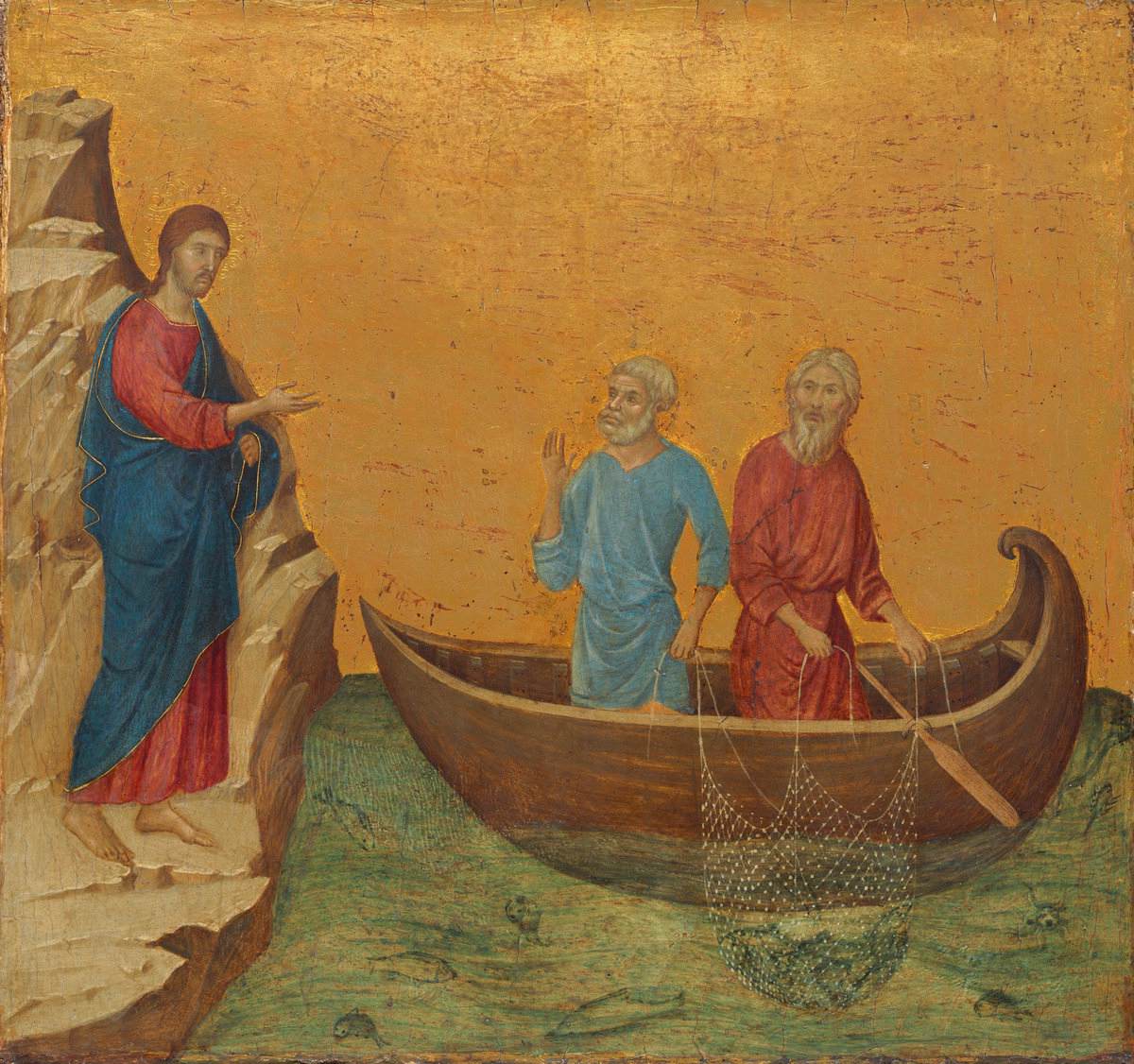
16. Now as he walked by the sea of Galilee, he saw Simon and Andrew his brother casting a net into the sea: for they were fishers.
17. And Jesus said unto them, Come ye after me, and I will make you to become fishers of men.
18. And straightway they forsook their nets, and followed him.
19. And when he had gone a little farther thence, he saw James the son of Zebedee, and John his brother, who also were in the ship mending their nets.
20. And straightway he called them: and they left their father Zebedee in the ship with the hired servants, and went after him.
GLOSS. (non occ.) The Evangelist, having mentioned the preaching of Christ to the multitude, goes on to the calling of the disciples, whom he made ministers of his preaching, whence it follows, And passing along the sea of Galilee, &c.
THEOPHYLACT. As the Evangelist John relates, Peter and Andrew were disciples of the Forerunner, but seeing that John had borne witness to Jesus, they joined themselves to him; afterwards, grieving that John had been cast into prison, they returned to their trade. Wherefore there follows, casting nets into the sea, for they were fishers. Look then upon them, living on their own labours, not on the fruits of iniquity; for such men were worthy to become the first disciples of Christ; whence it is subjoined, And Jesus said unto them, Come ye after me. Now He calls them for the second time; for this is the second calling in respect of that, of which we read in John. But it is shewn to what they were called, when it is added, I will make you become fishers of men.
REMIGIUS. For by the net of holy preaching they drew fish, that is, men, from the depths of the sea, that is, of infidelity, to the light of faith. Wonderful indeed is this fishing! for fishes when they are caught, soon after die; when men are caught by the word of preaching, they rather are made alive.
BEDE. (in Marc. i. 6) Now fishers and unlettered men are sent to preach, that the faith of believers might be thought to lie in the power of God, not in eloquence or in learning. It goes on to say, and immediately they left their nets, and followed him.
THEOPHYLACT. For we must not allow any time to lapse, but at once follow the Lord. After these again, He catches James and John, because they also, though poor, supported the old age of their father. Wherefore there follows, And when he had gone a little farther thence, he saw James the son of Zebedee, &c. But they left their father, because he would have hindered them in following Christ. Do thou, also, when thou art hindered by thy parents, leave them, and come to God. It is shewn by this that Zebedee was not a believer; but the mother of the Apostles believed, for she followed Christ, when Zebedee was dead.
BEDE. (ubi sup.) It may be asked, how he could call two fishers from each of the boats, (first, Peter and Andrew, then having gone a little further, the two others, sons of Zebedee,) when Luke says that James and John were called to help Peter and Andrew, and that it was to Peter only that Christ said, Fear not, from this time thou shalt catch men; (Luke 5:10) he also says, that at the same time, when they had brought their ships to land, they followed him. We must therefore understand that that transaction which Luke intimates happened first, and afterwards that they, as their custom was, had returned to their fishing. So that what Mark here relates happened afterwards; for in this case they followed the Lord, without drawing their boats ashore, (which they would have done had they meant to return,) and followed Him, as one calling them, and ordering them to follow.
PSEUDO-JEROME. Further, we are mystically carried away to heaven, like Elias, by this chariot, drawn by these fishers, as by four horses. On these four corner-stones the first Church is built; in these, as in the four Hebrew letters, (יהוה) we acknowledge the tetragrammaton, the name of the Lord, we who are commanded, after their example, to hear the voice of the Lord, and to forget (Ps. 45:11) the people of wickedness, and the house of our fathers’ conversation, which is folly before God, and the spider’s net, in the meshes of which we, like gnats, were all but fallen, and were confined by things vain as the air, which hangs on nothing; loathing also the ship of our former walk. For Adam, our forefather according to the flesh, is clothed with the skins of dead beasts; but now, having put off the old man, with his deeds, following the new man we are clothed with those skins of Solomon, with which the bride rejoices that she has been made beautiful. (Cant. 1:4. Vulg.) Again, Simon, means obedient; Andrew, manly; James, supplanter;f John, grace; by which four names, we are knit together into God’s host;g by obedience, that we may listen; by manliness, that we do battle; by overthrowing, that we may persevere; by grace, that we may be preserved. (supplantatione) Which four virtues are called cardinal; for by prudence, we obey; by justice, we bear ourselves manfully; by temperance, we tread the serpent underfoot; by fortitude, we earn the grace of God.
THEOPHYLACT. We must know also, that action is first called, then contemplation; for Peter is the type of the active life, for he was more ardent than the others, just as the active life is the more bustling; but John is the type of the contemplative life, for he speaks more fully of divine things.
Catena Aurea Mark 1
NAVARRE BIBLE COMMENTARY (RSV)
Ad Majorem Dei Gloriam (To the Greater Glory of God)
First Reading:
From: Hebrews 1:1-6
The Greatness of the Incarnate Son of God
-----------------------------------------
[1] In many and various ways God spoke of old to our fathers by the prophets; [2] but in these last days he has spoken to us by a Son, whom he appointed the heir of all things, through whom also he created the world. [3] He reflects the glory of God and bears the very stamp of his nature, upholding the universe by his word of power. When he had made purification for sins, he sat down at the right hand of the Majesty on high, [4] having become as much superior to angels as the name he has obtained is more excellent than theirs.
Proof from Sacred Scripture
---------------------------
[5] For to what angel did God ever say, "Thou art my Son, today I have begotten thee"? Or again, "I will be to him a father, and he shall be to me a son"? [6] And again, when he brings the first-born into the world, he says, "Let all God's angels worship him."
***********************************************************************
Commentary:
1-4. The first four verses are a kind of prologue to the letter, which does not carry the greetings and words of thanksgiving to God normally found in letters of St Paul. Like the prologue of St John's Gospel, the letter moves immediately into its main subject--the divinity of Jesus Christ, our Redeemer. It speaks of Christ as a Son whose sonship is eternal, prior to the creation of the world and to his Incarnation; it speaks also of Christ's mission to save all men, a mission appropriate to the Word who created all things. This exposition culminates in the affirmation of Christ's absolute superiority over angels, a theme dealt with, in different ways, up to the end of the second chapter.
The entire epistle in fact develops the subject entered on in the prologue--the sublimity of Christ, the natural and eternal Son of God, the universal Mediator, the eternal Priest. This is why St Thomas Aquinas says that the subject matter of this epistle is the "excellence" of Christ. In this respect the Letter to the Hebrews is different from the other letters in the Pauline corpus: in some letters (the "Great Epistles" and the Captivity Letters) the Apostle deals with the grace which imbues the entire mystical body of the Church; others (the Pastoral Letters) deal with the grace bestowed on certain members of the Church (such as Timothy and Titus); whereas the Letter to the Hebrews looks at grace as it is found in the Head of the mystical body, Christ. This "excellence" of Christ the Angelic Doctor adds, is examined by St Paul from four points of view: the first is that of Christ's origin, which the sacred writer identifies by calling him the true (natural, metaphysical) Son of God, when he says that God has spoken to us by a Son; the second is that of his power, for he depicts him as being made the heir of all things; the third is that of his activity, when he affirms that he created the world; the fourth, his sublime dignity, when he says that Christ reflects the glory of God (cf. "Commentary on Heb.", Prologue and 1:1).
Christ is thus presented as the pinnacle and fullness of salvific Revelation, as the Second Vatican Council reminds us: "After God had spoken many times and in various ways through the prophets 'in these last days he has spoken to us by a Son' (Heb 1:1-2). For he sent his Son, the eternal Word who enlightens all men, to dwell among men and to tell them about the inner life of God [...]. He did this by the total fact of his presence and self-manifestation--by words and works, signs and miracles, but above all by his death and glorious resurrection from the dead, and finally by sending the Spirit of truth. He revealed that God was with us, to deliver us from the darkness of sin and death, and to raise us up to eternal life" ("Dei Verbum", 4).
1. Divine Revelation, which is rightly called "the Word of God", develops in stages in the course of the Old and New Testaments. "By this Revelation," Vatican II teaches, 'the invisible God (cf. Col 1:15; 1 Tim 1:17), from the fullness of his love, addresses men as his friends (cf. Ex 33:11; Jn 15:14-15), and moves among men (cf. Bar 3:38), in order to invite and receive them into his own company. This economy of Revelation is realized by deeds and words, which are intrinsically bound up with each other. As a result, the works performed by God in the history of salvation show forth and bear out the doctrine and realities signified by the words; the words, for their part, proclaim the works, and bring to light the mystery they contain" ("Dei Verbum", 3). Revelation is, then, a gradual opening up of God's mysteries whereby little by little, like a wise teacher, it makes known who he is and what his plans are concerning the salvation of all mankind. For, although there is only one God and one way of salvation, man needs to be educated by means of many precepts and to progress by stages on his way to God and so advance in faith towards complete salvation in Christ. God in his mercy reveals his mysteries to man in this way in order that the whole world experiencing "this saving proclamation, on hearing it should believe, on believing it hope, on hoping in it love" (St Augustine, "De Catechizandis Rudibus", 4, 8).
When speaking of Revelation, the First Vatican Council recalled that although 'God, the origin and end of all things, can be known with certainty by the natural light of human reason from the things that he created, [...] it was, nevertheless, the good pleasure of his wisdom and goodness to reveal himself and the eternal decrees of his will to the human race in another and supernatural way" ("Dei Filius", Chap. 2). This supernatural revelation, as it says (reaffirming the teaching of the Council of Trent), is contained in books and in oral traditions which the Apostles received from Christ or from the Holy Spirit and passed on to us. Christ's Gospel had earlier been promised by the prophets and, more generally, by the entire Old Testament. The epistle refers to this when it says that God spoke in the past through the mouth of the prophets "in many ways", that is, at various stages in the history of the chosen people, and "in various ways", that is, by means of visions, words, actions and historical events.
2. "The most intimate truth which this revelation gives us about God and the salvation of man shines forth in Christ, who is himself both the mediator and the sum total of Revelation" ("Dei Verbum", 2).
St John of the Cross comments on this passage in a very beautiful and profound way: "And this is as if he had said: That which God spoke of old in the prophets to our fathers in sundry ways and divers manners, he has now, at last, in these days, spoken to us once and for all in the Son. Herein the Apostle declares that God has become, as it were, dumb, and has no more to say, since that which he spoke before, in part, to the prophets, he has now spoken altogether in him, giving us the All, which is his Son.
"And so he who would now enquire of God, or seek any vision or revelation would not only be acting foolishly, but would be committing an offense against God, by not setting his eyes altogether upon Christ, and seeking no new thing or aught beside. And God might answer him after this manner, saying: 'If I have spoken all things to you in my Word, which is my Son, and I have no other word, what answer can I now make to you, or what can I reveal to you which is greater than this? Set your eyes on him alone, for in him I have spoken and revealed to you all things"' ("Ascent of Mount Carmel", Book 2, Chap. 22).
The "last days" refer to the period of time between the first coming of Christ and the second coming, or Parousia. These days have begun because the definitive "Word" of God, Jesus Christ, can be seen and heard. Mankind already finds itself in the "last age", in the "end of the ages" (cf. 1 Cor 10:11; Gal 4:4; Eph 1:10).
By speaking to us through his Son, God reveals to us his saving will from the moment of the Incarnation onwards, for the second person of the Blessed Trinity has come into the world to redeem us by dying for us and to open for us the way to heaven by his glorification. Therefore, Jesus Christ is the "prophet" par excellence (cf. note on Jn 7:40-43), for he perfects and completes God's merciful revelation. The Incarnation and the subsequent events of our Lord's life are, like his teaching, a source of salvation.
It was appropriate that the Son who perfectly revealed God the Father should also be the divine Word, the Creator of the world (cf. Jn 1:3). The creative action of the divine "Logos" or Word is not contradicted by the statement that Creation is the work of God the Father, for everything done by God outside himself ("ad extra") is an action common to the three divine persons; nor is it correct to see the Word as merely an instrument used by the Father, for he is one in substance with him.
"It is the good Father's own, unique Word who has ordered this universe. Being the good Word he has arranged the order of all things [...]. He was with God as Wisdom; as Word he contemplated the Father and created the universe, giving it substance, order and beauty" (St Athanasius, "Oratio Contra Gentes", 40 and 46). Not only did the Word make the Father manifest by creation; he, together with the Father and the Holy Spirit, acted in the revelation of the Old Testament: in fact, many patristic writers attributed to the Son--as "angel" or "messenger of Yahweh"--the divine epiphanies witnessed by Moses and the prophets. St Irenaeus writes, for example, that Christ prefigured and proclaimed future events through his "Patriarchs and prophets", thereby acting in his role as Teacher, promulgating the divine commandments and rules and training his people to obey God the Father (cf. "Against Heresies", XIV, 21). A profound harmony links God's revelation in Creation, in the Old Testament and in the New Testament: in each case it is the same God who is manifesting himself and the Word is ever actively involved. This activity of the Word is hidden and happens through the prophets in the Old Testament; whereas in the New the Word becomes flesh and acts directly. This passage in Hebrews combines the revelation of Jesus Christ as Mediator and maker of the universe (cf. Col 1:15-18; 1 Cor 8:6) with the idea that God has at last spoken to us in his Son, who "is in the bosom of the Father", and has made known to us the invisible mysteries of the Godhead (cf. Jn 1:18).
3a. These words, which describe Christ's divinity and eternity, recall the passage in the Book of Wisdom which reads, "For she is a reflection of eternal light, a spotless mirror of the working of God" (Wis 7:26). What the Old Testament described as an attribute of God is now revealed as a personal being the second person of the Trinity, the incarnate Word, Jesus Christ.
Using three images, the text teaches that Jesus Christ is perfect God, identical to the Father. By saying that he "reflects" the glory of the Father it means that he and the Father share the same nature--which is what we profess in the Creed when we say that Jesus Christ, the only-begotten Son of God, is "light from light, true God from true God" (Nicene-Constantinopolitan Creed). "The author means", St John Chrysostom writes, "that Christ has this glory in his own right; it can suffer no eclipse nor can it either increase or diminish" ("Hom. On Heb.", 2).
The Son is also "stamped" with the nature of the Father; "stamp" is a translation of the Greek word "character", which means the mark left by a tool used to engrave or seal (for example, the impression of a seal on wax, or the seal affixed to a document, or the brand used to identify livestock). This word indicates two things--first, the perfect equality between the mark and the seal which makes it, and second, the permanence of the mark.
"Upholding the universe by his word of power": the Son, through whom all things have been created, is also maintaining them in existence. God the Father not only creates but, through the Son, maintains a continual, direct influence on his creation; if he did not do so, as St Thomas Aquinas explains, the world would revert into non-being: "If the divine power ceased to operate, existence would cease, the being and subsistence of every created thing would end: (the Word) therefore upholds all things in respect of their existence, and he sustains them also by virtue of being the first cause of everything he has created" ("Commentary on Heb.", 1, 2). It makes sense that God the Father should wish to keep the world in existence by means of the same Word by whom he created it.
3b. This is the central message of the Epistle to the Hebrews: Christ, the consubstantial Son of the Father, the perfect reflection of his substance, who created all things and maintains them in existence, by becoming man brought about purification for sins and by his sacrifice was glorified and put at the right hand of the Father, receiving "the name which is above every name" (cf. Phil 2:6-11; Jn 1:1, 3, 14). The actions of Jesus Christ are a continuum of mercy and salvation which extends from the creation of the world and mankind to the point where he is seated in heaven at the right hand of the Father. Creation and Redemption are mysteries intimately linked to each other. The Son, the divine Word, is both Creator and Redeemer. "It is appropriate to speak in the first instance", St Athanasius writes, "of the creation of the universe and of God its Creator, in order correctly to appreciate the fact that the new creation of this universe has been brought about by the Word who originally created it. For there is no contradiction in the Father's effecting the salvation of creatures by him through whom they were created" ("De Incarnatione Contra Arianos", 1). This is why the tradition of the Church, echoing certain references in the New Testament (cf. Gal 6:15; 2 Cor 5:17; Eph 4:24; Col 3:10), describes the Redemption as a "new creation".
To "sit down at the right hand of the Majesty" is equivalent to saying "has the status of God": "Majesty" is a term of reverence used to refer to God without naming him; thus, Jewish rabbis would refer to God as "Lord", "the most High", "the Power", "Glory", etc. Sitting in the presence of God was a prerogative of the Davidic kings (cf.2 Sam 7:18; Ezek 44:3), and the person at the right hand was seen as occupying the place of honor (cf. Ps 45: 10). Psalm 110 proclaims that God will have the Messiah sit at his right hand, and at various times Christ referred to that prophecy to assert that he was the Messiah and God (cf. Mt 22:44; 26:63-65; Jn 5:17-18; 10:30-33). The exaltation of the Son to the right hand of the Father was a constant theme of apostolic preaching (cf. Acts 2:33; Rom 8:34; 1 Pet 3:22; Rev 3:21; Eph 1:20). As St John Chrysostom comments, when St Paul says that the Son sat down at the right hand of the Majesty he means principally to refer to the status of the Son as equal to that of the Father. And when he says that he is on high, in heaven, far from meaning to confine God within spatial limits, he wants us to see God the Son, as Lord of the universe, raised up to the very throne of his Father (cf. "Hom. on Heb.", 2).
4. The prologue ends with a very important statement, which introduces the theme of the rest of the first chapter: Christ is superior to the angels. To understand this comparison of Christ with the angels, one needs to bear in mind the outlook of the Jews at the time. The period immediately prior to the New Testament had seen a considerable development of devotion to angels among the ordinary religious Jews; with the result that this was the danger of Jesus, because he was a man, in some way being seen as on a lower level than angels, who, created beings though they are, are pure spirits. In the Acts of the Apostles (cf. Act 23:9), we find the Pharisees in the Sanhedrin surmising that St Paul's preaching may result from revelation given him by an angel; and belief in the existence of angels was a point of contention between Pharisees and Sadducees (cf. Acts 23:7). For this reason the author of Hebrews wants to make it quite clear to Christians of Jewish origin that Jesus is much more than an angelic being.
Christ is superior to angels, the inspired writer says, because he has the title of Son, which is his by natural right. This name demonstrates his divine nature, a nature superior to that of any visible or invisible created being, whether material or spiritual, whether earthly or angelic: something's name describes its essence and, particularly in Sacred Scripture, name and essence are at times one and the same. Thus, for example, the phrase "in the name of" (cf. Mt 28:19; Acts 3:6; 4:7; 4:12; etc.) refers not just to the authority or power of the person named, but to the person himself. Jesus Christ, because he is the very Son of God, is superior to angels by virtue of the glory due to his eternal oneness with the Father. As eternal Son of God, to him belonged, by right of inheritance, the title of Son and Lord. Moreover, after his passion and resurrection he has "become" superior to angels by a new title through his exaltation on high (cf. 1 Cor 15:24-27; Phil 2:9-11). This passage refers primarily to Jesus' glorification as man; for the words "having become as much superior to angels..." cannot refer, St John Chrysostom points out, to his divine essence: by virtue of his divinity the Son is equal to the Father and cannot be subject to change, cannot "become" anything: he is eternally what he is by generation from the Father: "Eternal Word by nature, he did not receive his divine essence by way of inheritance. These words, which manifest his superiority over the angels, can only refer to the human nature with which he has been clothed: for it is that nature that is a created one" ("Hom. on Heb.", 1).
On the essence of angels and what they are, see the note on Lk 1:11.
5. Ancient Hebrew exegesis of this verse of Psalm 2 took it in a messianic sense: the Messiah or Anointed would be king of Israel and would enjoy God's special protection. Therefore he merited being called "Son of God", in the same kind of way, though more eminently, as other kings and just men of Israel deserved the title. But in Hebrews 1:5 the verse is given a much more profound interpretation: the Messiah, Jesus Christ, is the eternal Son of God, begotten "today", that is, in the continuous present of the eternal Godhead. It is affirming the generation of the Son by the Father in the bosom of the Trinity, whereby the Son proceeds eternally from the Father and is his mirror image. This form of generation is radically different from physical generation, whereby one living being physically begets another like unto himself; and it is also quite different from Creation, whereby God makes everything out of nothing. It is different from physical generation because, in the Holy Trinity, Father and Son co-exist eternally and are one and the same and only God, not two gods. It is different from Creation because the Son has not been made from nothing but proceeds eternally from the Father.
God created angels in the context of time, as the Fourth Lateran Council says in its profession of faith: "We firmly believe and profess without qualification that there is only one true God [...], Creator of all things visible and invisible, spiritual and corporeal, who, by his almighty power, from the very beginning of time, has created both orders of creatures in the same way out of nothing, the spiritual or angelic world and the corporeal or visible universe. And afterwards he formed the creature man, who in a way belongs to both orders, as he is composed of spirit and matter" ("De Fide Catholica", Chap. 1).
The Son, on the other hand, proceeds from the Father eternally as light rays come constantly from the sun or as water forms one single thing with the spring from which it flows.
"These words have never been addressed to an angel," St Thomas Aquinas comments, "but to Christ alone. In them three things may be observed. First, the mode of origin, expressed in the word 'say'. It refers to a type of generation which is not of the flesh but rather of a spiritual and intellectual kind. Second, this generation has an altogether singular character, for he says, 'Thou art my Son', as if saying that although many others are called sons, being [God's] natural son is proper to Him alone; others are called sons of God because they partake of the Word of God. Third, this is not a temporal but an eternal generation" ("Commentary on Heb.", 1, 3).
The quotation from Psalm 2 is completed by Nathan's prophecy to David (2 Sam 7:14: "I will be his father, and he shall be my son"), which announces that a descendant of David will be the Messiah and will ever enjoy God's favor. But the Hebrews text also makes it much clearer that the Messiah is the Son of God in the proper sense of the word--a son by nature, and not by adoption (cf. Lk 1:32-33). In Christ, therefore, two things combine: he is the Son of God and he is the Messiah King.
6. Here the words of Deuteronomy 32:43, identical with those of Psalm 97:7 as given in the Septuagint, are used to convey, as a divine commandment addressed to spiritual beings, a directive to adore the Son. This is a further proof of Christ's superiority: the angels are to worship him. "This adoration shows his absolute superiority over angels: it is the superiority of the master over his servants and his slaves. When Jesus Christ left the bosom of his Father to enter this world, God required his angels to worship him. This is what a monarch does when he brings some great personage into his palace and wishes to have him honored: he orders his dignitaries to bow in his presence ("Hom. on Heb.", 3).
This reference to "bringing the first-born into the world" is consistently interpreted by the Fathers of the Church and by ancient writers as a reference to the Incarnation. Some authors also see this verse as referring to the second coming of Christ, when the world to come, unlike the present world, will be totally subject to the Redeemer. This interpretation connected with the end of time may explain why the text of Deuteronomy 32:43 is used: that passage is followed by reference to the last judgment by God.
Christ's human nature should be worshipped now and always by angels and men alike, for by doing so they adore Jesus, who is one person—which is divine--with two natures, one divine and one human; he is worshipped as one: his divinity and his humanity are worshipped at one and the same time
. This worship due to Christ over every created being is reminiscent of what St Paul says in Philippians 2:10: "at the name of Jesus every knee should bow in heaven and on earth and under the earth", referring to the glorified human nature of Christ. "It is fitting that the sacred humanity of Christ should receive the homage, praise and adoration of all the hierarchies of the angels and of all the legions of the blessed in heaven" (St J. Escriva, "Holy Rosary", Second Glorious Mystery).