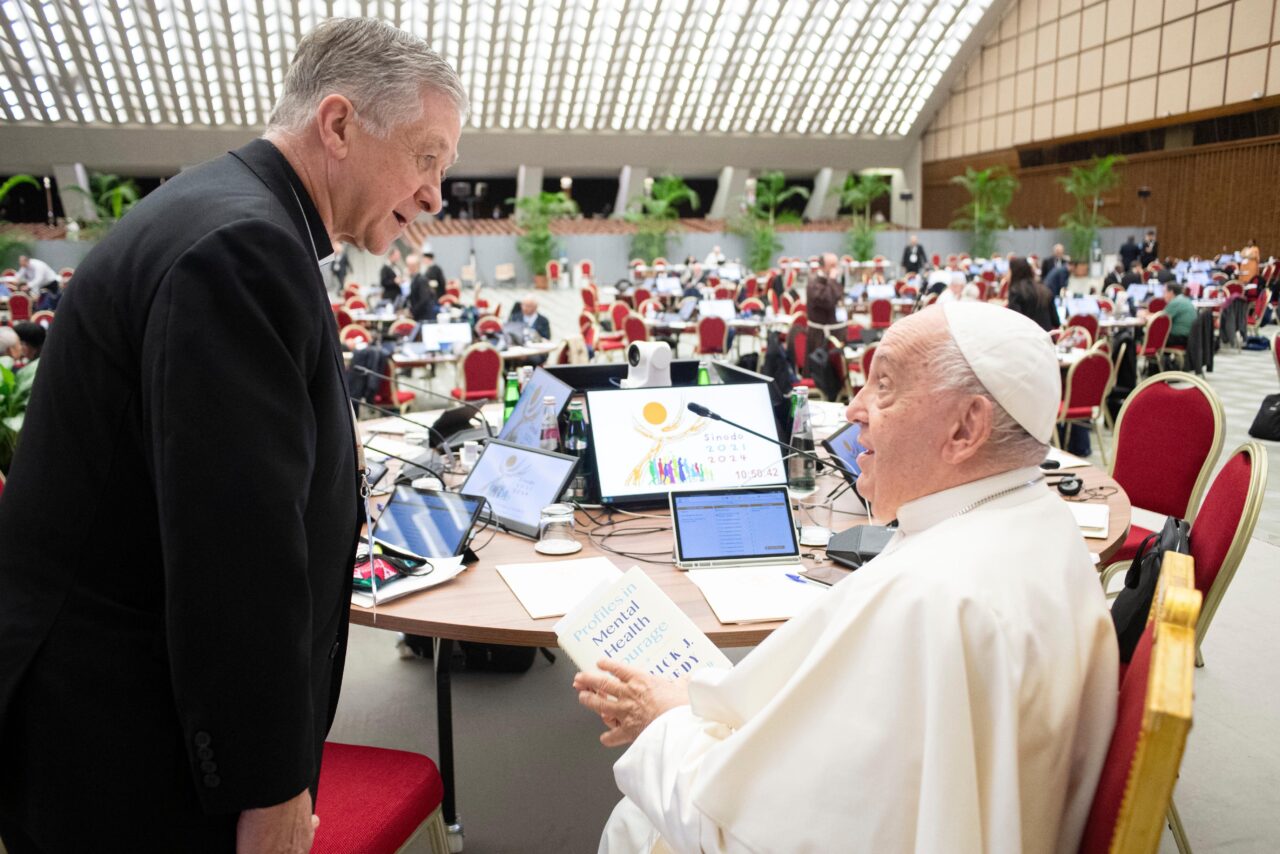
His master speaks
Posted on 01/09/2025 1:52:14 PM PST by ebb tide
His master speaks
The synodal approach to church life that Pope Francis is encouraging has greatly assisted me. It has forced me to rethink how I serve in the church and how I minister to those I serve. Perhaps the most important insight I have gained is that church leaders should be wary about presuming too much about people. We do better when we listen to others before we speak or make judgments about them. Given our years of education and preparation in the seminary and the deference that people often offer us, the fallacy that “Father knows best” can easily creep into our thinking.
Some years ago, Cardinal Luis Ladaria, former prefect of the Congregation for the Doctrine of the Faith, offered helpful advice to U.S. bishops. In 2021, we were formulating a national policy regarding admission to Communion for Catholics in public office who support legislation permitting abortion, euthanasia or other moral evils.
Cardinal Ladaria urged us to first “reach out to and engage in dialogue with Catholic politicians within their jurisdictions who adopt a pro-choice position regarding abortion legislation, euthanasia, or other moral evils, as a means of understanding the nature of their positions and their comprehension of Catholic teaching” (emphasis added). Only then, the cardinal noted, could the bishops discern “the best way forward for the church in the United States to witness to the grave moral responsibility of Catholic public officials to protect human life at all stages.”
We do better when we listen to others before we speak or make judgments about them.
In other words, we should listen to them rather than presume that we know how they understand church teaching, or that we know how they view carrying out the responsibilities of their office.
This approach of putting aside our preconceptions and really listening also applies to how church leaders ought to consider people in a variety of life situations. This includes not only LGBTQ Catholics, but also people who are married or single, those in so-called irregular situations, those who are living with physical and psychological disabilities and others.
Over this past decade as archbishop of Chicago, I have scheduled listening sessions with people representing all these groups. These conversations have given me a fresh perspective for understanding what the church means when it affirmed at the Second Vatican Council that “the joys and the hopes, the griefs and the anxieties of the men of this age, especially those who are poor or in any way afflicted, these are the joys and hopes, the griefs and anxieties of the followers of Christ. Indeed, nothing genuinely human fails to raise an echo in their hearts” (Gaudium et Spes, #1).
Of course, we can make that affirmation honestly only if we are in touch with people at those profound levels of human existence, and listen to them. In my conversations with LGBTQ Catholics, I have encountered searing truths about the realities of their lives in our church and in our world.
An overwhelming number of LGBTQ Catholics I’ve met told me that they suffer a sense of alienation precisely because they feel preemptively judged and excluded. The pain is especially sharp when it is experienced in their families or among those who have been their friends. This is also true when they experience this as members of their own church. They relate stories of being ostracized, even being thrown out of their family homes, when they told their parents about their sexual orientation. They felt unwelcome in the church and even spoke of being denied baptism and admission to Catholic schools for the children they adopted. One person told me that the way they were banished, shunned and even hated led them to the conclusion that being gay made them a modern-day leper. Tragically, this kind of alienation can lead to suicidal ideation.
In my conversations with LGBTQ Catholics, I have encountered searing truths about the realities of their life in our church and in our world.
Yet amidst these realities of exclusion and suffering lies a profound resiliency, an unwillingness to give up their desire to be good and respond to Christ’s call to follow him in the life of the church. They attend Mass. They become involved in parish life where they are welcomed. They pray daily and practice works of mercy, especially outreach to the poor.
Many of our LGBTQ Catholic sisters and brothers value community life. They are convinced that it is important to make the case for their place in the life of the church because they have something not only to receive but also to give, which we should recognize and welcome.
Many LGBTQ people also learn and know what sacrificial love is, as they take on the role of parenting children who otherwise would not have a home. This also happens when LGBTQ people put the social Gospel into practice by volunteering for good causes and by dealing compassionately with others, as so many of them already know what it means to feel excluded.
I believe we have a better chance of pursuing a holy life if we walk together “on the road” (synodos) and help each other along the way.
Contrary to what others often say or think about LGBTQ people, the idea that they are uniquely obsessed with sexual satisfaction is a myth (as if we don’t have abundant examples of cultural obsession with heterosexual gratification). Rather, what’s been clear in my conversations with LGBTQ Catholics is that they place a high priority on expressions of love and intimacy that comport with church teaching. In fact, they tend to see a relationship with a partner as an attempt to establish stability in their lives in the face of the promiscuity that is sometimes present in both the gay and straight communities.
Pastoral outreach to the LGBTQ population always should include the call of the Gospel to live a chaste and virtuous life. At the same time, in my 50 years as a priest I have learned that all of us struggle with those demands. We are, after all, all called to chastity.
Returning to Pope Francis’s call for a synodal church, I believe we have a better chance of pursuing a holy life if we walk together “on the road” (synodos) and help each other along the way. This means leaving behind preemptive exclusion and the shunning of those we have easily, if not lazily, judged as unworthy of our companionship. For if we talk with and, even more important, listen to each other, we may actually come to recognize what all God’s children share as members of the same family: that we are more alike than different, and that we are all from and going home to God.
Note that the Cupcake doesn't included sodomy as a moral evil. Yet he also supports Communion for Catholics in public office who support legislation permitting abortion.
Many LGBTQ people also learn and know what sacrificial love is, as they take on the role of parenting children who otherwise would not have a home.
A bald-faced lie from a homosexualist frankencardinal who is encouraging child abuse.
For if we talk with and, even more important, listen to each other, we may actually come to recognize what all God’s children share as members of the same family: that we are more alike than different, and that we are all from and going home to God.
That's what the Cupcake thinks.
Has Cupich protected a single child or has he ever held a homosexual predator truly accountable for molesting a child? Can anyone give at least one example?
Sodomy ... the second of four sins that cry out to Heaven for vengeance.
Listen to those who fundamentally missed the whole point of sex and manogamy.
Stop listening to bishops that talk do stupidly.
Amen
So we are to listen to people whose behavior, if normal, would have caused the end of humanity in the 2nd generation.
Gotcha!!
The tide is turning. I can feel it. Bergoglio’s generation is having its last gasps, and their slightly younger LGBT-leaning proteges like Soupy and Big Mac are nearing retirement age. The conservative/populist wave that started with MAGA is catching on in Europe and will eventually help sweep away the rot in the Church.
Meadow Muffins!!! Buggery is absolutely NOT an expression of love, and it absolutely DOES NOT comport with Church teaching. At least, not with Catholic Church teaching.
Fire.
Brimstone.
Zip up your fly Cup!
Would the good cardinal say the same thing about racists?
“The conservative/populist wave ... is catching on”
There are so many holy young priests here in Louisville. I keep noticing them everywhere. There are fervent and they don’t have time for games. God is replacing the graybeards spirit of Vatican II types and they don’t seem to realize it yet.
The Church considers the NT Canon as the inspired Word of God. Clerics like Cardinal Cupich have rejected the teaching found in Romans chapter 1, which speaks to the sin and immorality of homosexual behavior. The reason these clerics are not excommunicated is because the Pope allows - and some would say enables - their heresy.
“Put aside preconceptions and listen to what traditional Catholics have to say” — something Cdl. Cupich would never, ever, say.
Catholics tell Cardinal Cupich: Clerical Sex Abuse ‘Has Everything to do with Homosexuality’
Priest Defies Cardinal Cupich, Burns LGBTQ Flag on Church Grounds
Cupich’s Double Standard on Homosexuality
Recognition of ‘Other Forms of Family’ Called for by Youth Synod Small Group Led by Cdl. Cupich
Cupich and Wuerl Collaborated on Alternative Sex Abuse Proposal
Cupich and Company Accused of Withholding Names of at Least 500 Accused Priests
Disclaimer: Opinions posted on Free Republic are those of the individual posters and do not necessarily represent the opinion of Free Republic or its management. All materials posted herein are protected by copyright law and the exemption for fair use of copyrighted works.