Posted on 01/07/2025 6:01:33 AM PST by annalex
Tuesday after Epiphany Sunday ![]() Saint Raymond of Penafort Catholic Church, Springfield, VA Readings at MassThe readings shown here are for places where the Epiphany is celebrated on Sunday 5 January. Liturgical Colour: White. Year: C(I).
Let us love one another, since love comes from GodMy dear people, let us love one another since love comes from God and everyone who loves is begotten by God and knows God. Anyone who fails to love can never have known God, because God is love. God’s love for us was revealed when God sent into the world his only Son so that we could have life through him; this is the love I mean: not our love for God, but God’s love for us when he sent his Son to be the sacrifice that takes our sins away.
All nations shall fall prostrate before you, O Lord. O God, give your judgement to the king, to a king’s son your justice, that he may judge your people in justice and your poor in right judgement. All nations shall fall prostrate before you, O Lord. May the mountains bring forth peace for the people and the hills, justice. May he defend the poor of the people and save the children of the needy. All nations shall fall prostrate before you, O Lord. In his days justice shall flourish and peace till the moon fails. He shall rule from sea to sea, from the Great River to earth’s bounds. All nations shall fall prostrate before you, O Lord.
Alleluia, alleluia! Jesus proclaimed the Good News of the kingdom and cured all kinds of diseases among the people. Alleluia!
Alleluia, alleluia! The Lord has sent me to bring the good news to the poor, to proclaim liberty to captives. Alleluia!
Alleluia, alleluia! A great prophet has appeared among us; God has visited his people. Alleluia!
Alleluia, alleluia! Glory to you, O Christ, proclaimed to the pagans; glory to you, O Christ, believed in by the world. Alleluia!
Alleluia, alleluia! The people that lived in darkness has seen a great light; on those who dwell in the land and shadow of death a light has dawned. Alleluia!
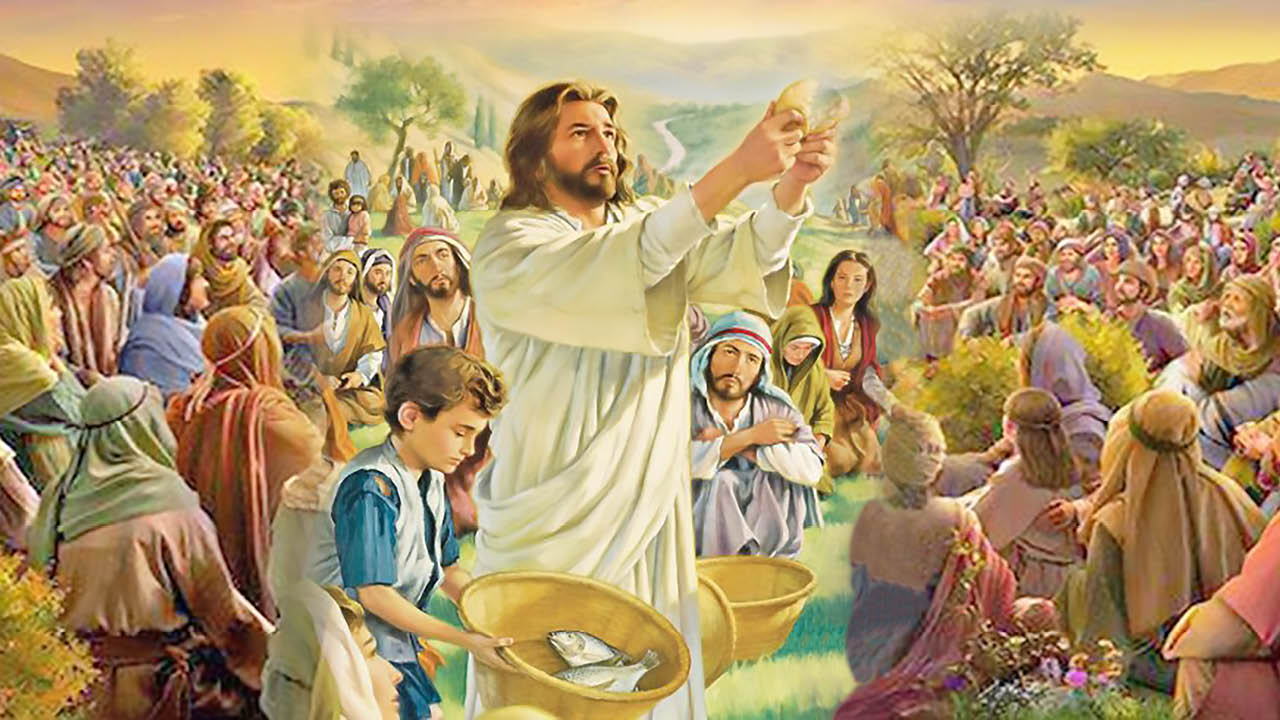
The feeding of the five thousandAs Jesus stepped ashore he saw a large crowd; and he took pity on them because they were like sheep without a shepherd, and he set himself to teach them at some length. By now it was getting very late, and his disciples came up to him and said, ‘This is a lonely place and it is getting very late. So send them away, and they can go to the farms and villages round about, to buy themselves something to eat.’ He replied, ‘Give them something to eat yourselves.’ They answered, ‘Are we to go and spend two hundred denarii on bread for them to eat?’ ‘How many loaves have you?’ he asked. ‘Go and see.’ And when they had found out they said, ‘Five, and two fish.’ Then he ordered them to get all the people together in groups on the green grass, and they sat down on the ground in squares of hundreds and fifties. Then he took the five loaves and the two fish, raised his eyes to heaven and said the blessing; then he broke the loaves and handed them to his disciples to distribute among the people. He also shared out the two fish among them all. They all ate as much as they wanted. They collected twelve basketfuls of scraps of bread and pieces of fish. Those who had eaten the loaves numbered five thousand men. Christian Art![]() Each day, The Christian Art website gives a picture and reflection on the Gospel of the day. The readings on this page are from the Jerusalem Bible, which is used at Mass in most of the English-speaking world. The New American Bible readings, which are used at Mass in the United States, are available in the Universalis apps, programs and downloads. |
KEYWORDS: catholic; christmas; mk6; prayer;

Please FReepmail me to get on/off the Alleluia Ping List.
| Mark | |||
| English: Douay-Rheims | Latin: Vulgata Clementina | Greek NT: Byzantine/Majority Text (2000) | |
| Mark 6 | |||
| 34. | And Jesus going out saw a great multitude: and he had compassion on them, because they were as sheep not having a shepherd, and he began to teach them many things. | Et exiens vidit turbam multam Jesus : et misertus est super eos, quia erant sicut oves non habentes pastorem, et cœpit docere multa. | και εξελθων ειδεν ο ιησους πολυν οχλον και εσπλαγχνισθη επ αυτοις οτι ησαν ως προβατα μη εχοντα ποιμενα και ηρξατο διδασκειν αυτους πολλα |
| 35. | And when the day was now far spent, his disciples came to him, saying: This is a desert place, and the hour is now past: | Et cum jam hora multa fieret, accesserunt discipuli ejus, dicentes : Desertus est locus hic, et jam hora præteriit : | και ηδη ωρας πολλης γενομενης προσελθοντες αυτω οι μαθηται αυτου λεγουσιν οτι ερημος εστιν ο τοπος και ηδη ωρα πολλη |
| 36. | Send them away, that going into the next villages and towns, they may buy themselves meat to eat. | dimitte illos, ut euntes in proximas villas et vicos, emant sibi cibos, quos manducent. | απολυσον αυτους ινα απελθοντες εις τους κυκλω αγρους και κωμας αγορασωσιν εαυτοις αρτους τι γαρ φαγωσιν ουκ εχουσιν |
| 37. | And he answering said to them: Give you them to eat. And they said to him: Let us go and buy bread for two hundred pence, and we will give them to eat. | Et respondens ait illis : Date illis vos manducare. Et dixerunt ei : Euntes emamus ducentis denariis panes, et dabimus illis manducare. | ο δε αποκριθεις ειπεν αυτοις δοτε αυτοις υμεις φαγειν και λεγουσιν αυτω απελθοντες αγορασωμεν δηναριων διακοσιων αρτους και δωμεν αυτοις φαγειν |
| 38. | And he saith to them: How many loaves have you? go and see. And when they knew, they say: Five, and two fishes | Et dicit eis : Quot panes habetis ? ite, et videte. Et cum cognovissent, dicunt : Quinque, et duos pisces. | ο δε λεγει αυτοις ποσους αρτους εχετε υπαγετε και ιδετε και γνοντες λεγουσιν πεντε και δυο ιχθυας |
| 39. | And he commanded them that they should make them all sit down by companies upon the green grass. | Et præcepit illis ut accumbere facerent omnes secundum contubernia super viride fœnum. | και επεταξεν αυτοις ανακλιναι παντας συμποσια συμποσια επι τω χλωρω χορτω |
| 40. | And they sat down in ranks, by hundreds and by fifties. | Et discubuerunt in partes per centenos et quinquagenos. | και ανεπεσον πρασιαι πρασιαι ανα εκατον και ανα πεντηκοντα |
| 41. | And when he had taken the five loaves, and the two fishes: looking up to heaven, he blessed, and broke the loaves, and gave to his disciples to set before them: and the two fishes he divided among them all. | Et acceptis quinque panibus et duobus pisces, intuens in cælum, benedixit, et fregit panes, et dedit discipulis suis, ut ponerent ante eos : et duos pisces divisit omnibus. | και λαβων τους πεντε αρτους και τους δυο ιχθυας αναβλεψας εις τον ουρανον ευλογησεν και κατεκλασεν τους αρτους και εδιδου τοις μαθηταις αυτου ινα παραθωσιν αυτοις και τους δυο ιχθυας εμερισεν πασιν |
| 42. | And they all did eat, and had their fill. | Et manducaverunt omnes, et saturati sunt. | και εφαγον παντες και εχορτασθησαν |
| 43. | And they took up the leavings, twelve full baskets of fragments, and of the fishes. | Et sustulerunt reliquias, fragmentorum duodecim cophinos plenos, et de piscibus. | και ηραν κλασματων δωδεκα κοφινους πληρεις και απο των ιχθυων |
| 44. | And they that did eat, were five thousand men. | Erant autem qui manducaverunt quinque millia virorum. | και ησαν οι φαγοντες τους αρτους πεντακισχιλιοι ανδρες |

6:30–34
30. And the apostles gathered themselves together unto Jesus, and told him all things, both what they had done, and what they had taught.
31. And he said unto them, Come ye yourselves apart into a desert place, and rest a while: for there were many coming and going, and they had no leisure so much as to eat.
32. And they departed into a desert place by ship privately.
33. And the people saw them departing, and many knew him, and ran afoot thither out of all cities, and outwent them, and came together unto him.
34. And Jesus, when he came out, saw much people, and was moved with compassion toward them, because they were as sheep not having a shepherd: and he began to teach them many things.
GLOSS. (non occ.) The Evangelist, after relating the death of John, gives an account of those things which Christ did with His disciples after the death of John, saying, And the Apostles gathered themselves together unto Jesus, and told him all things, both what they had done, and what they had taught.
PSEUDO-JEROME. For they return to the fountain-head whence the streams flow; those who are sent by God, always offer up thanks for those things which they have received.
THEOPHYLACT. Let us also learn, when we are sent on any mission, not to go far away, and not to overstep the bounds of the office committed, but to go often to him, who sends us, and report all that we have done and taught; for we must not only teach but act.
BEDE. (ubi sup.) Not only do the Apostles tell the Lord what they themselves had done and taught, but also his own and John’s disciples together tell Him what John had suffered, during the time that they were occupied in teaching, as Matthew relates. It goes on: And he said to them, Come ye yourselves apart, &c.
AUGUSTINE. (de Con. Evan. 2. 45) This is said to have taken place, after the passion of John, therefore what is first related took place last, for it was by these events that Herod was moved to say, This is John the Baptist, whom I beheaded.
THEOPHYLACT. Again, He goes into a desert place from His humility. But Christ makes His disciples rest, that men who are set over others may learn, that they who labour in any work or in the word deserve rest, and ought not to labour continually.
BEDE. (ubi sup.) How arose the necessity for giving rest to His disciples, He shews, when He adds, For there were many coming and going, and they had no leisure so much as to eat; we may then see how great was the happiness of that time, both from the toil of the teachers, and from the diligence of the learners. It goes on, And embarking in a ship, they departed into a desert place privately. The disciples did not enter into the ship alone, but taking up the Lord with them, they went to a desert place, as Matthew shews. (Matt. 14) Here He tries the faith of the multitude, and by seeking a desert place He would see whether they care to follow Him. And they follow Him, and that not on horseback, nor in carriages, but laboriously coming on foot, they shew how great is their anxiety for their salvation. There follows, And the people saw them departing, and many knew him, and ran afoot thither out of all cities, and outwent them. In saying that they outwent them on foot, it is proved that the disciples with the Lord did not reach the other bank of the sea, or of the Jordan, but they went to the nearest places of the same country, where the people of those parts could come to them on foot.
THEOPHYLACT. So do thou not wait for Christ till He Himself call you, but outrun Him, and come before Him. There follows, And Jesus when he came out saw much people, and was moved with compassion towards them, because they were as sheep having no shepherd. The Pharisees being ravening wolves did not feed the sheep, but devoured them; for which reason they gather themselves to Christ, the true Shepherd, who gave them spiritual food, that is, the word of God. Wherefore it goes on, And he began to teach them many things. For seeing that those who followed Him on account of His miracles were tired from the length of the way, He pitied them, and wished to satisfy their wish by teaching them.
BEDE. (in Marc. 2, 26) Matthew says that He healed their sick, for the real way of pitying the poor is to open to them the way of truth by teaching them, and to take away their bodily pains.
PSEUDO-JEROME. Mystically, however, the Lord took apart those whom He chose, that though living amongst evil men, they might not apply their minds to evil things, as Lot in Sodom, Job in the land of Uz, and Obadiah in the house of Ahab.
BEDE. (in Marc. 2, 25) Leaving also Judæa, the holy preachers, in the desert of the Church, overwhelmed by the burden of their tribulations amongst the Jews, obtained rest by the imparting of the grace of faith to the Gentiles.
PSEUDO-JEROME. Little indeed is the rest of the saints here on earth, long is their labour, but afterwards, they are bidden to rest from their labours. But as in the ark of Noah, the animals that were within were sent forth, and they that were without rushed in, so is it in the Church, Judas went, the thief came to Christ. But as long as men go back from the faith, the Church can have no refuge from grief; for Rachel weeping for her children would not be comforted. Moreover, this world is not the banquet, in which the new wine is drank, when the new song will be sung by men made anew, when this mortal shall have put on immortality.
BEDE. (in Marc. 2, 26) But when Christ goes to the deserts of the Gentiles, many bauds of the faithful leaving the walls of their cities, that is their old manner of living, follow Him.
6:35–44
35. And when the day was now far spent, his disciples came unto him, and said, This is a desert place, and now the time is far passed:
36. Send them away, that they may go into the country round about, and into the villages, and buy themselves bread: for they have nothing to eat.
37. He answered and said unto them, Give ye them to eat. And they say unto him, Shall we go and buy two hundred pennyworth of bread, and give them to eat?
38. He saith unto them, How many loaves have ye? go and see. And when they knew, they say, Five, and two fishes.
39. And he commanded them to make all sit down by companies upon the green grass.
40. And they sat down in ranks, by hundreds, and by fifties.
41. And when he had taken the five loaves and the two fishes, he looked up to heaven, and blessed, and brake the loaves, and gave them to his disciples to set before them; and the two fishes divided he among them all.
42. And they did all eat, and were filled.
43. And they took up twelve baskets full of the fragments, and of the fishes.
44. And they that did eat of the loaves were about five thousand men.
THEOPHYLACT. The Lord, placing before them, first, what is most profitable, that is, the food of the word of God, afterwards also gave the multitude food for their bodies; in beginning to relate which, the Evangelist says, And when the day was now far spent, his disciples came unto him, and said, This is a desert place.
BEDE. (ubi sup.) The time being far spent, points out that it was evening. Wherefore Luke says, But the day had begun to decline.
THEOPHYLACT. See now, how those who are disciples of Christ grow in love to man, for they pity the multitudes, and come to Christ to intercede for them. But the Lord tried them, to see whether they would know that His power was great enough to feed them. Wherefore it goes on, He answered, and said unto them, Give ye them to eat.
BEDE. (ubi sup.) By these words He calls on His Apostles, to break bread for the people, that they might be able to testify that they had no bread, and thus the greatness of the miracle might become more known.
THEOPHYLACT. But the disciples thought that He did not know what was necessary for the feeding of so large a multitude, for their answer shews that they were troubled. For it goes on, And they said unto him, Let us go and buy two hundred pennyworth, of bread, and give them to eat.
AUGUSTINE. (Con. Evan. 2. 46) This in the Gospel of John is the answer of Philip, but Mark gives it as the answer of the disciples, wishing it to be understood that Philip made this answer as a mouthpiece of the others; although he might put the plural number for the singular, as is usual. It goes on, And he saith unto them, How many loaves hare ye? go and see. The other Evangelists pass over this being done by the Lord. It goes on, And when they knew, they say, Five, and two fishes. This, which was suggested by Andrew, as we learn from John, the other Evangelists, using the plural for the singular, have put into the mouth of the disciples. It goes on, And he commanded them to wake all sit down by companies upon the green grass, and they sat down in ranks by hundreds and by fifties. But we need not be perplexed, though Luke says that they were ordered to sit down by fifties, and Mark by hundreds and fifties, for one has mentioned a part, the other the whole. Mark, who mentions the hundreds, fills up what the other has left out.
THEOPHYLACT. We are given to understand that they lay down in parties, separate from one another, for what is translated by companies, is repeated twice over in the Greek, as though it were by companies and companies. It goes on, And when he had taken the five loaves and the two fishes, he looked up to heaven, and blessed, and brake the loaves, and gave them to his disciples to set before them: and the two fishes divided he among them all.
CHRYSOSTOM. (Vict. Ant. e Cat. in Marc. v. Chrys. Hom in Matt. 49) Now it was with fitness that He looked up to heaven, for the Jews, when receiving manna in the desert, presumed to say of God, Can he give bread? (Ps. 78:20) To prevent this therefore, before He performed the miracle, He referred to His Father what He was about to do.
THEOPHYLACT. He also looks up to heaven, that He may teach us to seek our food from God, and not from the devil, as they do who unjustly feed on other men’s labours. By this also He intimated to the crowd, that He could not be opposed to God, since He called upon God. And He gives the bread to His disciples to set before the multitude, that by handling the bread, they might see that it was an undoubted miracle. It goes on: And they did all eat, and were filled: and they took up twelve baskets full of the fragments. Twelve baskets of fragments remained over and above, that each of the Apostles, carrying a basket on his shoulder, might recognise the unspeakable wonder of the miracle. For it was a proof of overflowing power not only to feed so many men, but also to leave such a superabundance of fragments. Even though Moses gave manna, yet what was given to each was measured by his necessity, and what was over and above was overrun with worms. Elias also fed the woman, but gave her just what was enough for her; but Jesus, being the Lord, makes his gifts with superabundant profusion.
BEDE. (ubi sup.) Again, in a mystical sense, the Saviour refreshes the hungry crowds at the day’s decline, because, either now that the end of the world approaches, or now that the Sun of justice has set in death for us, we are saved from wasting away in spiritual hunger. He calls the Apostles to Him at the breaking of bread, intimating that daily by them our hungry souls are fed, that is, by their letters and examples. By the five loaves are figured the Five Books of Moses, by the two fishes the Psalms and Prophets.
THEOPHYLACT. Or the two fishes are the discourses of fishermen, that is, their Epistles and Gospel.
BEDE. (ubi sup.) wThere are five senses in the outward man, which shews that by the five thousand men are meant those who, living in the world, know how to make a good use of external things.
GREGORY. (Mor. 16, 55) The different ranks in which those who ate lie down, mark out the divers churches which make up the one Catholicx. But the Jubilee rest is contained in the mystery of the number fifty, and fifty must be doubled before it reaches up to a hundred. As then the first step is to rest from doing evil, that afterwards the soul may rest more fully from evil thoughts, some lie down in parties of fifty, others of a hundred.
BEDE. (ubi sup.) Again, those men lie down on grass and are fed by the food of the Lord, who have trodden under foot their concupiscences by continence, and apply themselves diligently to hear and fulfil the words of God.1 The Saviour, however, does not create a new sort of food; for when He came in the flesh He preached no other things than were predicted,1 but shewed how pregnant with mysteries of grace were the writings of the Law and the Prophets. He looks up to heaven, that He may teach us that there we must look for grace. He breaks and distributes to the disciples that they may place the bread before the multitudes, because He has opened the mysteries of prophecy to holy doctors, who are to preach them to the whole world. What is left by the crowd is taken up by the disciples, because the more sacred mysteries, which cannot be received by the foolish, are not to be passed by with negligence, but to be inquired into by the perfect. For by the twelve baskets, the Apostles and the following Doctors are typified, externally indeed despised by men, but inwardly full of healthful food. For all know that carrying baskets is a part of the work of slaves.
PSEUDO-JEROME. Or, in the gathering of the twelve baskets full of fragments, is signified the time, when they shall sit on thrones, judging all who are left of Abraham, Isaac, and Jacob, the twelve tribes of Israel, when the remnant of Israel shall be saved.
Catena Aurea Mark 6
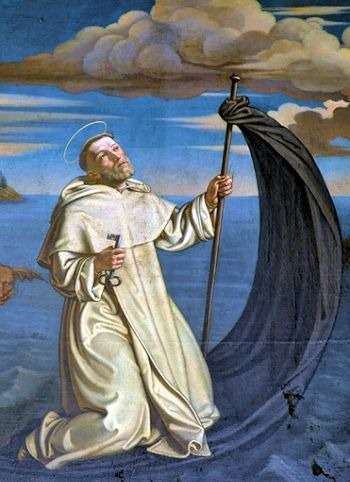
Saint Raymond of Peñafort’s Story
Since Raymond lived into his hundredth year, he had a chance to do many things. As a member of the Spanish nobility, he had the resources and the education to get a good start in life.
By the time he was 20, he was teaching philosophy. In his early 30s he earned a doctorate in both canon and civil law. At 41 he became a Dominican. Pope Gregory IX called him to Rome to work for him and to be his confessor. One of the things the pope asked him to do was to gather together all the decrees of popes and councils that had been made in 80 years since a similar collection by Gratian. Raymond compiled five books called the Decretals. They were looked upon as one of the best organized collections of Church law until the 1917 codification of canon law.
Earlier, Raymond had written for confessors a book of cases. It was called Summa de Casibus Poenitentiae. More than simply a list of sins and penances, it discussed pertinent doctrines and laws of the Church that pertained to the problem or case brought to the confessor.
At the age of 60, Raymond was appointed archbishop of Tarragona, the capital of Aragon. He didn’t like the honor at all and ended up getting sick and resigning in two years.
He didn’t get to enjoy his peace long, however, because when he was 63 he was elected by his fellow Dominicans to be the head of the whole Order, the successor of Saint Dominic. Raymond worked hard, visited on foot all the Dominicans, reorganized their constitutions and managed to put through a provision that a master general be allowed to resign. When the new constitutions were accepted, Raymond, then 65, resigned.
He still had 35 years to oppose heresy and work for the conversion of the Moors in Spain. He convinced Saint Thomas Aquinas to write his work Against the Gentiles.
In his 100th year, the Lord let Raymond retire.
Reflection
Raymond was a lawyer, a canonist. Legalism can suck the life out of genuine religion if it becomes too great a preoccupation with the letter of the law to the neglect of the spirit and purpose of the law. The law can become an end in itself, so that the value the law was intended to promote is overlooked. But we must guard against going to the opposite extreme and seeing law as useless or something to be lightly regarded. Laws ideally state those things that are for the best interests of everyone and make sure the rights of all are safeguarded. From Raymond, we can learn a respect for law as a means of serving the common good.
Saint Raymond of Peñafort is a Patron Saint of:
Lawyers

Ad Majorem Dei Gloriam (To the Greater Glory of God)
First Reading:
From: 1 John 4:7-10
God is Love. Brotherly Love, the Mark of Christians
---------------------------------------------------
[7] Beloved, let us love one another, for love is of God, and he who loves is born of God and knows God. [8] He who does not love does not know God; for God is love. [9] In this the love of God was made manifest among us, that God sent his only Son into the world, so that we might live through him. [10] In this is love, not that we loved God but that he loved us and sent his Son to be the expiation for our sins.
***********************************************************************
Commentary:
7-21. St John now expands on the second aspect of the divine commandment (cf. 1 Jn 3:23)—brotherly love. The argument is along these lines: God is love and it was he who loved us to begin with (vv. 7-10); brotherly love is the response which God's love calls for (vv. 11 16); when our love is perfect, we feel no fear (vv. 17-18); brotherly love is an expression of love of God (vv. 19-21).
This is not tiresome repetition of the ideas already discussed (2:7-11; 3:11-18): contrary to the false teaching which is beginning to be spread, charity is the sure mark, the way to recognize the genuine disciple.
St Jerome hands down a tradition concerning the last years of St John's life: when he was already a very old man, he used always say the same thing to the faithful: "My children, love one another!" On one occasion, he was asked why he insisted on this: "to which he replied with these words worthy of John: 'Because it is the Lord's commandment, and if you keep just this commandment, it will suffice"' ("Comm. in Gal.", III, 6, 10).
7. The divine attributes, God's perfections, which he has to the highest degree, are the cause of our virtues: for example, because God is holy, we have been given a capacity to be holy. Similarly, because God is love, we can love. True love, true charity, comes from God.
8. "God is love": without being strictly speaking a definition (in 1:5 he says "God is light"), this statement reveals to us one of the most consoling attributes of God: "Even if nothing more were to be said in praise of love in all the pages of this epistle", St Augustine explains, "even if nothing more were to be said in all the pages of Sacred Scripture, and all we heard from the mouth of the Holy Spirit were that 'God is love', there would be nothing else we would need to look for" ("In Epist. Ioann. Ad Parthos", 7, 5).
God's love for men was revealed in Creation and in the preternatural and supernatural gifts he gave man prior to sin; after man's sin, God's love is to be seen, above all, in forgiveness and redemption (as St John goes on to say: v. 9), for the work of salvation is the product of God's mercy: "It is precisely because sin exists in the world, which 'God so loved . . . that he gave his only Son' (Jn 3:16), that God, who 'is love' (1 Jn 4:8), "cannot reveal himself other than as mercy". This corresponds not only to the most profound truth of that love which God is, but also to the whole interior truth of man and of the world which is man's temporary homeland" (St Pope John Paul II, "Dives In Misericordia", 13).
9. God has revealed his love to men by sending his own Son; that is, it is not only Christ's teachings which speak to us of God's love, but, above all, his presence among us: Christ himself is the fullness of revelation of God (cf. Jn 1:18; Heb 1:1) and of his love for men. "The source of all grace is God's love for us, and he has revealed this not just in words but also in deeds. It was divine love which led the second Person of the most holy Trinity, the Word, the Son of God the Father, to take on our flesh, our human condition, everything except sin. And the Word, the Word of God, is the Word from which Love proceeds (cf. "Summa Theologiae", I, q. 43, a. 5, quoting St Augustine, "De Trinitate", IX, 10).
"Love is revealed to us in the incarnation, the redemptive journey which Jesus Christ made on our earth, culminating in the supreme sacrifice of the cross. And on the cross it showed itself through a new sign: 'One of the soldiers pierced his side with a spear, and at once there came out blood and water' (Jn 19:34). This water and blood of Jesus speaks to us of a self-sacrifice brought to the last extreme: 'It is finished' (Jn 19:30)—everything is achieved, for the sake of love" (St J. Escriva, "Christ Is Passing By", 162).
"Among us": it is difficult to convey in English everything the Greek contains. The Greek expression means that the love of God was shown to those who witnessed our Lord's life (the Apostles) and to all other Christians, whose participate in this apostolic witness (cf. note on 1 Jn 1:1-3; this idea is repeated in vv. 14 and 16). But it also means "within us", inside us, in our hearts, insofar as we partake of God's own life by means of sanctifying grace: every Christian is a witness to the fact that Christ has come so that men "may have life, and have it abundantly" (Jn 10:10).
10. Given that love is an attribute of God (v. 8), men have a capacity to love insofar as they share in God's qualities. So, the initiative always lies with God.
When explaining in what love consists. St John points to its highest form of expression: "he sent (his Son) to be the expiation of our sins" (cf. 2:2). Similar turns of phrase occur throughout the letter: the Son of God manifested himself "to destroy the works of the devil" (3:8); "he laid down his life for us" (3:16). All these statements show that: 1) Christ's death is a SACRIFICE in the strict sense of the word, the most sublime act of recognition of God's sovereignty; 2) it is an atoning sacrifice, because it obtains God's pardon for the sins of men; 3) it is the supreme act of God's love, so much so that St John actually says, "in this is love."
What is amazing, St Alphonsus teaches, "is that he could have saved us without suffering or dying and yet he chose a life of toil and humiliation, and a bitter and ignominious death, even death on a cross, something reserved for the very worst offenders. And why was it that, when he could have redeemed us without suffering, he chose to embrace death on the Cross? To show us how much he loved us" ("The Love of Jesus Christ", chap. 1).
From: Mark 6:34-44
First Miracle of the Loaves
---------------------------
[34] As he (Jesus) landed he saw a great throng, and he had compassion on them, because they were like sheep without a shepherd; and he began to teach them many things. [35] And when it grew late, his disciples came to him and said, "This is a lonely place, and the hour is now late; [36] send them away, to go into the country and villages round about and buy themselves something to eat." [37] But he answered them, "You give them something to eat." And they said to him, "Shall we go and buy two hundred denarii worth of bread, and give it to them to eat?" [38] And he said to them, "How many loaves have you? Go and see." And when they had found out, they said, "Five, and two fish." [39] Then he commanded them all to sit down by companies upon the green grass. [40] So they sat down in groups, by hundreds and by fifties. [41] And taking the five loaves and the two fish he looked up to heaven, and blessed, and broke the loaves, and gave them to the disciples to set before the people; and he divided the two fish among them all. [42] And they all ate and were satisfied. [43] And they took up twelve baskets full of broken pieces and of the fish. [44] And those who ate the loaves were five thousand men.
***********************************************************************
Commentary:
34. Our Lord had planned a period of rest, for himself and his disciples, from the pressures of the apostolate (Mk 6:31-32). And he has to change his plans because so many people come, eager to hear him speak. Not only is he not annoyed with them: he feels compassion on seeing their spiritual need. "My people are destroyed for lack of knowledge" (Hos 4:6). They need instruction and our Lord wants to meet this need by preaching to them. "Jesus is moved by hunger and sorrow, but what moves him most is ignorance" (St J. Escriva, "Christ Is Passing By", 109).
37. A denarius was what an artisan earned for a normal day's work. The disciples must, therefore, have thought it little less than impossible to fulfill the Master's command, because they would not have had this much money.
41. This miracle is a figure of the Holy Eucharist: Christ performed it shortly before promising that sacrament (cf. Jn 6:1ff), and the Fathers have always so interpreted it. In this miracle Jesus shows his supernatural power and his love for men--the same power and love as make it possible for Christ's one and only body to be present in the eucharistic species to nourish the faithful down the centuries. In the words of the sequence composed by St Thomas Aquinas for the Mass of Corpus Christi: "Sumit unus, sumunt mille, quantum isti, tantum ille, nec sumptus consumitur" (Be one or be a thousand fed, they eat alike that living bread which, still received, ne'er wastes away).
This gesture of our Lord--looking up to heaven--is recalled in the Roman canon of the Mass: "Et elevatis oculis in caelum, ad Te Deum Patrem suum omnipotentem" (and looking up to heaven, to you, his almighty Father). At this point in the Mass we are preparing to be present at a miracle greater than that of the multiplication of the loaves--the changing of bread into his own body, offered as food for all men.
42. Christ wanted the left-overs to be collected (cf. Jn 6:12) to teach us not to waste things God gives us, and also to have them as a tangible proof of the miracle.
The collecting of the leftovers is a way of showing us the value of little things done out of love for God--orderliness, cleanliness, finishing things completely. It also reminds the sensitive believer of the extreme care that must be taken of the eucharistic species. Also, the generous scale of the miracle is an expression of the largesse of the messianic times. The Fathers recall that Moses distributed the manna for each to eat as much as he needed but some left part of it for the next day and it bred worms (Ex 16:16-20). Elijah gave the widow just enough to meet her needs (1 Kings 17:13-16). Jesus, on the other hand, gives generously and abundantly.
Disclaimer: Opinions posted on Free Republic are those of the individual posters and do not necessarily represent the opinion of Free Republic or its management. All materials posted herein are protected by copyright law and the exemption for fair use of copyrighted works.