Free Republic
Browse · Search
Religion
Topics · Post Article

Skip to comments.

Catholic Caucus: Daily Mass Readings 4-January-2025
Universalis/Jerusalem Bible ^

Posted on 01/04/2025 7:09:17 AM PST by annalex

Saturday 4 January 2025

Saint Elizabeth Ann Seton


St. Elizabeth Ann Seton Catholic Church, Cedar Rapids, Iowa

Readings at Mass

Liturgical Colour: White. Year: C(I).

Readings for the feria

Readings for the memorial

These are the readings for the feria


First reading1 John 3:7-10

No-one sins who has been begotten by God

My children, do not let anyone lead you astray:
to live a holy life
is to be holy just as he is holy;
to lead a sinful life is to belong to the devil,
since the devil was a sinner from the beginning.
It was to undo all that the devil has done
that the Son of God appeared.
No one who has been begotten by God sins;
because God’s seed remains inside him,
he cannot sin when he has been begotten by God.
In this way we distinguish the children of God
from the children of the devil:
anybody not living a holy life
and not loving his brother
is no child of God’s.

Responsorial Psalm
Psalm 97(98):1,7-9
All the ends of the earth have seen the salvation of our God.
Sing a new song to the Lord
  for he has worked wonders.
His right hand and his holy arm
  have brought salvation.
All the ends of the earth have seen the salvation of our God.
Let the sea and all within it, thunder;
  the world, and all its peoples.
Let the rivers clap their hands
  and the hills ring out their joy
at the presence of the Lord.
All the ends of the earth have seen the salvation of our God.
For the Lord comes,
  he comes to rule the earth.
He will rule the world with justice
  and the peoples with fairness.
All the ends of the earth have seen the salvation of our God.

Gospel AcclamationJn1:14,12
Alleluia, alleluia!
The Word became flesh, and dwelt among us.
To all who received him he gave power to become children of God.
Alleluia!
Or:Heb1:1-2
Alleluia, alleluia!
At various times in the past
and in various different ways,
God spoke to our ancestors through the prophets;
but in our own time, the last days,
he has spoken to us through his Son.
Alleluia!
Or:
Alleluia, alleluia!
A hallowed day has dawned upon us.
Come, you nations, worship the Lord,
for today a great light has shone down upon the earth.
Alleluia!

GospelJohn 1:35-42

'We have found the Messiah'

As John stood with two of his disciples, Jesus passed, and John stared hard at him and said, ‘Look, there is the lamb of God.’ Hearing this, the two disciples followed Jesus. Jesus turned round, saw them following and said, ‘What do you want?’ They answered, ‘Rabbi,’ – which means Teacher – ‘where do you live?’ ‘Come and see’ he replied; so they went and saw where he lived, and stayed with him the rest of that day. It was about the tenth hour.
  One of these two who became followers of Jesus after hearing what John had said was Andrew, the brother of Simon Peter. Early next morning, Andrew met his brother and said to him, ‘We have found the Messiah’ – which means the Christ – and he took Simon to Jesus. Jesus looked hard at him and said, ‘You are Simon son of John; you are to be called Cephas’ – meaning Rock.

Continue

These are the readings for the memorial


First reading
Deuteronomy 10:8-9

The Lord set apart the tribe of Levi to do him service

Moses said to the people: ‘The Lord set apart the tribe of Levi to carry the ark of the Lord’s covenant, to stand in the presence of the Lord, to do him service and in his name to pronounce blessing as they still do today. Levi therefore has no share or inheritance with his brothers: the Lord is his inheritance, as the Lord your God told him.’

Responsorial PsalmPsalm 1:1-4,6
His delight is the law of the Lord.
or
Happy the man who has placed his trust in the Lord.
or
The just will flourish like the palm-tree in the courts of our God.
Happy indeed is the man
  who follows not the counsel of the wicked;
nor lingers in the way of sinners
  nor sits in the company of scorners,
but whose delight is the law of the Lord
  and who ponders his law day and night.
His delight is the law of the Lord.
or
Happy the man who has placed his trust in the Lord.
or
The just will flourish like the palm-tree in the courts of our God.
He is like a tree that is planted
  beside the flowing waters,
that yields its fruit in due season
  and whose leaves shall never fade;
  and all that he does shall prosper.
His delight is the law of the Lord.
or
Happy the man who has placed his trust in the Lord.
or
The just will flourish like the palm-tree in the courts of our God.
Not so are the wicked, not so!
For they like winnowed chaff
  shall be driven away by the wind:
for the Lord guards the way of the just
  but the way of the wicked leads to doom.
His delight is the law of the Lord.
or
Happy the man who has placed his trust in the Lord.
or
The just will flourish like the palm-tree in the courts of our God.

Gospel AcclamationMt5:3
Alleluia, alleluia!
How happy are the poor in spirit:
theirs is the kingdom of heaven.
Alleluia!
Or:Mt5:6
Alleluia, alleluia!
Happy those who hunger and thirst for what is right:
they shall be satisfied.
Alleluia!
Or:Mt5:8
Alleluia, alleluia!
Happy the pure in heart:
they shall see God.
Alleluia!
Or:Mt11:25
Alleluia, alleluia!
Blessed are you, Father,
Lord of heaven and earth,
for revealing the mysteries of the kingdom
to mere children.
Alleluia!
Or:Mt23:11,12
Alleluia, alleluia!
The greatest among you must be your servant, says the Lord:
the man who humbles himself will be exalted.
Alleluia!
Or:Mt11:28
Alleluia, alleluia!
Come to me, all you who labour and are overburdened
and I will give you rest, says the Lord.
Alleluia!
Or:Lk21:36
Alleluia, alleluia!
Stay awake, praying at all times
for the strength to stand with confidence
before the Son of Man.
Alleluia!
Or:Jn8:12
Alleluia, alleluia!
I am the light of the world, says the Lord;
anyone who follows me will have the light of life.
Alleluia!
Or:Jn8:31-32
Alleluia, alleluia!
If you make my word your home
you will indeed be my disciples,
and you will learn the truth, says the Lord.
Alleluia!
Or:Jn13:34
Alleluia, alleluia!
I give you a new commandment:
love one another just as I have loved you,
says the Lord.
Alleluia!
Or:Jn14:23
Alleluia, alleluia!
If anyone loves me he will keep my word,
and my Father will love him,
and we shall come to him.
Alleluia!
Or:Jn15:4,5
Alleluia, alleluia!
Make your home in me, as I make mine in you,
says the Lord;
whoever remains in me bears fruit in plenty.
Alleluia!
Or:Jn15:9,5
Alleluia, alleluia!
Remain in my love, says the Lord;
whoever remains in me, with me in him,
bears fruit in plenty.
Alleluia!

GospelMatthew 19:3-12

Husband and wife are no longer two, but one body

Some Pharisees approached Jesus, and to test him they said, ‘Is it against the Law for a man to divorce his wife on any pretext whatever?’ He answered, ‘Have you not read that the creator from the beginning made them male and female and that he said: This is why a man must leave father and mother, and cling to his wife, and the two become one body? They are no longer two, therefore, but one body. So then, what God has united, man must not divide.’
  They said to him, ‘Then why did Moses command that a writ of dismissal should be given in cases of divorce?’ ‘It was because you were so unteachable’ he said ‘that Moses allowed you to divorce your wives, but it was not like this from the beginning. Now I say this to you: the man who divorces his wife – I am not speaking of fornication – and marries another, is guilty of adultery.’
  The disciples said to him, ‘If that is how things are between husband and wife, it is not advisable to marry.’ But he replied, ‘It is not everyone who can accept what I have said, but only those to whom it is granted. There are eunuchs born that way from their mother’s womb, there are eunuchs made so by men and there are eunuchs who have made themselves that way for the sake of the kingdom of heaven. Let anyone accept this who can.’

Continue


Christian Art

Illustration

Each day, The Christian Art website gives a picture and reflection on the Gospel of the day.

The readings on this page are from the Jerusalem Bible, which is used at Mass in most of the English-speaking world. The New American Bible readings, which are used at Mass in the United States, are available in the Universalis apps, programs and downloads.

You can also view this page with the Gospel in Greek and English.


TOPICS: Catholic; General Discusssion; Prayer; Worship
KEYWORDS: catholic; christmas; jn1; prayer
For your reading, reflection, faith-sharing, comments, questions, discussion.

1 posted on 01/04/2025 7:09:17 AM PST by annalex
[ Post Reply | Private Reply | View Replies]

To: All

KEYWORDS: catholic; christmas; jn1; prayer


2 posted on 01/04/2025 7:09:50 AM PST by annalex (fear them not)
[ Post Reply | Private Reply | To 1 | View Replies]

To: annalex
My dad is back in the hospital. [JimRob update at 242]
Jim still needs our prayers. Thread 2
Prayer thread for Salvation's recovery
Pray for Ukraine
Prayer thread for Fidelis' recovery
Update on Jim Robinson's health issues
3 posted on 01/04/2025 7:10:13 AM PST by annalex (fear them not)
[ Post Reply | Private Reply | To 2 | View Replies]

To: annalex
John
 English: Douay-RheimsLatin: Vulgata ClementinaGreek NT: Byzantine/Majority Text (2000)
 John 1
35The next day again John stood, and two of his disciples. Altera die iterum stabat Joannes, et ex discipulis ejus duo.τη επαυριον παλιν ειστηκει ο ιωαννης και εκ των μαθητων αυτου δυο
36And beholding Jesus walking, he saith: Behold the Lamb of God. Et respiciens Jesum ambulantem, dicit : Ecce agnus Dei.και εμβλεψας τω ιησου περιπατουντι λεγει ιδε ο αμνος του θεου
37And the two disciples heard him speak, and they followed Jesus. Et audierunt eum duo discipuli loquentem, et secuti sunt Jesum.και ηκουσαν αυτου οι δυο μαθηται λαλουντος και ηκολουθησαν τω ιησου
38And Jesus turning, and seeing them following him, saith to them: What seek you? Who said to him, Rabbi, (which is to say, being interpreted, Master,) where dwellest thou? Conversus autem Jesus, et videns eos sequentes se, dicit eis : Quid quæritis ? Qui dixerunt ei : Rabbi (quod dicitur interpretatum Magister), ubi habitas ?στραφεις δε ο ιησους και θεασαμενος αυτους ακολουθουντας λεγει αυτοις τι ζητειτε οι δε ειπον αυτω ραββι ο λεγεται ερμηνευομενον διδασκαλε που μενεις
39He saith to them: Come and see. They came, and saw where he abode, and they stayed with him that day: now it was about the tenth hour. Dicit eis : Venite et videte. Venerunt, et viderunt ubi maneret, et apud eum manserunt die illo : hora autem erat quasi decima.λεγει αυτοις ερχεσθε και ιδετε ηλθον και ειδον που μενει και παρ αυτω εμειναν την ημεραν εκεινην ωρα ην ως δεκατη
40And Andrew, the brother of Simon Peter, was one of the two who had heard of John, and followed him. Erat autem Andreas, frater Simonis Petri, unus ex duobus qui audierant a Joanne, et secuti fuerant eum.ην ανδρεας ο αδελφος σιμωνος πετρου εις εκ των δυο των ακουσαντων παρα ιωαννου και ακολουθησαντων αυτω
41He findeth first his brother Simon, and saith to him: We have found the Messias, which is, being interpreted, the Christ. Invenit hic primum fratrem suum Simonem, et dicit ei : Invenimus Messiam (quod est interpretatum Christus).ευρισκει ουτος πρωτος τον αδελφον τον ιδιον σιμωνα και λεγει αυτω ευρηκαμεν τον μεσιαν ο εστιν μεθερμηνευομενον χριστος
42And he brought him to Jesus. And Jesus looking upon him, said: Thou art Simon the son of Jona: thou shalt be called Cephas, which is interpreted Peter. Et adduxit eum ad Jesum. Intuitus autem eum Jesus, dixit : Tu es Simon, filius Jona ; tu vocaberis Cephas, quod interpretatur Petrus.και ηγαγεν αυτον προς τον ιησουν εμβλεψας [δε] αυτω ο ιησους ειπεν συ ει σιμων ο υιος ιωνα συ κληθηση κηφας ο ερμηνευεται πετρος

4 posted on 01/04/2025 7:11:43 AM PST by annalex (fear them not)
[ Post Reply | Private Reply | To 3 | View Replies]

To: annalex

Catena Aurea by St. Thomas Aguinas

1:35–36

35. Again the next day after John stood, and two of his disciples;

36. And looking upon Jesus as he walked, he saith, Behold the Lamb of God!

CHRYSOSTOM. (Hom. xviii. [al. xvii.] 1) Many not having attended to John’s words at first, he rouses them a second time: Again the next day after John stood, and two of his disciples.

BEDE. (Hom. in Vigil. S. And.) John stood, because he had ascended that citadel of all excellences, from which no temptations could cast him down: his disciples stood with him, as stout-hearted followers of their master.

CHRYSOSTOM. (Hom. xviii. [al. xvii.] c. 2) But wherefore went he not all about, preaching in every place of Judæa; instead of standing near the river, waiting for His coming, that he might point Him out? Because he wished this to be done by the works of Christ Himself. And observe how much greater an effort was produced; He struck a small spark, and suddenly it rose into a flame. Again, if John had gone about and preached, it would have seemed like human partiality, and great suspicion would have been excited. Now the Prophets and Apostles all preached Christ absent; the former before His appearance in the flesh, the latter after His assumption. But He was to be pointed out by the eye, not by the voice only; and therefore it follows: And looking upon Jesus us He walked, he saith, Behold the Lamb of God!

THEOPHYLACT. Looking he saith, as if signifying by his looks his love and admiration for Christ.

AUGUSTINE. (Tr. vii. c. 8) John was the friend of the Bridegroom; he sought not his own glory, but bare witness to the truth. And therefore he wished not his disciples to remain with him, to the hindrance of their duty to follow the Lord; but rather shewed them whom they should follow, saying, Behold the Lamb of God.

CHRYSOSTOM. (Hom. xviii. 1. in Joan) He makes not a long discourse, having only one object before him, to bring them and join them to Christ; knowing that they would not any further need his witness. (c. 2.). John does not however speak to his disciples alone, but publicly in the presence of all. And so, undertaking to follow Christ, through this instruction common to all, they remained thenceforth firm, following Christ for their own advantage, not as an act of favour to their masterx. John does not exhort: he simply gazes in admiration on Christ, pointing out the gifty He came to bestow, the cleansing from sin: and the mode in which this would be accomplished: both of which the word Lamb testifies to. Lamb has the article affixed to it, as a sign of preeminence.

AUGUSTINE. (Tr. vii. c. 5) For He alone and singly is the Lamb without spot, without sin; not because His spots are wiped off, but because He never had a spot. He alone is the Lamb of God, for by His blood alone can men be redeemed. (c. 6). This is the Lamb whom the wolves fear; even the slain Lamb, by whom the lion was slain.

BEDE. (Hom. 1) The Lamb therefore he calls Him; for that He was about to give us freely His fleece, that we might make of it a wedding garment; i. e. would leave us an example of life, by which we should be warmed into love.

ALCUIN. John stands in a mystical sense, the Law having ceased, and Jesus comes, bringing the grace of the Gospel, to which that same Law bears testimony. Jesus walks, to collect disciples.

BEDE. (Hom. in Vigil. S. And.) The walking of Jesus has a reference to the economy of the Incarnation, by means of which He has condescended to come to us, and give us a pattern of life.

1:37–40

37. And the two disciples heard him speak, and they followed Jesus.

38. Then Jesus turned, and saw them following, and saith unto them, What seek ye? They said unto Him, Rabbi, (which is to say, being interpreted, Master,) where dwellest thou?

39. He saith unto them, Come and see. They came and saw where he dwelt, and abode with him that day: for it was about the tenth hour.

40. One of the two which heard John speak, and followed him, was Andrew, Simon Peter’s brother.

ALCUIN. John having borne witness that Jesus was the Lamb of God, the disciples who had been hitherto with him, in obedience to his command, followed Jesus: And the two disciples heard him speak, and they followed Jesus.

CHRYSOSTOM. (Hom. xviii. 1 et sq.) Observe; when he said, He that cometh after me is made before me, and, Whose shoe’s latchet I am not worthy to unloose, he gained over none; but when he made mention of the economy, and gave his discourse a humbler turn, saying, Behold the Lamb of God, then his disciples followed Christ. For many persons are less influenced by the thoughts of God’s greatness and majesty, than when they hear of His being man’s Helper and Friend; or any thing pertaining to the salvation of men. Observe too, when John says, Behold the Lamb of God, Christ says nothing. The Bridegroom stands by in silence; others introduce Him, and deliver the Bride into His hands; He receives her, and so treats her that she no longer remembers those who gave her in marriage. Thus Christ came to unite to Himself the Church; He said nothing Himself; but John, the friend of the Bridegroom, came forth, and put the Bride’s right hand in His; i. e. by his preaching delivered into His hands men’s souls, whom receiving He so disposed of, that they returned no more to John. And observe farther; As at a marriage the maiden goes not to meet the bridegroom, (even though it be a king’s son who weds a humble handmaid,) but he hastens to her; so is it here. For human nature ascended not into heaven, but the Son of God came down to human nature, and took her to His Father’s house. Again; There were disciples of John who not only did not follow Christ, but were even enviously disposed toward Him; but the better part heard, and followed; not from contempt of their former master, but by his persuasion; because he promised them that Christ would baptize with the Holy Ghost. And see with what modesty their zeal was accompanied. They did not straight way go and interrogate Jesus on great and necessary doctrines, nor in public, but sought private converse with Him; for we are told that Jesus turned, and saw them following, and saith unto them, What seek ye? Hence we learn, that when we once begin to form good resolutions, God gives us opportunities enough of improvement. Christ asks the question, not because He needed to be told, but in order to encourage familiarity and confidence, and shew that He thought them worthy of His instructions.

THEOPHYLACT. (in loc.) Observe then, that it was upon those who followed Him, that our Lord turned His face and looked upon them. Unless thou by thy good works follow Him, thou shalt never be permitted to see His face, or enter into His dwelling.

ALCUIN. The disciples followed behind His back, in order to see Him, and did not see His face. So He turns round, and, as it were, lowers His majesty, that they might be enabled to behold His face.

ORIGEN. (tom. ii. c. 29) Perhaps it is not without a reason, that after six testimonies John ceases to bear witness, and Jesus asks seventhly, What seek ye?

CHRYSOSTOM. (Hom. xviii. in Joan. sparsim) And besides following Him, their questions shewed their love for Christ; They said unto Him, Rabbi, (which is, being interpreted, Master,) where dwellest Thou? They call Him, Master, before they have learnt any thing from Him; thus encouraging themselves in their resolution to become disciples, and to shew the reason why they followed.

ORIGEN. An avowal, befitting persons who came from hearing John’s testimony. They put themselves under Christ’s teaching, and express their desire to see the dwelling of the Son of God.

ALCUIN. They do not wish to be under His teaching for a time only, but enquire where He abides; wishing an immediate initiation in the secrets of His word, and afterwards meaning often to visit Him, and obtain fuller instruction. And, in a mystical sense too, they wish to know in whom Christ dwells, that profiting by their example they may themselves become fit to be His dwelling. Or, their seeing Jesus walking, and straightway enquiring where He resides, is an intimation to us, that we should, remembering His Incarnation, earnestly entreat Him to shew us our eternal habitation. The request being so good a one, Christ promises a free and full disclosure. He saith unto them, Come and see: that is to say, My dwelling is not to be understood by words, but by works; come, therefore, by believing and working, and then see by understanding.

ORIGEN. (tom. ii. c. 29) Or perhaps come, is an invitation to action; see, to contemplation.

CHRYSOSTOM. (Hom. xviii. [al. xvii.] 3) Christ does not describe His house and situation, but brings them after Him, shewing that he had already accepted them as His own. He says not, It is not the time now, to-morrow ye shall hear if ye wish to learn; but addresses them familiarly, as friends who had lived with him a long time. But how is it that He saith in another place, The Son of man hath not where to lay His head? (Matt. 8:20) when here He says, Come and see where I live? His not having where to lay His head, could only have meant that He had no dwelling of His own, not that He did not live in a house at all: for the next words arc, They came and saw where He dwelt, and abode with Him that day. Why they stayed the Evangelist does not say: it being obviously for the sake of His teaching.

AUGUSTINE. (Tr. vii. c. 9) What a blessed day and night was that! Let us too build up in our hearts within, and make Him an house, whither He may come and teach us.

THEOPHYLACT. And it was about the tenth hour. The Evangelist mentions the time of day purposely, as a hint both to teachers and learners, not to let time interfere with their work.

CHRYSOSTOM. (Hom. xviii. 3) It shewed a strong desire to hear Him, since even at sunset they did not turn from Him. To sensual persons the time after meals is unsuitable for any grave employment, their bodies being overloaded with food. But John, whose disciples these were, was not such an one. His evening was a more abstemious one than our mornings.

AUGUSTINE. (Tr. vii. c. 10) The number here signifies the law, which was composed of ten commandments. The time had come when the law was to be fulfilled by love, the Jews, who acted from fear, having been unable to fulfil it, and therefore was it at the tenth hour that our Lord heard Himself called, Rabbi; none but the giver of the law is the teacher1 of the law.

CHRYSOSTOM. (Hom. xviii. 3) One of the two which heard John speak and followed Him was Andrew, Simon Peter’s brother. Why is the other name left out? Some say, because this Evangelist himself was that other. Others, that it was a disciple of no eminence, and that there was no use in telling his name any more than those of the seventy-two, which are omitted.

ALCUIN. Or it would seem that the two disciples who followed Jesus were Andrew and Philip.

1:41–42

41. He first findeth his own brother Simon, and saith unto him, We have found the Messias, which is, being interpreted, the Christ.

42. And he brought him to Jesus. And when Jesus beheld him, he said, Thou art Simon the son of Jona: thou shalt be called Cephas, which is by interpretation, A stone.

CHRYSOSTOM. (Chrys. Hom. xix. 1) Andrew kept not our Lord’s words to himself; but ran in haste to his brother, to report the good tidings: He first findeth his own brother Simon, and saith unto him, We have found the Messias, which is, being interpreted, the Christ.

BEDE. (Hom. in Vig. St. Andr.) This is truly to find the Lord; viz. to have fervent love for Him, together with a care for our brother’s salvation.

CHRYSOSTOM. (Hom. xix. [al. xviii.] 1) The Evangelist docs not mention what Christ said to those who followed Him; but we may infer it from what follows. Andrew declares in few words what he had learnt, discloses the power of that Master Who had persuaded them, and his own previous longings after Him. For this exclamation, We have found, expresses a longing for His coming, turned to exultation, now that He was really come.

AUGUSTINE. (Tr. vii. c. 13) Messias in Hebrew, Christus in Greek, Unctus in Latin. Chrism is unction, and He had a special unction, which from Him extended to all Christians, as appears in the Psalm, God, even Thy God, hath anointed Thee with the oil of gladness above Thy fellows1. (Ps. 44, [45]) All holy persons arc partakers with Him; but He is specially the Holy of Holies, specially anointed.

CHRYSOSTOM. (Hom. xix. 1, 2) And therefore he said not Messias, but the Messias. Mark the obedience of Peter from the very first; ho went immediately without delay, as appears from the next words: And he brought him to Jesus. Nor let us blame him as too yielding, because he did not ask many questions, before he received the word. It is reasonable to suppose that his brother had told him all, and sufficiently fully; but the Evangelists often make omissions for the sake of brevity. But, besides this, it is not absolutely said that he did believe, but only, He took him to Jesus; i. e. to learn from the mouth of Jesus Himself, what Andrew had reported. Our Lord begins now Himself to reveal the things of His Divinity, and to exhibit them gradually by prophecy. For prophecies are no less persuasive than miracles; inasmuch as they are preeminently God’s work, and are beyond the power of devils to imitate, while miracles may be phantasy or appearance: the foretelling future events with certainty is an attribute of the incorruptible nature alone: And when Jesus beheld him, He said, Thou art Simon the son of Jonas; thou shall be called Cephas, which is by interpretation, A stone.

BEDE. (Hom. i. Temp. Hier. in Vig. S. Andr.) He beheld him not with His natural eye only, but by the insight of His Godhead discerned from eternity the simplicity and greatness of his soul, for which he was to be elevated above the whole Church. In the word Peter, we must not look for any additional meaning, as though it were of Hebrew or Syriac derivation; for the Greek and Latin word Peter, has the same meaning as Cephas; being in both languages derived from petra. He is called Peter on account of the firmness of his faith, in cleaving to that Rock, of which the Apostle speaks, And that Rock was Christ; (1 Cor. 10:4) which secures those who trust in it from the snares of the enemy, and dispenses streams of spiritual gifts.

AUGUSTINE. (Tr. vii. c. 14) There was nothing very great in our Lord saying whose son he was, for our Lord knew the names of all His saints, having predestinated them before the foundation of the world. But it was a great thing for our Lord to change his name from Simon to Peter. Peter is from petra, rock, which rock is the Church: so that the name of Peter represents the Church. And who is safe, unless he build upon a rock? Our Lord here rouses our attention: for had he been called Peter before, we should not have seen the mystery of the Rock, and should have thought that he was called so by chance, and not providentially. God therefore made him to be called by another name before, that the change of that name might give vividness to the mystery.

CHRYSOSTOM. (Hom. xix. [al. xviii. 2]) He changed the name too to shew that He was the same who done so before in the Old Testament; who had called Abram Abraham, Sarai Sarah, Jacob Israel. Many He had named from their birth, as Isaac and Samson; others again after being named by their parents, as were Peter, and the sons of Zebedee. Those whose virtue was to be eminent from the first, have names given them from the first; those who were to be exalted afterwards, are named afterwards.

AUGUSTINE. (de Con. Evang. l. ii. c. 17) The account here of the two disciples on the Jordan, who follow Christ (before he had gone into Galilee) in obedience to John’s testimony; viz. of Andrew bringing his brother Simon to Jesus, who gave him, on this occasion, the name of Peter; disagrees considerably with the account of the other Evangelists, viz. that our Lord found these two, Simon and Andrew, fishing in Galilee, and then bid them follow Him: unless we understand that they did not regularly join our Lord when they saw Him on the Jordan; but only discovered who He was, and full of wonder, then returned to their occupations. Nor must we think that Peter first received his name on the occasion mentioned in Matthew, when our Lord says, Thou art Peter, and upon this rock will I build My Church; (Mat. 16:18) but rather when our Lord says, Thou shall be called Cephas, which is by interpretation, A stone.

ALCUIN. Or perhaps He does not actually give him the name now, but only fixes beforehand what He afterwards gave him when He said, Thou art Peter, and upon this rock will I build My Church. And while about to change his name, Christ wishes to shew that even that which his parents had given him, was not without a meaning. For Simon signifies obedience, Joanna grace, Jona a dove: as if the meaning was; Thou art an obedient son of grace, or of the dove, i. e. the Holy Spirit; for thou hast received of the Holy Spirit the humility, to desire, at Andrew’s call, to see Me. The elder disdained not to follow the younger; for where there is meritorious faith, there is no order of seniority.

Catena Aurea John 1


5 posted on 01/04/2025 7:12:20 AM PST by annalex (fear them not)
[ Post Reply | Private Reply | To 4 | View Replies]

To: annalex


Calling of Peter and Andrew

Duccio di Buoninsegna

1308-11
Tempera on wood, 43,5 x 46 cm
National Gallery of Art, Washington

6 posted on 01/04/2025 7:12:45 AM PST by annalex (fear them not)
[ Post Reply | Private Reply | To 5 | View Replies]

To: annalex

The Life of Saint Elizabeth Ann Seton

“Elizabeth Ann Seton is a saint. St. Elizabeth Ann Seton is an American. All of us say this with special joy, and with the intention of honoring the land and the nation from which she sprang forth as the first flower in the calendar of the saints. Elizabeth Ann Seton was wholly American! Rejoice for your glorious daughter. Be proud of her. And know how to preserve her fruitful heritage.” –Pope Paul VI

Saint Elizabeth Ann SetonElizabeth Ann Bayley was born in New York City on August 28, 1774 to a prominent Episcopal family, and lost her mother at the age of three. In 1794, at the age of 19, Elizabeth married William Magee Seton, a wealthy businessman with whom she had five children. William died of tuberculosis in 1803, leaving Elizabeth a young widow. After discovering Catholicism in Italy, where her husband had died, Elizabeth returned to the United States and entered the Catholic Church in 1805 in New York.
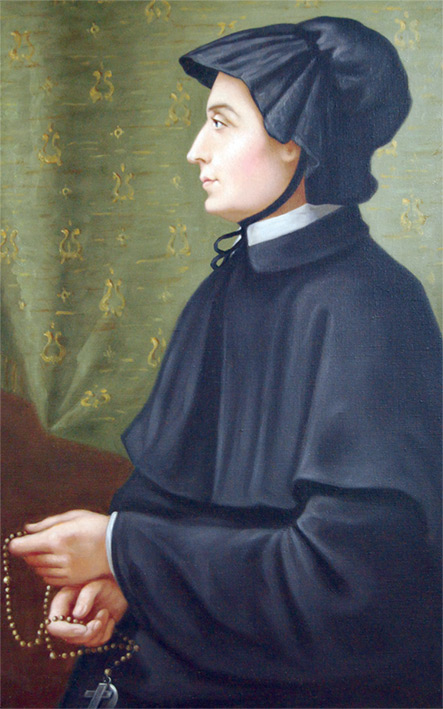
After a number of difficult years, Elizabeth moved in 1809 to Emmitsburg, Maryland, where she founded the Sisters of Charity of St. Joseph’s, the first community for religious women established in the United States. She also began St. Joseph’s Academy and Free School, planting the seeds of Catholic education in the United States. Her legacy now includes religious congregations in the United States and Canada, whose members work on the unmet needs of people living in poverty in North America and beyond.

Mother Seton, as she is often called, was canonized on Sunday, September 14, 1975 in St. Peter’s Square by Pope Paul VI. She was the first citizen born in the United States to be given the title of “Saint.” Her remains are entombed in Emmitsburg in the Basilica at the National Shrine that bears her name.

Download Her Biography (PDF)

You can learn how Elizabeth Ann Seton became a saint in our animated video, Betty Bayley Becomes A Saint, especially for children and teens.

Read some of her quotes and favorite prayers

Download a Student Learning Packet and even more educational resources about Mother Seton. View Helpful Resources

Saint Elizabeth Ann Seton

setonshrine.org
7 posted on 01/04/2025 7:16:23 AM PST by annalex (fear them not)
[ Post Reply | Private Reply | To 6 | View Replies]

To: annalex
NAVARRE BIBLE COMMENTARY (RSV)

Ad Majorem Dei Gloriam (To the Greater Glory of God)

First Reading:

From: 1 John 3:7-10

A Child of God Does Not Sin
---------------------------
[7] Little children, let no one deceive you. He who does right is righteous, as he is righteous. [8] He who commits sin is of the devil; for the devil has sinned from the beginning. The reason the Son of God appeared was to destroy the works of the devil. [9] No one born of God commits sin; for God's nature abides in him, and he cannot sin because he is born of God. [10] By this it may be seen who are the children of God, and who are the children of the devil: whoever does not do right is not of God, nor he who does not love his brother.

***********************************************************************
Commentary:

6-9. This passage acts as a preface to v. 10, where the Apostle spells out the criteria for distinguishing the children of God from the children of the devil--the practice of Christian virtues and the keeping of the commandments of God, especially that of brotherly love.

To understand correctly what St John is saying here, it is useful to remember his controversy with the false teachers (the Gnostics): these were trying to deceive the faithful (v. 7) and claimed to have a special knowledge of God (gnosis), which put them above good and evil, so that what the Church regarded as sin they saw as morally indifferent and as incapable of undermining the union with God they claimed they had.

To identify these heretics, the Apostle has recourse to words of our Lord: "the tree is known by its fruit" (Mt 12:33). Thus, the genuine Christian is recognized by deeds of righteousness (v. 7), that is, by keeping the commandments of God and leading a holy life. And the qualities essential to the Christian life are incompatible with sin; these qualities are--divine filiation ("he is born of God": v. 9), intimate union with Christ ("who abides in him": v. 6), and sanctifying grace, together with the infused virtues and the gifts of the Holy Spirit (this seems to be what the expression "God's nature abides in him" means: v. 9). Thus it is understandable that "No one who abides in him (Christ) sins" (v. 6).

In fact, as long as "God's nature abides in him...he cannot sin" (v. 9). Clearly St John does not mean that a Christian is incapable of sinning; at the start of the letter he said, "If we say we have no sin, we deceive ourselves" (1:8). What he wants to make quite clear is that no one can justify his own sin by the device of claiming to be a child of God: the righteousness of the children of God reflects itself in their actions, whereas "he who commits sin is of the devil" (v. 8), for sin cuts one off from God and means one has submitted to the slavery of the devil.

The ancient heresy has grown up again, in a way, in our own time: there are those who claim that union with God is not broken by transgression of commandments, even in grave matter, provided one does not withdraw one's "fundamental option" for God. Against this error, the Magisterium of the Church reminds us that "care must be taken not to reduce mortal sin to an act of 'fundamental option'--as is commonly said today--against God, intending thereby an explicit and formal contempt for God or neighbor. For mortal sin exists also when a person knowingly and willingly, for whatever reason chooses something gravely disordered. In fact, such a choice already includes contempt for the divine law, a rejection of God's love for humanity and the whole of creation: the person turns away from God and loses charity" ("Reconciliatio et Paenitentia", 17).

10. "Children of the devil": this is a common Semitic way of speaking meaning "the devil's supporters". In St John's writings we find references to "children of the devil" (cf. Jn 8:44; Acts 13:10) and to people who are "of the devil" (v. 8), and Judas is even called a "devil" (Jn 6:70; but he never uses an expression like "born of the devil". Therefore, the expressions "children of the devil" and "children of God" cannot be put on the same plane.

Also, "children of God" refers here primarily to the moral dimension of Christian life, as a description (the opposite of "the children of the devil") of those whose actions show they are on God's side. However, being children of God has a radically different meaning from being children of the devil, because it derives from something transcendental --God's causing the Christian to partake of his own divine nature through the life of grace (cf. 1 Jn 3:1-2 and notes on same).

The criteria for distinguishing the two groups mentioned are: the practice of righteousness, that is, striving for holiness and fighting against sin, reviewed in the previous section (vv. 3-9), and the practice of brotherly love, as we shall see in the next section (vv. 11-24).

8 posted on 01/04/2025 8:51:25 AM PST by fidelis (Ecce Crucem Domini! Fugite partes adversae! Vicit Leo de tribu Juda, Radix David! Alleluia!)
[ Post Reply | Private Reply | To 7 | View Replies]

Gospel Reading:

From: John 1:35-42

The Calling of the First Disciples
----------------------------------
[35] The next day again John was standing with two of his disciples; [36] and he looked at Jesus as He walked, and said, "Behold, the Lamb of God!" [37] The two disciples heard him say this, and they followed Jesus. [38] Jesus turned, and saw them following, and said to them, "What do you seek?" And they said to Him, "Rabbi" (which means Teacher), "where are You staying?" [39] He said to them, "Come and see." They came and saw where He was staying; and they stayed with Him that day, for it was about the tenth hour. [40] One of the two who heard John speak, and followed him, was Andrew, Simon Peter's brother. [41] He first found his brother Simon, and said to him, "We have found the Messiah' (which means Christ). [42] He brought him to Jesus. Jesus looked at him and said, "So you are Simon, the son of John? You shall be called Cephas" (which means Peter).

***********************************************************************
Commentary:

35-39. Through these words of the Baptist, these two disciples are moved by grace to approach the Lord. John's testimony is an example of the special graces God distributes to attract people to Himself. Sometimes He addresses a person directly by stirring his soul and inviting him to follow Him; at other times, as in the present case, He chooses to use someone close to us who knows us, to bring us to meet Christ.

The two disciples already had a keen desire to see the Messiah; John's words move them to try to become friends of our Lord: it is not merely natural curiosity but Christ's personality which attracts them. They want to get to know Him, to be taught by Him and to enjoy His company. "Come and see" (John 1:39; cf. 11:34)—a tender invitation to begin that intimate friendship they were seeking. Time and personal contact with Christ will be needed to make them more secure in their vocation. The Apostle St John, one of the protagonists in this scene, notes the exact time it took place: "it was about the tenth hour", roughly four in the afternoon.

Christian faith can never be just a matter of intellectual curiosity; it affects one's whole life: a person cannot understand it unless he really lives it; therefore, our Lord does not at this point tell them in detail about His way of life; He invites them to spend the day with Him. St Thomas Aquinas comments on this passage saying that our Lord speaks in a lofty, mystical way because what God is (in Himself or in grace) can only be understood through experience: words cannot describe it. We grow in this understanding by doing good works (they immediately accepted Christ's invitation and as a reward "they saw"), by recollection and by applying our mind to the contemplation of divine things, by desiring to taste the sweetness of God, by assiduous prayer. Our Lord invited everyone to do all this when He said, "Come and see", and the disciples discovered it all when, in obedience to our Lord, "they went" and were able to learn by personal experience, whereas they could not understand the words alone (cf. "Commentary on St John, in loc".).

40-41. The Evangelist now gives us the name of one of the two disciples involved in the previous scene; he will mention Andrew again in connection with the multiplication of the loaves (John 6:8) and the last Passover (John 12:22).

We cannot be absolutely sure who the second disciple was; but since the very earliest centuries of the Christian era he has always been taken to be the Evangelist himself. The vividness of the account, the detail of giving the exact time, and even John's tendency to remain anonymous (John 19:16; 20:2; 21:7,20) seem to confirm this.

"St John the Apostle, who pours into his narrative so much that is first-hand, tells of his first unforgettable conversations with Christ. `"Master where are you staying?" He said to them, "Come and see." They went and saw where He was staying; and they stayed with Him that day, for it was about the tenth hour.'

"This divine and human dialogue completely changed the life of John and Andrew, and Peter and James and so many others. It prepared their hearts to listen to the authoritative teaching which Jesus gave them beside the Sea of Galilee" (St J. Escriva, "Christ is Passing By", 108).

Those hours spent with our Lord soon produce the first results of apostolate. Andrew, unable to contain his joy, tells Simon Peter the news that he has found the Messiah, and brings him to Him. Now, as then, there is a pressing need to bring others to know the Lord.

"Open your own hearts to Jesus and tell Him your story. I don't want to generalize. But one day perhaps an ordinary Christian, just like you, opened your eyes to horizons both deep and new, yet as old as the Gospel. He suggested to you the prospect of following Christ earnestly, seriously, of becoming an apostle of apostles. Perhaps you lost your balance then and didn't recover it. Your complacency wasn't quite replaced by true peace until you freely said 'yes' to God, because you wanted to, which is the most supernatural of reasons. And in its wake came a strong, constant joy, which disappears only when you abandon Him" (St. J. Escriva, "Christ Is Passing By", 1).

42. What was it like when Jesus looked at someone? From what He says here, He seems both imperious and tender. On other occasions His glance is enough to invite a person to leave everything and follow Him, as in the case of Matthew (Matthew 9:9); or He seems to be full of love, as in His meeting with the rich young man (Mark 10:21), or He seems angry or sad, because of the Pharisees' unbelief (Mark 2:5), or compassionate, towards the widow of Nain (Luke 7:13). He is able to move Zacchaeus' heart to conversion (Luke 19:5); and He Himself is moved by the faith and generosity of the poor widow who gave in alms everything she had (Mark 12:41-44). His penetrating look seems to lay the soul bare to God and provoke one to self-examination and contrition--as happened to the adulterous woman (John 8:10) and to Peter who, after denying Christ (Luke 22:61) wept bitterly (Mark 14:72).

"You shall be called Cephas": naming something is the same as taking possession of the thing named (cf. Genesis 17:5; 22:28; 32:28; Isaiah 62:2). Thus, for example, Adam when he was made lord of creation, gave names to creating things (Genesis 2:20). "Cephas" is the Greek transcription of an Aramaic word meaning stone, rock: therefore, St. John, writing in Greek, has to explain the meaning of the word Jesus used. Cephas was not a proper name, but our Lord put it on Peter to indicate his role as His vicar, which He will later on reveal (Matthew 16:16-18): Simon was destined to be the stone, the rock, of the Church.

The first Christians regarded this new name as so significant that they used it without translating it (cf. Galatians 2:9, 11, 14); later its translation "Peter" (Petros, Petrus) became current, pushing the Apostle's old name--Simon--into the background.

"Son of John": ancient manuscripts include variants, such as "son of Jona".

9 posted on 01/04/2025 8:51:45 AM PST by fidelis (Ecce Crucem Domini! Fugite partes adversae! Vicit Leo de tribu Juda, Radix David! Alleluia!)
[ Post Reply | Private Reply | To 8 | View Replies]

Click here to go to the My Catholic Life! Devotional thread for a meditation on today’s Gospel Reading.

10 posted on 01/04/2025 8:52:54 AM PST by fidelis (Ecce Crucem Domini! Fugite partes adversae! Vicit Leo de tribu Juda, Radix David! Alleluia!)
[ Post Reply | Private Reply | To 9 | View Replies]

Disclaimer: Opinions posted on Free Republic are those of the individual posters and do not necessarily represent the opinion of Free Republic or its management. All materials posted herein are protected by copyright law and the exemption for fair use of copyrighted works.

Free Republic
Browse · Search
Religion
Topics · Post Article

FreeRepublic, LLC, PO BOX 9771, FRESNO, CA 93794
FreeRepublic.com is powered by software copyright 2000-2008 John Robinson