Free Republic
Browse · Search
Religion
Topics · Post Article

Skip to comments.

Catholic Caucus: Daily Mass Readings 23-December-2024
Universalis/Jerusalem Bible ^

Posted on 12/23/2024 4:34:58 AM PST by annalex

Monday 23 December 2024

23 December
(optional commemoration of Saint John of Kęty, Priest)


St. John Cantius Church, Chicago

Readings at Mass

Liturgical Colour: Violet. Year: C(I).


First reading
Malachi 3:1-4,23-24

Before my day comes, I will send you Elijah my prophet

The Lord God says this: Look, I am going to send my messenger to prepare a way before me. And the Lord you are seeking will suddenly enter his Temple; and the angel of the covenant whom you are longing for, yes, he is coming, says the Lord of Hosts. Who will be able to resist the day of his coming? Who will remain standing when he appears? For he is like the refiner’s fire and the fullers’ alkali. He will take his seat as refiner and purifier; he will purify the sons of Levi and refine them like gold and silver, and then they will make the offering to the Lord as it should be made. The offering of Judah and Jerusalem will then be welcomed by the Lord as in former days, as in the years of old.
  Know that I am going to send you Elijah the prophet before my day comes, that great and terrible day. He shall turn the hearts of fathers towards their children and the hearts of children towards their fathers, lest I come and strike the land with a curse.

Responsorial Psalm
Psalm 24(25):4-5,8-9,10,14
Stand erect, hold your heads high, because your liberation is near at hand.
Lord, make me know your ways.
  Lord, teach me your paths.
Make me walk in your truth, and teach me:
  for you are God my saviour.
Stand erect, hold your heads high, because your liberation is near at hand.
The Lord is good and upright.
  He shows the path to those who stray,
He guides the humble in the right path,
  He teaches his way to the poor.
Stand erect, hold your heads high, because your liberation is near at hand.
His ways are faithfulness and love
  for those who keep his covenant and law.
The Lord’s friendship is for those who revere him;
  to them he reveals his covenant.
Stand erect, hold your heads high, because your liberation is near at hand.

Gospel Acclamation
Alleluia, alleluia!
King of the peoples
  and cornerstone of the Church,
come and save man,
  whom you made from the dust of the earth.
Alleluia!

GospelLuke 1:57-66

'His name is John'

The time came for Elizabeth to have her child, and she gave birth to a son; and when her neighbours and relations heard that the Lord had shown her so great a kindness, they shared her joy.
  Now on the eighth day they came to circumcise the child; they were going to call him Zechariah after his father, but his mother spoke up. ‘No,’ she said ‘he is to be called John.’ They said to her, ‘But no one in your family has that name’, and made signs to his father to find out what he wanted him called. The father asked for a writing-tablet and wrote, ‘His name is John.’ And they were all astonished. At that instant his power of speech returned and he spoke and praised God. All their neighbours were filled with awe and the whole affair was talked about throughout the hill country of Judaea. All those who heard of it treasured it in their hearts. ‘What will this child turn out to be?’ they wondered. And indeed the hand of the Lord was with him.

Nothing has changed

In England, Wales and Scotland, the translation of the readings used at Mass has changed. Your current calendar setting is “United States”, so you have not been affected by this change.
This message will disappear at the end of December.

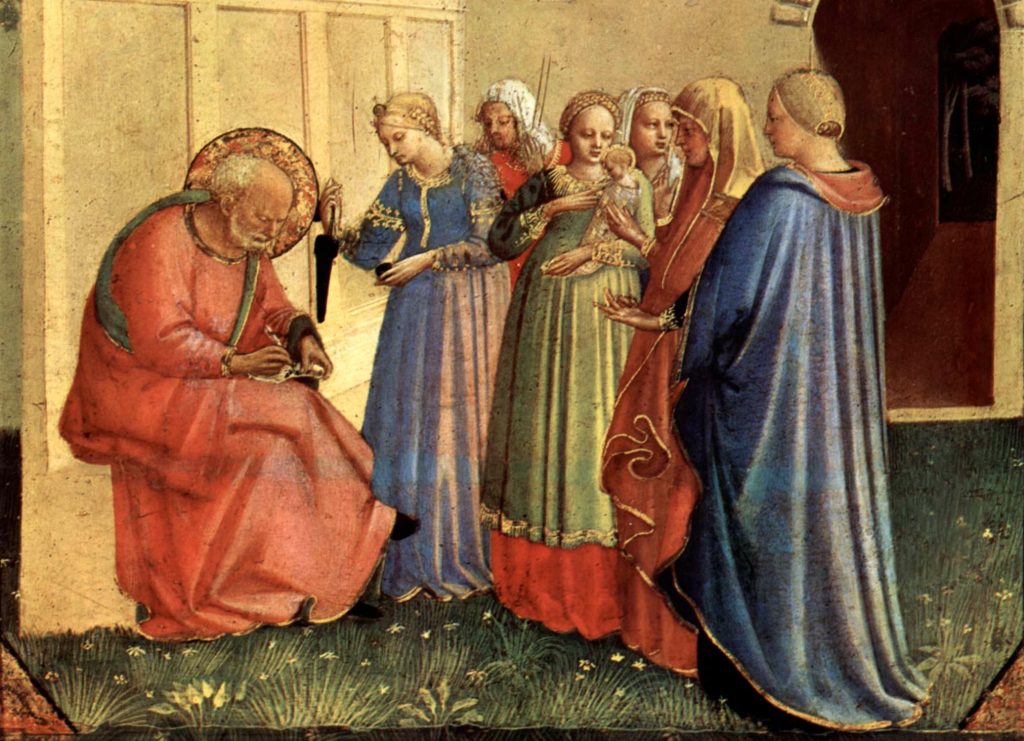
Christian Art

Illustration

Each day, The Christian Art website gives a picture and reflection on the Gospel of the day.

The readings on this page are from the Jerusalem Bible, which is used at Mass in most of the English-speaking world. The New American Bible readings, which are used at Mass in the United States, are available in the Universalis apps, programs and downloads.

You can also view this page with the Gospel in Greek and English.


TOPICS: Catholic; General Discusssion; Prayer; Worship
KEYWORDS: advent; catholic; lk1; prayer
For your reading, reflection, faith-sharing, comments, questions, discussion.

1 posted on 12/23/2024 4:34:58 AM PST by annalex
[ Post Reply | Private Reply | View Replies]

To: All

KEYWORDS: advent; catholic; lk1; prayer;


2 posted on 12/23/2024 4:35:29 AM PST by annalex (fear them not)
[ Post Reply | Private Reply | To 1 | View Replies]

To: nickcarraway; NYer; ELS; Pyro7480; livius; ArrogantBustard; Catholicguy; RobbyS; marshmallow; ...

Alleluia Ping

Please FReepmail me to get on/off the Alleluia Ping List.


3 posted on 12/23/2024 4:36:42 AM PST by annalex (fear them not)
[ Post Reply | Private Reply | To 2 | View Replies]

To: annalex
My dad is back in the hospital. [JimRob update at 242]
Jim still needs our prayers. Thread 2
Prayer thread for Salvation's recovery
Pray for Ukraine
Prayer thread for Fidelis' recovery
Update on Jim Robinson's health issues
4 posted on 12/23/2024 4:37:00 AM PST by annalex (fear them not)
[ Post Reply | Private Reply | To 3 | View Replies]

To: annalex
Luke
 English: Douay-RheimsLatin: Nova VulgataGreek NT: Byzantine/Majority Text (2000)
 Luke 1
57Now Elizabeth's full time of being delivered was come, and she brought forth a son. Elisabeth autem impletum est tempus pariendi, et peperit filium. τη δε ελισαβετ επλησθη ο χρονος του τεκειν αυτην και εγεννησεν υιον
58And her neighbours and kinsfolks heard that the Lord had shewed his great mercy towards her, and they congratulated with her. Et audierunt vicini et cognati eius quia magnificavit Dominus misericordiam suam cum illa, et congratulabantur ei. και ηκουσαν οι περιοικοι και οι συγγενεις αυτης οτι εμεγαλυνεν κυριος το ελεος αυτου μετ αυτης και συνεχαιρον αυτη
59And it came to pass, that on the eighth day they came to circumcise the child, and they called him by his father's name Zachary. Et factum est, in die octavo venerunt circumcidere puerum et vocabant eum nomine patris eius, Zachariam. και εγενετο εν τη ογδοη ημερα ηλθον περιτεμειν το παιδιον και εκαλουν αυτο επι τω ονοματι του πατρος αυτου ζαχαριαν
60And his mother answering, said: Not so; but he shall be called John. Et respondens mater eius dixit: “ Nequaquam, sed vocabitur Ioannes ”. και αποκριθεισα η μητηρ αυτου ειπεν ουχι αλλα κληθησεται ιωαννης
61And they said to her: There is none of thy kindred that is called by this name. Et dixerunt ad illam: “ Nemo est in cognatione tua, qui vocetur hoc nomine ”. και ειπον προς αυτην οτι ουδεις εστιν εν τη συγγενεια σου ος καλειται τω ονοματι τουτω
62And they made signs to his father, how he would have him called. Innuebant autem patri eius quem vellet vocari eum. ενενευον δε τω πατρι αυτου το τι αν θελοι καλεισθαι αυτον
63And demanding a writing table, he wrote, saying: John is his name. And they all wondered. Et postulans pugillarem scripsit dicens: “ Ioannes est nomen eius ”. Et mirati sunt universi. και αιτησας πινακιδιον εγραψεν λεγων ιωαννης εστιν το ονομα αυτου και εθαυμασαν παντες
64And immediately his mouth was opened, and his tongue loosed, and he spoke, blessing God. Apertum est autem ilico os eius et lingua eius, et loquebatur benedicens Deum. ανεωχθη δε το στομα αυτου παραχρημα και η γλωσσα αυτου και ελαλει ευλογων τον θεον
65And fear came upon all their neighbours; and all these things were noised abroad over all the hill country of Judea. Et factus est timor super omnes vicinos eorum, et super omnia montana Iudaeae divulgabantur omnia verba haec. και εγενετο επι παντας φοβος τους περιοικουντας αυτους και εν ολη τη ορεινη της ιουδαιας διελαλειτο παντα τα ρηματα ταυτα
66And all they that had heard them laid them up in their heart, saying: What an one, think ye, shall this child be? For the hand of the Lord was with him. Et posuerunt omnes, qui audierant, in corde suo dicentes: “ Quid putas puer iste erit? ”. Etenim manus Domini erat cum illo.και εθεντο παντες οι ακουσαντες εν τη καρδια αυτων λεγοντες τι αρα το παιδιον τουτο εσται και χειρ κυριου ην μετ αυτου

5 posted on 12/23/2024 4:39:36 AM PST by annalex (fear them not)
[ Post Reply | Private Reply | To 1 | View Replies]

To: annalex

Catena Aurea by St. Thomas Aguinas

1:57–58

57. Now Elisabeth’s full time came that she should be delivered; and she brought forth a son.

58. And her neighbours and her cousins heard how the Lord had shewed great mercy upon her; and they rejoiced with her.

AMBROSE. If you carefully observe, you will find that the word signifying fulness is no where used except at the birth of the righteous. Hence it is said, Now Elisabeth’s full time came. For the life of the righteous hath fulness, but the days of the wicked are empty.

CHRYSOSTOM. And for that reason the Lord kept back the delivery of Elisabeth, that her joy might be increased, and her fame the greater. Hence it follows, And her neighbours and cousins heard, &c. For they who had known her barrenness were made the witnesses of the Divine grace, and no one seeing the child departed in silence, but gave praise to God, Who had vouchsafed him beyond their expectation.

AMBROSE. For the bringing forth of saints causes the rejoicing of many; it is a common blessing; for justice is a public virtue, and therefore at the birth of a just man a sign of his future life is sent beforehand, and the grace of the virtue which is to follow is represented, being foreshadowed by the rejoicing of the neighbours.

1:59–64

59. And it came to pass, that on the eighth day they came to circumcise the child; and they called him Zacharias, after the name of his father.

60. And his mother answered and said, Not so; but he shall be called John.

61. And they said unto her, There is none of thy kindred that is called by this name.

62. And they made signs to his father, how he would have him called.

63. And he asked for a writing table, and wrote, saying, His name is John. And they marvelled all.

64. And his mouth was opened immediately, and his tongue loosed, and he spake, and praised God.

CHRYSOSTOM. (in Gen. Hom. 39.) The rite of circumcision was first delivered to Abraham as a sign of distinction, that the race of the Patriarch might be preserved in unmixed purity, and so might be able to obtain the promises. But now that the promise of the covenant is fulfilled, the sign attached to it is removed. So then through Christ circumcision ceased, and baptism came in its place; but first it was right that John should be circumcised; as it is said, And it came to pass, that on the eighth day, &c. For the Lord had said, Let the child of eight days be circumcised among you. (Gen. 17:13.) But this measurement of time I conceive was ordered by Divine mercy for two reasons. First, because in its most tender years the child the more easily bears the cutting of the flesh. Secondly, that from the very operation itself we might be reminded that it was done for a sign; for the young child scarcely distinguishes any of the things that are around him. But after the circumcision, the name was conferred, as it follows, And they called him. But this was done because we must first receive the seal of the Lord, then the name of man. Or, because no man except he first cast aside his fleshly lusts, which circumcision signifies, is worthy to have his name written in the book of life.

AMBROSE. The holy Evangelist has especially remarked, that many thought the child should be called after his father Zacharias, in order that we might understand, not that any name of his kinsfolk was displeasing to his mother, but that the same word had been communicated to her by the Holy Spirit, which had been foretold by the Angel to Zacharias. And in truth, being dumb, Zacharias was unable to mention his son’s name to his wife, but Elisabeth obtained by prophecy what she had not learnt from her husband. Hence it follows, And she answered, &c. Marvel not that the woman pronounced the name which she had never heard, seeing the Holy Spirit who imparted it to the Angel revealed it to her; nor could she be ignorant of the forerunner of the Lord, who had prophesied of Christ. And it well follows, And they said unto her, &c. that you might consider that the name belongs not to the family, but to the Prophet. Zacharias also is questioned, and signs made to him, as it follows, And they made signs to the father, &c. But since unbelief had so bereft him of utterance and hearing, that he could not use his voice, he spoke by his hand-writing, as it follows, And he asked for a writing table, and wrote, saying, His name is John; that is, we give no name to him who has received his name from God.

ORIGEN. (non occ.) Zacharias is by interpretation “remembering God,” but John signifies “pointing to.” Now “memory” relates to something absent, “pointing to,” to something present. But John was not about to set forth the memory of God as absent, but with his finger to point him out as present, saying, Behold the Lamb of God.

CHRYSOSTOM. But the name John is also interpreted the grace of God. Because then by the favour of Divine grace, not by nature, Elisabeth conceived this son, they engraved the memory of the benefit on the name of the child.

THEOPHYLACT. And because with the mother the dumb father also agreed as to the name of the child, it follows, And they all marvelled. For there was no one of this name among their kinsfolk that any one could say that they had both previously determined upon it.

GREGORY NAZIANZEN. (Orat. vi.) The birth of John then broke the silence of Zacharias, as it follows, And his mouth was opened. For it were unreasonable when the voice of the Word had come forth, that his father should remain speechless.

AMBROSE. Rightly also, from that moment was his tongue loosed, for that which unbelief had bound, faith set free. Let us then also believe, in order that our tongue, which has been bound by the chains of unbelief, may be loosed by the voice of reason. Let us write mysteries by the Spirit if we wish to speak. Let us write the forerunner of Christ, not on tables of stone, but on the fleshly tablets of the heart. For he who names John, prophesies Christ. For it follows, And he spake, giving thanks.

BEDE. Now in an allegory, the celebration of John’s birth was the beginning of the grace of the New Covenant. His neighbours and kinsfolk had rather give him the name of his father than that of John. For the Jews, who by the observance of the Law were united to him as it were by ties of kindred, chose rather to follow the righteousness which is of the Law, than receive the grace of faith. But the name of John, (i. e. the grace of God,) his mother in word, his father in writing, suffice to announce, for both the Law itself as well as the Psalms and the Prophecies, in the plainest language foretel the grace of Christ; and that ancient priesthood, by the foreshadowing of its ceremonies and sacrifices, bears testimony to the same. And well doth Zacharias speak on the eighth day of the birth of his child, for by the resurrection of the Lord, which took place on the eighth day, i. e. the day after the sabbath, (septimam sabbati.) the hidden secrets of the legal priesthood were revealed.

1:65–66

65. And fear came on all that dwelt round about them: and all these sayings were noised abroad throughout all the hill country of Judæa.

66. And all they that heard them laid them up in their hearts, saying, What manner of child shall this be! And the hand of the Lord was with him.

THEOPHYLACT. As at the silence of Zacharias the people marvelled, so likewise when he spoke. Hence it is said, And fear came upon all; that from these two circumstances all might believe there was something great in the child that was born. But all these things were ordained, to the end that he who was to bear witness of Christ might also be esteemed trustworthy. Hence it follows, And all they that heard them laid them up in their heart, saying, What manner of child, &c.

BEDE. For forerunning signs prepare the way for the forerunner of the truth, and the future prophet is recommended by auspices sent before him; hence it follows, For the hand of the Lord was with him.

GREEK EXPOSITOR. (Metaphrastes.) For God worked miracles in John which he did not himself, but the right hand of God in him.

GLOSS. (ordin.) But mystically, at the time of our Lord’s resurrection, by the preaching of the grace of Christ, a wholesome dread shook the hearts not only of the Jews, (who were neighbours, either from the place of their dwelling, or from the knowledge of the law,) but of the foreign nations also. The name of Christ surmounts not only the hilly country of Judæa, but all the heights of worldly dominion and wisdom.

Catena Aurea Luke 1


6 posted on 12/23/2024 4:41:19 AM PST by annalex (fear them not)
[ Post Reply | Private Reply | To 5 | View Replies]

To: annalex


Scenes from the Life of St John the Baptist: 2. Birth and Naming of the Baptist

Giotto di Bondone

1320
Fresco, 280 x 450 cm
Peruzzi Chapel, Santa Croce, Florence

7 posted on 12/23/2024 4:41:39 AM PST by annalex (fear them not)
[ Post Reply | Private Reply | To 6 | View Replies]

To: annalex
About our Patron Saint
grape-band-brown.png

St. John of Kenty

Patron Saint of Teachers, Students, Priests and Pilgrims

To most Catholics in this country, St. John from Kenty—otherwise known as John Kanty or John Cantius—is an obscure saint, and, even in Europe, few people probably know of Pope John Paul II’s deep and lifelong devotion to this professor saint.

Only thirteen miles from the Holy Father’s own birthplace, John was born in the small southern Polish town of Kenty on June 24, 1390. At the age of 23, he registered for studies at the Jagiellonian University, located in the not too distant city of Krakow—then, the capital of the Polish Kingdom. Founded in 1364 by royal decree, it was the same university at which astronomer, Nicolas Copernicus, would study almost 80 years later.

Enrolled in the Department of Liberal Arts, John became a doctor of philosophy in 1418. During the following three years, he undertook further studies in preparation for the priesthood, while supporting himself by conducting philosophy classes at the university.

Immediately following ordination, he accepted a position as rector at the prestigious school of the Canons Regular of the Most Holy Sepulcher in Miechow. That such a school would offer him this position at his relatively young age was evidence of John’s exceptional intellect and talents. It was there in conducting formation classes for the young novices that he became firmly grounded in the writings and spirituality of St. Augustine.

In 1429, a position became vacant in the Philosophy Department at the Jagiellonian University. John quickly returned to Krakow for the opportunity, taking up residence at the university where he remained until his death. He also began studies in theology and, after 13 long years of study intertwined with teaching and administrative duties as head of the Philosophy Department, he finally received his doctorate. Later, after the death of his mentor, the eminent theologian Benedykt Hesse, John assumed directorship of the university’s Theology Department.

As most learned men of his day, John spent many of his free hours hand-copying manuscripts of the Holy Scriptures, theological tracts, and other scholarly works. Although only 26 volumes have survived to our time, their total of over 18,000 pages is a testament to his exceptional industriousness.

During the course of his life in Krakow, John became well known among the city’s residents for his generosity and compassion toward the poor, always sacrificing his own needs in order to help those less fortunate. He felt a special affinity toward needy students at the university, helping to care for their spiritual, physical, and academic needs, whether it was in the classroom or from the pulpit, everyone knew him as a staunch defender of the faith and enemy of heretics.

By the time the Master from Kenty died on December 24, 1473, the people of Krakow already considered him a very holy man. That this opinion was wholly justified can be evidenced by the numerous favors and miracles attributed to John’s intercession, beginning immediately following his death. Before long, John from Kenty became known widely throughout Europe, drawing pilgrims from many countries to his tomb in the university’s Collegiate Church of St. Anne.

Despite this, the process for his beatification did not begin until 150 years later. Finally, in 1676, Pope Clement XIII declared him a saint of the Roman Catholic Church, proclaiming October 20 as his feast day.

Throughout his many years in Krakow, our philosopher Pontiff, St. John Paul II drew much inspiration at the grave of his patron saint of learning. It was no surprise, therefore, that during his 1997 pilgrimage to Poland, he once more prayed at the saint’s tomb. There, during a special gathering with professors from the Jagiellonian University (both his and St. John’s alma mater), he alluded to the Master from Kenty when he stated the saint’s life exemplified what emerges when “knowledge and wisdom seek a covenant with holiness.”

cross-divider.png

TIMES NOT UNLIKE OUR OWN

Taken from Society of St. John Cantius newsletter Via Sacra, Vol.1, Issue 2, May 25, 1999

St. John from Kenty, patron of our religious community, lived in times not unlike our own. Although not as intense as the cultural crisis of the late twentieth century, his time was nonetheless a period of tension and sweeping change. As for us, it was a time of crisis as well as reform in the realms of culture, politics, and religion.

In Europe of the fifteenth century, the Church was still reeling from the effects of the western schism. The emergence of antipopes divided the allegiances of Catholics. Criticism of Church authority led to the support of conciliarism, which asserted that the only solution to the Church’s problems was submission of the Pope to the authority of Church councils.

Many philosophers wished to separate the Church from the realm of learning, some mystics wished to separate piety from a search for the truth, Hussite heretics wished to detach the Church from all temporal matters, and academics defended the rights of pagans and schismatics under the banner of freedom of conscience. The similarity to our time is uncanny.

However, even amidst such sentiments among many of his colleagues at the Krakovian Academy, St. John from Kenty stood firm in his loyalty to the Roman Pontiff and the timeless teachings of the Church.

Despite the turmoil, it was also a period of renewal within the Church. St. John stood out as one of a number of mystics in fifteenth-century Krakow who were influenced by devotio moderna—a contemporary Dutch movement, which encouraged lay people to a life of individual piety through reflection on the Gospels, personal consecration, and works of mercy. It also promoted a renewed devotion to the Eucharist through the practice - considered revolutionary for the time - of frequent reception of Confession and Holy Communion.

The influence of this movement on the Master from Kenty may explain why, among the numerous manuscripts produced by this seasoned scholar, we find no great theological or mystical treatises. One trait characteristic of devotio moderna was that it did not encourage the writing of such works, as was popular in that day. It called rather for a humble silence and renunciation of the unnecessary praise from others, that such works would have entailed.

What the Master from Kenty did leave us, however, were many volumes of transcribed manuscripts, as well as practical commentaries on morality and faith.

St. John from Kenty didn’t found a school of mysticism or live in a monastery, but in a manner unique for his day, he demonstrated how one could live the Gospels in everyday life through service to the Church and one’s fellow man. He drew constant inspiration from a deep devotion to Christ’s Passion and a profound love of our Savior’s Blessed Mother.

So exemplary was he, that two centuries later, Pope Clement XIII wrote for his canonization that the saint from Kenty “belonged to a group of outstanding men, distinguished by knowledge and holiness, who both taught and put into practice, as well as defended, the true faith which was under attack by its enemies.”


cantius.org
8 posted on 12/23/2024 4:48:14 AM PST by annalex (fear them not)
[ Post Reply | Private Reply | To 7 | View Replies]

To: annalex

9 posted on 12/23/2024 4:50:04 AM PST by annalex (fear them not)
[ Post Reply | Private Reply | To 8 | View Replies]

To: annalex
NAVARRE BIBLE COMMENTARY (RSV)

Ad Majorem Dei Gloriam (To the Greater Glory of God)

First Reading:

From: Malachi 3:1-4; 4:5-6 RSVCE (3:1-4; 23-24 – NABRE)

Shortcoming of Priests (Continuation)
-------------------------------------
(The oracle of the word of the LORD to Israel by Malachi.)
[1] “Behold, I send my messenger to prepare the way before me, and the Lord whom you seek will suddenly come to his temple; the messenger of the covenant in whom you delight, behold, he is coming, says the LORD of hosts. [2] But who can endure the day of his coming, and who can stand when he appears?

“For he is like a refiner’s fire and like fullers’ soap; [3] he will sit as a refiner and purifier of silver, and he will purify the sons of Levi and refine them like gold and silver, till they present right offerings to the LORD. [4] Then the offering of Judah and Jerusalem will be pleasing to the LORD as in the days of old and as in former years."

[4:5] "Behold, I will send you Elijah the prophet before the great and terrible day of the LORD comes. [6] And he will turn the hearts of fathers to their children and the hearts of children to their fathers, lest I come and smite the land with a curse."

***********************************************************************
Commentary:

2:17-3:5. As at the start of the book, the question raised here is a fairly general one: What is the point of keeping the Law if those who do evil are the ones who have success in life? The question focuses on rewards in this life only (cf. 2:17), but the prophet’s reply extends beyond that: he announces a day of judgment when priests and ritual will be purified (3:3-4) and the oppressed will receive justice (3:5); on the day of the Lord, God will set everything right.

However, the force of the oracle lies not so much in the fact of divine judgment as in the mysterious way in which that day is announced (3:1-2). We are told that the Lord of hosts himself will come to His temple, and his coming will strike fear into the hearts of men. The passage, in fact, seems to be speaking about three different personages--the messenger who will precede the coming of the Lord and who later on, in the epilogue, is identified as the prophet Elijah (cf. 4:5); the Lord himself; and the angel (literally the “messenger”) of the Covenant (3:1). In mentioning the first (the messenger who prepares the way: 3:1) the prophet may have in mind the sort of protocol used by kings who had a herald announce their arrival. This personage’s role is similar to that described in Isaiah 40:3ff. However, a little further on there is the “messenger of the covenant”. It is not clear what this means; it could be the Lord himself; a further messenger, whose role is similar to that of Moses, that is, a mediator of the Covenant; or, finally, the messenger mentioned earlier, the herald, who is now being given a new role. No clear interpretation can be established beyond doubt.

The New Testament will resolve this question of interpretation. The Synoptic Gospels (cf. Mk 1:2) and Jesus himself (Mt 11:7-15; cf. Lk 7:24-30) identify the first messenger, the one who prepares the way, with Elijah, and sees his fulfillment in the person of John the Baptist. This makes Jesus the Lord who comes to his temple. The Church reads it that way when the liturgy of the feast of the Presentation of Jesus in the Temple (cf. Lk 2:22-40) includes Malachi 3:1-4 as a first reading. But as can be seen from many passages of the New Testament (for example, the episode of the Transfiguration: Mt 17:1-13 and par.), Jesus is also the mediator of the New Covenant.

In the tradition of the Church, the ambiguity here is seen as a way of indicating the two-fold coming of the Lord-in the humility of the flesh, and in the glory and splendor of the End: “We proclaim the coming of Christ: he comes not once, but twice, and the second coming will be more glorious than the first. The first was a time of suffering; in the second, however, he will wear the crown of divine kingship. Almost everything in the life our Lord Jesus Christ has two meanings. He was born twice: once, of the Father, from all eternity; and then, of the Virgin, in the fullness of time. He comes twice, too: he came first in silence, like rain falling on wool; and he will come again in glory. First, he was wrapped in swaddling clothes and laid in a manger; when he comes again, he will be robed in light. First, he shouldered the cross, without fear of suffering; when he comes again, he will come in glory, surrounded by the hosts of angels. Let us consider not only the life of the Lord, but also his future coming [...]. Because of his great mercy, he was made man to teach men and persuade them; when he comes again, all men, whether they want to or not, will be made subject to the power and authority of the King. The words of the prophet Malachy refer to both of these events” (St Cyril of Jerusalem, "Catecheses Ad Illuminandos", 15, 1-2).

10 posted on 12/23/2024 7:16:33 AM PST by fidelis (Ecce Crucem Domini! Fugite partes adversae! Vicit Leo de tribu Juda, Radix David! Alleluia!)
[ Post Reply | Private Reply | To 9 | View Replies]

Gospel Reading:

From: Luke 1:57-80

The Birth and Circumcision of John the Baptist
-----------------------------------------------------------
[57] Now the time came for Elizabeth to be delivered, and she gave birth to a son. [58] And her neighbors and kinsfolk heard that the Lord had shown great mercy to her, and they rejoiced with her. [59] And on the eighth day they came to circumcise the child; and they would have named him Zechariah after his father, [60] but his mother said, "Not so; he shall be called John." [61] And they said to her, "None of your kindred is called by this name." [62] And they made signs to his father, inquiring what he would have him called. [63] And he asked for a writing tablet, and wrote, "His name is John." And they all marvelled. [64] And immediately his mouth was opened and his tongue loosed, and he spoke, blessing God. [65] And fear came on all their neighbors. And all these things were talked about through all the hill country of Judea; [66] and all who heard them laid them up in their hearts, saying "What then will this child be?" For the hand of the Lord was with him.

[67] And his father Zechariah was filled with the Holy Spirit, and prophesied, saying, [68] "Blessed be the Lord God of Israel, for he has visited and redeemed his people, [69] and has raised up a horn of salvation for us in the house of his servant David, [70] as he spoke by the mouth of his holy prophets from of old, [71] that we should be saved from our enemies, and from the hand of all who hate us; [72] to perform the mercy promised to our fathers, and to remember his holy covenant, [73] the oath which he swore to our father Abraham, [74] to grant us that we, being delivered from the hand of our enemies, might serve him without fear, [75] in holiness and righteousness before him all the days of our life. [76] And you, child, will be called the prophet of the Most High; for you will go before the Lord to prepare his ways, [77] to give knowledge of salvation to his people in the forgiveness of their sins, [78] through the tender mercy of our God, when the day shall dawn upon us from on high [79] to give light to those who sit in darkness and in the shadow of death, to guide our feet into the way of peace."

[80] And the child grew and became strong in spirit, and he was in the wilderness till the day of his manifestation to Israel.

***********************************************************************
Commentary:

59. Circumcision was a rite established by God under the Old Covenant to mark out those who belonged to His chosen people: He commanded Abraham to institute circumcision as a sign of the Covenant He had made with him and all his descendants (cf. Genesis 17:10-14), prescribing that it should be done on the eighth day after birth. The rite was performed either at home or in the synagogue, and, in addition to the actual circumcision, the ceremony included prayers and the naming of the child.

With the institution of Christian Baptism the commandment to circumcise ceased to apply. At the Council of Jerusalem (cf. Acts 15:1ff), the Apostles definitely declared that those entering the Church had no need to be circumcised.

St. Paul's explicit teaching on the irrelevance of circumcision in the context of the New Alliance established by Christ is to be found in Galatians 5:2ff; 6:12ff; and Colossians 2:11ff.

60-63. By naming the child John, Zechariah complies with the instructions God sent him through the angel (Luke 1:13).

64. This miraculous event fulfills the prophecy the angel Gabriel made to Zechariah when he announced the conception and birth of the Baptist (Luke 1:19-20). St. Ambrose observes: `With good reason was his tongue loosed, because faith untied what had been tied by disbelief" ("Expositio Evangelii Sec. Lucam. in loc.").

Zechariah's is a case similar to that of St. Thomas, who was reluctant to believe in the resurrection of our Lord, and who believed only when Jesus gave him clear proof (cf. John 20:24-29). For these two men God worked a miracle and won their belief; but normally He requires us to have faith and to obey Him without His working any new miracles. This was why He upbraided Zechariah and punished him, and why He reproached Thomas: "Have you believed because you have seen Me? Blessed are those who have not seen and yet believe" (John 20:29).

67. Zechariah, who was a righteous man (cf. v. 6), received the special grace of prophecy when his son was born--a gift which led him to pronounce his canticle, called the "Benedictus", a prayer so full of faith, reverence and piety that the Church has laid it down to be said daily in the Liturgy of the Hours. Prophecy has not only to do with foretelling future events; it also means being moved by the Holy Spirit to praise God. Both aspects of prophecy are to be found in the "Benedictus".

68- 79. Two parts can be discerned in the "Benedictus": in the first (vv. 68-75) Zechariah thanks God for sending the Messiah, the Savior, as he promised the patriarchs and prophets of Israel.

In the second (vv. 76-79) he prophesies that his son will have the mission of being herald of the Most High and precursor of the Messiah, proclaiming God's mercy which reveals itself in the coming of Christ.

72-75. Again and again God promised the patriarchs of the Old Testament that he would take special care of Israel, giving them a land which they would enjoy undisturbed and many descendants in whom all the peoples of the earth would be blessed. This promise he ratified by means of a covenant or alliance, of the kind commonly made between kings and their vassals in the Near East. God, as Lord, would protect the patriarchs and their descendants, and these would prove their attachment to him by offering him certain sacrifices and by doing him service. See, for example, Genesis 12:13; 17:1-8; 22:16-18 (God's promise, covenant and pledge to Abraham); and Genesis 5:11-12 (where he repeats these promises to Jacob). Zechariah realizes that the events resulting from the birth of John his son, the Precursor of the Messiah; constitute complete fulfillment of these divine purposes.

78-79. The "dawning", the "dayspring", is the Messiah, Jesus Christ, coming down from heaven to shed his light upon us: "the son of righteousness shall rise, with healing on its wings" (Mal 4:2). Already in the Old Testament we were told about the glory of the Lord, the reflection of his presence--something intimately connected with light. For example, when Moses returned to the encampment after talking with God, his face so shone that the Israelites "were afraid to come near him" (Ex 34:30). St John is making the same reference when he says that "God is light and in him there is no darkness" (1 Jn 1:5) and that there will be no light in heaven "for the glory of God is its light" (cf. Rev 21:23; 22:5).

The angels (cf. Rev 1:11) and the saints (cf. Wis 3:7; Dan 2:3) partake of this divine splendor; our Lady does so in a special way. As a symbol of the Church she is revealed to us in the Apocalypse as "clothed with the sun, with the moon under her feel, and on her head a crown of twelve stars" (12:1).

Even when we live in this world, this divine light reaches us through Jesus Christ who, because he is God, is "the true light that enlightens every man" (Jn 1:9), as Christ himself tells us: "I am the light of the world; he who follows me will not walk in darkness" (Jn 8:12).

Such is Christians' share in this light of God that Jesus tells us: "You are the light of the world" (Mt 5:14). Therefore, we must live as children of the light (cf. Lk 16:8), whose fruit takes the form of "all that is good and right and true" (Eph 5:9); our lives should shine out, thereby helping people to know God and give him glory (cf. Mt 5:16).

80. "Wilderness": this must surely refer to the "Judean wilderness" which stretches from the northwestern shores of the Dead Sea to the hill country of Judea. It is not a sand desert but rather a barren steppe with bushes and basic vegetation which suit bees and grasshoppers or wild locusts. It contains many caves which can provide shelter.

11 posted on 12/23/2024 7:17:18 AM PST by fidelis (Ecce Crucem Domini! Fugite partes adversae! Vicit Leo de tribu Juda, Radix David! Alleluia!)
[ Post Reply | Private Reply | To 10 | View Replies]

Click here to go to the My Catholic Life! Devotional thread for a meditation on today’s Gospel Reading.

12 posted on 12/23/2024 7:18:40 AM PST by fidelis (Ecce Crucem Domini! Fugite partes adversae! Vicit Leo de tribu Juda, Radix David! Alleluia!)
[ Post Reply | Private Reply | To 11 | View Replies]

Disclaimer: Opinions posted on Free Republic are those of the individual posters and do not necessarily represent the opinion of Free Republic or its management. All materials posted herein are protected by copyright law and the exemption for fair use of copyrighted works.

Free Republic
Browse · Search
Religion
Topics · Post Article

FreeRepublic, LLC, PO BOX 9771, FRESNO, CA 93794
FreeRepublic.com is powered by software copyright 2000-2008 John Robinson