Posted on 12/19/2024 3:16:34 AM PST by annalex
19 December St. Volodymyr and Olha Ukrainian Catholic Church, Chicago Readings at MassLiturgical Colour: Violet. Year: C(I).
'You will conceive and bear a son'There was a man of Zorah of the tribe of Dan, called Manoah. His wife was barren, she had borne no children. The angel of the Lord appeared to this woman and said to her, ‘You are barren and have had no child. But from now on take great care. Take no wine or strong drink, and eat nothing unclean. For you will conceive and bear a son. No razor is to touch his head, for the boy shall be God’s nazirite from his mother’s womb. It is he who will begin to rescue Israel from the power of the Philistines.’ Then the woman went and told her husband, ‘A man of God has just come to me; his presence was like the presence of the angel of God, he was so majestic. I did not ask him where he came from, and he did not reveal his name to me. But he said to me, “You will conceive and bear a son. From now on, take no wine or strong drink, and eat nothing unclean. For the boy shall be God’s nazirite from his mother’s womb to his dying day.”’ The woman gave birth to a son and called him Samson. The child grew, and the Lord blessed him; and the spirit of the Lord began to move him.
My lips are filled with your praise, with your glory all the day long. Be a rock where I can take refuge, a mighty stronghold to save me; for you are my rock, my stronghold. Free me from the hand of the wicked. My lips are filled with your praise, with your glory all the day long. It is you, O Lord, who are my hope, my trust, O Lord, since my youth. On you I have leaned from my birth, from my mother’s womb you have been my help. My lips are filled with your praise, with your glory all the day long. I will declare the Lord’s mighty deeds proclaiming your justice, yours alone. O God, you have taught me from my youth and I proclaim your wonders still. My lips are filled with your praise, with your glory all the day long.
Alleluia, alleluia! Root of Jesse, set up as a sign to the peoples, come to save us, and delay no more. Alleluia!
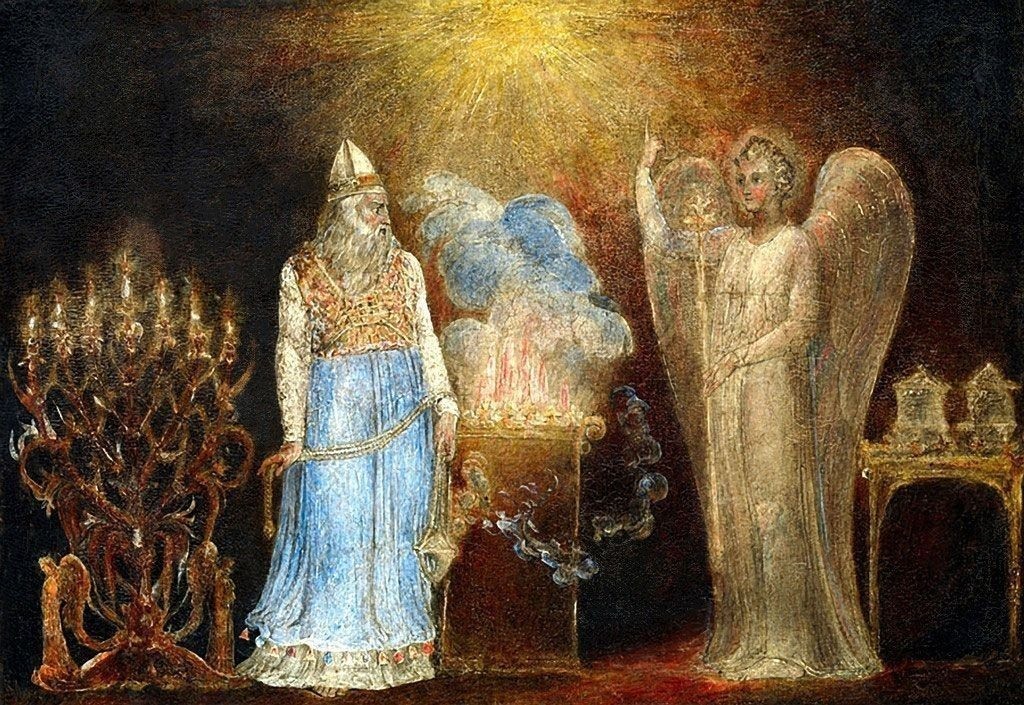
'Your wife Elizabeth will bear a son'In the days of King Herod of Judaea there lived a priest called Zechariah who belonged to the Abijah section of the priesthood, and he had a wife, Elizabeth by name, who was a descendant of Aaron. Both were worthy in the sight of God, and scrupulously observed all the commandments and observances of the Lord. But they were childless: Elizabeth was barren and they were both getting on in years. Now it was the turn of Zechariah’s section to serve, and he was exercising his priestly office before God when it fell to him by lot, as the ritual custom was, to enter the Lord’s sanctuary and burn incense there. And at the hour of incense the whole congregation was outside, praying. Then there appeared to him the angel of the Lord, standing on the right of the altar of incense. The sight disturbed Zechariah and he was overcome with fear. But the angel said to him, ‘Zechariah, do not be afraid, your prayer has been heard. Your wife Elizabeth is to bear you a son and you must name him John. He will be your joy and delight and many will rejoice at his birth, for he will be great in the sight of the Lord; he must drink no wine, no strong drink. Even from his mother’s womb he will be filled with the Holy Spirit, and he will bring back many of the sons of Israel to the Lord their God. With the spirit and power of Elijah, he will go before him to turn the hearts of fathers towards their children and the disobedient back to the wisdom that the virtuous have, preparing for the Lord a people fit for him.’ Zechariah said to the angel, ‘How can I be sure of this? I am an old man and my wife is getting on in years.’ The angel replied, ‘I am Gabriel who stand in God’s presence, and I have been sent to speak to you and bring you this good news. Listen! Since you have not believed my words, which will come true at their appointed time, you will be silenced and have no power of speech until this has happened.’ Meanwhile the people were waiting for Zechariah and were surprised that he stayed in the sanctuary so long. When he came out he could not speak to them, and they realised that he had received a vision in the sanctuary. But he could only make signs to them, and remained dumb. When his time of service came to an end he returned home. Some time later his wife Elizabeth conceived, and for five months she kept to herself. ‘The Lord has done this for me’ she said ‘now that it has pleased him to take away the humiliation I suffered among men.’ Nothing has changedIn England, Wales and Scotland, the translation of the readings used at Mass has changed. Your current calendar setting is “United States”, so you have not been affected by this change. This message will disappear at the end of December. Christian Art![]() Each day, The Christian Art website gives a picture and reflection on the Gospel of the day. The readings on this page are from the Jerusalem Bible, which is used at Mass in most of the English-speaking world. The New American Bible readings, which are used at Mass in the United States, are available in the Universalis apps, programs and downloads. |
KEYWORDS: advent; catholic; lk1; prayer

Please FReepmail me to get on/off the Alleluia Ping List.
| Luke | |||
| English: Douay-Rheims | Latin: Vulgata Clementina | Greek NT: Byzantine/Majority Text (2000) | |
| Luke 1 | |||
| 5. | There was in the days of Herod, the king of Judea, a certain priest named Zachary, of the course of Abia; and his wife was of the daughters of Aaron, and her name Elizabeth. | Fuit in diebus Herodis, regis Judææ, sacerdos quidam nomine Zacharias de vice Abia, et uxor illius de filiabus Aaron, et nomen ejus Elisabeth. | εγενετο εν ταις ημεραις ηρωδου του βασιλεως της ιουδαιας ιερευς τις ονοματι ζαχαριας εξ εφημεριας αβια και η γυνη αυτου εκ των θυγατερων ααρων και το ονομα αυτης ελισαβετ |
| 6. | And they were both just before God, walking in all the commandments and justifications of the Lord without blame. | Erant autem justi ambo ante Deum, incedentes in omnibus mandatis et justificationibus Domini sine querela. | ησαν δε δικαιοι αμφοτεροι ενωπιον του θεου πορευομενοι εν πασαις ταις εντολαις και δικαιωμασιν του κυριου αμεμπτοι |
| 7. | And they had no son, for that Elizabeth was barren, and they both were well advanced in years. | Et non erat illis filius, eo quod esset Elisabeth sterilis, et ambo processissent in diebus suis. | και ουκ ην αυτοις τεκνον καθοτι η ελισαβετ ην στειρα και αμφοτεροι προβεβηκοτες εν ταις ημεραις αυτων ησαν |
| 8. | And it came to pass, when he executed the priestly function in the order of his course before God, | Factum est autem, cum sacerdotio fungeretur in ordine vicis suæ ante Deum, | εγενετο δε εν τω ιερατευειν αυτον εν τη ταξει της εφημεριας αυτου εναντι του θεου |
| 9. | According to the custom of the priestly office, it was his lot to offer incense, going into the temple of the Lord. | secundum consuetudinem sacerdotii, sorte exiit ut incensum poneret, ingressus in templum Domini : | κατα το εθος της ιερατειας ελαχεν του θυμιασαι εισελθων εις τον ναον του κυριου |
| 10. | And all the multitude of the people was praying without, at the hour of incense. | et omnis multitudo populi erat orans foris hora incensi. | και παν το πληθος ην του λαου προσευχομενον εξω τη ωρα του θυμιαματος |
| 11. | And there appeared to him an angel of the Lord, standing on the right side of the alter of incense. | Apparuit autem illi angelus Domini, stans a dextris altaris incensi. | ωφθη δε αυτω αγγελος κυριου εστως εκ δεξιων του θυσιαστηριου του θυμιαματος |
| 12. | And Zachary seeing him, was troubled, and fear fell upon him. | Et Zacharias turbatus est videns, et timor irruit super eum. | και εταραχθη ζαχαριας ιδων και φοβος επεπεσεν επ αυτον |
| 13. | But the angel said to him: Fear not, Zachary, for thy prayer is heard; and thy wife Elizabeth shall bear thee a son, and thou shalt call his name John: | Ait autem ad illum angelus : Ne timeas, Zacharia, quoniam exaudita est deprecatio tua : et uxor tua Elisabeth pariet tibi filium, et vocabis nomen ejus Joannem : | ειπεν δε προς αυτον ο αγγελος μη φοβου ζαχαρια διοτι εισηκουσθη η δεησις σου και η γυνη σου ελισαβετ γεννησει υιον σοι και καλεσεις το ονομα αυτου ιωαννην |
| 14. | And thou shalt have joy and gladness, and many shall rejoice in his nativity. | et erit gaudium tibi, et exsultatio, et multi in nativitate ejus gaudebunt : | και εσται χαρα σοι και αγαλλιασις και πολλοι επι τη γεννησει αυτου χαρησονται |
| 15. | For he shall be great before the Lord; and shall drink no wine nor strong drink: and he shall be filled with the Holy Ghost, even from his mother's womb. | erit enim magnus coram Domino : et vinum et siceram non bibet, et Spiritu Sancto replebitur adhuc ex utero matris suæ : | εσται γαρ μεγας ενωπιον [του] κυριου και οινον και σικερα ου μη πιη και πνευματος αγιου πλησθησεται ετι εκ κοιλιας μητρος αυτου |
| 16. | And he shall convert many of the children of Israel to the Lord their God. | et multos filiorum Israël convertet ad Dominum Deum ipsorum : | και πολλους των υιων ισραηλ επιστρεψει επι κυριον τον θεον αυτων |
| 17. | And he shall go before him in the spirit and power of Elias; that he may turn the hearts of the fathers unto the children, and the incredulous to the wisdom of the just, to prepare unto the Lord a perfect people. | et ipse præcedet ante illum in spiritu et virtute Eliæ : ut convertat corda patrum in filios, et incredulos ad prudentiam justorum, parare Domino plebem perfectam. | και αυτος προελευσεται ενωπιον αυτου εν πνευματι και δυναμει ηλιου επιστρεψαι καρδιας πατερων επι τεκνα και απειθεις εν φρονησει δικαιων ετοιμασαι κυριω λαον κατεσκευασμενον |
| 18. | And Zachary said to the angel: Whereby shall I know this? for I am an old man, and my wife is advanced in years. | Et dixit Zacharias ad angelum : Unde hoc sciam ? ego enim sum senex, et uxor mea processit in diebus suis. | και ειπεν ζαχαριας προς τον αγγελον κατα τι γνωσομαι τουτο εγω γαρ ειμι πρεσβυτης και η γυνη μου προβεβηκυια εν ταις ημεραις αυτης |
| 19. | And the angel answering, said to him: I am Gabriel, who stand before God: and am sent to speak to thee, and to bring thee these good tidings. | Et respondens angelus dixit ei : Ego sum Gabriel, qui asto ante Deum : et missus sum loqui ad te, et hæc tibi evangelizare. | και αποκριθεις ο αγγελος ειπεν αυτω εγω ειμι γαβριηλ ο παρεστηκως ενωπιον του θεου και απεσταλην λαλησαι προς σε και ευαγγελισασθαι σοι ταυτα |
| 20. | And behold, thou shalt be dumb, and shalt not be able to speak until the day wherein these things shall come to pass, because thou hast not believed my words, which shall be fulfilled in their time. | Et ecce eris tacens, et non poteris loqui usque in diem quo hæc fiant, pro eo quod non credidisti verbis meis, quæ implebuntur in tempore suo. | και ιδου εση σιωπων και μη δυναμενος λαλησαι αχρι ης ημερας γενηται ταυτα ανθ ων ουκ επιστευσας τοις λογοις μου οιτινες πληρωθησονται εις τον καιρον αυτων |
| 21. | And the people were waiting for Zachary; and they wondered that he tarried so long in the temple. | Et erat plebs exspectans Zachariam : et mirabantur quod tardaret ipse in templo. | και ην ο λαος προσδοκων τον ζαχαριαν και εθαυμαζον εν τω χρονιζειν αυτον εν τω ναω |
| 22. | And when he came out, he could not speak to them: and they understood that he had seen a vision in the temple. And he made signs to them, and remained dumb. | Egressus autem non poterat loqui ad illos, et cognoverunt quod visionem vidisset in templo. Et ipse erat innuens illis, et permansit mutus. | εξελθων δε ουκ ηδυνατο λαλησαι αυτοις και επεγνωσαν οτι οπτασιαν εωρακεν εν τω ναω και αυτος ην διανευων αυτοις και διεμενεν κωφος |
| 23. | And it came to pass, after the days of his office were accomplished, he departed to his own house. | Et factum est, ut impleti sunt dies officii ejus, abiit in domum suam : | και εγενετο ως επλησθησαν αι ημεραι της λειτουργιας αυτου απηλθεν εις τον οικον αυτου |
| 24. | And after those days, Elizabeth his wife conceived, and hid herself five months, saying: | post hos autem dies concepit Elisabeth uxor ejus, et occultabat se mensibus quinque, dicens : | μετα δε ταυτας τας ημερας συνελαβεν ελισαβετ η γυνη αυτου και περιεκρυβεν εαυτην μηνας πεντε λεγουσα |
| 25. | Thus hath the Lord dealt with me in the days wherein he hath had regard to take away my reproach among men. | Quia sic fecit mihi Dominus in diebus, quibus respexit auferre opprobrium meum inter homines. | οτι ουτως μοι πεποιηκεν ο κυριος εν ημεραις αις επειδεν αφελειν το ονειδος μου εν ανθρωποις |

1:5–7
5. There was in the days of Herod, the king of Judæa, a certain priest named Zacharias, of the course of Abia: and his wife was of the daughters of Aaron, and her name was Elisabeth.
6. And they were both righteous before God, walking in all the commandments and ordinances of the Lord blameless.
7. And they had no child, because that Elisabeth was barren, and they both were now well stricken in years.
CHRYSOSTOM. (noc occ.) St. Luke commences the history of his Gospel with Zacharias and the birth of John; relating one marvellous event before another, the less before the greater. For since a virgin was about to become a mother, it had been fore-ordained by grace that the old should previously conceive. He fixes the time, when he says, In the days of Herod, and in the following words adds his rank, king of Judæa. (in Matt. cap. 2.). There was another Herod, who killed John; he was tetrarch, whereas this one was king.
BEDE. (in Luc. Evang.) Now the time of Herod, i. e. of a foreign king, bears witness to our Lord’s coming, for it had been foretold, The sceptre shall not depart from Judah, nor a lawgiver from between his feet, until Shiloh come. (Gen. 49:12.) For from the time that our fathers came out of Egypt, they were governed by judges of their own nation, until the Prophet Samuel; and then by kings, until the carrying away to Babylon. But after the return from Babylon, the chief power was in the hands of priests, until the time of Hyrcanus, who was both king and high priest. He was slain by Herod, after which the government of the kingdom was delivered over by the command of Augustus Cæsar to this same Herod, a foreigner, in whose thirty-first year, according to the prophecy we have mentioned, Shiloh came.
AMBROSE. Divine Scripture teaches us with respect to those whom we commemorate, that not only the characters of the men themselves, but of their parents also, ought to be praised, that they might be distinguished by an inheritance, as it were, handed down to them of unspotted purity. Now not only from his parents, but also from his ancestors, St. John derives his illustrious descent, a descent not exalted by secular power, but venerable from its sanctity. Complete then is that praise which comprehends birth, character, office, actions, and judgments.
The office was that of the Priesthood, as it is said, A certain Priest of the name of Zacharias.
BEDE. (in Homil. in vigil. S. Joh. Bap.) For John was allotted a Priestly tribe, that he might with the more authority herald forth a change of priesthood.
AMBROSE. His birth is implied in the mention made of his ancestors. Of the course of Abia, i. e. of high rank among the noblest families.
BEDE. There were Princes of the Sanctuary or High Priests, both of the sons of Eleazar and the sons of Thamar, whose courses according to their respective services when they entered into the House of God David divided into twenty-four lots, of which the family of Abia (from which Zacharias was descended) obtained the eighth lot. (1 Chron. 24.) But it was not without meaning that the first preacher of the new covenant was born with the rights of the eighth lot; because as the old Covenant is often expressed by the seventh number on account of the Sabbath, so frequently is the new Covenant by the eighth, because of the sacrament of our Lord’s or our resurrection.
THEOPHYLACT. Wishing to shew also that John was legally of Priestly descent, Luke adds, And his wife was of the daughters of Aaron, and her name was Elisabeth, for it was not permitted to the Jews to take a wife from any other tribe but their own. Elisabeth by interpretation signifies “rest,” Zacharias “the remembrance of the land.”
BEDE. John was born of just parents, that so he might the more boldly give precepts of justice to the people, which he had not learnt as novelties, but had received by right of inheritance from his ancestors. Hence it follows, And they were both just before God.
AMBROSE. Here their whole character is comprehended in their justice, but it is well said before God, for a man by affecting a popular good-will might seem just to me, but not be just before God, if that justice instead of springing from simpleness of heart, was a mere pretence carried on by flattery. Perfect then is the praise, “that a man is just before God;” for he only is perfect who is approved by Him who cannot be deceived. St. Luke comprehends the action in the commandment, the doing justice in the justification. Hence it follows, walking in all the commandments and justifications of the Lord. For when we obey the command of heaven we walk in the commandments of the Lord, when we observe justice we seem to possess the justification of the Lord. But to be “blameless” we must “provide things honest, not only before God, but also before men”; (Prov. 3:4.) there is no blame when both motive and action are alike good, but a too austere righteousness often provokes censure. A righteous act may also be done unrighteously, as when a man out of ostentation gives largely to the poor, which is not without just cause of blame. It follows, And they had no son, because Elisabeth was barren.
CHRYSOSTOM. (ex Hom. in Gen. 49.) Not only Elisabeth, but the wives of the Patriarchs also, Sarah, Rebecca, Rachel, were barren, which was counted a disgrace among the ancients. Not that their barrenness was the effect of sin, since all were just and virtuous, but ordained rather for your benefit, that when you saw a virgin giving birth to the Lord, you might not be faithless, or perplexing your mind with respect to the womb of the barren.
THEOPHYLACT. And that you might learn that the law of God seeketh not a bodily increase of sons but a spiritual, both were far advanced, not only in the body but in the Spirit, “making ascents in their heartb,” having their life as the day not as the night, and walking honestly as in the day. (Ps. 84:6, 1 Thess. 5:5.)
1:8–10
8. And it came to pass, that while he executed the Priest’s office before God in the order of his course,
9. According to the custom of the Priest’s office, his lot was to burn incense when he went into the temple of the Lord.
10. And the whole multitude of the people were praying without at the time of incense.
BEDE. The Lord appointed by the hand of Moses one High Priest, at whose death another was to succeed in due order. This was observed until the time of David, who by the command of the Lord increased the number of the Priests; and so at this time Zacharias is said to have been performing his Priest’s office in the order of his course, as it follows: But it came to pass, when Zacharias was performing the Priest’s office in the order of his course before God, according to the custom of the Priesthood, his lot was, &c.
AMBROSE. Zacharias seems here to be designated High Priest, because into the second tabernacle went the High Priest alone once every year, not without blood, which he offered for himself and the sins of the people. (Heb. 9:7.)
BEDE. It was not by a new lot that he was chosen when the incense was to be burnt, but by the old lot, whereby according to the order of his Priesthood he succeeded in the course of Abia. It follows, And all the multitude of the people, &c. Incense was ordered to be carried into the Holy of Holies by the High Priest, the whole people waiting without the temple. It was to be on the tenth day of the seventh month, and this day was to be called the day of expiation or propitiation, the mystery of which day the Apostle explaining to the Hebrews, points to Jesus as the true High Priest, who in His own blood has entered the secret places of heaven that he might reconcile the Father unto us, and intercede for the sins of those who still wait praying before the doors.
AMBROSE. This then is that High Priest who is still sought by lot, for as yet the true High Priest is unknown; for he who is chosen by lot is not obtained by man’s judgment. That High Priest therefore was sought for, and another typified, the true High Priest for ever, who not by the blood of victims, but by His own blood, was to reconcile God the Father to mankind. Then indeed there were changes in the Priesthood, now it is unchangeable.
1:11–14
11. And there appeared unto him an angel of the the Lord standing on the right side of the altar of incense.
12. And when Zacharias saw him, he was troubled, and fear fell upon him.
13. But the angel said unto him, Fear not, Zacharias: for thy prayer is heard; and thy wife Elisabeth shall bear thee a son, and thou shalt call his name John.
14. And thou shalt have joy and gladness; and many shall rejoice at his birth.
CHRYSOSTOM. (Hom. 2. de Inc. Dei Nat.) When Zacharias entered into the temple to offer up prayers to God for all men, interceding between God and man, he saw an angel standing within, as it is said, And there appeared unto him an angel.
AMBROSE. It is well said that there appeared an angel to Zacharias, who suddenly beheld him; and this is the expression especially used by Divine Scripture with respect to angels or God, that what cannot be seen beforehand may be said to appear. For things which are the objects of our senses are not seen as He is seen, Who is seen only as He will, and Whose nature is not to be seen.
ORIGEN. And we speak thus not only of the present time, but also of the future. When we shall have passed from the world, God will not appear unto all men, nor will the angels, but unto him only who has a clean heart. The place will neither hinder nor serve any one.
CHRYSOSTOM. (Hom. li. in Matt.) But the angel evidently came not in a dream, because the tidings he brought were too hard to be understood, and needed therefore a more visible and marvellous manifestation.
DAMASCENE. (de fide Orthodox. ii. 3.) Angels, however, are revealed not as they really are, but transformed (as men are able to behold them) into whatever the Lord commands.
THEOPHYLACT. It is said the altar of incense, because the other altar was set apart for burnt offerings.
AMBROSE. It was not without good reason that the angel appeared in the temple, for the coming of the true High Priest was now announced, and the Heavenly Sacrifice was preparing at which angels were to minister. For one cannot doubt that an angel stands by where Christ is sacrificed. But he appeared at the right hand of the altar of incense, because he brought down the token of Divine mercy. For the Lord is on my right hand, so that I should not be moved. (Ps. 16:8.)
CHRYSOSTOM. (de Inc. Dei Nat.) The justest of men can not without fear behold an angel; Zacharias therefore, not sustaining the sight of the angel’s presence, nor able to withstand his brightness, is troubled, as it is added, Zacharias was troubled. But as it happens, when a charioteer is frightened, and has let loose his reins, the horses run headlong, and the chariot is overturned; so is it with the soul, when it is taken by any surprise or alarm; as it is here added, and fear fell upon him.
ORIGEN. A new face suddenly presenting itself to the human eye, troubles and startles the mind. The angel knowing this to be the nature of man, first dispels the alarm, as it follows, But the angel said unto him, Fear not.
ATHANASIUS. (in vita Anton.) Whereby it is not difficult to discern between good and bad spirits, for if joy has succeeded to fear, we may know that relief has come from God, because the peace of the soul is a sign of the Divine Presence; but if the fear remains unshaken, it is an enemy who is seen.
ORIGEN. The angel not only soothes his fears, but gladdens him with good tidings, adding, For thy prayer is heard, and thy wife Elisabeth shall bear a son.
AUGUSTINE. (de Quæst. Evan. l. i. q. l.) Now here we must first consider that it is not likely that Zacharias, when offering sacrifice for the sins or for the salvation or redemption of the people, would neglect the public petitions, to pray (though himself an old man, and his wife also old) that he might receive children; and, next, above all that no one prays for what he despairs of ever obtaining. And even up to this time, sc much had he despaired of ever having children, that he would not believe, even when an angel promised it to him. The words, Thy prayer is heard, must be understood therefore to refer to the people; and as salvation, redemption, and the putting away of the sins of the people was to be through Christ, it is told Zacharias that a son shall be born to him, because that son was ordained to be the forerunner of Christ.
CHRYSOSTOM. (sup.) Or it means, that this was to be the proof of his prayer having been heard, namely, that a son should be born to him, crying, Behold the Lamb of God!
THEOPHYLACT. As if when Zacharias asks, How shall I know this? the angel answers, Because Elisabeth shall bring forth a son, thou shalt believe that the sins of thy people are forgiven.
AMBROSE. Or, as follows; Divine mercy is ever full and overflowing, not narrowed to a single gift, but pouring in an abundant store of blessings; as in this case, where first the fruit of his prayer is promised; and next, that his barren wife shall bear a child, whose name is announced as follows; And thou shalt call his name John.
BEDE. It is meant as a token of particular merit, when a man has a name given him or changed by God.
CHRYSOSTOM. (Joann. Hom. xviii.) Which must be the meaning here, for those who from their earliest years were destined to shine forth in virtue, received their names at the very first from a divine source; while those who were to rise up in later years, had a name given them afterwards.
BEDE. John is therefore interpreted, “one in whom is grace, or the grace of God;” by which name it is declared, first, that grace was given to his parents, to whom in their old age a son was to be born; next, to John himself, who was to become great before the Lord; lastly, also to the children of Israel, whom he was to convert to the Lord. Hence it follows, And he shall be a joy unto thee, and a cause of rejoicing.
ORIGEN. For when a just man is born into the world, the authors of his birth rejoice; but when one is born who is to be as it were an exile to labour and punishment, they are struck with terror and dismay.
AMBROSE. But a saint is not only the blessing of his parents, but also the salvation of many; as it follows, And many shall rejoice at his birth. Parents are reminded here to rejoice at the birth of saints, and to give thanks. For it is no slight gift of God to vouchsafe unto us children, to be the transmitters of our race, to be the heirs of succession.
1:15–17
15. For he shall be great in the sight of the Lord, and shall drink neither wine nor strong drink; and he shall be filled with the Holy Ghost, even from his mother’s womb.
16. And many of the children of Israel shall he turn to the Lord their God.
17. And he shall go before him in the spirit and power of Elias, to turn the hearts of the fathers to the children, and the disobedient to the wisdom of the just; to make ready a people prepared for the Lord.
AMBROSE. Next to his becoming the rejoicing of many, the greatness of his virtue is prophesied; as it is said, For he shall be great in the sight of the Lord. The greatness signified is not of the body, but of the soul. Greatness in the sight of the Lord is greatness of soul, greatness of virtue.
THEOPHYLACT. For many are called great before men, but not before God, as the hypocrites. And so in like manner was John called great, as the parents of John were called just, before the Lord.
AMBROSE. He extended not the boundaries of an empire, nor brought back in triumph the spoils of war, (but, what is far greater,) preaching in the desert he overcame by his great virtue the delights of the world, and the lusts of the flesh. Hence it follows; And he shall drink no wine nor strong drink.
BEDE. Sicera is interpreted “drunkenness,” and by the word the Hebrews understand any drink that can intoxicate, (whether made from fruits, corn, or any other thing.) But it was part of the law of the Nazarites to give up wine and strong drink at the time of their consecration. (Numb. 6:5.) Hence John, and others like him, that they might always remain Nazarites, (i. e. holy,) are careful always to abstain from these things. For he ought not to be drunk with wine (in which is licentiousness) who desires to be filled with the new wine of the Holy Spirit; rightly then is he, from whom all drunkenness with wine is utterly put away, filled with the grace of the Spirit. But it follows, And he shall be filled with the Holy Spirit.
AMBROSE. On whomsoever the Holy Spirit is poured, in him there is fulness of great virtue; as in St. John, who before he was born, when yet in his mother’s womb, bore witness to the grace of the Spirit which he had received, when leaping in the womb of his parent he hailed the glad tidings of the coming of the Lord. There is one spirit of this life, another of grace. The former has its beginning at birth, its end at death; the latter is not tied down to times and seasons, is not quenched by death, is not shut out of the womb.
GREEK EXPOSITOR. (Metaphrastes sup.) But what John’s work is to be, and what he will do through the Holy Spirit, is shewn as follows; And many of the children of Israel shall he turn, &c.
ORIGEN. John indeed turned many, but it is the Lord’s work to turn all to God their Father.
BEDE. Now since John (who, bearing witness to Christ, baptized the people in His faith) is said to have turned the children of Israel to the Lord their God, it is plain that Christ is the God of Israel. Let the Arians then cease to deny that Christ our Lord is God. Let the Photiniansc blush to ascribe Christ’s beginning to the Virgin. Let the Manichæns no longer believe that there is one God of the people of Israel, another of the Christians.
AMBROSE. But we need no testimony that St. John turned the hearts of many, for to this point we have the express witness of both prophetic and and evangelical Scriptures. For the voice of one crying in the wilderness, Prepare ye the way of the Lord, and make His paths straight; and his baptisms thronged by the people, declare the rapid progress of conversion. For the forerunner of Christ preached, not himself, but the Lord; and therefore it follows, And he shall go before Him. It was well said, that he shall go before Him, who both in birth and in death was His forerunner.
ORIGEN. In the spirit and power of Elijah.—He says not, in the mind of Elijah, but in the spirit and power. For the spirit which was in Elijah came upon John, and in like manner his power.
AMBROSE. For never is the spirit without power, nor power without the spirit. And therefore it is said, in the spirit and power; because holy Elijah had great power and grace. Power, so that he turned back the false hearts of the people to faith; power of abstinence, and patience, and the spirit of prophecy. Elijah was in the wilderness, in the wilderness also was John. The one sought not the favour of king Ahab; the other despised that of Herod. The one divided Jordan; the other brought men to the Saving waters; John, the forerunner of our Lord’s first coming; Elijah of His latter.
BEDE. But what was foretold of Elias by Malachi, is now spoken by the angel of John; as it follows, That he should turn the hearts of the parents to the children; (Mal. 4:5, 6.) pouring into the minds of the people, by his preaching, the spiritual knowledge of the ancient saints. And the disobedient to the wisdom of the just; i. e. not laying claim to righteousness from the works of the law, but seeking salvation by faith. (Rom. 10. sup.)
GREEK EXPOSITOR. Or else; The Jews were the parents of John and the Apostles; but, nevertheless, from pride and infidelity raged violently against the Gospel. Therefore, like dutiful children, John first, and the Apostles after him, declared to them the truth, winning them over to their own righteousness and wisdom. So also will Elias convert the remnant of Hebrews to the truth of the Apostles.
BEDE. But because he had said that Zacharias’ prayer for the people was heard, he adds, To make ready a people prepared1 for the Lord; by which he teaches in what manner the same people must be healed and prepared; namely, by repenting at the preaching of John and believing on Christ.
THEOPHYLACT. Or, John made ready a people not disbelieving but prepared, that is, previously fitted to receive Christ.
ORIGEN. This sacrament 2 of preparation is even now fulfilled in the world, for even now the spirit and power of John must come upon the soul, before it believes in Jesus Christ.
1:18–22
18. And Zacharias said unto the angel, Whereby shall I know this? for I am an old man, and my wife well stricken in years.
19. And the angel answering said unto him, I am Gabriel, that stand in the presence of God; and am sent to speak unto thee, and to shew thee these glad tidings.
20. And, behold, thou shalt be dumb, and not able to speak, until the day that these things shall be performed, because thou believest not my words, which shall be fulfilled in their season.
21. And the people waited for Zacharias, and marvelled that he tarried so long in the temple.
22. And when he came out, he could not speak unto them: and they perceived that he had seen a vision in the temple: for he beckoned unto them and remained speechless.
CHRYSOSTOM. (Hom. ii. De Inc. Nat. Dei sup.) Considering his own age, and moreover the barrenness of his wife, Zacharias doubted; as it is said, And Zacharias said unto the angel, Whereby shall I know this? as if he said, “How shall this be?” And he adds the reason of his doubting; For I am an old man. An unseasonable time of life, an ill-suited nature; the planter infirm, the soil barren. But it is thought by some a thing unpardonable. in the priest, that he raises a course of objections; for whenever God declares any thing, it becomes us to receive it in faith, and moreover, disputes of this kind are the mark of a rebellious spirit. Hence it follows; And the angel answering said unto him, I am Gabriel, who stand before God.
BEDE. As if he says, “If it were man who promised these miracles, one might with impunity demand a sign, but when an angel promises, it is then not right to doubt. It follows; And I am sent to speak to thee.
CHRYSOSTOM. (sup.) That when you hear that I am sent from God, you should deem none of the things which are said unto thee to be of man, for I speak not of myself, but declare the message of Him who sends me. And this is the merit and excellence of a messenger to relate nothing of his own.
BEDE. Here we must remark, that the angel testifies, that he both stands before God, and is sent to bring good tidings to Zacharias.
GREGORY. (Hom. xxxiv. in Evang.) For when angels come to us, they so outwardly fulfil their ministry, as at the same time inwardly to be never absent from His sight; since, though the angelic spirit is circumscribed, the highest Spirit, which is God, is not circumscribed. The angels therefore even when sent are before Him, because on whatever mission they go, they pass within Him.
BEDE. But he gives him the sign which he asks for, that he who spoke in unbelief, might now by silence learn to believe; as it follows; and, behold, thou shall be dumb.
CHRYSOSTOM. (sup.) That the bonds might be transferred from the powers of generation to the vocal organs. From no regard to the priesthood was he spared, but for this reason was the more smitten, because in a matter of faith he ought to have set an example to others.
THEOPHYLACT. (cap. i.) Because the word in the Greek (κωφὸς) may also signify deaf, he well says, Because thou believest not, thou shalt be deaf, and shalt not be able to speak. For most reasonably he suffered these two things; as disobedient, he incurs the penalty of deafness; as an objector, of silence.
CHRYSOSTOM. (sup.) But the Angel says, And, behold; in other words, “At this instant.” But mark the mercy of God in what follows: Until the day in which these things shall be performed. As if he said, “When by the issues of events I shall have proved my words, and thou shalt perceive that thou art rightly punished, I will remove the punishment from thee.” And he points out the cause of the punishment, adding, Because thou believest not my words, which shall be fulfilled in their season; not considering His power Who sent me, and before Whom I stand. But if he who was incredulous about a mortal birth is punished, how shall he escape vengeance, who speaks falsely of the heavenly and unspeakable birth?
GREEK EXPOSITOR. (Antipater Bostrensis.) Now while these things were going on within, the delay excited surprise among the multitudes who were waiting without, as it follows: And the people waited for Zacharias, and marvelled that he tarried. And while various suspicions were going about, each man repeating them as it pleased him, Zacharias coming forth told by his silence what he secretly endured. Hence it follows, And when he came out, he could not speak.
THEOPHYLACT. But Zacharias beckoned to the people, who perhaps enquired the cause of his silence, which, as he was not able to speak, he signified to them by nodding. Hence it follows, And he beckoned to them, and remained speechless.
AMBROSE. But a nod is a certain action of the body, without speech endeavouring to declare the will, yet not expressing it.
1:23–25
23. And it came to pass, that, as soon as the days of his ministration were accomplished, he departed to his own house.
24. And after those days his wife Elisabeth conceived, and hid herself five months, saying,
25. Thus hath the Lord dealt with me in the days wherein he looked on me, to take away my reproach among men.
BEDE. During the time of their course, the priests of the temple were so occupied by their office, that they kept themselves not only from the society of their wives, but even from the very threshold of their houses. Hence it is said, And it came to pass, that, as soon as the days were accomplished, &c. For as there was then required a priestly succession from the root of Aaron, of necessity then a time was appointed for keeping up the inheritance. But as now not a carnal succession, but spiritual perfection, is looked for, the priests are enjoined (in order that they might ever be able to serve the altar) the perpetual observance of chastity. It follows: But after those days, &c. that is, after the days of Zacharias’s ministration were completed. But these things were done in the month of September, the twenty-second day of the month, upon which the Jews were bound to observe the feast of the Tabernacles, just before the equinox, at which the night began to be longer than the day, because Christ must increase, but John must decrease. And those days of fasting were not without their meaning; for by the mouth of John, repentance and mortification were to be preached to men. It follows: And she hid herself. (see John 3:30.)
AMBROSE. What reason then for concealment, except shame? For there are certain allowed times in wedlock, when it is becoming to attend to the begetting of children; while the years thrive, while there is hope of child-bearing. But when in good time old age has come on, and the period of life is more fitted for governing children, than begetting them, it is a shame to bear about the signs of pregnancy, however lawful. It is a shame to be laden with the burden of another age, and for the womb to swell with the fruit of not one’s own time of life. It was a shame then to her on account of her age; and hence we may understand the reason why they did not at this time come together, for surely she who blushed not at their coming together in their old age, would not blush at her child-bearing; and yet she blushes at the parental burden, while she yet is unconscious of the religious mystery. But she who hid herself because she had conceived a son, began to glory that she carried in her womb a prophet.
ORIGEN. And therefore he says, Five months, that is, until Mary should conceive, and her babe leaping with joy should prophesy.
AMBROSE. And though she might blush at the time of her child-bearing, on the other hand she rejoiced that she was free from reproach, saying, Thus hath the Lord dealt with me.
CHRYSOSTOM. Truly He has loosed her barrenness, a supernatural gift He has bestowed upon her, and the unfruitful rock has produced the green blade. He has taken away her disgrace, in that He has made her to bring forth. Hence it follows: In the days wherein he looked on me, to take away my reproach among men.
AMBROSE. For it is a shame among women not to receive that reward of marriage, which is the only cause of their being married.
CHRYSOSTOM. (Homil. de Anna.) Her joy therefore is twofold. The Lord has taken away from her the mark of barrenness, and also given her an illustrious offspring. In the case of other births, the coming together of the parents only occurs; this birth was the effect of heavenly grace.
BEDE. Now mystically by Zacharias may be signified the Jewish Priesthood, by Elisabeth the law itself; which, well administered by the teaching of the Priests, ought to have borne spiritual children to God, but was not able, because the Law made no one perfect. (Heb. 7:19, 1 Tim. 1:8.) Both were just, because the law is good, and the Priesthood for that time holy; both were well stricken in years, because at Christ’s coming both the Law and Priesthood were just bending to old age. Zacharias enters the temple, because it is the priest’s office to enter into the sanctuary of heavenly mysteries. There was a multitude without the doors, because the multitude cannot penetrate mysteries. When he places frankincense on the altar, he discovers that John will be born; for while the teachers are kindled with the flame of divine reading, they find the grace of God flow to them through Jesus: and this is done by an angel, for the Law was ordained by angels. (Gal. 3:19.)
AMBROSE. But in one man the voice of the people was put to silence, because in one man the whole people was addressing God. For the word of God has come over to us, and in us is not silent. He is dumb who understands not the Law; for why should you think the man who knows not a sound, to be more dumb than him who knows not a mystery. The Jewish people are like to one beckoning, who cannot make his actions intelligible.
BEDE. And yet Elisabeth conceives John, because the more inward parts of the Law abound with sacraments of Christ. She conceals her conception five months, because Moses in five books set forth the mysteries of Christ; or because the dispensation of Christ is represented by the words or deeds of the saints, in the five ages of the world.
Catena Aurea Luke 1

His academic journey in canon law and theology led him to Avignon, culminating in his commitment as a Benedictine monk. His administrative and spiritual aptitude shone through when he was appointed abbot of his monastery in 1352. His diplomatic prowess was recognized in his role as a papal ambassador and his service as a bishop across Italy and Europe.
Urban V’s papal election in 1362 was remarkable, as it occurred while he was engaged in diplomatic work and notably, he was not a cardinal at the time. His tenure as pope was characterized by his deep spirituality and intellectual brilliance, coupled with a simple and modest lifestyle. This approach often put him at odds with the more comfort-seeking clergymen of his time. Despite resistance, Urban V remained committed to reform, overseeing the restoration of numerous churches and monasteries.
His papacy was marked by significant achievements such as mediating peace between French and Italian rulers, founding several universities, promoting the Crusades, and importantly, heeding Saint Catherine of Siena’s counsel to return the papacy to Rome, thus ending the Avignon Papacy’s exile.
Urban V’s efforts to maintain peace were evident when the outbreak of war between England and France called him back to Avignon. Sadly, he passed away upon his return in 1370, on December 19. In line with his wishes, his body was moved from Avignon to Marseille, where his tomb became a site renowned for miracles.
Urban V maintained his Benedictine spirit throughout his papacy, often wearing his monk’s habit. His integrity and virtue were particularly noteworthy in a Europe riddled with scandal and corruption. As he lay on his deathbed, he invited the people to witness his passing, emphasizing the importance of transparency and humility in leadership, even in death.

Ad Majorem Dei Gloriam (To the Greater Glory of God)
First Reading:
From: Judges 13:2-7, 24-25a
Samson, God’s Nazirite from His Mother’s Womb
----------------------------------------------------------------
[2] And there was a certain man of Zorah of the tribe of the Danites whose name was Manoah; and his wife was barren and had no children [3] And the angel of the Lord appeared to the woman and said to her, “Behold, you are barren and have no children; but you shall conceive and bear a son [4] Therefore beware and drink no wine or strong drink, and eat nothing unclean, [5] for lo, you shall conceive and bear a son. No razor shall come upon his head, for the boy shall be a Nazirite to God from birth; and he shall begin to deliver Israel from the hand of the Philistines.” [6] Then the woman came and told her husband, A man of God came to me, and his countenance was like the countenance of the angel of God, very terrible; I did not ask him whence he was, and he did not tell me his name; [7] but he said to me, ‘Behold, you shall conceive and bear a son; so then drink no wine or strong drink, and eat nothing unclean, for the boy shall be a Nazirite to God from birth to the day of his death.”
[24] And the woman bore a son, and called his name Samson; and the boy grew and the Lord blessed him. [25a] And the Spirit of the Lord began to stir him.
***********************************************************************
Commentary:
13:1-21:25. History repeats itself once more (cf. 13:1): infidelity causes the Israelites to lose the Lord’s favor. On this occasion they fall foul of the Philistines, a Mediterranean people who had come down the coast and on to the plains of Canaan; their military strength proved superior to Israel’s. However, God again decides to send a liberator--Samson, of the tribe of Dan.
The story of Samson begins with the announcement of his birth; his parents are told that he will be a Nazirite, consecrated to God, from his birth (13:2-24), The account goes on to portray Samson as a rather empty-headed person (14:1-19), and reports various feats which show that God endowed him with a physical strength which enabled him to deal with his people’s enemies, despite his personal defects (14:20-16:3). Still, he will end up being seduced by Delilah and revealing to her the secret or his strength: as a result he will fall into the hands of the Philistines and he imprisoned (16:4-22). Eventually his hair will grow back and he will avenge himself for how he was treated, losing his own life in the process but causing the death of many Philistines (16:23-31).
After narrating the story of Samson, the sacred writer again tags on some other stories as an appendix. To his account of the deeds of Deborah he attached the ancient canticle celebrating her victory; and after the death of Gideon he described in detail the (failed) coup of Abimelech, one of Gideon’s sons. Now he brings in two stories which are similar in so far as the protagonist in each is a Levite and both men were given hospitality by Ephraimites. Their connection with the history of Samson is through the tribe of Dan, to which Samson belonged. The first of these two accounts (17:1-18:31) is connected with the migration of the tribe of Dan (from their original place, in the Shephelah, beside where the Philistines were in control, towards the north of the country, to the slopes of the mountains of Lebanon), and the protagonist is a Levite,who is taken in first by a man of Ephraim and later by the Danites (17:1-18:31). The second story deals with another Levite given hospitality by an Ephraimite in Gibe-ah, but the Benjaminites of that city want to sexually abuse him and they ill-treat his concubine so badly that she dies. This sparks a concerted attack on Benjamin by the other tribes which almost wipes out the Benjaminites (19:1-21:25).
Both episodes show ever more clearly the internal anarchy affecting the tribes of Israel and the decadent state of morality to which they have been reduced; there is no one capable of re-establishing order--as the text repeatedly says, “in those days there was no king in Israel; every man did what was right in his own eyes” (17:6 and 21:25; cf. 18:1 and 19:1).
Thus, the book draws to a close by illustrating that, despite the exceptional patience and mercy of God who constantly forgave his people for their unfaithfulness and raised up one savior after another, Israel continued to sin against him. Therefore, they could have no reason to complain against God if he left them at the mercy of their enemies. When the sacred writer was gathering all these ancient traditions during the Babylonian exile and composing this book in its present form, he made it quite clear that they could not blame the course of events on the Lord or argue that his power had weakened: history shows that they themselves were to blame for what happened.
13:2-25. Samson’s vocation was decided by God from even before he was conceived. This account has a structure similar to that of the calling of Gideon (6:11-23). God sends his angel to a woman who is barren and tells her she will have a son (v. 5), who will be consecrated to God as a Nazirite (cf. Num 6:1-21 and its note), and he will perform a specific mission--to save his people from the Philistines. In this account, vocation, dedication to God and mission are all closely linked.
The main features of vocation are outlined here. The initiative comes from God who sees his people’s predicament and prepares, from birth onwards, a man who will save them from their enemies. In due course he announces his plans through a messenger: an angel presentshimself to the wife of Manoah (v. 3)--she sees him as a “man of God” (v. 6)--and he tells her about God’s plans. The couple’s readiness to go along with God’s will is plain to see (vv. 8 and 12). As happens in some supernatural communications, in special circumstances the Lord offers some remarkable sign to demonstrate that the message indeed comes from him and that what he says will happen (cf. 6:2 1; Lk 1:20, 36).
Some of God’s ways of acting to be seen in Gideon’s vocation (6:11-24) are also found in the annunciation to Mary (cf. Lk 1:26-38). The way Manoah and his wife make themselves available for God's plan to work, as also Mary's great refinement and generosity in doing the divine will, are messages to the reader of God's word in Scripture--to check his or her own readiness to go along with God's plans.
From: Luke 1:5-25
The Birth of John the Baptist Foretold
--------------------------------------
[5] In the days of Herod, king of Judea, there was a priest named Zechariah, of the division of Abijah; and he had a wife of the daughters of Aaron, and her name was Elizabeth. [6] And they were both righteous before God, walking in all the commandments and ordinances of the Lord blameless. [7] But they had no child, because Elizabeth was barren, and both were advanced in years.
[8] Now while he was serving as priest before God when his division was on duty, [9] according to the custom of the priesthood, it fell to him by lot to enter the temple of Lord and burn incense. [10] And the whole multitude of the people were praying outside at the hour of incense. [11] And there appeared to him an angel of the Lord standing on the right side of the altar of incense. [12] And Zechariah was troubled when he saw him, and fear fell upon him. [13] But the angel said to him, "Do not be afraid, Zechariah, for your prayer is heard, and your wife Elizabeth will bear you a son, and you shall call his name John. [14] And you will have joy and gladness, and many will rejoice at his birth; [15] for he will be great before the Lord, and he shall drink no wine nor strong drink, and he will be filled with the Holy Spirit, even from his mother's womb. [16] And he will turn many of the sons of Israel to the Lord their God, [17] and he will go before him in the spirit and power of Elijah, to turn the hearts of the fathers to the children and the disobedient to the wisdom of the just, to make ready for the Lord a people prepared."
[18] And Zechariah said to the angel, "How shall I know this? For I am an old man, and my wife is advanced in years." [19] And the angel answered him, "I am Gabriel, who stand in the presence of God; and I was sent to speak to you, and to bring you this good news. [20] And behold, you will be silent and unable to speak until the day that these things come to pass, because you did not believe my words, which will be fulfilled in their time." [21] And the people were waiting for Zechariah, and they wondered at his delay in the temple. [22] And when he came out, he could not speak to them, and they perceived that he had seen a vision in the temple; and he made signs to them and remained dumb. [23] And when his time of service was ended, he went to his home.
[24] After these days his wife Elizabeth conceived, and for five months she hid herself, saying, [25] "Thus the Lord has done to me in the days when He looked on me, to take away my reproach among men."
***********************************************************************
Commentary:
6. After referring to the noble ancestry of Zechariah and Elizabeth, the evangelist now speaks of a higher type of nobility, the nobility of virtue: "Both were righteous before God." "For not everyone who is righteous in men's eyes is righteous in God's; men have one way of seeing and God another; men see externals but God sees into the heart. It can happen that someone seems righteous because his virtue is false and is practiced to win people's approval; but he is not virtuous in God's sight if his righteousness is not born of simplicity of soul but is only simulated in order to appear good.
"Perfect praise consists in being righteous before God, because only he can be called perfect who is approved by Him who cannot be deceived" (St. Ambrose, "Expositio Evangelii Sec. Lucam, in loc.").
In the last analysis what a Christian must be is righteous before God. St. Paul is advocating this when he tells the Corinthians, "But with me it is a very small thing that I should be judged by you or by any human court. It is the Lord who judges me. Therefore do not pronounce judgment before the time, before the Lord comes, who will bring to light the things now hidden in darkness and will disclose the purposes of the heart. Then every man will receive his commendation from God" (1 Corinthians 4:3ff). On the notion of the just or righteous man, see the note on Matthew 1:19.
8. There were twenty-four groups or turns of priests to which functions were allocated by the drawing of lots; the eighth group was that of the family of Abijah (cf. 1 Chronicles 24:7-19), to which Zechariah belonged.
9-10. Within the sacred precincts, in a walled-off area, stood the temple proper. Rectangular in form, there was first a large area which was called "the Holy Place", in which was located the altar of incense referred to in verse 9. Behind this was the inner sanctum, called "the Holy of Holies", where the Ark of the Covenant with the tablets of the Law used to be kept; only the high priest had access to this, the most sacred part of the temple. The veil or great curtain of the temple separated these two areas from one another. The sacred building was surrounded by a courtyard, called the courtyard of the priests and outside this, at the front of the temple, was what was called the courtyard of the Israelites, where the people stayed during the ceremony of incensing. 10. While the priest offered incense to God, the people in the courtyard joined with him in spirit: even in the Old Testament every external act of worship was meant to be accompanied by an interior disposition of self-offering to God.
With much more reason should there be this union between external and internal worship in the liturgical rites of the New Covenant (cf. "Mediator Dei", 8), in the liturgy of the Church. Besides, this consistency befits the nature of man, comprised as he is of body and soul.
11. Angels are pure spirits, that is, they have no body of any kind; therefore, "they do not appear to men exactly as they are; rather, they manifest themselves in forms which God gives them so that they can be seen by those to whom He sends them" (St. John Damascene, "De Fide Orthodoxa," 2, 3).
In addition to adoring and serving God, angelic spirits act as God's messengers and channels of His providence towards men; this explains why they appear so often in salvation history and why Sacred Scripture refers to them in so many passages (cf., e.g. Hebrews 1:14).
Christ's birth was such an important event that angels were given a very prominent role in connection with it. Here, as at the Annunciation to Mary, the archangel St. Gabriel is charged with delivering God's message.
"It is no accident that the angel makes his appearance in the temple, for this announces the imminent coming of the true Priest and prepares the heavenly sacrifice at which the angels will minister. Let it not be doubted, then, that the angels will be present when Christ is immolated" (St. Ambrose, "Expositio Evangelii Sec. Lucam, in loc.").
12. "No matter how righteous a man be, he cannot look at an angel without feeling afraid; that is why Zechariah was alarmed: he could not but quake at the presence of the angel; he could not take the brightness that surrounded him" (St. John Chrysostom, "De Incomprehensibili Dei Natura"). The reason for this is not so much the angels' superiority to man as the fact that the grandeur of God's majesty shines out through the angel: "And the angel said to me, `Write this: Blessed are those who are invited to the marriage supper of the Lamb.' And he said to me, `These are true words of God.' Then I fell down at his feet to worship him, but he said to me, `You must not do that! I am a fellow servant with you and your brethren who hold the testimony of Jesus. Worship God'" (Revelation 19:9-10).
13. Through the archangel God intervenes in an exceptional way in the married life of Zechariah and Elizabeth; but the message he brings has much wider reference; it has significance for the whole world. Elizabeth is already quite old but she is going to have a son who will be called John ("God is gracious") and he will be the forerunner of the Messiah. This showed that "the fullness of time" (cf. Galatians 4:4) was imminent, for which all righteous people of Israel had yearned (cf. John 8:56; Hebrews 11:13).
"Your prayer is heard," St. Jerome comments, "that is to say, you are given more than you asked for. You prayed for the salvation of the people, and you have been given the Precursor" ("Expositio Evangelium Sec. Lucam, in loc."). Our Lord also sometimes gives us more than we ask for: "There is a story about a beggar meeting Alexander the Great and asking him for alms. Alexander stopped and instructed that the man be given the government of five cities. The beggar, totally confused and taken aback, explained, `I didn't ask for that much.' And Alexander replied, `You asked like the man you are; I give like the man I am" (St. J. Escriva, "Christ Is Passing By", 160). Since God responds so generously and gives us more than we ask for, we should face up to difficulties and not be cowed by them.
14-17. The archangel St. Gabriel gives Zechariah three reasons why he should rejoice over the birth of this child; first, because God will bestow exceptional holiness on him (verse 15); second, because he will lead many to salvation (verse 16); and third, because his whole life, everything he does, will prepare the way for the expected Messiah (verse 17).
In St. John the Baptist two prophecies of Malachi are fulfilled; in them we are told that God will send a messenger ahead of Him to prepare the way for Him (Malachi 3:1; 4:5-6). John prepares the way for the first coming of the Messiah in the same way as Elijah will prepare the way for His second coming (cf. St. Ambrose, "Expositio Evangelii Sec. Lucam, in loc."; St. Thomas Aquinas, "Commentary on St. Matthew", 17, 11, "in loc."). This is why Christ will say, "What did you go out to see? A prophet? Yes, I tell you, and more than a prophet. This is he of whom it is written, `Behold, I send My messenger before Thy face, who shall prepare Thy way before Thee'" (Luke 7:26-27).
18. Zechariah's incredulity and his sin lie not in his doubting that this message has come from God but in forgetting that God is almighty, and in thinking that he and Elizabeth are past having children. Later, referring to the conception of John the Baptist, the same angel explains to Mary that "with God nothing will be impossible" (Luke 1:37). When God asks us to take part in any undertaking we should rely on His omnipotence rather than our own meagre resources.
19-20. "Gabriel" means "might of God". God commanded the archangel Gabriel to announce the events connected with the incarnation of the Word; already in the Old Testament it was Gabriel who proclaimed to the prophet Daniel the time of the Messiah's coming (Daniel 8:15-26, 9:20-27). This present passage deals with the announcement of the conception and birth of Christ's Precursor, and it is the time same angel who will reveal to the Blessed Virgin the mystery of the Incarnation.
24. Elizabeth hid herself because of the strangeness of pregnancy at her age and out of a holy modesty which advised her not to make known God's gifts prematurely.
25. Married couples who want to have children, to whom God has not yet given any, can learn from Zechariah and Elizabeth and have recourse to them as intercessors. To couples in this situation Monsignor Escriva de Balaguer recommended that "they should not give up hope too easily. They should ask God to give them children and, if it is His will, to bless them as He blessed the Patriarchs of the Old Testament. And then it would be advisable for both of them to see a good doctor. If in spite of everything God does not give them children, they should not feel frustrated. They should be happy, discovering in this very fact God's will for them. Often God does not give them children because He is `asking more'. God asks them to put the same effort and the same kind and gentle dedication into helping their neighbors as they would have put into raising their own children, without the human joy that comes from parenthood. There is, then, no reason for feeling they are failures or for giving way to sadness" ("Conversations", 96).
Here is the authoritative teaching of John Paul II on this subject: "It must not be forgotten, however, that, even when procreation is not possible, conjugal life does not for this reason lose its value. Physical sterility in fact can be for spouses the occasion for other important services to the life of the human person--for example, adoption, various forms of educational work, assistance to other families and to poor or handicapped children" ("Familiaris Consortio", 14).
Disclaimer: Opinions posted on Free Republic are those of the individual posters and do not necessarily represent the opinion of Free Republic or its management. All materials posted herein are protected by copyright law and the exemption for fair use of copyrighted works.