Free Republic
Browse · Search
Religion
Topics · Post Article

Skip to comments.

Catholic Caucus: Daily Mass Readings 12-December-2024
Universalis/Jerusalem Bible ^

Posted on 12/12/2024 3:11:39 AM PST by annalex

Thursday 12 December 2024

Our Lady of Guadalupe
Feast


Saint Finian's Catholic Church, Towlaght Townland, Co. Meath, Ireland

Readings at Mass

Liturgical Colour: White. Year: C(I).


First reading
Zechariah 2:14-17

'I am coming', says the Lord

Sing, rejoice,
daughter of Zion;
for I am coming
to dwell in the middle of you
– it is the Lord who speaks.
Many nations will join the Lord,
on that day;
they will become his people.
But he will remain among you,
and you will know that the Lord of Hosts has sent me to you.
But the Lord will hold Judah
as his portion in the Holy Land,
and again make Jerusalem his very own.
Let all mankind be silent before the Lord!
For he is awaking and is coming from his holy dwelling.

Responsorial Psalm
Judith 13:18a-19
You are the highest honour of our race!
May you be blessed, my daughter, by God Most High,
beyond all women on earth;
and may the Lord God be blessed,
the Creator of heaven and earth.
You are the highest honour of our race!
The trust you have shown
shall not pass from the memories of men,
but shall ever remind them
of the power of God.
You are the highest honour of our race!

Gospel Acclamation
Alleluia, alleluia!
Blessed are you, holy Virgin Mary,
and most worthy of all praise,
for the sun of justice, Christ our God,
was born of you.
Alleluia!

GospelLuke 1:26-38

'I am the handmaid of the Lord'

The angel Gabriel was sent by God to a town in Galilee called Nazareth, to a virgin betrothed to a man named Joseph, of the House of David; and the virgin’s name was Mary. He went in and said to her, ‘Rejoice, so highly favoured! The Lord is with you.’ She was deeply disturbed by these words and asked herself what this greeting could mean, but the angel said to her, ‘Mary, do not be afraid; you have won God’s favour. Listen! You are to conceive and bear a son, and you must name him Jesus. He will be great and will be called Son of the Most High. The Lord God will give him the throne of his ancestor David; he will rule over the House of Jacob for ever and his reign will have no end.’ Mary said to the angel, ‘But how can this come about, since I am a virgin?’ ‘The Holy Spirit will come upon you’ the angel answered ‘and the power of the Most High will cover you with its shadow. And so the child will be holy and will be called Son of God. Know this too: your kinswoman Elizabeth has, in her old age, herself conceived a son, and she whom people called barren is now in her sixth month, for nothing is impossible to God.’ ‘I am the handmaid of the Lord,’ said Mary ‘let what you have said be done to me.’ And the angel left her.

Nothing has changed

In England, Wales and Scotland, the translation of the readings used at Mass has changed. Your current calendar setting is “United States”, so you have not been affected by this change.
This message will disappear at the end of December.

Christian Art

Illustration

Each day, The Christian Art website gives a picture and reflection on the Gospel of the day.

The readings on this page are from the Jerusalem Bible, which is used at Mass in most of the English-speaking world. The New American Bible readings, which are used at Mass in the United States, are available in the Universalis apps, programs and downloads.

You can also view this page with the Gospel in Greek and English.


TOPICS: Catholic; General Discusssion; Prayer; Worship
KEYWORDS: advent; catholic; lk1; prayer
For your reading, reflection, faith-sharing, comments, questions, discussion.

1 posted on 12/12/2024 3:11:39 AM PST by annalex
[ Post Reply | Private Reply | View Replies]

To: All

KEYWORDS: advent; catholic; lk1; prayer


2 posted on 12/12/2024 3:12:17 AM PST by annalex (fear them not)
[ Post Reply | Private Reply | To 1 | View Replies]

To: nickcarraway; NYer; ELS; Pyro7480; livius; ArrogantBustard; Catholicguy; RobbyS; marshmallow; ...

Alleluia Ping

Please FReepmail me to get on/off the Alleluia Ping List.


3 posted on 12/12/2024 3:13:04 AM PST by annalex (fear them not)
[ Post Reply | Private Reply | To 2 | View Replies]

To: annalex
My dad is back in the hospital. [JimRob update at 242]
Jim still needs our prayers. Thread 2
Prayer thread for Salvation's recovery
Pray for Ukraine
Prayer thread for Fidelis' recovery
Update on Jim Robinson's health issues
4 posted on 12/12/2024 3:13:23 AM PST by annalex (fear them not)
[ Post Reply | Private Reply | To 3 | View Replies]

To: annalex
Luke
 English: Douay-RheimsLatin: Vulgata ClementinaGreek NT: Byzantine/Majority Text (2000)
 Luke 1
26And in the sixth month, the angel Gabriel was sent from God into a city of Galilee, called Nazareth, In mense autem sexto, missus est angelus Gabriel a Deo in civitatem Galilææ, cui nomen Nazareth,εν δε τω μηνι τω εκτω απεσταλη ο αγγελος γαβριηλ υπο του θεου εις πολιν της γαλιλαιας η ονομα ναζαρετ
27To a virgin espoused to a man whose name was Joseph, of the house of David; and the virgin's name was Mary. ad virginem desponsatam viro, cui nomen erat Joseph, de domo David : et nomen virginis Maria.προς παρθενον μεμνηστευμενην ανδρι ω ονομα ιωσηφ εξ οικου δαυιδ και το ονομα της παρθενου μαριαμ
28And the angel being come in, said unto her: Hail, full of grace, the Lord is with thee: blessed art thou among women. Et ingressus angelus ad eam dixit : Ave gratia plena : Dominus tecum : benedicta tu in mulieribus.και εισελθων ο αγγελος προς αυτην ειπεν χαιρε κεχαριτωμενη ο κυριος μετα σου ευλογημενη συ εν γυναιξιν
29Who having heard, was troubled at his saying, and thought with herself what manner of salutation this should be. Quæ cum audisset, turbata est in sermone ejus, et cogitabat qualis esset ista salutatio.η δε ιδουσα διεταραχθη επι τω λογω αυτου και διελογιζετο ποταπος ειη ο ασπασμος ουτος
30And the angel said to her: Fear not, Mary, for thou hast found grace with God. Et ait angelus ei : Ne timeas, Maria : invenisti enim gratiam apud Deum.και ειπεν ο αγγελος αυτη μη φοβου μαριαμ ευρες γαρ χαριν παρα τω θεω
31Behold thou shalt conceive in thy womb, and shalt bring forth a son; and thou shalt call his name Jesus. Ecce concipies in utero, et paries filium, et vocabis nomen ejus Jesum :και ιδου συλληψη εν γαστρι και τεξη υιον και καλεσεις το ονομα αυτου ιησουν
32He shall be great, and shall be called the Son of the most High; and the Lord God shall give unto him the throne of David his father; and he shall reign in the house of Jacob for ever. hic erit magnus, et Filius Altissimi vocabitur, et dabit illi Dominus Deus sedem David patris ejus : et regnabit in domo Jacob in æternum,ουτος εσται μεγας και υιος υψιστου κληθησεται και δωσει αυτω κυριος ο θεος τον θρονον δαυιδ του πατρος αυτου
33And of his kingdom there shall be no end. et regni ejus non erit finis.και βασιλευσει επι τον οικον ιακωβ εις τους αιωνας και της βασιλειας αυτου ουκ εσται τελος
34And Mary said to the angel: How shall this be done, because I know not man? Dixit autem Maria ad angelum : Quomodo fiet istud, quoniam virum non cognosco ?ειπεν δε μαριαμ προς τον αγγελον πως εσται τουτο επει ανδρα ου γινωσκω
35And the angel answering, said to her: The Holy Ghost shall come upon thee, and the power of the most High shall overshadow thee. And therefore also the Holy which shall be born of thee shall be called the Son of God. Et respondens angelus dixit ei : Spiritus Sanctus superveniet in te, et virtus Altissimi obumbrabit tibi. Ideoque et quod nascetur ex te sanctum, vocabitur Filius Dei.και αποκριθεις ο αγγελος ειπεν αυτη πνευμα αγιον επελευσεται επι σε και δυναμις υψιστου επισκιασει σοι διο και το γεννωμενον αγιον κληθησεται υιος θεου
36And behold thy cousin Elizabeth, she also hath conceived a son in her old age; and this is the sixth month with her that is called barren: Et ecce Elisabeth cognata tua, et ipsa concepit filium in senectute sua : et hic mensis sextus est illi, quæ vocatur sterilis :και ιδου ελισαβετ η συγγενης σου και αυτη συνειληφυια υιον εν γηρει αυτης και ουτος μην εκτος εστιν αυτη τη καλουμενη στειρα
37Because no word shall be impossible with God. quia non erit impossibile apud Deum omne verbum.οτι ουκ αδυνατησει παρα τω θεω παν ρημα
38And Mary said: Behold the handmaid of the Lord; be it done to me according to thy word. And the angel departed from her. Dixit autem Maria : Ecce ancilla Domini : fiat mihi secundum verbum tuum. Et discessit ab illa angelus.ειπεν δε μαριαμ ιδου η δουλη κυριου γενοιτο μοι κατα το ρημα σου και απηλθεν απ αυτης ο αγγελος

(*) Verses 32-33 breakdown differs in the translations.

5 posted on 12/12/2024 3:17:32 AM PST by annalex (fear them not)
[ Post Reply | Private Reply | To 4 | View Replies]

To: annalex

Catena Aurea by St. Thomas Aguinas

1:26–27

26. And in the sixth month the angel Gabriel was sent from God unto a city of Galilee, named Nazareth,

27. To a virgin espoused to a man whose name was Joseph, of the house of David; and the virgin’s name was Mary.

BEDE. Because either the Incarnation of Christ was to be in the sixth age of the world, or because it was to serve to the fulfilling of the law, rightly in the sixth month of John’s conception was an angel sent to Mary, to tell her that a Saviour should be born. Hence it is said, And in the sixth month, &c. We must understand the sixth month to be March, on the twenty-fifth day of which our Lord is reported to have been conceived, and to have suffered, as also to have been born on the twenty-fifth day of December. But if either the one day we believe to be the vernal equinox, or the other the winter solstice, it happens that with the increase of light He was conceived or born Who lighteneth every man that cometh into the world. But if any one shall prove, that before the time of our Lord’s nativity or conception, light began either to increase, or supersede the darkness, we then say, that it was because John, before the appearance of His coming, began to preach the kingdom of heaven.

BASIL. (in Esai. 6.) The heavenly spirits visit us, not as it seems fit to them, but as the occasion conduces to our advantage, for they are ever looking upon the glory and fulness of the Divine Wisdom; hence it follows, The angel Gabriel was sent.

GREGORY. (Hom. 34, in Evan.) To the virgin Mary was sent, not any one of the angels, but the archangel Gabriel; for upon this service it was meet that the highest angel should come, as being the bearer of the highest of all tidings. He is therefore marked by a particular name, to signify what was his effectual part in the work. For Gabriel is interpreted, “the strength of God.” By the strength of God then was He to be announced Who was coming as the God of strength, and mighty in battle, to put down the powers of the air.

GLOSS. (interlin.) But the place is also added whither he is sent, as it follows, To a city, Nazareth. For it was told that He would come a Nazarite, (i. e. the holy of the holy.)

BEDE. (in Homil. de fest Annunt.) It was a fit beginning for man’s restoration, that an angel should be sent down from God to consecrate a virgin by a divine birth, for the first cause of man’s perdition was the Devil sending a serpent to deceive a woman by the spirit of pride.

AUGUSTINE. (de san. Virg. cap. vi.) To a virgin, for Christ could be born from virginity alone, seeing He could not have an equal in His birth. It was necessary for our Head by this mighty miracle to be born according to the flesh of a virgin, that He might signify that his members were to be born in the spirit of a virgin Church.

PSEUDO-JEROME. (Hieron. vol. xi. 92. De Assumpt.) And rightly an angel is sent to the virgin, because the virgin state is ever akin to that of angels. Surely in the flesh to live beyond the flesh is not a life on earth but in heaven.

CHRYSOSTOM. (sup. Mat. Hom. 4.) The angel announces the birth to the virgin not after the conception, lest she should be thereby too much troubled, but before the conception he addresses her, not in a dream, but standing by her in visible shape. For as great indeed were the tidings she receives, she needed before the issue of the event an extraordinary visible manifestation.

AMBROSE. Scripture has rightly mentioned that she was espoused, as well as a virgin, a virgin, that she might appear free from all connexion with man; espoused, that she might not be branded with the disgrace of sullied virginity, whose swelling womb seemed to bear evident marks of her corruption. But the Lord had rather that men should cast a doubt upon His birth than upon His mother’s purity. He knew how tender is a virgin’s modesty, and how easily assailed the reputation of her chastity, nor did He think the credit of His birth was to be built up by His mother’s wrongs. It follows therefore, that the holy Mary’s virginity was of as untainted purity as it was also of unblemished reputation. Nor ought there, by an erroneous opinion, to be left the shadow of an excuse to living virgins, that the mother of our Lord even seemed to be evil spoken of. But what could be imputed to the Jews, or to Herod, if they should seem to have persecuted an adulterous offspring? And how could He Himself say, I came not to abolish the law, but to fulfil it, (Matt. 5:18.) if He should seem to have had his beginning from a violation of the law, for the issue of an unmarried person is condemned by the law? (Deut. 23:17.) Not to add that also greater credit is given to the words of Mary, and the cause of falsehood removed? For it might seem that unmarried becoming pregnant, she had wished to shade her guilt by a lie; but an espoused person has no reason for lying, since to women child-birth is the reward of wedlock, the grace of the marriage bed. Again, the virginity of Mary was meant to baffle the prince of the world, who, when he perceived her espoused to a man, could cast no suspicion on her offspring.

ORIGEN. For if she had had no husband, soon would the thought have stolen into the Devil’s mind, how she who had known no man could be pregnant. It was right that the conception should be Divine, something more exalted than human nature.

AMBROSE. But still more has it baffled the princes of the world, for the malice of devils soon detects even hidden things, while they who are occupied in worldly vanities, can not know the things of God. But moreover, a more powerful witness of her purity is adduced, her husband, who might both have been indignant at the injury, and revenged the dishonour, if he also had not acknowledged the mystery; of whom it is added, Whose name was Joseph, of the house of David.

BEDE. (in Homil. de Annunt. sup.) Which last applies not only to Joseph, but also to Mary, for the Law commanded that every one should take a wife out of his own tribe or family. It follows, And the virgin’s name was Mary.

BEDE. Maria, in Hebrew, is the star of the sea; but in Syriac it is interpreted Mistress, and well, because Mary was thought worthy to be the mother of the Lord of the whole world, and the light of endless ages.

1:28–29

28. And the angel came in unto her, and said, Hail, thou that art highly favoured, the Lord is with thee: blessed art thou among women.

29. And when she saw him, she was troubled at his saying, and cast in her mind what manner of salutation this should be.

AMBROSE. Mark the virgin by her manner of life. Alone in an inner chamber, unseen by the eyes of men, discovered only by an angel; as it is said, And the angel came in unto her. That she might not be dishonoured by any ignoble address, she is saluted by an angel.

GREGORY OF NYSSA. (Diem Nat. Orat. in Christi.) Far different then to the news formerly addressed to the woman, is the announcement now made to the Virgin. In the former, the cause of sin was punished by the pains of childbirth; in the latter, through gladness, sorrow is driven away. Hence the angel not unaptly proclaims joy to the Virgin, saying, Hail.

GREEK EXPOSITOR. (Geometer) But that she was judged worthy of the nuptials is attested by his saying, Full of grace. For it is signified as a kind of token or marriage gift of the bridegroom, that she was fruitful in graces. For of the things which he mentions, the one appertains to the bride, the other to the bridegroom.

PSEUDO-JEROME. (Jerome sup.) And it is well said, Full of grace, for to others, grace comes in part; into Mary at once the fulness of grace wholly infused itself. She truly is full of grace through whom has been poured forth upon every creature the abundant rain of the Holy Spirit. But already He was with the Virgin Who sent the angel to the Virgin. The Lord preceded His messenger, for He could not be confined by place Who dwells in all places. Whence it follows, The Lord is with thee.

PSEUDO-AUGUSTINE. (Aug. in Serm. de Annunt. iii. app. 195.) More than with me, for He Himself is in thy heart, He is (made) in thy womb, He fills thy soul, He fills thy womb.

GREEK EXPOSITOR. (Geometer) But this is the sum of the whole message. The Word of God, as the Bridegroom, effecting an incomprehensible union, Himself, as it were, the same both planting, and being planted, hath moulded the whole nature of man into Himself. But comes last the most perfect and comprehensive salutation; Blessed art thou among women. i. e. Alone, far before all other women; that women also should be blessed in thee, as men are in thy Son; but rather both in both. For as by one man and one woman came at once both sin and sorrow, so now also by one woman and one man hath both blessing and joy been restored, and poured forth upon all.

AMBROSE. But mark the Virgin by her bashfulness, for she was afraid, as it follows; And when she heard, she was troubled, It is the habit of virgins to tremble, and to be ever afraid at the presence of man, and to be shy when he addresses her. Learn, O virgin, to avoid light talking. Mary feared even the salutation of an angel.

GREEK EXPOSITOR. (sup.) But as she might be accustomed to these visions, the Evangelist ascribes her agitation not to the vision, but to the things told her, saying, she was troubled at his words. Now observe both the modesty and wisdom of the Virgin; the soul, and at the same time the voice. When she heard the joyful words, she pondered them in her mind, and neither openly resisted through unbelief, nor forthwith lightly complied; avoiding equally the inconstancy of Eve, and the insensibility of Zacharias. Hence it is said, And she cast in her mind what manner of salutation this was, it is not said conception, for as yet she knew not the vastness of the mystery. But the salutation, was there aught of passion in it as from a man to a virgin? or was it not of God, seeing that he makes mention of God, saying, The Lord is with thee.

AMBROSE. She wondered also at the new form of blessing, unheard of before, reserved for Mary alone.

ORIGEN. For if Mary had known that similar words had been addressed to others, such a salutation would never have appeared to her so strange and alarming.

1:30–33

30. And the angel said unto her, Fear not, Mary: for thou hast found favour with God.

31. And, behold, thou shalt conceive in thy womb, and bring forth a son, and shalt call his name JESUS.

32. He shall be great, and shall be called the Son of the Highest: and the Lord God shall give unto him the throne of his father David:

33. And he shall reign over the house of Jacob for ever; and of his kingdom there shall be no end.

When the angel saw that she was troubled at this unusual salutation, calling her by her name as if she was well known to him, he tells her she must not fear, as it follows; And the angel said, Fear not, Mary.

GREEK EXPOSITOR. (Photius.) As if he said, I came not to deceive you, nay rather to bring down deliverance from deception; I came not to rob you of your inviolable virginity, but to open a dwelling-place for the Author and Guardian of thy purity; I am not a servant of the Devil, but the ambassador of Him that destroyeth the Devil. I am come to form a marriage treaty, not to devise plots. So far then was he from allowing her to be harassed by distracting thoughts, lest he should be counted a servant unfaithful to his trust.

CHRYSOSTOM. But he who earns favour in the sight of God has nothing to fear. Hence it follows, For thou hast found favour before God. But how shall any one find it, except through the means of his humility. For God giveth grace to the humble. (James 4:6, 1 Pet. 5:5.)

GREEK EXPOSITOR. (ubi sup.) For the Virgin found favour with God, in that decking her own soul in the bright robes of chastity, she prepared a dwelling-place pleasing to God. Not only did she retain her virginity inviolate, but her conscience also she kept from stain. As many had found favour before Mary, he goes on to state what was peculiar to her. Behold, thou shall conceive in thy womb.

GREEK EXPOSITOR. (Geometer.) By the word behold, he denotes rapidity and actual presence, implying that with the utterance of the word the conception is accomplished.

GREEK EXPOSITOR. (Sev. Antiochenus.) Thou shalt conceive in thy womb, that he might shew that our Lord from the very Virgin’s womb, and of our substance, took our flesh upon Him. For the Divine Word came to purify man’s nature and birth, and the first elements of our generation. And so without sin and human seed, passing through every stage as we do, He is conceived in the flesh, and carried in the womb for the space of nine months.

GREEK EXPOSITOR. (Geometer.) But since it happens also that to the spiritual mind is given in an especial manner to conceive the Divine Spirit, and bring forth the Spirit of salvation, as says the Prophet; therefore he added, And thou shalt bring forth a Son. (Is. 26:18.)

AMBROSE. But all are not as Mary, that when they conceive the word of the Holy Spirit, they bring forth; for some put forth the word prematurely, others have Christ in the womb, but not yet formed.

GREGORY OF NYSSA. (Orat. in Diem Nat.) While the expectation of child-birth strikes a woman with terror, the sweet mention of her offspring calms her, as it is added, And thou shall call his name Jesus. The coming of the Saviour is the banishing of all fear.

BEDE. Jesus is interpreted Saviour, or Healing.

GREEK EXPOSITOR. (Geom. sup.) And he says, Thou shalt call, not His father shall call, for He is without a father as regards His lower birth, as He is without a mother in respect of the higher.

CYRIL OF ALEXANDRIA. (de fide ad Theod.) But this name was given anew to the Word in adaptation to His nativity in the flesh; as that prophecy saith, Thou shalt be called by a new name which the mouth of the Lord hath named. (Is. 62:2.)

GREEK EXPOSITOR. (sup.) But as this name was common to Him with the successor of Moses, the angel therefore implying that He should not be after Joshua’s likeness, adds, He shall be great. (Josh. 1.)

AMBROSE. It was said also of John, that he shall be great, but of him indeed as of a great man, of Christ, as of the great God. For abundantly is poured forth the power of God; widely the greatness of the heavenly substance extended, neither confined by place, nor grasped by thought; neither determined by calculation, nor altered by age.

ORIGEN. See then the greatness of the Saviour, how it is diffused over the whole world. Go up to heaven, see there how it has filled the heavenly places; carry thy thoughts down to the deep, behold, there too He has descended. If thou seest this, then, in like manner, beholdest thou fulfilled in very deed, He shall be great.

GREEK EXPOSITOR. (Photius.) The assumption of our flesh does not diminish ought from the loftiness of the Deity, but rather exalts the lowness of man’s nature. Hence it follows, And he shall be called the Son of the Highest. Not, Thou shalt give Him the name, but He Himself shall be called. By whom, but His Father of like substance with Himself? For no one hath known the Son but the Father. (Matt. 11:27.) But He in Whom exists the infallible knowledge of His Son, is the true interpreter as to the name which should be given Him, when He says, This is my beloved Son; (Matt. 17:5.) for such indeed from everlasting He is, though His name was not revealed till now; therefore he says, He shall be called, not shall be made or begotten. For before the worlds He was of like substance with the Father. Him therefore thou shalt conceive; His mother thou shalt become; Him shall thy virgin shrine enclose, Whom the heavens were not able to contain.

CHRYSOSTOM. (non occ.) But since it seems shocking or unworthy to some men that God should inhabit a body, is the Sun, I would ask, the heat whereof is felt by each body that receives its rays, at all sullied as to its natural purity? Much more then does the Sun of Righteousness, in taking upon Himself a most pure body from the Virgin’s womb, escape not only defilement, but even shew forth His own mother in greater holiness.

GREEK EXPOSITOR. (Severus Antiochenus.) And to make the Virgin mindful of the prophets, he adds, And the Lord God shall give unto him the seat of David, that she might know clearly, that He Who is to be born of her is that very Christ, Whom the prophets promised should be born of the seed of David.

CYRIL OF ALEXANDRIA. (contra Julian lib. viii.) Not however from Joseph proceeded the most pure descent of Christ. For from one and the same line of connexion had sprung both Joseph and the Virgin, and from this the only-begotten had taken the form of man.

BASIL. (Epist. 236. ad Amphil.) Our Lord sat not on the earthly throne of David, the Jewish kingdom having been transferred to Herod. The seat of David is that on which our Lord reestablished His spiritual kingdom which should never be destroyed. Hence it follows, And he shall reign over the house of Jacob.

CHRYSOSTOM. (Hom. vii. in Matt.) Now He assigns to the present house of Jacob all those who were of the number of the Jews that believed on Him. For as Paul says, They are not all Israel which are of Israel, but the children of the promise are counted for the seed.

BEDE. Or by the house of Jacob he means the whole Church which either sprang from a good root, or though formerly a wild olive branch, has yet been for a reward of its faith grafted into the good olive tree. (Rom. 11:17.)

GREEK EXPOSITOR. (Geometer.) But to reign for ever is of none save God alone; and hence though because of the incarnation Christ is said to receive the seat of David, yet as being Himself God He is acknowledged to be the eternal King. It follows, And, his kingdom shall have no end, not in that He is God, but in that He is man also. Now indeed He has the kingdom of many nations, but finally he shall reign over all, when all things shall be put under Him. (1 Cor. 15:25.)

BEDE. Let Nestorius then cease to say that the Virgin’s Son is only man, and to deny that He is taken up by the Word of God into the unity of the Person. For the Angel when he says that the very same has David for His father whom he declares is called the Son of the Highest, demonstrates the one Person of Christ in two natures. The Angel uses the future tense (vocabitur, regnabit) not because, as the Heretics say, Christ was not before Mary, but because in the same person, man with God shares the same name of Son.

1:34–35

34. Then said Mary unto the angel, How shall this be, seeing I know not a man?

35. And the angel answered and said unto her, The Holy Ghost shall come upon thee, and the power of the Highest shall overshadow thee: therefore also that holy thing which shall be born of thee shall be called the Son of God.

AMBROSE. It was Mary’s part neither to refuse belief in the Angel, nor too hastily take unto herself the divine message. How subdued her answer is, compared with the words of the Priest. Then said Mary to the Angel, How shall this be? She says, How shall this be? He answers, Whereby shall I know this? He refuses to believe that which he says he does not know, and seeks as it were still further authority for belief. She avows herself willing to do that which she doubts not will be done, but how, she is anxious to know. Mary had read, Behold, she shall conceive and bear a son. (Is. 7:14.) She believed therefore that it should be, but how it was to take place she had never read, for even to so great a prophet this had not been revealed. So great a mystery was not to be divulged by the mouth of man, but of an Angel.

GREGORY OF NYSSA. (Orat. in Diem Nat. Christi.) Hear the chaste words of the Virgin. The Angel tells her she shall bear a son, but she rests upon her virginity, deeming her inviolability a more precious thing than the Angel’s declaration. Hence she says, Seeing that I know not a man.

BASIL. (235. Ep. Amph.) Knowledge is spoken of in various ways. The wisdom of our Creator is called knowledge, and an acquaintance with His mighty works, the keeping also of His commandments, and the constant drawing near to Him; and besides these the marriage union is called knowledge, as it is here.

GREGORY OF NYSSA. (sup.) These words of Mary are a token of what she was pondering in the secrets of her heart; for if for the sake of the marriage union she had wished to be espoused to Joseph, why was she seized with astonishment when the conception was made known unto her? seeing in truth she might herself be expecting at the time to become a mother according to the law of nature. But because it was meet that her body being presented to God as an holy offering-should be kept inviolate, therefore she says, Seeing that I know not a man. As if she said, Notwithstanding that thou who speakest art an Angel, yet that I should know a man is plainly an impossible thing. How then can I be a mother, having no husband? For Joseph I have acknowledged as my betrothed.

GREEK EXPOSITOR. (Geometer.) But mark, how the Angel solves the Virgin’s doubts, and shews to her the unstained marriage and the unspeakable birth. And the Angel answered, and said unto her, The Holy Spirit shall come upon thee.

CHRYSOSTOM. (Hom. 49 in Gen.) As if he said, Look not for the order of nature in things which transcend and overpower nature. Dost thou say, How shall this be, seeing I know not a man? Nay rather, shall it happen to thee for this very reason, that thou hast never known a husband. For if thou hadst, thou wouldest not have been thought worthy of the mystery, not that marriage is unholy, but virginity more excellent. It became the common Lord of all both to take part with us, and to differ with us in His nativity; for the being born from the womb, He shared in common with us, but in that He was born without cohabitation, He was exalted far above us.

GREGORY OF NYSSA. (Orat. in Diem Nat.) O blessed is that womb which because of the overflowing purity of the Virgin Mary has drawn to itself the gift of life! For in others scarcely indeed shall a pure soul obtain the presence of the Holy Spirit, but in her the flesh is made the receptacle of the Spirit.

GREGORY OF NYSSA. (Lib. de Vita Moysis.) For the tables of our nature which guilt had broken, the true Lawgiver has formed anew to Himself from our dust without cohabitation, creating a body capable of taking His divinity, which the finger of God hath carved, that is to say, the Spirit coming upon the Virgin.

GREGORY OF NYSSA. (in Diem Natal.) Moreover, the power of the Highest shall overshadow thee. Christ is the power of the most high King, who by the coming of the Holy Spirit is formed in the Virgin.

GREGORY. (18 Moral. c. 20. super Job 27:21.) By the term overshadowing, both natures of the Incarnate God are signified. For shadow is formed by light and matter. But the Lord by His Divine nature is light. Because then immaterial light was to be embodied in the Virgin’s womb, it is well said unto her, The power of the Highest shall overshadow thee, that is, the human body in thee shall receive an immaterial light of divinity. For this is said to Mary for the heavenly refreshing of her soul.

BEDE. Thou shalt conceive then not by the seed of man whom thou knowest not, but by the operation of the Holy Spirit, with which thou art filled. There shall be no flame of desire in thee when the Holy Spirit shall overshadow thee.

GREGORY OF NYSSA. (Orat. in Diem Nat.) Or he says, overshadow thee, because as a shadow takes its shape from the character of those bodies which go before it, so the signs of the Son’s Deity will appear from the power of the Father. (non occ. in Greg. Nyss.). For as in us a certain life-giving power is seen in the material substance, by which man is formed; so in the Virgin, has the power of the Highest in like manner, by the life-giving Spirit, taken from the Virgin’s body a fleshly substance inherent in the body to form a new man. Hence it follows, Therefore also that holy thing which shall be born of thee.

ATHANASIUS. (Ep. ad Epictetum.) For we confess that which then was taken up from Mary to be of the nature of man and a most real body, the very same also according to nature with our own body. For Mary is our sister, seeing we have all descended from Adam.

BASIL. (Lib. de Spirit. Sanct. c. v.) Hence also, St. Paul says, God sent forth his Son, born not (through a woman) but of a woman. For the words through a woman might convey only a notion of birth as a passing through, but when it is said, of a woman, (Gal. 4:4.) there is openly declared a communion of nature between the son and the parent.

GREGORY. (18 Moral. c. 52. super Job 28:19.) To distinguish His holiness from ours, Jesus is stated in an especial manner to be born holy. For we although indeed made holy, are not born so, for we are constrained by the very condition of our corruptible nature to cry out with the Prophet, Behold, I was conceived in iniquity. (Ps. 51:5.) But He alone is in truth holy, who was not conceived by the cementing of a fleshly union, nor as the heretics rave, one person in His human nature, another in His divine; not conceived and brought forth a mere man, and afterwards by his merits, obtained that He should be God, but the Angel announcing and the Spirit coming, first the Word in the womb, afterwards within the womb the Word made flesh. Whence it follows, Shall be called the Son of God.

GREEK EXPOSITOR. (Victor Presbyter.) But observe, how the Angel has declared the whole Trinity to the Virgin, making mention of the Holy Spirit, the Power, and the Most High, for the Trinity is indivisible.c

1:36–38

36. And, behold, thy cousin Elisabeth, she hath also conceived a son in her old age: and this is the sixth month with her, who was called barren.

37. For with God nothing shall be impossible.

38. And Mary said, Behold the handmaid of the Lord; be it unto me according to thy word. And the angel departed from her.

CHRYSOSTOM. (49 in Gen.) Seeing that his previous words had overcome the mind of the virgin, the angel drops his discourse to a humbler subject, persuading her by reference to sensible things. Hence he says, And, behold, Elisabeth thy cousin, &c. Mark the discretion of Gabriel; he did not remind her of Sarah, or Rebecca, or Rachel, because they were examples of ancient times, but he brings forward a recent event, that he might the more forcibly strike her mind. For this reason also he noticed the age, saying, She also hath conceived a son in her old age; and the natural infirmity also. As it follows, And this is the sixth month with her who was called barren. For not immediately at the beginning of Elisabeth’s conception did he make this announcement, but after the space of six months, that the swelling of her womb might confirm its truth.

GREGORY NAZIANZEN. (Carm. 18. de Geneal. Christi.) But some one will ask, How is Christ related to David, since Mary sprang from the blood of Aaron, the angel having declared Elisabeth to be her kinswoman? But this was brought about by the Divine counsel, to the end that the royal race might be united to the priestly stock; that Christ, Who is both King and Priest, might be descended from both according to the flesh. For it is written, that Aaron, the first High Priest according to the law, took from the tribe of Judah for his wife Elisabeth, the daughter of Aminadab. (Exod. 6:23.) And observe the most holy administration of the Spirit, in ordering that the wife of Zacharias should be called Elisabeth, so bringing us back to that Elisabeth whom Aaron married.

BEDE. So it was then, lest the virgin should despair of being able to bear a son, that she received the example of one both old and barren about to bring forth, in order that she might learn that all things are possible with God, even those which seem to be opposed to the order of nature. Whence it follows, For there shall be no word (verbum) impossible with God.

CHRYSOSTOM. For the Lord of nature can do all things as He will, Who executes and disposes all things, holding the reins of life and death.

AUGUSTINE. (contra Faust. l. xxvi. c. 5.) But whoever says, “If God is omnipotent, let Him cause those things which have been done to have not been done,” does not perceive that he says, “Let Him cause those things which are true, in that very respect in which they are true to be false.” For He may cause a thing not to be which was, as when He makes a man who began to be by birth, not to be by death. But who can say that He makes not to be that which no longer is in being? For whatever is past is no longer in being. But if aught can happen to a thing, that thing is still in being to which any thing happens, and if it is, how is it past? Therefore that is not in being which we have truly said has been, because the truth is, in our opinions, not in that thing which no longer is. But this opinion God can not make false; and we do not so call God omnipotent as supposing also that He could die. He plainly is alone truly called omnipotent, who truly is, and by whom alone that is, whatever in any wise exists, whether spirit or body.

AMBROSE. Behold now the humility, the devotion of the virgin. For it follows, But Mary said, Behold the handmaid of the Lord. She calls herself His handmaid, who is chosen to be His mother, so far was she from being exalted by the sudden promise. At the same time also by calling herself handmaid, she claimed to herself in no other way the prerogative of such great grace than that she might do what was commanded her. For about to bring forth One meek and lowly, she was bound herself to shew forth lowliness. As it follows, Be it unto me according to thy word. You have her submission, you see her wish. Behold the handmaid of the Lord, signifies the readiness of duty. Be it unto me according to thy word, the conception of the wish.

GREEK EXPOSITOR. (Geometer.) Some men will highly extol one thing, some another, in these words of the virgin. One man, for example, her constancy, another her willingness of obedience; one man her not being tempted by the great and glorious promises of the great archangel; another, her self-command in not giving an instant assent, equally avoiding both the heedlessness of Eve and the disobedience of Zacharias. But to me the depth of her humility is an object no less worthy of admiration

GREGORY. (sup.) Through an ineffable sacrament of a holy conception and a birth inviolable, agreeable to the truth of each nature, the same virgin was both the handmaid and mother of the Lord.

BEDE. Having received the consent of the virgin, the angel soon returns heavenward, as it follows, And the angel departed from her.

EUSEBIUS. (vel Geometer.) Not only having obtained what he wished, but wondering at her virgin beauty, and the ripeness of her virtue.

Catena Aurea Luke 1


6 posted on 12/12/2024 3:21:14 AM PST by annalex (fear them not)
[ Post Reply | Private Reply | To 5 | View Replies]

To: annalex


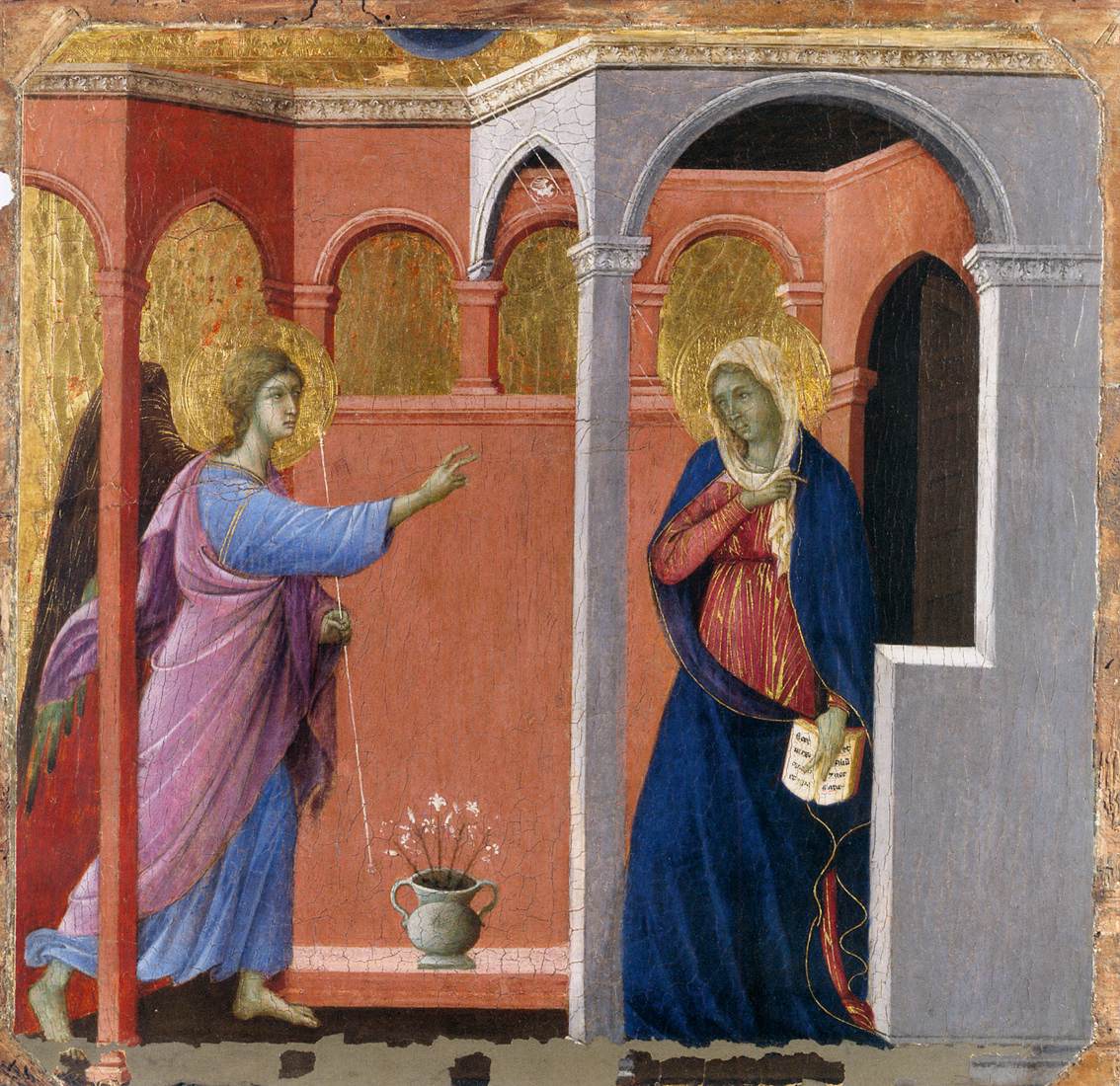
Annunciation

Duccio di Buoninsegna

1308-11
Tempera on wood, 43 x 44 cm
National Gallery, London

7 posted on 12/12/2024 3:21:31 AM PST by annalex (fear them not)
[ Post Reply | Private Reply | To 6 | View Replies]

To: annalex

St Finnian of Clonard: Teacher of Irish Saints

Saint Finnian of Clonard (470–549 AD) was a key figure in early Irish Christianity, often known as one of the "Fathers of Irish Monasticism."

Early Life of St Finnian

Finnian was born around 470 AD in Myshall, County Carlow, Ireland. Little is known about his early life, but it's believed that he received an excellent Christian education, possibly from Irish missionaries or monasteries in Wales, such as St. David's Monastery. During his time in Wales, Finnian was inspired by the monastic practices and learning traditions he encountered, particularly those associated with Saint Cadoc and Saint Gildas.

Founding of Clonard Monastery

In the early 6th century, Finnian returned to Ireland and established the Monastery of Clonard on the River Boyne, in what is today County Meath. Clonard rapidly became one of medieval Ireland's most important monastic schools, drawing students from across the island and beyond. At its peak, Clonard had up to 3,000 students studying scripture, theology, and various monastic disciplines.

St Finnian's most famous contribution to Irish Christianity was its role in training the Twelve Apostles of Ireland, a group of saints who became pivotal figures in spreading Christianity throughout the island. These included saints like St. Columba, St. Ciarán of Clonmacnoise, and St. Brendan the Navigator. These saints played key roles in establishing monasteries across Ireland and made the island a center of Christian learning during the early Middle Ages.

The model of monastic life that Finnian promoted at Clonard—focused on asceticism, communal living, and devotion to prayer and learning—became a template for other monasteries. Many of his students went on to found their own influential monastic communities, such as Clonmacnoise and Iona, which were central to Ireland’s Christian heritage.

Miracles of St Finnian

There are no extensive records of specific miracles attributed to St. Finnian of Clonard, unlike some other saints from his time. Some traditions hold that St. Finnian was known for his gift of healing. It is said that people would come to him for physical and spiritual healing, seeking his blessing and prayers. This reflects the common belief in the healing power of saints in early Christianity.

When Clonard Monastery was under threat from invading Vikings, Finnian prayed for divine protection. The legend suggests that, in response to his prayers, God protected the monastery from harm, safeguarding both the monks and the sacred grounds.

One of the most famous stories involving St. Finnian is connected to St. Columba (Colmcille). According to legend, St. Columba secretly copied a manuscript of the Psalms from St. Finnian's Bible while at Clonard. When Finnian discovered this, he demanded that the copy be returned, leading to the famous dispute that resulted in the Battle of Cúl Dreimhne (or the Battle of the Book). While not a miracle in itself, the event has taken on a legendary, almost mystical quality, highlighting Finnian's protective stance over sacred texts.

St. Finnian is often credited with having prophetic insight, especially when it came to recognizing the future greatness of his disciples. His ability to discern their potential and guide them on their spiritual journeys was seen as a divine gift. This prophetic insight is considered one of his spiritual "miracles" as a teacher and leader.

Death of St Finnian

Saint Finnian passed away in 549 AD, likely during a plague that swept through the region. His feast day is celebrated on December 12 when his role as a key figure in early Irish Christianity and his contributions to monasticism and the education of Ireland's saints is honoured.


yourirish.com
8 posted on 12/12/2024 3:29:43 AM PST by annalex (fear them not)
[ Post Reply | Private Reply | To 7 | View Replies]

To: annalex

9 posted on 12/12/2024 3:31:27 AM PST by annalex (fear them not)
[ Post Reply | Private Reply | To 8 | View Replies]

To: annalex
NAVARRE BIBLE COMMENTARY (RSV)

Ad Majorem Dei Gloriam (To the Greater Glory of God)

First Reading:

Zechariah 2:14-17

Third vision: The Measurer
---------------------------------
[10] Sing and rejoice, O daughter of Zion; for lo, I come and I will dwell in the midst of you, says the Lord. [11] And many nations shall join themselves to the Lord in that day, and shall be my people; and I will dwell in the midst of you, and you shall know that the Lord of hosts has sent me to you. [12] And the Lord will inherit Judah as his portion in the holy land, and will again choose Jerusalem."

[13] Be silent, all flesh, before the Lord; for he has roused himself from his holy dwelling.

**************************************************************************
Commentary:

2:1-13. What the prophet now sees and hears concerns the city of Jerusalem. It is going to be remodeled as an open city, without walls; its defence will be provided by God himself and therefore more people will be able to live there. The man with the measuring line is an angel, as are the other two figures mentioned. The idea of measuring the city in order to rebuild it is also found in Ezekiel 40-42 and Jeremiah 21:38-40 and, later, Revelation 11:1.

The vision is followed by an oracle (vv. 6-10) in which the Lord speaks through the angel. He invites the Jews to leave Babylon and return to the holy land. This is a call that is also found in Isaiah and Jeremiah (cf. Is 48:20; Jer 50:8; 51:6). It could be that some were reluctant to move. God promises that in Judah they will be safe from other nations because they are his beloved people, the "apple of his eye" (v. 8), and his angel will defend them. Moreover, he will settle there, and many nations will become his people (vv. 10-11).

Presence of the Lord, security against enemies and a way for the nations to become people of God – these are the features that Judah and Jerusalem will have following the return from exile. In this sense, they prefigure the Church. Commenting on v. 4, St Jerome points out: "Reading in a spiritual sense, all of these things are to be found in the Church, which is 'without walls', or, as the Septuagint puts it, 'katakarpos'; that is, filled with an abundance of fruit and a great multitude of men and asses […]. The men and the asses [cattle, animals] stand for the two people, the Jews and the Gentiles; those who came to faith in Christ through the fulfillment of the Law are called men; we, however, who were idolatrous and lived as though in a wilderness, being far from the Law, and alone, because of our distance from the prophets who suffered, are the asses […]. But these animals hear the voice of the good shepherd, and know him, and they follow him" ("Commentarii in Zachariam", 2, 4).

2:10. This call for rejoicing, similar to that made by the prophet Zephaniah (cf. Zeph 3:14) and one made later (9:9), is repeated in the angel Gabriel's greeting to the Blessed Virgin when he tells her that she is to conceive the Messiah (cf. Lk 1:28). That event will truly bring about what is said here, for Mary is "the mother of him in whom 'the whole fullness of deity dwells bodily' (Col 2:9)" ("Catechism of the Catholic Church", 722). Bl. John Paul II sees Mary, the Mother of the Redeemer, prefigured in the title "daughter of Zion" found here: "Her presence in the midst of Israel -- a presence so discreet as to pass almost unnoticed by the eyes of her contemporaries -- shone very clearly before the Eternal One, who had associated this hidden 'daughter of Sion' (cf. Zeph. 3:14; Zeph. 2:10) with the plan of salvation embracing the whole history of humanity" ("Redemptoris Mater", 3).

2:13. The "Catechism of the Catholic Church", 2143, interprets the silence as one "of loving adoration". This is the attitude that all will have when they see what God will do for Judah and Jerusalem; for Christians, it is the attitude they will have towards the incarnation, passion, death and resurrection of our Lord and towards what God does for his Church.

or:

From: Revelation 11:19a; 12:1-6a, 12a

The Sounding of the Seventh Trumpet
-----------------------------------
[19] Then God's temple in heaven was opened, and the ark of his covenant was seen within his temple.

The Woman Fleeing from the Dragon
---------------------------------
[1] And a great portent appeared in heaven, a woman clothed with the sun, with the moon under her feet, and on her head a crown of twelve stars; [2] she was with child and she cried out in her pangs of birth, in anguish for delivery [3] And another portent appeared in heaven; behold, a great red dragon, with seven heads and ten horns, and seven diadems upon his heads. [4] His tail swept down a third of the stars of heaven, and cast them to the earth. And the dragon stood before the woman who was about to bear a child, that he might devour her child when she brought it forth; [5] she brought forth a male child, one who is to rule all the nations with a rod of iron, but her child was caught up to God and to his throne, [6] and the woman fled into the wilderness, where she has a place prepared by God.

[10] And I heard a loud voice in heaven, saying, "Now the salvation and the power and the kingdom of our God and the authority of his Christ have come. [11] And they have conquered him by the blood of the Lamb and by the word of the testimony, for they loved not their lives even unto death. [12] Rejoice then, 0 heaven and you that dwell therein! "

***********************************************************************
Commentary:

19. The seer introduces the heavenly temple (the location par excellence of God's presence), paralleling the earlier mention of the temple of Jerusalem (cf. 11:1-2). The opening of the temple and the sight of the Ark of the Covenant show that the messianic era has come to an end and God's work of salvation has been completed. The ark was the symbol of Israel's election and salvation and of God's presence in the midst of his people. According to a Jewish tradition, reported in 2 Maccabees 2:4-8, Jeremiah placed the ark in a secret hiding place prior to the destruction of Jerusalem, and it would be seen again when the Messiah carne. The author of the Apocalypse uses this to assure us that God has not forgotten his covenant: he has sealed it definitively in heaven, where the ark is located.

Many early commentators interpreted the ark as a reference to Christ's sacred humanity, and St Bede explains that just as the manna was kept in the original ark, so Christ's divinity lies hidden in his sacred body (cf. "Explanatio Apocalypsis", 11, 19).

The heavenly covenant is the new and eternal one made by Jesus Christ (cf. Mt 26:26-29 and par.) which will be revealed to all at his second coming when the Church will triumph, as the Apocalypse goes on to describe. The presence of the ark in the heavenly temple symbolizes the sublimity of the messianic kingdom, which exceeds anything man could create. "The vigilant and active expectation of the coming of the Kingdom is also the expectation of a finally perfect justice for the living and the dead, for people of all times and places, a justice which Jesus Christ, installed as supreme Judge, will establish (cf. Mt 24:29-44, 46; Acts 10:42; 2 Cor 5: 10). This promise, which surpasses all human possibilities, directly concerns our life in this world. For true justice must include everyone; it must explain the immense load of suffering borne by all generations. In fact, without the resurrection of the dead and the Lord's judgment, there is no justice in the full sense of the term. The promise of the resurrection is freely made to meet the desire for true justice dwelling in the human heart" (SCDF, "Libertatis Conscientia", 60).

The thunder and lightning which accompany the appearance of the ark are reminiscent of the way God made his presence felt on Sinai; they reveal God's mighty intervention (cf. Rev 4:5; 8:5) which is now accompanied by the chastisement of the wicked, symbolized by the earthquake and hailstones (cf. Ex 9: 13-35).

1-17. We are now introduced to the contenders in the eschatological battles which mark the final confrontation between God and his adversary, the devil. The author uses three portents to describe the leading figures involved, and the war itself. The first is the woman and her offspring, including the Messiah (12:1-2); the second is the dragon, who will later transfer his power to the beasts (12:3); the third, the seven angels with the seven bowls (15:1).

Three successive confrontations with the dragon are described--1) that of the Messiah to whom the woman gives birth (12:1-6); 2) that of St Michael and his angels (12:7-12); and 3) that of the woman and the rest of her offspring (12:13-17) These confrontations should not be seen as being in chronological order. They are more like three distinct pictures placed side by side because they are closely connected: in each the same enemy, the devil, does battle with God's plans and with those whom God uses to carry them out.

1-2. The mysterious figure of the woman has been interpreted ever since the time of the Fathers of the Church as referring to the ancient people of Israel, or the Church of Jesus Christ, or the Blessed Virgin. The text supports all of these interpretations but in none do all the details fit. The woman can stand for the people of Israel, for it is from that people that the Messiah comes, and Isaiah compares Israel to "a woman with child, who writhes and cries out in her pangs when she is near her time" (Is 26:17).

She can also stand for the Church, whose children strive to overcome evil and to bear witness to Jesus Christ (cf. v. 17). Following this interpretation St Gregory wrote: "The sun stands for the light of truth, and the moon for the transitoriness of temporal things; the holy Church is clothed like the sun because she is protected by the splendor of supernatural truth, and she has the moon under her feet because she is above all earthly things" ("Moralia", 34, 12).

The passage can also refer to the Virgin Mary because it was she who truly and historically gave birth to the Messiah, Jesus Christ our Lord (cf. v. 5). St Bernard comments: "The sun contains permanent color and splendor; whereas the moon's brightness is unpredictable and changeable, for it never stays the same. It is quite right, then, for Mary to be depicted as clothed with the sun, for she entered the profundity of divine wisdom much further than one can possibly conceive" ("De B. Virgine", 2).

In his account of the Annunciation, St Luke sees Mary as representing the faithful remnant of Israel; the angel greets her with the greeting given in Zephaniah 3:15 to the daughter of Zion (cf. notes on Lk 1:26- 31). St Paul in Galatians 4:4 sees a woman as the symbol of the Church, our mother; and non-canonical Jewish literature contemporary with the Book of Revelation quite often personifies the community as a woman. So, the inspired text of the Apocalypse is open to interpreting this woman as a direct reference to the Blessed Virgin who, as mother, shares in the pain of Calvary (cf. Lk 2:35) and who was earlier prophesied in Isaiah 7:14 as a "sign" (cf. Mt 1:22-23). At the same time the woman can be interpreted as standing for the people of God, the Church, whom the figure of Mary represents.

The Second Vatican Council has solemnly taught that Mary is a "type" or symbol of the Church, for "in the mystery of the Church, which is itself rightly called mother and virgin, the Blessed Virgin stands out in eminent and singular fashion as exemplar both of virgin and mother. Through her faith and obedience she gave birth on earth to the very Son of the Father, not through the knowledge of man but by the overshadowing of the Holy Spirit, in the manner of a new Eve who placed her faith, not in the serpent of old but in God's messenger, without wavering in doubt. The Son whom she brought forth is he whom God placed as the first-born among many brethren (cf. Rom 8:29), that is, the faithful, in whose generation and formation she cooperates with a mother's love" (Vatican II, "Lumen Gentium", 63).

The description of the woman indicates her heavenly glory, and the twelve stars of her victorious crown symbolize the people of God—the twelve patriarchs (cf. Gen 37:9) and the twelve apostles. And so, independently of the chronological aspects of the text, the Church sees in this heavenly woman the Blessed Virgin, "taken up body and soul into heavenly glory, when her earthly life was over, and exalted by the Lord as Queen over all things, that she might be the more fully conformed to her Son, the Lord of lords (cf. Rev 19:16) and conqueror of sin and death" ("Lumen Gentium", 59). The Blessed Virgin is indeed the great sign, for, as St Bonaventure says, "God could have made none greater. He could have made a greater world and a greater heaven; but not a woman greater than his own mother" ("Speculum", 8).

3-4. In his description of the devil (cf. v. 9), St John uses symbols taken from the Old Testament. The dragon or serpent comes from Genesis 3:1-24, a passage which underlies all the latter half of this book. Its red color and seven heads with seven diadems show that it is bringing its full force to bear to wage this war. The ten horns in Daniel 7:7 stand for the kings who are Israel's enemies; in Daniel a horn is also mentioned to refer to Antiochus IV Epiphanes, of whom Daniel also says (to emphasize the greatness of Antiochus' victories) that it cast stars down from heaven onto the earth (cf. Dan 8:10). Satan drags other angels along with him, as the text later recounts (Rev 12:9). All these symbols, then, are designed to convey the enormous power of Satan. "The devil is described as a serpent", St Cyprian writes, "because he moves silently and seems peaceable and comes by easy ways and is so astute and so deceptive [...] that he tries to have night taken for day, poison taken for medicine. So, by deceptions of this kind, he tries to destroy truth by cunning. That is why he passes himself off as an angel of light" ("De Unitate Ecclesiae", I-III).

After the fall of our first parents war broke out between the serpent and his seed and the woman and hers: "I will put enmity between you and the woman, between your seed and her seed; he shall bruise your head, and you shall bruise his heel" (Gen 3:15). Jesus Christ is the woman's descendant who will obtain victory over the devil (cf. Mk 1:23-26; Lk 4:31-37; etc.). That is why the power of evil concentrates all his energy on destroying Christ (cf. Mt 2:13-18) or to deflecting him from his mission (cf. Mt 4:1-11 and par.). By relating this enmity to the beginnings of the human race St. John paints a very vivid picture.

5. The birth of Jesus Christ brings into operation the divine plan announced by the prophets (cf. Is 66:7) and by the Psalms (cf. Ps 2:9), and marks the first step in ultimate victory over the devil. Jesus' life on earth, culminating in his passion, resurrection and ascension into heaven, was the key factor in achieving this victory. St John emphasizes the triumph of Christ as victor, who, as the Church confesses, "sits at the right hand of the Father" ("Nicene-Constantinopolitan Creed").

6. The figure of the woman reminds us of the Church, the people of God. Israel took refuge in the wilderness to escape from Pharaoh, and the Church does the same after the victory of Christ. The wilderness stands for solitude and intimate union with God. In the wilderness God took personal care of his people, setting them free from their enemies (cf. Ex 17:8-16) and nourishing them with quail and manna (cf. Ex 16:1-36). The Church is given similar protection against the powers of hell (cf. Mt 16:18) and Christ nourishes it with his body and his word all the while it makes its pilgrimage through the ages; it has a hard time (like Israel in the wilderness) but there will be an end to it: it will take one thousand two hundred and sixty days (cf. notes on 11:3).

Although the woman, in this verse, seems to refer directly to the Church, she also in some way stands for the particular woman who gave birth to the Messiah, the Blessed Virgin. As no other creature has done, Mary has enjoyed a very unique type of union with God and very special protection from the powers of evil, death included. Thus, as the Second Vatican Council teaches, "in the meantime [while the Church makes its pilgrim way on earth], the Mother of Jesus in the glory which she possesses in body and soul in heaven is the image and beginning of the Church as it is to be perfected in the world to come. Likewise she shines forth on earth, until the day of the Lord shall come (cf. 2 Pet 3:10), a sign of certain hope and comfort to the pilgrim people of God" ("Lumen Gentium", 68).

10-12. With the ascension of Christ into heaven the Kingdom of God is established and so all those who dwell in heaven break out into a song of joy. The devil has been deprived of his power over man in the sense that the redemptive action of Christ and man's faith enable man to escape from the world of sin. The text expresses this joyful truth by saying that there is now no place for the accuser, Satan whose name means and whom the Old Testament teaches to be the accuser of men before God: cf. Job 1:6-12; 2:1-10). Given what God meant creation to be, Satan could claim as his victory anyone who, through sinning, disfigured the image and likeness of God that was in him. However, once the Redemption has taken place, Satan no longer has power to do this, for, as St John writes, "if any one does sin, we have an advocate with the Father, Jesus Christ the righteous; and he is the expiation for our sins, and not for ours only but also for the sins of the whole world" (Jn 2:1-2). Also, on ascending into heaven, Christ sent us the Holy Spirit as "Intercessor and Advocate, especially when man, that is, mankind, find themselves before the judgment of condemnation by that 'accuser' about whom the Book of Revelation says that 'he accuses them day and night before our God"' (John Paul II, "Dominum Et Vivificantem", 67).

Although Satan has lost this power to act in the world, he still has time left, between the resurrection of our Lord and the end of history, to put obstacles in man's way and frustrate Christ's action. And so he works ever more frenetically, as he sees time run out, in his effort to distance everyone and society itself from the plans and commandments of God.

The author of the Book of Revelation uses this celestial chant to warn the Church of the onset of danger as the End approaches.

10 posted on 12/12/2024 8:15:24 AM PST by fidelis (Ecce Crucem Domini! Fugite partes adversae! Vicit Leo de tribu Juda, Radix David! Alleluia!)
[ Post Reply | Private Reply | To 9 | View Replies]

Gospel Reading:

From: Luke 1:26-38

The Annunciation and Incarnation of the Son of God
--------------------------------------------------
[26] In the sixth month the angel Gabriel was sent from God to a city of Galilee named Nazareth, [27] to a virgin betrothed to a man whose name was Joseph, of the house of David; and the virgin's name was Mary. [28] And he came to her and said, "Hail, full of grace, the Lord is with you!" [29] But she was greatly troubled at the saying, and considered in her mind what sort of greeting this might be. [30] And the angel said to her, "Do not be afraid, Mary, for you have found favor with God. [31] And behold, you will conceive in your womb and bear a son, and you shall call His name Jesus. [32] He will be great, and will be called the Son of the Most High; and the Lord God will give to Him the throne of His father David, [33] and He will reign over the house of Jacob for ever; and of His Kingdom there will be no end." [34] And Mary said to the angel, "How can this be, since I have no husband?" [35] And the angel said to her, "The Holy Spirit will come upon you, and the power of the Most High will overshadow you; therefore the child to be born will be called holy, the Son of God. [36] And behold, your kinswoman Elizabeth in her old age has also conceived a son; and this is the sixth month with her who was called barren. [37] For with God nothing will be impossible." [38] And Mary said, "Behold, I am the handmaid of the Lord; let it be done to me according to your word." And the angel departed from her.

***********************************************************************
Commentary:

26-38. Here we contemplate our Lady who was "enriched from the first instant of her conception with the splendor of an entirely unique holiness; [...] the virgin of Nazareth is hailed by the heralding angel, by divine command, as `full of grace' (cf. Luke 1:28), and to the heavenly messenger she replies, `Behold the handmaid of the Lord, be it done unto me according to thy word' (Luke 1:38). Thus the daughter of Adam, Mary, consenting to the word of God, became the Mother of Jesus. Committing herself wholeheartedly to God's saving will and impeded by no sin, she devoted herself totally, as a handmaid of the Lord, to the person and work of her Son, under and with Him, serving the mystery of Redemption, by the grace of Almighty God. Rightly, therefore, the Fathers (of the Church) see Mary not merely as passively engaged by God, but as freely cooperating in the work of man's salvation through faith and obedience" (Vatican II, "Lumen Gentium", 56).

The annunciation to Mary and incarnation of the Word constitute the deepest mystery of the relationship between God and men and the most important event in the history of mankind: God becomes man, and will remain so forever, such is the extent of His goodness and mercy and love for all of us. And yet on the day when the Second Person of the Blessed Trinity assumed frail human nature in the pure womb of the Blessed Virgin, it all happened quietly, without fanfare of any kind.

St. Luke tells the story in a very simple way. We should treasure these words of the Gospel and use them often, for example, practicing the Christian custom of saying the Angelus every day and reflecting on the five Joyful Mysteries of the Rosary.

27. God chose to be born of a virgin; centuries earlier He disclosed this through the prophet Isaiah (cf. Isaiah 7:14; Matthew 1:22-23). God, "before all ages made choice of, and set in her proper place, a mother for His only-begotten Son from whom He, after being made flesh, should be born in the blessed fullness of time: and He continued His persevering regard for her in preference to all other creatures, to such a degree that for her alone He had singular regard" (Pius IX, "Ineffabilis Deus," 2). This privilege granted to our Lady of being a virgin and a mother at the same time is a unique gift of God. This was the work of the Holy Spirit "who at the conception and the birth of the Son so favored the Virgin Mother as to impart fruitfulness to her while preserving inviolate her perpetual virginity" ("St. Pius V Catechism," I, 4, 8). Paul VI reminds us of this truth of faith: "We believe that the Blessed Mary, who ever enjoys the dignity of virginity, was the Mother of the incarnate Word, of our God and Savior Jesus Christ" ("Creed of the People of God", 14).

Although many suggestions have been made as to what the name Mary means, most of the best scholars seem to agree that Mary means "lady". However, no single meaning fully conveys the richness of the name.

28. "Hail, full of grace": literally the Greek text reads "Rejoice!", obviously referring to the unique joy over the news which the angel is about to communicate.

"Full of grace": by this unusual form of greeting the archangel reveals Mary's special dignity and honor. The Fathers and Doctors of the Church "taught that this singular, solemn and unheard-of-greeting showed that all the divine graces reposed in the Mother of God and that she was adorned with all the gifts of the Holy Spirit", which meant that she "was never subject to the curse", that is, was preserved from all sin. These words of the archangel in this text constitute one of the sources which reveal the dogma of Mary's Immaculate Conception (cf. Pius IX, "Ineffabilis Deus"; Paul VI, "Creed of the People of God").

"The Lord is with you!": these words are not simply a greeting ("the Lord be with you") but an affirmation ("the Lord is with you"), and they are closely connected with the Incarnation. St. Augustine comments by putting these words on the archangel's lips: "He is more with you than He is with me: He is in your heart, He takes shape within you, He fills your soul, He is in your womb" ("Sermo De Nativitate Domini", 4).

Some important Greek manuscripts and early translations add at the end of the verse: "Blessed are you among women!", meaning that God will exalt Mary over all women. She is more excellent than Sarah, Hannah, Deborah, Rachel, Judith, etc., for only she has the supreme honor of being chosen to be the Mother of God.

29-30. Our Lady is troubled by the presence of the archangel and by the confusion truly humble people experience when they receive praise.

30. The Annunciation is the moment when our Lady is given to know the vocation which God planned for her from eternity. When the archangel sets her mind at ease by saying, "Do not be afraid, Mary," he is helping her to overcome that initial fear which a person normally experiences when God gives him or her a special calling. The fact that Mary felt this fear does not imply the least trace of imperfection in her: hers is a perfectly natural reaction in the face of the supernatural. Imperfection would arise if one did not overcome this fear or rejected the advice of those in a position to help--as St. Gabriel helped Mary.

31-33. The archangel Gabriel tells the Blessed Virgin Mary that she is to be the Mother of God by reminding her of the words of Isaiah which announced that the Messiah would be born of a virgin, a prophecy which will find its fulfillment in Mary (cf. Matthew 1:22-23; Isaiah 7:14).

He reveals that the Child will be "great": His greatness comes from His being God, a greatness He does not lose when He takes on the lowliness of human nature. He also reveals that Jesus will be the king of the Davidic dynasty sent by God in keeping with His promise of salvation; that His Kingdom will last forever, for His humanity will remain forever joined to His divinity; that "He will be called Son of the Most High", that is that He really will be the Son of the Most High and will be publicly recognized as such, that is, the Child will be the Son of God.

The archangel's announcement evokes the ancient prophecies which foretold these prerogatives. Mary, who was well-versed in Sacred Scripture, clearly realized that she was to be the Mother of God.

34-38. Commenting on this passage John Paul II said: "`Virgo fidelis', the faithful Virgin. What does this faithfulness of Mary mean? What are the dimensions of this faithfulness? The first dimension is called search. Mary was faithful first of all when she began, lovingly, to seek the deep sense of God's plan in her and for the world. `Quomodo fiet?' How shall this be?, she asked the Angel of the Annunciation [...]."

"The second dimension of faithfulness is called reception, acceptance. The `quomodo fiet?' is changed, on Mary's lips, to a `fiat': Let it be done, I am ready, I accept. This is the crucial moment of faithfulness, the moment in which man perceives that he will never completely understand the `how': that there are in God's plan more areas of mystery than of clarity; that is, however he may try, he will never succeed in understanding it completely[...]."

"The third dimension of faithfulness is consistency to live in accordance with what one believes; to adapt one's own life to the object of one's adherence. To accept misunderstanding, persecutions, rather than a break between what one practises and what one believes: this is consistency[...]."

"But all faithfulness must pass the most exacting test, that of duration. Therefore, the fourth dimension of faithfulness is constancy. It is easy to be consistent for a day or two. It is difficult and important to be consistent for one's whole life. It is easy to be consistent in the hour of enthusiasm, it is difficult to be so in the hour of tribulation. And only a consistency that lasts throughout the whole life can be called faithfulness. Mary's `fiat' in the Annunciation finds its fullness in the silent `fiat' that she repeats at the foot of the Cross" ("Homily in Mexico City Cathedral", 26 January 1979).

34. Mary believed in the archangel's words absolutely; she did not doubt as Zechariah had done (cf. 1:18). Her question, "How can this be?", expresses her readiness to obey the will of God even though at first sight it implied a contradiction: on the one hand, she was convinced that God wished her to remain a virgin; on the other, here was God also announcing that she would become a mother. The archangel announces God's mysterious design, and what had seemed impossible, according to the laws of nature, is explained by a unique intervention on the part of God.

Mary's resolution to remain a virgin was certainly something very unusual, not in line with the practice of righteous people under the Old Covenant, for, as St. Augustine explains, "particularly attentive to the propagation and growth of the people of God, through whom the Prince and Savior of the world might be prophesied and be born, the saints were obliged to make use of the good of matrimony" ("De Bono Matrimonii", 9, 9). However, in the Old Testament, there were some who, in keeping with God's plan, did remain celibate--for example, Jeremiah, Elijah, Eliseus and John the Baptist. The Blessed Virgin, who received a very special inspiration of the Holy Spirit to practise virginity, is a first-fruit of the New Testament, which will establish the excellence of virginity over marriage while not taking from the holiness of the married state, which it raises to the level of a sacrament (cf. "Gaudium Et Spes", 48).

35. The "shadow" is a symbol of the presence of God. When Israel was journeying through the wilderness, the glory of God filled the Tabernacle and a cloud covered the Ark of the Covenant (Exodus 40:34-36). And when God gave Moses the tablets of the Law, a cloud covered Mount Sinai (Exodus 24:15-16); and also, at the Transfiguration of Jesus the voice of God the Father was heard coming out of a cloud (Luke 9:35).

At the moment of the Incarnation the power of God envelops our Lady—an expression of God's omnipotence. The Spirit of God--which, according to the account in Genesis (1:2), moved over the face of the waters, bringing things to life--now comes down on Mary. And the fruit of her womb will be the work of the Holy Spirit. The Virgin Mary, who herself was conceived without any stain of sin (cf. Pius IX, "Ineffabilis Deus") becomes, after the Incarnation, a new tabernacle of God. This is the mystery we recall every day when saying the Angelus.

38. Once she learns of God's plan, our Lady yields to God's will with prompt obedience, unreservedly. She realizes the disproportion between what she is going to become--the Mother of God--and what she is—a woman. However, this is what God wants to happen and for Him nothing is impossible; therefore no one should stand in His way. So Mary, combining humility and obedience, responds perfectly to God's call: "Behold, I am the handmaid of the Lord; let it be done according to your word."

"At the enchantment of this virginal phrase, the Word became flesh" (St J. Escriva, "Holy Rosary", first joyful mystery). From the pure body of Mary, God shaped a new body, He created a soul out of nothing, and the Son of God united Himself with this body and soul: prior to this He was only God; now He is still God but also man. Mary is now the Mother of God. This truth is a dogma of faith, first defined by the Council of Ephesus (431). At this point she also begins to be the spiritual Mother of all mankind. What Christ says when He is dying--`Behold, your son..., behold, your mother" (John 19:26-27)--simply promulgates what came about silently at Nazareth. "With her generous `fiat' (Mary) became, through the working of the Spirit, the Mother of God, but also the Mother of the living, and, by receiving into her womb the one Mediator, she became the true Ark of the Covenant and true Temple of God" (Paul VI, "Marialis Cultus", 6).

The Annunciation shows us the Blessed Virgin as perfect model of "purity" (the RSV "I have no husband" is a euphemism); of "humility" ("Behold, I am the handmaid of the Lord"); of "candor" and "simplicity" ("How can this be?"); of "obedience" and "lively faith" ("Let it be done to me according to your word"). "Following her example of obedience to God, we can learn to serve delicately without being slavish. In Mary, we don't find the slightest trace of the attitude of the foolish virgins, who obey, but thoughtlessly. Our Lady listens attentively to what God wants, ponders what she doesn't fully understand and asks about what she doesn't know. Then she gives herself completely to doing the divine will: `Behold I am the handmaid of the Lord; let it be done to me according to your word'. Isn't that marvellous? The Blessed Virgin, our teacher in all we do, shows us here that obedience to God is not servile, does not bypass our conscience. We should be inwardly moved to discover the `freedom of the children of God' (cf. Romans 8:21)" (St J. Escriva, "Christ Is Passing By", 173).

or:

From: Luke 1:39-47

The Visitation
----------------
[39] In those days Mary arose and went with haste into the hill country, to a city of Judah, [40] and she entered the house of Zechariah and greeted Elizabeth. [41] And when Elizabeth heard the greeting of Mary, the babe leaped in her womb; and Elizabeth was filled with the Holy Spirit [42] and she exclaimed with a loud cry, "Blessed are you among women, and blessed is the fruit of your womb! [43] And why is this granted me, that the mother of my Lord should come to me? [44] For behold, when the voice of your greeting came to my ears, the babe in my womb leaped for joy. [45] And blessed is she who believed that there would be a fulfillment of what was spoken to her from the Lord."

The Magnificat
------------------
[46] And Mary said, "My soul magnifies the Lord, [47] and my spirit rejoices in God my Savior,

***********************************************************************
Commentary:

39-56. We contemplate this episode of our Lady's visit to her cousin St. Elizabeth in the Second Joyful Mystery of the Rosary: "Joyfully keep Joseph and Mary company...and you will hear the traditions of the House of David.... We walk in haste towards the mountains, to a town of the tribe of Judah (Luke 1:39).

"We arrive. It is the house where John the Baptist is to be born. Elizabeth gratefully hails the Mother of her Redeemer: Blessed are you among women, and blessed is the fruit of your womb. Why should I be honored with a visit from the mother of my Lord? (Luke 1:42-43).

"The unborn Baptist quivers...(Luke 1:41). Mary's humility pours forth in the "Magnificat".... And you and I, who are proud--who were proud--promise to be humble" (St J. Escriva, "Holy Rosary").

39. On learning from the angel that her cousin St. Elizabeth is soon to give birth and is in need of support, our Lady in her charity hastens to her aid. She has no regard for the difficulties this involves. Although we do not know where exactly Elizabeth was living (it is now thought to be Ain Karim), it certainly meant a journey into the hill country which at that time would have taken four days.

From Mary's visit to Elizabeth Christians should learn to be caring people. "If we have this filial contact with Mary, we won't be able to think just about ourselves and our problems. Selfish personal problems will find no place in our mind" (St J. Escriva, "Christ Is Passing By," 145).

42. St. Bede comments that Elizabeth blesses Mary using the same words as the archangel "to show that she should be honored by angels and by men and why she should indeed be revered above all other women" ("In Lucae Evangelium Expositio, in loc.").

When we say the "Hail Mary" we repeat these divine greetings, "rejoicing with Mary at her dignity as Mother of God and praising the Lord, thanking Him for having given us Jesus Christ through Mary" ("St. Pius X Catechism", 333).

43. Elizabeth is moved by the Holy Spirit to call Mary "the mother of my Lord", thereby showing that Mary is the Mother of God.

44. Although he was conceived in sin--original sin--like other men, St. John the Baptist was born sinless because he was sanctified in his mother's womb by the presence of Jesus Christ (then in Mary's womb) and of the Blessed Virgin. On receiving this grace of God St. John rejoices by leaping with joy in his mother's womb--thereby fulfilling the archangel's prophecy (cf. Luke 1:15).

St. John Chrysostom comments on this scene of the Gospel: "See how new and how wonderful this mystery is. He has not yet left the womb but he speaks by leaping; he is not yet allowed to cry out but he makes himself heard by his actions [...]; he has not yet seen the light but he points out the Sun; he has not yet been born and he is keen to act as Precursor. The Lord is present, so he cannot contain himself or wait for nature to run its course: he wants to break out of the prison of his mother's womb and he makes sure he witnesses to the fact that the Savior is about to come" ("Sermo Apud Metaphr., Mense Julio").

45. Joining the chorus of all future generations, Elizabeth, moved by the Holy Spirit, declares the Lord's Mother to be blessed and praises her faith. No one ever had faith to compare with Mary's; she is the model of the attitude a creature should have towards its Creator--complete submission, total attachment. Through her faith, Mary is the instrument chosen by God to bring about the Redemption; as Mediatrix of all graces, she is associated with the redemptive work of her Son: "This union of the Mother with the Son in the work of salvation is made manifest from the time of Christ's virginal conception up to His death; first when Mary, arising in haste to go to visit Elizabeth, is greeted by her as blessed because of her belief in the promise of salvation and the Precursor leaps with joy in the womb of his mother [...]. The Blessed Virgin advanced in her pilgrimage of faith and faithfully persevered in her union with her Son unto the cross, where she stood (cf. John 19:25), in keeping with the Divine Plan, enduring with her only-begotten Son the intensity of His suffering, associating herself with His sacrifice in her mother's heart, and lovingly consenting to the immolation of this Victim which was born of her" (Vatican II, "Lumen Gentium", 57f).

The new Latin text gives a literal rendering of the original Greek when it says "quae credidit" (RSV "she who has believed") as opposed to the Vulgate "quae credidisti" ("you who have believed") which gave more of the sense than a literal rendering.

46-55. Mary's "Magnificat" canticle is a poem of singular beauty. It evokes certain passages of the Old Testament with which she would have been very familiar (especially 1 Samuel 2:1-10).

Three stanzas may be distinguished in the canticle: in the first (verses 46-50) Mary glorifies God for making her the Mother of the Savior, which is why future generations will call her blessed; she shows that the Incarnation is a mysterious expression of God's power and holiness and mercy. In the second (verses 51-53) she teaches us that the Lord has always had a preference for the humble, resisting the proud and boastful. In the third (verses 54-55) she proclaims that God, in keeping with His promise, has always taken care of His chosen people--and now does them the greatest honor of all by becoming a Jew (cf. Romans 1:3).

"Our prayer can accompany and imitate this prayer of Mary. Like her, we feel the desire to sing, to acclaim the wonders of God, so that all mankind and all creation may share our joy" (St. J. Escriva, "Christ Is Passing By", 144).

46-47. "The first fruits of the Holy Spirit are peace and joy. And the Blessed Virgin had received within herself all the grace of the Holy Spirit" (St. Basil, "In Psalmos Homilae", on Psalm 32). Mary's soul overflows in the words of the "Magnificat". God's favors cause every humble soul to feel joy and gratitude. In the case of the Blessed Virgin, God has bestowed more on her than on any other creature. "Virgin Mother of God, He whom the heavens cannot contain, on becoming man, enclosed Himself within your womb" ("Roman Missal", Antiphon of the Common of the Mass for Feasts of Our Lady). The humble Virgin of Nazareth is going to be the Mother of God; the Creator's omnipotence has never before manifested itself in as complete a way as this.

11 posted on 12/12/2024 8:15:45 AM PST by fidelis (Ecce Crucem Domini! Fugite partes adversae! Vicit Leo de tribu Juda, Radix David! Alleluia!)
[ Post Reply | Private Reply | To 10 | View Replies]

Click here to go to the My Catholic Life! Devotional thread for a meditation on today’s Gospel Reading.

12 posted on 12/12/2024 8:16:45 AM PST by fidelis (Ecce Crucem Domini! Fugite partes adversae! Vicit Leo de tribu Juda, Radix David! Alleluia!)
[ Post Reply | Private Reply | To 11 | View Replies]

Disclaimer: Opinions posted on Free Republic are those of the individual posters and do not necessarily represent the opinion of Free Republic or its management. All materials posted herein are protected by copyright law and the exemption for fair use of copyrighted works.

Free Republic
Browse · Search
Religion
Topics · Post Article

FreeRepublic, LLC, PO BOX 9771, FRESNO, CA 93794
FreeRepublic.com is powered by software copyright 2000-2008 John Robinson