Posted on 12/11/2024 5:24:07 AM PST by annalex
Wednesday of the 2nd week of Advent San Lorenzo in Damaso, Rome, burial place of Saint Damasus I Readings at MassLiturgical Colour: Violet. Year: C(I).
The Lord strengthens the powerless‘To whom could you liken me and who could be my equal?’ says the Holy One. Lift your eyes and look. Who made these stars if not he who drills them like an army, calling each one by name? So mighty is his power, so great his strength, that not one fails to answer. How can you say, Jacob, how can you insist, Israel, ‘My destiny is hidden from the Lord, my rights are ignored by my God’? Did you not know? Had you not heard? The Lord is an everlasting God, he created the boundaries of the earth. He does not grow tired or weary, his understanding is beyond fathoming. He gives strength to the wearied, he strengthens the powerless. Young men may grow tired and weary, youths may stumble, but those who hope in the Lord renew their strength, they put out wings like eagles. They run and do not grow weary, walk and never tire.
My soul, give thanks to the Lord. My soul, give thanks to the Lord all my being, bless his holy name. My soul, give thanks to the Lord and never forget all his blessings. My soul, give thanks to the Lord. It is he who forgives all your guilt, who heals every one of your ills, who redeems your life from the grave, who crowns you with love and compassion. My soul, give thanks to the Lord. The Lord is compassion and love, slow to anger and rich in mercy. He does not treat us according to our sins nor repay us according to our faults. My soul, give thanks to the Lord.
Alleluia, alleluia! Behold, our Lord will come with power and will enlighten the eyes of his servants. Alleluia!
Alleluia, alleluia! Look, the Lord will come to save his people. Blessed those who are ready to meet him. Alleluia!
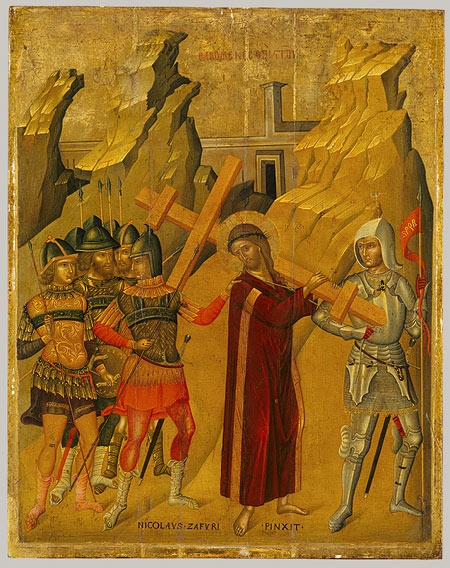
My yoke is easy and my burden lightJesus said, ‘Come to me, all you who labour and are overburdened, and I will give you rest. Shoulder my yoke and learn from me, for I am gentle and humble in heart, and you will find rest for your souls. Yes, my yoke is easy and my burden light.’ Nothing has changedIn England, Wales and Scotland, the translation of the readings used at Mass has changed. Your current calendar setting is “United States”, so you have not been affected by this change. This message will disappear at the end of December. Christian Art![]() Each day, The Christian Art website gives a picture and reflection on the Gospel of the day. The readings on this page are from the Jerusalem Bible, which is used at Mass in most of the English-speaking world. The New American Bible readings, which are used at Mass in the United States, are available in the Universalis apps, programs and downloads. |
KEYWORDS: advent; catholic; mt11; prayer;

Please FReepmail me to get on/off the Alleluia Ping List.
| Matthew | |||
| English: Douay-Rheims | Latin: Vulgata Clementina | Greek NT: Byzantine/Majority Text (2000) | |
| Matthew 11 | |||
| 28. | Come to me, all you that labour, and are burdened, and I will refresh you. | Venite ad me omnes qui laboratis, et onerati estis, et ego reficiam vos. | δευτε προς με παντες οι κοπιωντες και πεφορτισμενοι καγω αναπαυσω υμας |
| 29. | Take up my yoke upon you, and learn of me, because I am meek, and humble of heart: and you shall find rest to your souls. | Tollite jugum meum super vos, et discite a me, quia mitis sum, et humilis corde : et invenietis requiem animabus vestris. | αρατε τον ζυγον μου εφ υμας και μαθετε απ εμου οτι πραος ειμι και ταπεινος τη καρδια και ευρησετε αναπαυσιν ταις ψυχαις υμων |
| 30. | For my yoke is sweet and my burden light. | Jugum enim meum suave est, et onus meum leve. | ο γαρ ζυγος μου χρηστος και το φορτιον μου ελαφρον εστιν |

11:28–30
28. Come unto me, all ye that labour and are heavy laden, and I will give you rest.
29. Take my yoke upon you, and learn of me; for I am meek and lowly in heart: and ye shall find rest unto your souls.
30. For my yoke is easy, and my burden is light.
CHRYSOSTOM. By what He had said, He brought His disciples to have a desire towards Him, shewing them His unspeakable excellence; and now He invites them to Him, saying, Come unto me, all ye that labour and are heavy laden.
AUGUSTINE. (Serm. 69. 1.) Whence do we all thus labour, but that we are mortal men, bearing vessels of clay which cause us much difficulty. But if the vessels of flesh are straitened, the regions of love will be enlarged. To what end then does He say, Come unto me, all ye that labour, but that ye should not labour?
HILARY. He calls to Him those that were labouring under the hardships of the Law, and those who are burdened with the sins of this world.
JEROME. That the burden of sin is heavy the Prophet Zachariah bears witness, saying, that wickedness sitteth upon a talent of lead. (Zech. 5:7.) And the Psalmist fills it up, Thy iniquities are grown heavy upon me. (Ps. 38:4)
GREGORY. (Mor. xxx. 15.) For a cruel yoke and hard weight of servitude it is to be subject to the things of time, to be ambitious of the things of earth, to cling to falling things, to seek to stand in things that stand not, to desire things that pass away, but to be unwilling to pass away with them. For while all things fly away against our wish, those things which had first harassed the mind in desire of gaining them, now oppress it with fear of losing them.
CHRYSOSTOM. He said not, Come ye, this man and that man, but All whosoever are in trouble, in sorrow, or in sin, not that I may exact punishment of you, but that I may remit your sins. Come ye, not that I have need of your glory, but that I seek your salvation. And I will refresh you; not, I will save you, only; but that is much greater, I will refresh you, that is, I will set you in all quietness.
RABANUS. (non occ.) I will not only take from you your burden, but will satisfy you with inward refreshment.
REMIGIUS. Come, He says, not with the feet, but with the life, not in the body, but in faith. For that is a spiritual approach by which any man approaches God; and therefore it follows, Take my yoke upon you.
RABANUS. The yoke of Christ is Christ’s Gospel, which joins and yokes together Jews and Gentiles in the unity of the faith. This we are commanded to take upon us, that is, to have in honour; lest perchance setting it beneath us, that is wrongly despising it, we should trample upon it with the miry feet of unholiness; wherefore He adds, Learn of me.
AUGUSTINE. (Serm. 69. 1.) Not to create a world, or to do miracles in that world; but that I am meek and lowly in heart. Wouldest thou be great? Begin with the least. Wouldest thou build up a mighty fabric of greatness? First think of the foundation of humility; for the mightier building any seeks to raise, the deeper let him dig for his foundation. Whither is the summit of our building to rise? To the sight of God.
RABANUS. We must learn then from our Saviour to be meek in temper, and lowly in mind; let us hurt none, let us despise none, and the virtues which we have shewn in deed let us retain in our heart.
CHRYSOSTOM. And therefore in beginning the Divine Law He begins with humility, and sets before us a great reward, saying, And ye shall find rest for your souls. This is the highest reward, you shall not only be made useful to others, but shall make yourself to have peace; and He gives you the promise of it before it comes, but when it is come, you shall rejoice in perpetual rest. And that they might not be afraid because He had spoken of a burden, therefore He adds, For my yoke is pleasant, and my burden light.
HILARY. He holds forth the inducements of a pleasant yoke, and a light burden, that to them that believe He may afford the knowledge of that good which He alone knoweth in the Father.
GREGORY. (Mor. iv. 33.) What burden is it to put upon the neck of our mind that He bids us shun all desire that disturbs, and turn from the toilsome paths of this world?
HILARY. And what is more pleasant than that yoke, what lighter than that burden? To be made better, to abstain from wickedness, to choose the good, and refuse the evil, to love all men, to hate none, to gain eternal things, not to be taken with things present, to be unwilling to do that to another which yourself would be pained to suffer.
RABANUS. But how is Christ’s yoke pleasant, seeing it was said above, Narrow is the way which leadeth unto life? (Mat. 7:14.) That which is entered upon by a narrow entrance is in process of time made broad by the unspeakable sweetness of love.
AUGUSTINE. (Serm. 70. 1.) So then they who with unfearing neck have submitted to the yoke of the Lord endure such hardships and dangers, that they seem to be called not from labour to rest, but from rest to labour. But the Holy Spirit was there who, as the outward man decayed, renewed the inward man day by day, and giving a foretaste of spiritual rest in the rich pleasures of God in the hope of blessedness to come, smoothed all that seemed rough, lightened all that was heavy. Men suffer amputations and burnings, that at the price of sharper pain they may be delivered from torments less but more lasting, as boils or swellings. What storms and dangers will not merchants undergo that they may acquire perishing riches? Even those who love not riches endure the same hardships; but those that love them endure the same, but to them they are not hardships. For love makes right easy, and almost nought all things however dreadful and monstrous. How much more easily then does love do that for true happiness, which avarice does for misery as far as it can?
JEROME. And how is the Gospel lighter than the Law, seeing in the Law murder and adultery, but under the Gospel anger and concupiscence also, are punished? Because by the Law many things are commanded which the Apostle fully teaches us cannot be fulfilled; by the Law works are required, by the Gospel the will is sought for, which even if it goes not into act, yet does not lose its reward. The Gospel commands what we can do, as that we lust not; this is in our own power; the Law punishes not the will but the act, as adultery. Suppose a virgin to have been violated in time of persecution; as here was not the will she is held as a virgin under the Gospel; under the Law she is cast out as defiled.
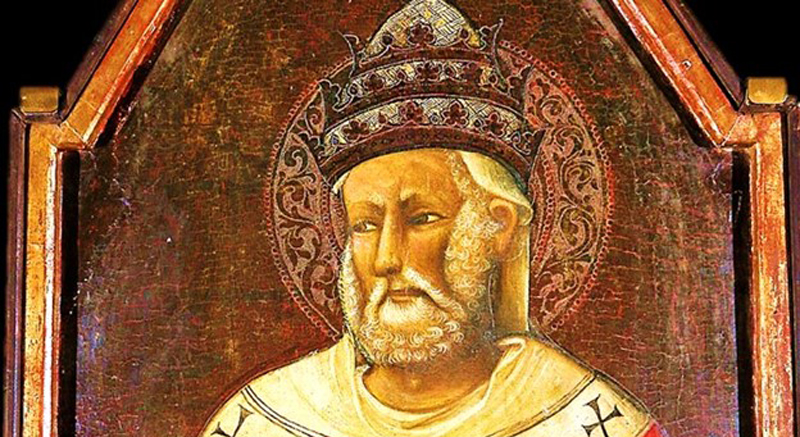
Saint Damasus I’s Story
To his secretary Saint Jerome, Damasus was “an incomparable person, learned in the Scriptures, a virgin doctor of the virgin Church, who loved chastity and heard its praises with pleasure.” Damasus seldom heard such unrestrained praise. Internal political struggles, doctrinal heresies, uneasy relations with his fellow bishops and those of the Eastern Church marred the peace of his pontificate.
The son of a Roman priest, possibly of Spanish extraction, Damasus started as a deacon in his father’s church, and served as a priest in what later became the basilica of San Lorenzo in Rome. He served Pope Liberius (352-366) and followed him into exile.
When Liberius died, Damasus was elected bishop of Rome; but a minority elected and consecrated another deacon, Ursinus, as pope. The controversy between Damasus and the antipope resulted in violent battles in two basilicas, scandalizing the bishops of Italy. At the synod that Damasus called on the occasion of his birthday, he asked them to approve his actions. The bishops’ reply was curt: “We assembled for a birthday, not to condemn a man unheard.” Supporters of the antipope even managed to get Damasus accused of a grave crime—probably sexual—as late as A.D. 378. He had to clear himself before both a civil court and a Church synod.
As pope, his lifestyle was simple in contrast to other ecclesiastics of Rome, and he was fierce in his denunciation of Arianism and other heresies. A misunderstanding of the Trinitarian terminology used by Rome threatened amicable relations with the Eastern Church, and Damasus was only moderately successful in dealing with that challenge.
During his pontificate, Christianity was declared the official religion of the Roman state, and Latin became the principal liturgical language as part of the pope’s reforms. His encouragement of Saint Jerome’s biblical studies led to the Vulgate, the Latin translation of Scripture which 12 centuries later the Council of Trent declared to be “authentic in public readings, disputations, preaching.”
Reflection
The history of the papacy and the Church is inextricably mixed with the personal biography of Damasus. In a troubled and pivotal period of Church history, he stands forth as a zealous defender of the faith who knew when to be progressive and when to entrench.
Damasus makes us aware of two qualities of good leadership: alertness to the promptings of the Spirit, and service. His struggles are a reminder that Jesus never promised his Rock protection from hurricane winds nor his followers immunity from difficulties. His only guarantee is final victory.

Ad Majorem Dei Gloriam (To the Greater Glory of God)
First Reading:
From: Isaiah 40:25-31
God, Creator and Ruler of All (Continuation)
------------------------------------------------------
[25] Whom then will you compare me, that I should be like him? says the Holy One. [26] Lift up your eyes on high and see: who created these? He who brings out their host by number, calling them all by name; by the greatness of his might, and because he is strong in power not one is missing.
[27] Why do you say, 0 Jacob, and speak, 0 Israel, “My way is hid from the Lord, and my right is disregarded by my God”? [28] Have you not known? Have you not heard? The Lord is the everlasting God, the Creator of the ends of the earth; He does not faint or grow weary, his understanding is unsearchable. [29] He gives power to the faint, and to him who has no might he increases strength. [30] Even youths shall faint and be weary, and young men shall fall exhausted, [31] but they who wait for the Lord shall renew their strength, they shall mount up with wings like eagles, they shall run and not be weary, they shall walk and not faint.
***********************************************************************
Commentary:
40:12-41:29. The message of hope at the start of the second part of Isaiah is not the product of naïve credulity nor is it a dream that can never come true. These verses outline the logical basis of that hope: first, the immense power of God, to be seen in creation (40:12-31); and second, the sovereignty of God, who rules over the destiny of human beings and desires to save his people, and who raises up Cyrus to do that very thing (41:1-29).
40:12-31. These verses deal with the first of the arguments to justify hope. A series of ironical questions, vividly worded, conveys the omnipresence and transcendence of God (similar to what happens in Job 38:2-21): the Lord made all things and there is nothing, no one, to compare with him (vv. 12-26). In v. 26, the “host” is a reference to the heavenly bodies. In Babylonian religion and cosmology, these were considered to be gods. The sacred writer demythologizes them, making them mere creatures of God.
But the Lord does not confine himself to heaven, away from the cares of men, heedless of what is happening to his people. He, who is author of everything that exists, of life, of the rulers of the earth, is infinitely good, and in his providence he supports and strengthens those who trust in him (vv. 27-31). The image of the eagle (v. 31) is reminiscent of Psalm 103:5: “Your youth is renewed like the eagle’s.” St Augustine, commenting on these words, points out that in ancient times it was thought that when an eagle grew old it was unable to eat food because its beak got too big and, “finding itself in such difficulty, it is said that the eagle, driven by natural instinct and the need to recover its youth, strikes the upper part of it beak against a rock, because the beak has grown too large and prevents it from eating. The beak is worn down by the rock and the eagle eats easily again, and its whole body is restored. Having been old, the eagle is made young and strong again: the sheen returns to its feathers, and power to its wings. It soars to the heights once more, and experiences in that way a type of resurrection” ("Enarrationes In Psalmos", 102, 9). And so, Christian preaching has used this simile in a spiritual sense as a call to renew one’s efforts, trusting in God; If we hope in him, we can cope with difficulties without getting tired, for, as St Bernard points out, “ubi autem amor est, labor non est, sed sapor”: “where there is love, there is no suffering, but rather savoring” ("In Cantica Canticorum", 85, 8).
From: Matthew 11:28-30
Jesus Thanks His Father
------------------------------
[28] Come to Me, all who labor and are heavy laden, and I will give you rest. [29] Take My yoke upon you, and learn from Me; for I am gentle and lowly in heart, and you will find rest for your souls. [30] For My yoke is easy, and My burden is light."
***********************************************************************
Commentary:
28-30. Our Lord calls everyone to come to Him. We all find things difficult in one way or another. The history of souls bears out the truth of these words of Jesus. Only the Gospel can fully satisfy the thirst for truth and justice which sincere people feel. Only our Lord, our Master--and those to whom He passes on His power--can soothe the sinner by telling him, "Your sins are forgiven" (Matthew 9:2). In this connection Pope Paul VI teaches: "Jesus says now and always, `Come to Me, all who labor and are heavy laden, and I will give you rest.' His attitude towards us is one of invitation, knowledge and compassion; indeed, it is one of offering, promise, friendship, goodness, remedy of our ailments; He is our comforter; indeed, our nourishment, our bread, giving us energy and life" ("Homily on Corpus Christi", 13 June 1974).
"Come to Me": the Master is addressing the crowds who are following Him, "harassed and helpless, like sheep without a shepherd" (Matthew 9:36). The Pharisees weighed them down with an endless series of petty regulations (cf. Acts 15:10), yet they brought no peace to their souls. Jesus tells these people, and us, about the kind of burden He imposes: "Any other burden oppresses and crushes you, but Christ's actually takes weight off you. Any other burden weighs down, but Christ's gives you wings. If you take a bird's wings away, you might seem to be taking weight off it, but the more weight you take off, the more you tie it down to the earth. There it is on the ground, and you wanted to relieve it of a weight; give it back the weight of its wings and you will see how it flies" (St. Augustine, "Sermon" 126).
"All you who go about tormented, afflicted and burdened with the burden of your cares and desires, go forth from them, come to Me and I will refresh you and you shall find for your souls the rest which your desires take from you" (St. John of the Cross, "Ascent of Mount Carmel", Book 1, Chapter 7, 4).
Disclaimer: Opinions posted on Free Republic are those of the individual posters and do not necessarily represent the opinion of Free Republic or its management. All materials posted herein are protected by copyright law and the exemption for fair use of copyrighted works.