Free Republic
Browse · Search
Religion
Topics · Post Article

Skip to comments.

Catholic Caucus: Daily Mass Readings 26-November-2024
Universalis/Jerusalem Bible ^

Posted on 11/26/2024 5:03:37 AM PST by annalex

26 November 2024

Tuesday of week 34 in Ordinary Time


Cathedral of St. John Berchmans, Shreveport, LA

Readings at Mass

Liturgical Colour: Green. Year: B(II).


First reading
Apocalypse 14:14-19

The harvest and the vintage of the earth are ripe

In my vision I, John, saw a white cloud and, sitting on it, one like a son of man with a gold crown on his head and a sharp sickle in his hand. Then another angel came out of the sanctuary, and shouted aloud to the one sitting on the cloud, ‘Put your sickle in and reap: harvest time has come and the harvest of the earth is ripe.’ Then the one sitting on the cloud set his sickle to work on the earth, and the earth’s harvest was reaped.
  Another angel, who also carried a sharp sickle, came out of the temple in heaven, and the angel in charge of the fire left the altar and shouted aloud to the one with the sharp sickle, ‘Put your sickle in and cut all the bunches off the vine of the earth; all its grapes are ripe.’ So the angel set his sickle to work on the earth and harvested the whole vintage of the earth and put it into a huge winepress, the winepress of God’s anger.

Responsorial Psalm
Psalm 95(96):10-13
The Lord comes to rule the earth.
Proclaim to the nations: ‘God is king.’
  The world he made firm in its place;
  he will judge the peoples in fairness.
The Lord comes to rule the earth.
Let the heavens rejoice and earth be glad,
  let the sea and all within it thunder praise,
let the land and all it bears rejoice,
  all the trees of the wood shout for joy
at the presence of the Lord for he comes,
  he comes to rule the earth.
The Lord comes to rule the earth.
With justice he will rule the world,
  he will judge the peoples with his truth.
The Lord comes to rule the earth.

Gospel AcclamationLk21:28
Alleluia, alleluia!
Stand erect, hold your heads high,
because your liberation is near at hand.
Alleluia!
Or:Rv2:10
Alleluia, alleluia!
Even if you have to die, says the Lord,
keep faithful, and I will give you
the crown of life.
Alleluia!

GospelLuke 21:5-11

The destruction of the Temple foretold

When some were talking about the Temple, remarking how it was adorned with fine stonework and votive offerings, Jesus said, ‘All these things you are staring at now – the time will come when not a single stone will be left on another: everything will be destroyed.’ And they put to him this question: ‘Master,’ they said ‘when will this happen, then, and what sign will there be that this is about to take place?’
  ‘Take care not to be deceived,’ he said ‘because many will come using my name and saying, “I am he” and, “The time is near at hand.” Refuse to join them. And when you hear of wars and revolutions, do not be frightened, for this is something that must happen but the end is not so soon.’ Then he said to them, ‘Nation will fight against nation, and kingdom against kingdom. There will be great earthquakes and plagues and famines here and there; there will be fearful sights and great signs from heaven.’

Nothing is changing

In England, Wales and Scotland, the translation of the readings used at Mass is changing. Your current calendar setting is “United States”, so you will not be affected by this change.
This message will disappear at the end of December.

Christian Art

Illustration

Each day, The Christian Art website gives a picture and reflection on the Gospel of the day.

The readings on this page are from the Jerusalem Bible, which is used at Mass in most of the English-speaking world. The New American Bible readings, which are used at Mass in the United States, are available in the Universalis apps, programs and downloads.

You can also view this page with the Gospel in Greek and English.


TOPICS: Catholic; General Discusssion; Prayer; Worship
KEYWORDS: catholic; lk21; ordinarytime; prayer
For your reading, reflection, faith-sharing, comments, questions, discussion.

1 posted on 11/26/2024 5:03:37 AM PST by annalex
[ Post Reply | Private Reply | View Replies]

To: All

KEYWORDS: catholic; lk21; ordinarytime; prayer;


2 posted on 11/26/2024 5:04:08 AM PST by annalex (fear them not)
[ Post Reply | Private Reply | To 1 | View Replies]

To: nickcarraway; NYer; ELS; Pyro7480; livius; ArrogantBustard; Catholicguy; RobbyS; marshmallow; ...

Alleluia Ping

Please FReepmail me to get on/off the Alleluia Ping List.


3 posted on 11/26/2024 5:04:37 AM PST by annalex (fear them not)
[ Post Reply | Private Reply | To 2 | View Replies]

To: annalex
My dad is back in the hospital. [JimRob update at 242]
Jim still needs our prayers. Thread 2
Prayer thread for Salvation's recovery
Pray for Ukraine
Prayer thread for Fidelis' recovery
Update on Jim Robinson's health issues
4 posted on 11/26/2024 5:04:55 AM PST by annalex (fear them not)
[ Post Reply | Private Reply | To 3 | View Replies]

To: annalex
Luke
 English: Douay-RheimsLatin: Vulgata ClementinaGreek NT: Byzantine/Majority Text (2000)
 Luke 21
5And some saying of the temple, that it was adorned with goodly stones and gifts, he said: Et quibusdam dicentibus de templo quod bonis lapidibus et donis ornatum esset, dixit :και τινων λεγοντων περι του ιερου οτι λιθοις καλοις και αναθημασιν κεκοσμηται ειπεν
6These things which you see, the days will come in which there shall not be left a stone upon a stone that shall not be thrown down. Hæc quæ videtis, venient dies in quibus non relinquetur lapis super lapidem, qui non destruatur.ταυτα α θεωρειτε ελευσονται ημεραι εν αις ουκ αφεθησεται λιθος επι λιθω ος ου καταλυθησεται
7And they asked him, saying: Master, when shall these things be? and what shall be the sign when they shall begin to come to pass? Interrogaverunt autem illum, dicentes : Præceptor, quando hæc erunt, et quod signum cum fieri incipient ?επηρωτησαν δε αυτον λεγοντες διδασκαλε ποτε ουν ταυτα εσται και τι το σημειον οταν μελλη ταυτα γινεσθαι
8Who said: Take heed you be not seduced; for many will come in my name, saying, I am he; and the time is at hand: go ye not therefore after them. Qui dixit : Videte ne seducamini : multi enim venient in nomine meo, dicentes quia ego sum : et tempus appropinquavit : nolite ergo ire post eos.ο δε ειπεν βλεπετε μη πλανηθητε πολλοι γαρ ελευσονται επι τω ονοματι μου λεγοντες οτι εγω ειμι και ο καιρος ηγγικεν μη ουν πορευθητε οπισω αυτων
9And when you shall hear of wars and seditions, be not terrified: these things must first come to pass; but the end is not yet presently. Cum autem audieritis prælia et seditiones, nolite terreri : oportet primum hæc fieri, sed nondum statim finis.οταν δε ακουσητε πολεμους και ακαταστασιας μη πτοηθητε δει γαρ ταυτα γενεσθαι πρωτον αλλ ουκ ευθεως το τελος
10Then he said to them: Nation shall rise against nation, and kingdom against kingdom. Tunc dicebat illis : Surget gens contra gentem, et regnum adversus regnum.τοτε ελεγεν αυτοις εγερθησεται εθνος επι εθνος και βασιλεια επι βασιλειαν
11And there shall be great earthquakes in divers places, and pestilences, and famines, and terrors from heaven; and there shall be great signs. Et terræmotus magni erunt per loca, et pestilentiæ, et fames, terroresque de cælo, et signa magna erunt.σεισμοι τε μεγαλοι κατα τοπους και λιμοι και λοιμοι εσονται φοβητρα τε και σημεια απ ουρανου μεγαλα εσται

5 posted on 11/26/2024 5:06:58 AM PST by annalex (fear them not)
[ Post Reply | Private Reply | To 4 | View Replies]

To: annalex

Catena Aurea by St. Thomas Aguinas

21:5–8

5. And as some spake of the temple, how it was adorned with goodly stones and gifts, he said,

6. As for these things which ye behold, the days will come, in the which there shall not be left one stone upon another, that shall not be thrown down.

7. And they asked him, saying, Master, but when shall these things be? and what sign will there be when these things shall come to pass?

8. And he said, Take heed that ye be not deceived: for many shall come in my name, saying, I am Christ; and the time draweth near: go ye not therefore after them.

EUSEBIUS. How beautiful was every thing relating to the structure of the temple, history informs us, and there are yet preserved remains of it, enough to instruct us in what was once the character of the buildings. But our Lord proclaimed to those that were wondering at the building of the temple, that there should not be left in it one stone upon another. For it was meet that that place, because of the presumption of its worshippers, should suffer every kind of desolation.

BEDE. For it was ordained by the dispensation of God that the city itself and the temple should be overthrown, lest perhaps some one yet a child in the faith, while wrapt in astonishment at the rites of the sacrifices, should be carried away by the mere sight of the various beauties.

AMBROSE. It was spoken then of the temple made with hands, that it should be overthrown. For there is nothing made with hands which age does not impair, or violence throw down, or fire burn. Yet there is also another temple, that is, the synagogue, whose ancient building falls to pieces as the Church rises. There is also a temple in every one, which falls when faith is lacking, and above all when any one falsely shields himself under the name of Christ, that so he may rebel against his inward inclinations.

CYRIL OF ALEXANDRIA. Now His disciples did not at all perceive the force of His words, but supposed they were spoken of the end of the world. Therefore asked they Him, saying, Master, but when shall these things be? and what sign, &c.

AMBROSE. Matthew adds a third question, that both the time of the destruction of the temple, and the sign of His coming, and the end of the world, might be inquired into by the disciples. But our Lord being asked when the destruction of the temple should be, and what the sign of His coming, instructs them as to the signs, but does not mind to inform them as to the time. It follows, Take heed that ye be not deceived.

ATHANASIUS. (Orat. 1. cont. Arian.) For since we have received, delivered unto us by God, graces and doctrines which are above man, (as, for example, the rule of a heavenly life, power against evil spirits, the adoption and the knowledge of the Father and the Word, the gift of the Holy Spirit,) our adversary the devil goeth about seeking to steal from us the seed of the word which has been sown. But the Lord, shutting up in us His teaching as His own precious gift, warns us, lest we be deceived. And one very great gift He gives us, the word of God, that not only we be not led away by what appears, but even if there is ought lying concealed, by the grace of God we may discern it. For seeing that the devil is the hateful inventor of evil, what he himself is he conceals, but craftily assumes a name desirable to all; just as if a man wishing to get into his power some children not His own, should in the absence of the parents counterfeit their looks, and lead away the children who were longing for them. In every heresy then the devil says in disguise, “I am Christ, and with me there is truth.” And so it follows, For many shall come in my name, saying, I am Christ; and the time draweth near.

CYRIL OF ALEXANDRIA. For before His descent from heaven, there shall come some to whom we must not give place. For the Only-begotten Son of God, when He came to save the world, wished to be in secret, that He might bear the cross for us. But His second coming shall not be in secret, but terrible and open. For He shall descend in the glory of God the Father, with the Angels attending Him, to judge the world in righteousness. Therefore He concludes, Go ye not therefore after them.

TITUS BOSTRENSIS. Or perhaps He docs not speak of false Christs coming before the end of the world, but of those who existed in the Apostles’ time.

BEDE. For there were many leaders when the destruction of Jerusalem was at hand, who declared themselves to be Christ, and that the time of deliverance was drawing nigh. Many heresiarchs also in the Church have preached that the day of the Lord is at hand, whom the Apostles condemn. (2 Thess. 2:2.) Many Antichrists also came in Christ’s name, of whom the first was Simon Magus, who said, This man is the great power of God. (Acts 8:10.)

21:9–11

9. But when ye shall hear of wars and commotions, be not terrified: for these things must first come to pass; but the end is not by and by.

10. Then said he unto them, Nation shall rise against nation, and kingdom against kingdom:

11. And great earthquakes shall be in divers places, and famines, and pestilences; and fearful sights and great signs shall there be from heaven.

GREGORY. (in Hom. 35. in Evang.) God denounces the woes that shall forerun the destruction of the world, that so they may the less disturb when they come, as having been foreknown. For darts strike the less which are foreseen. And so He says, But when ye shall hear of wars and commotions, &c. Wars refer to the enemy, commotions to citizens. To shew us then that we shall be troubled from within and without, He asserts that the one we suffer from the enemy, the other from our own brethren.

AMBROSE. But of the heavenly words none are greater witnesses than we, upon whom the ends of the world have come. What wars and what rumours of wars have we received!

GREGORY. But that the end will not immediately follow these evils which come first, it is added, These things must first come to pass; but the end is not yet, &c. For the last tribulation is preceded by many tribulations, because many evils must come first, that they may await that evil which has no end. It follows, Then said he unto them, Nation shall rise against nation, &c. For it must needs be that we should suffer some things from heaven, some from earth, some from the elements, and some from men. Here then are signified the confusions of men. It follows, And great earthquakes shall be in divers places. This relates to the wrath from above.

CHRYSOSTOM. (Hom. 11. in Acta.) For an earthquake is at one time a sign of wrath, as when our Lord was crucified the earth shook; but at another time it is a token of God’s providence, as when the Apostles were praying, the place was moved where they were assembled. It follows, and pestilence.

GREGORY. (in Hom. 35.) Look at the vicissitudes of bodies. And famine. Observe the barrenness of the ground. And fearful sights and great signs there shall be from heaven. Behold the variableness of the climate, which must be ascribed to those storms which by no means regard the order of the seasons. For the things which come in fixed order are not signs. For every thing that we receive for the use of life we pervert to the service of sin, but all those things which we have bent to a wicked use, are turned to the instruments of our punishment.

AMBROSE. The ruin of the world then is preceded by certain of the world’s calamities, such as famine, pestilence, and persecution.

THEOPHYLACT. Now some have wished to place the fulfilment of these things not only at the future consummation of all things, but at the time also of the taking of Jerusalem. For when the Author of peace was killed, then justly arose among the Jews wars and sedition, But from wars proceed pestilence and famine, the former indeed produced by the air infected with dead bodies, the latter through the lands remaining uncultivated. Josephus also relates the most intolerable distresses to have occurred from famine; and at the time of Claudius Cæsar there was a severe famine, as we read in the Acts, (Acts 11:28.) and many terrible events happened, forboding, as Josephus says, the destruction of Jerusalem.

CHRYSOSTOM. But He says, that the end of the city shall not come immediately, that is, the taking of Jerusalem, but there shall be many battles first.

BEDE. The Apostles are also exhorted not to be alarmed by these forerunners, nor to desert Jerusalem and Judæa. But the kingdom against kingdom, and the pestilence of those whose word creepeth as a cancer, and the famine of hearing the word of God, and the shaking of the whole earth, and the separation from the true faith, may be explained also in the heretics, who contending one with another bring victory to the Church.

AMBROSE. There are also other wars which the Christian wages, the struggles of different lusts, and the conflicts of the will; and domestic foes are far more dangerous than foreign.

Catena Aurea Luke 21

6 posted on 11/26/2024 5:08:18 AM PST by annalex (fear them not)
[ Post Reply | Private Reply | To 5 | View Replies]

To: annalex


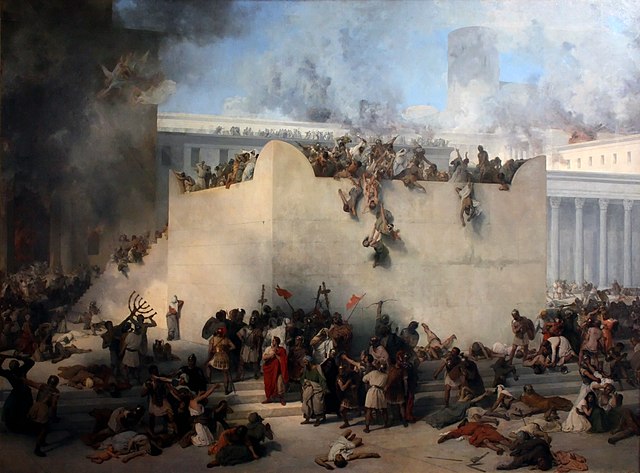
The destruction of the Temple of Jerusalem.

Francesco Hayez

Oil on canvas, 1867
Gallerie dell'Accademia, Venice

7 posted on 11/26/2024 5:08:37 AM PST by annalex (fear them not)
[ Post Reply | Private Reply | To 6 | View Replies]

To: annalex
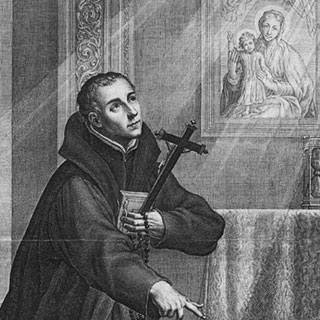
Saint John Berchmans

John Berchmans

Saint

  • Death: 08/13/1621
  • Nationality (place of birth): Belgium

John Berchmans (1599-1621) personifies the ideal that ordinary deeds done extraordinarily well lead to great holiness. He died very young, only five years after entering the novitiate, but his great desire to be a priest inspired him to live religious life fully. He was born to a very religious family in Diest, Belgium, and started studies that would lead to the priesthood early in his life. He lived in the rectory of Notre Dame parish while he studied, but after three years his father told him he would have to leave school and learn a practical trade to help his family's poor finances. The pastor of the Diest Béguinage offered to pay for Berchmans' education in return for his service as a servant; in 1612 the young man took the same arrangement in Mechlin at the household of Canon Froymont. In Mechlin, though, Berchmans met the Jesuits and decided to join them rather than become a diocesan priest. His father was disappointed because a diocesan priest could contribute to the family while a Jesuit could not, but he gave his son permission to pursue his goal.

Berchmans entered the Jesuits in 1616 and performed all the novice duties with joy and exacting fidelity. He also sought to control himself through penances. A few months after he entered the Jesuits, his mother died; then his father gave up his shoemaking shop and entered the diocesan seminary. He was ordained a priest in April 1618. Later that year, on Sept. 25, John pronounced the three vows of religious life and went to Antwerp to study philosophy. After only three weeks he was informed that he would move to Rome for studies. Before he could return to Mechlin to say goodbye to his father, the latter died suddenly.

The young Jesuit arrived in Rome on Dec. 31 and joined the community at the Roman College, where he was as faithful to his studies and religious life as he had been in the novitiate. He excelled in his studies and at the end of his third year he was selected to defend the entire course of philosophy in a public disputation. His health had suffered from the effort he had put into studying for his final exam, and he became steadily weaker as he prepared for the public disputation, held on July 8. He hoped to rest when it was over, but he was also selected to represent the Roman College at another disputation to be held in August at the Greek College. The two events took too much out of his weakened condition.

On Aug. 7 he suffered an attack of dysentery, and then a fever set in. When the superior saw how pale and weak Berchmans was, he sent him to the infirmary. The young Jesuit grew more ill day by day as his lungs became inflamed and he grew weaker and weaker. He spoke of Paradise as if he would soon be there when other scholastics came to visit. The brother infirmarian suggested that he should receive Communion the next day, even though it was not a Sunday. The Jesuit community came in procession bringing Viaticum to the their dying brother. He asked for his crucifix, rosary and rule book and received a steady stream of visitors, including Father General. He spent his final night in prayer and died on August 13 in the morning.

Originally Collected and edited by: Tom Rochford,SJ


jesuits.global

8 posted on 11/26/2024 5:12:46 AM PST by annalex (fear them not)
[ Post Reply | Private Reply | To 7 | View Replies]

To: annalex

9 posted on 11/26/2024 5:14:22 AM PST by annalex (fear them not)
[ Post Reply | Private Reply | To 8 | View Replies]

To: annalex
NAVARRE BIBLE COMMENTARY (RSV)

Ad Majorem Dei Gloriam (To the Greater Glory of God)

First Reading:

From: Revelation 14:14-19

The Harvest and the Vintage
----------------------------------
[14] Then I looked, and lo, a white cloud, and seated on the cloud one like a son of man, with a golden crown on his head, and a sharp sickle in his hand. [15] And another angel came out of the temple, calling with a loud voice to him who sat upon the cloud, "Put in your sickle, and reap, for the hour to reap has come, for the harvest of the earth is fully ripe." [16] So he who sat upon the cloud swung his sickle on the earth, and the earth was reaped.

[17] And another angel came out of the temple in heaven, and he too had a sharp sickle. [18] Then another angel came out from the altar, the angel who has power over fire, and he called with a loud voice to him who had the sharp sickle, "Put in your sickle, and gather the clusters of the vine of the earth, for its grapes are ripe." [19] So the angel swung his sickle on the earth and gathered the vintage of the earth, and threw it into the great wine press of the wrath of God.

***********************************************************************
Commentary:

14-20. This preliminary description of the Last Judgment is given in two scenes--the harvest (cf. 14:14-16) and the vintage (cf. 14:17-20) --no doubt following the prophecy of Joel about how God will judge nations hostile to Israel: "Let the nations bestir themselves, and come up to the valley of Jehoshaphat; for there I shall sit to judge all the nations round about. Put in the sickle, for the harvest is ripe. Go in, tread, for the wine press is full" (Joel 3:12-13).

In the first scene Christ himself appears, described as "son of man" (cf. Dan 7:13); it is he who will deliver the judgment (symbolized by the harvest), as in the parable of the wheat and the weeds (cf. Mt 13: 24-30). In the second it is an angel sent by God who gathers the grapes and puts them in the press to be trodden on either by God (in keeping with the prophecy of Isaiah 63:3, which says, "I have trodden the wine press alone") or by Christ (as we are told later in Revelation 19:15). In either case we are being told that Jesus Christ, true God and true man, has been empowered to perform the General Judgment which, according to Jewish tradition, will take place at the gates of Jerusalem (cf., e.g. Zech 14:4) and which involves a huge bloodbath (cf. Rev 14:20).

In both scenes, an angel has the prominent role of giving the order (cf. vv. 15, 18). The fact that he comes out from the temple and the altar shows that the outcome is linked to the prayers of the saints and martyrs, which stir Christ to take action (cf. Rev 8:3-4). So it is that the moment Christ is made present on the altar through the consecration of the bread and wine the Church calls for him to come again--calls for his second coming, the Parousia, which will make his victory complete: "When we eat this bread and drink this cup, we proclaim your death, Lord Jesus, until you come in glory" ("Roman Missal", eucharistic acclamation).

10 posted on 11/26/2024 7:01:46 AM PST by fidelis (Ecce Crucem Domini! Fugite partes adversae! Vicit Leo de tribu Juda, Radix David! Alleluia!)
[ Post Reply | Private Reply | To 9 | View Replies]

Gospel Reading:

From: Luke 21:5-11

Discourse on the Destruction of Jerusalem and the End of the World
-------------------------------------------------------------------------------------
[5] And as some spoke of the temple, how it was adorned with noble stones and offerings, He (Jesus) said, [6] "As for these things which you see, the days will come when there shall not be left here one stone upon another that will not be thrown down." [7] And they asked Him, "Teacher, when will this be, and what will be the sign when this is about to take place?" [8] And He said, "Take heed that you are not led astray; for many will come in My name, saying, 'I am He!' and, 'The time is at hand!' Do not go after them. [9] And when you hear of wars and tumults, do not be terrified; for this must first take place, but the end will not be at once."

[10] Then He said to them, "Nation will rise against nation, and kingdom against kingdom; [11] there will be great earthquakes, and in various places famines and pestilences; and there will be terrors and great signs from heaven."

***********************************************************************
Commentary:

5-36. The disciples are in awe of the magnificence of the temple, and Jesus uses the occasion to give a long discourse, known as the "eschatological discourse" because it has to do with the last days of the world. The account given here is very similar to those in the other Synoptic Gospels (cf. Mt 24:1-51; Mk 13:1-37). The discourse deals with three inter-connected subjects--the destruction of Jerusalem (which took place some forty years later), the end of the world, and the second coming of Christ in glory and majesty. Jesus, who also predicts here the persecution of the Church will experience, exhorts His disciples to be patient, to pray and be watchful.

Our Lord speaks here in the style and language of prophecy, using images taken from the Old Testament; also, in this discourse prophecies which are going to be fulfilled very soon are mixed in with others which have to do with the end of the world. It is not our Lord's intention to satisfy people's curiosity about future events, but to protect them from being discouraged and scandalized about what is going to happen in the days immediately ahead. This explains why He exhorts them: "Take heed that you are not led astray" (v. 8); "do not be tempted" (v. 9); "watch at all times" (v. 34).

8. On hearing that Jerusalem is going to be destroyed, the disciples ask what sign will be given as a warning of these events (vv. 5-7). Jesus answers by telling them “not to be led astray," that is to say, not to expect any warning; not to be misled by false prophets; to stay faithful to Him. These false prophets will come along claiming to be the Messiah ("I am He!"). Our Lord's reply in fact refers to two events which in the Jewish mind were interrelated--the destruction of the Holy City and the end of the world. This is why He goes on to speak of both events and implies that there will be a long gap between the two; the destruction of the temple and of Jerusalem are a kind of sign or symbol of the catastrophes which will mark the end of the world.

9-11. Our Lord does not want His disciples to confuse just any catastrophe--famine, earthquake, war--or even persecution with the signals of the end of the world. He exhorts them quite clearly: "Do not be tempted," because although all these has to happen, "the end will not be at once;" in spite of the difficulties of all kinds the Gospel will spread to the ends of the earth. Difficulties should not paralyze the preaching of the faith.

11 posted on 11/26/2024 7:02:06 AM PST by fidelis (Ecce Crucem Domini! Fugite partes adversae! Vicit Leo de tribu Juda, Radix David! Alleluia!)
[ Post Reply | Private Reply | To 10 | View Replies]

Click here to go to the My Catholic Life! Devotional thread for a meditation on today’s Gospel Reading.

12 posted on 11/26/2024 7:03:19 AM PST by fidelis (Ecce Crucem Domini! Fugite partes adversae! Vicit Leo de tribu Juda, Radix David! Alleluia!)
[ Post Reply | Private Reply | To 11 | View Replies]

Disclaimer: Opinions posted on Free Republic are those of the individual posters and do not necessarily represent the opinion of Free Republic or its management. All materials posted herein are protected by copyright law and the exemption for fair use of copyrighted works.

Free Republic
Browse · Search
Religion
Topics · Post Article

FreeRepublic, LLC, PO BOX 9771, FRESNO, CA 93794
FreeRepublic.com is powered by software copyright 2000-2008 John Robinson