Skip to comments.
Catholic Caucus: Daily Mass Readings 25-November-2024
Universalis/Jerusalem Bible ^
Posted on 11/25/2024 4:24:52 AM PST by annalex
25 November 2024
Monday of week 34 in Ordinary Time

Saint Catherine of Alexandria Cathedral, Dumaguete, Negros Oriental, Philippines.Readings at MassLiturgical Colour: Green. Year: B(II).
| First reading |
|---|
| Apocalypse 14:1-5 |
|---|
The redeemed have Christ and his Father's name written on their foreheadsIn my vision I, John, saw Mount Zion, and standing on it a Lamb who had with him a hundred and forty-four thousand people, all with his name and his Father’s name written on their foreheads. I heard a sound coming out of the sky like the sound of the ocean or the roar of thunder; it seemed to be the sound of harpists playing their harps. There in front of the throne they were singing a new hymn in the presence of the four animals and the elders, a hymn that could only be learnt by the hundred and forty-four thousand who had been redeemed from the world; they follow the Lamb wherever he goes; they have been redeemed from amongst men to be the first-fruits for God and for the Lamb. They never allowed a lie to pass their lips and no fault can be found in them.
| Responsorial Psalm |
|---|
| Psalm 23(24):1-6 |
|---|
Such are the men who seek your face, O Lord. The Lord’s is the earth and its fullness, the world and all its peoples. It is he who set it on the seas; on the waters he made it firm. Such are the men who seek your face, O Lord. Who shall climb the mountain of the Lord? Who shall stand in his holy place? The man with clean hands and pure heart, who desires not worthless things. Such are the men who seek your face, O Lord. He shall receive blessings from the Lord and reward from the God who saves him. Such are the men who seek him, seek the face of the God of Jacob. Such are the men who seek your face, O Lord.
Alleluia, alleluia! Even if you have to die, says the Lord, keep faithful, and I will give you the crown of life. Alleluia! Alleluia, alleluia! Stay awake and stand ready, because you do not know the hour when the Son of Man is coming. Alleluia!
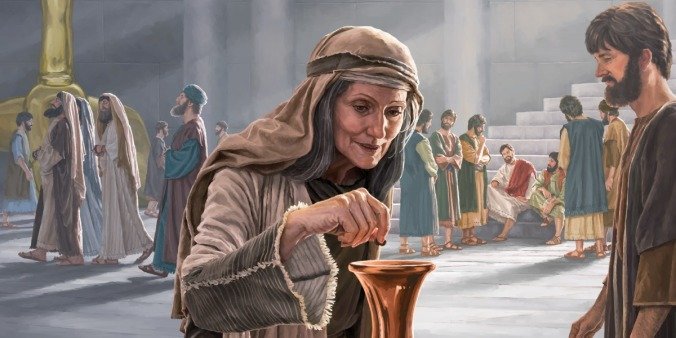
The widow's miteAs Jesus looked up, he saw rich people putting their offerings into the treasury; then he happened to notice a poverty-stricken widow putting in two small coins, and he said, ‘I tell you truly, this poor widow has put in more than any of them; for these have all contributed money they had over, but she from the little she had has put in all she had to live on.’
Nothing is changingIn England, Wales and Scotland, the translation of the readings used at Mass is changing. Your current calendar setting is “United States”, so you will not be affected by this change. This message will disappear at the end of December. Christian Art Each day, The Christian Art website gives a picture and reflection on the Gospel of the day. The readings on this page are from the Jerusalem Bible, which is used at Mass in most of the English-speaking world. The New American Bible readings, which are used at Mass in the United States, are available in the Universalis apps, programs and downloads.
You can also view this page with the Gospel in Greek and English. |
TOPICS: Catholic; General Discusssion; Prayer; Worship
KEYWORDS: catholic; lk21; ordinarytime; prayer
For your reading, reflection, faith-sharing, comments, questions, discussion.
1
posted on
11/25/2024 4:24:52 AM PST
by
annalex
To: All
KEYWORDS: catholic; lk21; ordinarytime; prayer
2
posted on
11/25/2024 4:25:25 AM PST
by
annalex
(fear them not)
To: nickcarraway; NYer; ELS; Pyro7480; livius; ArrogantBustard; Catholicguy; RobbyS; marshmallow; ...

Alleluia Ping Please FReepmail me to get on/off the Alleluia Ping List.
3
posted on
11/25/2024 4:26:10 AM PST
by
annalex
(fear them not)
To: annalex
4
posted on
11/25/2024 4:26:36 AM PST
by
annalex
(fear them not)
To: annalex
5
posted on
11/25/2024 4:27:42 AM PST
by
Strict9
To: annalex
| Luke |
| | English: Douay-Rheims | Latin: Vulgata Clementina | Greek NT: Byzantine/Majority Text (2000) |
| | Luke 21
|
| 1. | AND looking on, he saw the rich men cast their gifts into the treasury. | Respiciens autem, vidit eos qui mittebant munera sua in gazophylacium, divites. | αναβλεψας δε ειδεν τους βαλλοντας τα δωρα αυτων εις το γαζοφυλακιον πλουσιους |
| 2. | And he saw also a certain poor widow casting in two brass mites. | Vidit autem et quamdam viduam pauperculam mittentem æra minuta duo. | ειδεν δε τινα και χηραν πενιχραν βαλλουσαν εκει δυο λεπτα |
| 3. | And he said: Verily I say to you, that this poor widow hath cast in more than they all: | Et dixit : Vere dico vobis, quia vidua hæc pauper plus quam omnes misit. | και ειπεν αληθως λεγω υμιν οτι η χηρα η πτωχη αυτη πλειον παντων εβαλεν |
| 4. | For all these have of their abundance cast into the offerings of God: but she of her want, hath cast in all the living that she had. | Nam omnes hi ex abundanti sibi miserunt in munera Dei : hæc autem ex eo quod deest illi, omnem victum suum quem habuit, misit. | απαντες γαρ ουτοι εκ του περισσευοντος αυτοις εβαλον εις τα δωρα του θεου αυτη δε εκ του υστερηματος αυτης απαντα τον βιον ον ειχεν εβαλεν |
6
posted on
11/25/2024 4:29:03 AM PST
by
annalex
(fear them not)
To: annalex
Catena Aurea by St. Thomas Aguinas
Luke CHAP. 21
21:1–41. And he looked up, and saw the rich men casting their gifts into the treasury.
2. And he saw also a certain poor widow casting in thither two mites.
3. And he said, Of a truth I say unto you, that this poor widow hath cast in more than they all:
4. For all these have of their abundance cast in unto the offerings of God: but she of her penury hath cast in all the living that she had.
GLOSS. (non occ.) Our Lord having rebuked the covetousness of the Scribes who devoured widows’ houses, commends the almsgiving of a widow; as it is said, And he looked up, and saw the rich men casting into the treasury, & c.
BEDE. In the Greek language, φυλάξαι signifies to keep, and gaza in Persian means riches, hence gazophylacium is used for the name of the place in which money is kept. Now there was a chest with an opening at the top placed near the altar, on the right hand of those entering the house of God, into which the Priests cast all the money, which was given for the Lord’s temple. But our Lord as He overthrows those who trade in His house, so also He remarks those who bring gifts, giving praise to the deserving, but condemning the bad. Hence it follows, And he saw also a certain poor widow casting in thither two mites.
CYRIL OF ALEXANDRIA. She offered two oboli, which with the sweat of her brow she had earned for her daily living, or what she daily begs for at the hands of others she gives to God, shewing that her poverty is fruitful to her. Therefore does she surpass the others, and by a just award receives a crown from God; as it follows, Of a truth I say unto you, that this poor widow hath cast in more, &c.
BEDE. For whatever we offer with an honest heart is well pleasing to God, who hath respect unto the heart, not the substance, nor does He weigh the amount of that which is given in sacrifice, but of that from which it is taken; as it follows, For all these have cast in of their abundance, but she all that she had.
CHRYSOSTOM. (Hom. 1. in Ep. ad Heb., Hom. 28.) For God regarded not the scantiness of the offering, but the overflowing of the affection. Almsgiving is not the bestowing a few things out of many, but it is that of the widow emptying, herself of her whole substance. But if you cannot offer as much as the widow, at least give all that remains over.
BEDE. Now mystically, the rich men who cast their gifts into the treasury signify the Jews puffed up with the righteousness of the law; the poor widow, the simplicity of the Church which is called poor, because it has either cast away the spirit of pride, or its sins, as if they were worldly riches. But the Church is a widow, because her Husband endured death for her. She cast two mites into the treasury, because in God’s sight, in whose keeping are all the offerings of our works, she presents her gifts, whether of love to God and her neighbour, or of faith and prayer. And these excel all the works of the proud Jews, for they of their abundance cast into the offerings of God, in that they presume on their righteousness, but the Church casts in all her living, for every thing that hath life she believes to be the gift of God.
THEOPHYLACT. Or the widow may be taken to mean any soul bereft as it were of her first husband, the ancient law, and not worthy to be united to the Word of God. Who brings to God instead of a dowry faith and a good conscience, and so seems to offer more than those who are rich in words, and abound in the moral virtues of the Gentiles.
Catena Aurea Luke 21
7
posted on
11/25/2024 4:30:46 AM PST
by
annalex
(fear them not)
To: annalex
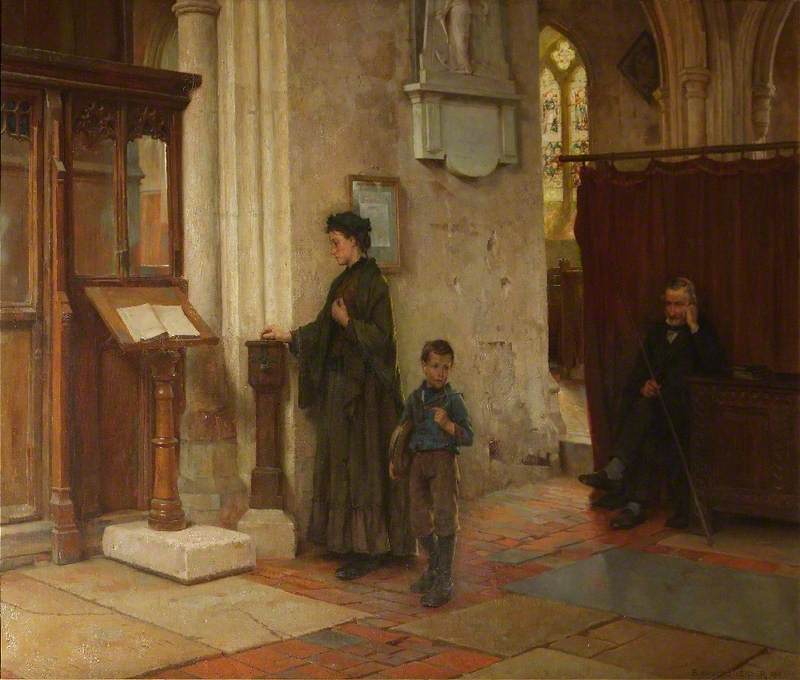
The Widow's Mite
W. T. Blandford-Fletcher (1858-1936)
Worcester City Art Gallery & Museum
Worcester, England
8
posted on
11/25/2024 4:32:13 AM PST
by
annalex
(fear them not)
To: annalex
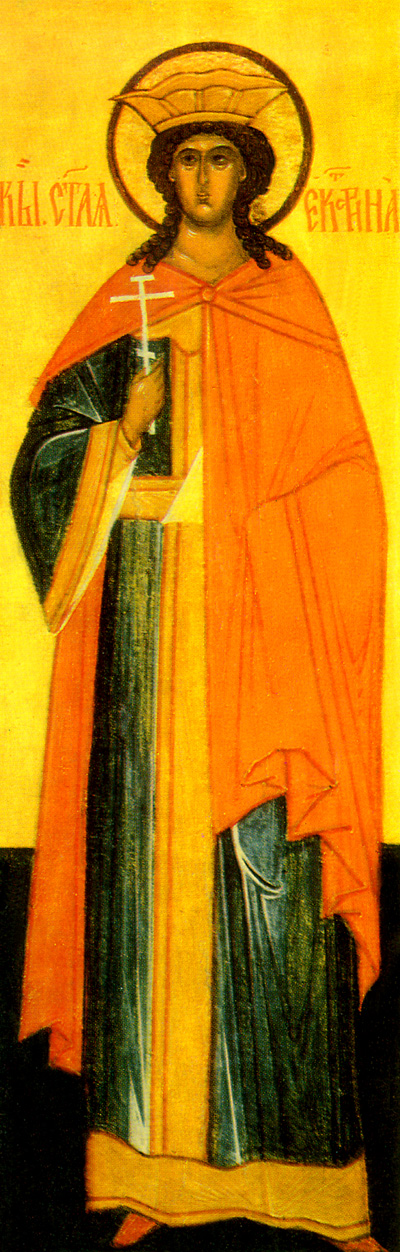
Great Martyr Katherine of Alexandria
Commemorated on
November 24 
Troparion & Kontakion
The Holy Great Martyr Katherine was the daughter of Konstos, the governor of Alexandria, Egypt during the reign of Emperor Maximian (305-313). Living in the capital, the center of Hellenistic knowledge, and possessed of a rare beauty and intellect, Katherine received an excellent education, studying the works of the greatest philosophers and teachers of antiquity. Young men from the most worthy families of the empire sought the hand of the beautiful Katherine, but she was not interested in any of them. She told her parents that she would enter into marriage only with someone who surpassed her in nobility, wealth, comeliness and wisdom.
Katherine’s mother, a secret Christian, sent her to her own Spiritual Father, a saintly Elder living in a cave outside the city, for advice. After listening to Katherine, the Elder said that he knew of someone who surpassed her in everything. “His countenance is more radiant than the shining of the sun, and all of creation is governed by His wisdom. His riches are given to all the nations of the world, yet they never diminish. His compassion is unequaled.”
This description of the Heavenly Bridegroom produced an ardent desire in the soul of the holy maiden to see Him. "If you do as I tell you,” said the monk, “you will gaze upon the countenance of this illustrious man.” In parting, the Elder gave Katherine an icon of the Theotokos with the Divine Child on Her arm and told her to pray with faith to the Queen of Heaven, the Mother of the Heavenly Bridegroom, and she would hear Katherine and grant her heart’s desire.
Katherine prayed all night and was permitted to see the Most Holy Virgin, Who said to her Divine Son, “Behold Thy handmaiden Katherine, how fair and virtuous she is.” But the Child turned His face away from her saying, “No, she is ugly and unbelieving. She is a foolish pauper, and I cannot bear to look at her until she forsakes her impiety.”
Katherine returned again to the Elder deeply saddened, and told him what she had seen in the dream. He received her, instructed her in the faith of Christ, admonished her to preserve her purity and integrity and to pray unceasingly. She then received the Mystery of Holy Baptism from him. Again Saint Katherine had a vision of the Most Holy Theotokos with her Child. Now the Lord looked at her tenderly and gave her a beautiful ring, a wondrous token of her betrothal to the Heavenly Bridegroom (this ring is still on her hand).
At that time Emperor Maximian was in Alexandria for a pagan festival. Therefore, the celebration was especially splendid and crowded. The cries of the sacrificial animals, the smoke and the smell of the sacrifices, the endless blaze of fires, and the bustling crowds at the arenas defiled the city of Alexandria. Human victims also were brought, the confessors of Christ, who would not deny Him under torture. They were condemned to death in the fire. Katherine's love for the Christian martyrs, and her fervent desire to ease their sufferings, compelled her to speak to the pagan priest and to Emperor Maximian.
Introducing herself, the Saint confessed her faith in the One True God, and exposed the errors of the pagans. The beauty of the maiden captivated the Emperor. In order to convince her of the superiority of pagan wisdom, the Emperor ordered fifty of the most learned philosophers and rhetoricians of the Empire to dispute with her, but the Saint got the better of the wise men, so that they came to believe in Christ themselves. Saint Katherine made the Sign of the Cross over the martyrs, and they bravely accepted death for Christ and were burnt alive by order of the Emperor.
Unable to persuade the Saint, Maximian tried to entice her with the promise of riches and fame. Hearing her angry refusal, the Emperor ordered his men to subject the Saint to terrible tortures, and then throw her in prison. The Empress Augusta, who had heard much about the Saint, wanted to see her. She prevailed upon the military commander Porphyrios to accompany her to the prison with a detachment of soldiers. The Empress was impressed by Katherine's strong spirit, and her face was radiant with divine grace. The holy martyr explained the Christian Faith to them, and they were converted to Christ.
On the following day, they again brought the martyr to the judgment court where, under the threat of being broken on the wheel, she was urged to renounce the Christian Faith and to offer sacrifice to the "gods." The Saint steadfastly confessed Christ and she was taken to be tortured on four wheels with sharp iron spikes, but an Angel smashed the instruments of execution, which shattered into pieces with many pagans standing nearby.
After seeing this miracle, the Empress Augusta and the imperial courtier Porphyrios and 200 soldiers confessed their faith in Christ before everyone, and they were beheaded. Maximian tried again to entice the holy martyr, offering to marry her, and again he was refused. Saint Katherine remained faithful to her heavenly Bridegroom Christ, and after praying to Him, she laid her head on the block beneath the executioner’s sword.
The relics of Saint Katherine were taken by the Angels to Mount Sinai. In the VI century, the venerable head and left hand of the holy martyr were found through a revelation and transferred with honor to the newly-constructed church of the Monastery on Mount Sinai, built by the holy Emperor Justinian (November 14).
Saint Katherine is called upon for relief and assistance during a difficult childbirth. Pilgrims to her monastery on Mount Sinai are given souvenir rings as a remembrance of their visit.
Saint Katherine is commemorated on November 25 in Greek usage.
oca.org
9
posted on
11/25/2024 4:39:04 AM PST
by
annalex
(fear them not)
To: annalex

Self-Portrait as Saint Catherine of Alexandria
Artemisia Gentileschi (1593 – 1656)
10
posted on
11/25/2024 4:44:14 AM PST
by
annalex
(fear them not)
To: annalex
NAVARRE BIBLE COMMENTARY (RSV)
Ad Majorem Dei Gloriam (To the Greater Glory of God)
First Reading:
From: Revelation 14:1-3, 4b-5
The Lamb and His Companions
------------------------------------
[1] Then I looked, and lo, on Mount Zion stood the Lamb, and with him a hundred and forty-four thousand who had his name and his Father's name written on their foreheads. [2] And I heard a voice from heaven like the sound of many waters and like the sound of loud thunder; the voice I heard was like the sound of harpers playing on their harps, [3] and they sing a new song before the throne and before the four living creatures and before the elders. No one could learn that song except the hundred and forty-four thousand who had been redeemed from the earth. [4] It is these who follow the Lamb wherever he goes; these have been redeemed from mankind as first fruits for God and the Lamb, [5] and in their mouth no lie was found, for they are spotless.
***********************************************************************
Commentary:
14:1-16:21 The book now turns to the Lamb and to divine judgment (anticipating the victory of the Lamb). It stays with this theme up to chapter 17 at which point the powers of evil appear again (in various symbolic forms) and are subjected to the judgment of God. First we are shown the Lamb and his entourage (cf. 14:l-5); immediately after this the Last Judgment is proclaimed and a preliminary description given (14:6-20); the glory of the Lamb is again extolled (cf. 15: 1-4) and the unleashing of the wrath of God is further described in terms of the pouring out of the seven bowls (cf. 15:5-16:21).
In opposition to the powers of evil and the active hostility to God and the Church caused by the machinations of Satan stand the risen Christ and his followers, who sing in praise of his glory and triumph. These followers are those who have attained redemption; the salvation will reach its climax when the Kingdom of God is fully established (the marriage of the Lamb, and the heavenly Jerusalem: chaps. 21-22). In the meantime, although the Church has to do battle with the forces of evil, it can contemplate Christ "as an innocent lamb (who) merited life for us by his blood which he freely shed. In him God reconciled us to himself and to one another, freeing us from the bondage of the devil and of sin, so that each one of us could say with the Apostle: the Son of God 'loved me and gave himself for me' (Gal 2:20)" (Vatican II, "Gaudium Et Spes", 22).
1-3. It is highly significant that the Lamb stands on Mount Zion, in Jerusalem, which was where God dwelt among men according to the Old Testament (cf. Ps 74:1; 132:14; etc.) and where, according to certain Jewish traditions, the Messiah would appear, to join all his followers. The assembly, then, is an idealization of the Church, protected by Christ and gathered about him. It includes all those who belong to Christ and to the Father and who therefore bear his mark, which shows them to be children of God. They are so many that it is impossible to count them, but their number is complete: they are given a symbolic number which is 12 (the tribes of Israel) by 12 (the Apostles) by 1000 (a number indicating a huge scale): cf. Rev 7:3ff.
The one hundred and forty-four thousand are not yet in heaven (for the loud noise comes from heaven); they are on earth, but they have been rescued from the power of the beast (cf. 13:13-14). The verse from heaven symbolizes the strength and power of God; and the heavenly voice speaks with the gentleness of liturgical music. It is a new song, for it now sings of the salvation wrought by Christ (cf. 15:34) in the same style as the Old Testament chants the praises of God (cf., e.g., Ps 33:3; 40:2; 96:1). Only those who belong to Christ can join in this song and be associated with the heavenly liturgy: "It is especially in the sacred liturgy that our union with the heavenly Church is best realized; in the liturgy, through the sacramental signs, the power of the Holy Spirit acts on us, and with community rejoicing we celebrate together the praise of the divine majesty; when all those of every tribe and tongue and people and nation (cf. Rev 5:9) who have been redeemed by the blood of Christ and gathered together into one Church glorify, in one common song of praise, the one and triune God" ("Lumen Gentium", 50).
4-5. The text refers to those who are properly disposed to take part in the marriage supper of the Lamb (cf. 19:9; 21:2) because they have not been stained by idolatry but have kept themselves undefiled for him. St Paul compares every Christian to a chaste virgin (cf. 2 Cor 11:2) and describes the Church as the spouse of Christ (cf. Eph 5:21-32). The author of the Apocalypse is referring to all the members of the Church insofar as they are holy, that is, called to holiness; but the symbolism he uses also draws attention to the fact that virginity and celibacy for the sake of the Kingdom of heaven is a special expression and clear sign of the Church as Bride of Christ. Referring to the chastity practiced by religious, the Second Vatican Council teaches that in this way they "recall that wonderful marriage made by God, which will be fully manifested in the future age, and in which the Church has Christ for her only spouse" ("Perfectae Caritatis", 12).
The one hundred and forty-four thousand are also those who have identified themselves fully with Christ, dead and risen, by denying themselves and devoting all their energies to apostolate (cf. Mt 10: 38). They also stand for those whom Christ, by the shedding of his blood, has made his own and his Father's property (like Israel, the first fruits of Yahweh: cf. Jer 2:3), that is, those who constitute a holy people like that remnant of Israel described in Zephaniah 3:13: "they shall do no wrong and utter no lies, nor shall there be found in their mouth a deceitful tongue." The prophet's words refer to people who have not invoked false gods, but the Apocalypse applies them to those who are fully committed to Christ.
11
posted on
11/25/2024 9:30:12 AM PST
by
fidelis
(Ecce Crucem Domini! Fugite partes adversae! Vicit Leo de tribu Juda, Radix David! Alleluia!)
Gospel Reading: From: Luke 21:1-4
The Widow's Mite
----------------
[1] He (Jesus) looked up and saw the rich putting their gifts into the treasury; [2] and He saw a poor widow put in two copper coins. [3] And He said, "Truly I tell you, this poor widow has put in more than all of them; [4] for they all contributed out of their abundance, but she out of her poverty put in all the living she had."
***********************************************************************
Commentary:
1-4. Our Lord, surrounded by His disciples, watches people putting offerings into the treasury. This was a place in the women's courtyard, where there were various collection boxes for the offerings of the faithful. Just then, something happens whose significance Jesus wants His disciples to notice: a poor widow puts in two small coins, of very little value. He describes this as the greatest offering of all, praising the generosity of giving alms for this purpose, particularly that of those people who give part of what they need. Our Lord is moved by this tiny offering because in her case it implies a big sacrifice. "The Lord does not look", St. John Chrysostom comments, "at the amount offered but at the affection with which it is offered" ("Hom. on Heb", 1). Generosity is of the essence of almsgiving. This woman teaches us that we can move God's heart if we give Him all we can, which will always amount to very little even if we give our very lives. "How little a life is to offer to God!" (St Josemaria Escriva, "The Way", 42).
12
posted on
11/25/2024 9:30:28 AM PST
by
fidelis
(Ecce Crucem Domini! Fugite partes adversae! Vicit Leo de tribu Juda, Radix David! Alleluia!)
13
posted on
11/25/2024 9:31:20 AM PST
by
fidelis
(Ecce Crucem Domini! Fugite partes adversae! Vicit Leo de tribu Juda, Radix David! Alleluia!)
Disclaimer:
Opinions posted on Free Republic are those of the individual
posters and do not necessarily represent the opinion of Free Republic or its
management. All materials posted herein are protected by copyright law and the
exemption for fair use of copyrighted works.
FreeRepublic.com is powered by software copyright 2000-2008 John Robinson