Rivers of blood will flow through the streets of Sahuayo. – Jacobita Zepeda del Toro, Seer of Sahuayo
Posted on 11/23/2024 7:00:59 PM PST by ebb tide
Rivers of blood will flow through the streets of Sahuayo. – Jacobita Zepeda del Toro, Seer of Sahuayo
A COLUMN OF Mexican federal troops descending a mountain slope in Jiquilpan, heading toward Cotija, stumbled upon a platoon of Cristero soldiers.
Immediately, a skirmish broke out that lasted for three days – from March 16 to March 19, 1928 – between the two factions: federal versus faithful. On the 19th, the group of 35 Cristeros retreated to El Moral, a cave where they sought refuge after two of their men – Jesus Zambrano and Juan Aguilar – received wounds during the conflict.
Grave tactical error. Once safely inside, they found themselves surrounded, with their only exit blocked by the enemy, who encamped at the mouth of the cave. Fighting picked up again around 2 that afternoon and stretched through the night and all through the next day, the 20th, when, at sunset, the fed-up federals set fire to a pile of chili peppers and grass at the entrance of the cave and fanned billows of smoke inside.
Choking on the fumes, exhausted, without food, without water, the out-of-option Cristeros bargained with the opposing forces, who promised that anyone who laid down their arms would not be killed or harmed. Assured, the Catholic soldiers stepped out from the grotto and surrendered, around 6 that evening.
Upon capitulation, three were immediately executed: one of the wounded, Aguilar, because he could not walk, and two others, because they refused to comply with orders. The rest of the men were tied together, two by two, back-to-back, then forced to march in the late night.
En route, as the line of prisoners moved forward, Cristero Captain Celso Valdovinos contemplated his purpose and the Will of God and prayed: “You don’t want me to keep fighting with Your enemies?”
As the line of prisoners and their captors approached Jiquilpan, Valdovinos felt the rope around his wrists begin to loosen, and he whispered to his fellow captive, Captain Manuel Andrade, to whom he was bound: “Let’s slip into the shadows. I no longer feel knots in the rope.”
In the pitch-black, pre-dawn hours, with just a sliver of the waning crescent moon illuminating the night, the two stealthily slipped out of line, away from the others, dropped to their knees and crawled away, unheard, unseen and escaped undetected.
The rest of the captured men continued to Sahuayo, where they arrived about 11 in the morning, on March 21, and were locked up in the baptistry of the Parish of Apostle Santiago, Saint James the Apostle, converted by the federal troops into a multi-purpose facility that housed a barracks, stable, armory and prison. There, the Catholic soldiers endured torturous interrogations about the Cristero movement, but no one answered any questions. Threatened with death, they still refused to talk, and, instead, shouted, “Viva Cristo Rey y la Virgen de Guadalupe!”
Jesus Zambrano, one of the first to be shot, failed to die. An officer fired another bullet right into his head, a tiro de gracia. Several more times the Cristero soldier survived and was shot. An officer ordered that Zambrano be searched to determine why he would not succumb to his fatal wounds. Soldiers stripped him and found tied around his neck a crucifix, which was yanked off. Then, immediately, he died.
At 1 that afternoon, two hours after their arrival, the sun shone brightly as a federal captain called the name of one of the Cristeros, who – obediently and meekly – let himself be led to the church courtyard and directed to a spot near the northside door.
“Quien viva?” asked the officer sarcastically, rhetorically and then immediately ordered, “Shout, Viva Calles!” referring to an acclamation for Mexican President Plutarco Elias Calles (born Francisco Plutarco Elias Campuzano, 1877-1945).
“No! Viva Cristo Rey y Santa Maria de Guadalupe!” shouted the Cristero.
At that, a Callista commissioned officer, Lieutenant Sidronio Hernandez Herrera – who had earlier retrieved his pistol from its holster and positioned himself behind the door – stepped out and shot the unsuspecting prisoner of war in the back of his head.
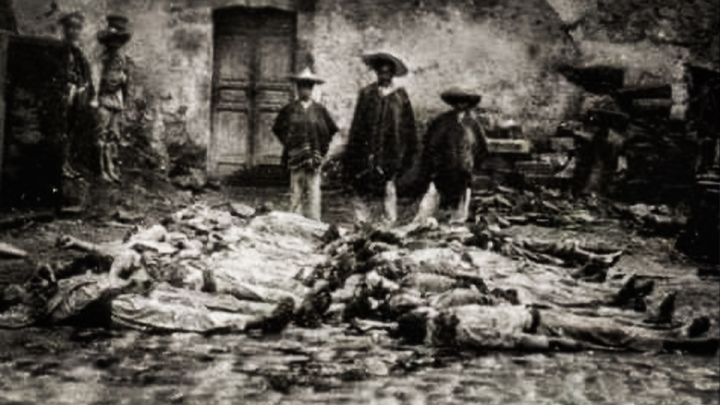
Everything – the shouting, the shooting – was heard by the remaining prisoners. Each, knowingly, waited his turn, until one by one, the same actions were repeated 26 times, until 27 bodies lay face up in two lines on top of the courtyard stones.
During the executions, one of the first to be shot failed to die and was heard moaning and groaning. An officer stepped forward and fired another bullet into the man – Jesus Zambrano – point blank, right into his head, a tiro de gracia. However, he soon, again, showed signs of life. Subsequently, he was shot in the chest. Again and again, several more times the Cristero soldier survived and was shot. Flummoxed at the man’s inexplicable, supernatural ability to escape death, an officer ordered that Zambrano be searched to determine why he would not succumb to his otherwise-fatal bullet wounds. Soldiers stripped him and found tied around his neck a crucifix, which was yanked off. Then, immediately, he died.
Last ones ushered into the courtyard: Lieutenant Colonel David Galvan, the commanding officer of the Cristeros, and two youths, Claudio Becerra and Felix Barajas. Ordered to stand next to the bodies, just as they were photographed, suddenly, black clouds covered the sun. From nowhere, a squall blew in.
Wind ripped purple blossoms from the jacaranda trees standing in front of the church and crimson-colored flowers from the bougainvillea bushes growing along the wall in the courtyard. The petals fell atop the executed, adorning their bodies. But then a torrential downpour soon washed away the petals and the gore, in a flush of rainwater mixed with blood and flowers that flowed over the stones, out of the courtyard, down the stairs at the corner of Calle Francisco I. Madero and Calle Insurgentes, and rushed along the street toward the east end of Sahuayo.
A few hours later, after the storm had calmed, officials ordered that the bodies be removed and dumped in the Municipal Cemetery of Sahuayo.
In the quiet of the dwindling, late afternoon, the steady sounds of turning wagon wheels on an old garbage cart approached and creaked to a stop. Soldiers stacked the 27 bodies carelessly in back of the cart, which slowly rolled grotesquely through town, to terrorize and intimidate faithful Catholics already traumatized from years of witnessing the atrocities committed against the faithful by the Callista henchmen. Arriving at the graveyard, the martyrs were unloaded and tossed into a common grave, buried together, entwined.
The three survivors were transported to Zamora, where Galvan was unsuccessfully interrogated, tortured and then escorted during the dark night to a railroad station, where he was executed by a firing squad, on March 24, 1928. Not long after, the two youths, Becerra and Barajas, escaped their captors.
Eventually, the remains of the 27 Martyrs of Sahuayo were exhumed and respectfully interred in the catacombs of the Sacred Heart of Jesus Church, where they remain to this day.
THE 27 MARTYRS OF SAHUAYO
Reinaldo Alvarez, of Cotija, Michoacan
Paulo Barajas, of Cotija, Michoacan
Rafael Barajas Senior, of Agua Blanca, Michoacan
Rafael Barajas Junior, of Agua Blanca, Michoacan
Celedonio Capistran, of Santa Fe, Jalisco
Juan Capistran, of Santa Fe, Jalisco
Aurelio Cardenas, (unknown)
Miguel Contreras, of Quitupan, Jalisco
Rafael Galvan, of Poca Sangre, Michoacan
Abraham Gonzalez, of Quitupan, Jalisco
Ramon Guerrero, of Pueblo Nuevo, Jalisco
Jose de Jesus Lopez, (unknown)
Antonio Lopez, of Caramicua, Michoacan
Epifanio Lopez, of Quitupan, Jalisco
Manuel Lopez, of Quitupan, Jalisco
Wenceslao Lopez, of Caramicua, Michoacan
Juan Muratalla, of Agua Blanca, Michoacan
Jose N., (unknown)
Demetrio Ochoa, of Llanitos, Michoacan
Francisco Orozco, of Piedra Grande, Michoacan
Juan Orozco, of Piedra Grande, Michoacan
Juan Salceda, of Calera, Michoacan
Antonio Valdovinos, of San Antonio, Jalisco
Enrique Valencia, of Moral, Michoacan
Jesus Zambrano, of Moral, Michoacan
David Zepeda, of Llanitos, Michoacan
Ramon Zepeda, of Zapote, Michoacan
__________________
Miscellanea and facts were pulled from the following: “El Nino Testigo de Cristo Rey: Jose Sanchez del Rio, Martir Cristero,” by Luis Laurean Cervanates. “Martires de Sahuayo,” by the Diccionario de Historia Cultural de la Iglesia en America Latina.
Ping
Because communists are liars, like their father below ...
My future daughter-in-law’s great grandfather and great great grandfather were both martyred in the Cristero war. They were executed for refusing to give up the faith. The blessings of their martyrdom continue to this generation. My son and she will be married by an FSSP priest in the old Latin rite early next year.
Good for them and congratulations!
My niece was just married in an FSSP nuptial Mass in Baltimore.
That would be at St. Alphonsus, where my wife and I frequently go to Mass. we also go to Mount Calvary, a parish of the Personal Ordinariate of the Chair of St. Peter, a few blocks away from St. Alphonsus.
FYI, Archbishop Lori will be celebrating a Pontifical High Mass at St. Alphonsus in March. Kinda brave in this pontifical milieu.
You’re fortunate.
My niece lives in D.C., but the Shrine of St Alphonsus (with the FSSP) was the closest she could have a traditional nupital Mass.
Disclaimer: Opinions posted on Free Republic are those of the individual posters and do not necessarily represent the opinion of Free Republic or its management. All materials posted herein are protected by copyright law and the exemption for fair use of copyrighted works.