Free Republic
Browse · Search
Religion
Topics · Post Article

Skip to comments.

Catholic Caucus: Daily Mass Readings 23-November-2024
Universalis/Jerusalem Bible ^

Posted on 11/23/2024 6:53:08 AM PST by annalex

23 November 2024

Saturday of week 33 in Ordinary Time


The Church of St. Clement in Rome

Readings at Mass

Liturgical Colour: Green. Year: B(II).


First reading
Apocalypse 11:4-12

The prophets will die who have been a plague to the world

I, John, heard a voice saying: ‘These, my two witnesses, are the two olive trees and the two lamps that stand before the Lord of the world. Fire can come from their mouths and consume their enemies if anyone tries to harm them; and if anybody does try to harm them he will certainly be killed in this way. They are able to lock up the sky so that it does not rain as long as they are prophesying; they are able to turn water into blood and strike the whole world with any plague as often as they like. When they have completed their witnessing, the beast that comes out of the Abyss is going to make war on them and overcome them and kill them. Their corpses will lie in the main street of the Great City known by the symbolic names Sodom and Egypt, in which their Lord was crucified. Men out of every people, race, language and nation will stare at their corpses, for three-and-a-half days, not letting them be buried, and the people of the world will be glad about it and celebrate the event by giving presents to each other, because these two prophets have been a plague to the people of the world.’
  After the three-and-a-half days, God breathed life into them and they stood up, and everybody who saw it happen was terrified; then they heard a loud voice from heaven say to them, ‘Come up here’, and while their enemies were watching, they went up to heaven in a cloud.

Responsorial Psalm
Psalm 143(144):1-2,9-10
Blessed be the Lord, my rock.
Blessed be the Lord, my rock,
  who trains my arms for battle,
  who prepares my hands for war.
Blessed be the Lord, my rock.
He is my love, my fortress;
  he is my stronghold, my saviour
my shield, my place of refuge.
  He brings peoples under my rule.
Blessed be the Lord, my rock.
To you, O God, will I sing a new song;
  I will play on the ten-stringed lute
to you who give kings their victory,
  who set David your servant free.
Blessed be the Lord, my rock.

Gospel Acclamationcf.Lk8:15
Alleluia, alleluia!
Blessed are those who,
with a noble and generous heart,
take the word of God to themselves
and yield a harvest through their perseverance.
Alleluia!
Or:cf.2Tim1:10
Alleluia, alleluia!
Our Saviour Jesus Christ abolished death
and he has proclaimed life through the Good News.
Alleluia!

GospelLuke 20:27-40

In God all men are alive

Some Sadducees – those who say that there is no resurrection – approached Jesus and they put this question to him, ‘Master, we have it from Moses in writing, that if a man’s married brother dies childless, the man must marry the widow to raise up children for his brother. Well then, there were seven brothers. The first, having married a wife, died childless. The second and then the third married the widow. And the same with all seven, they died leaving no children. Finally the woman herself died. Now, at the resurrection, to which of them will she be wife since she had been married to all seven?’
  Jesus replied, ‘The children of this world take wives and husbands, but those who are judged worthy of a place in the other world and in the resurrection from the dead do not marry because they can no longer die, for they are the same as the angels, and being children of the resurrection they are sons of God. And Moses himself implies that the dead rise again, in the passage about the bush where he calls the Lord the God of Abraham, the God of Isaac and the God of Jacob. Now he is God, not of the dead, but of the living; for to him all men are in fact alive.’
  Some scribes then spoke up. ‘Well put, Master’ they said – because they would not dare to ask him any more questions.

Nothing is changing

In England, Wales and Scotland, the translation of the readings used at Mass is changing. Your current calendar setting is “United States”, so you will not be affected by this change.
This message will disappear at the end of December.

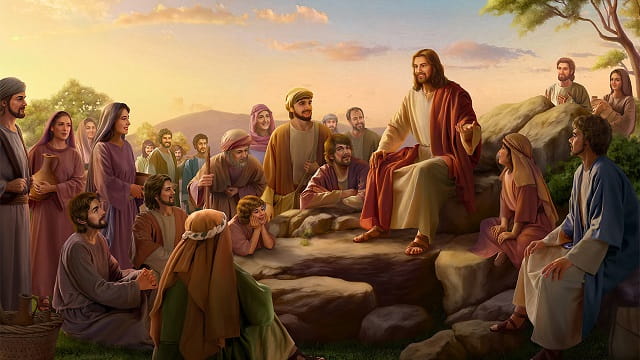
Christian Art

Illustration

Each day, The Christian Art website gives a picture and reflection on the Gospel of the day.

The readings on this page are from the Jerusalem Bible, which is used at Mass in most of the English-speaking world. The New American Bible readings, which are used at Mass in the United States, are available in the Universalis apps, programs and downloads.

You can also view this page with the Gospel in Greek and English.


TOPICS: Catholic; General Discusssion; Prayer; Worship
KEYWORDS: catholic; lk20; ordinarytime; prayer
For your reading, reflection, faith-sharing, comments, questions, discussion.

1 posted on 11/23/2024 6:53:08 AM PST by annalex
[ Post Reply | Private Reply | View Replies]

To: All

KEYWORDS: catholic; lk20; ordinarytime; prayer


2 posted on 11/23/2024 6:53:36 AM PST by annalex (fear them not)
[ Post Reply | Private Reply | To 1 | View Replies]

To: nickcarraway; NYer; ELS; Pyro7480; livius; ArrogantBustard; Catholicguy; RobbyS; marshmallow; ...

Alleluia Ping

Please FReepmail me to get on/off the Alleluia Ping List.


3 posted on 11/23/2024 6:54:12 AM PST by annalex (fear them not)
[ Post Reply | Private Reply | To 2 | View Replies]

To: annalex
My dad is back in the hospital. [JimRob update at 242]
Jim still needs our prayers. Thread 2
Prayer thread for Salvation's recovery
Pray for Ukraine
Prayer thread for Fidelis' recovery
Update on Jim Robinson's health issues
4 posted on 11/23/2024 6:54:31 AM PST by annalex (fear them not)
[ Post Reply | Private Reply | To 3 | View Replies]

To: annalex
Luke
 English: Douay-RheimsLatin: Vulgata ClementinaGreek NT: Byzantine/Majority Text (2000)
 Luke 20
27And there came to him some of the Sadducees, who deny that there is any resurrection, and they asked him, Accesserunt autem quidam sadducæorum, qui negant esse resurrectionem, et interrogaverunt eum,προσελθοντες δε τινες των σαδδουκαιων οι αντιλεγοντες αναστασιν μη ειναι επηρωτησαν αυτον
28Saying: Master, Moses wrote unto us, If any man's brother die, having a wife, and he leave no children, that his brother should take her to wife, and raise up seed unto his brother. dicentes : Magister, Moyses scripsit nobis : Si frater alicujus mortuus fuerit habens uxorem, et hic sine liberis fuerit, ut accipiat eam frater ejus uxorem, et suscitet semen fratri suo.λεγοντες διδασκαλε μωσης εγραψεν ημιν εαν τινος αδελφος αποθανη εχων γυναικα και ουτος ατεκνος αποθανη ινα λαβη ο αδελφος αυτου την γυναικα και εξαναστηση σπερμα τω αδελφω αυτου
29There were therefore seven brethren: and the first took a wife, and died without children. Septem ergo fratres erant : et primus accepit uxorem, et mortuus est sine filiis.επτα ουν αδελφοι ησαν και ο πρωτος λαβων γυναικα απεθανεν ατεκνος
30And the next took her to wife, and he also died childless. Et sequens accepit illam, et ipse mortuus est sine filio.και ελαβεν ο δευτερος την γυναικα και ουτος απεθανεν ατεκνος
31And the third took her. And in like manner all the seven, and they left no children, and died. Et tertius accepit illam. Similiter et omnes septem, et non reliquerunt semen, et mortui sunt.και ο τριτος ελαβεν αυτην ωσαυτως ωσαυτως δε και οι επτα ου κατελιπον τεκνα και απεθανον
32Last of all the woman died also. Novissime omnium mortua est et mulier.υστερον [δε] παντων απεθανεν και η γυνη
33In the resurrection therefore, whose wife of them shall she be? For all the seven had her to wife. In resurrectione ergo, cujus eorum erit uxor ? siquidem septem habuerunt eam uxorem.εν τη ουν αναστασει τινος αυτων γινεται γυνη οι γαρ επτα εσχον αυτην γυναικα
34And Jesus said to them: The children of this world marry, and are given in marriage: Et ait illis Jesus : Filii hujus sæculi nubunt, et traduntur ad nuptias :και αποκριθεις ειπεν αυτοις ο ιησους οι υιοι του αιωνος τουτου γαμουσιν και εκγαμισκονται
35But they that shall be accounted worthy of that world, and of the resurrection from the dead, shall neither be married, nor take wives. illi vero qui digni habebuntur sæculo illo, et resurrectione ex mortuis, neque nubent, neque ducent uxores :οι δε καταξιωθεντες του αιωνος εκεινου τυχειν και της αναστασεως της εκ νεκρων ουτε γαμουσιν ουτε εκγαμιζονται
36Neither can they die any more: for they are equal to the angels, and are the children of God, being the children of the resurrection. neque enim ultra mori potuerunt : æquales enim angelis sunt, et filii sunt Dei, cum sint filii resurrectionis.ουτε γαρ αποθανειν ετι δυνανται ισαγγελοι γαρ εισιν και υιοι εισιν του θεου της αναστασεως υιοι οντες
37Now that the dead rise again, Moses also shewed, at the bush, when he called the Lord, The God of Abraham, and the God of Isaac, and the God of Jacob; Quia vero resurgant mortui, et Moyses ostendit secus rubum, sicut dicit Dominum, Deum Abraham, et Deum Isaac, et Deum Jacob.οτι δε εγειρονται οι νεκροι και μωσης εμηνυσεν επι της βατου ως λεγει κυριον τον θεον αβρααμ και τον θεον ισαακ και τον θεον ιακωβ
38For he is not the God of the dead, but of the living: for all live to him. Deus autem non est mortuorum, sed vivorum : omnes enim vivunt ei.θεος δε ουκ εστιν νεκρων αλλα ζωντων παντες γαρ αυτω ζωσιν
39And some of the scribes answering, said to him: Master, thou hast said well. Respondentes autem quidam scribarum, dixerunt ei : Magister, bene dixisti.αποκριθεντες δε τινες των γραμματεων ειπον διδασκαλε καλως ειπας
40And after that they durst not ask him any more questions. Et amplius non audebant eum quidquam interrogare.ουκετι δε ετολμων επερωταν αυτον ουδεν

5 posted on 11/23/2024 6:57:28 AM PST by annalex (fear them not)
[ Post Reply | Private Reply | To 4 | View Replies]

To: annalex

Catena Aurea by St. Thomas Aguinas

20:27–40

27. Then came to him certain of the Sadducees, which deny that there is any resurrection; and they asked him,

28. Saying, Master, Moses wrote unto us, If any man’s brother die, having a wife, and he die without children, that his brother should take his wife, and raise up seed unto his brother.

29. There were therefore seven brethren: and the first took a wife, and died without children.

30. And the second took her to wife, and he died childless.

31. And the third took her; and in like manner the seven also: and they left no children, and died.

32. Last of all the woman died also.

33. Therefore in the resurrection whose wife of them is she? for seven had her to wife.

34. And Jesus answering said unto them, The children of this world marry, and are given in marriage:

35. But they which shall be accounted worthy to obtain that world, and the resurrection from the dead, neither marry, nor are given in marriage:

36. Neither can they die any more: for they are equal unto the angels; and are the children of God, being the children of the resurrection.

37. Now that the dead are raised, even Moses shewed at the bush, when he calleth the Lord the God of Abraham, and the God of Isaac, and the God of Jacob.

38. For he is not a God of the dead, but of the living: for all live unto him.

39. Then certain of the Scribes answering said, Master, thou hast well said.

40. And after that they durst not ask him any question at all.

BEDE. There were two heresies among the Jews, one of the Pharisees, who boasted in the righteousness of their traditions, and hence they were called by the people, “separated;” the other of the Sadducees, whose name signified “righteous,” claiming to themselves that which they were not. When the former went away, the latter came to tempt Him.

ORIGEN. The heresy of the Sadducees not only denies the resurrection of the dead, but also believes the soul to die with the body. Watching then to entrap our Saviour in His words, they proposed a question just at the time when they observed Him teaching His disciples concerning the resurrection; as it follows, And they asked him, saying, Master, Moses wrote to us, If a brother, &c.

AMBROSE. According to the letter of the law, a woman is compelled to marry, however unwilling, in order that a brother may raise up seed to his brother who is dead. The letter therefore killeth, but the Spirit is the master of charity.

THEOPHYLACT. Now the Sadducees resting upon a weak foundation, did not believe in the doctrine of the resurrection. For imagining the future life in the resurrection to be carnal, they were justly misled, and hence reviling the doctrine of the resurrection as a thing impossible they invent the story, There were seven brothers, &c.

BEDE. (ut sup.) They devise this story in order to convict those of folly, who assert the resurrection of the dead. Hence they object a base fable, that they may deny the truth of the resurrection.

AMBROSE. Mystically, this woman is the synagogue, which had seven husbands, as it is said to the Samaritan, Thou hadst five husbands, (John 4:18.) because the Samaritan follows only the five books of Moses, the synagogue for the most part seven. And from none of them has she received the seed of an hereditary offspring, and so can have no part with her husbands in the resurrection, because she perverts the spiritual meaning of the precept into a carnal. For not any carnal brother is pointed at, who should raise seed to his deceased brother, but that brother who from the dead people of the Jews should claim unto himself for wife the wisdom of the divine worship, and from it should raise up seed in the Apostles, who being left as it were unformed in the womb of the synagogue, have according to the election of grace been thought worthy to be preserved by the admixture of a new seed.

BEDE. Or these seven brothers answer to the reprobate, who throughout the whole life of the world, which revolves in seven days, are fruitless in good works, and these being carried away by death one after another, at length the course of the evil world, as the barren woman, itself also passes away.

THEOPHYLACT. But our Lord shews that in the resurrection there will be no fleshly conversation, thereby overthrowing their doctrine together with its slender foundation; as it follows, And Jesus said unto them, The children of this world marry, &c.

AUGUSTINE. (de Quæst. Ev. l. ii. cap. 49.) For marriages are for the sake of children, children for succession, succession because of death. Where then there is no death, there are no marriages; and hence it follows, But they which shall be accounted worthy, &c.

BEDE. Which must not be taken as if only they who are worthy were either to rise again or be without marriage, but all sinners also shall rise again, and abide without marriage in that new world. But our Lord wished to mention only the elect, that He might incite the minds of His hearers to search into the glory of the resurrection.

AUGUSTINE. (de Quæst. Ev. ubi sup.) As our discourse is made up and completed by departing and succeeding syllables, so also men themselves whose faculty discourse is, by departure and succession make up and complete the order of this world, which is built up with the mere temporal beauty of things. But in the future life, seeing that the Word which we shall enjoy is formed by no departure and succession of syllables, but all things which it has it has everlastingly and at once, so those who partake of it, to whom it alone will be life, shall neither depart by death, nor succeed by birth, even as it now is with the angels; as it follows, For they are equal to the angels.

CYRIL OF ALEXANDRIA. For as the multitude of the angels is indeed very great, yet they are not propagated by generation, but have their being from creation, so also to those who rise again, there is no more necessity for marriage; as it follows, And are the children of God.

THEOPHYLACT. As if He said, Because it is God who worketh in the resurrection, rightly are they called the sons of God, who are regenerated by the resurrection. For there is nothing carnal seen in the regeneration of them that rise again, there is neither coming together, nor the womb, nor birth.

BEDE. Or they are equal to the angels, and the children of God, because made new by the glory of the resurrection, with no fear of death, with no spot of corruption, with no quality of an earthly condition, they rejoice in the perpetual beholding of God’s presence.

ORIGEN. But because the Lord says in Matthew, which is here omitted, Ye do err, not knowing the Scriptures, (Mat. 22:29.) I ask the question, where is it so written, They shall neither marry, nor be given in marriage? for as I conceive there is no such thing to be found either in the Old or New Testament, but the whole of their error had crept in from the reading of the Scriptures without understanding; for it is said in Esaias, My elect shall not have children for a curse. (Isai. 65:23.) Whence they suppose that the like will happen in the resurrection. But Paul interpreting all these blessings as spiritual, knowing them not to be carnal, says to the Ephesians, Ye have blessed us in all spiritual blessings. (Eph. 1:3.)

THEOPHYLACT. Or to the reason above given the Lord added the testimony of Scripture, Now that the dead are raised, Moses also shewed at the bush, (Exod. 3:6.) as the Lord saith, I am the God of Abraham, the God of Isaac, and the God of Jacob. As if he said, If the patriarchs have once returned to nothing so as not to live with God in the hope of a resurrection, He would not have said, I am, but, I was, for we are accustomed to speak of things dead and gone thus, I was the Lord or Master of such a thing; but now that He said, I am, He shews that He is the God and Lord of the living. This is what follows, But he is not a God of the dead, but of the living: for all live unto him. For though they have departed from life, yet live they with Him in the hope of a resurrection.

BEDE. Or He says this, that after having proved that the souls abide alter death, (which the Sadducees denied,) He might next introduce the resurrection also of the bodies, which together with the souls have done good or evil. But that is a true life which the just live unto God, even though they are dead in the body. Now to prove the truth of the resurrection, He might have brought much more obvious examples from the Prophets, but the Sadducees received only the five books of Moses, rejecting the oracles of the Prophets.

CHRYSOSTOM. (de Anna, Serm. 4.) As the saints claim as their own the common Lord of the world, not as derogating from His dominion, but testifying their affection after the manner of lovers, who do not brook to love with many, but desire to express a certain peculiar and especial attachment; so likewise does God call Himself especially the God of these, not thereby narrowing but enlarging His dominion; for it is not so much the multitude of His subjects that manifests His power, as the virtue of His servants. Therefore He does not so delight in the name of the God of heaven and earth, as in that of the God of Abraham, Isaac, and Jacob. Now among men servants are thus denominated by their masters; for we say, ‘The steward of such a man,’ but on the contrary God is called the God of Abraham.

THEOPHYLACT. But when the Sadducees were silenced, the Scribes commend Jesus, for they were opposed to them, saying to Him, Master, thou hast well said.

BEDE. And since they had been defeated in argument, they ask Him no further questions, but seize Him, and deliver Him up to the Roman power. From which we may learn, that the poison of envy may indeed be subdued, but it is a hard thing to keep it at rest.



Catena Aurea Luke 20

6 posted on 11/23/2024 6:58:43 AM PST by annalex (fear them not)
[ Post Reply | Private Reply | To 5 | View Replies]

To: annalex


Mystical Marriage of St Catherine

Paolo Veronese

c. 1575
Oil on canvas, 337 x 241 cm
Gallerie dell'Accademia, Venice

7 posted on 11/23/2024 6:59:25 AM PST by annalex (fear them not)
[ Post Reply | Private Reply | To 6 | View Replies]

To: annalex

Saint of the Day for November 29

(d. 101)


Saint Clement’s Story

Clement of Rome was the third successor of Saint Peter, reigning as pope during the last decade of the first century. He’s known as one of the Church’s five “Apostolic Fathers,” those who provided a direct link between the Apostles and later generations of Church Fathers.

Clement’s First Epistle to the Corinthians was preserved and widely read in the early Church. This letter from the bishop of Rome to the Church in Corinth concerns a split that alienated a large number of the laity from the clergy. Deploring the unauthorized and unjustifiable division in the Corinthian community, Clement urged charity to heal the rift.


Reflection

Today many in the Church experience polarization regarding worship, how we speak of God, and other issues. We’d do well to take to heart the exhortation from Clement’s Epistle: “Charity unites us to God. It knows no schism, does not rebel, does all things in concord. In charity all the elect of God have been made perfect.”

Rome’s Basilica of St. Clement, one of the city’s earliest parish churches, is probably built on the site of Clement’s home. History tells us that Pope Clement was martyred either in the year 99 or in 101. His liturgical feast is celebrated on November 23.


Saint Clement is the Patron Saint of:

Marble Workers
Mariners
Tanners


8 posted on 11/23/2024 7:02:38 AM PST by annalex (fear them not)
[ Post Reply | Private Reply | To 7 | View Replies]

To: annalex
franciscanmedia.org
9 posted on 11/23/2024 7:03:38 AM PST by annalex (fear them not)
[ Post Reply | Private Reply | To 8 | View Replies]

To: annalex


A Vision of the Trinity appearing to Pope Saint Clement

Giovanni Battista Tiepolo (1696–1770)

10 posted on 11/23/2024 7:07:17 AM PST by annalex (fear them not)
[ Post Reply | Private Reply | To 9 | View Replies]

To: annalex
NAVARRE BIBLE COMMENTARY (RSV)

Ad Majorem Dei Gloriam (To the Greater Glory of God)

First Reading:

From: Revelation 11:4-12

The Death and Resurrection of the Two Witnesses (Continuation)
--------------------------------------------------------------
[4] These are the two olive trees and the two lampstands which stand before the Lord of the earth. [5] And if any one would harm them, fire pours from their mouth and consumes their foes; if any one would harm them, thus he is doomed to be killed. [6] They have power to shut the sky, that no rain may fall during the days of their prophesying, and they have power over the waters to turn them into blood, and to smite the earth with every plague, as often as they desire. [7] And when they have finished their testimony, the beast that ascends from the bottomless pit will make war upon them and conquer them and kill them, [8] and their dead bodies will lie in the street of the great city which is allegorically called Sodom and Egypt, where their Lord was crucified. [9] For three days and a half, men from the peoples and tribes and tongues and nations gaze at their dead bodies and refuse to let them be placed in a tomb, [10] and those who dwell on the earth will rejoice over them and make merry and exchange presents, because these two prophets had been a torment to those who dwell on the earth. [11] But after the three and a half days a breath of life from God entered them, and they stood up on their feet, and great fear fell on those who saw them. [12] Then they heard a loud voice from heaven saying to them, "Come up hither!" And in the sight of their foes they went up to heaven in a cloud.

***********************************************************************
Commentary:

3-6. The period of tribulation coincides with the length of time the two witnesses prophesy. They call people to penance (symbolized by their use of sackcloth). God protects them in a very special way; and yet he does not spare them death or suffering; in the end, however, they will be glorified in heaven. In the Apocalypse the identity of the two witnesses is not given; they are referred to as "olive trees" --the same language as used of Zerubbabel, a prince of the line of David, and Joshua, the high priest (cf. Zech 3:3-14). But they are assigned features of Elijah, who brought about a drought (cf. 1 Kings 17:1-3; 18:1), and Moses, who turned the Nile to blood (cf. Ex 7:14- 16). The enemies of Elijah and Moses were also devoured by fire from heaven (cf. 2 Kings 1 :10; Num 16:35). However, because the two witnesses testify to Jesus Christ and die martyrs, tradition identifies them with St Peter and St Paul, who suffered martyrdom in Rome, the city which the Book of Revelation later mentions symbolically. Some early commentators (e.g. Ticonius and St Bede) saw the two witnesses as standing for the Old and New Testaments; but this interpretation has had little following. St Jerome ("Epist." 59) says that they are Elijah and Enoch, and St Gregory the Great and others give that interpretation ("Moralia", 9, 4).

What St John is doing is using a theme which occurs fairly frequently in apocalyptic writings where Elijah and Enoch or other combinations of prominent figures are portrayed as opponents of antichrist. His two witnesses do have features of Elijah and Moses, both of whom bore witness to Christ at the Transfiguration (cf. Mt 17:1-8 and par.). However, the duration of the trial they undergo, and the entire context of the passage, point rather to them standing for the prophetic witness of the Church, symbolized by certain more outstanding witnesses, who were present at the death of Christ, which took place in Jerusalem, and who were also witnesses of his glorious resurrection. However, it is the entire Church, right through the course of its history, that has been given the prophetic role of calling men to repentance in the midst of harassment and hostility: "The holy People of God shares also in Christ's prophetic office: it spreads a broad and living witness to him, especially by a life of faith and love and by offering to God a sacrifice of praise, the fruit of lips praising his name (cf. Heb 13:15)" (Vatican II, "Lumen Gentium", 12). "The Church announces the good tidings of salvation [...] , so that all men may believe the one true God and Jesus Christ whom he has sent and may be converted from their ways, doing penance (cf. Jn 17:3; Lk 24:27; Acts 2:38)" (Vatican II, "Sacrosanctum Concilium", 9).

7-10. The prophet Daniel used four beasts to symbolize the empires of the world as enemies of the people of Israel. In the Apocalypse the beast stands for the enemy of the Church and the enemy of God. Further on it will develop this theme and link the beasts to the dragon or Satan (cf. 13:2), and describe their defeat by Christ, the Lamb of God (cf. 14:1; 19:19-21).

The symbol of the beast is brought forward in this passage to show that there will be a point, or various points, before the End when the forces of evil will apparently win victory. Martyrdom silences the voices of the witnesses of Jesus Christ who preach repentance; many will rejoice over this and even deride those whose words or actions they find uncomfortable, despite the fact that when a Christian bears witness to the salvation that comes from Jesus he is motivated purely by love. "Since Jesus, the Son of God, showed his love by laying down his life for us, no one has greater love than he who lays down his life for him and for his brothers (cf. 1 Jn 3:16; Jn 15:13). Some Christians have been called from the beginning, and will always be called, to give this greatest testimony of love to all, especially to persecutors. Martyrdom makes the disciple like his Master, who willingly accepted death for the salvation of the world, and through it he is conformed to Him by the shedding of blood. Therefore the Church considers it the highest gift and supreme test of love. And while it is given to few, all however must be prepared to confess Christ before men and to follow him along the way of the cross amidst the persecutions which the Church never lacks" ("Lumen Gentium", 42).

"The great city", whose name is not given, seems to be Jerusalem, which in Isaiah 1:10 is called Sodom because it has turned its back on God. However, when the writer tells us that it is "allegorically called Sodom and Egypt, where their Lord was crucified" (v. 8), we may take Jerusalem here to stand for any city or even any nation where perversity holds sway (cf. Wis 19:14-17, which alludes to Sodom and Egypt) and where Christians are persecuted and hunted down (cf. Acts 9:5). Thus, St Jerome ("Epist." 17) interpreted the names of Sodom and Egypt as having a mystical or figurative meaning, referring to the entire world seen as the city of the devil and of evildoers.

Further on, St John will identify the Rome of his time with this "great city" (cf. 17:9).

Evil will triumph for only a limited period. Its reign is fixed to last "three days and a half", to show its brevity and temporary character as compared with the one thousand two hundred and sixty days (three years and a half) for which the prophetic witness endures (cf. note on 11: 1-2).

11-13. Those who have given their lives to bear witness to Jesus will also, through the power of the Holy Spirit, share in his resurrection and ascension into heaven. The writer describes this by various references to the Old Testament, references rich in meaning. The breath of life which causes the witnesses to stand up, that is, to be resurrected, reveals the power of the Spirit of God, which is also described by the prophet Ezekiel in his vision of the dry bones which become living warriors (cf. Ezek 37:1-14). The voice which calls them up to heaven reminds us of what happened to Elijah at the end of his life (cf. 2 Kings 2:11), and to certain other Old Testament saints like Enoch (cf. Gen 5:24; Sir 44:16); according to certain Jewish traditions (cf. Flavius Josephus, "Jewish Antiquities", IV, 8, 48), all of these men were carried up into heaven at the end of their days on earth.

The exaltation of the witnesses is in sharp contrast with the punishment meted out to their enemies, a punishment designed to move men to conversion. The earthquake indicates that the chastisement is sudden and unexpected; the number of those who die symbolizes a great crowd (thousands) embracing all types (seven).

The prophecy of the two witnesses is a call to the Christian to bear witness to Christ in the midst of persecution, even to the point of martyrdom. It makes it quite clear that God does not abandon those who boldly take his side. If the prophets of the Old Testament suffered martyrdom, the same will happen in the new, only more so: the messianic times have begun, persecution will grow in strength, but the end of the world is approaching.

11 posted on 11/23/2024 9:07:43 AM PST by fidelis (Ecce Crucem Domini! Fugite partes adversae! Vicit Leo de tribu Juda, Radix David! Alleluia!)
[ Post Reply | Private Reply | To 10 | View Replies]

Gospel Reading:

From: Luke 20:27-40

The Resurrection of the Dead
----------------------------
[27] There came to Him (Jesus) some Sadducees, those who say that there is no resurrection, [28] and they asked Him a question saying, "Teacher, Moses wrote for us that if a man's brother dies, having a wife but no children, the man must take the wife and raise up children for his brother. [29] Now there were seven brothers; the first took a wife, and died without children; [30] and the second [31] and the third took her, and likewise all seven left no children and died. [32] Afterward the woman also died. [33] In the resurrection, therefore, whose wife will the woman be? For the seven had her as wife."

[34] And Jesus said to them, "The sons of this age marry and are given in marriage; [35] but those who are accounted worthy to attain to that age and to the resurrection from the dead neither marry nor are given in marriage, [36] for they cannot die any more, because they are equal to angels and are sons of God, being sons of the resurrection. [37] But that the dead are raised, even Moses showed, in the passage about the bush, where he calls the Lord the God of Abraham and the God of Isaac and the God of Jacob. [38] Now He is not God of the dead, but of the living; for all live to Him." [39] And some of scribes answered, "Teacher, you have spoken well." [40] For they no longer dared to ask Him any question.

***********************************************************************
Commentary:

27-40. The Sadducees did not believe in the resurrection of the body or the immortality of the soul. They came along to ask Jesus a question which is apparently unanswerable. According to the Levirate law (cf. Deuteronomy 25:5ff), if a man died without issue, his brother was duty bound to marry his widow to provide his brother with descendants. The consequences of this law would seem to give rise to a ridiculous situation at the resurrection of the dead.

Our Lord replies by reaffirming that there will be a resurrection; and by explaining the properties of those who have risen again, the Sadducees' argument simply evaporates. In this world people marry in order to continue the species: that is the primary aim of marriage. After the resurrection there will be no more marriage because people will not die anymore.

Quoting Sacred Scripture (Exodus 3:2, 6) our Lord shows the grave mistake the Sadducees make, and He argues: God is not the God of the dead but of the living, that is to say, there exists a permanent relationship between God and Abraham, Isaac and Jacob, who have been dead for years. Therefore, although these just men have died as far as their bodies are concerned, they are alive, truly alive, in God—their souls are immortal--and they are awaiting the resurrection of their bodies.

See also the notes on Matthew 22:23-33 and Mark 12:18-27.

[The note on Matthew 22:23-33 states: 23-33. The Sadducees argue against belief in the resurrection of the dead on the basis of the Levirate law, a Jewish law which laid down that when a married man died without issue, one of his brothers, according to a fixed order, should marry his widow and the first son of that union be given the dead man's name. By outlining an extreme cases the Sadducees make the law and belief in resurrection look ridiculous. In His reply, Jesus shows up the frivolity of their objections and asserts the truth of the resurrection of the dead. ]

[The note on Mark 12:18-27 states: 18-27. Before answering the difficulty proposed by the Sadducees, Jesus wants to identify the source of the problem--man's tendency to confine the greatness of God inside a human framework through excessive reliance on reason, not giving due weight to divine Revelation and the power of God. A person can have difficulty with the truths of faith; this is not surprising, for these truths are above human reason. But it is ridiculous to try to find contradictions in the revealed word of God; this only leads away from any solution of difficulty and may make it impossible to find one's way back to God. We need to approach Sacred Scripture, and, in general, the things of God, with the humility which faith demands. In the passage about the burning bush, which Jesus quotes to the Sadducees, God says this to Moses: "Put off your shoes from your feet, for the place on which you stand is holy ground" (Exodus 3:5).]

12 posted on 11/23/2024 9:08:07 AM PST by fidelis (Ecce Crucem Domini! Fugite partes adversae! Vicit Leo de tribu Juda, Radix David! Alleluia!)
[ Post Reply | Private Reply | To 11 | View Replies]

Click here to go to the My Catholic Life! Devotional thread for a meditation on today’s Gospel Reading.

13 posted on 11/23/2024 9:09:21 AM PST by fidelis (Ecce Crucem Domini! Fugite partes adversae! Vicit Leo de tribu Juda, Radix David! Alleluia!)
[ Post Reply | Private Reply | To 12 | View Replies]

To: annalex; Al Hitan; Fedora; irishjuggler; Jaded; kalee; markomalley; miele man; Mrs. Don-o; ...

St. Clement I, Pope, Martyr–R (III) - St. Felicity, Martyr–R (Comm.)

St. Clement I was a companion and a disciple of SS. Peter and Paul, and the third successor of St. Peter. He was exiled by the emperor Trajan and cast into the sea in 100.

ST. FELICITAS, the mother of the Seven Holy Brothers, martyrs, was beheaded shortly after her sons in 150.
*-*-*-*-*-*-*-*-*-*
ST. CLEMENT is said to have been a convert of noble birth, and to have been consecrated bishop by St. Peter himself. With the words of the apostles still ringing in his ears, he began to rule the Church of God; and thus he was among the first, as he was among the most illustrious, in the long line of those who have held the place and power of Peter. He lived at the same time and in the same city with Domitian, the persecutor of the Church; and besides external foes he had to contend with schism and rebellion from within. The Corinthian Church was torn by intestine strife, and its members set the authority of their clergy at defiance. It was then that St. Clement interfered in the plenitude of his apostolic authority, and sent his famous epistle to the Corinthians. He urged the duties of charity, and above all of submission to the clergy. He did not speak in vain; peace and order were restored. St. Clement had done his work on earth, and shortly after sealed with his blood the Faith which he had learned from Peter and taught to the nations.

Reflection—God rewards a simple spirit of submission to the clergy, for the honor done to them is done to Him. Your virtue is unreal, your faith in danger, if you fail in this.


14 posted on 11/23/2024 9:41:03 AM PST by ebb tide ("The Spirit of Vatican II" is nothing more than a wicked "ideology" of the modernists.)
[ Post Reply | Private Reply | To 1 | View Replies]

To: ebb tide

Thank you


15 posted on 11/24/2024 8:36:16 AM PST by annalex (fear them not)
[ Post Reply | Private Reply | To 14 | View Replies]

Disclaimer: Opinions posted on Free Republic are those of the individual posters and do not necessarily represent the opinion of Free Republic or its management. All materials posted herein are protected by copyright law and the exemption for fair use of copyrighted works.

Free Republic
Browse · Search
Religion
Topics · Post Article

FreeRepublic, LLC, PO BOX 9771, FRESNO, CA 93794
FreeRepublic.com is powered by software copyright 2000-2008 John Robinson