Skip to comments.
Catholic Caucus: Daily Mass Readings 16-November-2024
Universalis/Jerusalem Bible ^
Posted on 11/16/2024 8:35:11 AM PST by annalex
16 November 2024
Saturday of week 32 in Ordinary Time

St. Gertrude the Great Church in West Chester, Ohio. Readings at MassLiturgical Colour: Green. Year: B(II).
It is our duty to welcome missionaries and contribute our share to their workMy friend, you have done faithful work in looking after these brothers, even though they were complete strangers to you. They are a proof to the whole Church of your charity and it would be a very good thing if you could help them on their journey in a way that God would approve. It was entirely for the sake of the name that they set out, without depending on the pagans for anything; it is our duty to welcome men of this sort and contribute our share to their work for the truth.
| Responsorial Psalm |
|---|
| Psalm 111(112):1-6 |
|---|
Happy the man who takes delight in the commands of the Lord. Happy the man who fears the Lord, who takes delight in all his commands. His sons will be powerful on earth; the children of the upright are blessed. Happy the man who takes delight in the commands of the Lord. Riches and wealth are in his house; his justice stands firm for ever. He is a light in the darkness for the upright: he is generous, merciful and just. Happy the man who takes delight in the commands of the Lord. The good man takes pity and lends, he conducts his affairs with honour. The just man will never waver: he will be remembered for ever. Happy the man who takes delight in the commands of the Lord.
Alleluia, alleluia! Accept and submit to the word which has been planted in you and can save your souls. Alleluia! Alleluia, alleluia! Through the Good News God called us to share the glory of our Lord Jesus Christ. Alleluia!
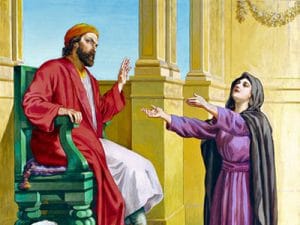
The parable of the unjust judgeJesus told his disciples a parable about the need to pray continually and never lose heart. ‘There was a judge in a certain town’ he said ‘who had neither fear of God nor respect for man. In the same town there was a widow who kept on coming to him and saying, “I want justice from you against my enemy!” For a long time he refused, but at last he said to himself, “Maybe I have neither fear of God nor respect for man, but since she keeps pestering me I must give this widow her just rights, or she will persist in coming and worry me to death.”’ And the Lord said ‘You notice what the unjust judge has to say? Now will not God see justice done to his chosen who cry to him day and night even when he delays to help them? I promise you, he will see justice done to them, and done speedily. But when the Son of Man comes, will he find any faith on earth?’
Nothing is changingIn England, Wales and Scotland, the translation of the readings used at Mass is changing. Your current calendar setting is “United States”, so you will not be affected by this change. This message will disappear at the end of December. Universalis podcast: The week ahead – from 17 to 23 NovemberThe feasts of the four Roman basilicas; our reasons for fearing the gift of death. (15 minutes)
Episode notes.Play Christian Art Each day, The Christian Art website gives a picture and reflection on the Gospel of the day. The readings on this page are from the Jerusalem Bible, which is used at Mass in most of the English-speaking world. The New American Bible readings, which are used at Mass in the United States, are available in the Universalis apps, programs and downloads.
You can also view this page with the Gospel in Greek and English. |
TOPICS: Catholic; General Discusssion; Prayer; Worship
KEYWORDS: catholic; lk18; ordinarytime; prayer
For your reading, reflection, faith-sharing, comments, questions, discussion.
1
posted on
11/16/2024 8:35:11 AM PST
by
annalex
To: All
KEYWORDS: catholic; lk18; ordinarytime; prayer
2
posted on
11/16/2024 8:35:38 AM PST
by
annalex
(fear them not)
To: nickcarraway; NYer; ELS; Pyro7480; livius; ArrogantBustard; Catholicguy; RobbyS; marshmallow; ...

Alleluia Ping Please FReepmail me to get on/off the Alleluia Ping List.
3
posted on
11/16/2024 8:36:37 AM PST
by
annalex
(fear them not)
To: annalex
4
posted on
11/16/2024 8:36:56 AM PST
by
annalex
(fear them not)
To: annalex
| Luke |
| | English: Douay-Rheims | Latin: Vulgata Clementina | Greek NT: Byzantine/Majority Text (2000) |
| | Luke 18
|
| 1. | AND he spoke also a parable to them, that we ought always to pray, and not to faint, | Dicebat autem et parabolam ad illos, quoniam oportet semper orare et non deficere, | ελεγεν δε και παραβολην αυτοις προς το δειν παντοτε προσευχεσθαι και μη εκκακειν |
| 2. | Saying: There was a judge in a certain city, who feared not God, nor regarded man. | dicens : Judex quidam erat in quadam civitate, qui Deum non timebat, et hominem non reverebatur. | λεγων κριτης τις ην εν τινι πολει τον θεον μη φοβουμενος και ανθρωπον μη εντρεπομενος |
| 3. | And there was a certain widow in that city, and she came to him, saying: Avenge me of my adversary. | Vidua autem quædam erat in civitate illa, et veniebat ad eum, dicens : Vindica me de adversario meo. | χηρα δε ην εν τη πολει εκεινη και ηρχετο προς αυτον λεγουσα εκδικησον με απο του αντιδικου μου |
| 4. | And he would not for a long time. But afterwards he said within himself: Although I fear not God, nor regard man, | Et nolebat per multum tempus. Post hæc autem dixit intra se : Etsi Deum non timeo, nec hominem revereor : | και ουκ ηθελησεν επι χρονον μετα δε ταυτα ειπεν εν εαυτω ει και τον θεον ου φοβουμαι και ανθρωπον ουκ εντρεπομαι |
| 5. | Yet because this widow is troublesome to me, I will avenge her, lest continually coming she weary me. | tamen quia molesta est mihi hæc vidua, vindicabo illam, ne in novissimo veniens sugillet me. | δια γε το παρεχειν μοι κοπον την χηραν ταυτην εκδικησω αυτην ινα μη εις τελος ερχομενη υποπιαζη με |
| 6. | And the Lord said: Hear what the unjust judge saith. | Ait autem Dominus : Audite quid judex iniquitatis dicit : | ειπεν δε ο κυριος ακουσατε τι ο κριτης της αδικιας λεγει |
| 7. | And will not God revenge his elect who cry to him day and night: and will he have patience in their regard? | Deus autem non faciet vindictam electorum suorum clamantium ad se die ac nocte, et patientiam habebit in illis ? | ο δε θεος ου μη ποιηση την εκδικησιν των εκλεκτων αυτου των βοωντων προς αυτον ημερας και νυκτος και μακροθυμων επ αυτοις |
| 8. | I say to you, that he will quickly revenge them. But yet the Son of man, when he cometh, shall he find, think you, faith on earth? | Dico vobis quia cito faciet vindictam illorum. Verumtamen Filius hominis veniens, putas, inveniet fidem in terra ? | λεγω υμιν οτι ποιησει την εκδικησιν αυτων εν ταχει πλην ο υιος του ανθρωπου ελθων αρα ευρησει την πιστιν επι της γης |
|
5
posted on
11/16/2024 8:39:00 AM PST
by
annalex
(fear them not)
To: annalex

Catena Aurea by St. Thomas Aguinas
18:1–8
1. And he spake a parable unto them to this end, that men ought always to pray, and not to faint;
2. Saying, There was in a city a judge, which feared not God, neither regarded man:
3. And there was a widow in that city; and she came unto him, saying, Avenge me of mine adversary.
4. And he would not for a while: but afterwards he said within himself, Though I fear not God, nor regard man;
5. Yet because this widow troubleth me, I will avenge her, lest by her continual coming she weary me.
6. And the Lord said, Hear what the unjust judge saith.
7. And shall not God avenge his own elect, which cry day and night unto him, though he bear long with them?
8. I tell you that he will avenge them speedily. Nevertheless when the Son of man cometh, shall he find faith on the earth?
THEOPHYLACT. Our Lord having spoken of the trials and dangers which were coming, adds immediately afterward their remedy, namely, constant and earnest prayer.
CHRYSOSTOM. He who hath redeemed thee, hath shewn thee what He would have thee do. He would have thee be instant in prayer, He would have thee ponder in thy heart the blessings thou art praying for, He would have thee ask and receive what His goodness is longing to impart. He never refuses His blessings to them that pray, but rather stirs men up by His mercy not to faint in praying. Gladly accept the Lord’s encouragement: be willing to do what He commands, not to do what He forbids. Lastly, consider what a blessed privilege is granted thee, to talk with God in thy prayers, and make known to Him all thy wants, while He though not in words, yet by His mercy, answers thee, for He despiseth not petitions, He tires not but when thou art silent.
BEDE. We should say that he is always praying, and faints not, who never fails to pray at the canonical hours. Or all things which the righteous man does and says towards God, are to be counted as praying.
AUGUSTINE. (lib. ii. qu. 45.) Our Lord utters His parables, either for the sake of the comparison, as in the instance of the creditor, who when forgiving his two debtors all that they owed him was most loved by him who owed him most; or on account of the contrast, from which he draws his conclusion; as, for example, if God so clothe the grass of the field, which to-day is, and tomorrow is cast into the oven, shall he not much more clothe you, O ye of little faith. So also here when he brings forward the case of the unjust judge.
THEOPHYLACT. We may observe, that irreverence towards man is a token of a greater degree of wickedness. For as many as fear not God, yet are restrained by their shame before men, are so far the less sinful; but when a man becomes reckless also of other men, the burden of his sins is greatly increased.
It follows, And there was a widow in that city.
AUGUSTINE. The widow may be said to resemble the Church, which appears desolate until the Lord shall come, who now secretly watches over her. But in the following words, And she came unto him, saying, Avenge me, &c. we are told the reason why the elect of God pray that they may be avenged; which we find also said of the martyrs in the Revelations of St. John, (Rev. 6:10.) though at the same time we are very plainly reminded to pray for our enemies and persecutors. This avenging of the righteous then we must understand to be, that the wicked may perish. And they perish in two ways, either by conversion to righteousness, or by punishment having lost the opportunity of conversion. Although, if all men were converted to God, there would still remain the devil to be condemned at the end of the world. And since the righteous are longing for this end to come, they are not unreasonably said to desire vengeance.
CYRIL OF ALEXANDRIA. Or else; Whenever men inflict injury upon us, we must then think it a noble thing to be forgetful of the evil; but when they offend against the glory of God by taking up arms against the ministers of God’s ordinance, we then approach God imploring His help, and loudly rebuking them who impugn His glory.
AUGUSTINE. (ut sup.) If then with the most unjust judge, the perseverance of the suppliant at length prevailed even to the fulfilment of her desire, how much more confident ought they to feel who cease not to pray to God, the Fountain of justice and mercy? And so it follows. And the Lord said, Hear what, &c.
THEOPHYLACT. As if He said, If perseverance could melt a judge defiled with every sin, how much more shall our prayers incline to mercy God the Father of all mercies! But some have given a more subtle meaning to the parable, saying, that the widow is a soul that has put off the old man, (that is, the devil,) who is her adversary, because she approaches God, the righteous Judge, who neither fears (because He is God alone) nor regards man, for with God there is no respect of persons. Upon the widow then, or soul ever supplicating Him against the devil, God shews mercy, and is softened by her importunity. After having taught us that we must in the last days resort to prayer because of the dangers that are coming, our Lord adds, Nevertheless, when the Son of man cometh, shall he find faith on the earth?
AUGUSTINE. (Serm. 115.) Our Lord speaks this of perfect faith, which is seldom found on earth. See how full the Church of God is; were there no faith, who would enter it? Were there perfect faith, who would not move mountains?
BEDE. When the Almighty Creator shall appear in the form of the Son of man, so scarce will the elect be, that not so much the cries of the faithful as the torpor of the others will hasten the world’s fall. Our Lord speaks then as it were doubtfully, not that He really is in doubt, but to reprove us; just as we sometimes, in a matter of certainty, might use the words of doubt, as, for instance, in chiding a servant, “Remember, am I not thy master?”
AUGUSTINE. (ut sup.) Our Lord adds this to shew, that when faith fails, prayer dies. In order to pray then, we must have faith, and that our faith fail not, we must pray. Faith pours forth prayer, and the pouring forth of the heart in prayer gives stedfastness to faith.
Catena Aurea Luke 18
6
posted on
11/16/2024 8:39:48 AM PST
by
annalex
(fear them not)
To: annalex
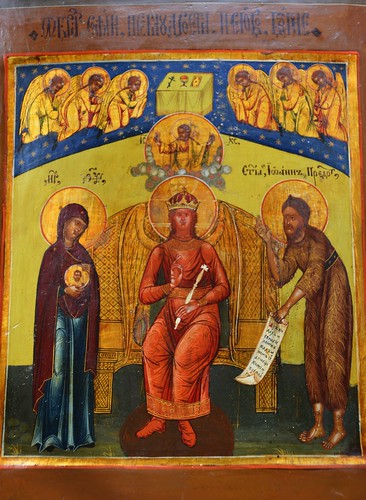
Jesus, the Wisdom of God
7
posted on
11/16/2024 8:40:35 AM PST
by
annalex
(fear them not)
To: annalex
Saint of the Day for November 14
(January 6, 1256 – November 17, 1302)
Saint Gertrude the Great’s Story
Gertrude, a Benedictine nun in Helfta, Saxony, was one of the great mystics of the 13th century. Together with her friend and teacher Saint Mechtild, she practiced a spirituality called “nuptial mysticism,” that is, she came to see herself as the bride of Christ. Her spiritual life was a deeply personal union with Jesus and his Sacred Heart, leading her into the very life of the Trinity.
But this was no individualistic piety. Gertrude lived the rhythm of the liturgy, where she found Christ. In the liturgy and in Scripture she found the themes and images to enrich and express her piety. There was no clash between her personal prayer life and the liturgy. The Liturgical Feast of Saint Gertrude the Great is November 16.
Reflection
Saint Gertrude’s life is another reminder that the heart of the Christian life is prayer: private and liturgical, ordinary or mystical, but always personal.
franciscanmedia.org
8
posted on
11/16/2024 8:44:22 AM PST
by
annalex
(fear them not)
To: annalex
9
posted on
11/16/2024 8:47:30 AM PST
by
annalex
(fear them not)
To: annalex
NAVARRE BIBLE COMMENTARY (RSV)
Ad Majorem Dei Gloriam (To the Greater Glory of God)
First Reading:
From: 3 John 5-8
Praise for Gaius
--------------------
[3] For I great rejoiced when some of the brethren arrived and testified to the truth of your life, as indeed you do follow the truth. [4] No greater joy can I have than this, to hear that my children follow the truth.
[5] Beloved, it is a loyal thing you do when you render any service to the brethren, especially to strangers, [6] who have testified to your love before the church. You will do well to send them on their journey as befits God's service. [7] For they have set out for his sake and have accepted nothing from the heathen. [8] So we ought to support such men, that we may be fellow workers in the truth.
***********************************************************************
Commentary:
With great simplicity St John says why his paternal heart feels so happy--because Gaius, as his charity shows (vv. 5-8), is such a good-living man (vv. 3-4).
He uses a typically Semitic turn of phrase to describe Gaius' upright life: 'you follow the truth." In the Old Testament the Patriarchs are praised for "walking with God" (cf., e.g. Gen 5:22, 24; 6:9). This image of the wayfarer took on great importance after the Exodus: the people of Israel by divine will made their way as pilgrims to the Promised Land and in the course of that journey the great event of the Covenant took place (cf. Ex 19:24). "Walking with God" means the same as "fulfilling what the Covenant requires", that is, the commandments (cf. 2 Jn 4). With the coming of Christ, who said of himself, "I am the way, and the truth, and the life" (Jn 14:6), it has become quite clear that walking in the truth means being totally attached to the person of Christ: "live in him" (Col 2:6), "walk in the light" (1 Jn 1:7), "follow the truth" (2 Jn 4), all mean the same sort of thing--living in communion with Christ, being a genuine Christian in everything one thinks and does.
Gaius' charity expressed itself in welcoming and helping the preachers sent by John (in the early times of the Church itinerant missionaries helped to keep alive the faith and promote solidarity among the scattered churches). They had set out "for his sake", that is, Christ's (v. 7; cf. Acts 5:41; Phil 2:9-10; Jas 2:7). By helping (even materially), Christians become "fellow workers in the truth" (v. 8) and merit the reward promised by our Lord: "He who receives you receives me, and he who receives me receives him who sent me"(Mt 10:40).
"Fellow workers in the truth": the Second Vatican Council applies these words to lay people when explaining how their apostolate and the ministry proper to pastors complement each other. And it goes on: "Lay people have countless opportunities for exercising the apostolate of evangelization and sanctification. The very witness of a Christian life, and good works done in a supernatural spirit, are effective in drawing men to the faith and to God; and that is what the Lord has said: 'Let your light shine so brightly before men, that they may see your good works and give glory to your Father who is in heaven.' (Mt 5:16).
"This witness of life, however, is not the sole element in the apostolate; the true apostle is on the lookout for opportunities to announce Christ by word, either to unbelievers to draw them towards the faith, or to the faithful to instruct them, strengthen them and incite them to a more fervent life" ("Apostolicam Actuositatem", 6).
10
posted on
11/16/2024 8:51:18 AM PST
by
fidelis
(Ecce Crucem Domini! Fugite partes adversae! Vicit Leo de tribu Juda, Radix David! Alleluia!)
Gospel Reading: From: Luke 18:1-8
Persevering Prayer. Parable of the Unjust Judge
------------------------------------------------------------
[1] And He (Jesus) told them a parable, to the effect that they ought always to pray and not lose heart. [2] He said, "In a certain city there was a judge who neither feared God nor regarded man; [3] and there was a widow in that city who kept coming to him saying, `Vindicate me against my adversary.' [4] For a while he refused; but afterward he said to himself, `Though I neither fear God nor regard man, [5] yet because this widow bothers me, I will vindicate her, or she will wear me out by her continual coming.' [6] And the Lord said, "hear what the unrighteous judge says. [7] And will not God vindicate His elect, who cry to Him day and night? Will He delay long over them? [8] I tell you, He will vindicate them speedily. Nevertheless, when the Son of Man comes, will he find faith on earth?"
***********************************************************************
Commentary:
1-8. The parable of the unjust judge is a very eloquent lesson about the effectiveness of persevering, confident prayer. It also forms a conclusion to Jesus' teaching about watchfulness, contained in the previous verses (17:23-26). Comparing God with a person like this makes the point even clearer: if even an unjust judge ends up giving justice to the man who keeps on pleading his case, how much more will God, who is infinitely just, and who is our Father, listen to the persevering prayer of His children. God, in other words, gives justice to His elect if they persist in seeking His help.
1. "They ought always to pray and not lose heart." Why must we pray?
"1. WE MUST PRAY FIRST AND FOREMOST BECAUSE WE ARE BELIEVERS.
"Prayer is in fact the recognition of our limitation and our dependence: we come from God, we belong to God and we return to God! We cannot, therefore, but abandon ourselves to Him, our Creator and Lord, with full and complete confidence [...].
"Prayer, therefore, is first of all an act of intelligence, a feeling of humility and gratitude, an attitude of trust and abandonment to Him who gave us life out of love.
"Prayer is a mysterious but real dialogue with God, a dialogue of confidence and love.
"2. WE, HOWEVER, ARE CHRISTIANS, AND THEREFORE WE MUST PRAY AS CHRISTIANS.
"For the Christian, in fact, prayer acquires a particular characteristic, which completely changes its innermost nature and innermost value. The Christian is a disciple of Jesus; he is one who really believes that Jesus is the Word Incarnate, the Son of God who came among us on this earth.
"As a man, the life of Jesus was a continual prayer, a continual act of worship and love of the Father and since the maximum expression of prayer is sacrifice, the summit of Jesus' prayer is the Sacrifice of the Cross, anticipated by the Eucharist at the Last Supper and handed down by means of the Holy Mass throughout the centuries.
"Therefore, the Christian knows that his prayer is that of Jesus; every prayer of his starts from Jesus; it is He who prays in us, with us, for us. All those who believe in God, pray; but the Christian prays in Jesus Christ: Christ is our prayer!
"3. FINALLY, WE MUST ALSO PRAY BECAUSE WE ARE FRAIL AND GUILTY.
"It must be humbly and realistically recognized that we are poor creatures, confused in ideas, tempted by evil, frail and weak, in continual need of inner strength and consolation. Prayer gives the strength for great ideas, to maintain faith, charity, purity and generosity. Prayer gives the courage to emerge from indifference and guilt, if unfortunately one has yielded to temptation and weakness. Prayer gives light to see and consider the events of one's own life and of history in the salvific perspective of God and eternity. Therefore, do not stop praying! Let not a day pass without your having prayed a little! Prayer is a duty, but it is also a great joy, because it is a dialogue with God through Jesus Christ! Every Sunday, Holy Mass: if it is possible for you, sometimes during the week. Every day, morning and evening prayers, and at the most suitable moments!" (John Paul II, "Audience with Young People", 14 March 1979).
8. Jesus combines His teaching about perseverance in prayer with a serious warning about the need to remain firm in the faith: faith and prayer go hand in hand. St. Augustine comments, "In order to pray, let us believe; and for our faith not to weaken, let us pray. Faith causes prayer to grow, and when prayer grows our faith is strengthened" ("Sermon", 115).
Our Lord has promised His Church that it will remain true to its mission until the end of time (cf. Matthew 28:20); the Church, therefore, cannot go off the path of the true faith. But not everyone will remain faithful: some will turn their backs on the faith of their own accord. This is the mystery which St. Paul describes as "the rebellion" (2 Thessalonians 2:3) and which Jesus Christ announces on other occasions (cf. Matthew 24:12-13). In this way our Lord warns us, to help us stay watchful and persevere in the faith and in prayer even though people around us fall away.
11
posted on
11/16/2024 8:51:36 AM PST
by
fidelis
(Ecce Crucem Domini! Fugite partes adversae! Vicit Leo de tribu Juda, Radix David! Alleluia!)
12
posted on
11/16/2024 8:52:55 AM PST
by
fidelis
(Ecce Crucem Domini! Fugite partes adversae! Vicit Leo de tribu Juda, Radix David! Alleluia!)
Disclaimer:
Opinions posted on Free Republic are those of the individual
posters and do not necessarily represent the opinion of Free Republic or its
management. All materials posted herein are protected by copyright law and the
exemption for fair use of copyrighted works.
FreeRepublic.com is powered by software copyright 2000-2008 John Robinson