Catena Aurea by St. Thomas Aguinas
24. Verily, verily, I say to you, He that hears my word, and believes in him that sent me, has everlasting life, and shall not come into condemnation; but is passed from death to life.
GLOSS. Having said that the Son quickens whom He will, He next shows that we attain to life through the Son: Verily, verily, I say to you, He that hears My word, and believes in Him that sent Me, has everlasting life.
AUG. If, in hearing and believing is eternal life, how much more in understanding? But the step to our piety is faith, the fruit of faith, understanding. It is not, Believes in Me, but in Him that sent Me. Why is one to hear His word, and believe another? Is it not that He means to say, His word is in Me? And what is, Hears My word, but hears Me? And it is, Believe in Him that sent Me; as to say, He that believes in Him, believes in His Word, i.e. in Me, because I am the Word of the Father.
CHRYS. Or, He did not say, He that hears My words, and believes in Me; as they would have thought this empty boasting and arrogance. To say, Believes in Him that sent Me, was a better way of making His discourse acceptable. To this end He says two things: one, that he who hears Him, believes on the Father; the other, that he who hears and believes shall not come into condemnation.
AUG. But who is this favored Person? Will there be any one better than the Apostle Paul, who says, We must all appear before the judgment-seat of Christ? Now judgment sometimes means punishment, sometimes trial. In the sense of trial, we must all appear before the judgment-seat of Christ: in the sense of condemnation we read, some shall not come into judgment; i.e. shall not be condemned. It follows, but is passed from death into life: not, is now passing, but has passed from the death of unbelief, into the life of faith, from the death of sin, to the life of righteousness. Or, it is so said perhaps, to prevent our supposing that faith would save us from bodily death, that penalty which we must pay for Adam's transgression. He, in whom we all then were, heard the divine sentence, You shall surely die; nor can we evade it. But when we have suffered the death of the old man, we shall receive the life of the new, and by death make a passage to life. But to what life? To life everlasting: the dead shall rise again at the end of the world, and enter into everlasting life. For this life does not deserve the name of life; only that life is true which is eternal.
AUG. We see the lovers of this present transitory life so intent on its welfare, that when in danger of death, they will take any means to delay its approach, though they can not hope to drive it off altogether. If so much care and labor then is spent on gaining a little additional length of life, how ought we to strive after life eternal? And if they are thought wise, who endeavor in every way to put off death, though they can live but a few days longer; how foolish are they who so live, as to lose the eternal day?
25. Verily, verily, I say to you, The hour is coming, and now is, when the dead shall hear the voice of the Son of God: and they that hear shall live.
26. For as the Father has life in himself; so has he given to the Son to have life in himself.
AUG. Some one might ask you, The Father quickens him who believes in Him; but what of you? do you not quicken? Observe you that the Son also quickens whom He will; Verily, verily, I say to you, The hour is coming, and now is, when the dead shall hear the voice of the Son of God; and they that hear shall live.
CHRYS. After, The hour comes, He adds, and now is; to let us know that it will not be long before it comes. For as in the future resurrection we shall be roused by hearing His voice speaking to us, so is it now.
THEOPHYL. Here He speaks with a reference to those whom He was about to raise from the dead: viz. the daughter of the ruler of the synagogue, the son of the widow, and Lazarus.
AUG. Or, He means to guard against our thinking, that the being passed from death to life, refers to the future resurrection; its meaning being, that he who believes is passed: and therefore He says, Verily, verily, I say to you, The hour comes, (what hour?) and now is, when the dead shall hear the voice of the Son of God, and they that hear shall live. He said not, because they live, they hear; but in consequence of hearing, they come to life again. But what is hearing, but obeying? For they who believe and do according to the true faith, live, and are not dead; whereas those who believe not, or, believing, live a bad life, and have not love, are rather to be accounted dead. And yet that hour is still going on, and will go on, the same hour, to the end of the world: as John says, It is the last hour.
AUG. When the dead, i.e. unbelievers, shall hear the voice of the Son of God, i.e. the Gospel: and they that hear, i.e. who obey, shall live, i.e. be justified, and no longer remain in unbelief.
AUG. But some one will ask, Has the Son life, whence those who believe will fire? Hear His own words: As the Father has life in Himself, so has He given to the Son to have life in Himself. Life is original and absolute in Him, comes from no other source, depends on no other power. He is not as if He were partaker of a life, which is not Himself; but has life in Himself: so as that He Himself is His own life. Hear, O dead soul, the Father, speaking by the Son: arise, that you may receive that life which you have not in yourself, and enter into the first resurrection. For this life, which the Father and the Son are, pertains to the soul, and is not perceived by the body. The rational mind only discovers the life of wisdom.
HILARY. The heretics, driven hard by Scripture proofs, are obliged to attribute to the Son at any rate a likeness, in respect of virtue, to the Father. But they do not admit a likeness of nature, not being able to see that a likeness of virtue, could not arise but from a likeness of nature; as an inferior nature can never attain to the virtue of a higher and better one. And it cannot be denied that the Son of God has the same virtue with the Father, when He says, What things soever (the Father) does, the same does the Son likewise. But an express mention of the likeness of nature follows: As the Father has life in Himself, so has He given to the Son to have life in Himself. In life are comprehended nature and essence. And the Son, as He has it, so has He it given to Him. For the same which is life in both, is essence in both; and the life, i.e. essence, which is begotten from life, is born; though not born unlike the other. For, being life from life, it remains like in nature to its origin.
AUG. The Father must he understand not to have given life to the Son, who was existing without life, but so to have begotten Him, independently of time, that the life which He gave Him in begetting, was co-eternal with His own.
HILARY. Living born from living, has the perfection of nativity, without the newness of nature. For there is nothing new implied in generation from living to living, the life not coming at its birth from nothing. And the life which derives its birth from life, must by the unity of nature, and the sacrament of a perfect birth, both be in the living being, and have the being who lives it, in itself. Weak human nature indeed is made up of unequal elements, and brought to life out of inanimate matter; nor does the human offspring live for some time after it is begotten. Neither does it wholly live from life, since much grows up in it insensibly, and decays insensibly. But in the case of God, the whole of what He is, lives: for God is life, and from life, can nothing be but what is living.
AUG. Given to the Son, then, has the meaning of, begat the Son; for He gave Him tines life, by begetting. As He gave Him being, so He gave Him to have life in Himself; so that the Son did not stand in need of life to come to Him from without; but was in Himself the fullness of life, whence others, i.e. believers, received their life. What then is the difference between Them? This that one gave, the other received.
CHRYS The likeness is perfect in all but one respect, viz. that, in point of essence, one is the Father, the other the Son.
HILARY. For the person of the receiver, is distinct from that of the giver: it being inconceivable that one and the same person, should give to and receive from Himself. He who lives of Himself is one person: He who acknowledges an Author of His life is another.
27. And has given him authority to execute judgment also, because he is the Son of man.
28. Marvel not at this: for the hour is coming, in the which all that are in the graves shall hear his voice,
29. And shall come forth; they that have done good, to the resurrection of life; and they that have done evil, to the resurrection of damnation.
THEOPHYL. The Father granted the Son power not only to give life, but also to execute judgment. And has given Him authority to execute judgment.
CHRYS. But why does He dwell so constantly on these subjects; judgment, resurrection, and life? Because these are the most powerful arguments for bringing men over to the faith, and the most likely ones to prevail with obstinate hearers. For one who is persuaded that he shall rise again, and be called by the Son to account for his misdeeds, will, though he know nothing more than this, be anxious to propitiate his Judge. It follows, Because He is the Son of man, marvel not at this. Paul of Samosata reads it, Has given Him power to execute judgment also, because He is the Son of man. But this connection has no meaning; for He does not receive the power to judge because He is man, (as, on this supposition, what would prevent all men from being judges:) but because He is the ineffable Son of God; therefore is He Judge. We must read it then, Because He is the Son of man, marvel not at this. As Christ's hearers thought him a mere man, and as what He asserted of Himself was too high to be true of men, or even angels, or any being short of God Himself, there was a strong obstacle in the way of their believing, which our Lord notices in order to remove it: Marvel not, He says, that He is the Son of man: and then adds the reason why they should not marvel: For the hour is coming, in the which all that are in the graves shall hear the voice of the Son of God. And why did He not say, Marvel not that He is the Son of man: because in truth He is the Son of God? Because, having given out that it was He who should raise men from the dead, the resurrection being a strictly divine work, He leaves His hearers to infer that He is God, and the Son of God. Persons in arguing often do this. When they have brought out grounds amply sufficient to prove the conclusion they want, they do not draw that conclusion themselves; but, to make the victory greater; leave the opponent to draw it. In referring above to the resurrection of Lazarus and the rest, he said nothing about judgment, for Lazarus did not rise again for judgment; whereas now, that He is speaking of the general resurrection, He brings in the mention of the judgment: And (they) shall come forth, He says, they that have done good to the resurrection of life, and they that have done evil to the resurrection of damnation. Having said above, He that hears My words, and believe in Him that sent Me, has everlasting life; that men might not suppose from this, that belief was sufficient for salvation, He proceeds to speak of works: And they that have done good, - and they that have done evil.
AUG. Or thus: Inasmuch as the Word was in the beginning with God, the Father gave Him to have life in Himself; but inasmuch as the Word w as made flesh of the Virgin Mary, being made man, He became the Son of man: and as the Son of man, He received power to execute judgment at the end of the world; at which time the bodies of the dead shall rise again. The souls then of the dead God raises by Christ the Son of God, their bodies by the same Christ, the Son of man. Wherefore He adds, Because He is the Son of man: for, as to the Son of God, He always had the power.
AUG. At the judgment will appear the form of man, that form will judge, which was judged; He will sit a Judge Who stood before the judge; He will condemn the guilty, Who was condemned innocent. For it is proper that the judged should see their Judge. Now the judged consist of both good and bad; so that the form of the servant will be strewn to good and bad alike; the form of God to the good only. Blessed are the pure in heart, for they shall see God.
AUG. None if the, founders of false religious sects have been able to deny the resurrection of the soul, but many have denied the resurrection of the body; and, unless You, Lord Jesus, had declared it, what answer could we give the gainsayer? To set forth this truth, He says, Marvel not at this; (i.e. that He has given power to the Son of man to execute judgment,) for the hour is coming, &c.
AUG. He does not add, And now is, here; because this hour would be at the end of the world. Marvel not, i.e. marvel not, men will all be judged by a man. But what men? Not those only, whom He will find alive, For the hour comes, in which all that are in their graves shall hear His voice.
AUG. What can be plainer? Men's bodies are in their graves, not their souls. Above when He said, The hour comes, and added, and now is; He proceeds, When the dead shall hear the voice of the Son of God. He does not say, All the dead; for by the dead are meant the wicked, and the wicked have not all been brought to obey the Gospel But in the end of the world all that are in their graves shall hear His voice, and come forth. He does not say, Shall live, as He said above, when He spoke of the eternal and blessed life; which all will not have, who shall come forth from their graves. This judgment was committed to Him because He was the Son of man. But what takes place in this judgment? They that have done good shall go to the resurrection of life, i.e. to live with the Angels of God; they that have done evil to the resurrection of judgment. Judgment here meaning damnation.
Catena Aurea John 5
Saint Victorinus of Pettau
Feast November 2
Bishop and Martyr – Born: Third Century – Died: 304 A.D.
The little known of his life is provided by the great St. Jerome (De viris ill. 74). Born in Greece in the mid-third century, Victorinus spoke Greek better than Latin, which explains why St. Jerome expressed the opinion that his works written in Latin were more remarkable for their matter than for their style. Bishop of the City of Pettau, he was the first theologian to use Latin for his exegesis.

Painting by Bernardino Zenale of Saint Jerome (far right) with Our Lady, the Infant Jesus and St. Ambrose (far left).
His works are mainly exegetical, meaning that he spent his life in the critical interpretation of biblical text to discover its intended meaning. Victorinus composed commentaries on various books of Holy Scripture, such as Genesis, Exodus, Leviticus, Isaiah, Ezekiel, Habakkuk, Ecclesiastes, the Canticle of Canticles, St. Matthew, and the Apocalypse, besides treatises against the heresies of his time. All that has survived is his Commentary on Apocalypse and the short tract On the construction of the world (De fabrica mundi).
Victorinus was very influenced by Origen, an early Christian scholar, ascetic, and theologian who was born and spent the first half of his career in Alexandria. His works were ranked with the apocrypha and other writings which according to the Decretum Gelasianum decree list De libris recipiendis et non recipiendis ("On books to be received and not to be received"), later attributed to Pope Gelasius I, were to be rejected as not considered free of error. By contrast, St. Jerome gives him an honorable place in his catalogue of ecclesiastical writers.
The Commentary on the Apocalypse
As his greatest surviving work, let us take a look at The Commentary on the Apocalypse. This exegetical work was composed not long after the Valerian Persecution, about 260 A.D. According to Claudio Moreschini, "The interpretation is primarily allegorical, with a marked interest in arithmology… It seems that he did not give a running commentary on the entire text but contented himself with a paraphrase of selected passages.
Saint Victorinus was apparently the first of the Church Fathers to ascertain the basic notion of “repetition” – that the Apocalypse is not one uninterrupted and developing line of prophecy, but rather that various subdivisions run parallel with each other. And he saw that the theme of the soon coming Second Advent was a continuous thread of thought throughout the Apocalypse.

The Four Horsemen of the Apocalypse, St. George altar, in the Basilica of the Sacred Heart of Jesus in Zagreb, Croatia.
He wrote of the seven churches as representing seven classes of Christians within the church. The seven seals are explained as constituting a prophetic preview of the spread of the gospel throughout the world. In connection with the Second Advent and the end of the world he looked for wars, famines, pestilences and persecution of the church.
The crowned rider of the four horsemen seated upon the white horse, going forth "conquering, and to conquer," is interpreted as prophetic of Christ's church going forth on its victorious mission, the triumph of Christianity over paganism. The red horse is explained as "coming wars," predicted as significant events preceding the end. The black horse, Victorinus avers, signifies "famines" in the time of the Antichrist. The pale horse meant "coming destructions."
The angel with the seal in chapter 7 symbolizes Elias the prophet as the "precursor of the times of Antichrist." Then comes the kingdom of Antichrist and finally the angel reapers smite the kingdom of Antichrist, delivering the saints.
The first and second angels of Revelation 14 are the predicted Elias and Jeremiah, witnessing before the Second Advent and end of the world, ushering in the eternal kingdom. The leopard beast of Revelation 14 signifies the kingdom of the time of Antichrist. Victorinus considers the 666 of verse 18 as the computation of letters, each of which comprise the equivalent number, of an assortment of possible names.
Saint Victorinus believed that after the seven plagues of the last days in Revelation 15, Babylon, in Revelation 17, is identified as Rome seated upon her "seven hills," drunk with the blood of martyrs. The seven heads of the seven-hilled Rome are believed, in their immediate application, to represent seven emperors, the sixth being Domitian, with the eighth who is "of the seven," as Nero. Victorinus interpreted the "thousand years" in Revelation 20, in which Satan is bound, as occurring "in the first advent of Christ, even to the end of the age."
The Martyrdom of Saint Victorinus
(Taken from Rev. Alban Butler (1711-1773), in his Lives of the Saints, Volume 2)
Saint Victorinus and six companions were citizens of Corinth, and confessed their faith before Tertius the proconsul, in their own country, in 249, in the beginning of the reign of Decius.

Calcografia (engraving on copper plates used for printmaking and illustrations) of Emperor Numerian in whose reign Saint Victorinus won his crown of martyrdom.
After their torments they passed into Egypt, whether by compulsion or by voluntary banishment is not known, and there finished their martyrdom at Diospolis, capital of Thebais, in the reign of Numerian, in 284, under the governor Sabinus.
After the governor had tried the constancy of martyrs by racks, scourges, and various inventions of cruelty, he caused Victorinus to be thrown into a great mortar (the Greek Menology says, of marble.)
The executioners began by pounding his feet and legs, saying to him at every stroke: “Spare yourself, wretch. It depends upon you to escape this death, if you will only renounce your new God.”
The prefect grew furious at his constancy, and at length commanded his head to be beaten to pieces. The sight of this mortar, so far from casting a damp on his companions, seemed to inspire them with the greater ardor to be treated in the like manner.
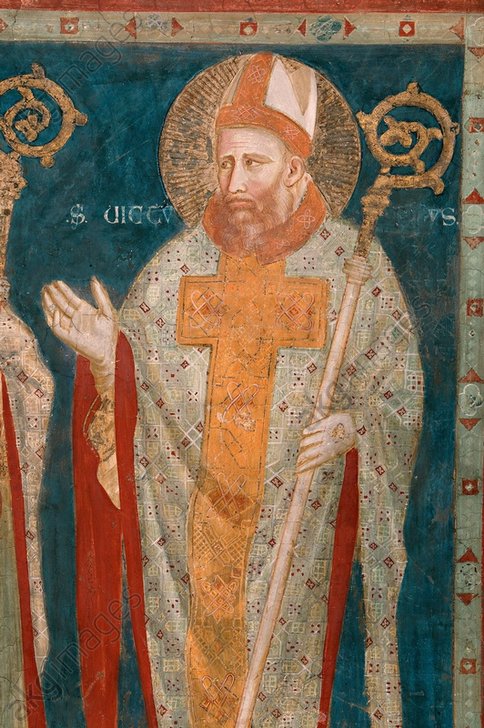
Header Image: Fresco of Saint Victorinus, found in a church in Nova Cerkev, a settlement in eastern Slovenia.
Footnotes:
americaneedsfatima.org
Second Reading: From: Romans 6:3-9
Baptism (Continuation)
---------------------------
[3] Do you not know that all of us who have been baptized into Christ Jesus were baptized into His death? [4] We were buried therefore with Him by baptism into death, so that as Christ was raised from the dead by the glory of the Father, we too might walk in newness of life.
[5] For if we have been united with Him in a death like His, we shall certainly be united with Him in a resurrection like His. [6] We know that our old self was crucified with Him so that the sinful body might be destroyed, and we might no longer be enslaved to sin. [7] For He who has died is freed from sin. [8] But if we have died with Christ, we believe that we shall also live with Him. [9] For we know that Christ being raised from the dead will never die again; death no longer has dominion over him.
*******************************************************************
Commentary:
1-11. The universal dominion of sin, which began with the sin of Adam, is not the only event to be reckoned with. When sin reached its full extent, the grace brought by Jesus Christ came in superabundance. Through Baptism this grace reaches each of us and frees us from the control of sin. When we receive this Sacrament we die: that is to say, our blameworthiness is destroyed, we renounce sin once and for all, and are born again into a new life.
"The Lord", St. Ambrose tells the newly baptized, "who wanted His benefactions to endure, the serpent's plans to be turned to naught, and the harm done to be put right, delivered a sentence to mankind: 'You are dust, and to dust you shall return' (Genesis 3:19), and made man subject to death [...]. The remedy was given him: man would die and rise again [...]. You ask me how? [...] Pay attention. So that in this world too the devil's snare would be broken, a rite was instituted whereby man would die, being alive, and rise again, being alive [...]. Through immersion in water the sentence is blotted out: 'You are dust, and to dust you shall return'" ("De Sacramentis", II, 6).
This passage of the epistle, which reveals the key truths concerning Baptism, also reminds us of the profound meaning of this rite which Christ established, its spiritual effects in Christians and its far-reaching effects with respect to the Christian life. Thus, we can apply to Baptism what St. Thomas Aquinas says about all the sacraments: "Three aspects of sanctification may be considered--its very cause, which is Christ's Passion; its form, which is grace and the virtues; and its ultimate end, which is eternal life. And all these are signified by the sacraments. Consequently, a sacrament is a sign which is both a reminder of the past, that is, of the Passion of Christ, and an indication of what is effected in us by Christ's Passion, and a foretelling and pledge of future glory" ("Summa Theologiae", III, q. 60, a. 3).
In the specific case of Baptism, the various things which the Sacrament implies carry a special nuance--a new birth which presupposes a symbolic death. It reproduces in us not only the Passion, Death and burial of Christ, symbolized by immersion in water (verses 3-4, 6), but also new life, the life of grace which pours into the soul, enabling the person to share in the Resurrection of Christ (verses 4-5). This sharing in Christ's Resurrection to immortal life is a kind of seed which will ultimately produce the glorious resurrection of our bodies.
The baptized person is, therefore, someone newly created, someone born into a new life, someone who has moved out of darkness into light. The white garment used at Baptism symbolizes innocence and grace; the burning candle, the light of Christ--two symbols the Church uses in the baptismal liturgy to signify what is happening.
Thus, in Baptism, God "removes every trace of sin, whether original or personal" ("The Rite of Baptism", Introduction, 5) and also remits the penalties that these sins incur. On being baptized in the name of the Three Divine Persons, the Christian is shown God the Father's love for him (a love he has not merited), is given a share in the Paschal Mystery of the Son, and to him is communicated new life in the Spirit (cf. "Instruction on Infant Baptism", 20 October 1980, 9). Baptism, which is also described as "the door of the spiritual life", unites a person to Christ and to the Church by means of grace, which makes us children of God and heirs to Heaven. Finally, in addition to the infused virtues and supernatural gifts, the person is given "the graces necessary to live in a Christian way, and on his soul is impressed the sacramental character which makes him a Christian for evermore" ("St. Pius X Catechism", 250).
Baptism, which confers a "character", that is, a kind of seal confirming our Christian calling, gives us a share in Christ's priesthood and makes us capable of receiving the other sacraments.
4. It is easier to grasp the symbolism of burial and resurrection if one remembers that in earlier times, and particularly in the apostolic period, Baptism was usually administered by immersion in water--in some cases by total immersion, up to three times, with one Person of the Blessed Trinity being invoked each time. "They asked you, 'Do you believe in God the Father almighty?' You said, 'I believe', and you were immersed, that is, you were buried. Again they asked you, 'Do you believe in our Lord Jesus Christ and in His Cross?' You said, 'I believe', and you were again immersed. This time you have been buried with Christ, and he who is buried with Christ rises with Christ. For a third time you were asked, 'Do you believe in the Holy Spirit?' You said, 'I believe', and for a third time you were immersed, so that by this three-fold confession you might be loosed of your many attachments to your past life" (St. Ambrose, "De Sacramentis", II, 7).
Today Baptism is normally administered by pouring water over the head-- a method also used in apostolic times and which gradually came into general use because it was found more convenient.
5. Just as the ingraft and the plant form a single thing and make a single principle of life, Christians by being grafted onto or incorporated into Christ through Baptism form one single thing with Him and begin to draw on His divine life. We are also "united with Him in a death like His": Christ suffered physical death; we, in Baptism, die spiritually to the life of sin. St. John Chrysostom explains this as follows: "Baptism is for us what the Cross and burial were for Christ; but with this difference: the Savior died physically, He was physically buried, whereas we ought to die spiritually. That is why the Apostle does not say we are 'united with Him with His death', but 'in a death like his" ("Hom. on Rom.", 10).
9-10. Jesus Christ chose to bear all the consequences of sin, even though He was sinless. His voluntary death on the Cross and His glorious Resurrection broke the bonds of death, for Himself and for all His own. Death no longer shall have dominion: "[Christ died] that through death He might destroy him who has the power of death, that is, the devil, and deliver all those who through fear of death were subject to lifelong bondage" (Hebrews 2:14-15). And as a consequence He won, for His own human nature and for us, a new life.
In all those who have been baptized these same events in Christ's life are in some way reproduced. "Our past sins have been wiped out by the action of grace. Now, so as to stay dead to sin after Baptism, personal effort is called for, although God's grace continues to be with us, providing us with great help" (Chrysostom, "Hom. on Rom.", 11). This personal effort might be encapsulated in a resolution: "May we never die through sin; may our spiritual resurrection be eternal" (St. J. Escriva, "Holy Rosary", 1st Glorious Mystery).