
Catena Aurea by St. Thomas Aguinas
11:2932
29. And when the people were gathered thick together, he began to say, This is an evil generation: they seek a sign; and there shall no sign be given it, but the sign of Jonas the prophet.
30. For as Jonas was a sign unto the Ninevites, so shall also the Son of man be to this generation.
31. The queen of the south shall rise up in the judgment with the men of this generation, and condemn them; for she came from the utmost parts of the earth to hear the wisdom of Solomon; and, behold, a greater than Solomon is here.
32. The men of Nineve shall rise up in the judgment with this generation, and shall condemn it: for they repented at the preaching of Jonas; and, behold, a greater than Jonas is here.
BEDE. Our Lord had been assailed with two kinds of questions, for some accused Him of casting out devils through Beelzebub, to whom up to this point His answer was addressed; and others tempting Him, sought from Him a sign from heaven, and these He now proceeds to answer. As it follows, And when the people were gathered thick together, he began to say, This is an evil generation, &c.
AMBROSE. That you may know that the people of the Synagogue are treated with dishonour, while the blessedness of the Church is increased. But as Jonas was a sign to the Ninevites, so also will the Son of man be to the Jews. Hence it is added, They seek a sign; and there shall no sign be given them but the sign of Jonas the prophet.
BASIL. (in Esai. 7.) A sign is a thing brought openly to view, containing in itself the manifestation of something hidden, as the sign of Jonas represents the descent to hell, the ascension of Christ, and His resurrection from the dead. Hence it is added, For as Jonas was a sign to the Ninevites, so shall also the Son of man be to this generation. He gives them a sign, not from heaven, because they were unworthy to see it, but from the lowest depths of hell; a sign, namely, of His incarnation, not of His divinity; of His passion, not of His glorification.
AMBROSE. Now as the sign of Jonas is a type of our Lords passion, so also is it a testimony of the grievous sins which the Jews have committed. We may remark at once both the mighty voice of warning, and the declaration of mercy. For by the example of the Ninevites both a punishment is denounced, and a remedy promised. Hence even the Jews ought not to despair of pardon, if they will but practise repentance.
THEOPHYLACT. Now Jonas after he came forth from the whales belly converts the men of Nineveh by his preaching, but when Christ rose again, the Jewish nation believed not. So there was a sentence already passed upon them, of which there follows a second example, as it is said, The queen of the south shall rise up in the judgment with the men of this generation, and condemn them.
BEDE. Not certainly by any authority to judge, but by the contrast of a better deed. As it follows, For she came from the utmost parts of the earth to hear the wisdom of Solomon; and, behold, a greater than Solomon is here. Hie in this place is not the pronoun, but the adverb of place, that is, there is one present among you who is incomparably superior to Solomon. He said not, I am greater than Solomon, that he might teach us to be humble, though fruitful in spiritual graces. As if he said, The barbarian woman hastened to hear Solomon, taking so long a journey to be instructed in the knowledge of visible living creatures, and the virtues of herbs. But ye when ye stand by and hear Wisdom herself teaching you invisible and heavenly things, and confirming her words with signs and wonders, are strangers to the word, and senselessly disregard the miracles.
BEDE. But if the queen of the South, who doubtless is of the elect, shall rise up in judgment together with the wicked, we have a proof of the one resurrection of all men, good as well as bad, and that not according to Jewish fables to happen a thousand years before the judgment, but at the judgment itself.
AMBROSE. Herein also while condemning the Jewish people, He strongly expresses the mystery of the Church, which in the queen of the South, through the desire of obtaining wisdom, is gathered together from the uttermost parts of the whole earth, to hear the words of the Peacemaking Solomon; a queen plainly whose kingdom is undivided, rising up from different and distant nations into one body.
GREGORY OF NYSSA. (Hom. 7. Cant.) Now as she was queen of the Ethiopians, and in a far distant country, so in the beginning the Church of the Gentiles was in darkness, and far off from the knowledge of God. But when Christ the Prince of peace shone forth, the Jews being still in darkness, thither came the Gentiles, and offered to Christ the frankincense of piety, the gold of divine knowledge, and precious stones, that is, obedience to His commands.
THEOPHYLACT. Or because the South is praised in Scripture as warm and life-giving, therefore the soul reigning in the south, that is, in all spiritual conversation, comes to hear the wisdom of Solomon, the Prince of peace, the Lord our God, (i. e. is raised up to contemplate Him,) to whom no one shall come except he reign in a good life. But He brings next an example from the Ninevites, saying, The men of Nineveh shall rise up in judgment with this generation, and shall condemn it.
CHRYSOSTOM. (non occ.) The judgment of condemnation comes from men like or unlike to those who are condemned. From like, for instance, as in the parable of the ten virgins, but from unlike, when the Ninevites condemn those who lived at the time of Christ, that so their condemnation might be the more remarkable. (Hom. 43. in Matt.). For the Ninevites indeed were barbarians, but these Jews. The one enjoying the prophetic teaching, the other having never received the divine word. To the former came a servant, to the latter the Master, of whom the one foretold destruction, the other preached the kingdom of heaven. To all men then was it known that the Jews ought rather to have believed, but the contrary happened; therefore he adds, For they repented at the preaching of Jonas, and, behold, a greater than Jonas is here.
AMBROSE. Now in a mystery, the Church consists of two things, either ignorance of sin, which has reference mainly to the queen of the South, or ceasing to sin, which relates indeed to the repentant Ninevites. For repentance blots out the offence, wisdom guards against it.
AUGUSTINE. (de Cons. Ev. lib. ii. c. 39.) Luke indeed relates this in the same place as Matthew, but in a somewhat different order. But who does not see that it is an idle question, in what order our Lord said those things, seeing that we ought to learn by the most precious authority of the Evangelist, that there is no falsehood. But not every man will repeat anothers words in the same order in which they proceeded from his mouth, seeing that the order itself makes no difference with respect to the fact, whether it be so or not.
Catena Aurea Luke 11
St. Callistus I
Feast day: Oct 14
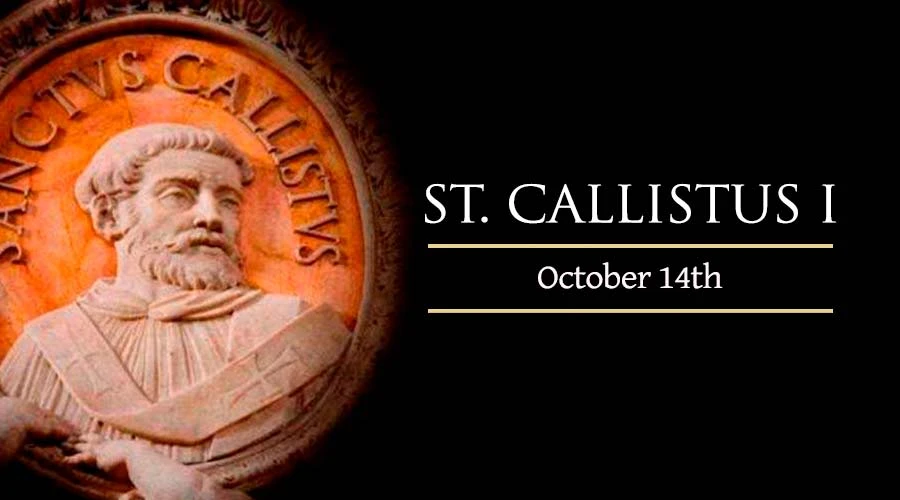
Pope Callistus I is celebrated in churches throughout the world as a saint and martyr on October 14. The saint caused a major controversy, including a schism that lasted almost two decades, by choosing to emphasize God's mercy in his ministry. However, the early Pope's model of leadership has endured, and his martyrdom in the year 222 confirmed his example of holiness.
Because no completely trustworthy biography of Pope Callistus I exists, historians have been forced to rely on an account by his contemporary Hippolytus of Rome. Although Hippolytus himself was eventually reconciled to the Church and canonized as a martyr, he vocally opposed the pontificate of Callistus and three of his successors, to the point of usurping papal prerogatives for himself (as the first “antipope”). Nevertheless, his account of Callistus' life and papacy provides important details.
According to Hippolytus' account, Callistus – whose year of birth is not known - began his career as a highly-placed domestic servant, eventually taking responsibility for his master's banking business. When the bank failed, Callistus received the blame, and attempted to flee from his master. Being discovered, he was demoted to serve as a manual laborer in Rome. Thus, under inauspicious circumstances, Callistus came as a slave to the city where he would later serve as Pope.
Matters went from bad to worse when he was sent to work in the mines, possibly for causing a public disturbance, if Hippolytus' account is to be trusted. However, Callistus may also simply have been sentenced due to a persecution of Christians, as he was among the many believers eventually freed on the initiative of Pope St. Victor I.
During the subsequent reign of Pope Zephyrinus, Callistus became a deacon and the caretaker of a major Roman Christian cemetery (which still bears his name as the “Cemetery of St. Callistus”), in addition to advising the Pope on theological controversies of the day. He was a natural candidate to follow Zephyrinus, when the latter died in 219.
Hippolytus, an erudite Roman theologian, accused Pope Callistus of sympathizing with heretics, and resented the new Pope's clarification that even the most serious sins could be absolved after sincere confession. The Pope's assertion of divine mercy also scandalized the North African Christian polemicist Tertullian, already in schism from the Church in Carthage, who also erroneously held that certain sins were too serious to be forgiven through confession.
Considered in light of this error, Hippolytus' catalogue of sins allegedly “permitted” by Callistus – including extramarital sex and early forms of contraception - may in fact represent offenses which the Pope never allowed, but which he was willing to absolve in the case of penitents seeking reconciliation with the Church.
Even so, Callistus could not persuade Hippolytus' followers of his rightful authority as Pope during his own lifetime. The Catholic Church, however, has always acknowledged the orthodoxy and holiness of Pope St. Callistus I, particularly since the time of his martyrdom – traditionally ascribed to an anti-Christian mob - in 222. St. Callistus' own intercession after death may also have made possible the historic reconciliation between his opponent Hippolytus, and the later Pope Pontian. The Pope and former antipope were martyred together in 236, and both subsequently canonized.
catholicnewsagency.com
NAVARRE BIBLE COMMENTARY (RSV)
Ad Majorem Dei Gloriam (To the Greater Glory of God)
First Reading:
From: Galatians 4:22-24, 26-27, 31-5:1
The Two Covenants: Hagar and Sarah
-------------------------------------------------
[22] For it is written that Abraham had two sons, one by a slave and one by a free woman. [23] But the son of the slave was born according to the flesh, the son of the free woman through promise. [24] Now this is an allegory: these women are two covenants. One is from Mount Sinai, bearing children for slavery; she is Hagar. [26] But the Jerusalem above is free, and she is our mother. [27] For it is written, "Rejoice, O barren one that dost not bear; break forth and shout, thou who art not in travail; for the desolate hath more children than she who hath a husband." [31] So, brethren, we are not children of the slave but of the free woman.
Christian Liberty
----------------------
[1] For freedom Christ has set us free; stand fast therefore, and do not submit again to a yoke of slavery.
***********************************************************************
Commentary:
21-31. The entire Old Testament narrative contains lessons for Christians. The Apostle says as much when he declares that these things have a symbolic meaning and "were written down for your instruction, upon whom the end of the ages has come" (1 Cor 10:11). However, certain episodes and people have particular significance, and this passage cites one (cf. Gen chaps. 16, 17 and 21). Abraham had been given a promise by God that he would have a son (Gen 15:4) by his wife Sarah (cf. Gen 17:19). However, both of them were quite old, and Sarah, besides, was barren; so, in keeping with the ancestral customs of the tribe, Sarah made Abraham take Hagar, her slave-girl, and Hagar had a son, Ishmael. However, God told Abraham that this son was not the son of the promise (cf. Gen 17:19). The promise was fulfilled sometime later when, through a miracle of God, Sarah gave birth to a son. St Paul speaks to us about the allegorical meaning of this episode: two women--Sarah, Abraham's wife and the mother of Isaac, and Hagar, her slave and the mother of Ishmael--stand for two stages in Salvation History. Hagar symbolizes the stage of the Old Covenant made on Mount Sinai, while Sarah represents the New Covenant sealed forever by the blood of Christ, the covenant which frees us from the yoke of the Law and from sin.
Paul's conclusion from this is that Christians are brothers of Isaac, born of the free woman, and therefore they are heirs of the promise made to Abraham and his descendants.
24-26. The sacred writer wants to stress that if one continues to be subject to the Mosaic Law it is equivalent to remaining a slave, to being a son of Hagar. People in that position constitute the present Jerusalem who is "in slavery with her children". Against this there is the heavenly Jerusalem, a metaphor also used in the Apocalypse to describe the Church triumphant in glory (cf. Rev 21:2, 10). This metaphor also conveys the idea of the transcendent, supernatural character of the Church.
Undoubtedly St Paul's Jewish contemporaries would have regarded this comparison of Jerusalem with Hagar as virtually blasphemous. However, we do know that the rabbis of his time did make a distinction between the earthly Jerusalem and the heavenly Jerusalem, the former being only a pale shadow of the latter. The Apostle uses these teachings, which can be deduced from Sacred Scripture, to explain that those who believe in Christ are the true descendants--spiritual descendants--of the lawful wife, Sarah, who prefigures the heavenly Jerusalem; whereas those who do not believe in Christ, although they belong racially to the people of Israel, are no longer true descendants of the lawful wife, but rather are children of Hagar.
St Paul then makes a play on words, in typical rabbinical style: since Hagar is one of the names of the mountainous region of Sinai, to which, according to the geographical notions of the time, Mount Sion also belongs (Sion being the hill on which Jerusalem is built), this earthly Jerusalem is connected with Hagar, the slave, to whom the divine promise was not made. This whole passage, while we may find it very odd, does reveal St Paul's earlier training as a rabbi, a training which divine Providence uses to show us the inner meaning of one of the most important episodes in Old Testament history.
1-3. The Law of Moses, which was divinely revealed, was something good; it suited the circumstances of the time. Christ came to bring this Law to perfection (cf. notes on Mt 5:17-19 and Gal 5:14-15). All the elaborate legal and ritual prescriptions in the Mosaic Law were laid down by God for a specific stage in Salvation History, that is, the stage which ended with the coming of Christ. Christians are under no obligation to follow the letter of that Law (cf. St Thomas Aquinas, "Summa Theologiae", I-II, q. 108, a.3 ad 3).
Although in this letter to the Galatians the Apostle is emphasizing, as we have seen, freedom from the Law of Moses, obviously this liberation cannot be entirely disconnected from freedom in general. If someone submits to circumcision after being baptized, it amounts to subjecting oneself to a series of practices which have now no value and to depriving oneself of the fruits of Christ's Redemption. In other words, subjection to the Law brings with it a loss of freedom in general. Paul is using the full might of his apostolic authority when he says, "If you receive circumcision, Christ will be of no advantage to you." Christ's Redemption alone is effective; it has no need of the rites of the Old Testament.
Gospel Reading:
From: Luke 11:29-32
The Sign of Jonah
-----------------------
[29] When the crowds were increasing, He (Jesus) began to say, "This generation is an evil generation; it seeks a sign, but no sign shall be given to it except the sign of Jonah. [30] For as Jonah became a sign to the men of Nineveh, so will the Son of Man be to this generation. [31] The queen of the South will arise at the judgment with the men of this generation and condemn them; for she came from the ends of the earth to hear the wisdom of Solomon, and behold, something greater than Solomon is here. [32] The men of Nineveh will arise at the judgment with this generation and condemn it; for they repented at the preaching of Jonah, and behold, something greater than Jonah is here."
*************************************
Commentary:
29-32. Jonah was the prophet who led the Ninevites to do penance: his actions and preaching they saw as signifying that God had sent him (cf. note on Matthew 12:41-42).
[Note on Matthew 12:41-42 states: 41-42. Nineveh was a city in Mesopotamia (modern Iraq) to which the prophet Jonah was sent. The Ninevites did penance (John 3:6-9) because they recognized the prophet and accepted his message; whereas Jerusalem does not wish to recognize Jesus, of whom Jonah was merely a figure. The queen of the South was the queen of Sheba in southwestern Arabia, who visited Solomon (1 Kings 10:1-10) and was in awe of the wisdom with which God had endowed the King of Israel. Jesus is also prefigured in Solomon, whom Jewish tradition saw as the epitome of the wise man. Jesus' reproach is accentuated by the example of pagan converts, and gives us a glimpse of the universal scope of Christianity, which will take root among the Gentiles.
There is a certain irony in what Jesus says about "something greater" than Jonah or Solomon having come: really, He is infinitely greater, but Jesus prefers to tone down the difference between Himself and any figure, no matter how important, in the Old Testament.]