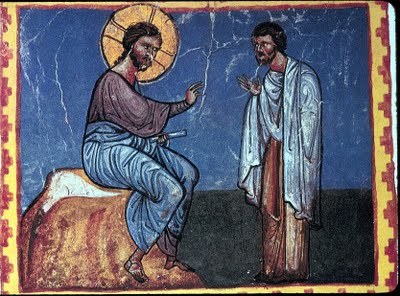
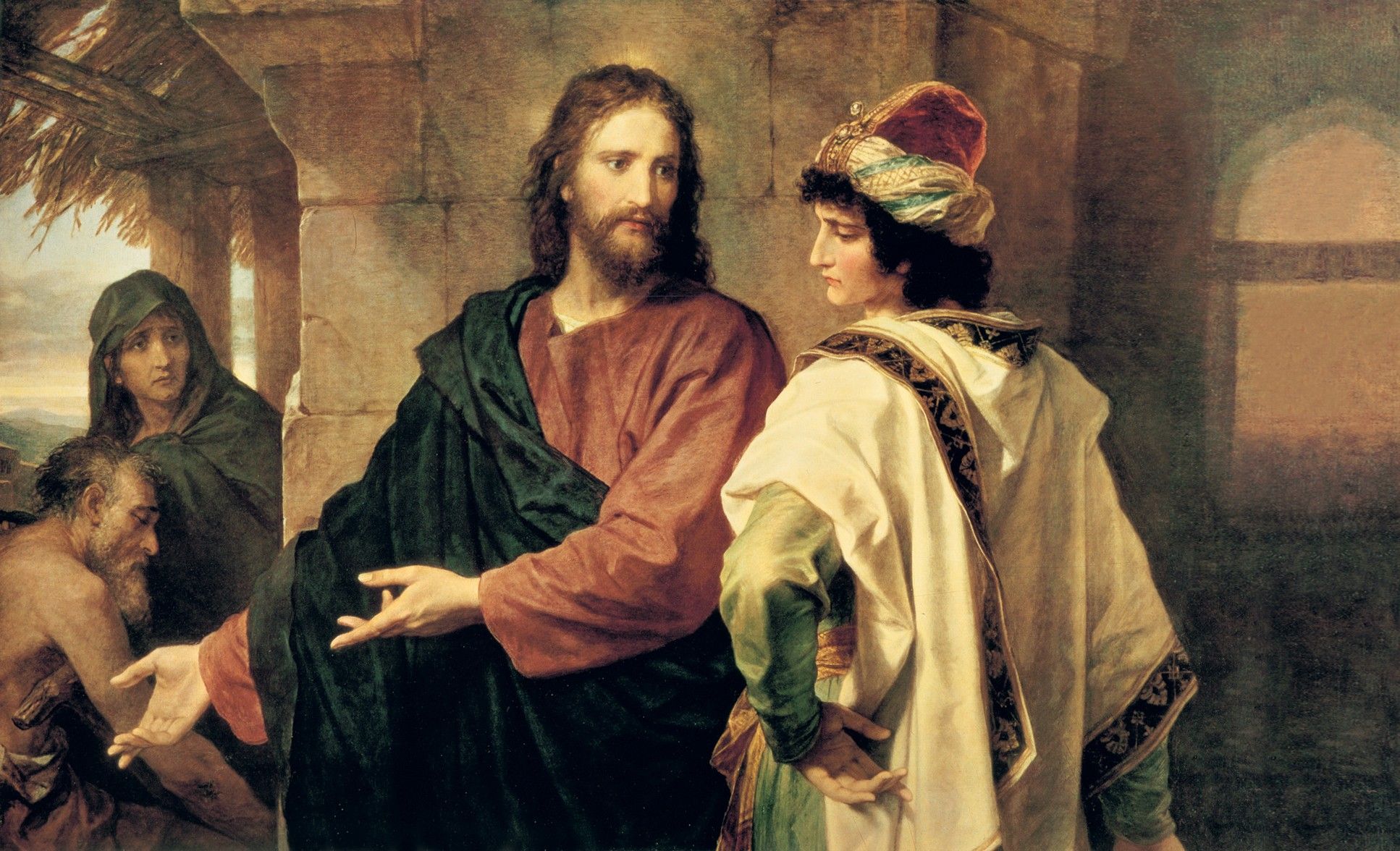
17. And when he was gone forth into the way, there came one running, and kneeled to him, and asked him, Good Master, what shall I do that I may inherit eternal life?
18. And Jesus said to him, Why call you me good? there is none good but one, that is, God.
19. You know the commandments, Do not commit adultery, Do not kill, Do not steal, Do not bear false witness, Defraud not, Honor your father and mother.
20. And he answered and said to him, Master, all these have I observed from my youth.
21. Then Jesus beholding him loved him, and said to him, One thing you lack: go your way, Sell whatsoever you have, and give to the poor, and you shall have treasure in heaven: and come, take up the cross, and follow me.
22. And he was sad at that saying, and went away grieved: for he had great possessions.
23. And Jesus looked round about, and said to his disciples, How hardly shall they that have riches enter into the kingdom of God!
24. And the disciples were astonished at his words. But Jesus answered again, and said to them, Children, how hard is it for them that trust in riches to enter into the kingdom of God!
25. It is easier for a camel to go through the eye of a needle, than for a rich man to enter into the kingdom of God.
26. And they were astonished out of measure, saying among themselves, Who then can be saved?
27. And Jesus looking upon them said, With men it is impossible, but not with God: for with God all things are possible.
BEDE; A certain man had heard from the Lord that only they who are willing to be like little children are worthy to enter into the kingdom of heaven, and therefore he desires to have explained to him, not in parables, but openly, by the merits of what works a man may attain everlasting life. Wherefore it is said: And when he was gone forth into the way, there came one running, and kneeled to him, and asked him, Good Master, what shall I do that I may inherit eternal life?
THEOPHYL. I wonder at this young man, who when all others come to Christ to be healed of their infirmities, begs of Him the possession of everlasting life, notwithstanding his love of money, the malignant passion which afterwards caused his sorrow.
CHRYS. Because however he had come to Christ as he would to a man, and to one of the Jewish doctors, Christ answered him as Man. Wherefore it goes on: And Jesus said to him, Why call you me good? there is none good but the One God. In saying which He does not exclude men from goodness, but from a comparison with the goodness of God.
BEDE; But by this one God, who is good, we must not only understand the Father, but also the Son, whom says, I am the good Shepherd; and also the Holy Ghost, because it is said, The Father which is in heaven will give the good Spirit to them that ask him. For the One and Undivided Trinity itself, Father, Son amid Holy Ghost, is the Only and One good God. The Lord therefore does not deny Himself to be good, but implies that He is God; He does not deny that He is good Master, but He declares that no master is good but God.
THEOPHYL; Therefore the Lord intended by these words to raise the mind of the young man, so that he might know Him to be God. But He also implies another thing by these words, that when you have to converse with a man, you should not flatter him in your conversation, but look back upon God, the root and fount of goodness, and do honor to Him.
BEDE; But observe that the righteousness of the law, when kept in its own time, conferred not only earthly goods, but also eternal life on those who chose it. Wherefore the Lord's answer to one who inquires concerning everlasting life is, You know the commandments, Do not commit adultery, Do not kill; for this is the childlike blamelessness which is proposed to us, if we would enter the kingdom of heaven.
On which there follows, And he answered and said to him, Master, all these have I observed from my youth. We must not suppose that this man either asked the Lord, with a wish to tempt him, as some have fancied, or lied in his account of his life; but we must believe that he confessed with simplicity how he had lived; which is evident, from what is subjoined,
Then Jesus beholding him loved him, and said to him. If however he had been guilty of lying or of dissimulation, by no means would Jesus, after, looking on the secrets of his heart, have been said to love him.
ORIGEN; For in that He loved, or kissed him, He appears to affirm the truth of his profession, in saying that he had fulfilled all those things; for on applying His mind to him, He saw that the man answered with a good conscience.
PSEUDO-CHRYS. It is worthy of inquiry, however, how He loved a man, who, He knew, would not follow Him? But this is so much as to say, that since he was worthy of love in the first instance, because he observed the things of the law from his youth, so in the end, though he did not take upon himself perfection, he did not suffer a lessening of his former love. For although he did not pass the bounds of humanity, nor follow the perfection of Christ, still he was not guilty of any sin, since he kept the law according to the capability of a man, and in this mode of keeping it, Christ loved him.
BEDE; For God loves those who keep the commandments of the law, though they be inferior; nevertheless, He shows to those who would be perfect the deficiency of the law, for He came not to destroy the law, but to fulfill it. Wherefore there follows: And said to him, One thing you lacks: go your way, sell whatever you have, and give to the poor, and you shall have treasure in heaven: and come, follow me; for whoever would be perfect ought to sell all that he has, not a part, like Ananias and Sapphira, but the whole.
THEOPHYL. And when he has sold it, to give it to the poor, not to stage-players and luxurious persons.
CHRYS. Well too did He say, not eternal life, but treasure, saying, And you shall have treasure in heaven; for since the question was concerning wealth, and the renouncing of all things, He shows that He returns more things than He has bidden us leave, in proportion as heaven is greater than earth.
THEOPHYL. But because there are many poor who are not humble, but are drunkards or have some other vice, for this reason He says, And come, follow me.
BEDE; For he follows the Lord, who imitates Him, and walks in His footsteps. It goes on: And he was sad at that saying, and went away grieved.
CHRYS. And the Evangelist adds the cause of his grief, saying, For he had great possessions. The feelings of those who have little and those who have much are not the same, for the increase of acquired wealth lights up a greater flame of covetousness.
There follows: And Jesus looked round about, and said to his disciples, How hardly shall they that have riches enter into the kingdom of God.
THEOPHYL. He says not here, that riches are bad, but that those are bad who only have them to watch them carefully; for He teaches us not to have them, that is, not to keep or preserve them, but to use them in necessary things.
CHRYS. But the Lord said this to His disciples, who were poor and possessed nothing, in order to teach them not to blush at their poverty, and as it were to make an excuse to them, and give them a reason, why He had not allowed them to possess any thing. It goes on: And the disciples were astonished at his words; for it is plain, since they themselves were poor, that they were anxious for the salvation of others.
BEDE; But there is a great difference between having riches, and loving them; wherefore also Solomon says not, He that has silver, but, He that loves silver shall not be satisfied with silver. Therefore the Lord unfolds the words of His former saying to His astonished disciples, as follows: But Jesus answered again, and said to them, Children, how hard it is for them that trust in their riches to enter the kingdom of God. Where we must observe that He says not, how impossible, but how hard; for what is impossible cannot in any way come to pass, what is difficult can be compassed, though with labor.
CHRYS. Or else, after saying difficult, He then shows that it is impossible, and that not simply, but with a certain vehemence; and he shows this by an example, saying, It is easier for a camel to pass through the eye of a needle, than for a rich man to enter the kingdom of heaven.
THEOPHYL. It may be that by camel, we should understand the animal itself, or else that thick cable, which is used for large vessels.
BEDE; How then could either in the Gospel, Matthew and Joseph, or in the Old Testament, very many rich persons, enter into the kingdom of God, unless it be that they learned through the inspiration of God either to count their riches as nothing, or to quit them altogether. Or in a higher sense, it is easier for Christ to suffer for those who love Him, than for, the lovers of this world to turn to Christ; for under the name of camel, He wished Himself to he understood, because He bore the burden of our weakness; and by the needle, He understands the prickings, that is, the pains of His Passion. By the eye of a needle, therefore, He means the straits of His Passion, by which He, as it were, deigned to mend the torn garments of our nature. it goes on;
And they were astonished above measure, saying among themselves, Who then can be saved? Since the number of poor people is immeasurably the greater, and these might be saved, though tine rich perished, they must have understood Him to mean that all who love riches, although they cannot obtain them, are reckoned in the number of the rich. It goes on; And Jesus looking upon them said, With men it is impossible, but not with God; which we must not take to mean, that covetous and proud persons can enter into the kingdom of Heaven with their covetousness and pride, but that it is possible with God that they should be converted from covetousness arid pride to charity and lowliness.
CHRYS. And the reason why He says that this is the work of God is, that He may show that he who is put into this path by God, has much need of grace; from which it is proved, that great is the reward of those rich men, who are willing to follow the r discipline of Christ.
THEOPHYL. Or we must understand that by, with man it is impossible, but not with God, He means, that when we listen to God, it becomes possible, but as long as we keep our human notions, it is impossible. There follows, For all things are possible with God; when He says all things, you must understand, that have a being; which sin has not, for it is a thing without being and substance , Or else: sin does not come under the notion of strength, but of weakness, therefore sin, like weakness, is impossible with God But can God cause that not to have been done which has been done? To which we answer, that God is Truth, but to cause that which has been done should not have been done is falsehood. How then can truth do what is false? He must first therfore quit His own nature, so that they who speak thus really say, Can God cease to be God? which is absurd. 28. Then Peter began to say to him, Lo, we have left all, and have followed you.
29. And Jesus answered and said, Truly I say to you, there is no man that has left house, or brethren, or sisters, or father, or mother, or wife, or children, or lands, for my sake, and the Gospel's,
30. But he shall receive an hundredfold now in this time, houses, and brethren, and sisters, and mothers, and children, and lands, with persecutions; and in the world to come eternal life.
31. But many that are first shall be last; and the last first.
GLOSS. Because the youth, on hearing the advice of our Savior concerning the casting away of his goods, had gone away sorrowful, the disciples of Christ, who had already fulfilled the foregoing precept, began to question Him concerning their reward, thinking that they had done a great thing, since the young man, who had fulfilled the commandments of the law, had not been able to hear it without sadness. Wherefore Peter questions the Lord for himself and the others, in these words, Then Peter began to say to him, Lo, we have left all, and have followed you.
THEOPHYL. Although Peter had left but few things, still he calls these his all; for even a few things keep us by the bond of affection, so that he shall be beatified who leaves a few things.
BEDE; And because it is not sufficient to have left all, he adds that which makes up perfection, and have followed you. As if he said, We have done what You have commanded. What reward therefore will You give us? But while Peter asks only concerning the disciples, our Lord makes a general answer; wherefore it goes on: Jesus answered and said, Truly I say to you, There is no one that has left house, or brethren, on. sisters, or father, or mother, or children, or lands. But in saying this, He does not mean that we should leave our fathers, without helping them, or that we should separate ourselves from our wives; but He instructs us to prefer the glory of God to the things of this world.
CHRYS. But it seems to me that by these words He intended covertly to proclaim that there were to be persecutions, as it would come to pass that many fathers would allure their sons to impiety, and in many wives their husbands. Again He delays not to say, for my name's sake and the Gospel's, as Mark says, or for the kingdom of God, as Luke says; the name of Christ is the power of the Gospel, and of His kingdom; for the Gospel is received in the name of Jesus Christ, and the kingdom is made known, and comes by His name.
BEDE; Some, however, taking occasion from this saying, in which it is announced that he shall receive an hundredfold now in this time, teach that Jewish fable of a thousand years after the resurrection of the just, when all that we have left for the Lord's sake is to be restored with manifold usury, besides which we are to receive the crown of everlasting life. These persons do not perceive, that although the promise in other respects be honorable, yet in the hundred wives, which the other Evangelists mention, its foulness is made manifest: particularly when the Lord testifies that there shall be no marriage in the resurrection, and asserts that those things which are put away from us for His sake are to be received again in this life with persecutions, which, as they affirm, will not take place in their thousand years.
PSEUDO-CHRYS. This hundredfold reward therefore must be in participation, not in possession, for the Lord fulfilled this to them not carnally, but spiritually.
THEOPHYL. For a wife is busied in a house about her husband's food and raiment. See also how this is the case with the Apostles; for many women busied themselves about their food and their clothing, and ministered to them. In like manner the Apostles had many fathers and mothers, that is, persons who loved them; as Peter, for instance, leaving one house, had afterwards the houses of all the disciples. And what is more wonderful, they are to be persecuted and oppressed, for it is with persecutions that the Saints are to possess all things, for which reason there follows, But many that are first shall be last, and the last first. For the Pharisees who were first became the last; but those who left all and followed Christ were last in this world through tribulation and persecutions, but shall be first by the hope which is in God.
BEDE. This which is here said, shall receive a hundredfold, may be understood in a higher sense. For the number a hundred which is reckoned by changing from the left to the right hand, although it has the same appearance in the bending of the fingers as the ten had on the left, nevertheless is increased to a much greater quantity. This means, that all who have despised temporal things for the sake of the kingdom of heaven through undoubting faith, taste the joy of the same kingdom in this life which is full of persecutions, and in the expectation of the heavenly country, which is signified by the right hand, have a share in the happiness of all the elect.
But because all do not accomplish a virtuous course of life with the same ardor as they began it, it is presently added, But many that are first shall be last, and the last first; for we daily see many persons who, remaining in a lay habit, are eminent for their meritorious life; but others, who from their youth have been ardent in a spiritual profession, at last wither away in the sloth of ease, and with a hazy folly finish in the flesh, what they had begun in the Spirit.
Catena Aurea Mark 10
Gospel Reading:From: Mark 10:17-30
The Rich Young Man
------------------
[17] And as He (Jesus) was setting out on His journey, a man ran up and knelt before Him, and asked Him, "Good Teacher, what must I do to inherit eternal life?" [18] And Jesus said to him, "Why do you call Me good? No one is good but God alone. [19] You know the commandments: `Do not kill, Do not commit adultery, Do not steal, Do not bear false witness, Do not defraud, Honor your father and mother.'" [20] And he said to Him, "Teacher, all these I have observed from my youth." [21] And Jesus looking upon him loved him, and said to him, "You lack one thing; go, sell what you have, and give to the poor, and you will have treasure in Heaven; and come, follow Me." [22] At that saying his countenance fell, and he went away sorrowful; for he had great possessions.
Poverty and Renunciation
---------------------------------
[23] And Jesus looked around and said to His disciples, "How hard it will be for those who have riches to enter the Kingdom of God!" [24] And the disciples were amazed at His words. But Jesus said to them again, "Children, how hard it is for those who trust in riches to enter the Kingdom of God!" [25] It is easier for a camel to go through the eye of a needle than for a rich man to enter the Kingdom of God." [26] And they were exceedingly astonished, and said to Him, "Then who can be saved?" [27] Jesus looked at them and said, "With men it is impossible, but not with God; for all things are possible with God." [28] Peter began to say to Him (Jesus), "Lo, we have left everything and followed You." [29] Jesus said, "Truly, I say to you, there is no one who has left house or brothers or sisters or mother or father or children or lands, for My sake and for the Gospel, [30] who will not receive a hundredfold now in this time, houses and brothers and sisters and mothers and children and lands, with persecutions, and in the age to come eternal life.
***********************************************************************
Commentary:
17-18. As Matthew 19:16 makes clear, the young man approaches Jesus as an acknowledged teacher of the spiritual life, in the hope that He will guide him towards eternal life. It is not that Christ rejects the praise He is offered: He wants to show the depth of the young man's words: He is good, not because He is a good man but because He is God, who is Goodness Itself. So, the young man has spoken the truth, but he has not gone far enough. Hence the enigmatic nature of Jesus' reply and its profundity. The young man's approach is upright but too human; Jesus tries to get him to see things from an entirely supernatural point of view. If this man is to really attain eternal life he must see in Christ not just a good master but the divine Savior, the only Master, the only one who, because He is God, is Goodness Itself. Cf. note on Mt. 19:16-22. 19. Our Lord has not come to abolish the Law but to fulfill it (Matthew 5:17). The commandments are the very core of the Law and keeping them is necessary for attaining eternal life. Christ brings these commandments to fulfillment in a double sense. First, because He helps us discover their full implications for our lives. The light of Revelation makes it easy for us to grasp the correct meaning of the precepts of the Decalogue--something that human reason, on its own, can only achieve with difficulty. Second, His grace gives us strength to counter our evil inclinations, which stem from Original Sin. The commandments, therefore, still apply in the Christian life: they are like signposts indicating the way that leads to Heaven.
21-22. Our Lord knows that this young man has a generous heart. This is why He treats him so affectionately and invites him to greater intimacy with God. But He explains that this means renunciation--leaving his wealth behind so as to give his heart whole and entire to Jesus. God calls everyone to holiness, but holiness is reached by many different routes. It is up to every individual to take the necessary steps to discover which route God wants him to follow. The Lord sows the seed of vocation in everyone's soul, to show him the way to go to reach the goal of holiness, which is common to all.
In other words, if a person does not put obstacles in the way, if he responds generously to God, he feels a desire to be better, to give himself more generously. As fruit of this desire he seeks to know God's will; he prays to God to help him, and asks people to advise him. In responding to this sincere search, God uses a great variety of instruments. Later, when a person thinks he sees the way God wants him to follow, he may still not take the decision to go that way: he is afraid of the renunciation it involves: at this point he should pray and deny himself if the light--God's invitation--is to win out against human calculation. For, although God is calling, man is always free, and therefore, he can respond generously or be a coward, like the young man we are told about in this passage. Failure to respond generously to one's vocation always produces sadness.
21. "In its precise eloquence", St. Pope John Paul II points out, commenting on this passage, "this deeply penetrating event expresses a great lesson in a few words: it touches upon substantial problems and basic questions that have in no way lost their relevance. Everywhere young people are asking important questions—questions on the meaning of life, on the right way to live, on the scale of values: `What must I do...?' `What must I do to share in everlasting life?'...To each of you I say therefore: heed the call of Christ when you hear him saying to you: `Follow Me!' Walk in My path! Stand by My side! Remain in My love! There is a choice to be made: a choice for Christ and His way of life, and His commandment of love.
"The message of love that Christ brought is always important, always relevant. It is not difficult to see how today's world, despite its beauty and grandeur, despite the conquests of science and technology, despite the refined and abundant material goods that it offers, is yearning for more truth, for more love, for more joy. And all of this is found in Christ and in His way of life.... Faced with problems and disappointments, many people will try to escape from their responsibility: escape in selfishness, escape in sexual pleasure, escape in drugs, escape in violence, escape in indifference and cynical attitudes. But today, I propose to you the option of love, which is the opposite of escape. If you really accept that love from Christ, it will lead you to God. Perhaps in the priesthood or religious life; perhaps in some special service to your brothers and sisters: especially to the needy, the poor, the lonely, the abandoned, those whose rights have been trampled upon, or those whose basic needs have not been provided for. Whatever you make of your life, let it be something that reflects the love of Christ" ("Homily on Boston Common").
22. "The sadness of the young man makes us reflect. We could be tempted to think that many possessions, many of the goods of this world, can bring happiness. We see instead in the case of the young man in the Gospel that his many possessions had become an obstacle to accepting the call of Jesus to follow Him. He was not ready to say "yes" to Jesus and "no" to self, to say "yes" to love and "no" to escape. Real love is demanding. I would fail in my mission if I did not clearly tell you so. For it was Jesus—Jesus Himself—who said: `You are My friends if you do what I command you' (John 15:14). Love demands effort and a personal commitment to the will of God. It means discipline and sacrifice, but it also means joy and human fulfillment.
"Dear young people: do not be afraid of honest effort and work; do not be afraid of the truth. With Christ's help, and through prayer, you can answer His call, resisting temptations and fads, and every form of mass manipulation. Open your hearts to the Christ of the Gospels—to His love and His truth and His joy. Do not go away sad!...
"Follow Christ! You who are single or who are preparing for marriage. Follow Christ! You who are young or old. Follow Christ! You who are sick or aging; who are suffering or in pain. You who feel the need for healing, the need for love, the need for a friend--follow Christ!
"To all of you I extend--in the name of Christ--the call, the invitation, the plea: `Come and follow Me'" (St. Pope John Paul II, "Homily on Boston Common").
23-27. The reaction of the rich young man gives our Lord another opportunity to say something about the way to use material things. In themselves they are good: they are resources God has made available to people for their development in society. But excessive attachment to things is what makes them an occasion of sin. The sin lies in "trusting" in them, as if they solve all life's problems, and turning one's back on God. St. Paul calls covetousness idolatry (Colossians 3:5). Christ excludes from the Kingdom of God anyone who becomes so attached to riches that his life is centered around them. Or, more accurately, that person excludes himself.
Possessions can seduce both those who already have them and those who are bent on acquiring them. Therefore, there are--paradoxically—poor people who are really rich, and rich people who are really poor. Since absolutely everyone has an inclination to be attached to material things, the disciples see salvation as an impossible goal: "Then who can be saved?" No one, if we rely on human resources. But God's grace makes everything possible. Cf. note on Matthew 6:11.
Also, not putting our trust in riches means that everyone who does have wealth should use it to help the needy. This "demands great generosity, much sacrifice and unceasing effort on the part of the rich man. Let each one examine his conscience, a conscience that conveys a new message for our times. Is he prepared to support out of his own pocket works and undertakings organized in favor of the most destitute? Is he ready to pay higher taxes so that the public authorities can intensify their efforts in favor of development?" (Paul VI, "Populorum Progressio", 47).
28-30. Jesus Christ requires every Christian to practise the virtue of poverty: He also requires us to practise real and effective austerity in the possession and use of material things. But of those who have received a specific call to apostolate--as in the case, here, of the Twelve--He requires absolute detachment from property, time, family, etc. so that they can be fully available, imitating Jesus Himself who, despite being Lord of the universe, became so poor that He had nowhere to lay His head (cf. Matthew 8:20). Giving up all these things for the sake of the Kingdom of Heaven also relieves us of the burden they involve: like a soldier shedding some encumbrance before going into action, to be able to move with more agility. This gives one a certain lordship over all things: no longer the slave of things, one experiences that feeling St. Paul referred to: "As having nothing, and yet possessing everything" (2 Corinthians 6:10). A Christian who sheds his selfishness in this way has acquired charity and, having charity, he has everything: "All are yours; you are Christ's; and Christ is God's" (1 Corinthians 3:22-23).
The reward for investing completely in Christ will be fully obtained in eternal life: but we will also get it in this life. Jesus says that anyone who generously leaves behind his possessions will be rewarded a hundred times over in this life. He adds "with persecutions" (v. 30) because opposition is part of the reward for giving things up out of love for Jesus Christ: a Christian's glory lies in becoming like the Son of God, sharing in His cross so as later to share in His glory: "provided we suffer with Him in order that we may also be glorified with Him (Romans 8:17); "all who desire to live a godly life in Christ Jesus will be persecuted' (2 Timothy 3:12).
29. These words of our Lord particularly apply to those who by divine vocation embrace celibacy, giving up their right to form a family on earth. By saying "for My sake and for the Gospel" Jesus indicates that His example and the demands of His teaching give full meaning to this way of life: "This, then, is the mystery of the newness of Christ, of all that He is and stands for; it is the sum of the highest ideals of the Gospel and of the Kingdom; it is a particular manifestation of grace, which springs from the paschal mystery of the Savior and renders the choice of celibacy desirable and worthwhile on the part of those called by our Lord Jesus. Thus, they intend not only to participate in Christ's priestly office, but also to share with Him His very condition of living" (Paul VI, "Sacerdotalis Coelibatus", 23).