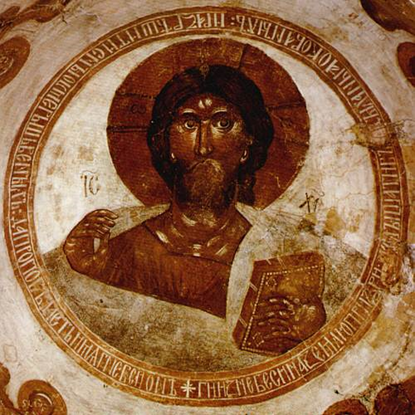
Catena Aurea by St. Thomas Aguinas
11:5–8
5. And he said unto them, Which of you shall have a friend, and shall go unto him at midnight, and say unto him, Friend, lend me three loaves;
6. For a friend of mine in his journey is come to me, and I have nothing to set before him?
7. And he from within shall answer and say, Trouble me not: the door is now shut, and my children are with me in bed; I cannot rise and give thee.
8. I say unto you, Though he will not rise and give him, because he is his friend, yet because of his importunity he will rise and give him as many as he needeth.
CYRIL OF ALEXANDRIA. The Saviour had before taught, in answer to the request of His apostles, how men ought to pray. But it might happen that those who had received this wholesome teaching, poured forth their prayers indeed according to the form given to them, but carelessly and languidly, and then when they were not heard in the first or second prayer, left off praying. That this then might not be our case, He shews by means of a parable, that cowardice in our prayers is hurtful, but it is of great advantage to have patience in them. Hence it is said, And he says unto them, Which of you shall have a friend.
THEOPHYLACT. God is that friend, who loveth all men, and wills that all should he saved.
AMBROSE. Who is a greater friend to us, than He who delivered up His body for us? Now we have here another kind of command given us, that at all times, not only in the day, but at night, prayers should be offered up. For it follows, And shall go into him at midnight. (Ps. 119:62.) As David did when he said, At midnight I will rise and give thanks unto thee. For he had no fear of awakening them from sleep, whom he knew to be ever watching. For if David who was occupied also in the necessary affairs of a kingdom was so holy, that seven times in the day he gave praise to God, (Ps. 119:164.) what ought we to do, who ought so much the more to pray, as we more frequently sin, through the weakness of our mind and body? But if thou lovest the Lord thy God, thou wilt be able to gain favour, not only for thyself, but others. For it follows, And say unto him, Friend, lend me three loaves, &c.
AUGUSTINE. (Serm. 105) But what are these three loaves but the food of the heavenly mystery? For it may be that one has had a friend asking for what he cannot supply him with, and then finds that he has not what he is compelled to give. A friend then comes to you on his journey, that is, in this present life, in which all are travelling on as strangers, and no one remains possessor, but to every man is told, Pass on, O stranger, give place to him that is coming. (Ecclus 29, 27.) Or perhaps some friend or yours comes from a bad road, (that is, an evil life,) wearied and not finding the truth, by hearing and receiving which he may become happy. He comes to thee as to a Christian, and says, “Give me a reason,” asking perhaps what you from the simplicity of your faith are ignorant of, and not having wherewith to satisfy his hunger, are compelled to seek it in the Lord’s books. For perhaps what he asked is contained in the book, but obscure. You are not permitted to ask Paul himself, or Peter, or any prophet, for all that family is now resting with their Lord, and the ignorance of the world is very great, that is, it is midnight, and your friend who is urgent from hunger presses this, not contented with a simple faith; must he then be abandoned? Go therefore to the Lord Himself with whom the family is sleeping, Knock, and pray; of whom it is added, And he from within shall answer and say, Trouble me not. He delays to give, wishing that you should the more earnestly desire what is delayed, lost by being given at once it should grow common.
BASIL. (Const. Mon. c. 1.) For perhaps He delays purposely, to redouble your earnestness and coming to him, and that you may know what the gift of God is, and may anxiously guard what is given. For whatever a man acquires with much pains he strives to keep safe, lest with the loss of that he should lose his labour likewise.
GLOSS. (ordin.) He does not then take away the liberty of asking, but is the more anxious to kindle the desire of praying, by shewing the difficulty of obtaining that we ask for. For it follows, The door is now shut.
AMBROSE. This is the door which Paul also requests may be opened to him, beseeching to be assisted not only by his own prayers, but those also of the people, that a door of utterance may be opened to him to speak the mystery of Christ. (Col. 4:3.) And perhaps that is the door which John saw open, and it was said to him, Come up hither, and, I will shew thee things which must be hereafter. (Rev. 4:1.)
AUGUSTINE. (Qu. Ev. l. ii. qu. 21.) The time then referred to is that of the famine of the word, when the understanding is shut up, (Amos 8:11.) and they who dealing out the wisdom of the Gospel as it were bread, preached throughout the world, are now in their secret rest with the Lord. And this it is which is added, And my children are with me in bed.
GREGORY OF NYSSA. Well does he call those children who by the arms of righteousness have claimed to themselves freedom from passion, shewing that the good which by practice we have acquired, had been from the beginning laid up in our nature. For when any one renouncing the flesh, by living in the exercise of a virtuous life, has overcome passion, then he becomes as a child, and is insensible to the passions. But by the bed we understand the rest of Christ.
GLOSS. (ordin.) And because of what has gone before he adds, I cannot rise and give thee, which must have reference to the difficulty of obtaining.
AUGUSTINE. (de Quæst. Ev. lib. ii. qu. 21.) Or else, the friend to whom the visit is made at midnight, for the loan of the three loaves, is evidently meant for an allegory, just as a person set in the midst of trouble might ask God that He would give him to understand the Trinity, by which he may console the troubles of this present life. For his distress is the midnight in which he is compelled to be so urgent in his request for the three. Now by the three loaves it is signified, that the Trinity is of one substance. But the friend coming from his journey is understood the desire of man, which ought to obey reason, but was obedient to the custom of the world, which he calls the way, from all things passing along it. Now when man is converted to God, that desire also is reclaimed from custom. But if not consoled by that inward joy arising from the spiritual doctrine which declares the Trinity of the Creator, he is in great straits who is pressed down by earthly sorrows, seeing that from all outward delights he is commanded to abstain, and within there is no refreshment from the delight of spiritual doctrine. And yet it is effected by prayer, that he who desires should receive understanding from God, even though there be no one by whom wisdom should be preached. For it follows, And if that man shall continue, &c. The argument is drawn from the less to the greater. For, if a friend rises from his bed, and gives not from the force of friendship, but from weariness, how much more does God give who without weariness gives most abundantly whatever we ask?
AUGUSTINE. (ubi sup.) But when thou shalt have obtained the three loaves, that is, the food and knowledge of the Trinity, thou hast both the source of life and of food. Fear not. Cease not. For that bread will not come to an end, but will put an end to your want. Learn and teach. Live and eat.
THEOPHYLACT. Or else, The midnight is the end of life, at which many come to God. But the friend is the Angel who receives the soul. Or, the midnight is the depth of temptations, in which he who has fallen, seeks from God three loaves, the relief of the wants of his body, soul, and spirit; through whom we run into no danger in our temptations. But the friend who comes from his journey is God Himself, who proves by temptations who has nothing to set before Him, and who is weakened in temptation. But when He says, And the door is shut, we must understand that we ought to be prepared before temptations. But after that we have fallen into them, the gate of preparation is shut, and being found unprepared, unless God keep us, we are in danger.
11:9–13
9. And I say unto you, Ask, and it shall be given you; seek, and ye shall find; knock, and it shall be opened unto you.
10. For every one that asketh receiveth; and he that seeketh findeth; and to him that knocketh it shall be opened.
11. If a son shall ask bread of any of you that is a father, will he give him a stone? or if he ask a fish, will he for a fish give him a serpent?
12. Or if he shall ask an egg, will he offer him a scorpion?
13. If ye then, being evil, know how to give good gifts unto your children: how much more shall your heavenly Father give the Holy Spirit to them that ask him?
AUGUSTINE. (ubi sup.) Having laid aside the metaphor, our Lord added an exhortation, and expressly urged us to ask, seek, and knock, until we receive what we are seeking. Hence he says, And I say unto you, Ask, and it shall be given you.
CYRIL OF ALEXANDRIA. The words, I say unto you, have the force of an oath. For God doth not lie, but whenever He makes known any thing to His hearers with an oath, he manifests the inexcusable littleness of our faith.
CHRYSOSTOM. (Hom. 23. in Matt.) Now by asking, He means prayer, but by seeking, zeal and anxiety, as He adds, Seek, and ye shall find. For those things which are sought require great care. And this is particularly the case with God. For there are many things which block up our senses. As then we search for lost gold, so let us anxiously seek after God. He shews also, that though He does not forthwith open the gates, we must yet wait. Hence he adds, Knock, and it shall be opened unto you; for if you continue seeking, you shall surely receive. For this reason, and as the door shut makes you knock, therefore he did not at once consent that you might entreat.
GREEK EXPOSITOR. (Severus Antioch.) Or by the word knock perhaps he means seeking effectually, for one knocks with the hand, but the hand is the sign of a good work. Or these three may be distinguished in another way. For it is the beginning of virtue to ask to know the way of truth. But the second step is to seek how we must go by that way. The third step is when a man has reached the virtue to knock at the door, that he may enter upon the wide field of knowledge. All these things a man acquires by prayer. Or to ask indeed is to pray, but to seek is by good works to do things becoming our prayers. And to knock is to continue in prayer without ceasing.
AUGUSTINE. (Serm. 105.) But He would not so encourage us to ask were He not willing to give. Let human slothfulness blush, He is more willing to give than we to receive.
AMBROSE. Now he who promises any thing ought to convey a hope of the thing promised, that obedience may follow commands, faith, promises. And therefore he adds, For every one that asketh receiveth.
ORIGEN. But some one may seek to know, how it comes that they who pray are not heard? To which we must answer, that whose sets about seeking in the right way, omitting none of those things which avail to the obtaining of our requests, shall really receive what he has prayed to be given him. But if a man turns away from the object of a right petition, and asks not as it becomes him, he does not ask. And therefore it is, that when he does not receive, as is here promised, there is no falsehood. For so also when a master says, “Whoever will come to me, he shall receive the gift of instruction;” we understand it to imply a person going in real earnest to a master, that he may zealously and diligently devote himself to his teaching. Hence too James says, Ye ask and receive not, because ye ask amiss, (James 4:3.) namely, for the sake of vain pleasures. But some one will say, Nay, when men ask to obtain divine knowledge, and to recover their virtue they do not obtain? To which we must answer, that they sought not to receive the good things for themselves, but that thereby they might reap praise.
BASIL. (in Const. c. 1.) If also any one from indolence surrenders himself to his desires, and betrays himself into the hands of his enemies, God neither assists him nor hears him, because by sin he has alienated himself from God. It becomes then a man to offer whatever belongs to him, but to cry to God to assist him. Now we must ask for the Divine assistance not slackly, nor with a mind wavering to and fro, because such a one will not only not obtain what it seeks, but will the rather provoke God to anger. For if a man standing before a prince has his eye fixed within and without, lest perchance he should be punished, how much more before God ought he to stand watchful and trembling? But if when awakened by sin you are unable to pray stedfastly to the utmost of your power, check yourself, that when you stand before God you may direct your mind to Him. And God pardons you, because not from indifference, but infirmity, you cannot appear in His presence as you ought. If then you thus command yourself, do not depart until you receive. For whenever you ask and receive not, it is because your request was improperly made, either without faith, or lightly, or for things which are not good for you, or because you left off praying. But some frequently make the objection, “Why pray we? Is God then ignorant of what we have need?” He knows undoubtedly, and gives us richly all temporal things even before we ask. But we must first desire good works, and the kingdom of heaven; and then having desired, ask in faith and patience, bringing into our prayers whatever is good for us, convicted of no offence by our own conscience.
AMBROSE. The argument then persuading to frequent prayer, is the hope of obtaining what we pray for. The ground of persuasion was first in the command, afterwards it is contained in that example which He sets forth, adding, If a son shall ask bread of any of you, will he give him a stone? &c.
CYRIL OF ALEXANDRIA. In these words our Saviour gives us a very necessary piece of instruction. For often-times we rashly, from the impulse of pleasure, give way to hurtful desires. When we ask any such thing from God, we shall not obtain it. To shew this, He brings an obvious example from those things which are before our eyes, in our daily experience. For when thy son asks of thee bread, thou givest it him gladly, because he seeks a wholesome food. But when from want of understanding he asks for a stone to eat, thou givest it him not, but rather hinderest him from satisfying his hurtful desire. So that the sense may be, But which of you asking his father for bread, (which the father gives,) will he give him a stone? (that is, if he asked it.) There is the same argument also in the serpent and the fish; of which he adds, Or if he asks a fish, will he for a fish give him a serpent? And in like manner in the egg and scorpion, of which he adds, Or if he ask an egg, will he offer him a scorpion?
ORIGEN. Consider then this, if the bread be not indeed the food of the soul in knowledge, without which it can not be saved, as, for example, the well planned rule of a just life. But the fish is the love of instruction, as to know the constitution of the world, and the effects of the elements, and whatever else besides wisdom treats of. Therefore God does not in the place of bread offer a stone, which the devil wished Christ to eat, nor in the place of a fish does He give a serpent, which the Ethiopians eat who are unworthy to eat fishes. Nor generally in the place of what is nourishing does he give what is not eatable and injurious, which relates to the scorpion and egg.
AUGUSTINE. (de Quæst. Ev. lib. ii. qu. 22.) Or by the bread is meant charity, because we have a greater desire of it, and it is so necessary, that without it all other things are nothing, as the table without bread is mean. Opposed to which is hardness of heart, which he compared to a stone. But by the fish is signified the belief in invisible things, either from the waters of baptism, or because it is taken out of invisible places which the eye cannot reach. Because also faith, though tossed about by the waves of this world, is not destroyed, it is rightly compared to a fish, in opposition to which he has placed the serpent on account of the poison of deceit, which by evil persuasion had its first seed in the first man. Or, by the egg is understood hope. For the egg is the young not yet formed, but hoped for through cherishing, opposed to which he has placed the scorpion, whose poisoned sting is to be dreaded behind; as the contrary to hope is to look back, since the hope of the future reaches forward to those things which are before.
AUGUSTINE. (Serm. 105.) What great things the world speaks to thee, and roars them behind thy back to make thee look behind! O unclean world, why clamourest thou! Why attempt to turn him away! Thou wouldest detain him when thou art perishing, what wouldest thou if thou wert abiding for ever? Whom wouldest thou not deceive with sweetness, when bitter thou canst infuse false food?
CYRIL OF ALEXANDRIA. Now from the example just given he concludes, If then ye being evil, (i. e. having a mind capable of wickedness, and not uniform and settled in good, as God,) know how to give good gifts; how much more shall your heavenly Father?
BEDE. Or, he calls the lovers of the world evil, who give those things which they judge good according to their sense, which are also good in their nature, and are useful to aid imperfect life. Hence he adds, Know how to give good gifts to your children. The Apostles even, who by the merit of their election had exceeded the goodness of mankind in general, are said to be evil in comparison with Divine goodness, since nothing is of itself good but God alone. But that which is added, How much more shall your heavenly Father give the Holy Spirit to them that ask him, for which Matthew has written, will give good things to them that ask him, shews that the Holy Spirit is the fulness of God’s gifts, since all the advantages which are received from the grace of God’s gifts flow from that source.
ATHANASIUS. (Dial. 1. de Trin.) Now unless the Holy Spirit were of the substance of God, Who alone is good, He would by no means be called good, since our Lord refused to be called good, inasmuch as He was made man.
AUGUSTINE. (Serm. 105.) Therefore, O covetous man, what seekest thou? or if thou seekest any thing else, what will suffice thee to whom the Lord is not sufficient?
Catena Aurea Luke 11
 St. Paulinus of York, Archbishop of York(c.AD 563-644)
 Paulinus, the first Christian missionary to the kingdom of Northumbria, was a "tall man with a slight stoop, who had black hair, a thin face and a narrow, aquiline nose, his presence being venerable and awe-inspiring". He left Italy in AD 601, at the bidding of Pope Gregory the Great, to assist St. Augustine in his work of conversion. With Paulinus, came Mellitus, Justus, and Rufinianus, and they brought, to Augustine, a letter from Gregory, in which the Pope expressed a desire that York should become a metropolitical see with twelve suffiragans. For many years, Paulinus assisted Augustine and Justus in the south of England. However, in AD 625, King Edwin of Northumbria, still a pagan, married the Christian Aethelburga, daughter of King Aethelbert of Kent who had received St. Augustine. Paulinus went with her to her husband's kingdom, having been consecrated - on 21st July AD 625 - by Archbishop Justus as Bishop of the Northumbrians.
The story of Paulinus' labours in the north and the manner in which he succeeded in effecting the conversion of Edwin and of his principal chiefs is well-known. The saint held a famous conference with the highest Northumbrian thegns, probably at a Royal Palace in Londesborough in the East Riding of Yorkshire. Here he explained to them the advantages of the Christian religion, illustrating his arguments thus:
"This is how the present life of man on Earth, King, appears to me in comparison with that time which is unknown to us. You are sitting feasting with your ealdormen and thegns in winter time. The fire is burning on the hearth in the middle of the hall and all outside is warm, while outside the wintry storms of rain and snow are raging - and a sparrow flies swiftly through the hall. It enters in at one door and quickly flies out through the other. For the few moments it is inside, the storm and wintry tempest cannot touch it, but after the briefest moment of calm, it flits from your sight, out of the wintry storm and into it again.So this life of man appears but for a momnet. What follows or, indeed, what went before, we know not at all."
Having been offered hope of life after death, the thegns were won over. Even the King's pagan high priest, Coifi - probably motivated by hopes of his own survival - rode out to the great pagan temple at Goodmanham, a very short distance from Londesborough, threw a spear into it and began its demolition. The present parish church there may possibly occupy the site. Shortly after this conference, the baptism of Edwin took place, at York, on Easter Day (12th April) AD 627. Two of his children, and many other persons of noble birth, were baptised at the same time. Round the baptistery, which had been hastily built, the King caused a small stone church to be constructed. It stood somewhere in the vicinity of the present minster, under which its cemetery has been excavated.
The kingdom of Edwin embraced the whole country from the Humber to the Clyde and the Forth and there are traces of Paulinus and his labours in many parts of this vast district. According to Bede, he used to baptise in the river Swale, near "Cataractum" - the modern Catterick. Local tradition asserts that he baptised at Brafferton, also on the Swale; and the position of the church on the bank of the river may have been intended to commemorate the fact. "Paulin's Carr" and the "Cross of Paulinus," in the adjoining parish of Easingwold, are both mentioned in an Inquisition of the reign of King Edward I. He apparently built a church in Leeds (Campoduno) and ancient crosses, were connected with his name at nearby Dewsbury and at Whalley. While "Pallinsburn" and "St. Paulinus' Well" occur in Northumberland. Here also, at Yeavering in the Cheviots, he is said to have spent thirty-six days in catechising the converts - probably from the grandstand excavated there - and baptising them in the river Glen. Edwin's kingdom, or at least his influence, extended at one time south of the Humber. At Lincoln, in ancient Lindsey, St. Paulinus built a small church at the insistence of Blaecca, the "praefectus" of the city, whom he had converted. Paulinus consecrated Archbishop Honorius of Canterbury here in AD 628. The church was, almost certainly, St. Paul's-in-the-Bail, erected in the centre of the ruinous Roman Forum. Along with St. James the Deacon, he baptised in the Trent at Littleborough in Nottinghamshire and he is also said to have founded Southwell Minster in the same county.
In AD 633, King Edwin fell in the Battle of Hatfield Chase (Nottinghamshire). It was unsafe for the Queen to remain in Northumbria and Paulinus returned with her to Kent. International communications were, not surprisingly, poor in those days and, unaware of this new state of affairs, Pope Honorius I wrote to King Edwin and Archbishop Honorius of Canterbury in June the following year, sending the pallium for, now exiled, Paulinus.
Bishop Romanus of Rochester having died, Paulinus was immediately given his see, which he presided over until his death on 10th October AD 644. He was buried in the chapter-house of the cathedral there, but Archbishop Lanfranc translated his relics and placed them in a beautiful silver shrine. The name of Paulinus was inserted in the Calendar and he became the great Patron Saint of Rochester.
* * *
There is no merit in the old theory that Paulinus was the adopted Christian name of Prince Rhun ap Urien of Rheged who is recorded by Nennius to have baptised King Edwin. This was probably an early conversion, during his younger years of exile, which later lapsed. Paulinus was a true Italian, as reported by Bede who received his information from the Abbot of "Peartaneu" in Lincolnshire, to whom it had been given by an old man whom Paulinus, in the presence of Edwin, had baptised in the Trent.
Edited from Richard John King's "Handbook to the Cathedrals of England: Northern Division" (1903).
earlybritishkingdoms.com