Skip to comments.
Catholic Caucus: Daily Mass Readings 6-October-2024
Universalis/Jerusalem Bible ^
Posted on 10/06/2024 8:34:32 AM PDT by annalex
6 October 2024
27th Sunday in Ordinary Time

St. Bruno Catholic Church, Whittier, CA Readings at MassLiturgical Colour: Green. Year: B(II).
| First reading | Genesis 2:18-24 |
|---|
A man and his wife become one bodyThe Lord God said, ‘It is not good that the man should be alone. I will make him a helpmate.’ So from the soil the Lord God fashioned all the wild beasts and all the birds of heaven. These he brought to the man to see what he would call them; each one was to bear the name the man would give it. The man gave names to all the cattle, all the birds of heaven and all the wild beasts. But no helpmate suitable for man was found for him. So the Lord God made the man fall into a deep sleep. And while he slept, he took one of his ribs and enclosed it in flesh. The Lord God built the rib he had taken from the man into a woman, and brought her to the man. The man exclaimed: ‘This at last is bone from my bones, and flesh from my flesh! This is to be called woman, for this was taken from man.’ This is why a man leaves his father and mother and joins himself to his wife, and they become one body.
| Responsorial Psalm | Psalm 127(128) |
|---|
May the Lord bless us all the days of our life. O blessed are those who fear the Lord and walk in his ways! By the labour of your hands you shall eat. You will be happy and prosper. May the Lord bless us all the days of our life. Your wife like a fruitful vine in the heart of your house; your children like shoots of the olive, around your table. May the Lord bless us all the days of our life. Indeed thus shall be blessed the man who fears the Lord. May the Lord bless you from Zion in a happy Jerusalem all the days of your life! May you see your children’s children. On Israel, peace! May the Lord bless us all the days of our life.
| Second reading | Hebrews 2:9-11 |
|---|
The one who sanctifies is the brother of those who are sanctifiedWe see in Jesus one who was for a short while made lower than the angels and is now crowned with glory and splendour because he submitted to death; by God’s grace he had to experience death for all mankind. As it was his purpose to bring a great many of his sons into glory, it was appropriate that God, for whom everything exists and through whom everything exists, should make perfect, through suffering, the leader who would take them to their salvation. For the one who sanctifies, and the ones who are sanctified, are of the same stock; that is why he openly calls them brothers.
| Gospel Acclamation | Jn17:17 |
|---|
Alleluia, alleluia! Your word is truth, O Lord: consecrate us in the truth. Alleluia! Alleluia, alleluia! As long as we love one another God will live in us and his love will be complete in us. Alleluia!
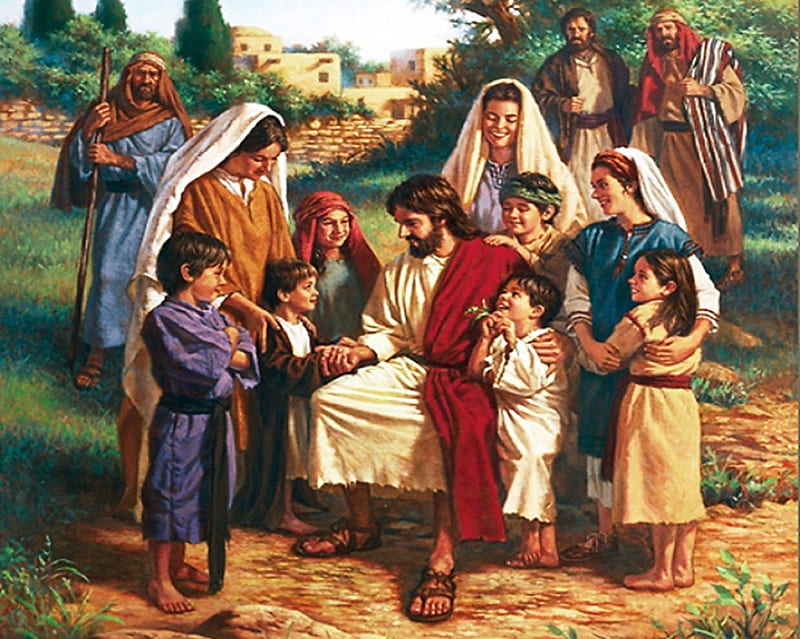
What God has united, man must not divideSome Pharisees approached Jesus and asked, ‘Is it against the law for a man to divorce his wife?’ They were testing him. He answered them, ‘What did Moses command you?’ ‘Moses allowed us’ they said ‘to draw up a writ of dismissal and so to divorce.’ Then Jesus said to them, ‘It was because you were so unteachable that he wrote this commandment for you. But from the beginning of creation God made them male and female. This is why a man must leave father and mother, and the two become one body. They are no longer two, therefore, but one body. So then, what God has united, man must not divide.’ Back in the house the disciples questioned him again about this, and he said to them, ‘The man who divorces his wife and marries another is guilty of adultery against her. And if a woman divorces her husband and marries another she is guilty of adultery too.’ People were bringing little children to him, for him to touch them. The disciples turned them away, but when Jesus saw this he was indignant and said to them, ‘Let the little children come to me; do not stop them; for it is to such as these that the kingdom of God belongs. I tell you solemnly, anyone who does not welcome the kingdom of God like a little child will never enter it.’ Then he put his arms round them, laid his hands on them and gave them his blessing. Universalis podcast: The week ahead – from 6 to 12 OctoberSaint John Henry Newman; the Feast of the Holy Rosary. (16 minutes)
Episode notes.Play Christian Art Each day, The Christian Art website gives a picture and reflection on the Gospel of the day. The readings on this page are from the Jerusalem Bible, which is used at Mass in most of the English-speaking world. The New American Bible readings, which are used at Mass in the United States, are available in the Universalis apps, programs and downloads.
You can also view this page with the Gospel in Greek and English. |
TOPICS: Catholic; General Discusssion; Prayer; Worship
KEYWORDS: catholic; mk10; ordinarytime; prayer
For your reading, reflection, faith-sharing, comments, questions, discussion.
1
posted on
10/06/2024 8:34:32 AM PDT
by
annalex
To: All
KEYWORDS: catholic; mk10; ordinarytime; prayer
2
posted on
10/06/2024 8:34:59 AM PDT
by
annalex
(fear them not)
To: nickcarraway; NYer; ELS; Pyro7480; livius; ArrogantBustard; Catholicguy; RobbyS; marshmallow; ...

Alleluia Ping Please FReepmail me to get on/off the Alleluia Ping List.
3
posted on
10/06/2024 8:35:31 AM PDT
by
annalex
(fear them not)
To: annalex
4
posted on
10/06/2024 8:35:48 AM PDT
by
annalex
(fear them not)
To: annalex
| Mark |
| | English: Douay-Rheims | Latin: Vulgata Clementina | Greek NT: Byzantine/Majority Text (2000) |
| | Mark 10
|
| 2. | And the Pharisees coming to him asked him: Is it lawful for a man to put away his wife? tempting him. | Et accedentes pharisæi interrogabant eum : Si licet vero uxorem dimittere : tentantes eum. | και προσελθοντες [οι] φαρισαιοι επηρωτησαν αυτον ει εξεστιν ανδρι γυναικα απολυσαι πειραζοντες αυτον |
| 3. | But he answering, saith to them: What did Moses command you? | At ille respondens, dixit eis : Quid vobis præcepit Moyses ? | ο δε αποκριθεις ειπεν αυτοις τι υμιν ενετειλατο μωσης |
| 4. | Who said: Moses permitted to write a bill of divorce, and to put her away. | Qui dixerunt : Moyses permisit libellum repudii scribere, et dimittere. | οι δε ειπον μωσης επετρεψεν βιβλιον αποστασιου γραψαι και απολυσαι |
| 5. | To whom Jesus answering, said: Because of the hardness of your heart he wrote you that precept. | Quibus respondens Jesus, ait : Ad duritiam cordis vestri scripsit vobis præceptum istud : | και αποκριθεις ο ιησους ειπεν αυτοις προς την σκληροκαρδιαν υμων εγραψεν υμιν την εντολην ταυτην |
| 6. | But from the beginning of the creation, God made them male and female. | ab initio autem creaturæ masculum et feminam fecit eos Deus. | απο δε αρχης κτισεως αρσεν και θηλυ εποιησεν αυτους ο θεος |
| 7. | For this cause a man shall leave his father and mother; and shall cleave to his wife. | Propter hoc relinquet homo patrem suum et matrem, et adhærebit ad uxorem suam : | ενεκεν τουτου καταλειψει ανθρωπος τον πατερα αυτου και την μητερα και προσκολληθησεται προς την γυναικα αυτου |
| 8. | And they two shall be in one flesh. Therefore now they are not two, but one flesh. | et erunt duo in carne una. Itaque jam non sunt duo, sed una caro. | και εσονται οι δυο εις σαρκα μιαν ωστε ουκετι εισιν δυο αλλα μια σαρξ |
| 9. | What therefore God hath joined together, let not man put asunder. | Quod ergo Deus conjunxit, homo non separet. | ο ουν ο θεος συνεζευξεν ανθρωπος μη χωριζετω |
| 10. | And in the house again his disciples asked him concerning the same thing. | Et in domo iterum discipuli ejus de eodem interrogaverunt eum. | και εν τη οικια παλιν οι μαθηται αυτου περι του αυτου επηρωτησαν αυτον |
| 11. | And he saith to them: Whosoever shall put away his wife and marry another, committeth adultery against her. | Et ait illis : Quicumque dimiserit uxorem suam, et aliam duxerit, adulterium committit super eam. | και λεγει αυτοις ος εαν απολυση την γυναικα αυτου και γαμηση αλλην μοιχαται επ αυτην |
| 12. | And if the wife shall put away her husband, and be married to another, she committeth adultery. | Et si uxor dimiserit virum suum, et alii nupserit, mœchatur. | και εαν γυνη απολυση τον ανδρα αυτης και γαμηθη αλλω μοιχαται |
| 13. | And they brought to him young children, that he might touch them. And the disciples rebuked them that brought them. | Et offerebant illi parvulos ut tangeret illos. Discipuli autem comminabantur offerentibus. | και προσεφερον αυτω παιδια ινα αψηται αυτων οι δε μαθηται επετιμων τοις προσφερουσιν |
| 14. | Whom when Jesus saw, he was much displeased, and saith to them: Suffer the little children to come unto me, and forbid them not; for of such is the kingdom of God. | Quos cum videret Jesus, indigne tulit, et ait illis : Sinite parvulos venire ad me, et ne prohibueritis eos : talium enim est regnum Dei. | ιδων δε ο ιησους ηγανακτησεν και ειπεν αυτοις αφετε τα παιδια ερχεσθαι προς με μη κωλυετε αυτα των γαρ τοιουτων εστιν η βασιλεια του θεου |
| 15. | Amen I say to you, whosoever shall not receive the kingdom of God as a little child, shall not enter into it. | Amen dico vobis : Quisquis non receperit regnum Dei velut parvulus, non intrabit in illud. | αμην λεγω υμιν ος εαν μη δεξηται την βασιλειαν του θεου ως παιδιον ου μη εισελθη εις αυτην |
| 16. | And embracing them, and laying his hands upon them, he blessed them. | Et complexans eos, et imponens manus super illos, benedicebat eos. | και εναγκαλισαμενος αυτα τιθεις τας χειρας επ αυτα ευλογει αυτα |
5
posted on
10/06/2024 8:37:58 AM PDT
by
annalex
(fear them not)
To: annalex
2. And the Pharisees came to him, and asked him, Is it lawful for a man to put away his wife? tempting him.
3. And he answered and said to them, What did Moses command you?
4. And they said, Moses suffered to write a bill of divorcement, and to put her away.
5. And Jesus answered and said to them, For the hardness of your heart he wrote you this precept.
6. But from the beginning of the creation God made them male and female.
7. For this cause shall a man leave his father and mother, and cleave to his wife.
8. And they two shall be one flesh: so then they are no more two, but one flesh.
9. What therefore God has joined together, let not man put asunder.
10. And in the house his disciples asked him again of the same matter.
11. And he said to them, Whoever shall put away his wife, and marry another, commits adultery against her.
12. And if a woman shall put away her husband and be married to another, she commits adultery.
BEDE; Up to this time Mark had related what our Lord said and did in Galilee; here he begins to relate what He did, taught, or suffered in Judea, and first indeed across the Jordan on the east; and this is what is said in these words: And he arose from thence, and comes into the coasts of Judea, by the farther side of Jordan; then also on this side Jordan, when He came to Jericho, Bethany, and Jerusalem. And though all the province of the Jews is generally called Judea, to distinguish it from other nations, more especially, however, its southern portion was called Judea, to distinguish it from Samaria, Galilee, Decapolis, and the other regions in the same province.
THEOPHYL. But He enters the region of Judea, which the envy of the Jews had often caused Him to leave, because His Passion was to take place there. He did not, however, then go up to Jerusalem, but to the confines of Judea, that He might do good to the multitudes, who were not evil; for Jerusalem was, from the malice of the Jews, the worker of all the wickedness. Wherefore it goes on: And the people resort to him again, and, as he was wont, he taught them again.
BEDE; Mark the difference of temper in the multitude and in the Pharisees. The former meet together, in order to be taught, and that their sick may be healed, as Matthew relates; the latter come to Him, to try to deceive their Savior by tempting Him. Wherefore there follows, And the Pharisees came to him, and asked him, Is it lawful for a man to put away his wife? tempting Him.
THEOPHYL. They come to Him indeed, and do not quit Him, lest the multitudes should believe on Him; and by continually coming to Him, they thought to bring Him into difficulty, and to confuse Him by their questions. For they proposed to Him a question, which had on either side a precipice, so that whether He said that it was lawful for a man to put away his wife, or that it was not lawful, they might accuse Him, and contradict what He said, out of the doctrines of Moses. Christ, therefore, being Very Wisdom, in answering their question, avoids their snares.
CHRYS. For being asked, whether it is lawful, he does not immediately reply, it is not lawful, lest they should raise an outcry, but He first wished them to answer Him as to the sentence of the law, that they by their answer might furnish Him with what it was right to say. Wherefore it goes on, And he answered and said to them, What did Moses command you?
And afterwards, And they said, Moses suffered to write a bill of divorcement, and to put her away. They put forward indeed this that Moses had said either on account of the question of our Savior, or wishing to excite against Him a multitude of men. For divorce was an indifferent thing among the Jews, and all practiced it, as though it were permitted by the law.
AUG. It makes nothing, however, to the truth of the fact, whether, as Matthew says, they themselves addressed to the Lord the question concerning the bill of divorcement, allowed to them by Moses, on our Lord's forbidding the separation, and confirming His sentence from the law, or whether it was in answer to a question of His, that they said this concerning the command of Moses, as Mark here says. For His wish was to give them no reason why Moses permitted it, before they themselves had mentioned the fact; since then the wish of the parties speaking, which is what the words ought to express, is in either way shown, there is no discrepancy, though there be a difference in the way of relating it. It may also be meant that, as Mark expresses it, the question put to them by the Lord, What did Moses command? was in answer to those who had previously asked His opinion concerning the putting away of a wife; and when they had replied that Moses permitted them to write a bill of divorcement, and to put her away, His answer was concerning that same law, given by Moses, how God instituted the marriage of a male, and a female, saying those things which Matthew relates; on hearing which they again rejoined what they had replied to Him when He first asked them, namely, Why then did Moses command?
AUG. Moses, however, was against a man's dismissing his wife, for he interposed this delay, that a person whose mind was bent on separation, might be deterred by the writing of the bill, and desist; particularly, since, as is related, among the Hebrews, no one was allowed to write Hebrew characters but the scribes. The law therefore wished to send him, whom it ordered to give a bill of divorcement, before he dismissed his wife, to them, who ought to be wise interpreters of the law, and just opponents of quarrel. For a bill could only be written for him by men, who by their good advice might overrule him, since his circumstances and necessity had put him into their bands, and so by treating between him and his wife they might persuade them to love and concord. But if a hatred so great had arisen that it could not be extinguished and corrected, then indeed a bill was to be written, that he might not lightly put away her who was the object of his hate, in such a way as to prevent his being recalled to the love, which he owed her by marriage, through the persuasion of the wise. For this reason it is added, For the hardness of your heart, he wrote this precept; for great was the hardness of heart which could not be melted or bent to the taking back and recalling the love of marriage, even by the interposition of a bill in a way which gave room for the just and wise to dissuade them.
PSEUDO-CHRYS. Or else, it is said, For the hardness of your hearts, because it is possible for a soul purged from desires and from anger to bear the worst of women; but if those passions have a redoubled force over the mind, many evils will arise from hatred in marriage. Thus then, He saves Moses, who had given the law, from their accusation, and turns the whole upon their head. But since what He had said was grievous to them, He at once brings back the discourse to the old law, saying, But from the beginning of the creation, God made them male and female.
BEDE; He says not male and females, which the sense would have required had it referred to the divorce of former wives, but male and female, so that they might be bound by the tie of one wife.
CHRYS. If however he had wished one wife to be put away and another to be brought in, He would have created several women. Nor did God only join one woman to one man, but He also bade a man quit his parents and cleave to his wife. Wherefore it goes on: And he said, (that is, God said by Adam,) For this cause shall a man leave his father and mother, and cleave to his wife. From the very mode of speech, showing the impossibility of severing marriage, because He said, He shall cleave.
BEDE; And in like manner, because He says, he shall cleave to his wife, not wives. It goes on: And they two shall be one flesh.
CHRYS. Being framed out of one root, they will join into one body. It goes on: So then they are no more two, but one flesh.
BEDE; The reward then of marriage is of two to become one flesh. Virginity being joined to the Spirit, becomes of one spirit.
CHRYS. After this, bringing forward an awful argument, He said not, do not divide, but He concluded, What therefore God has joined together, let not man put asunder.
AUG. Behold the Jews are convinced out of the books of Moses, that a wife is not to be put away, while they fancied that in putting her away, they were doing the will of Moses. In like manner from this place, from the witness of Christ Himself, we know this, that God made and joined male and female, for denying which the Manichees are condemned, resisting now not the books of Moses, but the Gospel of Christ.
BEDE; What therefore God has conjoined by making one flesh of a man and a woman, that man cannot separate, but God alone. Man separates, when we dismiss the first wife because we desire a second; but it is God who , separates, when by common consent, for the sake of serving God, we so have wives as though we had none.
CHRYS. But if two persons, whom God has joined together, are not to be separated; much more is it wrong to separate from Christ, the Church, which God has joined to Him.
THEOPHYL. But the disciples were offended, as not being fully satisfied with what had been said; for this reason they again question Him, wherefore there follows, And in the house, his disciples asked him again of the same matter.
PSEUDO-JEROME; This second question is said to be asked again by the Apostles, because it is on the subject of which the Pharisees had asked Him, that is, concerning the state of marriage; and this is said by Mark in his own person.
GLOSS. For a repetition of a saying of the Word, produces not weariness, but thirst and hunger; wherefore it is said, They that eat me shall yet be hungry, and they that drink me shall yet be thirsty; for the tasting of the honeyed words of wisdom yields all manner of savor to them who love her. Wherefore the Lord instructs His disciples over again; for it goes on, And he said to them, Whoever shall put away his wife and marry another, commits adultery upon her.
PSEUDO-CHRYS. The Lord calls by the name of adultery cohabitation with her who is not a man's wife; she is not, however, a wife, whom a man has taken to him, after quitting his first; and for this reason he commits adultery upon her, that is, upon the second, whom he brings in. And the same thing is true in the case of the woman; wherefore it goes on, And if a woman shall put away her husband, and marry another, she commits adultery; for she cannot be joined to another as her own husband, if she leave him who is really her own husband. The law indeed forbade what was plainly adultery; but the Savior forbids this, which was neither plain, nor known to all, though it was contrary to nature.
BEDE; In Matthew it is more fully expressed, Whoever shall put away his wife, except it be for fornication. The only carnal cause then is fornication; the only spiritual cause is the fear of God, that a man should put away his wife to enter into religion, as we read that many have done. But there is no cause allowed by the law of God for marrying another, during the lifetime of her who is quitted.
PSEUDO-CHRYS. There is no contrariety in Matthew's relating that He spoke these words to the Pharisees, though Mark says that they were spoken to the disciples; for it is possible that He may have spoken them to both.
13. And they brought young children to him, that he should touch them: and his disciples rebuked those that brought them.
14. But when Jesus saw it, he was much displeased, and said to them, Suffer the little children to come to me, and forbid them not: for of such is the kingdom of God.
15. Truly I say to you, Whoever shall not receive the kingdom of God as a little child, he shall not enter therein.
16. And he took them up in his arms, put his hands upon them, and blessed them.
THEOPHYL. The wickedness of the Pharisees in tempting Christ, has been related above, and now is shown the great faith of the multitude, who believed that Christ conferred a blessing on the children whom they brought to Him, by the mere laying on of His hands. Wherefore it is said: And they brought young children to him, that he might touch them.
CHRYS. But the disciples, out of regard for the dignity of Christ, forbade those who brought them. And this is what is added: And his disciples rebuked those who brought them. But our Savior; in order to teach His disciples to be modest in their ideas, and to tread under foot worldly pride, takes the children to Him, and assigns to them the kingdom of God: wherefore it goes on: And he said to them, Suffer little children to come to me, and forbid them not
ORIGEN; If any of those who profess to hold the office of teaching in the Church should see a person bringing to them some of the foolish of this world, and low born, and weak, who for this reason are called children and infants, let him not forbid the man who offers such an one to the Savior, as though he were acting without judgment. After this He exhorts those of His disciples who are already grown to full stature to condescend to be useful to children, that they may become to children as children, that they may gain children; for He Himself, when He was in the form of God, humbled Himself, and became a child. On which He adds: For of such is the kingdom of heaven.
CHRYS. For indeed the mind of a child is pure from all passions, for which reason, we ought by free choice to do those works, which children have by nature.
THEOPHYL. Wherefore He says not, for of these, but of such is the kingdom of God, that is, of persons who have both in their intention and their work the harmlessness and simplicity which children have by nature. For a child does not hate, does nothing of evil intent, nor though beaten does he quit his mother; and though she does him in vile garments, prefers them to kingly apparel; in like manner he, who lives according to the good ways of his mother the Church, honors nothing before her, nay, not pleasure, which is the queen of many; wherefore also the Lord subjoins, Truly I say to you, Whoever shall not receive the kingdom of God as a little child, he shall not enter therein.
BEDE; That is, if you have not innocence and purity of mind like that of children, you cannot enter into the kingdom of heaven. Or else, we are ordered to receive the kingdom of God, that is, the doctrine of the Gospel, a little child, because as a child, when he is taught, does not contradict his teachers, nor put together reasonings and words against them, but receives with faith what they teach, and obeys them with awe, so we also are to receive the word of the Lord with simple obedience, and without any gainsaying. It goes on: And he took them up in his arms, put his hands upon them, and blessed them.
PSEUDO-CHRYS. Fitly does He take them up into His arms to bless them, as it were, lifting into His own bosom , and reconciling Himself to His creation, which in the beginning fell from Him, and was separated from Him. Again, He puts His hands upon the children, to teach us the working of His divine power; and indeed, He puts His hands upon them, as others are wont to do, though His operation is not as that of others, for though He was God, He kept to human ways of acting, as being very man.
BEDE; Having embraced the children, He also blessed them, implying that the lowly in spirit are worthy of His blessing, grace, and love.
Catena Aurea Mark 10
6
posted on
10/06/2024 8:39:28 AM PDT
by
annalex
(fear them not)
To: annalex
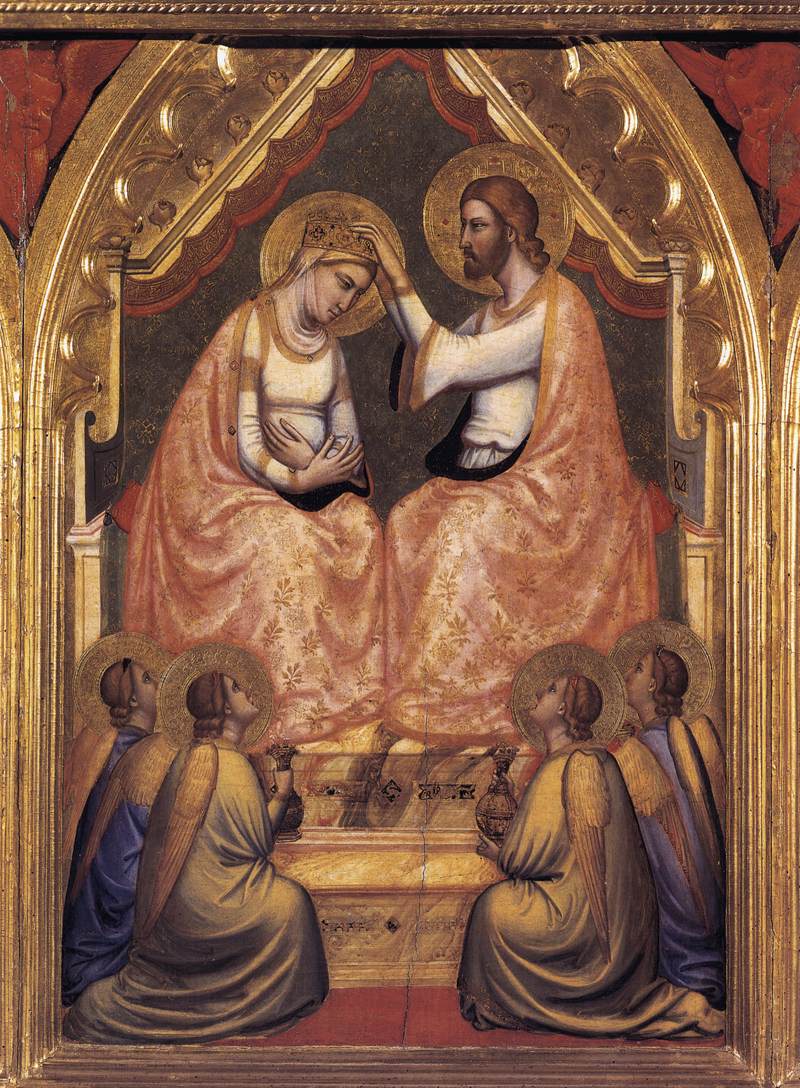
Baroncelli Polyptych: Coronation of the Virgin
Giotto di Bondone
c. 1334
Tempera on wood
Baroncelli Chapel, Santa Croce, Florence
7
posted on
10/06/2024 8:40:00 AM PDT
by
annalex
(fear them not)
To: annalex
Saint of the Day for October 6
(c. 1030 – October 6, 1101)
Saint Bruno’s Story
This saint has the honor of having founded a religious order which, as the saying goes, has never had to be reformed because it was never deformed. No doubt both the founder and the members would reject such high praise, but it is an indication of the saint’s intense love of a penitential life in solitude.
Bruno was born in Cologne, Germany, became a famous teacher at Rheims, and was appointed chancellor of the archdiocese at the age of 45. He supported Pope Gregory VII in his fight against the decadence of the clergy, and took part in the removal of his own scandalous archbishop, Manasses. Bruno suffered the plundering of his house for his pains.
He had a dream of living in solitude and prayer, and persuaded a few friends to join him in a hermitage. After a while he felt the place unsuitable and through a friend, was given some land which was to become famous for his foundation “in the Chartreuse”—from which comes the word Carthusians. The climate, desert, mountainous terrain, and inaccessibility guaranteed silence, poverty, and small numbers.
Bruno and his friends built an oratory with small individual cells at a distance from each other. They met for Matins and Vespers each day and spent the rest of the time in solitude, eating together only on great feasts. Their chief work was copying manuscripts.
Hearing of Bruno’s holiness, the pope called for his assistance in Rome. When the pope had to flee Rome, Bruno pulled up stakes again, and after refusing a bishopric, spent his last years in the wilderness of Calabria.
Bruno was never formally canonized, because the Carthusians were averse to all occasions of publicity. However, Pope Clement X extended his feast to the whole Church in 1674.
Reflection
If there is always a certain uneasy questioning of the contemplative life, there is an even greater puzzlement about the extremely penitential combination of community and hermit life lived by the Carthusians. May we mirror Bruno’s quest for holiness and unity with God.
franciscanmedia.org
8
posted on
10/06/2024 8:44:11 AM PDT
by
annalex
(fear them not)
To: annalex

Saint Bruno
Girolamo Marchesi (1480–1550)
Walters Art Museum
9
posted on
10/06/2024 8:46:26 AM PDT
by
annalex
(fear them not)
To: annalex
NAVARRE BIBLE COMMENTARY (RSV)
Ad Majorem Dei Gloriam (To the Greater Glory of God)
First Reading:
From: Genesis 2:18-24
The Creation of Eve
------------------------
[18] Then the Lord God said, "It is not good that the man should be alone; I will make him a helper fit for him." [19] So out of the ground the Lord God formed every beast of the field and every bird of the air, and brought them to the man to see what he would call them; and whatever the man called every living creature, that was its name. [20] The man gave names to all, cattle, and to the birds of the air, and to every beast of the field; but for the man there was not found a helper fit for him. [21] So the Lord God caused a deep sleep to fall upon the man, and while he slept took one of his ribs and closed up its place with flesh; [22] and the rib which the Lord God had taken from the man he made into a woman and brought her to the man. [23] Then the man said, "This at last is bone of my bones and flesh of my flesh; she shall be called Woman, because she was taken out of Man." [24] Therefore a man leaves his father and his mother and cleaves to his wife, and they be- come one flesh.
***********************************************************************
Commentary:
2:18-25. God continues to take care of man, his creature. The sacred writer conveys this by means of a human metaphor, depicting God as a potter who realizes his creation is not yet perfect. The creation of the human being is not yet over: he needs to be able to live in a full and deep union with another of his kind. The animals were also created by God, but they cannot provide complete companionship. So God creates woman, giving her the same body as man. From now on it is possible for the human being to communicate. The creation of woman, therefore, marks the climax of God's love for the human being he created.
This passage also shows us man's interiority: he is aware of his own aloneness. Although here loneliness is more a possibility and a fear rather than a real situation, we are being told that it is through awareness of being alone that man can appreciate the benefit of communion with others.
2:19-20. Like man, animals are created out of matter, but they are not said to have received from God the breath of life. Only man is given the breath of life, and this is what makes him essentially different from animals: man has a form of life given him directly by God; that is to say, he is animated by a spiritual principle which enables him to converse with God and to have real communion with other human beings. We call this "soul" or "spirit". It makes man more akin to God than to animals, even though the human body is made from the earth and belongs to the earth just as an animal's body does (cf. the notes on 1:26 and 2:7).
"The unity of soul and body is so profound that one has to consider the soul to be the 'form' of the body (cf. Council of Vienne, "Fidei Catholicae"): that is, it is because of its spiritual soul that the body made of matter becomes a living, human body; spirit and matter, in man, are not two natures united, but rather their union forms a single nature" ("Catechism of the Catholic Church", 365).
2:21-22. This sleep is a kind of death; it is as if God suspended the life he gave man, in order to re-shape him so that he can begin to live again in another way--by being two, man and woman, and no longer alone. By describing the creation of woman as coming from one of Adam's ribs, the sacred writer is saying that, contrary to people's thinking at the time, man and woman have the same nature and the same dignity, for both have come from the same piece of clay that God shaped and made into a living being. The Bible is also explaining the mutual attraction man and woman have for one another.
2.23 When man--now in the sense of the male human being—recognizes woman as a person who is his equal, someone who has the same nature as himself, he discovers in her the fit "helper" God wanted him to have. Now indeed the creation of the human being is complete, having become "man becomes the image of God not so much in the moment of solitude as in the moment of communion" (St. Pope John Paul II, General Audience, 4 November 1979).
The first man's acclaim for the first woman shows the capacity both have to associate intimately in marriage. Man's attitude to woman as it comes across here is that of husband to wife. "In his wife he sees the fulfillment of God's intention: 'It not good that the man should he alone; will make him a helper fit for him,' and he makes his own the cry of Adam, the first husband: 'This at last is bone of my bones and flesh of my flesh.' Authentic conjugal love presupposes and requires that a man have a profound respect for the equal dignity of his wife: 'You are not her master,' writes St Ambrose ("Hexaemeron", 5, 7, 19) 'but her husband; she was not given to you to be your slave, but your wife [...]. Reciprocate her attentiveness to you and be grateful to her for her love"' (St. Pope John Paul II, "Familiaris Consortio", 25).
2:24. These words are a comment by the sacred writer in which, having told the story of the creation of woman, he depicts the institution of marriage as something established by God at the time when human life began. As John Paul II explains, "this conjugal communion sinks its roots in the natural complementarity that exists between man and woman, and is nurtured through the personal willingness of the spouses to share their entire life-project, what they have and what they are: for this reason such communion is the fruit and the sign of a profoundly human need" ("Farniliaris Consortio", 19).
By joining in marriage, man and woman form a family. Even the earliest translations of the Bible (Greek and Aramaic), interpreted this passage as meaning "the two will become one flesh", thereby indicating that marriage as willed by God was monogamous. Jesus also referred to this passage about the origin of man to teach the indissolubility of marriage, drawing the conclusion that "what God has joined together, let no man put asunder" (Mt 19:5 and par.) The Church teaches the same: "The intimate partnership of life and the love which constitutes the married state has been established by the Creator and endowed by him with its own proper laws: it is rooted in the contract of its partners, that is, in their irrevocable personal consent. It is an institution confirmed by the divine law and receiving its stability, even in the eyes of society, from the human act by which the partners mutually surrender themselves to each other; for the good of the partners, of the children, and of society this sacred bond no longer depends on human decision alone. For God himself is the author of marriage and has endowed it with various benefits and with various ends in view" (Vatican II, "Gaudium Et Spes", 48,).
10
posted on
10/06/2024 10:12:19 AM PDT
by
fidelis
(👈 Under no obligation to respond to rude, ignorant, abusive, bellicose, and obnoxious posts.)
Second ReadingFrom: Hebrews 2:5-12
Jesus, Man's Brother, was Crowned with Glory and Honor Above the Angels
--------------------------------------------------------------------------------------------------
[9] But we see Jesus, who for a little while was made lower than the angels, crowned with glory and honor because of the suffering of death, so that by the grace of God he might taste death for every one.
[10] For it was fitting that he, for whom and by whom all things exist, in bringing many sons to glory should make the pioneer of their salvation perfect through suffering. [11] For he who sanctifies and those who are sanctified have all one origin. That is why he is not ashamed to call them brethren.
***********************************************************************
Commentary:
5-9. The saving dimension of the Incarnation is being explored here with the help of quotations from Psalm 2 and other psalms. Christians should stay true to Christ, because in addition to his being the cause and beginning of salvation he has been made Lord of the universe; everything is subject to him. God the Father, in other words, has established Christ--not the angels--as Lord of "the world to come".
God has put everything under Christ as man. The words of Psalm 8 are quoted as applying to Christ as man, for he is the perfection of manhood, the perfect man, and he merited being crowned with glory and honor because of his obedience, humility, and passion and death (cf. Phil 2:6-11; 1 Pet 2:21-25); even death itself has become subject to him (cf. 1 Cor 15:22-28). His enemies have been made his footstool (cf. Ps 8:6; 110:1; Mt 22:44); he will channel everything back to God, and God will be all in all.
5. "The world to come" was a term the Jews used to refer to the period immediately following the coming of the Messiah. The rabbis distinguished three periods in the history of the world--the "present world", the time when they were waiting for the Messiah; the "day of the Messiah", the point at which his kingdom would be established; and the "world to come", which would begin with the Resurrection of the dead and the judging of the nations. Many teachers of the Law tended to confuse the "world to come" in some way with the "day of the Messiah", which was its initial stage.
The author of the epistle seems to be saying that the government of the present world is entrusted by God to angels (cf. Deut 32:8; Dan 10: 13f), but that in the world to come that is, in the definitive Kingdom--God the Creator's original plan will be implemented: Christ, true God and true man, with his glorified manhood, will be the King of Creation and the holy angels and the blessed will reign with him. The "world to come", although it has begun with the Resurrection and glorification of Jesus, will not reach its fullness until the second coming of Christ and the resurrection of the dead. Until then, there exists a tension between "this world" and the "world to come": the former has received a mortal wound but it is still alive; the latter has begun to exist but it has not yet attained its final full expression.
6. Psalm 8 is a hymn praising God for creating all things; particularly man, whom he has made master of all creation. The words of the Psalm quoted here are those which praise God's caring love, as shown by his making man, despite his limitations, lord of Creation.
However, the text of the epistle shows us that the words of the Psalm have a deeper meaning: they refer to Jesus (cf. 1 Cor 15:27; Eph 1:22) and particularly to his degradation. "Although these words can be applied to every man," St John Chrysostom comments "they do however most properly apply to Christ. For the words 'thou hast put everything in subjection under his feet' (v. 8) are more suitable to him than to us, for the Son of God visited us who were of no account and having taken and loved our condition, he became higher than us all" ("Hom. On Heb.", 4).
The author of Hebrews uses Psalm 8 to demonstrate Christ's superiority over angels by giving it a deeply messianic interpretation. Thus, the man "crowned with glory and honor" is the risen Christ, now seated at the right hand of the Father; and the one to whom everything has been subjected is also the same Christ (cf. 1:13), as St Paul proclaims in 1 Cor 15:27; Eph 1:22; Phil 3:21.
8. In keeping with its application to Christ of the words of Psalm 8: 4-6, the epistle says that God the Father has subjected everything to him. This does not mean that there is inequality or difference in power or nature between Father and Son, as if the Son himself were subject to the Father, and the Father had given him, as he would a subordinate, authority over the world. "Arius argued in this way," writes St Thomas: "the Father subjected everything to the Son; therefore, the Son is less than the Father. I reply that it is true that the Father subjected everything to the Son according to his human nature, in respect of which he is less than the Father, as St John says, 'the Father is greater than I' (14:28). But according to his divine nature, Christ himself subjected all things to himself" ("Commentary on Heb.", 2, 2).
Christ's dominion over the universe is something which men cannot see and it will not become manifest until his second coming as Lord and Judge of the living and the dead. "Christ, true God and true man, lives and reigns. He is the Lord of the universe. Everything that lives is kept in existence only through him. Why, then, does he not appear to us in all his glory? Because his kingdom is 'not of this world' (Jn 18:36), though it is in this world [...]. Those who expected the Messiah to have visible temporal power were mistaken. [...] When Christ began to preach on earth he did not put forward a political program. He said, 'Repent, for the kingdom of God is at hand' (Mt 3:2; 4:17). He commissioned his disciples to proclaim this good news (cf. Lk 10:9) and he taught them to pray for the coming of the Kingdom (cf. Mt 6:10)" (St. J. Escriva, "Christ Is Passing By", 180).
9. The words "who for a little while was made lower than the angels" refer to Jesus in the crisis of his Passion and Death, when he freely humbled himself and lowered himself to suffer punishment and death-- sufferings to which angels are not subject.
"For a little while" is a translation of the Greek word which the New Vulgate renders as "paulo minus" (a little less than), and which also occurs in Hebrews 2:7 in the quotation from Psalm 8. The RSV translation in both instances is "for a little while".
Every human creature, including Christ as man, can be seen in some sense as lower than the angels. This inferiority basically has to do with the fact that human knowledge is inferior to that of angels because it is dependent on sense experience, and also because angels cannot experience suffering and death. "The angels cannot suffer and are immortal by nature, so that when Christ deigned to submit to his passion and death he made himself lower than them, not because he lost his sublimity or in any way was diminished, but because he took on our weakness. He made himself lower than the angels, not as far as his divinity or his soul were concerned but only in respect of his body" ("Commentary on Heb.", 2, 2).
Christ's self-abasement is a permanent example to us to strive to respond to his love. St John Chrysostom suggests that we draw from it this practical lesson: "If he whom the angels worship consented, out of love for us, to become for a time lower than them, you for your part should endure everything out of love for him" ("Hom. on Heb.", 4).
One of the results of Christ's passion was his exaltation and glorification. Because Christ attained victory on the Cross, to the benefit of all mankind, the Cross is the only route to heaven: "The holy cross is shining upon us", the Church says. "In the cross is victory, in the cross is power. By the cross every sin is overcome" ("Liturgy of the Hours", Exaltation of the Cross, Morning Prayer, Ant. 3). But virtue of Christ's passion, the Cross is no longer an ignominious scaffold; it is a glorious throne. Tradition attributes to St Andrew the Apostle these words in praise of the cross on which he was going to die: "O goodly Cross, glorified by the limbs of our Lord, O Cross so long desired, so ardently loved, so tirelessly sought and now offered to me: take me to my Master so that he who redeemed me through thee, may welcome me through thee" ("Ex Passione S. Andreae", Reading).
Through his death, Christ has been crowned with glory and honor; moreover he has died on our behalf. His death and glorification are the cause and model of our salvation and glorification. Sacrifice, atonement and merit are indissolubly linked to the redemptive work of Christ and constitute a "grace of God", that is, a gratuitous gift from God. St Thomas Aquinas explains that "the passion of Christ is here alluded to in three ways. Firstly, its cause is referred to, for the text says 'by the grace of God'; then, its usefulness, when it says 'for every one'; thirdly, its outcome, when it says 'might taste"' ("Commentary on Heb.", 2, 3): Jesus did indeed, by the will of the Father, experience or "taste" death. His death is described as being like a bitter drink which he chose to take in sips, as if savoring it. The "cup" or chalice of the agony in the garden comes immediately to mind (cf. Mt 26:39; Mk 14:26; Lk 22:42; In 18:11; cf. also Mt 20:22f and Mk 10:38f).
Christian tradition has seen these words about "tasting death" as underlining that Christ underwent a most severe passion voluntarily, accepting it to atone for all the sins of mankind. These words also show that he accepted death without ceasing to be Lord of life: "This expression", St John Chrysostom states, "is very precise. It does not say 'that by the grace of God he might die', for the Lord once he tasted death delayed there only for a moment and immediately rose [...]. All men fear death; therefore, to enable us to take death in our stride, he tasted death even though it was not necessary for him to do so" ("Hom. on Heb.", 4).
10. After pointing to the results of Christ's death, the text stresses how appropriate it was that he should be abased in this way: he had to make himself in every way like his brethren in order to help them.
God the Father, who is the beginning and end of all things, desired to bring men to glory by means of his Son. Christ was to be the author of their salvation and therefore it was fitting that he should be made perfect through suffering. The Father made his Son "perfect" in the sense that by becoming man and therefore being able to suffer and die, he was fully equipped to be mankind's representative. "God has acted in a manner in keeping with his kindness towards us: he has clothed his first-born in a glory greater than that of all mankind and made him outstanding as a champion. Suffering is, therefore, a way to attain perfection and a source of salvation" ("Hom. on Heb.", 4). By perfectly obeying his Father, offering his life and especially his passion and death, Christ offers a perfect and superabundant sacrifice for the forgiveness of the sins of mankind and makes full atonement to the Father. As a reward for his obedience, Christ, as man, is made Head of the Church and King of the universe. It is in that sense that he is made "perfect" by the Father.
Ever since the Redemption, human suffering has become a way to perfection: it acts as expiation for personal sins, it spurs man to assert his spiritual and transcendental dimension, it makes for solidarity with others and links man to Christ's sacrifice. "Suffering must serve for conversion, that is, for the rebuilding of goodness in the subject, who can recognize the divine mercy in this call to repentance [...]. But in order to perceive the true answer to the 'why' of suffering, we must look to the revelation of divine love, the ultimate source of the meaning of everything that exists [...]. Christ causes us to enter into the mystery and to discover the 'why' of suffering, as far as we are capable of grasping the sublimity of divine love" (St. Pope John Paul II, "Salvifici Doloris", 12-13).
11. To accomplish the salvation of men Christ needed to be one of them --to share, with them, a human nature. This is why Christ is the only "true sanctifier", that is, the priest who performs rites and sacrifices, taking things stained by sin and making them pure and pleasing to God, that is, holy. Our Lord said something similar in the Gospel: "For their sake I consecrate myself, that they also may be consecrated in truth" (In 17:19).
11
posted on
10/06/2024 10:12:38 AM PDT
by
fidelis
(👈 Under no obligation to respond to rude, ignorant, abusive, bellicose, and obnoxious posts.)
Gospel ReadingFrom: Mark 10:2-16
The Indissolubility of Marriage
-------------------------------
[2] And Pharisees came up and in order to test Him asked, "Is it lawful for a man to divorce his wife?" [3] He answered them, "What did Moses command you?" [4] They said, "Moses allowed a man to write a certificate of divorce, and to put her away." [5] But Jesus said to them, "For your hardness of heart he wrote this commandment. [6] But from the beginning of creation, 'God made them male and female.'; [7] `For this reason a man shall leave his father and mother and be joined to his wife, [8] and the two shall become one.' So they are no longer two but one. [9] What therefore God has joined together, let not man put asunder."
[10] And in the house the disciples asked Him about this matter. [11] And He said to them, "Whoever divorces his wife and marries another, commits adultery against her; [12] and if she divorces her husband and marries another, she commits adultery."
Jesus and the Children
----------------------------
[13] And they were bringing children to Him, that He might touch them; and the disciples rebuked them. [14] But when Jesus saw it He was indignant, and said to them, "Let the children come to Me, do not hinder them; for to such belongs the Kingdom of God. [15] Truly, I say to you, whoever does not receive the Kingdom of God like a child shall not enter it." [16] And He took them in His arms and blessed them, laying His hands upon them.
***********************************************************************
Commentary:
1-12. This kind of scene occurs often in the Gospel. The malice of the Pharisees contrasts with the simplicity of the crowd, who listen attentively to Jesus' teaching. The Pharisees' question aimed at tricking Jesus into going against the Law of Moses. But Jesus Christ, Messiah and Son of God, has perfect understanding of that Law. Moses had permitted divorce because of the hardness of that ancient people: women had an ignominious position in those primitive tribes (they were regarded almost as animals or slaves); Moses, therefore, protected women's dignity against these abuses by devising the certificate of divorce; this was a real social advance. It was a document by which the husband repudiated his wife and she obtained freedom. Jesus restores to its original purity the dignity of man and woman in marriage, as instituted by God at the beginning of creation. "A man leaves his father and his mother and cleaves to his wife, and they become one flesh" (Genesis 2:24): in this way God established from the very beginning the unity and indissolubility of marriage. The Church's Magisterium, the only authorized interpreter of the Gospel and of the natural law, has constantly guarded and defended this teaching and has proclaimed it solemnly in countless documents (Council of Florence, "Pro Armeniis"; Council of Trent, "De Sacram. Matr."; Pius XI, "Casti Connubi"; Vatican II, "Gaudium Et Spes", 48; etc.).
Here is a good summary of this doctrine: "The indissolubility of marriage is not a caprice of the Church nor is it merely a positive ecclesiastical law. It is a precept of natural law, of divine law, and responds perfectly to our nature and to the supernatural order of grace" (St J. Escriva, "Conversations", 97). Cf. note on Matthew 5:31-32. 5-9. When a Christian realizes that this teaching applies to everyone at all times, he should not be afraid of people reacting against it: "It is a fundamental duty of the Church to reaffirm strongly [...] the doctrine of the indissolubility of marriage. To all those who, in our times, consider it too difficult, or indeed impossible, to be bound to one person for the whole of life, and to those caught up in a culture that rejects the indissolubility of marriage and openly mocks the commitment of spouses to fidelity, it is necessary to reaffirm the good news of the definitive nature of that conjugal love that has in Christ its foundation and strength (cf. Ephesians 5:25).
"Being rooted in the personal and total self-giving of the couple, and being required by the good of the children, the indissolubility of marriage finds its ultimate truth in the plan that God has manifested in His revelation: He wills and He communicates the indissolubility of marriage as a fruit, a sign and a requirement of the absolutely faithful love that God has for man and that the Lord Jesus has for the Church.
"Christ renews the first plan that the Creator inscribed in the hearts of man and woman, and in the celebration of the sacrament of matrimony offers `a new heart': thus the couples are not only able to overcome `hardness of heart' (Matthew 19:8), but also and above all they are able to share the full and definitive love of Christ, the new and eternal Covenant made flesh. Just as the Lord Jesus is the `faithful witness' (Revelation 3:14), the `yes' of the promises of God (cf. 2 Corinthians 1:20) and thus the supreme realization of the unconditional faithfulness with which God loves His people, so Christian couples are called to participate truly in the irrevocable indissolubility that binds Christ to the Church, His bride, loved by Him to the end (cf. John 13:1).
"To bear witness to the inestimable value of the indissolubility and fidelity of marriage is one of the most precious and most urgent tasks of Christian couples in our time" (St. Pope John Paul II, "Familiaris Consortio", 20).
13-16. This Gospel account has an attractive freshness and vividness about it which may be connected with St. Peter, from whom St. Mark would have taken the story. It is one of the few occasions when the Gospels tell us that Christ became angry. What provoked His anger was the disciples' intolerance: they felt that these people bringing children to Jesus were a nuisance: it meant a waste of His time; Christ had more serious things to do than be involved with little children. The disciples were well-intentioned; it was just that they were applying the wrong criteria. What Jesus had told them quite recently had not registered: "Whoever receives one such child in My name receives Me; and whoever receives Me, receives not Me but Him who sent Me" (Mark 9:37).
Our Lord also stresses that a Christian has to become like a child to enter the Kingdom of Heaven. "To be little you have to believe as children believe, to love as children love, to abandon yourself as children do..., to pray as children pray" (St J. Escriva, "Holy Rosary", Prologue).
Our Lord's words express simply and graphically the key doctrine of man's divine sonship: God is our Father and we are His sons and daughters, His children; the whole of religion is summed up in the relationship of a son with His good Father. This awareness of God as Father involves a sense of dependence on our Father in Heaven and trusting abandonment to His loving providence--in the way a child trusts its father or mother; the humility of recognizing that we can do nothing by ourselves; simplicity and sincerity, which make us straightforward and honest in our dealings with God and man.
12
posted on
10/06/2024 10:13:51 AM PDT
by
fidelis
(👈 Under no obligation to respond to rude, ignorant, abusive, bellicose, and obnoxious posts.)
Gospel ReadingFrom: Mark 10:2-16
The Indissolubility of Marriage
-------------------------------
[2] And Pharisees came up and in order to test Him asked, "Is it lawful for a man to divorce his wife?" [3] He answered them, "What did Moses command you?" [4] They said, "Moses allowed a man to write a certificate of divorce, and to put her away." [5] But Jesus said to them, "For your hardness of heart he wrote this commandment. [6] But from the beginning of creation, 'God made them male and female.'; [7] `For this reason a man shall leave his father and mother and be joined to his wife, [8] and the two shall become one.' So they are no longer two but one. [9] What therefore God has joined together, let not man put asunder."
[10] And in the house the disciples asked Him about this matter. [11] And He said to them, "Whoever divorces his wife and marries another, commits adultery against her; [12] and if she divorces her husband and marries another, she commits adultery."
Jesus and the Children
----------------------------
[13] And they were bringing children to Him, that He might touch them; and the disciples rebuked them. [14] But when Jesus saw it He was indignant, and said to them, "Let the children come to Me, do not hinder them; for to such belongs the Kingdom of God. [15] Truly, I say to you, whoever does not receive the Kingdom of God like a child shall not enter it." [16] And He took them in His arms and blessed them, laying His hands upon them.
***********************************************************************
Commentary:
1-12. This kind of scene occurs often in the Gospel. The malice of the Pharisees contrasts with the simplicity of the crowd, who listen attentively to Jesus' teaching. The Pharisees' question aimed at tricking Jesus into going against the Law of Moses. But Jesus Christ, Messiah and Son of God, has perfect understanding of that Law. Moses had permitted divorce because of the hardness of that ancient people: women had an ignominious position in those primitive tribes (they were regarded almost as animals or slaves); Moses, therefore, protected women's dignity against these abuses by devising the certificate of divorce; this was a real social advance. It was a document by which the husband repudiated his wife and she obtained freedom. Jesus restores to its original purity the dignity of man and woman in marriage, as instituted by God at the beginning of creation. "A man leaves his father and his mother and cleaves to his wife, and they become one flesh" (Genesis 2:24): in this way God established from the very beginning the unity and indissolubility of marriage. The Church's Magisterium, the only authorized interpreter of the Gospel and of the natural law, has constantly guarded and defended this teaching and has proclaimed it solemnly in countless documents (Council of Florence, "Pro Armeniis"; Council of Trent, "De Sacram. Matr."; Pius XI, "Casti Connubi"; Vatican II, "Gaudium Et Spes", 48; etc.).
Here is a good summary of this doctrine: "The indissolubility of marriage is not a caprice of the Church nor is it merely a positive ecclesiastical law. It is a precept of natural law, of divine law, and responds perfectly to our nature and to the supernatural order of grace" (St J. Escriva, "Conversations", 97). Cf. note on Matthew 5:31-32. 5-9. When a Christian realizes that this teaching applies to everyone at all times, he should not be afraid of people reacting against it: "It is a fundamental duty of the Church to reaffirm strongly [...] the doctrine of the indissolubility of marriage. To all those who, in our times, consider it too difficult, or indeed impossible, to be bound to one person for the whole of life, and to those caught up in a culture that rejects the indissolubility of marriage and openly mocks the commitment of spouses to fidelity, it is necessary to reaffirm the good news of the definitive nature of that conjugal love that has in Christ its foundation and strength (cf. Ephesians 5:25).
"Being rooted in the personal and total self-giving of the couple, and being required by the good of the children, the indissolubility of marriage finds its ultimate truth in the plan that God has manifested in His revelation: He wills and He communicates the indissolubility of marriage as a fruit, a sign and a requirement of the absolutely faithful love that God has for man and that the Lord Jesus has for the Church.
"Christ renews the first plan that the Creator inscribed in the hearts of man and woman, and in the celebration of the sacrament of matrimony offers `a new heart': thus the couples are not only able to overcome `hardness of heart' (Matthew 19:8), but also and above all they are able to share the full and definitive love of Christ, the new and eternal Covenant made flesh. Just as the Lord Jesus is the `faithful witness' (Revelation 3:14), the `yes' of the promises of God (cf. 2 Corinthians 1:20) and thus the supreme realization of the unconditional faithfulness with which God loves His people, so Christian couples are called to participate truly in the irrevocable indissolubility that binds Christ to the Church, His bride, loved by Him to the end (cf. John 13:1).
"To bear witness to the inestimable value of the indissolubility and fidelity of marriage is one of the most precious and most urgent tasks of Christian couples in our time" (St. Pope John Paul II, "Familiaris Consortio", 20).
13-16. This Gospel account has an attractive freshness and vividness about it which may be connected with St. Peter, from whom St. Mark would have taken the story. It is one of the few occasions when the Gospels tell us that Christ became angry. What provoked His anger was the disciples' intolerance: they felt that these people bringing children to Jesus were a nuisance: it meant a waste of His time; Christ had more serious things to do than be involved with little children. The disciples were well-intentioned; it was just that they were applying the wrong criteria. What Jesus had told them quite recently had not registered: "Whoever receives one such child in My name receives Me; and whoever receives Me, receives not Me but Him who sent Me" (Mark 9:37).
Our Lord also stresses that a Christian has to become like a child to enter the Kingdom of Heaven. "To be little you have to believe as children believe, to love as children love, to abandon yourself as children do..., to pray as children pray" (St J. Escriva, "Holy Rosary", Prologue).
Our Lord's words express simply and graphically the key doctrine of man's divine sonship: God is our Father and we are His sons and daughters, His children; the whole of religion is summed up in the relationship of a son with His good Father. This awareness of God as Father involves a sense of dependence on our Father in Heaven and trusting abandonment to His loving providence--in the way a child trusts its father or mother; the humility of recognizing that we can do nothing by ourselves; simplicity and sincerity, which make us straightforward and honest in our dealings with God and man.
13
posted on
10/06/2024 10:13:52 AM PDT
by
fidelis
(👈 Under no obligation to respond to rude, ignorant, abusive, bellicose, and obnoxious posts.)
To: fidelis
14
posted on
10/06/2024 10:14:51 AM PDT
by
fidelis
(👈 Under no obligation to respond to rude, ignorant, abusive, bellicose, and obnoxious posts.)
Disclaimer:
Opinions posted on Free Republic are those of the individual
posters and do not necessarily represent the opinion of Free Republic or its
management. All materials posted herein are protected by copyright law and the
exemption for fair use of copyrighted works.
FreeRepublic.com is powered by software copyright 2000-2008 John Robinson