Skip to comments.
Catholic Caucus: Daily Mass Readings 24-September-2024
Universalis/Jerusalem Bible ^
Posted on 09/24/2024 3:08:59 AM PDT by annalex
24 September 2024
Tuesday of week 25 in Ordinary Time
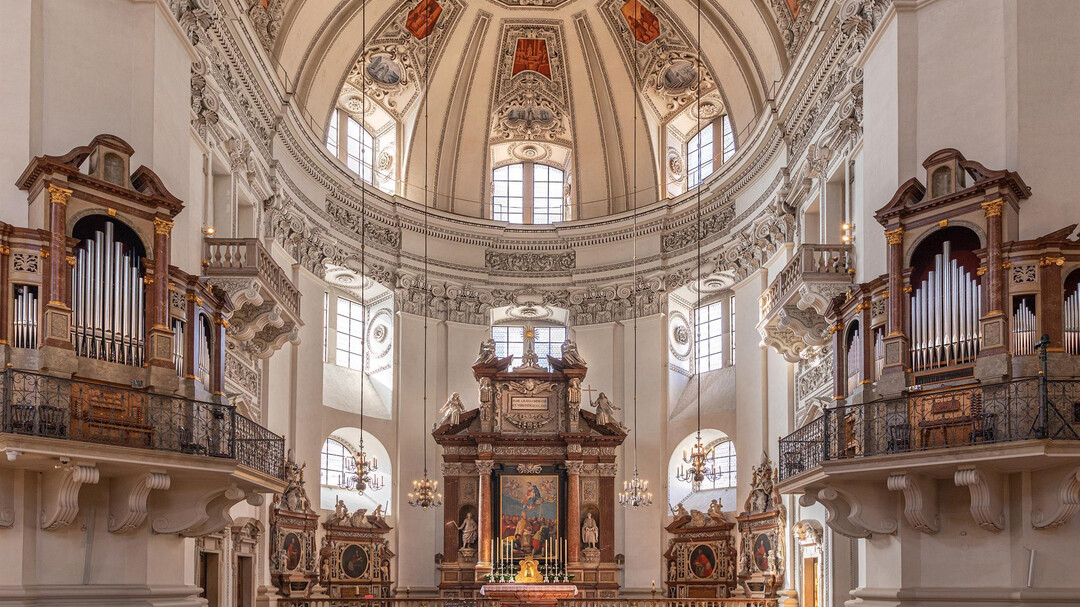
Salzburg CathedralReadings at MassLiturgical Colour: Green. Year: B(II).
| First reading |
|---|
| Proverbs 21:1-6,10-13 |
|---|
On wickedness and virtueLike flowing water is the heart of the king in the hand of the Lord, who turns it where he pleases. A man’s conduct may strike him as upright, the Lord, however, weighs the heart. To act virtuously and with justice is more pleasing to the Lord than sacrifice. Haughty eye, proud heart, lamp of the wicked, nothing but sin. The hardworking man is thoughtful, and all is gain; too much haste, and all that comes of it is want. To make a fortune with the help of a lying tongue, such the idle fantasy of those who look for death. The wicked man’s soul is intent on evil, he looks on his neighbour with dislike. When a mocker is punished, the ignorant man grows wiser, when a wise man is instructed he acquires more knowledge. The Just One watches the house of the wicked: he hurls the wicked to destruction. He who shuts his ear to the poor man’s cry shall himself plead and not be heard.
| Responsorial Psalm |
|---|
| Psalm 118(119):1,27,30,34-35,44 |
|---|
Guide me, Lord, in the path of your commands. They are happy whose life is blameless, who follow God’s law! Make me grasp the way of your precepts and I will muse on your wonders. Guide me, Lord, in the path of your commands. I have chosen the way of truth with your decrees before me. Train me to observe your law, to keep it with my heart. Guide me, Lord, in the path of your commands. Guide me in the path of your commands; for there is my delight. I shall always keep your law for ever and ever. Guide me, Lord, in the path of your commands.
| Gospel Acclamation | cf.Ps129:5 |
|---|
Alleluia, alleluia! My soul is waiting for the Lord, I count on his word. Alleluia! Alleluia, alleluia! Happy are those who hear the word of God and keep it. Alleluia!
'My mother and my brothers are those who hear the word of God'The mother and the brothers of Jesus came looking for him, but they could not get to him because of the crowd. He was told, ‘Your mother and brothers are standing outside and want to see you.’ But he said in answer, ‘My mother and my brothers are those who hear the word of God and put it into practice.’ Christian Art Each day, The Christian Art website gives a picture and reflection on the Gospel of the day. The readings on this page are from the Jerusalem Bible, which is used at Mass in most of the English-speaking world. The New American Bible readings, which are used at Mass in the United States, are available in the Universalis apps, programs and downloads.
You can also view this page with the Gospel in Greek and English. |
TOPICS: Catholic; General Discusssion; Prayer; Worship
KEYWORDS: catholic; lk8; ordinarytime; prayer
For your reading, reflection, faith-sharing, comments, questions, discussion.
1
posted on
09/24/2024 3:08:59 AM PDT
by
annalex
To: All
KEYWORDS: catholic; lk8; ordinarytime; prayer;
2
posted on
09/24/2024 3:09:40 AM PDT
by
annalex
(fear them not)
To: nickcarraway; NYer; ELS; Pyro7480; livius; ArrogantBustard; Catholicguy; RobbyS; marshmallow; ...

Alleluia Ping Please FReepmail me to get on/off the Alleluia Ping List.
3
posted on
09/24/2024 3:10:19 AM PDT
by
annalex
(fear them not)
To: annalex
4
posted on
09/24/2024 3:10:41 AM PDT
by
annalex
(fear them not)
To: annalex
| Luke |
| | English: Douay-Rheims | Latin: Vulgata Clementina | Greek NT: Byzantine/Majority Text (2000) |
| | Luke 8
|
| 19. | And his mother and brethren came unto him; and they could not come at him for the crowd. | Venerunt autem ad illum mater et fratres ejus, et non poterant adire eum præ turba. | παρεγενοντο δε προς αυτον η μητηρ και οι αδελφοι αυτου και ουκ ηδυναντο συντυχειν αυτω δια τον οχλον |
| 20. | And it was told him: Thy mother and thy brethren stand without, desiring to see thee. | Et nuntiatum est illi : Mater tua et fratres tui stant foris, volentes te videre. | και απηγγελη αυτω λεγοντων η μητηρ σου και οι αδελφοι σου εστηκασιν εξω ιδειν σε θελοντες |
| 21. | Who answering, said to them: My mother and my brethren are they who hear the word of God, and do it. | Qui respondens, dixit ad eos : Mater mea et fratres mei hi sunt, qui verbum Dei audiunt et faciunt. | ο δε αποκριθεις ειπεν προς αυτους μητηρ μου και αδελφοι μου ουτοι εισιν οι τον λογον του θεου ακουοντες και ποιουντες αυτον |
5
posted on
09/24/2024 3:14:51 AM PDT
by
annalex
(fear them not)
To: annalex

Catena Aurea by St. Thomas Aguinas
8:19–21
19. Then came to him his mother and his brethren, and could not come at him for the press.
20. And it was told him by certain which said, Thy mother and thy brethren stand without, desiring to see thee.
21. And he answered and said unto them, My mother and my brethren are these which hear the word of God, and do it.
TITUS BOSTRENSIS. Our Lord had left His kinsfolk according to the flesh, and was occupied in His Father’s teaching. But when they began to feel His absence, they came unto Him, as it is said, Then came unto him his mother and his brethren. When you hear of our Lord’s brethren you must include also the notions of piety and grace. For no one in regard of His divine nature is the brother of the Saviour, (for He is the Only-begotten,) but He has, by the grace of piety, made us partakers in His flesh and His blood, and He who is by nature God has become our brother.
BEDE. But those who are said to be our Lord’s brethren according to the flesh, you must not imagine to be the children of the blessed Mary, the mother of God, as Helvidius thinks, nor the children of Joseph by another wife, as some say, but rather believe to be their kinsfolk.
TITUS BOSTRENSIS. His brethren thought that when He heard of their presence He would send away the people, from respect to His mother’s name, and from His affection towards her, as it follows, And it was told him, Thy mother and thy brethren stand without.
CHRYSOSTOM. (Hom. 44. in Matt.) Think what it was, when the whole people stood by, and were hanging upon His mouth, (for His teaching had already begun,) to withdraw Him away from them. Our Lord accordingly answers as it were rebuking them, as it follows, And he answered and said unto them, My mother and my brethren are they which hear the word of God, and do it, &c.
AMBROSE. The moral teacher who gives himself an example to others, when about to enjoin upon others, that he who has not left father and mother, is not worthy of the Son of God, first submits Himself to this precept, not that He denies the claims of filial piety, (for it is His own sentence, He that knoweth not his father and mother shall die the death,) but because He knows that He is more bound to obey His Father’s mysteries than the feelings of His mother. Nor however are His parents harshly rejected, but the bonds of the mind are shewn to be more sacred than those of the body. Therefore in this place He does not disown His mother, (as some heretics say, eagerly catching at His speech,) since she is also acknowledged from the cross; but the law of heavenly ordinances is preferred to earthly affection.
BEDE. They then who hear the word of God and do it, are called the mother of our Lord, because they daily in their actions or words bring Him forth as it were in their inmost hearts; they also are His brethren where they do the will of His Father, Who is in heaven.
CHRYSOSTOM. (Hom. 41. in Matt.) Now He does not say this by way of reproof to His mother, but to greatly assist her, for if He was anxious for others to beget in them a just opinion of Himself, much more was He for His mother. And He had not raised her to such a height if she were always to expect to be honoured by Him as a son, and never to consider Him as her Lord.
THEOPHYLACT. But some take this to mean that certain men, hating Christ’s teaching, and mocking at Him for His doctrine, said, Thy mother and thy brethren stand without wishing to see thee; as if thereby to shew His meanness of birth. And He therefore knowing their hearts gave them this answer, that meanness of birth harms not, but if a man, though of low birth, hear the word of God, He reckons him as His kinsman. Because however hearing only saves no one, but rather condemns, He adds, and doeth it; for it becomes us both to hear and to do. But by the word of God He means His own teaching, for all the words which He Himself spake were from His Father.
AMBROSE. In a mystical sense he ought not to stand without, who was seeking Christ. Hence also that saying, Come unto him, and be enlightened (Ps. 34:6. Vulg.). For if they stand without, not even parents themselves are acknowledged; and perhaps for our example they are not. How are we acknowledged by Him if we stand without? That meaning also is not unreasonable, because by the figure of parents He points to the Jews of whom Christ was born, (Rom. 9:5.) and thought the Church to be preferred to the synagogue.
BEDE. For they cannot enter within when He is teaching whose words they refuse to understand spiritually. But the multitude went before and entered into the house, because when the Jews rejected Christ the Gentiles flocked to Him. But those who stand without, wishing to see Christ, are they, who not seeking a spiritual sense in the law, have placed themselves without to guard the letter of it, and as it were rather compel Christ to go out, to teach them earthly things, than consent to enter in themselves to learn spiritual things.
Catena Aurea Luke 8
6
posted on
09/24/2024 3:16:01 AM PDT
by
annalex
(fear them not)
To: annalex

Coronation of the Virgin
Fra Angelico
1434-35
Tempera on panel, 213 x 211 cm
Musée du Louvre, Paris
7
posted on
09/24/2024 3:16:30 AM PDT
by
annalex
(fear them not)
To: annalex
St. Rupert
Feast day: Mar 27
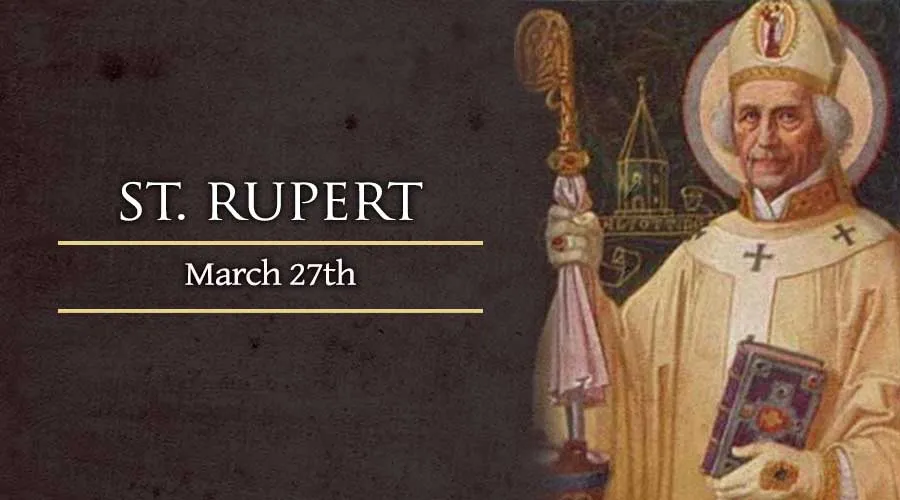
On March 27 the Catholic Church remembers the monk and bishop Saint Rupert, whose missionary labors built up the Church in two of its historic strongholds, Austria and Bavaria.
During his lifetime, the “Apostle of Bavaria and Austria” was an energetic founder of churches and monasteries, and a remarkably successful evangelist of the regions – which include the homeland of the Bavarian native Pope Benedict XVI.
Little is known about Rupert's early life, which is thought to have begun around 660 in the territory of Gaul in modern-day France. There is some indication that he came from the Merovignian royal line, though he embraced a life of prayer, fasting, asceticism and charity toward the poor.
This course of life led to his consecration as the Bishop of Worms in present-day Germany. Although Rupert was known as a wise and devout bishop, he eventually met with rejection from the largely pagan population, who beat him savagely and forced him to leave the city.
After this painful rejection, Rupert made a pilgrimage to Rome. Two years after his expulsion from Worms, his prayers were answered by means of a message from Duke Theodo of Bavaria, who knew of his reputation as a holy man and a sound teacher of the faith.
Bavaria, in Rupert's day, was neither fully pagan nor solidly Catholic. Although missionaries had evangelized the region in the past, the local religion tended to mix portions of the Christian faith – often misunderstood along heretical lines – with native pagan beliefs and practices.
The Bavarian duke sought Rupert's help to restore, correct, and spread the faith in his land. After sending messengers to report back to him on conditions in Bavaria, Rupert agreed. The bishop who had been brutally exiled from Worms was received with honor in the Bavarian city of Regensburg.
With the help of a group of priests he brought with him, Rupert undertook an extensive mission in Bavaria and parts of modern-day Austria. His missionary journeys resulted in many conversions, accompanied by numerous miracles including the healing of diseases.
In Salzburg, Rupert and his companions built a great church, which they placed under the patronage of St. Peter, and a monastery observing the Rule of St. Benedict. Rupert's niece became the abbess of a Benedictine convent established nearby.
Rupert served as both the bishop of Salzburg and the abbot of the Benedictine monastery he established there. This traditional pairing of the two roles, also found in the Irish Church after its development of monasticism, was passed on by St. Rupert's successors until the late 10th century.
St. Rupert died on March 27, Easter Sunday of the year 718, after preaching and celebrating Mass.
After the saint's death, churches and monasteries began to be named after him – including Salzburg's modern-day Cathedral of St. Rupert (also known as the “Salzburg Cathedral”), and the Church of St. Rupert which is believed to be the oldest surviving church structure in Vienna.
catholicnewsagency.com
8
posted on
09/24/2024 3:21:39 AM PDT
by
annalex
(fear them not)
To: annalex
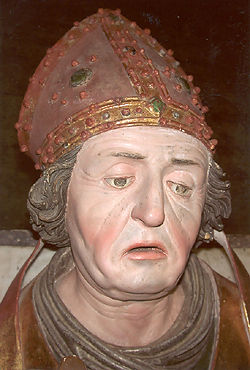
St. Rupert
Statue in St. Katharina in Dornbach
9
posted on
09/24/2024 3:24:20 AM PDT
by
annalex
(fear them not)
To: annalex
NAVARRE BIBLE COMMENTARY (RSV)
Ad Majorem Dei Gloriam (To the Greater Glory of God)
First Reading:
From: Proverbs 21:1-6, 10-13
The Way of the Wise
-------------------------
[1] The king’s heart is a stream of water in the hand of the Lord;
he turns it wherever he will.
[2] Every way of a man is right in his own eyes,
but the Lord weighs the heart.
[3] To do righteousness and justice
is more acceptable to the Lord than sacrifice.
[4] Haughty eyes and a proud heart,
the lamp of the wicked, are sin.
[5] The plans of the diligent lead surely to abundance,
but every one who is hasty comes only to want.
[6] The getting of treasures by a lying tongue
is a fleeting vapour and a snare of death.
[10] The soul of the wicked desires evil;
his neighbour finds no mercy in his eyes.
[11] When a scoffer is punished, the simple becomes wise;
when a wise man is instructed, he gains knowledge.
[12] The righteous observes the house of the wicked;
the wicked are cast down to ruin.
[13] He who closes his ear to the cry of the poor
will himself cry out and not be heard.
**************************************************
Commentary:
[The Navarre Bible Commentary has no commentary for this reading. The footnotes on the New American Bible state:]
21:1 “Channeled water” in Is 32:2 and Prv 5:16 is water that fertilizes arid land. It takes great skill to direct water, whether it be water to fertilize fields or cosmic floods harnessed at creation, for water is powerful and seems to have a mind of its own. It also requires great skill to direct the heart of a king, for it is inscrutable and beyond ordinary human control.
21:3 External rites or sacrifices do not please God unless accompanied by internal worship and right moral conduct; cf. 15:8; 21:27; Is 1:11–15; Am 5:22; Mal 1:12.
21:4 Heart and eyes depict, respectively, the inner and the outer person. “Haughty eyes” peering out from a “proud heart” show a thoroughly arrogant person. How can such a person flourish! Their lamp, which signifies life, will go out.
21:5 The antitheses are diligent and impetuous. The metaphor characterizing each type is taken from the world of commerce. Planning is important; bustle leads to waste.
21:12 It is difficult to ascertain the subject of the saying. Some hold it is the Lord, the “Righteous One,” who is normally the executor of justice in Proverbs. Others believe it is the just person who is the agent of divine justice. “Righteous One” is a title for God in Is 24:16. The best argument for making God the subject of the verb is that elsewhere in Proverbs righteous human beings never do anything to the wicked; only God does.
10
posted on
09/24/2024 7:25:16 AM PDT
by
fidelis
(Ecce Crucem Domini! Fugite partes adversae! Vicit Leo de tribu Juda, Radix David! Alleluia!)
Gospel Reading: From: Luke 8:19-21
The True Kinsmen of Jesus
----------------------------------
[19] Then His (Jesus') mother and His brethren came to Him, but they could not reach Him for the crowd. [20] And He was told, "Your mother and your brethren are standing outside, desiring to see You." [21] But He said to them, "My mother and my brethren are those who hear the word of God and do it."
***********************************************************************
Commentary:
19-21. These words of our Lord show us that fulfillment of the Will of God is more important than kinship and that, therefore, our Lady is more united to her Son by virtue of her perfect fulfillment of what God asked of her, than by the Holy Spirit's using her to make Christ's body (cf. notes on Matthew 12:48-50 and Mark 3:31-35).
[Notes on Matthew 12:48-50 states: 48-50. Jesus obviously loved His Mother and St. Joseph. He uses this episode to teach us that in His Kingdom human ties do not take precedence. In Luke 8:19 the same teaching is to be found. Jesus regards the person who does the will of His Heavenly Father as a member of His own family. Therefore, even though it means going against natural family feelings, a person should do just that when needs be in order to perform the mission the Father has entrusted to him (cf. Luke 2:49). We can say that Jesus loved Mary more because of the bonds between them created by grace than because He was her son by natural generation: Mary's divine motherhood is the source of all our Lady's other prerogatives; but this very motherhood is, in its turn, the first and greatest of the graces with which Mary was endowed.]
Notes on Mark 3:31-35 states: 31-35. In Aramaic, the language used by the Jews, the word "brethren" is a broad term indicating kinship: nephews, first cousins, and relatives in general are called `brethren' (for further explanation cf. note on Mark 6:1-3). "Jesus did not say this to disown His mother, but to show that she is worthy of honor not only account of having given birth to Jesus, but also because she has all the virtues" (Theoplylact, "Enarratio In Evangelium Marci, in loc.").
Therefore, the Church reminds us that the Blessed Virgin "in the course of her Son's preaching received the words whereby, in extolling a kingdom beyond the concerns and ties of flesh and blood, He declared blessed those who heard and kept the word of God as she was faithfully doing" (Vatican II, "Lumen Gentium", 58).
Our Lord, then, is also telling us that if we follow Him we will share His life more intimately than if were a member of His family. St. Thomas explains this by saying that Christ "had an eternal generation and a generation in time, and gave preference to the former. Those who do the will of the Father reach Him by Heavenly generation [...]. Everyone who does the will of the Father, that is to say, who obeys Him, is a brother or sister of Christ, because he is like Him who fulfilled the will of His Father. But he who not only obeys but converts others, begets Christ in them, and thus becomes like the Mother of Christ" ("Commentary on St. Matthew", 12, 49-50.)
11
posted on
09/24/2024 7:25:43 AM PDT
by
fidelis
(Ecce Crucem Domini! Fugite partes adversae! Vicit Leo de tribu Juda, Radix David! Alleluia!)
12
posted on
09/24/2024 7:27:30 AM PDT
by
fidelis
(Ecce Crucem Domini! Fugite partes adversae! Vicit Leo de tribu Juda, Radix David! Alleluia!)
Disclaimer:
Opinions posted on Free Republic are those of the individual
posters and do not necessarily represent the opinion of Free Republic or its
management. All materials posted herein are protected by copyright law and the
exemption for fair use of copyrighted works.
FreeRepublic.com is powered by software copyright 2000-2008 John Robinson