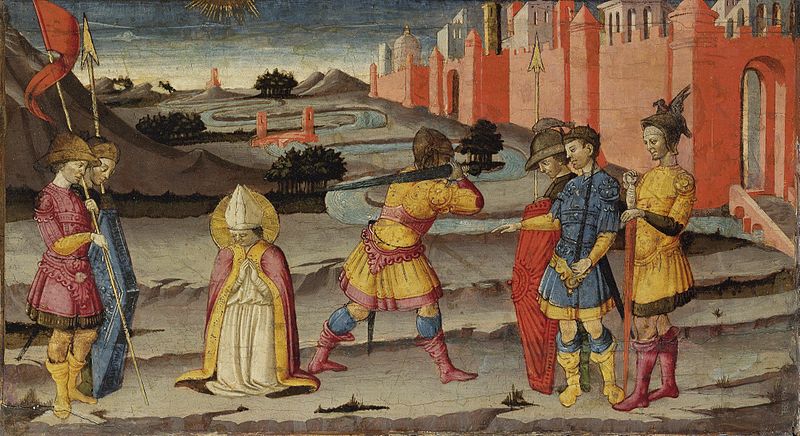
Catena Aurea by St. Thomas Aguinas
7:36–50
36. And one of the Pharisees desired him that he would eat with him. And he went into the Pharisee’s house, and sat down to meat.
37. And, behold, a woman in the city, which was a sinner, when she knew that Jesus sat at meat in the Pharisee’s house, brought an alabaster box of ointment,
38. And stood at his feet behind him weeping, and began to wash his feet with tears, and did wipe them with the hairs of her head, and kissed his feet, and anointed them with the ointment.
39. Now when the Pharisee which had bidden him saw it, he spake within himself, saying, This man, if he were a prophet, would have known who and what manner of woman this is that toucheth him: for she is a sinner.
40. And Jesus answering said unto him, Simon, I have somewhat to say unto thee. And he saith, Master, say on.
41. There was a certain creditor which had two debtors: the one owed five hundred pence, and the other fifty.
42. And when they had nothing to pay, he frankly forgave them both. Tell me therefore, which of them will love him most?
43. Simon answered and said, I suppose that he, to whom he forgave most. And he said unto him, Thou hast rightly judged.
44. And he turned to the woman, and said unto Simon, Seest thou this woman? I entered into thine house, thou gavest me no water for my feet: but she hath washed my feet with tears, and wiped them with the hairs of her head.
45. Thou gavest me no kiss: but this woman since the time I came in hath not ceased to kiss my feet.
46. My head with oil thou didst not anoint: but this woman hath anointed my feet with ointment.
47. Wherefore I say unto thee, Her sins, which are many, are forgiven; for she loved much: but to whom little is forgiven, the same loveth little.
48. And he said unto her, Thy sins are forgiven.
49. And they that sat at meat with him began to say within themselves, Who is this that forgiveth sins also?
50. And he said to the woman, Thy faith hath saved thee: go in peace.
BEDE. Having said just before, And the people that heard him justified God, being baptized with the baptism of John, the same Evangelist builds up in deed what he had proposed in word, namely, wisdom justified by the righteous and the penitent, saying, And one of the Pharisees desired him, &c.
GREGORY OF NYSSA. (Hom. de Mul. Peccat.) This account is full of precious instruction. For there are very many who justify themselves, being puffed up with the dreamings of an idle fancy, who before the time of judgment comes, separate themselves as lambs from the herds, not willing even to join in eating with the many, and hardly with those who go not to extremes, but keep the middle path in life. St. Luke, the physician of souls rather than of bodies, represents therefore our Lord and Saviour most mercifully visiting others, as it follows, And he went into the Pharisees’ house, and sat down to meat. Not that He should share any of his faults, but might impart somewhat of His own righteousness.
CYRIL OF ALEXANDRIA. A woman of corrupt life, but testifying her faithful affection, comes to Christ, as having power to release her from every fault, and to grant her pardon for the crimes she had committed. For it follows, And behold a woman in the city, which was a sinner, brought an alabaster box of ointment.
BEDE. Alabaster is a kind of white marble tinged with various colours, which is generally used for vessels holding ointment, because it is said to be the best sort for preserving the ointment sweet.
GREGORY. (in Hom. 33. in Ev.) For this woman, beholding the spots of her shame, ran to wash them at the fountain of mercy, and blushed not at seeing the guests, for since she was courageously ashamed of herself within, she thought there was nothing which could shame her from without. Observe with what sorrow she is wrung who is not ashamed to weep even in the midst of a feast!
GREGORY OF NYSSA. (ubi sup.) But to mark her own unworthiness, she stands behind with downcast eyes, and with her hair thrown about embraces His feet, and washing them with her tears, betokened a mind distressed at her state, and imploring pardon. For it follows, And standing behind, she began to wash his feet with her tears.
GREGORY. (in Hom. 33. in Evang.) For her eyes which once coveted after earthly things, she was now wearing out with penitential weeping. She once displayed her hair for the setting off of her face, she now wiped her tears with her hair. As it follows, And she wiped them with the hairs of her head. She once uttered proud things with her mouth, but kissing the feet of the Lord, she impressed her lips on the footsteps of her Redeemer. She once used ointment for the perfume of her body; what she had unworthily applied to herself, she now laudably offered to God. As it follows, And she anointed with ointment. As many enjoyments as she had in herself, so many offerings did she devise out of herself. She converts the number of her faults into the same number of virtues, that as much of her might wholly serve God in her penitence, as had despised God in her sin.
CHRYSOSTOM. (Hom. 6. in Matt.) Thus the harlot became then more honourable than the virgins. For no sooner was she inflamed with penitence, than she burst forth in love for Christ. And these things indeed which have been spoken of were done outwardly, but those which her mind pondered within itself, were much more fervent. God alone beheld them.
GREGORY. (ubi sup.) But the Pharisee beholding these things despises them, and finds fault, not only with the woman who was a sinner, but with the Lord who received her, as it follows, Now when the Pharisee who had bidden him saw it, he spake within himself, saying, This man, if he were a prophet, would have known who and what manner of woman this is which toucheth him. We see the Pharisee really proud in himself, and hypocritically righteous, blaming the sick woman for her sickness, the physician for his aid. The woman surely if she had come to the feet of the Pharisee would have departed with the heel lifted up against her. For he would have thought that he was polluted by another’s sin, not having sufficient of his own real righteousness to fill him. So also some gifted with the priests’ office, if perchance they have done any just thing outwardly or slightly, forthwith despise those who are put under them, and look with disdain on sinners who are of the people. But when we behold sinners, we must first bewail ourselves for their calamity, since we perhaps have had and are certainly liable to a similar fall. But it is necessary that we should carefully distinguish, for we are bound to make distinction in vices, but to have compassion on nature. For if we must punish the sinner, we must cherish a brother. But when by penance he has himself punished his own deed, our brother is no more a sinner, for he punished in himself what Divine justice condemned. The Physician was between two sick persons, but the one preserved her faculties in the fever, the other lost his mental perception. For she wept at what she had done; but the Pharisee, elated with a false sense of righteousness, overrated the vigour of his own health.
TITUS BOSTRENSIS. But the Lord not hearing his words, but perceiving his thoughts, shewed Himself to be the Lord of Prophets, as it follows, And Jesus answering said unto him, Simon, I have something to say unto thee.
GLOSS. (non occ. v. Lyra in loc.) And this indeed He spake in answer to his thoughts; and the Pharisee was made more attentive by these words of our Lord, as it is said, And he saith, Master, say on.
GREGORY. (ubi sup.) A parable concerning two debtors is opposed to him, of whom the one owed more, the other less; as it follows, There was a certain creditor which had two debtors, &c.
TITUS BOSTRENSIS. As if He said, Nor art thou without debts. What then! If thou art involved in fewer debts, boast not thyself, for thou art still in need of pardon. Then He goes on to speak of pardon, And when they had nothing to pay, he freely forgave them both.
GLOSS. (non occ.) For no one can of himself escape the debt of sin, but only by obtaining pardon through the grace of God.
GREGORY. (ubi sup.) But both debtors being forgiven, the Pharisee is asked which most loved the forgiver of the debts. For it follows, Who then will love him most? To which he at once answers, I suppose, that he to whom he forgave most. And here we must remark, that while the Pharisee is convicted upon his own grounds, the madman carries the rope by which he will be bound; as it follows, But he said unto him, Thou hast rightly judged. The good deeds of the sinful woman are enumerated to him, and the evils of the pretended righteous; as it follows, And he turned to the woman, and said unto Simon, Seest thou this woman? I entered into thy house, thou gavest me no water for my feet, but she hath washed my feet with her tears.
TITUS BOSTRENSIS. As if He said, To provide water is easy, to pour forth tears is not easy. Thou hast not provided even what was at hand, she hath poured forth what was not at hand; for washing my feet with her tears, she washed away her own stains. She wiped them with her hair, that so she might draw to herself the sacred moisture, and by that by which she once enticed youth to sin, might now attract to herself holiness.
CHRYSOSTOM. (Hom. 6. in Matt.) But as after the breaking of a violent storm there comes a calm, so when tears have burst forth, there is peace, and gloomy thoughts vanish; and as by water and the Spirit, so by tears and confession we are again made clean. Hence it follows, Wherefore I say unto you, Her sins which are many are forgiven, for she loveth much. For those who have violently plunged into evil, will in time also eagerly follow after good, being conscious to what debts they have made themselves responsible.
GREGORY. (Hom. 33. in Evan.) The more then the heart of the sinner is burnt up by the great fire of charity, so much the more is the rust of sin consumed.
TITUS BOSTRENSIS. But it more frequently happens that he who has sinned much is purified by confession, but he who has sinned little, refuses from pride to come to be healed thereby. Hence it follows, But to whom little is forgiven, the same loveth little.
CHRYSOSTOM. (Hom. 67. in Matt.) We have need then of a fervent spirit, for nothing hinders a man from becoming great. Let then no sinner despair, no virtuous man fall asleep; neither let the one be self-confident, for often the harlot shall go before him, nor the other distrustful, for he may even surpass the foremost. Hence it is also here added, But he said unto her, Thy sins are forgiven thee.
GREGORY. (ubi sup.) Behold she who had come sick to the Physician was healed, but because of her safety others are still sick; for it follows, And they that sat at meat began to say within themselves, Who is this that forgiveth sins also. But the heavenly Physician regards not those sick, whom He sees to be made still worse by His remedy, but her whom He had healed He encourages by making mention of her own piety; as it follows, But he said unto the woman, Thy faith hath made thee whole; for in truth she doubted not that she would receive what she sought for.
THEOPHYLACT. But after having forgiven her sins, He stops not at the forgiveness of sins, but adds good works, as it follows, Go in peace, i. e. in righteousness, for righteousness is the reconciliation of man to God, as sin is the enmity between God and man; as if He said, Do all things which lead you to the peace of God.
AMBROSE. Now in this place many seem to be perplexed with the question, whether the Evangelists do not appear to have differed concerning the faith.
GREEK EXPOSITOR. (Severus Antiochenus.) For since the four Evangelists relate that Christ was anointed with ointment by a woman, I think that there were three women, differing according to the quality of each, their mode of action, and the difference of times. John, for example, relates that Mary, the sister of Lazarus, six days before the Passover, anointed the feet of Jesus in her own house; but Matthew, after that the Lord had said, You know that after two days will be the Passover, adds, that in Bethany, at the house of Simon the leper, a woman poured ointment upon the head of our Lord, but did not anoint His feet as Mary. Mark also says the same as Matthew; but Luke gives the account not near the time of the Passover, but in the middle of the Gospel. Chrysostom explains it that there were two different women, one indeed who is described in John, another who is mentioned by the three.
AMBROSE. Matthew has introduced this woman as pouring ointment upon the head of Christ, and was therefore unwilling to call her a sinner, for the sinner, according to Luke, poured ointment upon the feet of Christ. She cannot then be the same, lest the Evangelists should seem to be at variance with one another. The difficulty may be also solved by the difference of merit and of time, so that the former woman may have been yet a sinner, the latter now more perfect.
AUGUSTINE. (de Cons. Ev. lib. ii. c. 79.) For I think we must understand that the same Mary did this twice, once indeed as Luke has related, when at first coming with humility and weeping, she was thought worthy to receive forgiveness of sins. Hence John, when he began to speak of the resurrection of Lazarus, before he came to Bethany, says, But it was Mary who anointed our Lord with ointment, and wiped his feet with her hair, whose brother Lazarus was sick. (John 11:2.) Mary therefore had already done this; but what she again did in Bethany is another occurrence, which belongs not to the relation of Luke, but is equally told by the other three.
GREGORY. (in Hom. 33. in Evang.) Now in a mystical sense the Pharisee, presuming upon his pretended righteousness, is the Jewish people; the woman who was a sinner, but who came and wept at our Lord’s feet, represents the conversion of the Gentiles.
AMBROSE. Or, the leper, is the prince of this world; the house of Simon the leper, is the earth. The Lord therefore descended from the higher parts to this earth; for this woman could not have been healed, who bears the figure of a soul or the Church, had not Christ come upon earth. But rightly does she receive the figure of a sinner, for Christ also took the form of a sinner. If then thou makest thy soul approach in faith to God, it not with foul and shameful sins, but piously obeying the word of God, and in the confidence of unspotted purity, ascends to the very head of Christ. But the head of Christ is God. (1 Cor. 11:3.) But let him who holds not the head of Christ, hold the feet, the sinner at the feet, the just at the head; nevertheless she also who sinned, has ointment.
GREGORY. (ubi sup.) What else is expressed by the ointment, but the sweet savour of a good report? If then we do good works by which we may sprinkle the Church with the sweet odour of a good report, what else do we but pour ointment upon the body of our Lord? But the woman stood by His feet, for we stood over against the feet of the Lord, when yet in our sins we resisted His ways. But if we are converted from our sins to true repentance, we now again stand by His feet, for we follow His footsteps whom we before opposed.
AMBROSE. Bring thou also repentance after sin. Wherever thou hearest the name of Christ, speed thither; into whatever house thou knowest that Jesus has entered, thither hasten; when thou findest wisdom, when thou findest justice sitting in any inner chamber, run to its feet, that is, seek even the lowest part of wisdom; confess thy sins with tears. Perhaps Christ washed not His own feet, that we might wash them with our tears. Blessed tears, which can not only wash away our own sin, but also water the footsteps of the heavenly Word, that His goings may abound in us. Blessed tears, in which there is not only the redemption of sinners, but the refreshing of the righteous.
GREGORY. (Hom. 33. in Evan.) For we water the feet of our Lord with tears if we are moved with compassion to any even the lowest members of our Lord. We wipe our Lord’s feet with our hair, when we shew pity to His saints (with whom we suffer in love) by the sacrifice of those things with which we abound.
AMBROSE. Throw about thy hair, scatter before Him all the graces of thy body. The hair is not to be despised which can wash the feet of Christ.
GREGORY. (ubi sup.) The woman kisses the feet which she has wiped. This also we fully do when we ardently love those whom we maintain by our bounty. By the feet also may be understood the mystery itself of the Incarnation. We then kiss the feet of the Redeemer when we love with our whole heart the mystery of the Incarnation. We anoint the feet with ointment, when we proclaim the power of His humanity with the good tidings of holy eloquence. But this also the Pharisee sees and grudges, for when the Jewish people perceives that the Gentiles preach God, it consumes away by its own malice. But the Pharisee is thus repulsed, that as it were through Him that false people might be made manifest, for in truth that unbelieving people never offered to the Lord even those things which were without them; but the Gentiles being converted, poured forth not only their substance but their blood. Hence He says to the Pharisee, Thou gavest me no water for my feet, but she hath washed my feet with her tears; for water is without us, the moisture of tears is within us. That unfaithful people also gave no kiss to the Lord, for it was unwilling to embrace Him from love whom it obeyed from fear, (for the kiss is the sign of love,) but the Gentiles being called cease not to kiss the feet of their Redeemer, for they ever breathe in His love.
AMBROSE. But she is of no slight merit of whom it is said, From the time that she entered has not ceased to kiss my feet, so that she knew not to speak aught but wisdom, to love aught but justice, to touch aught but chastity, to kiss aught but modesty.
GREGORY. (ubi sup.) But it is said to the Pharisee, My head with oil thou didst not anoint, for the very power even of Divinity on which the Jewish people professed to believe, he neglects to celebrate with due praise. But she hath anointed my feet with ointment. For while the Gentile people believed the mystery of His incarnation, it proclaimed also His lowest powers with the highest praise.
AMBROSE. Blessed is he even who can anoint with oil the feet of Christ, but more blessed is he who anoints with ointment, for the essence of many flowers blended into one, scatters the sweets of various odours. And perhaps no other than the Church alone can bring that ointment which has innumerable flowers of different perfumes, and therefore no one can love so much as she who loves in many individuals. But in the Pharisee’s house, that is, in the house of the Law and the Prophets, not the Pharisee, but the Church is justified. For the Pharisee believed not, the Church believed. The Law has no mystery by which secret faults are cleansed, and therefore that which is wanting in the Law is made up in the Gospel. But the two debtors are the two nations who are responsible for payment to the usurer of the heavenly treasury. But we do not owe to this usurer material money, but the balance of our good deeds, the coin of our virtues, the merits of which are estimated by the weight of sorrow, the stamp of righteousness, the sound of confession. But that denarius is of no slight value on which the image of the king is found. Woe to me if I shall not have what I received. Or because there is hardly any one who can pay the whole debt to the usurer, woe to me if I shall not seek the debt to be forgiven me. But what nation is it that owes most, if not we to whom most is lent? To them were entrusted the oracles of God, to us is entrusted the Virgin’s offspring, Immanuel, i. e. God with us, the cross of our Lord, His death, His resurrection. It cannot then be doubted that he owes most who receives most. Among men he perhaps offends most who is most in debt. By the mercy of the Lord the case is reversed, so that he loves most who owes most, if so be that he obtains grace. And therefore since there is nothing which we can worthily return to the Lord, woe be to me also if I shall not have loved. Let us then offer our love for the debt, for he loves most to whom most is given.
Catena Aurea Luke 7
NAVARRE BIBLE COMMENTARY (RSV)
Ad Majorem Dei Gloriam (To the Greater Glory of God)
First Reading:
From: 1 Corinthians 15:1-11
Christ's Resurrection and His Appearances
------------------------------------------------------
[1] Now I would remind you, brethren, in what terms I preached to you the gospel, which you received, in which you stand, [2] by which you are saved, if you hold it fast--unless you believed in vain.
[3] For I delivered to you as of first importance what I also received, that Christ died for our sins in accordance with the scriptures, [4] that he was buried, that he was raised on the third day in accordance with the scriptures, [5] and that he appeared to Cephas, then to the twelve. [6] Then he appeared to more than five hundred brethren at one time, most of whom are still alive, though some have fallen asleep. [7] Then he appeared to James, then to all the apostles. [8] Last of all, as to one untimely born, he appeared also to me. [9] For I am the least of the apostles, unfit to be called an apostle, because I persecuted the church of God. [10] But by the grace of God I am what I am, and his grace toward me was not in vain. On the contrary, I worked harder than any of them, though it was not I, but the grace of God which is with me. [11] Whether then it was I or they, so we preach and so you believed.
***********************************************************************
Commentary:
1-58. Some of the Corinthian Christians were objecting to the doctrine of the resurrection of the dead, because this was a belief with which Greeks were unfamiliar, even those Greeks who held that the soul was immortal. Given the great importance of this doctrine, St Paul replies at length, pointing first to the historical fact of Christ's resurrection (vv. 1-11 ) and how it necessarily connects up with the resurrection of the dead in general (vv. 12-34). He then goes on to discuss what form this resurrection will take (vv. 35-58). This epistle, which began with an exposition on Jesus Christ crucified, the power and wisdom of God (cf. 1:18-2:5), ends with a development of doctrine on the resurrection of Christ and the consequent resurrection of the members of his mystical body.
To understand what St Paul is saying it is useful to bear in mind that here he is referring only to the glorious resurrection of the just. Elsewhere in Sacred Scripture it is clearly stated that all men will rise from the dead (cf., e.g., Jn 5:28-29; Acts 24:15).
1-11. The resurrection of Jesus Christ is one of the essential doctrines of the Catholic faith, explicitly stated in the first creeds or symbols of the faith. It is in fact the supreme argument in favor of the divinity of Jesus and his divine mission: our Lord proclaimed it many times (cf., e.g., Mt 16:21-28; 17:22-27; 20:17-19), and by rising from the dead he provided the sign which he had promised those who did not believe him (cf. Mt 12:38-40).
This point is so important that the primary role of the Apostles is to bear witness to Christ's resurrection (cf. Acts 1:22; 2:32; 3:15; etc.); the proclamation of the resurrection of the Lord is the very core of apostolic catechesis (cf., e.g., the discourses of St Peter and St Paul reported in the Acts of the Apostles).
3-8. On the verbs "deliver" and "receive" see the note on 1 Cor 11:23-26. St Paul reminds the Corinthians of certain basic points in his preaching--that Jesus Christ died for our sins; "that he was buried, that he was raised on the third day in accordance with the scriptures" (a statement which has passed directly into the Creed) and was seen by many people.
It should be pointed out that the Greek verb translated as "appeared" refers to being seen by the eye. This is relevant to studying the nature of the appearances of the risen Jesus: St Paul is speaking of true, ocular, sight; there seems to be no way this can be identified with imagination or intellectual vision.
The appearances of the risen Christ are a direct proof of the historical fact of his resurrection. This argument gains special force when one remembers that at the time this letter was written many people who had seen the risen Lord were still alive (v. 6). Some of the appearances referred to by St Paul are also mentioned in the Gospels and in Acts--that to Peter (cf. Lk 24:34), those to the Apostles (cf., e.g., Lk 24:36-49; Jn 20:19-29), that to St Paul himself (cf. Acts 9:1-6); others--that to James and to the five hundred brethren—are mentioned only here.
The importance of this passage is enhanced by the fact that it is the earliest documentary record earlier than the Gospels--of our Lord's resurrection, which had taken place scarcely twenty years earlier.
4. "Was buried": in recounting the death of Christ, all four evangelists expressly mention that his body was buried (cf. Mt 27:57-61 and par.). St Paul also confirms the fact in this letter, written very soon after the time, thereby confirming a tradition which had come down from the beginning (v. 3). The fact that Christ's body was buried eliminates any doubt about his death, and underlines the miracle of the Resurrection: Jesus Christ rose by his own power, rejoining his soul with his body, and leaving the tomb with the same human body (not merely the appearance of a body) as died and was buried, although now that body was glorified and had certain special properties (cf. note on 15:42-44). The Resurrection, therefore, is an objective, physical event, witnessed to by the empty tomb (cf. Mt 28:1ff and par) and by Christ's appearances.
"He was raised on the third day": Jesus died and was buried on the evening of Good Friday; his body lay in the tomb the entire sabbath, and rose on the Sunday. It is correct to say that he rose on the third day after his death, even though it was not a full seventy-two hours later.
"According to the scriptures": St Paul may be referring to certain passages of the Old Testament which--"after" the event--were seen to foreshadow the Resurrection--for example, the episode of Jonah (chaps.1-2), which Jesus in fact applied to himself (cf. Mt 12:39-40; cf. also Hos 6:1-2 and Ps 16:9-10).
9-10. St Paul's humility, which leads him to think that his past faults render him unworthy of the grace of the apostolate, is precisely what gives God's grace scope to work in him. "Admit outright that you are a servant whose duty it is to perform very many services. Do not pride yourself on being called a son of God: let us recognize grace, yet be mindful of our nature; do not be proud of having rendered good service, of having done what you were supposed to do. The sun fulfills its function; the moon obeys, the angels carry out their charge. The Lord's chosen instrument for the Gentiles says, 'I am unfit to be called an apostle, because I persecuted the church of God' (1 Cor 15:9) [...]. Neither should we seek to be praised on our own account" (St Ambrose, "Expositio Evangelii sec. Lucam", VIII, 32).
However, the grace of God is not enough on its own. As in St Paul's case, man's cooperation is needed, because God has chosen to rely on our free response to grace: "God, who created you without you, will not save you without you" (St Augustine, "Sermon" 169, 13). And, commenting on St Paul's words--"Not I, but the grace of God which is with me"-- Augustine points out, "that is, not just me, but God with me; and therefore not the grace of God alone, nor myself alone, but the grace of God and myself" ("De Gratia Et Libero Arbitrio", V, l2).
Gospel Reading: From: Luke 7:36-50
The Woman Who was a Sinner
----------------------------------------
[36] 0ne of the Pharisees asked him to eat with him, and he went into the Pharisee's house, and sat at table. [37] And behold, a woman of the city, who was a sinner, when she learned that he was sitting at table in the Pharisee's house, brought an alabaster flask of ointment, [38] and standing behind him at his feet, weeping, she began to wet his feet with her tears; and wiped them with the hair of her head, and kissed his feet, and anointed them with the ointment.
[39] Now when the Pharisee who had invited him saw it, he said to himself, "If this man were a prophet, he would have known who and what sort of woman this is who is touching him, for she is a sinner." [40] And Jesus answering said to him, "Simon, I have something to say to you." And he answered, "What is it, Teacher?" [41] "A certain creditor had two debtors; one owed five hundred denarii and the other fifty. [42] When they could not pay, he forgave them both. Now which of them will love him more?" [43] Simon answered, "The one, I suppose, to whom he forgave more." And he said to him, "You have judged rightly." [44] Then turning toward the woman he said to Simon, "Do you see this woman? I entered your house, you gave me no water for my feet, but she has wet my feet with her tears and wiped them with her hair. [45] You gave me no kiss, but from the time I came in she has not ceased to kiss my feet. [46] You did not anoint my head with oil, but she has anointed my feet with ointment. [47] Therefore I tell you, her sins, which are many, are forgiven little, for she loved much; but he who is forgiven, loves little." [48] And he said to her, "Your sins are forgiven." [49] Then those who were at table with him began to say among themselves, "Who is this, who even forgives sins?" [50] And he said to the woman, "Your faith has saved you; go in peace."
***********************************************************************
Commentary:
36-40. This woman, moved no doubt by grace, was attracted by Christ's preaching and by what people were saying about him.
When dining, people reclined on low divans leaning on their left arm with their legs tucked under them, away from the table. A host was expected to give his guest a kiss of greeting and offer him water for his feet, and perfumes.
41-50. In this short parable of the two debtors Christ teaches us three things--his own divinity and his power to forgive sins; the merit the woman's love deserves; and the discourtesy implied in Simeon's neglecting to receive Jesus in the conventional way. Our Lord was not interested in these social niceties as such but in the affection which they expressed; that was why he felt hurt at Simeon's neglect.
"Jesus notices the omission of the expression of human courtesy and refinement which the Pharisee failed to show him. Christ is 'perfectus Deus, perfectus homo' ("Athanasian Creed"). He is perfect God, the second person of the Blessed Trinity, and perfect man. He comes to save, not to destroy nature. It is from him that we learn that it is unchristian to treat our fellow men badly, for they are creatures of God, made in his image and likeness (Gen 1:26)" (St J. Escriva, "Friends of God", 73).
Moreover, the Pharisee was wrong to think badly of this sinner and of Jesus: reckoning that Christ did not know anything about her, he complained inwardly. Our Lord, who could read the secret thoughts of men (which showed his divinity), intervened to point out to him his mistake. True righteousness, says St Gregory the Great (cf. "In Evangelia Homiliae", 33), is compassionate; whereas false righteousness is indignant. There are many people like this Pharisee: forgetting that they themselves were or are poor sinners, when they see other people's sin they immediately become indignant, instead of taking pity on them, or else they rush to judge them or sneer at them. They forget what St Paul says: "Let any one who thinks that he stands take heed lest he fall" (1 Cor 10:12); "Brethren, if any man is overtaken in any trespass, you who are spiritual should restore him in a spirit of gentleness [...]. Bear one another's burdens, and so fulfill the law of Christ" (Gal 6:1- 2).
We should strive to have charity govern all our judgments. Otherwise, we will easily be unjust towards others. "Let us be slow to judge. Each one see things from his own point of view, as his mind, with all its limitations, tells him, and through eyes that are often dimmed and clouded by passion.... Of what little worth are the judgments of men! Don't judge without sifting your judgment in prayer" (St J. Escriva, "The Way", 451).
Charity and humility will allow us to see in the sins of others our own weak and helpless position, and will help our hearts go out to the sorrow of every sinner who repents, for we too would fall into sins as serious or more serious if God in his mercy did not stay by our side.
"It was not the ointment that the Lord loved", St Ambrose comments, "but the affection; it was the woman's faith that pleased him, her humility. And you also, if you desire grace, increase your love; pour over the body of Jesus Christ your faith in the Resurrection, the perfume of the holy Church and the ointment of charity towards others" ("Expositio Evangelii sec. Lucam, in loc.").
47. Man cannot merit forgiveness for his sins because, since God is the offended party, they are of infinite gravity. We need the sacrament of Penance, in which God forgives us by virtue of the infinite merits of Jesus Christ; there is only one indispensable condition for winning God's forgiveness--our love, our repentance. We are pardoned to the extent that we love; when our heart is full of love there is no longer any room in it for sin because we have made room for Jesus, and he says to us as he said to this woman, "Your sins are forgiven." Repentance is a sign that we love God. But it was God who first loved us (cf.1 Jn 4:10). When God forgives us he is expressing his love for us. Our love for God is, then, always a response to his initiative. By forgiving us God helps us to be more grateful and more loving towards him. "He loves little", St Augustine comments, "who has little forgiven. You say that you have not committed many sins: but why is that the case? [...] The reason is that God was guiding you [...]. There is no sin that one man commits, which another may not commit also unless God, man's maker, guides him" ("Sermon", 99, 6). Therefore, we ought to fall ever more deeply in love with our Lord, not only because he forgives us our sins but also because he helps us by means of his grace not to commit them.
50. Jesus declares that it was faith that moved this woman to throw herself at his feet and show her repentance; her repentance wins his forgiveness. Similarly, when we approach the sacrament of Penance we should stir up our faith in the fact that it is "not a human but a divine dialogue. It is a tribunal of divine justice and especially of mercy, with a loving judge who 'has no pleasure in the death of the wicked; I desire that the wicked turn back from his way and live' (Ezek 33:11)" (St J. Escriva, "Christ Is Passing By", 78).