Skip to comments.
Catholic Caucus: Daily Mass Readings 17-September-2024
Universalis/Jerusalem Bible ^
Posted on 09/17/2024 4:39:39 AM PDT by annalex
17 September 2024
Tuesday of week 24 in Ordinary Time

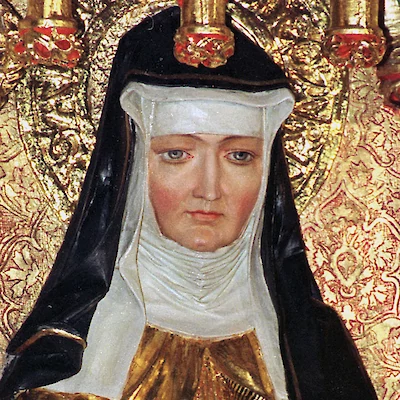
Benedictine Abbey of St. Hildegard, overlooking the towns of Rüdesheim and Bingen, Germany.Readings at MassLiturgical Colour: Green. Year: B(II).
| First reading |
|---|
| 1 Corinthians 12:12-14,27-31 |
|---|
You together are Christ's body: each of you a different partJust as a human body, though it is made up of many parts, is a single unit because all these parts, though many, make one body, so it is with Christ. In the one Spirit we were all baptised, Jews as well as Greeks, slaves as well as citizens, and one Spirit was given to us all to drink. Nor is the body to be identified with any one of its many parts. Now you together are Christ’s body; but each of you is a different part of it. In the Church, God has given the first place to apostles, the second to prophets, the third to teachers; after them, miracles, and after them the gift of healing; helpers, good leaders, those with many languages. Are all of them apostles, or all of them prophets, or all of them teachers? Do they all have the gift of miracles, or all have the gift of healing? Do all speak strange languages, and all interpret them? Be ambitious for the higher gifts.
| Responsorial Psalm | Psalm 99(100) |
|---|
We are his people, the sheep of his flock. Cry out with joy to the Lord, all the earth. Serve the Lord with gladness. Come before him, singing for joy. We are his people, the sheep of his flock. Know that he, the Lord, is God. He made us, we belong to him, we are his people, the sheep of his flock. We are his people, the sheep of his flock. Go within his gates, giving thanks. Enter his courts with songs of praise. Give thanks to him and bless his name. We are his people, the sheep of his flock. Indeed, how good is the Lord, eternal his merciful love. He is faithful from age to age. We are his people, the sheep of his flock.
| Gospel Acclamation | cf.2Tim1:10 |
|---|
Alleluia, alleluia! Our Saviour Jesus Christ abolished death and he has proclaimed life through the Good News. Alleluia! Alleluia, alleluia! A great prophet has appeared among us; God has visited his people. Alleluia!
The only son of his mother, and she a widowJesus went to a town called Nain, accompanied by his disciples and a great number of people. When he was near the gate of the town it happened that a dead man was being carried out for burial, the only son of his mother, and she was a widow. And a considerable number of the townspeople were with her. When the Lord saw her he felt sorry for her. ‘Do not cry’ he said. Then he went up and put his hand on the bier and the bearers stood still, and he said, ‘Young man, I tell you to get up.’ And the dead man sat up and began to talk, and Jesus gave him to his mother. Everyone was filled with awe and praised God saying, ‘A great prophet has appeared among us; God has visited his people.’ And this opinion of him spread throughout Judaea and all over the countryside. Christian Art Each day, The Christian Art website gives a picture and reflection on the Gospel of the day. The readings on this page are from the Jerusalem Bible, which is used at Mass in most of the English-speaking world. The New American Bible readings, which are used at Mass in the United States, are available in the Universalis apps, programs and downloads.
You can also view this page with the Gospel in Greek and English. |
TOPICS: Catholic; General Discusssion; Prayer; Worship
KEYWORDS: catholic; lk7; ordinarytime; prayer
For your reading, reflection, faith-sharing, comments, questions, discussion.
1
posted on
09/17/2024 4:39:39 AM PDT
by
annalex
To: All
KEYWORDS: catholic; lk7; ordinarytime; prayer;
2
posted on
09/17/2024 4:40:08 AM PDT
by
annalex
(fear them not)
To: nickcarraway; NYer; ELS; Pyro7480; livius; ArrogantBustard; Catholicguy; RobbyS; marshmallow; ...

Alleluia Ping Please FReepmail me to get on/off the Alleluia Ping List.
3
posted on
09/17/2024 4:40:53 AM PDT
by
annalex
(fear them not)
To: annalex
4
posted on
09/17/2024 4:41:10 AM PDT
by
annalex
(fear them not)
To: annalex
| Luke |
| | English: Douay-Rheims | Latin: Vulgata Clementina | Greek NT: Byzantine/Majority Text (2000) |
| | Luke 7
|
| 11. | And it came to pass afterwards, that he went into a city that is called Naim; and there went with him his disciples, and a great multitude. | Et factum est : deinceps ibat in civitatem quæ vocatur Naim : et ibant cum eo discipuli ejus et turba copiosa. | και εγενετο εν τω εξης επορευετο εις πολιν καλουμενην ναιν και συνεπορευοντο αυτω οι μαθηται αυτου ικανοι και οχλος πολυς |
| 12. | And when he came nigh to the gate of the city, behold a dead man was carried out, the only son of his mother; and she was a widow: and a great multitude of the city was with her. | Cum autem appropinquaret portæ civitatis, ecce defunctus efferebatur filius unicus matris suæ : et hæc vidua erat : et turba civitatis multa cum illa. | ως δε ηγγισεν τη πυλη της πολεως και ιδου εξεκομιζετο τεθνηκως υιος μονογενης τη μητρι αυτου και αυτη [ην] χηρα και οχλος της πολεως ικανος συν αυτη |
| 13. | Whom when the Lord had seen, being moved with mercy towards her, he said to her: Weep not. | Quam cum vidisset Dominus, misericordia motus super eam, dixit illi : Noli flere. | και ιδων αυτην ο κυριος εσπλαγχνισθη επ αυτη και ειπεν αυτη μη κλαιε |
| 14. | And he came near and touched the bier. And they that carried it, stood still. And he said: Young man, I say to thee, arise. | Et accessit, et tetigit loculum. (Hi autem qui portabant, steterunt.) Et ait : Adolescens, tibi dico, surge. | και προσελθων ηψατο της σορου οι δε βασταζοντες εστησαν και ειπεν νεανισκε σοι λεγω εγερθητι |
| 15. | And he that was dead, sat up, and began to speak. And he gave him to his mother. | Et resedit qui erat mortuus, et cœpit loqui. Et dedit illum matri suæ. | και ανεκαθισεν ο νεκρος και ηρξατο λαλειν και εδωκεν αυτον τη μητρι αυτου |
| 16. | And there came a fear on them all: and they glorified God, saying: A great prophet is risen up among us: and, God hath visited his people. | Accepit autem omnes timor : et magnificabant Deum, dicentes : Quia propheta magnus surrexit in nobis : et quia Deus visitavit plebem suam. | ελαβεν δε φοβος παντας και εδοξαζον τον θεον λεγοντες οτι προφητης μεγας εγηγερται εν ημιν και οτι επεσκεψατο ο θεος τον λαον αυτου |
| 17. | And this rumour of him went forth throughout all Judea, and throughout all the country round about. | Et exiit hic sermo in universam Judæam de eo, et in omnem circa regionem. | και εξηλθεν ο λογος ουτος εν ολη τη ιουδαια περι αυτου και εν παση τη περιχωρω |
5
posted on
09/17/2024 4:43:46 AM PDT
by
annalex
(fear them not)
To: annalex

Catena Aurea by St. Thomas Aguinas
7:11–17
11. And it came to pass the day after, that he went into a city called Nain; and many of his disciples went with him, and much people.
12. Now when he came nigh to the gate of the city, behold, there was a dead man carried out, the only son of his mother, and she was a widow: and much people of the city was with her.
13. And when the Lord saw her, he had compassion on her, and said unto her, Weep not.
14. And he came and touched the bier: and they that bare him stood still. And he said, Young man, I say unto thee, Arise.
15. And he that was dead sat up, and began to speak. And he delivered him to his mother.
16. And there came a fear on all: and they glorified God, saying, That a great prophet is risen up among us; and, That God hath visited his people.
17. And this rumour of him went forth throughout all Judæa, and throughout all the region round about.
CYRIL OF ALEXANDRIA. The Lord joins one miracle upon another. In the Former instance He came indeed when called for, but in this He came self-invited; as it is said, And it came to pass the day after that he went into a city called Nain.
BEDE. Nain is a city of Galilee, within two miles of mount Tabor. But by the divine counsel there were large multitudes accompanying the Lord, that there might be many witnesses of so great a miracle. Hence it follows, And his disciples went with him, and much people.
GREGORY OF NYSSA. (Tract. de Anima et Res. Post med.) Now the proof of the resurrection we learn not so much from the words as from the works of our Saviour, who, beginning His miracles with the less wonderful, reconciled our faith to far greater. First indeed in the grievous sickness of the centurion’s servant, He verged upon the power of resurrection; afterwards with a higher power he led men to the belief in a resurrection, when He raised the widow’s son, who was carried out to be buried; as it is said, Now when he came nigh to the gate of the city, behold, there was a dead man carried out, the only son of his mother.
TITUS BOSTRENSIS. But some one will say of the centurion’s servant, that he was not going to die. That such an one might restrain his rash tongue, the Evangelist explains that the young man whom Christ came upon was already dead, the only son of a widow. For it follows, And she was a widow, and much people of the city was. with her.
GREGORY OF NYSSA. (de hom. Opif. c. 25.) He has told us the sum of misery in a few words. The mother was a widow, and had no further hope of having children, she had no one upon whom she might look in the place of him that was dead. To him alone she had given suck, he alone made her home cheerful. All that is sweet and precious to a mother, was he alone to her.
CYRIL OF ALEXANDRIA. These were sufferings to excite compassion, and which might well affect to mourning and tears, as it follows, And when the Lord saw her, he had compassion on her, saying, Weep not.
BEDE. As if He said, Cease to weep for one as dead, whom you shall soon see rise again alive.
CHRYSOSTOM. (Tit. Bost.) But when He bids us cease from weeping Who consoles the sorrowful, He tells us to receive consolation from those who are now dead, hoping for their resurrection. But life meeting death stops the bier, as it follows, And he came.
CYRIL OF ALEXANDRIA. He performs the miracle not only in word, but also touches the bier, to the end that you might know that the sacred body of Christ is powerful to the saving of man. For it is the body of Life and the flesh of the Omnipotent Word, whose power it possesses. For as iron applied to fire does the work of fire, so the flesh, when it is united to the Word, which quickens all things, becomes itself also quickening, and the banisher of death.
TITUS BOSTRENSIS. (non occ.) But the Saviour is not like to Elias mourning over the son of the widow of Sarepta, (1 Kings 17) nor as Elisha who laid his own body upon the body of the dead, (2 Kings 4) nor as Peter who prayed for Tabitha, (Acts 9:40) but is none other than He who calls those things which be not, as though they were, who can speak to the dead as to the living, (Rom. 4:17) as it follows, And he said, Young man
GREGORY OF NYSSA. (ubi sup.) When He said, Young man, He signified that he was in the flower of his age, just ripening into manhood, who but a little while before was the sight of his mother’s eyes, just entering upon the time of marriage, the scion of her race, the branch of succession, the staff of her old age.
TITUS BOSTRENSIS. But straightway he arose to whom the command was made. For the Divine power is irresistible; there is no delay, no urgency of prayer, as it follows, And he that was dead sat up, and began to speak, and he gave him to his mother. These are the signs. of a true resurrection, for the lifeless body cannot speak, nor would the mother have carried back to her house her dead and lifeless son.
BEDE. But well does the Evangelist testify that the Lord is first moved with compassion for the mother, and then raises her son, that in the one case He might set before us for our imitation an example of piety, in the other He might build up our belief in His wonderful power. Hence it follows. And there came a fear upon all, and they glorified God, &c.
CYRIL OF ALEXANDRIA. This was a great thing in an insensible and ungrateful people. For in a short time afterward they would neither esteem Him as a prophet, nor allow that He did aught for the public good. But none of those that dwelt in Judæa were ignorant of this miracle, as it follows, And this rumour of him went forth throughout all Judæa.
MAXIMUS. (non occ.) But it is worthy of remark, that seven resurrections are related before our Lord’s, of which the first was that of the son of the widow of Sarepta, (1 Kings 17) the second of the Shunamite’s son, (2 Kings 4) the third which was caused by the remains of Elisha, (2 Kings 13) the fourth which took place at Nain, as is here related, the fifth of the ruler of the Synagogue’s daughter, (Mark 5) the sixth of Lazarus, (John 11) the seventh at Christ’s passion, for many bodies of the saints arose. (Mat. 27.) The eighth is that of Christ, who being free from death remained beyond for a sign that the general resurrection which is to come in the eighth age shall not be dissolved by death, but shall abide never to pass away.
BEDE. But the dead man who was carried without the gate of the city in the sight of many, signifies a man rendered senseless by the deadening power of mortal sin, and no longer concealing his soul’s death within the folds of his heart, but proclaiming it to the knowledge of the world, through the evidence of words or deeds as through the gate of the city. For the gate of the city, I suppose, is some one of the bodily senses. And he is well said to be the only son of his mother, for there is one mother composed of many individuals, the Church, but every soul that remembers that it is redeemed by the death of the Lord, knows the Church to be a widow.
AMBROSE. For this widow surrounded by a great multitude of people seems to be more than the woman who was thought worthy by her tears to obtain the resurrection of her only son, because the Church recalls the younger people from the funeral procession to life by the contemplation of her tears, who is forbid to weep for him to whom resurrection was promised.
BEDE. Or the dogma of Novatus is crushedb, who endeavouring to do away with the purifying of the penitent, denies that the mother Church, weeping for the spiritual extinction of her sons, ought to be consoled by the hope of their restoration to life.
AMBROSE. This dead man was borne on the bier by the four material elements to the grave, but there was a hope of his rising again because he was borne on wood, which though before it did not benefit us, yet after Christ had touched it, began to profit unto life, that it might be a sign that salvation was to be extended to the people by the wood of the cross. For we lie lifeless on the bier when either the fire of immoderate desire bursts forth, or the cold moisture breaks out, and through the sluggish state of our earthly body the vigour of our minds waxes dull.
BEDE. Or the coffin on which the dead is carried is the ill at ease conscience of a desperate sinner. But they who carry him to be buried are either unclean desires, or the allurements of companions, who stood when our Lord touched the bier, because the conscience, when touched by dread of the judgment from on high, often checking its carnal lusts, and those who unjustly praise, returns to itself, and answers its Saviour’s call to life.
AMBROSE. If then thy sin is so heavy that by thy penitential tears thou canst not thyself wash it out, let the mother Church weep for thee, the multitude standing by; soon shalt thou rise from the dead and begin to speak the words of life; they all shall fear, (for by the example of one all are corrected;) they shall also praise God who has given us such great remedies for escaping death.
BEDE. But God has visited His people not only by the one incarnation of His Word, but by ever sending It into our hearts.
THEOPHYLACT. By the widow also you may understand a soul that has lost her husband in the divine word. Her son is the understanding, which is carried out beyond the city of the living. Its coffin is the body, which some indeed have called the tomb. But the Lord touching him raises him up, causing him to become young, and rising from sin he begins to speak and teach others. For before he would not have been believed.
Catena Aurea Luke 7
6
posted on
09/17/2024 4:44:41 AM PDT
by
annalex
(fear them not)
To: annalex
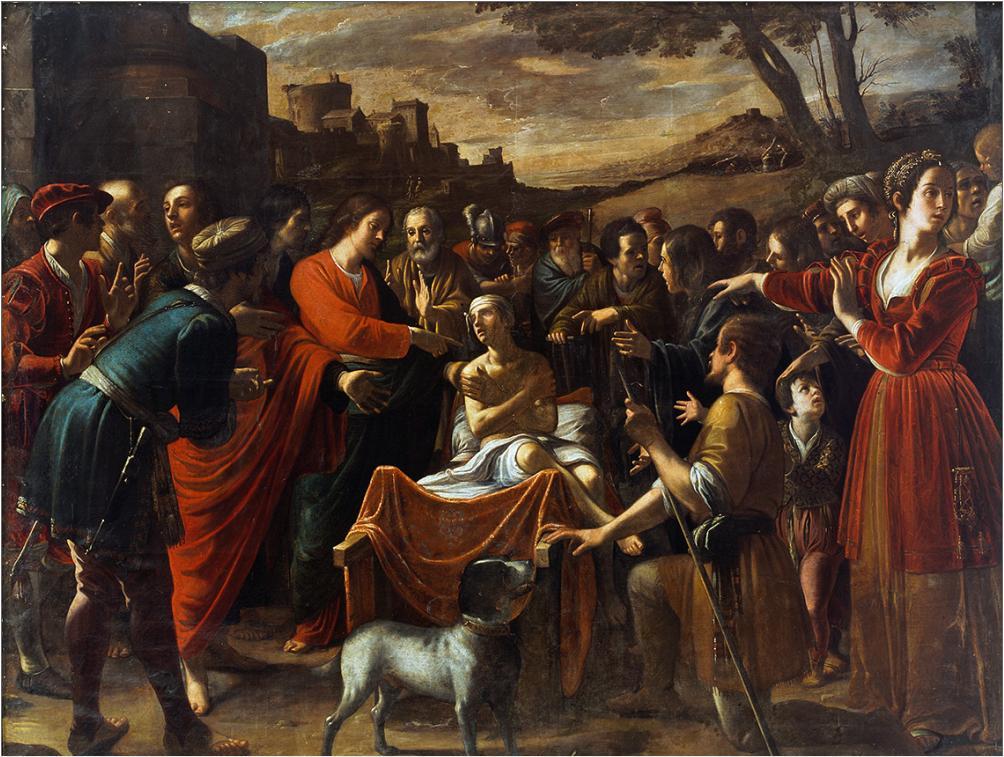
Miracle at Nain
Mario Minniti
1620
7
posted on
09/17/2024 4:45:25 AM PDT
by
annalex
(fear them not)
To: annalex
Saint of the Day for December 17
(September 16, 1098 – September 17, 1179)
Saint Hildegard of Bingen’s Story
Abbess, artist, author, composer, mystic, pharmacist, poet, preacher, theologian—where to begin in describing this remarkable woman?
Born into a noble family, she was instructed for ten years by the holy woman Blessed Jutta. When Hildegard was 18, she became a Benedictine nun at the Monastery of Saint Disibodenberg. Ordered by her confessor to write down the visions that she had received since the age of three, Hildegard took ten years to write her Scivias (Know the Ways). Pope Eugene III read it, and in 1147, encouraged her to continue writing. Her Book of the Merits of Life and Book of Divine Works followed. She wrote over 300 letters to people who sought her advice; she also composed short works on medicine and physiology, and sought advice from contemporaries such as Saint Bernard of Clairvaux.
Hildegard’s visions caused her to see humans as “living sparks” of God’s love, coming from God as daylight comes from the sun. Sin destroyed the original harmony of creation; Christ’s redeeming death and resurrection opened up new possibilities. Virtuous living reduces the estrangement from God and others that sin causes.
Like all mystics, Hildegard saw the harmony of God’s creation and the place of women and men in that. This unity was not apparent to many of her contemporaries.
Hildegard was no stranger to controversy. The monks near her original foundation protested vigorously when she moved her monastery to Bingen, overlooking the Rhine River. She confronted Emperor Frederick Barbarossa for supporting at least three antipopes. Hildegard challenged the Cathars, who rejected the Catholic Church claiming to follow a more pure Christianity.
Between 1152 and 1162, Hildegard often preached in the Rhineland. Her monastery was placed under interdict because she had permitted the burial of a young man who had been excommunicated. She insisted that he had been reconciled with the Church and had received its sacraments before dying. Hildegard protested bitterly when the local bishop forbade the celebration of or reception of the Eucharist at the Bingen monastery, a sanction that was lifted only a few months before her death.
In 2012, Hildegard was canonized and named a Doctor of the Church by Pope Benedict XVI. Her liturgical feast is celebrated on September 17.
Reflection
Pope Benedict spoke about Hildegard of Bingen during two of his general audiences in September 2010. He praised the humility with which she received God’s gifts, and the obedience she gave Church authorities. He praised too the “rich theological content” of her mystical visions that sum up the history of salvation from creation to the end of time.
During his papacy, Pope Benedict XVI said, “Let us always invoke the Holy Spirit, so that he may inspire in the Church holy and courageous women like Saint Hildegard of Bingen who, developing the gifts they have received from God, make their own special and valuable contribution to the spiritual development of our communities and of the Church in our time.”
franciscanmedia.org
8
posted on
09/17/2024 4:48:58 AM PDT
by
annalex
(fear them not)
To: annalex
9
posted on
09/17/2024 4:50:56 AM PDT
by
annalex
(fear them not)
To: annalex
NAVARRE BIBLE COMMENTARY (RSV)
Ad Majorem Dei Gloriam (To the Greater Glory of God)
First Reading:
From: 1 Corinthians 12:12-14, 27-31
Unity and Variety in the Mystical Body of Christ
------------------------------------------------------------
[12] For just as the body is one and has many members, and all the members of the body, though many, are one body, so it is with Christ. [13] For by one Spirit we were all baptized into one body--Jews or Greeks, slaves or free--and all were made to drink of one Spirit. [14] For the body does not consist of one member but of many. [15] If the foot should say, "Because I am not a hand, I do not belong to the body," that would not make it any less a part of the body. [16] And if the ear should say, "Because I am not an eye, I do not belong to the body," that would not make it any less a part of the body. [17] If the whole body were an eye, where would be the hearing? If the whole body were an ear, where would be the sense of smell? [18] But as it is, God arranged the organs in the body, each one of them, as he chose. [19] If all were a single organ, where would the body be? [20] As it is, there are many parts, yet one body. [21] The eye cannot say to the hand, "I have no need of you," nor again the head to the feet, "I have no need of you." [22] On the contrary, the parts of the body which seem to be weaker are indispensable, [23] and those parts of the body which we think less honorable we invest with the greater honor, and our unpresentable parts are treated with greater modesty, [24] which our more presentable parts do not require. But God has so composed the body, giving the greater honor to the inferior part, [25] that there may be no discord in the body, but that the members may have the same care for one another. [26] If one member suffers, all suffer together; if one member is honored, all rejoice together. [27] Now you are the body of Christ and individually members of it. [28] And God has appointed in the church first apostles, second prophets, third teachers, then workers of miracles, then healers, helpers, administrators, speakers in various kinds of tongues. [29] Are all apostles? Are all prophets? Are all teachers? Do all work miracles? [30] Do all possess gifts of healing? Do all speak with tongues? Do all interpret? [31] But earnestly desire the higher gifts. And I will show you a still more excellent way.
*********************************************************
Commentary:
12-13. In Greek and Latin literature, society is often compared to a body: even today we talk of "corporations", a term which conveys the idea that all the citizens of a particular city are responsible for the common good. St Paul, starting with this metaphor, adds two important features: 1) he identifies the Church with Christ: "so it is with Christ" (v. 12); and 2) he says that the Holy Spirit is its life-principle: "by one Spirit we were all baptized . . ., and all made to drink of the Spirit" (v. 13). The Magisterium summarizes this teaching by defining the Church as the "mystical body of Christ", an expression which "is derived from and is, as it were, the fair flower of the repeated teaching of Sacred Scripture and the holy Fathers" (Pius XII, "Mystici Corporis").
"So it is with Christ": "One would have expected him to say, so it is with the Church, but he does not say that [. . .]. For, just as the body and the head are one man, so too Christ and the Church are one, and therefore instead of 'the Church' he says 'Christ"' (Chrysostom, "Hom. on 1 Cor", 30, "ad loc."). This identification of the Church with Christ is much more then a mere metaphor; it makes the Church a society which is radically different from any other society: "The complete Christ is made up of the head and the body, as I am sure you know well. The head is our Savior himself, who suffered under Pontius Pilate and now, after rising from the dead, is seated at the right hand of the Father. And his body is the Church. Not this or that church, but the Church which is to be found all over the world. Nor is it only that which exists among us today, for also belonging to it are those who lived before us and those who will live in the future, right up to the end of the world. All this Church, made up of the assembly of the faithful--for all the faithful are members of Christ--has Christ as its head, governing his body from heaven. And although this head is located out of sight of the body, he is, however, joined to it by love" (St Augustine, "Enarrationes In Psalmos", 56, 1).
The Church's remarkable unity derives from the Holy Spirit who not only assembles the faithful into a society but also imbues and vivifies its members, exercising the same function as the soul does in a physical body: "In order that we might be unceasingly renewed in him (cf. Eph 4:23), he has shared with us his Spirit who, being one and the same in head and members, gives life to, unifies and moves the whole body. Consequently, his work could be compared by the Fathers to the function that the principle of life, the soul, fulfills in the human body" (Vatican II, "Lumen Gentium", 7).
"All were made to drink of one Spirit": given that the Apostle says this immediately after mentioning Baptism, he seems to be referring to a further outpouring of the Spirit, possibly in the sacrament of Confirmation. It is not uncommon for Sacred Scripture to compare the outpouring of the Spirit to drink, indicating that the effects of his presence are to revive the parched soul; in the Old Testament the coming of the Holy Spirit is already compared to dew, rain etc.; and St John repeats what our Lord said about "living water" (Jn 7:38; cf. 4:13-14).
Together with the sacraments of Christian initiation, the Eucharist plays a special role in building up the unity of the body of Christ. "Really sharing in the body of the Lord in the breaking of the eucharistic bread, we are taken up into communion with him and with one another. 'Because the bread is one, we, who are many, are one body, for we all partake of the one bread' (1 Cor 10:17). In this way all of us are made members of his body (cf. 1 Cor 12:27), 'and individual members of one another' (Rom 12:5)" ("Lumen Gentium", 7).
14-27. The unity of the mystical body, which derives from a single life- principle, the Holy Spirit, and tends towards a common same goal, that is, the building up of the Church, means that all its members, whatever their position, have the same basic dignity and the same importance. St Paul develops this thinking by a very effective literary device: he personifies the members of the human body and imagines the nobler members looking down on the lesser ones (vv. 21-24). This serves to reaffirm the truth of v. 25: "that the members may have the same care for one another". The responsibility of each Christian derives from the very essence of the vocation he or she receives at Baptism and Confirmation: "In the Church there is a diversity of ministries," [St. Josemaria Escriva explains, "but there is only one aim—the sanctification of men. And in this task all Christians participate in some way, through the character imprinted by the sacraments of Baptism and Confirmation. We must all feel responsible for the mission of the Church, which is the mission of Christ. He who does not have zeal for the salvation of souls, he who does not strive with all his strength to make the name and the teaching of Christ known and loved, will not understand the apostolicity of the Church.
"A passive Christian has failed to understand what Christ wants from all of us. A Christian who 'goes his own way', unconcerned about the salvation of others, does not love with the heart of Jesus. Apostolate is not a mission exclusive to the hierarchy, or to priests and religious. The Lord calls all of us to be, by our example and word, instruments of the stream of grace which springs up to eternal life" ("In Love with the Church", 15).
28-30. St Paul concludes this description of the different parts of the body by applying it to the Church, where variety of functions does not detract from unity. It would be a serious mistake not to recognize in the visible structure of the Church, which is so multifaceted, the fact that the Church founded by Christ is "one", visible at the same time as it is spiritual. The Second Vatican Council puts this very clearly: "But the society structured with hierarchical organs and the mystical body of Christ, the visible society and the spiritual community, the earthly Church and the Church endowed with heavenly riches, are not to be thought of as two realities. On the contrary, they form one complex reality which comes together from a human element and a divine element. For this reason the Church is compared, not without significance, to the mystery of the incarnate Word. As the assumed nature, inseparably united to Him, serves the divine Word as a living organ of salvation, so, in a somewhat similar way, does the social structure of the Church serve the Spirit of Christ who vivifies it, in the building up of the body (cf. Eph 4:15)" "Lumen Gentium", 8).
The Church is this way because that is the will of its founder, Jesus Christ: "The Church is by divine will a hierarchical institution. The Second Vatican Council describes it as a 'society structured with hierarchical organs' ("Lumen Gentium", 8) in which 'ministers are invested with a sacred power' ("ibid., 18). The hierarchy is not only compatible with freedom: it is at the service of the freedom of the children of God (cf. Rom 8:21). [...] 'Hierarchy' means holy government and sacred order. In no way does it imply a merely human arbitrary order or a subhuman despotism. Our Lord established in the Church a hierarchical order which should not degenerate into tyranny, because authority is as much a call to serve as is obedience.
"In the Church there is equality, because once baptized we are all equal, all children of the same God, our Father. There is no difference as Christians between the Pope and someone who has just joined the Church. But this radical equality does not mean that we can change the constitution of the Church in those things that were established by Christ. By expressed divine will there are different functions which imply different capacities, an indelible 'character' conferred on the sacred ministers by the sacrament of Order. At the summit of this order is Peter's successors and with him, and under him, all the bishops with the triple mission of sanctifying, governing and teaching" (St. J. Escriva, "In Love with the Church", 30).
31. "Earnestly desire the higher gifts": according to some Greek manuscripts this can be translated "earnestly seek the greater gifts". St Paul is encouraging his Christians to put greater value on those gifts of the Holy Spirit which contribute most to the goal of the Church than on those which are spectacular. He probably has in mind the teaching he will develop (chap. 14) about the superiority of graces and charisms to do with teaching and catechesis.
"A still more excellent way": this undoubtedly refers to charity, which he goes on to describe and praise (chap. 13). Therefore, what is called his "hymn to charity" is not a digression, much less a later addition, but an outpouring of the Apostle's soul, which perfectly explains why charity is the greatest of all gifts, a sure route to holiness and salvation, and the identifying mark of the Christian: "the first and most necessary gift is charity, by which we love God above all things and our neighbor because of Him [...]. This is because love, as the bond of perfection and fullness of the law (cf. Col 3:14, Rom 13:10), governs, gives meaning to, and perfects all the means of sanctification. Hence the true disciple of Christ is marked by love both of God and of his neighbor" (Vatican II, "Lumen Gentium", 42).
10
posted on
09/17/2024 7:54:17 AM PDT
by
fidelis
(Ecce Crucem Domini! Fugite partes adversae! Vicit Leo de tribu Juda, Radix David! Alleluia!)
Gospel Reading: From: Luke 7:11-17
The Son of the Widow in Nain Restored to Life
----------------------------------------------------------
[11] Soon afterwards He (Jesus) went to a city called Nain, and His disciples and a great crowd went with Him. [12] As He drew near to the gate of the city, behold, a man who had died was being carried out, the only son of his mother, and she was a widow; and a large crowd from the city was with her. [13] And when the Lord saw her, He had compassion on her and said to her, "Do not weep." [14] And He came and touched the bier, and the bearers stood still. And He said, "Young man, I say to you, arise." [15] And the dead man sat up, and began to speak. And He gave him to his mother. [16] Fear seized them all; and they glorified God, saying, "A great prophet has arisen among us!" and "God has visited His people!" [17] And this report concerning Him spread through the whole of Judea and all the surrounding country.
*************************************************
Commentary:
11-17. "Jesus crosses paths again with a crowd of people. He could have passed by or waited until they called Him. But He didn't. He took the initiative, because He was moved by a widow's sorrow. She had just lost all she had, her son.
"The evangelist explains that Jesus was moved. Perhaps He even showed signs of it, as when Lazarus died. Christ was not, and is not, insensitive to the suffering that stems from love. He is pained at seeing children separated from their parents. He overcomes death so as to give life, to reunite those who love one another. But at the same time, He requires that we first admit the pre-eminence of divine love, which alone can inspire genuine Christian living.
"Christ knows He is surrounded by a crowd which will be awed by the miracle and will tell the story all over the countryside. But He does not act artificially, merely to create an effect. Quite simply He is touched by that woman's suffering and cannot but console her. So He goes up to her and says, `Do not weep.' It is like saying, `I don't want to see you crying; I have come on earth to bring joy and peace.' And then comes the miracle, the sign of the power of Christ who is God. But first came His compassion, an evident sign of the tenderness of the heart of Christ the man" (St. J. Escriva, "Christ Is Passing By", 166).
15. This mother's joy on being given back her son reminds us of the joy of our Mother the Church when her sinful children return to the life of grace. "The widowed mother rejoiced at the raising of that young man," St. Augustine comments. "Our Mother the Church rejoices every day when people are raised again in spirit. The young man had been dead physically; the latter, dead spiritually. The young man's death was mourned visibly; the death of the latter was invisible and unmourned. He seeks them out Who knew them to be dead; only He can bring them back to life" ("Sermon", 98, 2).
11
posted on
09/17/2024 7:54:50 AM PDT
by
fidelis
(Ecce Crucem Domini! Fugite partes adversae! Vicit Leo de tribu Juda, Radix David! Alleluia!)
12
posted on
09/17/2024 7:55:39 AM PDT
by
fidelis
(Ecce Crucem Domini! Fugite partes adversae! Vicit Leo de tribu Juda, Radix David! Alleluia!)
Disclaimer:
Opinions posted on Free Republic are those of the individual
posters and do not necessarily represent the opinion of Free Republic or its
management. All materials posted herein are protected by copyright law and the
exemption for fair use of copyrighted works.
FreeRepublic.com is powered by software copyright 2000-2008 John Robinson